The 5 Most Efficient Ways to Get Your Work Done

There really isn’t some magic elixir out there that’s going to transform your mind and body, leading you to become a productivity machine. I hate to break the news to you. It’s not a quick fix. However, there are ways to work hard, increase your focus and take the pressure off. When you have a clear, beginner’s mind, you’re operating with limitless possibilities.
The picture begins to come into focus and sharpen. And suddenly, you’ve put the wheels in motion to start doing great things more efficiently and creatively than you ever have before.
Working with top executives, business leaders, athletes and writers has taught me that the most successful people are where they are because they operate efficiently. Time is our most precious commodity, and those who waste it find themselves wondering, What could have been? Those who make their time work for them end up living a happy life that they’re proud of.
As the author of a book, I can tell you that the most difficult part wasn’t the actual writing. It was the discipline to create an outline, a solid structure, and to commit to writing chapters that fit my narrative. Then, there was the editing process and refining the writing to make sure that it was easy-to-read and that it had flow.
I had to learn how to become efficient at creating this flow.
I had to learn how to become an efficient editor. It wasn’t what I thought it was at first, but it made me a better worker.
These are things that they can teach you in school, but are surely best learned by actually giving it a shot. As I begin to write my second book, I realize that I’m much better equipped to efficiently structure and edit each chapter. My time is limited and I want to be as productive as I can, without sacrificing the other things that I love to do.
So, what about you? What have you found to be the most efficient ways to get your work done? Here are the five most efficient ways to get your work done, with a bonus at the end.
1. Don’t just limit — Eliminate all distractions.Any game is played with both offense and defense. Well, here’s the defense. Just like on the football field, while you’re trying to score goals, you’re also aiming to limit your turnovers. You’re looking to improve your fundamentals to win the small battles within the game that add up to a victory in the end.
Eliminating your distractions is all about playing defense. If you don’t begin here, nothing else will really matter. All the “offense” in the world won’t matter, because you’ll compromise your efficiency by falling victim to distractions that take you away from the task at hand.
Here are several great ways to limit your distractions:
Work in solitude. This provides clarity and greater mindfulness. In the words of Susan Cain, author of the bestselling book, Quiet, “Solitude is a catalyst for innovation.”Put your phone and any electronic equipment away while you’re workingDon’t worry about what’s next until the bell ringsDr. Sherrie Bourg-Carter says,
“Solitude helps to improve concentration and increase productivity. When you remove as many distractions and interruptions as you can from your day, you are better able to concentrate, which will help you get more work done in a shorter amount of time.”2. “Keep the main thing, the main thing”
Keep your priorities or main goal for the day front and center. I started with the defense, now here’s the offense. Get very specific about what you want to do and pour your energy into this endeavor.
Focus on 1–2 things. That’s it. Tony Schwartz writes in HBR,
“ The best way… to fuel higher productivity and more innovative thinking is to strongly encourage finite periods of absorbed focus, as well as shorter periods of real renewal.
Concentrate on what matters most to you. If you do this, you will never go wrong.
3. First things FirstBy now you’ve surely heard of the Mark Twain quote, “If it’s your job to eat a frog, it’s best to do it first thing in the morning. And If it’s your job to eat two frogs, it’s best to eat the biggest one first.”
While most of us aren’t interested in eating amphibians, we are looking to do the work that we absolutely need to get done. It may not always be what we want, but when we prioritize and plan, we find that it’s what we need.
Again Schwartz writes, “Do the most important thing first in the morning, preferably without interruption, for 60 to 90 minutes, with a clear start and stop time. If possible, work in a private space during this period, or with sound-reducing earphones.”
Have a plan. Tackle the most important thing first!
“There is a difference between interest and commitment. When you’re interested in something, you do it only when it’s convenient. When you’re committed to something, you accept no excuses, only results.” — Ken Blanchard4. Stack your Less Creative, More Tedious Work in ChunksDedicate generous time blocks to your most creative work
One of the best lessons learned from Stephen Covey’s famous time quadrant is the need to address the urgent work on our schedules. It’s unavoidable when something is urgent. Even when something is not as important to you, if it’s urgent, you’re going to have to “put out the fire.” In other words — the bottom-left part of the quadrant is something you’re going to have to deal with.
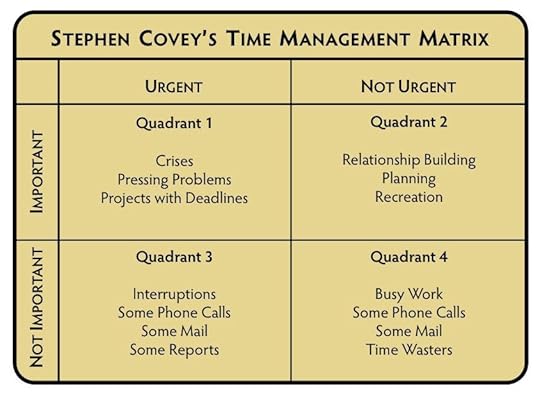 Copyright- Stephen Covey, The 7 Habits of Highly Effective People
While we’re all working to get to Quadrant 2, we’ll have to spend time in Quadrant 3. So, what are we going to do about it?
I’ve found the best way to power through the unimportant, yet urgent items, is to address that work in chunks. In the span of an 8-hour workday, you may only need to dedicate 30 minutes of your time to the Quadrant 3 work. The best time for this could be right after lunch, after you’ve replenished your system and had the opportunity to take some time away.
You’re still focused, you’ve received new energy, and you’ve had some time to clear your mind. Power through some of those obligations and stack them all together, if possible. Meet your deadlines, but don’t let this work trickle into your most creative time. This is where you fire off those emails, pay the bills, complete that perfunctory report and just get things done.
Give yourself time back in your schedule to focus on what you love to do most and immerse your energy and focus into that. That’s when you produce your best work.
5. Create your Mental ArchitectureVisualize and practice mindfulness for doing exactly what you intend to doWith positive affirmation and self-encouragement, plot out your most efficient day, week and month in your mind first.
Jeffrey Heer, now a professor at the University of Washington, wrote about several important reasons for why we create visualizations. These will help you understand just how much this matters in becoming more efficient at what you do:
- Answer questions (or discover them)
- Make decisions
- See data in context
- Expand memory
- Support graphical calculation
- Find patterns
- Present arguments or tell a story
- Inspire
One reason why I’ve become an effective keynote speaker is that I spend large amounts of time visualizing exactly what, why and how I want to say to an audience. Then, I tailor my message to that group based on the mental architecture that I’ve created. You can apply these same visualization principles into your own life.
*Take Breaks and Practice Self-CareLast, a bonus item. Remember to get up and take breaks. Whether you’re utilizing the Pomodoro technique or simply setting up iPhone reminders to get up, walk around and clear your mind every 20–25 minutes, be willing to hit the “Refresh” button so you can stay sharp. Self-care for you could be going for a run, or taking a nice nap to recharge.
Do the things for yourself that you know will help you rejuvenate yourself and boost your energy to power through each day with maximum efficiency.
Jump Start Your New Year!Join my newsletter and check out my bestselling book, The Value of You. This will give you inspiration to start planning for success on your journey. If you’re interested in working with me, try me here.
 This story is published in The Startup, Medium’s largest entrepreneurship publication followed by +409,714 people.Subscribe to receive our top stories here.


The 5 Most Efficient Ways to Get Your Work Done was originally published in The Startup on Medium, where people are continuing the conversation by highlighting and responding to this story.