Forensics, or "Whodunnit?" by Mystery Author Brad Harper

Forensics, or "Whodunnit?"
A Historical Perspective
by Brad Harper
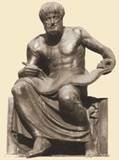
Aristotle said there are only three arguments:
Blame, Values, and Choice.
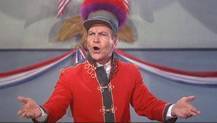 Think of Professor Henry Hill in the musical, The Music Man, in his famous song, "We got trouble right here, right here in River City!" (The current situation is not acceptable to our values.)
"That starts with T and that rhymes with P and that stands for Pool!" (The new pool hall is to blame for the current situation.)
He goes on to suggest a community band would lead the youth back onto the path of righteousness, which is an argument of choice. Arguments which center on assigning blame are called Forensics.
The oldest use of Forensic science I've found was three thousand years ago, and the detective in our story was a magistrate in a small village in China who happened upon the body of a woman hacked to death, near a field where some men were working. When he questioned them, they all denied any knowledge regarding her death, so he had them line up and lay their sickles on a table in front of them, instructing each man to stand beside his tool.
Imagine the scene now. It must have been a warm day for them to be out harvesting, and the sweat on their brow could have been from exertion... or the fear of being found out. After a few minutes a familiar buzzing was heard, and slowly more and more flies appeared and settled on one blade, and one blade only. The dried blood, invisible to the naked eye, drew the flies nonetheless, who served as witnesses for the prosecution.
Despite this promising start, forensic science had no significant new developments until around the middle of the nineteenth century when Rudolf Virchow, a German pathologist in Würzburg, developed the discipline of pathology, and his students coined the term "autopsy," which means "to see for yourself," and the use of medical science to assist law enforcement began.
Still, when Arthur Conan Doyle penned his first Holmes Story, A Study in Scarlet in 1887, police investigations relied primarily on eye witness accounts and interrogations. The techniques Doyle uses in his stories were for all practicality science fiction when they were written, and it took a French admirer of Doyle's detective to make Holmes' methods a practical reality.
Edmond Locard was both a physician and a lawyer, and in 1910 he persuaded the chief of police in Lyon, France, to give him two small attic rooms and two assistants to create the world's first crime lab. He was given two years to prove the concept, and as these two years drew near to ending without a significant breakthrough he became concerned his lab would be closed.
Then a young woman was found strangled in her apartment, and her lover was suspected as the killer, but four men swore he was playing cards with them in his apartment at the time the woman was probably murdered. Locard suspected the man right away, and scrapped the man's fingernails and retained the scrapings.
Cosmetics were common, but there were no large companies at the time, so women purchased them from the local pharmacy, each one having its own formula. Locard went to the pharmacy the murder victim used, and when this pharmacy's cosmetics was compared under a microscope with the scrapings from the suspect's fingernails, they matched perfectly. Confronted with this evidence, the man confessed he was the murderer, and had moved the clock back one hour in the room he'd played cards with his friends.
The conviction of the killer saved Locard's lab, and soon crime labs sprang up in police departments around the world, turning Doyle's science fiction, into fact.
Returning to the three types of arguments: Values are always argued in the present tense, things are or are not acceptable. Forensic arguments of course are waged in the past tense, someone did, or did not. Choice pertains to the future, we should or should not take a particular course of action. So, if you hear a couple arguing, and notice they are not both using the same verb tense, one of their problems is they're not having the same argument!
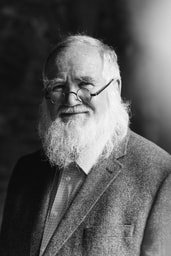 About the Author:
During my 37 years of active duty as an Army pathologist, I performed over 200 autopsies, and my clinical years are interwoven with four stints as the commanding officer of various medical units. I was an Infantry officer before medical school, and worked in the Pentagon. Yet, I also happily play Santa each Christmas (with my loving wife as Mrs. Claus). It is this juxtaposition of exploring the body, mind, and humanity that allows me to examine the mysteries of the past. Won't you come with me to the Victorian era, and the dark alleyways of London's Whitechapel in the east end?
Contact Links:
Website: https://bharperauthor.com/
Twitter: https://twitter.com/bharperauthor
Facebook: https://www.facebook.com/bharperauthor/
Instagram: https://www.instagram.com/bharperauthor/
Goodreads: https://www.goodreads.com/author/show/17721603.Bradley_Harper
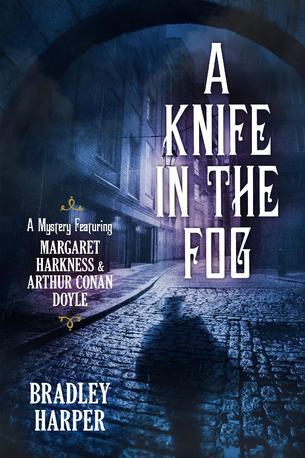 A Knife in the Fog
Genre: historical mystery
Physician Arthur Conan Doyle takes a break from his practice to assist London police in tracking down Jack the Ripper in this debut novel and series starter.
September 1888. A twenty-nine-year-old Arthur Conan Doyle practices medicine by day and writes at night. His first Sherlock Holmes story, A Study in Scarlet, although gaining critical and popular success, has only netted him twenty-five pounds. Embittered by the experience, he vows never to write another "crime story." Then a messenger arrives with a mysterious summons from former Prime Minister William Gladstone, asking him to come to London immediately.
Once there, he is offered one month's employment to assist the Metropolitan Police as a "consultant" in their hunt for the serial killer soon to be known as Jack the Ripper. Doyle agrees on the stipulation his old professor of surgery, Professor Joseph Bell--Doyle's inspiration for Sherlock Holmes--agrees to work with him. Bell agrees, and soon the two are joined by Miss Margaret Harkness, an author residing in the East End who knows how to use a Derringer and serves as their guide and companion.
Pursuing leads through the dank alleys and courtyards of Whitechapel, they come upon the body of a savagely murdered fifth victim. Soon it becomes clear that the hunters have become the hunted when a knife-wielding figure approaches.
Buy Links: Fountain Bookstore (signed copies available) Libro.fm (Audiobook) Indiebound Amazon AUTHOR, AUTHOR! Barnes & Noble Books-A-Million Kobo McNally Robinson (Canada) Indigo (Canada) Kirkus Review of A KNIFE IN THE FOG by Bradley Harper | Kirkus Reviews Thanks for stopping by the blog today! See you next week...


No comments have been added yet.