Building a battleship - fighting capability
The whole point of a battleship is to be able to fight. As I mentioned in earlier posts, I gave the Admiral George Leonard several docking bays to mount weapons or other payloads, giving the ship class tremendous flexibility during the course of their long service lives.
One of the most common weapons in Shayla’s world is the particle beam. This class of weapon shoots a tightly-focused bolt of charged particles - essentially controlled lightning - and the technology is scalable from hand-held to gargantuan.
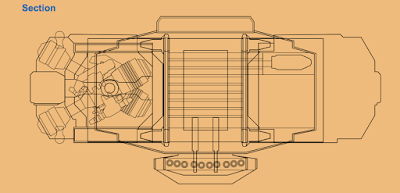
In George Leonard, the primary weapons are mounted in pairs as shown in this cross section. This view also shows a lower pod of torpedo launch tubes attached to the ship’s ventral docking points.
The hatch popped open and Shayla slipped inside the weapon bay. How to board a ship without boarding the ship, that was the trick. Although she was now technically on board, safely enclosed at last within the ship’s armored walls and shielding and subject once more to gravity, this cavernous hold was unpressurized and still technically open to space.
Shayla examined her surroundings with a pang of nostalgia. Life had been so much simpler back then in her days as a lowly marine. A wash of red light barely dispelled the darkness. Suspended overhead, the barrels of two particle beams—warehouse-sized siblings of the hand-held weapons she heartily despised—each dwarfed the scout she’d recently abandoned.
Pale green striplights marked a maze of companionways and catwalks that weaved between the inert bulk of machinery clinging to the bay walls. She craned her neck, eyes tracing the lines of cables and conduits high above.
Of course, this kind of offense needs a comparable defense, which Shayla later uses to her advantage ...
The maintenance corridor ran near the outer skin of the ship. In compartments alongside, electromagnetic shield generators lay dormant ready to protect this flank of the ship in combat. Thick doors at intervals down the narrow passage gave access to the shield machinery. Vivid signs on each door warned of deadly levels of radiation and electrical discharges.
Shayla cracked open the nearest door and slipped inside. She stopped a few minutes to study the layout of cables and machinery. The shields may be dormant but the circuits would still be hot, ready to come to life at a moment’s notice. She might not be an engineer, but she knew engineering, especially anything to do with weapons and defense systems—how to use the former, and how to disable the latter.
A ship’s shields worked by deflecting the energy from charged particle weapons—beams and plasma. Most incoming offense was deflected straight back out into space, but the shields caught and channeled a significant amount of run-off. Shield machinery also contained a large quantity of delicate electronics. The two were not meant to mix.
Shayla stood between two green-painted electrical cabinets. Massive bus bars along the far wall linked the shield coils to banks of cells, reservoirs to contain the leakage. Florescent hazard lines on the floor warned against straying too far into the room. She eyed a run of white-painted pipes along the ceiling, picking her target.
One of the most common weapons in Shayla’s world is the particle beam. This class of weapon shoots a tightly-focused bolt of charged particles - essentially controlled lightning - and the technology is scalable from hand-held to gargantuan.
In George Leonard, the primary weapons are mounted in pairs as shown in this cross section. This view also shows a lower pod of torpedo launch tubes attached to the ship’s ventral docking points.

The hatch popped open and Shayla slipped inside the weapon bay. How to board a ship without boarding the ship, that was the trick. Although she was now technically on board, safely enclosed at last within the ship’s armored walls and shielding and subject once more to gravity, this cavernous hold was unpressurized and still technically open to space.
Shayla examined her surroundings with a pang of nostalgia. Life had been so much simpler back then in her days as a lowly marine. A wash of red light barely dispelled the darkness. Suspended overhead, the barrels of two particle beams—warehouse-sized siblings of the hand-held weapons she heartily despised—each dwarfed the scout she’d recently abandoned.
Pale green striplights marked a maze of companionways and catwalks that weaved between the inert bulk of machinery clinging to the bay walls. She craned her neck, eyes tracing the lines of cables and conduits high above.
Of course, this kind of offense needs a comparable defense, which Shayla later uses to her advantage ...
The maintenance corridor ran near the outer skin of the ship. In compartments alongside, electromagnetic shield generators lay dormant ready to protect this flank of the ship in combat. Thick doors at intervals down the narrow passage gave access to the shield machinery. Vivid signs on each door warned of deadly levels of radiation and electrical discharges.
Shayla cracked open the nearest door and slipped inside. She stopped a few minutes to study the layout of cables and machinery. The shields may be dormant but the circuits would still be hot, ready to come to life at a moment’s notice. She might not be an engineer, but she knew engineering, especially anything to do with weapons and defense systems—how to use the former, and how to disable the latter.
A ship’s shields worked by deflecting the energy from charged particle weapons—beams and plasma. Most incoming offense was deflected straight back out into space, but the shields caught and channeled a significant amount of run-off. Shield machinery also contained a large quantity of delicate electronics. The two were not meant to mix.
Shayla stood between two green-painted electrical cabinets. Massive bus bars along the far wall linked the shield coils to banks of cells, reservoirs to contain the leakage. Florescent hazard lines on the floor warned against straying too far into the room. She eyed a run of white-painted pipes along the ceiling, picking her target.


No comments have been added yet.