When: The Scientific Secrets of Perfect Timing by Daniel H. Pink
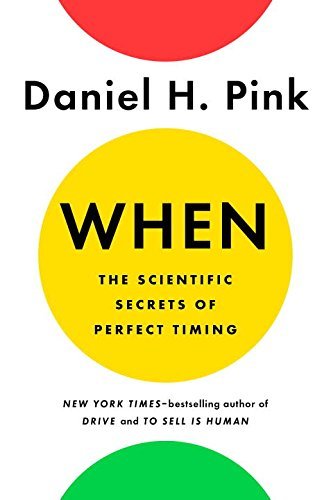
In WHEN: THE SCIENTIFIC SECRETS OF PERFECT TIMING, author Daniel Pink shares scientific, surprising findings that have serious consequences. Did you know, for instance, that the timing of your surgery is important? And if you are in court, the judge will act more leniently at certain times of day?
To work the most efficiently, it's important to figure out your own cycle of effectiveness--what the author calls "Waves of the Day." "All of us experience the day in three stages--a peak, a trough, and a recovery." Tailor your activities to match the best time for that type of task. Most people do analytical tasks better in the morning, and more insightful tasks in the evening. There is usually a poor time in the afternoon--the "trough." That time is your least effective time and "good for very little."
The author provides a simple way to figure out if you are a "Lark" (early bird) or "Owl" (late riser). Not all places are good for both types. For example, schools are setup to favor the "larks," or early-risers. This is unfortunate, since many teens are at their best much later in the day.

Probably an early-riser
The author emphasizes the importance of "restorative breaks." These are especially important during the low trough. Just a ten-minute nature walk can have an enormous impact. One Danish study showed that if students took a 20 minute break before a test, their scores were substantially higher. Here's something much more scary: A study of parole judges showed a significant difference in their rulings, based on the time of day. If your hearing was scheduled in the afternoon, good luck! However, if they took an afternoon break, they were back to their usual selves, and far more likely to grant parole. If you were unlucky enough to appear before them during the afternoon "trough," you "had essentially no chance at all."

Had an afternoon trial
Restorative breaks should ideally be outside, with nature, and away from work. It's best to be moving, and with others: "Consider a short walk outside with a friend during which you discuss something other than work."
When you start a task has a lasting effect on our attitude and our success. The author cites statistics showing the career path of graduates based on when they first started their career.
"Beginnings stay with us far longer than we know; their effects linger to the end."
So, starting anew, or a "fresh start" helps us recover from a false start. The section "Eighty-Six Days in the Year when you can Make a Fresh Start" has suggestions for starting anew. You can re-start on the first of the month, for example, or on an anniversary.

Restorative break
I found the "Science of Endings" particularly intriguing. We tend to remember events based on how they end. So, we can decide to change the ending:
"If we're conscious of the power of closing moments and our ability to shape them, we can craft more memorable and meaningful endings in many realms of life. . .
On a vacation, plan a great ending: "You'll enjoy the vacation more, both in the moment and in retrospect, if you consciously create an elevating final experience."
The same priniciple applies at work. At the end of a workday, take a few minutes to jot down your accomplishments for the day. This step of "recording what you've achieved can encode the entire day more positively." Ending the day with a moment of gratitude is a great idea. Gratitude is a "powerful restorative."
Chapter 6 has a fun set of suggestions in the concluding "Time Hacker's Handbook." You can improve your feeling of well-being by "synchronizing" with other people. For example, singing in a chorus, running in a group, joining a cooking class, etc.
So all in all, I found WHEN to be a fascinating, fun read. The author is a witty writer, who brings a lot of humor to the subject. His experience as a speech-writer is evident in the quality of the writing. I enjoyed reading about the various studies that illustrated peak times and low times. If I ever have to appear at a parole hearing, I'm definitely asking the judge to first take a "restorative break." Note: The author includes a surprising item of generiosity in the book itself. I hope you find it!

Hope it was morning surgery