Write Like It’s Business – Part IV
This series of blogposts shows creative writers how business management techniques apply to both the writing process and the storytelling process, and why the corporate world isn’t as alien at it seems.
 (c) Dennis Skley via Flickr
After discussing various business management models in Part I, Part II and Part III of this series, let’s delve into creating good and bad conflict by applying Maslow’s famous hierarchy of needs.
Hierarchy of Needs
The idea of this chiefly psychological model is that a person deprived of food and water will be less concerned with having a roof over his head than he is with finding physical sustenance. Once he has sustenance, he will be wanting shelter. Once he has shelter, he will long for company or a group to belong to. Once he belongs to a group, he will want to gain esteem inside and outside that group. And only someone who has those basic needs more or less fulfilled will be interested in actualising or transcending themselves.
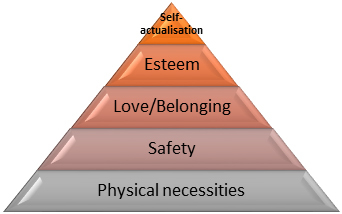
As any model, this hierarchy is extremely simplified. How important each of the strata is, will vary from person to person based on their personality, culture and unique circumstances. For this reason, the hierarchy’s validity as a psychological model is questioned by some. Even so, it is my firm belief that it provides a viable outline for writers to work with.
Because the model holds true, in however broad a sense, for 99,9% of humanity. That includes you, your readers, and your human(oid) characters.
Maslow’s Storytelling Lessons…
Lesson 1: Needs are the foundation of conflict in storytelling. What does the character want? What happens when they’re up the pyramid and the lower layers get knocked out from under them? How do they respond? What will that do to (re)gain that which they need?
Lesson 2: When you write a non-human character, like an alien entity, you should ask yourself if they respond roughly in accordance with this hierarchy of needs (most of the early Star Trek and Star Wars aliens). Or are they truly alien to us in that they don’t understand this fundamental part of human psychology? (Later Star Trek franchises, Alien, Abyss). Such a creature is unpredictable for us and thus scary. But going that was has its limits, because…
Lesson 3: …your readers are human. If you wish them to care for your character, they must be able to empathise. Maslow’s hierarchy provides a blueprint of the most basic level of empathising: being deprived of love, safety, and food is something almost everyone can relate to. You needn’t be orphaned or widowed to know what heartbreak is. You needn’t have known actual starvation in order to relate to Robinson Crusoe. Imagination goes a long way.
Likewise, a character that doesn’t respond to this hierarchy is truly alien, and therefore difficult to relate to. That works for an antagonist, but not for a protagonist.
…And A Wise Word To Introvert Writers
Know why you’re writing. Most often people want to write a book for esteem or for self-actualisation, but in this we forget an important aspect: many writers are introverts and as such don’t care much about belonging to a group. Problem is, other people do.
At the very least, authors must interact with their readers if they wish to be in any way successful. The more ambitious must also find rapport with publishers, agents, guest blogs, etc. in order to advance their writing career.
When it comes to this, I’m just as guilty as anyone else hiding behind their keyboard. I’ve felt the consequences of being the lone wolf, and trust me: they are severe.
The reason for this is no more complex than instinct.
People are herd animals. By that instinct, anything that jeopardised the group is to be avoided. Individuals who do not wish to belong to our group – or any group – are rooted out and rejected by people who do have a herd-instinct. It’s not a conscious choice, but it’s what the human animal does.
You won’t find more readers if you shun talking to them.
So no matter how introvert you are, learn to socialise. Create a persona for yourself if you must, a mask to hide behind, but don’t try to avoid reaching out to others. You won’t find more readers if you shun them.
Model Behaviour
It is out job as storytellers to convince our audience. We share this with business managers, and common ground means common lessons. Sales people take courses in storytelling. Why don’t more writers take courses in management? If nothing else, studying books and models is a good start.
Self-publishing requires self-management. Self-management 101 says not to reinvent that wheel, but to hitch a ride on science’s “how to” wagon instead.
As for starting a conversation: what else would you like me to write about on this blog. Would you like to see more about how business science applies to writing and storytelling? Or about ghosts and history and about how I apply all of the above in my books? Or perhaps something entirely different?
Please let me know in the comments!
Until next time,

Het bericht Write Like It’s Business – Part IV verscheen eerst op Chris Chelser.