Write Like It’s Business – Part I

Never before has the writing business been more about business than it is now. Any author who wants to be published (again) needs to be an entrepreneur as much as a writer. Taxes, contracts, advertisement, PR… It doesn’t matter if you are self-published or with a publishing house : most of us count our blessings if we can devote 10% of our time to getting actual writing done:
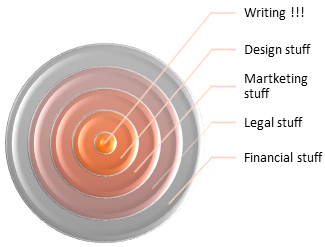
A sore sight, isn’t it?
The good news is that these new waters are far from uncharted. And the best way for newbies to navigate ancient currents, is to observe what its natural inhabitants have done for generations.
While the publishing revolution might be recent, the science of business management goes back more than a century. Many pitfalls, benchmarks, do’s and don’ts have already been charted. So why waste precious time and effort on reinventing the wheel, when we’d much rather work on our next book?
This series of blogposts takes creative writers on a ride past various business management techniques, how they apply to both the writing process and the storytelling process, and why the corporate world isn’t as alien at it seems.
Don’t believe me? Let’s take a closer look.
Writing Business Parallels
Society has a deep-rooted prejudice that artists are emotional and chaotic. Another prejudice says that business people are calculating and cold-hearted. Neither is true, but the human mind does so love a good stereotype. What these stereotypes neglect to mention, however, is that creative writers and business managers play the same game by very similar rules.
Creative writers and business managers play the same game by very similar rules.
Oh, don’t look so surprised. We are all human, after all. Whatever our differences in talents and temperament, we were born with a human brain that, on average, functions more or less the same as all the other human brains. For example, a sportsman’s eye-to-limb coordination is neurologically the same, regardless of whether he throws a big orange ball or a brown oblong ball.
When you break down the essence of what writers and managers do, you will find that the skills they require are equally similar. They merely play different varieties of the same game. Just look at what they do for a living:
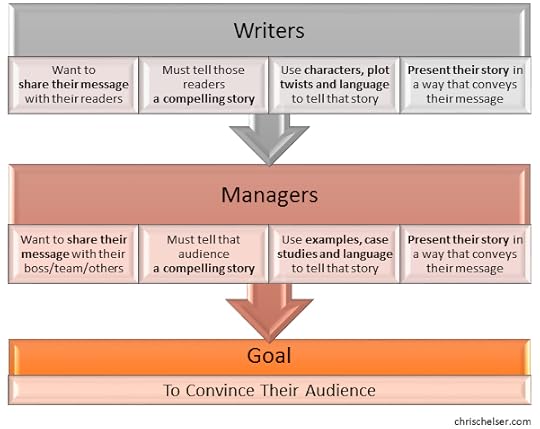
Both writers and business managers have a day job convincing their audience.
Who that audience is and what defines “convincing” to them may differ, just like a football goal isn’t the same as a basketball hoop. But in some cases, like market-specific non-fiction books, that difference is marginal. In the end, writers and managers need to go through the same kind of motions in order to achieve the same kind of end result.
Hopefully. Like writers can produce bad fiction or rush an unpolished manuscript to print, so managers can try to launch a bad plan or rush an unfinished draft to their bosses. For both, the consequences of such mistakes are the same, too: at best you’re told off, at worst you’re laid off.
Let’s Exchange Tactics
We’re in the same game, so let’s exchange tactics.
I know from personal experience that it’s worth the effort. A significant part of my writing skills developed during my years working as a financial and legal manager, when I honed my writing tactics on court documents, official correspondence, shareholder reports and whatnot.
But there are business tactics that are much faster and easier for writers to apply: models. Schematics created to make sense of organisations, people and processes. To make complex subjects easier to understand. Models that can give authors a leg up in the writing business.
And no, they’re not swimsuit models. Still, they are worth studying in detail ;).
#1: Production Planning Model
Business management models don’t come any more straightforward than this one:

Don’t be deceived by its simplicity. It’s an evergreen tool for good reason: the more complex a process becomes, the more likely people are to accidentally omit a step. Spelling out every step in order helps to stay on track and make sure that all that needs to be done, is done.
Apply that to your “book production process” and you might get this:

Yes, simple. Of course you can add as many steps to it as you please, breaking down every stage into smaller steps. It is the basis for making checklists, project planning and the like.
But this model can also be used to map out essential stages in your story:

Naturally you fill in scenes and events in more detail to monitor their chronological order, keep track of whether your main character can know this particular info in that chapter or not, and if that confrontation with the Bad Guy is of more use elsewhere in the storyline.
And before you dismiss this most basic model out of pride, just remember that all writers have been stuck in this other model at some point: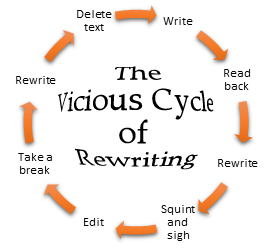
Many writers plan their stories and their work progress instinctively, with or without the help of sticky notes, scribbled scraps of paper or special software. Whichever your method, you are likely already using the Production Planning model.
See? Business management ideas can be useful! In Part II, we will be exploring the author’s benefits of employing two other classics from the Management Model Hall of Fame.
See you there!

Het bericht Write Like It’s Business – Part I verscheen eerst op Chris Chelser.