A World Without Bees
A World Without Bees, by Alison Benjamin and Brian McCallum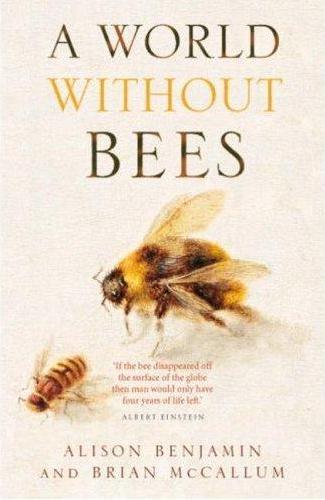 Blurb:“If the bee disappeared off the surface of the globe then man would only have four years of life left.” –Albert EinsteinA third of all that we eat, and much of what we wear, relies on pollination by honeybees. So if — or when — the world loses its black-and-yellow workers, the consequences will be dire.What is behind this catastrophe? Viruses, parasites, pesticides and climate change have all been blamed, as has modern monoculture agribusiness. In this timely book, two keen amateur apiarists investigate all the claims and counterclaims with the help of scientists and beekeepers in Europe, America and elsewhere.They ask the question that will soon be on everyone’s lips: Is there any possible way of saving the honeybees — and with them, the world as we know it?First of all, let me address the huge pink elephant in the room. Yes, this book looks boring as hell. You should have seen the look on the cashiers face when I brought it! I then had several family members taking the mickey, however, despite how it seems this book was very interesting and informative. In my opinion everyone should read this book, and books like it, because then maybe more people would understand what's going on in the world and stop being so damn selfish and make an effort to preserve the planet we live on, the air we breath and protect the animals that share the Earth with us. Most people don't realise - even I didn't - how the lack of bees would effect the planet.I'll admit parts of this book were a bit repetitive and at times it seemed like just a long list of dates, however, I never lost interest, mainly because I was desperate to find out if the find a solution in the end, which I should have guessed since bumblebees are currently on the endangered list and other species are under threat. This book was published in 2008, therefore, I don't really know all that much about any progress since then but I'll definitely be looking into it. Unfortunately, the authors haven't written an up-to-date sequel, but if they ever do I'll be sure to snap it up.As I've already said this is a very inspiring book, especially the last couple of chapters and anyone who's interested in conservation should definitely read it. Hopefully this book will change the minds of people who think human actions don't harm the environment.My favourite quotes from 'A World Without Bees':' "If the bee disappeared off the face of the globe, then man would only have four years of life left. No more pollination, no more plants, no more animals, no more man." '' "Out of the eater came forth meat, and out of the strong came forth sweetness." ''... she is more a slave to the community than its ruler.'' "It is a very distressing thing," he wrote, "to walk into ta yard in May and not hear a bee buzz." '' "In a world where there's wars, global warming, and huge deficits that we don't understand, the basic person gets that without bees there's something wrong." ''... truth is being sacrificed to profit.'' "Those who have the money are not interested in this sort of research, and those who are interested don't have the money." ''One reason for her feebleness is that a major ally has deserted her in her hour of need. By destroying the environment in which the honeybee lives, man is reducing her chances of survival.'' "We're placing so many demands on bees we're forgetting that they're a living organism and that they have a seasonal life cycle and they're going to have down times. We're wanting them to function as a machine. ..." ''Half of the bumblebee species in the UK are either already extinct or could face extinction in the next few decades,''... she is also raising the alarm for humankind.''But the silence also refers to the fact that nobody is listening to what the bees or the beekeepers are saying: they need help, and fast.''If we treat animals like machines, then we shouldn't be surprised when they break down.'
Blurb:“If the bee disappeared off the surface of the globe then man would only have four years of life left.” –Albert EinsteinA third of all that we eat, and much of what we wear, relies on pollination by honeybees. So if — or when — the world loses its black-and-yellow workers, the consequences will be dire.What is behind this catastrophe? Viruses, parasites, pesticides and climate change have all been blamed, as has modern monoculture agribusiness. In this timely book, two keen amateur apiarists investigate all the claims and counterclaims with the help of scientists and beekeepers in Europe, America and elsewhere.They ask the question that will soon be on everyone’s lips: Is there any possible way of saving the honeybees — and with them, the world as we know it?First of all, let me address the huge pink elephant in the room. Yes, this book looks boring as hell. You should have seen the look on the cashiers face when I brought it! I then had several family members taking the mickey, however, despite how it seems this book was very interesting and informative. In my opinion everyone should read this book, and books like it, because then maybe more people would understand what's going on in the world and stop being so damn selfish and make an effort to preserve the planet we live on, the air we breath and protect the animals that share the Earth with us. Most people don't realise - even I didn't - how the lack of bees would effect the planet.I'll admit parts of this book were a bit repetitive and at times it seemed like just a long list of dates, however, I never lost interest, mainly because I was desperate to find out if the find a solution in the end, which I should have guessed since bumblebees are currently on the endangered list and other species are under threat. This book was published in 2008, therefore, I don't really know all that much about any progress since then but I'll definitely be looking into it. Unfortunately, the authors haven't written an up-to-date sequel, but if they ever do I'll be sure to snap it up.As I've already said this is a very inspiring book, especially the last couple of chapters and anyone who's interested in conservation should definitely read it. Hopefully this book will change the minds of people who think human actions don't harm the environment.My favourite quotes from 'A World Without Bees':' "If the bee disappeared off the face of the globe, then man would only have four years of life left. No more pollination, no more plants, no more animals, no more man." '' "Out of the eater came forth meat, and out of the strong came forth sweetness." ''... she is more a slave to the community than its ruler.'' "It is a very distressing thing," he wrote, "to walk into ta yard in May and not hear a bee buzz." '' "In a world where there's wars, global warming, and huge deficits that we don't understand, the basic person gets that without bees there's something wrong." ''... truth is being sacrificed to profit.'' "Those who have the money are not interested in this sort of research, and those who are interested don't have the money." ''One reason for her feebleness is that a major ally has deserted her in her hour of need. By destroying the environment in which the honeybee lives, man is reducing her chances of survival.'' "We're placing so many demands on bees we're forgetting that they're a living organism and that they have a seasonal life cycle and they're going to have down times. We're wanting them to function as a machine. ..." ''Half of the bumblebee species in the UK are either already extinct or could face extinction in the next few decades,''... she is also raising the alarm for humankind.''But the silence also refers to the fact that nobody is listening to what the bees or the beekeepers are saying: they need help, and fast.''If we treat animals like machines, then we shouldn't be surprised when they break down.'


No comments have been added yet.