
Remarkable, not so enjoyable
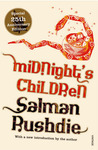 Midnight's Children by Salman Rushdie
My rating: 3 of 5 stars
I've been meaning to read Midnight's Children for a while now, as it's on just about every list you see of best novels of all time. The book is about Saleem Sinai, who is born on the stroke of midnight at the very moment India gains its independence in 1947. His life mirrors that of his country in an expansive tale of dashed hope and disappointment.
This is a remarkable book in many ways. It's got the scope and allegory of Günter Grass, the dark humor and complex plotting of Charles Dickens and John Irving, the wonderfully messy digressions of The Life and Opinions of Tristram Shandy, Gentleman, and some of the descriptive inventiveness of Angela Carter. I finished it thinking, "Wow, how did he do all that?"
That said, I wish I'd liked it more. It's a very dense, difficult read. The digressions and endless cast of characters--many with multiple names--made it a long slog for me. I found the obvious narrative manipulations (backtracking to explain, hiding things that are later explained, etc.) and overt metaphors grating, and almost gave up a couple of times. There's no subtlety here. It's all muscular bravado, a writer showing off. When this kind of thing is done in the service of the story, I tend to love it, but I often felt that the author was throwing too many things against the wall in the hope that something would stick, rather than making thoughtful choices.
I also wasn't a fan of the way this book playfully trivializes very serious events, even though Saleem keeps telling you how horrible things are and how much worse they will inevitably get. Despite the pretense of this all being about a country and a people, there really seemed to be no soul to this book. The narrator is gleefully unreliable and unlikeable, and the characters he depicts are almost all described in an unflattering light. Whereas, say, Graham Greene, Günter Grass, and Gabriel Garcia Marquez thoughtfully examine the struggle for the soul of their countries with characters that pulse with life, this all came across to me as a big and flat joke. Major historical events are really, you see, all about our unreliable narrator.
I know I'm coming at this years after the fact. At the time this book came out, it must have seemed like the arrival of such a new, exciting voice--a shift of the international literary landscape. But taking it purely as a piece of literature in our modern, internationally-connected time, I found it a harsh, cold read with much invention but not so much to take away from it in the end.
View all my reviews


No comments have been added yet.
Harrison Bae Wein

Harrison Bae Wein is author of the novel "The Life and Opinions of the Housecat Hastings." Or the human front for Hastings, depending on whom you believe. You can visit his website at http://harrisonw
...more
- Harrison Bae Wein's profile
- 2 followers

