
Daniel Darling's Blog, page 46
March 23, 2016
Human Dignity, Spiritual Leadership, and Madame Secretary: Some Recent Articles
Here are some recent articles I’ve published:
Stop Pitting Pro-Life Causes Against Each Other
For Relevant on the unfortunate tension between those who advocate for pro-life justice and those who advocate for racial justice:
Back in January, those of us in the U.S. celebrated both Martin Luther King Jr’s birthday and Sanctity of Life Sunday. What would it look like for the church to lament both the abortion industrial complex and systematic racial injustice, to confess the sins of abortion and racism, and to offer, for recovering racists and post-abortive women the freedom offered only in the cross of Christ?
Read more here:
How to Get Buy-In From the People You Lead
For Lifeway Pastors on the five things leaders need to help them lead well:
It’s amazing to me how many church leaders discount the important of building relationships with the people they serve. But all the seminary education and vision casting in the world won’t make up for a lack of intentional, one-on-one relationship-building. This is what separates pastors from mere preachers, leaders from title-holders, public servants from politicians.
Read more here:
For The Gospel Coalition, a piece on why I enjoy this new CBS drama:
Madam Secretary exposes Americans—comfortable in our cocoons of isolation—to the depth of human suffering and injustice around the globe. At its best, the show argues against both the heady statism that puts complete faith in government and the creeping cynicism that finds nothing redeemable at the highest levels of American power.
Read more here:
photo credit: Froderik Rubensson


March 17, 2016
The Way Home: Episode 61 featuring Andy Crouch
Andy Crouch is the executive editor of Christianity Today. He’s the author of several thoughtful and influential works, including Culture-Making, Playing God, and his newest book, Strong and Weak. Andy’s work has been a great influence on my life. Today’s conversation will be a fascinating and interesting discussion of what culture is, how traditions form, what Christianity looks like in a secular age, and how to redeem the use of power. Andy is one of the featured speakers at our upcoming National Conference in Nashville. This conversation is a sneak peak at his forthcoming talk.
Show Notes
Book: Strong and Weak: Embracing a Life of Love, Risk and True Flourishing

Website: andy-crouch.com
Twitter: @ahc
March 10, 2016
The Way Home: Episode 60 featuring Jeff Iorg
Dr. Iorg serves as the President of Golden Gate Baptist Theological Seminary in California. Prior to joining Golden Gate, he was the Executive Director of the Northwest Baptist Convention. Dr. Iorg began his career in pastoral ministry, pastoring congregations in Missouri and Texas before becoming one of the founding pastors of Greater Gresham Baptist Church in Oregon, one of the largest SBC churches in the Northwest.
Today we will talk with Dr. Iorg about his work at Golden Gate seminary, his journey in denominational leadership and about the topic of marriage. For several years now, but especially since last summer, many Christian leaders and commentators have referred to a ‘post marriage’ culture. Dr. Iorg will offer his thoughts on this and how churches and families can encourage and embody the principles of Biblical marriage in a culture that has rejected many of the norms and expectations about marriage that we previously took for granted.
Show Notes
Book: Ministry in the New Marriage Culture

Website: jeffiorg.com
Twitter: @Jeff_Iorg
Also:
The latest edition of Light Magazine
The most recent release from Leland House Press: Women On Life (edited by Trillia Newbell)
March 3, 2016
The Way Home: Episode 59 featuring Alex Chediak
Show Notes
Book: Beating the College Debt Trap: Getting a Degree without Going Broke

Website: alexchediak.com
Twitter: @chediak
Also:
The latest edition of Light Magazine
The most recent release from Leland House Press: Women On Life (edited by Trillia Newbell)
February 26, 2016
The Way Home: Episode 58 featuring Greg Smalley
Show Notes
Book: Crazy Little Thing Called Marriage: 12 Secrets for a Lifelong Romance

Website: smalleymarriage.com
Also:
The latest edition of Light Magazine
The most recent release from Leland House Press: Women On Life (edited by Trillia Newbell)
February 23, 2016
Troubled Hearts in Tumultuous Times
What is going on? This is the sentiment I’ve heard from many friends and family, especially as they survey this increasingly crazy election season. I have to admit that I’ve been more than a bit distressed myself lately. How is it, for instance, that a vulgar, reality-show icon who has built his empire by exploiting the poor, who openly mocks the disabled, who defends the abortion industrial complex, who threatens his opponents, who brags of his adultery, who says that he has “no need of forgiveness”–how is this guy winning among evangelicals in places like South Carolina? How is it that the worst kind of leaders continue to win and those who have accomplished records, who lead with dignity, who genuinely serve the common good don’t seem to win office? If you love your neighbor, you can’t help but be discouraged by the state of our world. Or perhaps you are not troubled by this election season, but by war, terrorism, economic concerns, relational issues, crime, cancer or some other concern has you wondering just what is going wrong in the world.
I’m a naturally optimistic guy, but last Sunday I walked into church feeling less than optimistic. But it was worshipping with my brothers and sisters in Christ that helped move me from despair to faith. Specifically it was the third verse of the hymn “The Church’s One Foundation”, a hymn that I’ve sung in church since I was a child:
Mid toil and tribulation, and tumult of her war,
she waits the consummation of peace forevermore,
till with the vision glorious her longing eyes are blest,
and the great church victorious shall be the church at rest.
I’ve attended church my whole life and have always found comfort in gathering with God’s people to worship Christ as Lord. But the older I get, as the trials of life and the troubles of the world press in on me more, as I see with fresh eyes the deep brokeness and the anguish of a world beset by the curse of sin, I’m comforted, every week, by simply going to church.
I’m comforted because when we go to church we are doing more than simply gathering with like-minded people around a set of shared values. What we are doing when we gather together is declaring truth to the world and to ourselves, that Christ–not the temporary powers of this world, not the movements, the media, the message-men–is sovereign over all things. We worship the One who was raised from the dead and raises us from the dead. We are refreshed again, with the eschatological hope that His kingdom is coming soon and that Christ is our only hope to renew and restore all things.
“The Church’s One Foundation” is a song of victory. Christ is building His church and is gathering His people from every nation, tribe and tongue. This He promised and this He will do. The church will endure, even amongst outside pressure and inside sin. Dangerous and destructive leaders can hurt God’s people and can be destructive to human flourishing, but they can’t put Christ back in the grave, they can’t keep Christ from building His church, and they won’t stop Christ from gathering history to Himself. It is this truth, not returns on Super Tuesday, that give us our hope.
This is why the word from the writer of Hebrews is so prescient today:
And let us consider how to stir up one another to love and good works, not neglecting to meet together, as is the habit of some, but encouraging one another, and all the more as you see the Day drawing near. (Hebrews 10:24-25 ESV)
Troubling times should drive us to worship, to gather with God’s people on Sundays and be reminded and refreshed of the grand gospel story. Church, for true believers, is not just a temporary emotional salve, but a reminder of the reality of who we are and where we are going.
I’ve found this reality to be true my whole life, but even more so as I’ve gotten older: We should work to build good communities, we should shape what happens in the public square, because we love our neighbors and we care about human flourishing, but what happens on Sundays is the most important thing in the world.
February 18, 2016
The Way Home: Episode 57 featuring Darrin Patrick
Darrin Patrick is the founder and lead pastor The Journey Church in St. Louis, vice-president of Acts 29, a church planting network, and chaplain of the St. Louis Cardinals. He is a prolific author and featured speaker. His latest book is The Dudes Guide to Marriage. Darrin and I will talk about baseball (in which I will give him grief about my Cubs sweeping his Cardinals out of the playoffs last year), men and marriage, and racial reconciliation. Darrin was a key figure in helping to bring healing to the Ferguson, Missouri community in 2015.
Show Notes
Book: The Dudes Guide to Marriage
Twitter: @darrinpatrick
Websites: darrinpatrick.org; thejourney.org; acts29.com; thedudesguide.org
Also:
The latest edition of Light Magazine
The most recent release from Leland House Press: Women On Life (edited by Trillia Newbell)
February 11, 2016
The Way Home: Episode 56 featuring Thomas Kidd
Today I am excited to be joined by Thomas Kidd. Dr. Kidd is a historian and professor who teaches history at Baylor University and serves as the Associate Director of Baylor’s Institute for Studies of Religion. He is a regular contributor for outlets such as WORLD Magazine, The Gospel Coalition, and USA Today. He is a prolific author whose latest books include Baptists in America and George Whitefield: America’s Spiritual Founding Father
 . Dr. Kidd’s research interests include 18th century North America, particularly the history of evangelicalism. Today we’ll talk with Dr. Kidd about Whitfield and his place as a founder of modern evangelicalism.
Show Notes
Book: George Whitefield: America’s Spiritual Founding Father
Twitter: @ThomasSKidd
Website: The Anxious Bench
Also:
The latest edition of Light Magazine
The most recent release from Leland House Press: Women On Life (edited by Trillia Newbell)
February 9, 2016
Some thoughts on productivity and leadership from a creative
Productivity is a growing field among evangelicals and I’m so grateful for this. Gifted men like Matt Perman and Michael Hyatt have helped us think through the best way to do be most efficient in our respective callings. At ERLC we are blessed to have our very own productivity guru, Daniel Patterson, who has taught me much about efficient ways to communicate within an organization and how to establish good work rhythms.
We live in an increasingly fragmented world. As a busy leader, I need all the help I can get to manage my many responsibilities as a husband, father, pastor, executive, team leader, writer, and speaker.
What I am learning is that productivity is not so much a template or a system, but a way of life. Men like Perman and Hyatt and Patterson are helpful not because they offer a one-size-fits-all way of doing things, but because they recognize that each person is wired differently. There are common things that everyone should do, obviously,but what works for some may not work for others. And vice versa. the bottom line is to ask the question, “How best can I invest my time, my gifts, and my resources for the people I’m call to serve?”
This looks a bit different for everyone. For instance, I’m a leader who is also somewhat of a creative. I like to dream and plan and chew on big themes. Ideas come to me fast and furiously. I don’t have a regular writing rhythm. I write when I a) have a deadline b) have an idea. This is pretty much all the time.
However, there is a side to me that appreciates order and discipline. For instance, when I pastored, I planned out my entire preaching calendar for the year, including titles, pericopes, and series. Ironically, it was this kind of high-level planning that spurred my creativity. I take a similar approach to my writing. With each article, I plan the structure, plan the sections, the chapters, etc. Same way with meetings. I don’t like meetings that have no agenda and no purpose.
So I’m a planner and I’m also spontaneous. This tension somehow works for me, though I’m still learning ways to be more efficient. One area I’ve grown is in managing email. I check it frequently on my phone (can’t break this habit), but I’ve disciplined myself to answer email in designated chunks of time. And I realized, about a year ago, that if I get my inbox down to about ten pending emails, I feel good. I don’t have inbox zero and Jesus still loves me. I’ve also learned to “calendar” things like reading time and writing time.
Perhaps the best approach with productivity is to periodically reassess our workflow and to listen and learn from others. When I was a pastor, one of my favorite things to do was to talk to other pastors and leaders and ask them what their days looked like. I learned from them, not by mimicking what they did, but by gleaning little ideas, pieces of their daily rhythms that might work for me. In fact, the day that I released my desire to be exactly like my heroes was the day I began to grow in my leadership.
I think we need to do two things as leaders. First, we must be humble, teachable and adaptable. Secondly, we should hold our productivity tips and rhythms loosely.
God often puts us in community with people who are wired differently than us, whether at work, in the home, or at church. This is how he sanctifies us. We’re forced to work with, to love, to serve those who do life differently than we do. So not only should we find our own work rhythms, we should adapt to the rhythms of others in order to serve them well.
I’m still work in progress. Some days I’m on my phone way more than I should be. Some days I don’t plan my time as efficiently as I should. Fortunately, for these days, we have grace.
February 5, 2016
Good Men Are Hard to Find: Lessons from the Life of George H.W. Bush
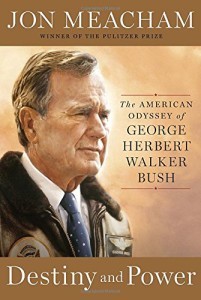 I just finished reading Jon Meacham’s magnificent biography of the 41st President of the United States, George HW Bush, a book I thoroughly enjoyed, from cover to cover.
Bush’s election to the presidency in 1988 was the first presidential election I paid attention to. I was ten years old, already a budding politics and history nerd. We huddled around the radio in our family room that November night (our family did not own a TV) and waited to hear the returns.
George HW Bush was in the arena during much of the pivotal history of the 20th century. His father, Prescott Bush, was a U.S. Senator. He volunteered to fight in World War II and became a fighter pilot whose plane was shot down over Chichi Jima. He and three others survived, but not after he finished his bombing mission, parachuted into the waters of the Pacific, and was rescued by a Navy submarine. When he returned home, Bush married Barbara, built an oil business in Texas, then got involved in politics. He won a seat in Congress, then ran for the Senate and lost. He served in a variety of roles in government: Ambassador to the United Nations, Ambassador to China, and Director of the CIA. He was the Chairman of the Republican National Committee. He was considered for the Vice-Presidency twice: in 1968 with Richard Nixon and in 1974 with Gerald Ford. He ran for President in 1980, lost to Ronald Reagan, and then was asked by Reagan to join the ticket. He served as Vice-President for 8 years before seeking the presidency and winning in 1988. Born just after World War I, Bush lived through the Great Depression, World War II, Korea, Vietnam Korea, the turbulent 60’s, Watergate, the assassinations of JFK, RFK, MLK, the fall of Communism, the Gulf War, the Iraq War, 9/11, the digital age, and much more. He saw two of his sons become governor and one become President. His life is a fascinating prism through which we can study the 20th century.
Reading this book was a pleasure on many levels. I enjoy, thoroughly, biographies, especially political ones. But more than this, I came away with several reflections on leadership and life. I thought I’d share a few with you.
1) You don’t have to be a monster to be a consequential leader. There is a narrative, fueled by the stories of men like Steve Jobs, that to be effective, one must be a tyrant: thoughtless, selfish, ruthless. Even among Christian leaders, this idea exists and is rewarded. George H.W. Bush demonstrates that you can lead at the highest levels of society and still be a kind and decent man. For Bush, his decency was something he was taught by his mother, but nurtured throughout his life by discipline. He refused to hold grudges, to settle scores, or to not be kind. He was prudent and deferential, often subsuming his own ambition for the good of those he served and for the good of the nation.
As I read this book, it reminded me of the fruit of the Spirit described in Galatians: gentleness. It’s a similar trait described in Titus 1 and 1 Timothy 3. Gentleness, is not weakness. It’s not avoiding conflict or about being nice. It’s a steady disposition and a genuine concern for those who are affected by your decisions. It’s modesty, a kind of selflessness. Today common decency is neither taught nor rewarded. This is why men who are both powerful and gentle are hard to find. But for Bush, a man who led well, it was in abundant supply.
2) Sometimes your best and most lasting work will go unnoticed. When the history of the end of the Cold War is retold, giants like Ronald Reagan, Margaret Thatcher, Lech Walesa, Pope John Paul II, Vaclav Havel and others are often (rightly) given credit for its demise. What goes unnoticed, however, is the vital role Bush played. It was during Bush’s presidency that the Berlin Wall fell and Germany was reunified and during his presidency when many former Soviet Republics gained their freedom. The end of the Cold War could have had a bloody end, but for Bush’s careful diplomacy and steady leadership.
Bush also assembled a coalition to push Saddam Hussein out of Iraq and presided over a hugely successful mission. His refusal to take out Saddam at the time seemed weak, but, in history’s hindsight, seems prudent given the struggles the U.S. has had in restoring stability in a post-Saddam Iraq.
There were many other similar crises over which Bush presided, both at home and abroad, that went unnoticed, but were evidence of careful leadership. And yet, until recently, most have not considered Bush a consequential president. He’s often lost when people discuss the 20th century’s greatest leaders. This reminds me that much of good leadership is done behind closed doors, when nobody is paying attention, on matters that often seem unimportant to the outside world. If our sense of service is fueled only by getting credit for what we do, by being noticed, we’ll not lead well. But if we are committed to faithfulness, wherever we lead, our leadership will have more lasting impact.
3) You can lead well and still love your family. To study the Bush family is to study a family deeply devoted to each other. George Bush often wrote touching notes to his children during times of crisis. He was, for them, a source of encouragement and strength. His kids adore their father. To hear Bush talk of his love for Barbara (He calls her “Bar”) is to hear a husband who deeply loves his wife, over the many seasons of life. George HW Bush was an ambitious, accomplished man and yet he didn’t sacrifice his kids.
As a husband and father, reading this book was, at times, sobering and convicting. It forced me to think through my faithfulness to my family and to ask hard questions of myself. Sadly, many good leaders are a mess at home. It doesn’t have to be this way. It shouldn’t be this way.
4) There is no substitute for experience in leadership. It struck me, as I read this book, that George HW. Bush may be the last President elected with a long record of public service. He may have, arguably, been the most experienced person to hold that office. This served him well, especially on foreign policy as he leveraged relationships with government leaders he had forged over decades.
Today such a resume is considered a liability, not just for Presidents but for leadership positions at all levels, including in the church. We are a culture obsessed with youth, with charisma, with raw talent. There is something to be said, of course, for young leadership. Maturity is not always tied to age. Sometimes young leaders have a prudence and vision beyond their years. Paul told Timothy to not let the church he served “despise his youth” (1 Timothy 4:12).
However, we should wise not to make youth and attractiveness the singular desirable quality in those we seek to lead us. In those moments of crisis, when leadership is difficult, those who’ve led before often have a reservoir of life experience to guide them.
5) Men plot and plan, but God is gathering history to himself. I have this thought after every Presidential biography I read. Reading history only reinforces to me the sovereignty of Christ over history. Bush’s life is no exception. But for a few inches left or right, he could have been killed while being shot down at sea in World War II. Had Richard Nixon made Bush a White House staffer instead of ambassador to the U.N, Bush’s career may have ended with Watergate. But for a few choices and mistakes and turns, he might have defeated Ronald Reagan and won the presidency in 1980. Had former President Gerald Ford accepted the offer to be Reagan’s running mate in 1980, Bush, the second choice, may not have ever been elected president 8 years later. Had a few historical events gone differently or not happened at all, we may have never known who George HW. Bush is.
The sovereignty of God, over history, shouldn’t drive us to either fatalism or passivity. We should live out our God-given callings with intentionality and purpose, but knowing that in the swirl of history, both in the world and in our own personal lives, there are no accidents and no coincidences. Nothing happens that doesn’t pass through the hands of a wise and perfect God.
Update: I can’t believe I forgot to mention that I’ve been to the George H.W. Bush Presidential Library in College Station, Texas on the campus of Texas A&M. I highly recommend the visit.


