
Alan Baxter's Blog, page 95
December 8, 2010
Spec Fic writers of the Illawarra
If you're a member of the New South Wales Writers Centre, check out the latest issue of Newswrite to find an article by Laura Goodin about the plethora of spec fic writers in the Wollongong area. There's a bunch of us and we're all friends, as are most spec fic writers around Australia – the community here is really tight. Laura decided to write an article about it.
We all got together at a pub in Wollongong and drank beer, talked about Starship Enterprise pizza cutters and had our photo taken for the magazine article. There were lots of pictures taken. Of course, as I should have anticipated, they used the one where I'm fucking about. I said, "Hey, maybe I should pose all China Mieville!" and stood apart from the group with my arms folded. So that's the shot they used. Oh well.
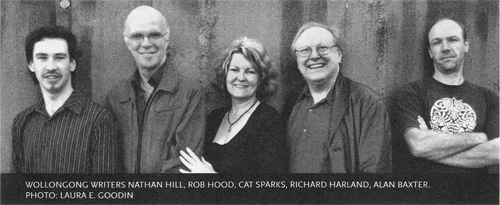
Nathan Hill, Rob Hood, Cat Sparks, Richard Harland and me. (Pic by Laura Goodin)
I certainly don't have what Mieville has, because I appear to have given myself several extra chins, while Mieville always looks all moody and mysterious. I just look smug.
You can learn all about the NSW Writers Centre here.
.


December 6, 2010
Death Most Definite by Trent Jamieson – review
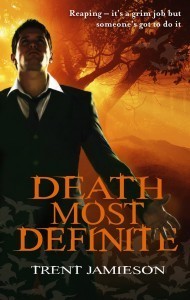 Death Most Definite by Trent Jamieson is a book I've been looking forward to reading, for many reasons. Firstly, and this does count for a lot, anyone that knows him will tell you that Trent is one of the nicest guys in spec fic, and I have to agree. He's also a brilliant writer, with over 70 short stories published, and he's taught at the prestigious Clarion South writers' workshop. So this is a nice guy with some serious writing chops. I've enjoyed a lot of his short fiction and wanted this, his first novel, to rock. I'm pleased to say that it rocks hard.
At first I was slightly perturbed as it's written in first person present tense. That often works well for short fiction, but I find it quite tiresome in novel length work. Also, the author is totally locked in to one single, current point of view. This can make it hard to tell a compelling story. Jamieson doesn't struggle with this at all, however, and spins a rollicking good yarn.
Another reason I really wanted to enjoy this book is because it's an urban fantasy thriller, which is the genre of my own novels, so I clearly have a passion for that particular niche. And it's about Death. Capital D. The dude himself as well as the concept. Jamieson cites in his Acknowledgements that he has been influenced by the great Death writers before him and that Death Most Definite is "a fusion of my love for Fritz Leiber, Terry Pratchett and Neil Gaiman's Deaths."
Gaiman and Pratchett are two of my favourite authors and there's no doubt they've influenced my own writing. So it's becoming pretty clear why I really wanted to like Death Most Definite. And I really did like it.
The story opens with Steven de Selby in a foodcourt in Brisbane. Steven is a Pomp, a conduit for dead souls to pass from this realm to the Underworld. It's a family business – his mother and father are Pomps – and that's the way they like it. In the foodcourt Steven spots a dead girl. Before he has a chance to decide what to do about that – after all, it's not new to him – she tells him to run and people start shooting at him. So begins a crazy chase all over Brisbane. Steven soon learns that someone is trying to upend and take over the Australia Regional death business, one of thirteen regions in the world. In the process, they're killing off Pomps left, right and centre and setting loose Stirrers, evil, hate-filled souls that occupy the bodies of the recently dead and make zombies seem like an easy alternative. Steven has to figure out what's going on while desperately trying to stay alive.
This is a masterfully constructed yarn, whizzing along at a furious pace for the entire book. It's a thriller in every sense of the word, with strange allies and double crosses, explosions and car chases. And all that good stuff is wrapped up in some absolutely solid world-building, creating an Australia where the business of death is managed on a daily basis by a corporate machine.
The story has some great twists, some fantastic character building and some truly inspired locations and events. When Steven visits the One Tree I was gobsmacked with the terrifying beauty Jamieson managed to create. This is a real page turner, and I don't shy away from the cliche. This book deserves it.
Death Most Definite is the first in a series, with the second volume, Managing Death, out this month. Put it on your Xmas list.
.
December 5, 2010
RealmShift and MageSign reviewed at The Specusphere
I was checking out The Specusphere over the weekend and saw that my novels have been reviewed there this month. It's a very nice review too.
Due to the style of the writing, the view of religion, the rollicking fight scenes, (and Baxter knows his stuff – check out the Kung Fu link on his webpage below!) and the author's tendency not to shrink away from flowery language this is not a book I would recommend for anyone with delicate sensibilities. For everyone else out there who enjoys a good bit of dark fiction, get it on your Christmas wish list, then believe hard in Santa.
That's right, folks. Leave you delicate sensibilities at the door and put them on your wish list. I can supply signed copies for that extra special Xmas gift if you contact me directly through this site.
.
December 2, 2010
NaNoWriMo – thoughts from an outsider
Firstly, in case people are wondering what the hell NaNoWriMo means, it's short for National Novel Writing Month. You can learn all about it here. In a nutshell, every year the month of November is dedicated to this idea, and people "win" NaNoWriMo if they manage to write 50,000 words of a novel between November 1st and 30th.
I see a lot of chatter around the social networks about this thing, but I've never done it myself, for several reasons. Firstly, I should clarify a couple of points. I'm very lucky that I've managed to create a situation where I have a lot more time to write than most people. The nature of how I make a living gives me large chunks of writing time. Of course, I spent a long time engineering that situation – you don't become a martial arts instructor overnight – but it's worth bearing in mind in the context of this post. I did it because I'm a writer and writing time is fucking important to me. So I recognise that my situation is different from people that are working full-time jobs and have kids or whatever and want to write. But more on that later.
The thing is, I don't really get NaNoWriMo. On the website it says:
National Novel Writing Month is a fun, seat-of-your-pants approach to novel writing. Participants begin writing on November 1. The goal is to write a 50,000 word, (approximately 175 page) novel by 11:59:59, November 30.
There's the first problem for me – 50,000 words is not a novel. It's barely more than a novella. However, I know that most people that get involved use the figure as motivation. They want to get 50,000 words of a novel written, rather than a 50,000 word novel, which is fair enough.
But is forcing yourself to write an average of around 1,700 words a day actually very useful? Another part of the site FAQ that really raises my eyebrows is this bit:
Why: The reasons are endless! To actively participate in one of our era's most enchanting art forms! To write without having to obsess over quality. To be able to make obscure references to passages from our novels at parties. To be able to mock real novelists who dawdle on and on, taking far longer than 30 days to produce their work.
The bolding is mine. Firstly, what's the use of spending an entire month writing 50,000 words of poor quality? Sure, you can maybe fix it up over the following months, but isn't it better to spend a month writing 20,000 words of good quality? Then do it again the following month. Then, after six months, you've got a decent novel to be working with.
The second bit I bolded just pisses me off. Of course real novelists take longer than 30 days to produce their work. That's because they care about the quality of the work. And they're presumably "real novelists" because their novels are published. As opposed to all the NaNoWriMo participants that spend a month a year churning out bollocks that'll never get them anywhere as writers. (I know that a lot of NaNoWriMo participants don't churn out bollocks, but I'm commenting from the frame of reference of the site quoted.)
I suppose this is what bothers me the most about this concept. To succeed as a writer you need to hone your craft constantly, not churn out as much as possible. Of course, the more you write, the better you'll get, but forcing a wordcount isn't the right approach in my opinion. I understand that for many people this month is a serious kickstart, forcing themselves to commit to projects they've been meaning to get around to. But I think it's far better to establish a situation where you find time regularly to write and concentrate on improving your craft regardless of how many words you manage each day.
A lot of "professional" writing advice says you have to write every day if you want to be successful. That's rubbish. Not everyone can write every day, and I know lots of very good pro writers that certainly don't. But they do write regularly, certainly at least once a week and probably a lot more often. Setting up a regular writing schedule, making time to write as much as possible, and constantly working to improve your writing is the path to success. Forcing 50,000 words in a month, once a year, is really not going to do anything other than:
a) Give you 175 pages of unsellable drek;
or
b) Leave you feeling bad about yourself because you didn't "win" NaNoWriMo because you only managed 40,000 words or something like that.
If the whole concept does work for you and gives you that motivational kick you need to get work done, then good for you. If the only writing you ever do is a word marathon for one month a year, it's not going to turn you into a successful writer.
So it's probably pretty obvious by now why I don't bother with it, but I do recognise that I've made writing time a priority in my life. To be honest, that's what every seriously aspiring writer needs to do. John Scalzi wrote this excellent and brutally honest post on the subject back in September. It's harsh, but I agree with him completely.
I'm interested in the thoughts of others out there on this subject, whether you've taken part in NaNoWriMo or not. Leave a comment and let me know what you think.
.
December 1, 2010
Smashwords – get busy with the ebook
You all know by now what a massive fan of Smashwords I am. It's the best site for ebook publishing, in my opinion, with distribution feeds to all the major stockists and outlets. I've been with Smashwords from nearly the beginning and watched them grow from strength to strength while they've done an awesome job of making my books available as multi-format ebook editions.
Loads of authors and publishers are turning to Smashwords to publish ebook editions of their published print work, self-publish their work or publish work by new and established authors alike.
Get on board. At the moment there's a "Spread the Word about Smashwords" promotion going on, and I'm getting involved to help. Below is a slideshow all about them. Vive le revolution!
Introduction to Smashwords – Ebook Publishing and Distribution Made Easy
View more presentations from Smashwords, Inc..
November 30, 2010
Give books generously this Xmas
Any regular readers here will know how I feel about Xmas and pretty much any other religious festival. Or any religion for that matter. But I do try to enter into the spirit of a small part of Xmas, that being the whole hanging out with family and sharing gifts thing. Of course, that's actually nothing to do with the Christ Mass that the holiday is based upon, but the Christians only stole the Roman Sol Invictus festival anyway, so it's all bollocks. My point is, at this time of year we try to get together with loved ones and share gifts and food. That's a good thing.
I don't have much in the way of family these days, but I have my in-laws, who are all very nice people to be around, and I have friends that are as close, if not closer, than family. Catching up with these people and having a big feed, spending time together, sharing gifts, it's all very important and enjoyable stuff. I always hope that during this time some of the stuff I get will be books. And it usually is. As far as I'm concerned, there are few better gifts than a book. I'm sure I could think of some things I'd rather have than a book, but this is not the place to explore my fantasties – you can read my novels for that.
I also plan to give away a lot of books this year. I dig giving people a book as a gift that I know, or at least suspect very strongly, that they'll really like. Perhaps one of the biggest drawbacks of the current ebook revolution is that we won't have so many solid books to wrap up in silly paper and hand over as presents. Regardless, in the meantime, I'll still be giving a lot of books as gifts this Xmas.
Which brings me to another point. I've decided to start giving books away all the time. I'm basically starting a new policy as from this Xmas. If anyone asks me if they can borrow any particular book from now on, I'm not going to lend it to them. I'm going to give it to them. If it's a special book, a rare or limited edition, or a signed copy or something like that, then I'll say no, they can't borrow it. If it's just a book that anyone can still buy off the shelf, I'll give it to them. If I really like it, I'll get myself another one, or look out for it in secondhand bookstores.
Now, don't immediately think to abuse my new found book philanthropy and start asking me for books left, right and centre. This is something that will happen naturally. Someone sees a book in my house, expresses an interest, asks if they can borrow it and I'll say, "Here, have it." I think that'll make everyone involved feel good and the book goes on to do its thing for more people instead of just sitting on a shelf.
Try it. You might like it.
.
November 29, 2010
How many of the Top 100 have you read?
There's this meme going around Facebook at the moment, so I thought I'd drag it out of the social network and onto my blog. It's pretty flawed, as these things always are, but interesting nonetheless. (Although I am confused by 14 and 98 – bit of a cock up there). Anyway, it goes like this:
Have you read more than 6 of these books? The BBC believes most people will have read only 6 of the 100 books listed here.
Instructions: Copy this into your NOTES. Bold those books you've read in their entirety, italicize the ones you started but didn't finish or read an excerpt. Tag other book nerds. Tag me as well so I can see your responses!
So yeah, the usual chain letter nature of these things applies here. I'll bold and italicise as instructed. If you're reading this, consider yourself tagged.
1) Pride and Prejudice – Jane Austen (Does And Zombies count?)
2) The Lord of the Rings – JRR Tolkien
3) Jane Eyre – Charlotte Bronte
4) Harry Potter series – JK Rowling
5) To Kill a Mockingbird – Harper Lee
6) The Bible
7) Wuthering Heights – Emily Bronte
8 ) Nineteen Eighty Four – George Orwell
9) His Dark Materials – Philip Pullman
10) Great Expectations – Charles Dickens
11) Little Women – Louisa M Alcott
12) Tess of the D'Urbervilles – Thomas Hardy
13) Catch 22 – Joseph Heller
14 ) Complete Works of Shakespeare – This could be a bold one, but I'm not sure I've read everything.
15) Rebecca – Daphne Du Maurier – not sure if I finished it ornot, was quite young
16) The Hobbit – JRR Tolkien
17) Birdsong – Sebastian Faulks
18) Catcher in the Rye – JD Salinger
19) The Time Traveller's Wife – Audrey Niffenegger
20) Middlemarch – George Eliot
21) Gone With The Wind – Margaret Mitchell
22) The Great Gatsby – F Scott Fitzgerald
23) Bleak House – Charles Dickens
24) War and Peace – Leo Tolstoy
25) The Hitch Hiker's Guide to the Galaxy – Douglas Adams
26) Brideshead Revisited – Evelyn Waugh
27) Crime and Punishment – Fyodor Dostoyevsky
28) Grapes of Wrath – John Steinbeck
29) Alice in Wonderland – Lewis Carroll
30) The Wind in the Willows – Kenneth Grahame
31) Anna Karenina – Leo Tolstoy
32) David Copperfield – Charles Dickens
33) Chronicles of Narnia – CS Lewis – I don't think I've read all seven, or whatever it is.
34) Emma – Jane Austen
35) Persuasion – Jane Austen
36) The Lion, The Witch and The Wardrobe – CS Lewis – Isn't this part of the Chronicles of Narnia? It's the 14/98 situation all over again. This really isn't a very well thought out list…
37) The Kite Runner – Khaled Hosseini
38) Captain Corelli's Mandolin – Louis De Berniere
39) Memoirs of a Geisha – Arthur Golden
40) Winnie the Pooh – AA Milne
41) Animal Farm – George Orwell
42) The Da Vinci Code – Dan Brown
43) One Hundred Years of Solitude – Gabriel Garcia Marquez
44) A Prayer for Owen Meaney – John Irving
45) The Woman in White – Wilkie Collins
46) Anne of Green Gables – LM Montgomery
47) Far From The Madding Crowd – Thomas Hardy
48) The Handmaid's Tale – Margaret Atwood
49) Lord of the Flies – William Golding
50) Atonement – Ian McEwan
51) Life of Pi – Yann Martel
52) Dune – Frank Herbert
53) Cold Comfort Farm – Stella Gibbons
54) Sense and Sensibility – Jane Austen
55) A Suitable Boy – Vikram Seth
56) The Shadow of the Wind – Carlos Ruiz Zafon
57) A Tale Of Two Cities – Charles Dickens
58) Brave New World – Aldous Huxley
59) The Curious Incident of the Dog in the Night-time – Mark Haddon
60) Love In The Time Of Cholera – Gabriel Garcia Marquez
61) Of Mice and Men – John Steinbeck
62) Lolita – Vladimir Nabokov
63) The Secret History – Donna Tartt
64) The Lovely Bones – Alice Sebold
65) Count of Monte Cristo – Alexandre Dumas
66) On The Road – Jack Kerouac
67) Jude the Obscure – Thomas Hardy
68) Bridget Jones's Diary – Helen Fielding
69) Midnight's Children – Salman Rushdie
70) Moby Dick – Herman Melville – Yep, I'm one of those people that's actually read this whole book. I now know far too much about whales.
71) Oliver Twist – Charles Dickens
72) Dracula – Bram Stoker
73) The Secret Garden – Frances Hodgson Burnett
74) Notes From A Small Island – Bill Bryson
75) Ulysses – James Joyce
76) The Bell Jar – Sylvia Plath
77) Swallows and Amazons – Arthur Ransome
78) Germinal – Emile Zola
79) Vanity Fair – William Makepeace Thackera
80) Possession – AS Byatt
81) A Christmas Carol – Charles Dickens
82) Cloud Atlas – David Mitchell
83) The Color Purple – Alice Walker
84) The Remains of the Day – Kazuo Ishiguro
85) Madame Bovary – Gustave Flaubert
86) A Fine Balance – Rohinton Mistry
87) Charlotte's Web – EB White
88) The Five People You Meet In Heaven – Mitch Albom
89) Adventures of Sherlock Holmes – Sir Arthur Conan Doyle I've read a lot of Sherlock Holmes, so I assume this is one of them. Is this an omnibus edition or something?
90) The Faraway Tree Collection – Enid Blyton
91) Heart of Darkness – Joseph Conrad
92) The Little Prince – Antoine De Saint-Exupery
93) The Wasp Factory – Iain Banks
94) Watership Down – Richard Adams
95) A Confederacy of Dunces – John Kennedy Toole
96) A Town Like Alice – Nevil Shute
97) The Three Musketeers – Alexandre Dumas
98) Hamlet – William Shakespeare
99) Charlie and the Chocolate Factory – Roald Dahl
100) Les Miserables – Victor Hugo
That's not a bad result, I suppose. Certainly more than six. But I do question the list. Including "complete works" or series, then adding another item which is a book from that series is a bit redundant and shows quite a lack of thought and planning in the list. But there you go. The list did at least make me notice a couple of things that I've been meaning to read but still haven't, so it wasn't a complete waste of time.
Tag!
EDIT: Thanks to Trudi Canavan in the comments for pointing out that the list from Facebook is not, in fact, the same as the original list from the BBC, which you can read here. Which is also out of date, having been last updated in August 2004. Ah, the internet is a minefield of "almost".
.
November 27, 2010
Don't say Face!
In a quick bit of nonsense news from teh intertubes, my mate Graham pointed out to me that Facebook are trying to trademark the word "Face". According to the news article:
The Facebook empire has just had a trademark application accepted for any use of the word "Face" in any product or service that could remotely be seen as offering any kind of competition to the all-conquering social network.
Specifically, the trademark covers "telecommunication services, namely, providing online chat rooms and electronic bulletin boards for transmission of messages among computer users in the field of general interest and concerning social and entertainment subject matter, none primarily featuring or relating to motoring or to cars".
None relating to cars, mind you. Oh no, car social networks can use "Face" as much as they like. For some reason.
Facebook now has to provide the US Patent & Trademark Office with a statement of use within three months. Presumably their statement of use will be something along the lines of, "We use it as half of our name."
Of course, it seems to me, as the original article points out, that this is a direct attack on Steve Jobs and Apple, targetting their whole Facetime thing. After Google and Facebook came to blows last week over Google refusing Facebook users direct connection to their Contacts list, and now this, I'm sitting back and popping me some corn. Seriously, when Google, Apple and Facebook finally get together to settle this thing, it'll make Godzilla versus King Kong versus King Ghidorah seem like a schoolyard noogiefest.
Interesting times ahead.
.
November 24, 2010
Independent Inkwell: Australian Small Publishing, a half hour documentary
Independent Inkwell: Australian Small Publishing is a half hour documentary delving into the motivations and stories of small and independent publishers. It's a fascinating bit of television, not least because I'm in it. Wearing my small press publisher hat rather than my writer hat I was asked to participate on behalf of Blade Red Press. Several Australian small and independent presses are involved, including Keith Stevenson of coeur de lion publishing, another spec fic specialist that I've talked about here a lot in the past.
The documentary is made by Max Rowan and was originally shown on TVS. It's now been uploaded to YouTube in three parts, each around 8 minutes (the half hour includes commercials, obviously, that aren't in the YouTube version.) While it's focussed on Australian small press, everything said applies to indie publishing worldwide. There's also some talk about the crossover with small press, indie press and self-publishing. It's really interesting viewing and above everything else left me feeling very positive for the future of small press and very proud of the small press community, here and overseas. Viva la revolution!
I've embedded all three parts below.
.
November 22, 2010
A few funny words
I'm often entertained by notices in public places, from street signs to restaurant menus and everything in between. Sometimes it's a case of English as a second language creating the funnies. Other times it's people trying too hard to say the right thing. After Freecon this Saturday a bunch of us went out for dinner and I found some comments on a menu that seem to be the result of both these things.
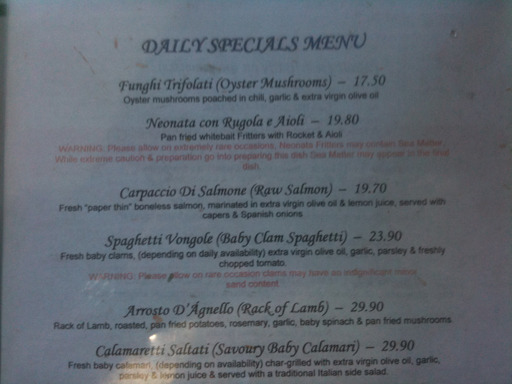
The photo hasn't come out all that well unfortunately. It's the red bits that made me laugh. The one at the bottom under Spaghetti Vongole says:
WARNING: Please allow on rare occasion clams may have an insignificant minor sand content.
Well, it's either insignificant or minor. And if you can notice it while eating the clams, it's really neither.
The one above that is even better:
WARNING: Please allow on extremely rare occasions, Neonata Fritters may contain Sea Matter. While extreme caution & preparation go into preparing this dish Sea Matter may appear in the final dish.
There is so much wrong with this sentence. First and foremost, what the fuck is Sea Matter? That could mean anything from a shark to a turd. Also, notice that extreme preparation goes into preparing that dish. Is that preparation while bungee jumping or something?
And it was a night for weird wordage. While at the restaurant I was sending an email from my iPhone about the board game High Frontier. I made a slight typo in the word "boardgame" and look what the old Autocorrect suggested:
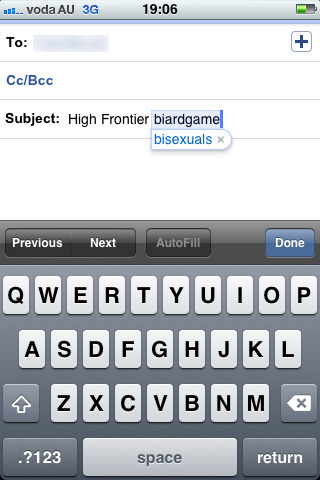
That's right Apple. You won't show boobs in any of your applications, but you'll jump at the chance to suggest "bisexuals" when I've typed "biardgame".
It's a funny old world.
.


