
Alan Baxter's Blog, page 91
February 6, 2011
New Age of Publishing – Guest Post 9 – Joanna Penn
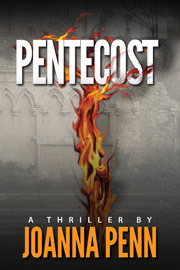
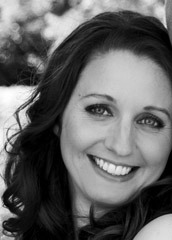 Joanna Penn is a person at the vanguard of indie authorship. She runs The Creative Penn website and has made a name for herself with her self-published books, How to Enjoy Your Job (2008), From Book to Market (2009) and From Idea to Book (2009). She's also a blogger, speaker, internet entrepreneur and international business consultant. She's now ventured into the realms of fiction and her first novel, Pentecost, is launching right now. Overachiever, much? I helped to beta-read Pentecost and can vouch for its exciting thrillery goodness. It's a ripping read, with great characters and excellent MacGuffins, so if you like thrillers, you should try it out. On the basis of Joanna's experience in the indie author scene, she's got a guest post here today talking about the lessons she's learned along the way. If you've been thinking of going it alone with your writing, you'll appreciate this post:
On Being An Indie Author: 5 Lessons Learned
Attitudes towards self-publishing or independent (indie) publishing are changing fast in today's digital world. Print on demand technology is now mainstream and dramatic ebook sales have turned heads in the publishing industry, outselling hardback fiction last Christmas. More authors are now entering the indie publishing market because they realize it is within their control to see their book in the hands of readers. You don't have to wait for the gatekeepers anymore and that's exciting!
In the last three years, I've self-published four books and I would love for you to avoid the mistakes I've made! Here are some of the biggest lessons I've learned that will save you time, money and heartache in your journey towards becoming an indie author.
1) Know thyself. This ancient wisdom holds true in the internet age. To be successful as an indie author, you have to be willing to play around with new technology as well as take the risk of looking stupid or failing before you succeed. You need to be impatient enough with traditional publishing to want to embrace the DIY attitude. You have to consider multiple aspects of the process from writing, to building a platform, and then everything that goes into publishing (which is more than you think!) You have to be (kind of) a control freak and a perfectionist because you need to get everything right. Your personality definitely matters when it comes to indie publishing (although you can cultivate these personality traits!) Look at what you need to do and assess whether or not you are willing to jump in 100%.
2) Embrace technology. Print on demand changed my life as an indie author. It means you can load a digital file to a provider like LightningSource or CreateSpace and your book can be available for sale on Amazon.com. When a customer orders a copy, it is printed and sent direct to the customer. No holding stock. No upfront costs for printing. No shipping effort for you. That can save you thousands of dollars as you don't have to order a small print run as old-style self-publishers had to. Please don't print a garage full of books unless you have guaranteed distribution. Understand and use POD as well as ebooks and the cost of entry to publishing a quality product is much lower. Learning about publishing technologies and online tools like blogging and social networking are the linchpins of a successful indie author. You are doing yourself out of a lot of money if you don't embrace the computer!
 3) Treat indie publishing as a business. You are a small business-person which means you need to track costs and income. You are not just a writer when you go the indie route. I set up my own company when I started The Creative Penn, fully intending it to become a publisher as well as the vehicle for my speaking business and online book/product sales. It's also good to remember that small businesses usually have a rough time for the first 3-5 years. I'm at the end of year two now and track all my sales as well as expenses. I still have a day job (like most writers) but the business pays for itself. This means I can budget for the inevitable costs of running a small business and also use the income to develop my business.
4) Use professionals for outsourcing. I have tried doing everything myself before i.e. book cover design, formatting of files for the Kindle, interior book layout etc but I have found that there are just some things I can't do well enough to have a professional finished product that is indistinguishable from traditionally published books. In the name of all serious indie publishers, I implore you to use a professional copyeditor as well as a pro cover designer (unless you are highly skilled at either). Those two are critical for a quality output. I also recommend you use someone with technical ability for formatting ebooks and print output. It will save you time and a lot of frustration which is worth the money (see above for budget!)
5) Embrace marketing. When I self-published my first book, I didn't know anything about marketing. I thought that people were just out there waiting for my book. After practically zero sales in the first month, I decided to learn about marketing. I read books, did online courses, listened to audios and played around with direct marketing. I made it onto Australian National TV with one press release, but I only sold one book so then I learned about internet marketing and blogging which has been the turning point for me. I had no marketing background but embracing marketing has changed my whole life. You need to learn to love it too as there are millions of books out there. How will anyone know about yours unless you start marketing?
Importantly, being an indie author is a great adventure where you can choose your own path. It's empowering to spend your time writing and promoting your own books instead of chasing that elusive traditional publishing deal. There are also more success stories these days of indie authors getting print deals after self-publishing generated great sales, so whatever your goals as an author, independent publishing can be a great start. I wish you the best on your indie journey!
***
Joanna Penn is the author of Pentecost, a thriller novel, out now on Amazon.com. Joanna is also a blogger at The Creative Penn: Adventures in Writing, Publishing and Book Marketing. Connect @thecreativepenn
Watch the book trailer for Pentecost here.
.


February 3, 2011
ThrillerCast, episode 11 is up
 The latest episode of ThrillerCast is up with myself and fellow Gryphonwood author, David Wood. It's called ThrillerCast, but we talk about all kinds of genre fiction, as usual.
This time it's an episode mainly about description, and what kinds of description work in various styles of fiction. Of course, we ramble on about a bunch of other stuff too. Our usual 20 minute timeframe is stretched out to about 30 minutes in this one.
You can find the show notes here and the download link. You can also subscribe through iTunes. Enjoy, and feel free to offer feedback. We're still quite new at this.
.
Free fiction and the value of our efforts
The advent of the internet has had many effects, not least of which is giving a voice to pretty much everybody. We're all sitting at keyboards making noise, like a flock of a billion seagulls fighting over one bag of chips. It's not a bad thing, as far as I'm concerned. The really strong voices lift above the white noise and everyone gravitates towards those voices that interest them. It's a big world and an infinite internet, so there's room in this sandbox for everyone. However, another aspect of that easy online voice is a million wannabe writers posting their stuff online and hoping people will read it. Again, not necessarily a bad thing, but a potentially damaging one for a writer's career in the long run.
I'm one of those voices, obviously. I've got some of my own fiction posted here for anyone to read. I've engaged in the Friday Flash phenomenon. Is this damaging for my career? I don't think so. I think it's helping my career, by giving potential readers an insight into some of my stuff. I've had some nice comments from people about stories they've read here. But I've engaged in the practice with careful forethought.
I decided to write about this after reading this post on Benjamin Solah's blog. You may remember that Benjamin guest posted here about a week ago, talking about his experiment self-publishing an ebook of his fiction. The power of the internet gave him some pretty solid and honest feedback very quickly. It can be summed up quite well in these comments on Ben's post by Jason Fischer:
My two cents is this: trunk stories belong in your trunk. You either take them apart and make them good enough to sell, or you leave them there. Why would you want anyone to see a piece of your writing that isn't working? If your career takes off, do you *really* want these out there?…
There's so much fiction out there for the reading, even more with the new e-book markets. As such, it is remarkably easy to slide into the infamous "90% of everything that is crap" of Sturgeon's Law. You should be aspiring to be in the other 10%, not taking the path of least resistance and self-publishing your unsellable trunk stuff.
Work on the nuts and bolts of your writing first and foremost. Be brutal with your own writing, edit, and edit some more. If you can't get it to work, trunk it and try something else, and LEAVE IT IN THE TRUNK. You can promote something till the cows come home, but if it's no good, no-one will want it…
These comments are culled from a longer conversation and it's worth reading Ben's post to see the whole discussion. Jason is someone worth listening to – apart from being a top bloke, his advice comes from great experience. He's made many quality short fiction sales and is a recent winner of Writers Of The Future, among many other awards and nominations. Check him out here.
I agree with his sentiments. So how is what I've done with fiction on my site different to Ben's experiment? There's one simple difference – all the fiction I've made available to read here is previously published somewhere (with a couple of exceptions that I'll talk about in a minute). Some of it is older stuff published in non-paying markets, but it's still stuff I'm proud of. Other stories are published in better markets and the links here are directly to sites where the story can be found. The point is that it made it past an editor, so I've got unbiased, third party confirmation that it's worth a read. For that reason, I'm happy to direct people towards it and say, "Here's some of my writing for you to check out, I hope you like it." If I wasn't able to sell that story to an editor, even "sell" it to a for the love market, then I certainly won't put it up here with a pouty face and a "well, I think it's good enough" attitude. Because it's not. Writers are the worst possible critics of their own work. Of course we love everything we write – we wrote it!
If people do like it, with any luck they'll seek out some of my other stuff, they might take a punt on my novels. Hopefully then they'll enjoy my books and recommend them to friends or buy copies to give as gifts. Using the same hypothesis, the first three chapters of both my books are available here (just click on book covers to find them) so that people can try before they buy.
The other exercise in free fiction I engaged in was Ghost Of The Black: A 'Verse Full Of Scum. In an effort to generate return visits to my site and more interest in my fiction, I wrote a 30,000ish word novella in a series of episodes, which I then posted here every Monday during 2008. This was a conscious decision to write a piece of fiction that I had no intention of trying to sell. Rather, it was a deliberate exercise in giving something away to showcase my writing. It's still available on the Serial Fiction page and it's also available as an ebook and print book, that I've self-published. On the whole it's been very well received and garnered a few decent reviews. Whether it's really done much to enhance my career is hard to say, but I certainly don't think it's done any damage. Whether I leave it here indefinitely is also hard to say. For now, I'm happy to leave it for people to enjoy. I may take down the Serial Fiction page one day, and just leave the ebook and print edition available for people to buy. I may take those away too at some point. (Leave a comment if you have a particular opinion about that – I'd be interested to know.)
What I haven't done is post here those stories that I couldn't sell. Believe me, my story trunk is a dark and nasty place, full of things I really don't want anyone else to see.
Another example of free, unpublished fiction here comes from my occasional jaunts into the Friday Flash meme. This is essentially a community of writers that post flash fiction on their websites and promote it with the #FridayFlash hashtag through Twitter and Facebook. A lot of those people don't care about getting published, they're just happy to be part of a community of likeminded people. Things that I've posted on Friday Flash are stories that I've decided are a good idea and an entertaining little yarn, but one that I don't want to spend time trying to sell or expand into a longer piece. They're all taster stories, exercises in writing and storytelling.
For me, writing is a very serious business. Friday Flash was a brief hobby. I don't mean to denigrate the community by this statement at all, it's just my own personal situation now. I'm not likely to post any more Friday Flash – I agree with the comments on Ben's post that it's a time-sink and I intend to spend that time on sellable short stories and novels. I've had fun with it, but now I'm moving on.
These days I only approach semi-pro and pro markets with my work. I know I can get stuff published in other places, but I'm improving my craft and expecting better results from myself. If I can't sell a story to at least a semi-pro market, I won't sell it at all. Nor will I post it here on my website. As the things on my site here attest, I was happy to get acceptances from much smaller markets before. Every writer starts somewhere. But I won't stay there. I want to improve as a writer and I want to sell my work to better and better places all the time. I intend to be a pro writer, as in, get paid pro rates for my work, and I'll keep working towards that. Recent sales are bearing out the worth of this endeavour – I'm making better sales all the time. I'm still yet to crack the big time pro markets, but I will one day.
In the meantime, I'm happy to leave the stuff here that I've already posted. I may well decide to take it all away at some point. Who knows?
What do you think? Do you appreciate free fiction as a taste of a writer's work? Are you a writer for or against the idea? Have you had good or bad experiences posting fiction on your site? Do you think I should leave free fiction here or take it away? Leave your comments – I'm interested in people's thoughts.
.
February 2, 2011
I talk about ebooks at jiraiya.com
Recently Shane Jiraiya Cummings guest posted here talking about his experience so far with his great ebook experiment. Well, what goes around and all that – Shane asked if I'd guest post on his blog, talking about my own ebook experience, so I did. You can find the post here.
Read, enjoy, comment, share.
.
Apple wants to have its cake and eat it
That is such a stupid expression. If you have a cake, of course you want to eat it. What's the point of having a cake if you don't intend to eat it? You going to wear it or something? It's like saying, "Oh you don't just want a car, you want to drive it too!" Yeah, of course I do. That's the fucking point of having a car.
But I digress. The NY Times is reporting that Apple has told Sony and some other developers that they can no longer sell ebooks through their iPhone/iPad apps unless those sale transactions go through Apple's system. What this basically means is that Apple want their 30% cut of every ebook sold from the Sony Reader store through the Sony Reader app on any of their devices.
On the one hand you can understand why Apple want a slice of the pie when their platform is being used for commerce, but it's actually taking the piss a bit. The whole concept behind the app phenomenon originally was that the more things you could do with an iPhone, the more likely people are to buy one. By making heaps of apps available, Apple would shift more hardware units. Hardware and accessories have always been Apple's core business after all. This decision marks a distinct shift in Apple's approach. To fully understand what they're doing, click the NY Times link above and have a read. It's a very clear article.
The downside to this for us is that it's holding back the emergence of ebooks as mainstream story consumption. By adding complication and costs to the delivery of ebooks, it only makes things more expensive for the end purchaser and slows the all-products-on-all-devices world that we desire. For ebooks to work properly and for prices to settle to an acceptable norm, people need to be able to buy any book from any store and read it on any device.
For example, you can buy and read Kindle books from Amazon on your Kindle reader. You can also get them and read them with the Kindle app on the iPhone. This Sony situation heralds a possible hiccough in that process – will Kindle be the next thing that Apple throttles? Will Kindle books suddenly become more expensive on other platforms, or not available at all?
This is a bad precedent. The real strength of ebooks and the place where most money is to be made is homogeneity and blanket coverage. When people can read any book from any store on any device, loads more people will start to pick up the technology. Just the same as music and MP3s. It wasn't until the MP3 format became standard that digital music players became ubiquitous.
More birth pains of the digital publishing industry. It'll be interesting to keep any eye on this one and see what happens. What do you think? Would Apple restricting its ebook content like this affect your ebook purchases?
.
January 31, 2011
Don't be a dick online
There's been a lot of debate recently about how people comport themselves online. There are stories of techers losing their job for complaining about students, other people losing jobs for complaining about said job, or their boss. Lovers discovering spouses and vice versa. Seriously, it's a minefield out there. But that's just life. I'm more interested in the persona someone puts out there when they're some form of public figure, even a very minor one. Obviously, from my point of view, I'm most interested in writers, editors, publishers and so on. It seems that a lot of the time those people can be real dicks online and it can only damage their careers. I got to thinking about this after I wrote a fairly poor review of Unimagined by Imran Ahmad. Ahmad himself came along and left a comment that did some serious damage to his reputation among people that would otherwise have never thought badly of him. Some people even said they wouldn't buy his book now, after the author "waded in with his ego-hammer". You can read that post and all associated comments here.
I spend a lot of time online. I know, that's really no surprise to anyone. But during that time I've seen a lot of people make serious asshats of themselves, for no real reason. Your personality online is very important. If you're a writer and you want people to read your stuff, you'll get more fans if those people feel like they know you. It's one of the many things about this changing world of publishing. Back in the day you could be a complete shit, utterly sociopathic, but no one would know. If you wrote good stuff and no one ever saw you, you'd just be reclusive or eccentric. These days, with everyone online, people like to know a bit about the author behind the book. As far as I'm concerned, the best way to manage that is just to be yourself. Unless you actually are a dick, of course, but then you've got bigger problems anyway.
Not everyone is going to like you. I think that's something we need to accept from an early age, regardless of what we do. Some people are just not going to dig you, just like there are some people you simply don't like. If you're being yourself and you're happy in your skin, fuck 'em. You don't need to please everyone. It's the same if you're an author with books that you'd like people to read. Not everyone will like your books and not everyone will like you, but if you're open and honest with your personality online, then the people that do like you will follow you, read your stuff, interact with you. If you have any sense, you'll interact right back.
To use myself as an example, I swear a lot. Yeah, I know, it's a shock to many, but it's true. I believe that words and language are seriously powerful things, but I also think that swearing is an unneccessarily heightened taboo. That's partly just rationalising my constant swearing, but fuck it. I don't care. It's how I am in real life, so I don't pretend to be different online. I'm always getting in trouble with parents because I inadvertantly swear around their children. I do my best not to, but I'm not very good at it. I'm also opinionated, I don't suffer fools, I call out the willfully ignorant, I can't stand injustice or bullying or hypocrisy and I'll challenge it every time I come face to face with it. That's just how I am in real life, so that's how I am online as well. But I try not to be a dick about it. It gets me in trouble, but so be it.
I like to have a laugh with it too. I'll be deliberately controversial and antagonistic to get a debate going and to interact. I'll question people to test their conviction. It's fun, it's interaction and it's part of who I am. But, again, I try not to be a complete arse about it. I still want to be a good guy, that people are interested in and entertained by. I want to be liked, same as everyone.
But while I'll be open and honest about who I am as often as possible, there are some things I'll keep to myself, because they're not right for open public consumption. Particularly, I won't bitch and moan about people to vent my frustrations. I won't rant and rave when I get a bad review. Other people are as entitled to their opinions as I am. Like Imran Ahmad coming onto the blog here and whining about a bad review, it would only damage my reputation. Not just my reputation generally, but with other professionals in my field – other writers, but also editors and publishers. If I went online and ranted on about some shitty rejection I'd had from so-and-so publisher that didn't know their arse from their elbow, that rant would DEFINITELY get back to them. (Of course, I have nothing but respect for all the great editors and publishers out there – I'm just talking hypothetically. Honest.) But it works the other way too. Sometimes editors will rant on about some fuckwit writer they've had to deal with and that writer WILL hear about it. The nature of Twitter and Facebook and blogs and all that stuff is that everybody knows everybody in some connection. There are certainly not six degrees of seperation any more. Sometimes there's not even one.
If you have someone you want to bitch and moan about, or a particular company or group you have the shits with, or a review or rejection that really pissed you off, ring a friend. Email a personal mate that understands. Do your venting in the privacy of an enclosed group. When you put that stuff out there online IT'S THERE FOREVER. You might delete it, but it's already cached. Whenever you say anything online, ask yourself if you really want it out there forever and for everyone to read, because that's what you're doing. Careers can crash and burn before they're started sometimes, because a person flags themselves as a nightmare to work with by the way they act online. This is especially true of newbies in the writing world, that haven't thickened their skin yet. Because seriously, people, you need the skin of an old elephant to survive with your ego intact in this game.
Be yourself, interact with others, let people in on your personality and your style, your standards and ethics if you like. But don't be a twat. People want to get to know you and with the internet the way it is we're all part of one massive community. Which is awesome – I love it, I really dig being part of this great big cyber love-in and everyone needs to embrace it these days. But like the title of the post says, don't be a dick online.
.
January 30, 2011
New Age Of Publishing – Guest Post 8 – Shane Jiraiya Cummings
Here's another in my series of guest posts discussing the changing face of publishing. In this one, dark fiction author Shane Jiraiya Cummings talks about his 'grand experiment'. He's decided to leap with both feet into the ebook self-publishing world and make the majority of his previously published work (and a couple of new things) available as ebooks, managing the whole process himself. He's being openly transparent about the mechanics and results, so have a read here about where he's gone so far and then follow along to see how it pans out.
The Grand Experiment
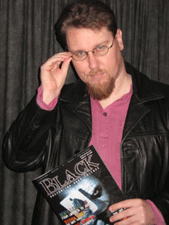 Filled with that euphoric sense of new year's I-can-do-anything-ness, in January, I embarked on what I call the 'Grand Experiment' with ebooks (yes, not just an experiment but a GRAND experiment!) Sure, plenty of other authors are testing the ebook waters with a title or two, but I don't believe this is enough to gain a foothold. Therefore, I released seven ebooks simultaneously into the wild on Amazon and Smashwords. With my novella Phoenix and the Darkness of Wolves already available, I currently have eight ebooks online. I also have two more in production and another few on the drawing board.
With eight books, I'm hoping the splash will be big enough for me to drum up 1,000 sales over the course of this year, and if I'm lucky, I might even join those industrious authors like J. A. Konrath, Scott Nicholson, or Amanda Hocking at the top of the e-food chain. But before I entertain delusions of grandeur, I'm taking things one week at a time.
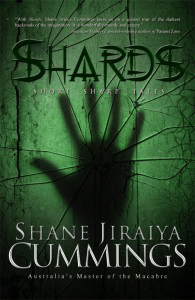
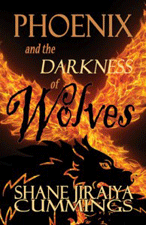 Aside from my sales target, the other thing I'm hoping to prove is whether short story collections and novellas will sell as successfully as novels. In the bookstores, novels are king, but I'm not so sure the same rule applies in the e-world. Five of my Grand Experiment titles are collections (the ebook version of Shards, which has two new stories, and the four volumes of the Apocrypha Sequence). The other two – The Smoke Dragon and Requiem for the Burning God – are novellas (as is my other ebook, Phoenix and the Darkness of Wolves, but this was published by Damnation Books, not self-published, so I have no control over its pricing).
My desire to prove that collections and novellas will sell well is not some wild stab in the dark. Others have already paved the way. Author Lee Goldberg on J. A. Konrath's blog said this month:
"My most profitable title, in terms of hours worked and pages written, is Three Ways to Die, a collection of three previously published short stories. In print, it's a mere fifty-six pages long, but it's selling 24 copies-a-day on the Kindle, earning me about $1500-a-month. That means I could potentially earn $18,000 this year just from those three short stories alone. That is insane."
$18,000 for three short stories? Yes, that is insane, but it's not beyond the realms of possibility. And remember, that's in just one year. I consider myself fortunate that I've been successful as a short story author. I've made more than a few 'pro' sales over the years, and by pro, I mean the SFWA and HWA rate of 5 cents/word. If you add up all my short story sales (and I've had more than 60 published so far – more than 120 sales when you count reprints), I estimate I've earned maybe $2000 from my short stories thus far. If you average that out, it's $33 per story. So you can see why I'm enviously eyeing Lee Goldberg's $18,000. Good luck to him, I say, but in the same breath, I say, if he can do it, why can't I?
The early signs are looking good. The Smoke Dragon, which is free on Smashwords (but 99c on Amazon because of their pricing limitations), has rocketed up the 'most downloaded' fantasy chart at Smashwords, and in a week (and without much in the way of promotion), it has been downloaded 230 times and been given two great reviews (one five star, one four star). Plus, I've sold two copies on Amazon. The fascinating thing about The Smoke Dragon is that it was available as a free PDF on my website for more than 12 months. You know how many times it was downloaded from my site? Three.
 I've read articles about music downloads and iTunes that suggested people want convenience over free stuff. Pirating music is finicky, prone to viruses, and just plain inconvenient for the average punter. It can also make people feel guilty. However, the convenience and prevalence of programs like iTunes is such that most people don't mind paying $1.69 for a song because it's easy and guilt-free. The same theory applies to ebooks, which is why I wanted my books on Amazon (the market leader), not just Smashwords. It's also why I'm not selling my titles from my website – it's one more set of clicks that people used to the convenience of Amazon or Smashwords just don't need.
If nothing else, I've already expanded my readership by embracing the e-revolution. In one week, 230+ people have read a story which, even though it was a Ditmar and Aurealis Award finalist, I couldn't give away. Another 110 people have downloaded samples of my other ebooks, and of those, a dozen have purchased my titles. Right now, the numbers are small, but again, it's the very first week, and except for some mates/colleagues mentioning my Grand Experiment online (for which I'm immensely grateful!), I haven't yet properly promoted my ebooks.
I used to lament that I couldn't get my work read beyond the Aussie small press diehards (bless them!). Well, now I've done it. I'm reaching new sets of eyes, and the exciting thing for me is that almost all of my ebooks are reprints. These are second, third, and even fourth bites of the cherry, but only a few hundred people at most have ever read my short stories, so it doesn't matter that they were published in small press magazines and anthologies. Repackaged as ebooks, they're ready for the wider world to enjoy.
I can't see any downsides to embracing ebook self publishing so far, but the ultimate test for me will be when my novel is ready (which should be soon). I'm torn between approaching a progressive publisher (who publishes ebooks and print books) or going it alone and self-publishing. This is why the ebook revolution is such a heady time for authors. If we choose to take total control over our destinies, there is a reasonable chance we'll fail, but if we succeed like someone such as Amanda Hocking – a previously unpublished author who sold 99,000 copies of her ebooks in December alone! – then the rewards will be worth it. For me, the next 12 months will decide my course one way or the other. Wish me luck!
If you're curious to see how the Grand Experiment progresses, you can follow it here.
.
New Age Of Publishing – Guest Post 8 – Shane Cummings
Here's another in my series of guest posts discussing the changing face of publishing. In this one, dark fiction author Shane Jiraiya Cummings talks about his 'grand experiment'. He's decided to leap with both feet into the ebook self-publishing world and make the majority of his previously published work (and a couple of new things) available as ebooks, managing the whole process himself. He's being openly transparent about the mechanics and results, so have a read here about where he's gone so far and then follow along to see how it pans out.
The Grand Experiment
Filled with that euphoric sense of new year's I-can-do-anything-ness, in January, I embarked on what I call the 'Grand Experiment' with ebooks (yes, not just an experiment but a GRAND experiment!) Sure, plenty of other authors are testing the ebook waters with a title or two, but I don't believe this is enough to gain a foothold. Therefore, I released seven ebooks simultaneously into the wild on Amazon and Smashwords. With my novella Phoenix and the Darkness of Wolves already available, I currently have eight ebooks online. I also have two more in production and another few on the drawing board.
With eight books, I'm hoping the splash will be big enough for me to drum up 1,000 sales over the course of this year, and if I'm lucky, I might even join those industrious authors like J. A. Konrath, Scott Nicholson, or Amanda Hocking at the top of the e-food chain. But before I entertain delusions of grandeur, I'm taking things one week at a time.
Aside from my sales target, the other thing I'm hoping to prove is whether short story collections and novellas will sell as successfully as novels. In the bookstores, novels are king, but I'm not so sure the same rule applies in the e-world. Five of my Grand Experiment titles are collections (the ebook version of Shards, which has two new stories, and the four volumes of the Apocrypha Sequence). The other two – The Smoke Dragon and Requiem for the Burning God – are novellas (as is my other ebook, Phoenix and the Darkness of Wolves, but this was published by Damnation Books, not self-published, so I have no control over its pricing).
My desire to prove that collections and novellas will sell well is not some wild stab in the dark. Others have already paved the way. Author Lee Goldberg on J. A. Konrath's blog said this month:
"My most profitable title, in terms of hours worked and pages written, is Three Ways to Die, a collection of three previously published short stories. In print, it's a mere fifty-six pages long, but it's selling 24 copies-a-day on the Kindle, earning me about $1500-a-month. That means I could potentially earn $18,000 this year just from those three short stories alone. That is insane."
$18,000 for three short stories? Yes, that is insane, but it's not beyond the realms of possibility. And remember, that's in just one year. I consider myself fortunate that I've been successful as a short story author. I've made more than a few 'pro' sales over the years, and by pro, I mean the SFWA and HWA rate of 5 cents/word. If you add up all my short story sales (and I've had more than 60 published so far – more than 120 sales when you count reprints), I estimate I've earned maybe $2000 from my short stories thus far. If you average that out, it's $33 per story. So you can see why I'm enviously eyeing Lee Goldberg's $18,000. Good luck to him, I say, but in the same breath, I say, if he can do it, why can't I?
The early signs are looking good. The Smoke Dragon, which is free on Smashwords (but 99c on Amazon because of their pricing limitations), has rocketed up the 'most downloaded' fantasy chart at Smashwords, and in a week (and without much in the way of promotion), it has been downloaded 230 times and been given two great reviews (one five star, one four star). Plus, I've sold two copies on Amazon. The fascinating thing about The Smoke Dragon is that it was available as a free PDF on my website for more than 12 months. You know how many times it was downloaded from my site? Three.
I've read articles about music downloads and iTunes that suggested people want convenience over free stuff. Pirating music is finicky, prone to viruses, and just plain inconvenient for the average punter. It can also make people feel guilty. However, the convenience and prevalence of programs like iTunes is such that most people don't mind paying $1.69 for a song because it's easy and guilt-free. The same theory applies to ebooks, which is why I wanted my books on Amazon (the market leader), not just Smashwords. It's also why I'm not selling my titles from my website – it's one more set of clicks that people used to the convenience of Amazon or Smashwords just don't need.
If nothing else, I've already expanded my readership by embracing the e-revolution. In one week, 230+ people have read a story which, even though it was a Ditmar and Aurealis Award finalist, I couldn't give away. Another 110 people have downloaded samples of my other ebooks, and of those, a dozen have purchased my titles. Right now, the numbers are small, but again, it's the very first week, and except for some mates/colleagues mentioning my Grand Experiment online (for which I'm immensely grateful!), I haven't yet properly promoted my ebooks.
I used to lament that I couldn't get my work read beyond the Aussie small press diehards (bless them!). Well, now I've done it. I'm reaching new sets of eyes, and the exciting thing for me is that almost all of my ebooks are reprints. These are second, third, and even fourth bites of the cherry, but only a few hundred people at most have ever read my short stories, so it doesn't matter that they were published in small press magazines and anthologies. Repackaged as ebooks, they're ready for the wider world to enjoy.
I can't see any downsides to embracing ebook self publishing so far, but the ultimate test for me will be when my novel is ready (which should be soon). I'm torn between approaching a progressive publisher (who publishes ebooks and print books) or going it alone and self-publishing. This is why the ebook revolution is such a heady time for authors. If we choose to take total control over our destinies, there is a reasonable chance we'll fail, but if we succeed like someone such as Amanda Hocking – a previously unpublished author who sold 99,000 copies of her ebooks in December alone! – then the rewards will be worth it. For me, the next 12 months will decide my course one way or the other. Wish me luck!
If you're curious to see how the Grand Experiment progresses, you can follow it here.
.
January 28, 2011
Amazon's ebook sales eclipse paperbacks 115:100
Timely news given my New Age of Publishing series of guest blogs currently running. The figures are a bit messy as hardbacks aren't included, but overall sales of paid Kindle books are outselling paperback books at a ratio of 115:100 through Amazon.com. The company says:
Amazon.com is now selling more Kindle books than paperback books. Since the beginning of the year, for every 100 paperback books Amazon has sold, the company has sold 115 Kindle books. Additionally, during this same time period the company has sold three times as many Kindle books as hardcover books.
This is across Amazon.com's entire US book business and includes sales of books where there is no Kindle edition. Free Kindle books are excluded and if included would make the numbers even higher.
Given that this is a piece of US-centric news, it would be interesting to see how global figures affect the ratios. But regardless of vagaries in statistics, one thing is clear: Ebooks are mainstreaming faster than most predicted.
The Kindle ereader is the single biggest selling product on Amazon, though Kindle edition books are obviously available on a variety of devices. I read a lot of Kindle books on my iPhone, for example. Anyone still denying the ebook revolution is certainly kidding themselves.
.
New Age Of Publishing – Guest Post 7 – Benjamin Solah
My series of posts looking at the changing face of publishing continues. This time I've got a post from Benjamin Solah. Ben is an emerging writer from Melbourne. He's also a poet and activist. He's been dipping his toe into the murky waters of publishing's new world and writes a bit here about his experiences. For anyone thinking about following Ben's path, there's some sage advice to be found in this one.
 eBooks have no doubt been a major talking point for writers and those in publishing and literary circles over the last year or so. But now, talk and speculation about digital publishing has moved toward action and I think we're beginning to see more and more people adopt eReaders as a form of reading alongside print books, but not yet a primary form of reading. What methods people are adopting is varied and it would be impossible for anyone to predict what device or form is going to emerge as dominant, be it something like the Kindle, another eReader, iPads and tablets, smart phones or plain old PCs and laptops.
The era we're in, I think, is one of speculation and one that is ripe for experimentation, for testing a variety of methods, devices and distribution. It would be mad for any publisher, writer or distributor to put their eggs in one basket. But even madder is some big names in the industry have been slow to put their eggs in any basket.
Enter the emerging writers and the small time writers. We've got a real chance to lead the way. And despite the term 'evangelical' having horrible connotations for me, I've become a bit of an eBook evangelist. I've spoken elsewhere about the chances emerging writers have to get in on the eBook market before the big guys do, but now part of me is assessing how much my little experiment is working and what is holding me back.
Using the emerging music scene that I have friends involved in, I was inspired to produce something like a demo tape or EP. I liked the idea of going to see a local band and if you liked them and wanted to support them, you'd buy their CD and/or t-shirt. It's never like the polished albums you buy from JB Hi-Fi, but it doesn't really matter. You hope by supporting them, it will contribute to them getting bigger.
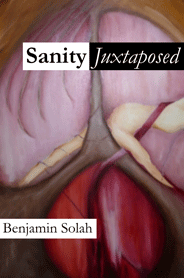 I tried this with writing and eBooks. I got together some of the flash fiction I posted on my blog, my very first short stories and poems and some blog posts, and put them into a collection called Sanity Juxtaposed. It's a kind of sample of my work and the early work is meant to be an example of where I've come from and how I've improved (dramatically) since then.
How's the experiment gone? Not as well as I'd hoped. I'm kind of assessing it now but not regretting having tried. The eBook remains available in a variety of places to see who will bite, but I'm already looking at how to improve.
For one, I've changed the price. eBook pricing remains hotly contested. I originally set it at $5. I wanted it to mean something if someone shelled out their cash. Unfortunately, the nature of shelling over $5 in the online word seems a lot harder than pulling out a $5 note at a gig. I put it down to $2 a few months ago, but nothing much has changed.
One thing I am questioning is whether it was a good idea to put those first pieces of writing in there. I outlined the rationale for doing so in the introduction and hoped it wouldn't mean those early works formed the basis of how people judged my writing, but with eBooks, most people download samples first before purchasing and I'm afraid those tales at the start probably served the basis for whether or not they bought the whole thing. I'd advise to put your best work forward and not devalue yourself.
Those are two things to consider if you're experimenting with eBooks – the price and what content you include. But it would be interesting to hear what others think and to use it to adjust my experiment accordingly. I haven't even mentioned marketing and how that affects sales. Playing around with covers, blurbs and promotion could mean a lot more than I've been able to look into yet.
And despite any mistakes we make, experiment, we must. Smashwords.com provides an ideal base in which to try things out and get yourself out there to a variety of formats and devices. I think it was even Alan that led me on this route, but others have followed such as Shane Jiraiya Cummings who has just launched his 'grand experiment' [Shane will be taking a guest blog here as well soon, talking about his experiences - Alan] with lots of titles on offer. He's yet another example of someone taking the dive into this whole thing and it benefits all of us.
Those that venture into this jungle of digital publishing learn and teach the others around us by asking questions and sharing what does and doesn't work. So if you're one of these emerging writers looking into this with trepidation, know you're not alone.
Benjamin Solah describes himself as a Marxist Horror Writer, writes fiction, performs poetry around Melbourne, and is an active blogger (http://benjaminsolah.com/blog) and socialist activist. He is currently working on a short story collection and his latest short story, 'Somewhere to Pray,' features in Chinese Whisperings: The Yang Book.
.


