
Blair Bancroft's Blog, page 36
December 30, 2017
Update on Series
 My neighbor's landlord still hasn't fixed the fence, but my flowers have made a comeback since Irma.
Actually, not fixing the fence is probably good, for if the landlord decides to replace the fence, it's bye-bye to the Black-eyed Susans and Passion Flower I've been growing for the past 2½ years. Sigh.
 Table decoration
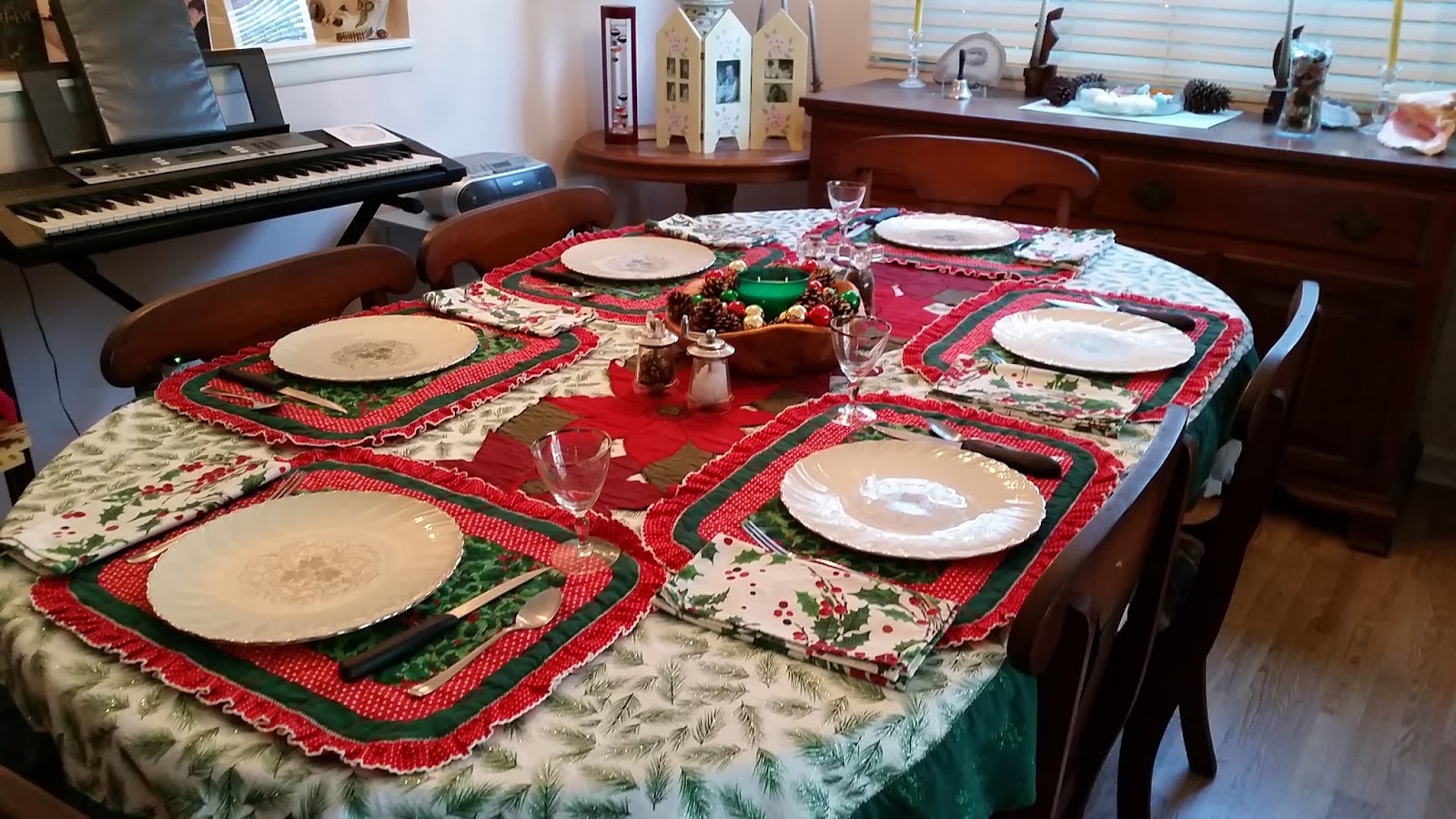 Fortunately, Squeak allowed the table to be set for Christmas dinner. No tromping on the plates or kicking over the wine glasses. Though the centerpiece has become fair game since we cleared the table.
My modest tree - downsized when I moved to Longwood - but it's full of memories, from an ornament I made at age 10 to those made by my children when little. Items bought all over the U.S., including the Ringling Museum in Sarasota, plus islands in the Caribbean, Harrods in London, and Tralee, Ireland. Also, ornaments acquired from Amway to the Orlando Art Museum's Festival of Trees. There's everything from hand-blown glass to hand-crocheted snowflakes. Butterflies from Key West, birds from ? And garlands from Target. Altogether a fun tree, and this year my granddaughter Hailey took over from her mother as the person designated to help Gramma "put up the tree" and "get the lights plugged in all the right sockets." First time we ever got it right on the first try! (Thanks to a 14-yr-old's sharp eyes.)
And yes, those are actual videotapes on the shelf in the background. The ones I wouldn't give up when I moved. And they still work.
~ * ~
MORE THOUGHTS ON WRITING A SERIES
I literally plunged into writing Royal Rebellion, Book 4 of my Blue Moon Rising series, about three weeks before Christmas—when I was in final formatting for The Blackthorne Curse. I had not intended to start it until January, but it simply insisted on coming into this world early. The result was "Interim," the introduction that tied Book 4 to the previous three books in the series. The Interim that I published to this blog as the short story, "The Wolf and the Witch."
And in the eleven chapters of Royal Rebellion that I've written since then, I discovered a confirmation of what was previously posted here about different kinds of series. If you write a romance series—say, featuring a group of friends, even loosely associated friends—each tale is new with characters from previous books putting in brief appearances here and there, oftentimes helping with a crisis at the end. The books of Mary Balogh are good examples of this kind of series. Also, Jayne Castle/Jayne Ann Krentz/Amanda Quick has written a whole slew of loosely connected stories of the paranormal, with characters ranging from Victorian times to their descendants on another planet far in the future.
And then there is the type of series—often mysteries—where a small core of characters play continuing central roles, but the story is new each time. The author has the advantage of having established characters to play with, but the challenge of coming up with new villains and varying plots each time. The books of Jack Higgins and Linda Castillo are good examples of this.
Thirdly, there are authors like George R. R. Martin who has one long story arc, with a thousand characters and nearly as many offshoots of the main plot, with the action taking place over a period of years. This kind of series might be called "Epic" or "Saga." Anne McCaffrey's classic Dragonrider series is also an example of this kind of series. (Although not a book series, the many Star Wars movies also fit this category.)
And, in my own modest way, that's what my Blue Moon Rising series is—an epic saga, featuring a huge cast of characters with a wide variety of Points of View, and action stretching over more than a decade. What I discovered when I approached the fourth and final book is this:
I had set up so many characters and situations in the first three books—some more complex than I'd realized at the time—that Book 4 is practically writing itself. The wry humor of some of the romantic situations practically leaps off the page. Plus the complexity of "What's the difference between a defector and a traitor?" (Depends on which side you're on.) Who is friend, who is foe? Are we sure, sure, sure? As I begin Chapter 12, I'm certainly having a lot of fun with it. But how to avoid a high body count, as basically the planet hosting the rebel headquarters is strongly pacifist? Haven't figured that one out yet. (I am an "out of the mist" author, after all.)
What it comes down to is: Series are fun to write. You can do far more character development over a whole slew of books, while indulging in a greater variety of plots and sub-plots than one book allows. There's also that aspect we've mentioned before—readers like series, snapping up each new book to find out what is happening in the lives of their favorite characters. And that's money in the bank.
Recommendation: If you haven't tried writing a series, give it serious consideration. If you already write series, keep those stories coming. I am an avid reader and just as addicted to that "next book" as everyone else.
~ * ~
Hurricane Update
Since Hurricane Maria, 215,000 Puerto Ricans have come to Florida. Only 45% of the power has been restored to the island. Here in the Orlando area, affordable housing has become a major problem, and the schools are struggling to cope with an influx of children who speak little English. This week was the last opportunity for Floridians with hurricane damage to file claims with FEMA. The 11-mile scenic drive around Lake Apopka just reopened after being heavily damaged during Irma. And, as seen above, not all fences have been repaired, although the debris piles are finally gone. Let's hope this year's storms are not a precursor of 2018!
For a link to Blair Bancroft's web site, click here.
For a link to Blair's Facebook Author Page, click here. To request a brochure from Grace's editing service, Best Foot Forward, please use the link to my website above. See Menu on the right.
Thanks for stopping by,
Grace


December 16, 2017
Holiday Greetings
A combination of music and photos to brighten the holiday season.
Here is Susie singing "Ave Maria" against a backdrop of photos she took herself. (This video is two or three years old but well worth watching even if you've seen it before.
For Susie Kone Reale singing Schubert's "Ave Maria," click here.
For over a decade now our family has attended the Orlando Museum of Art's Festival of Trees, their major fund-raising event of they year (in early November). And for the past three or four years the Citrus Singers have performed as part of the entertainment. So . . . I've saved the photos for a "Christmas Special."
 Susie & Singers on stage at the Art Museum
Oh, the wonderful gingerbread houses . . .



And, of course, the many, many trees - these are just a few of my favorites.

 A personal favorite


~ * ~
Saturday, December 16:What's that old expression? WE WUZ ROBBED! When it was time for the Citrus Singers to sing the National Anthem at the Cure Bowl today (on the CBS Sports Channel), the network cut to commercial! Would you believe? Everyone there said the girls did their usual great job, but really! That was not nice. We do, however, have a good picture of how they looked during rehearsal, courtesy of one of the parents:

Last but not least—please consider a little reading over the holiday - my Christmas novella, Mistletoe Moment, my Regency Gothic, The Blackthorne Curse, or my Regency Historical/Suspense, The Lady Takes a Risk. (Or one of my 30+ other books.)
~ * ~
For a link to Blair Bancroft's web site, click here.
For a link to Blair's Facebook Author Page, click here.
Thanks for stopping by,
Grace
December 9, 2017
Point of View
 Soccer 2010 - that's Hailey in the back with the big smile.
 Soccer 2017 - Riley & Cassidy in actionWhen I went to post a photo from the last game of the 2017 soccer season, I found the 2010 photo and I realized I began taking Hailey to soccer skills class in East Orlando in the fall of 2007. So . . . a whole decade of soccer with the three grand girls. (And a lot of learning for me too, as I knew nothing about soccer until moving to Orlando.)
* * * * *
QUESTION FROM GRACE
I've been posting my thoughts on Writing and Editing to this blog since January 2011. In spite of a semi-annual Index, there are now so many posts that even I find it difficult to locate what I need (as happened when I was researching Point of View this week). I would very much like to hear your thoughts on my organizing all these posts into book form - perhaps one on Writing and one on Editing - and making them available (for a modest price) on Amazon and Smashwords. There are, however, so many how-to books that the thought may be ridiculous. So, PLEASE, take a moment to let me know what you think. I like to believe I provide a unique perspective - more personal and less academic than most - but who knows??
REPEAT! I really would appreciate your taking the time to comment on this question.
* * * * *
POINT OF VIEW
A question about Point of View popped up on one of my Author email loops recently, and when I went back to see what I had written on POV before, I decided the subject could use a bit of updating.
What is Point of View?
Point of View refers to the thoughts, actions, reactions, and speech of the person narrating a scene. Are we seeing the scene through the eyes of the heroine? Are we seeing the scene through the eyes of the hero? Are we getting an insight to the villain's inner workings? Or, as sometimes happens, through the sharp eyes of a best friend, close relative, etc. Or, as done so often in classic novels of the past, is the Author acting as Narrator, giving us his/her Point of View?
For a link to what I consider the finest modern bit of Author Point of View—a previously posted excerpt from Nora Roberts's Carnal Innocence— click here.
* * *
Way, way back in Ages Dark (in the 1980s when the Romance market was pretty much only Harlequin/Silhouette), the rules at H/S stated there could be only one Point of View per scene. (Actually, as I think back to my early days writing Romance in the mid-90s, I believe it was only one Point of View per chapter.) Because H/S was there first, catering to readers who liked their romance "easy to read," their rules flowed out, coloring what was expected by Romance editors, even in publishing houses catering to a majority of readers who preferred their "reads" more challenging. (And who presumably had read the classics with Author POV and shifts of POV within chapters, and even within scenes, and not found themselves hopelessly confused.)
Which brings up another rule of the time (probably also from H/S, although I can't say for sure). NO Author Point of View. Each scene had to be written from inside the head of the Hero, Heroine, or possibly - at a stretch - the Villain. And that was it. No exceptions.
As a person who judged contests for a variety of RWA chapters, I wish I had a dollar for all the times I pointed out a violation of this absolute rule. Sigh. And somewhere - buried among all my Mosaic Moments blog posts - I have a post that reads in huge capital letters: DO NOT HEAD HOP! (Well, truthfully, head-hopping can be confusing, so if you're switching POVs in a scene, you have to be careful, but more on that later.)
What is head-hopping?
Head-hopping, to some, means any violation of the old H/S rule. But nowadays it's more likely to refer to changing the POV too many times within a scene. I.e., two paragraphs from the Hero's POV, one from the Heroine, back to Hero for his opinion of some dialogue, back to the Heroine's reaction to what he said . . . and oops! You begin to understand why H/S made that old rule for their authors.
So where's the porridge that's "just right"?
This depends entirely on the skill of the author. If you can handle multiple POVs from the git-go, then go for it. I still consider my first two books, The Sometime Bride and Tarleton's Wife my best work, partially because I wrote them before I ever heard about any "Rules of Romance." [I changed POVs. I had multiple POVs, not just the Hero and Heroine. I had the Hero and Heroine separated for great lengths of time. I included the serious topic of the Peninsular War and touched on Women's Rights, topics that were avoided at the time. The Sometime Bride ran to 140,000 words, etc., etc.]
But if you're tentative about your beginner's skill, there's nothing wrong with a strict one-scene-for-the-heroine, one-scene-for-the-hero style—as long as you keep the story moving forward, not standing at a dead halt while the same subject matter is rehashed from a different POV!. But you should also be aware that there's nothing wrong with switching POVs in a scene, as long as you make it clear in the very first line of the first paragraph of the switch which character is now doing the thinking.
Here's a story that may clarify the dangers of "one POV per chapter":
Back when I was just beginning to write Romance, I tried to read a wide variety of Romance novels. One so horrified me I bought it up at a POV workshop at my very first RWA conference. The author had written an entire chapter in the viewpoint of the Heroine. And then, in Chapter 2, proceeded to show the entire same scene from the viewpoint of the Hero! The story did not move forward. Nothing was new. As I recall, I did not go on to Chapter 3. And yes, the workshop presenter - RWA '95 or '96, as I recall - agreed that was a bit extreme, even for those times. So I felt a bit better.
But when I got my first New York contract (Penguin Putnam's Signet), I knuckled under and followed the rules from then on (fortunately, switching POV mid-scene was allowed). The rules became so ingrained that I could ignore them only when writing Gothics, which have only one POV and more recently . . . when I sat down to write The Lady Takes a Risk, I said to myself, "I'm going to wipe out all the POV rules I've learned and make an effort to write the way I did in The Sometime Bride and Tarleton's Wife (albeit with the humor of my Trad Regencies). And I was so pleased by the result, I intend to continue that approach with any other third-person book I write.
Recommended Approach to Point of View:
Stick to the number of POVs you're comfortable with. Just be aware that readers need to know who's thinking what. If you can make it easy for them to be aware of a switch of POV, then having two POVs in a scene should not be a problem. I don't even frown at getting off a one-liner in another character's point of view if it adds to the story and there's no doubt about who is thinking that particular thought. (You can best get away with one-liners in the final sentence of a scene or chapter.)
In general, if you're going to switch in the middle of a scene, stay in the new POV for the rest of the scene. Yes, you can switch back if you feel it's absolutely necessary, but you have to make it very clear you've made the switch - right there in the first sentence of the new POV.
And yes, Author POV can sneak in there occasionally. I particularly use it when covering a passage of time; sometimes, when introducing a new character. Keep in mind, however, that Author Point of View distances readers from the main characters who have the primary POVs. It's their story, and as much as possible, they should be the ones telling it. (Yes, authors, I know it's your story, but readers want to get inside the main characters' heads, see what they see, hear what they hear, feel what they feel. And since "thinking" and "feeling" can only be revealed by that character, let them have their moments of revelation. DO NOT stand back and narrate your story like a storyteller of old. Do not "tell" us what they're thinking. Let them tell us. Go with the Heroine's Point of View and the Hero's Point of View. Let us shiver with the Villain's Point of View. And if you feel a secondary character's POV will add to the story, by all means, use it. (Just don't let that secondary character detract from the primary focus on the Hero and Heroine.)
So I guess you could say I'm somewhere in the middle of the POV controversy. Romance, by the very nature of its subject, is more personal. It needs direct Point of View from the Hero and Heroine so we know what they're thinking. On that, Harlequin/Silhouette were totally correct. Even in all its sub-genres of Mystery, Suspense, Paranormal, SciFi, Young Adult, etc., Romance needs to keep the personal touch. (As opposed to some major opuses which seem to be written entirely in Author POV, with only occasional mention of how the main characters feel about what is going on.)
Now that I've thoroughly confused you . . .
Romance authors - it boils down to not being afraid to switch POVs within a scene. (Unless you have an editor who is still old-school enough to expressly forbid it.) Strict POV rules are from long ago and far, far away. Write what you feel, although you must be careful to make any switch immediately apparent. And give proper attribution to a one-liner in a new POV. It's your book. You have a right to say what you want to say without worrying about so-called "rules" that are decades out of date.
It was a 20-year battle to get entrenched authors and editors to replace the 19th c. font, Courier, and the 250-lines-per-page manuscript format for the "book look" of Times New Roman proportional type. And the "rules" on Point of View have been just as foolishly perpetuated. Time to join the modern world, friends. Point of View can be flexible. Not a rigid format with no exceptions.
~ * ~
For a link to Blair Bancroft's web site, click here.
For a link to Blair's Facebook Author Page, click here.
Thanks for stopping by,
Grace
December 2, 2017
The Blackthorne Curse
HURRICANE UPDATE
Those who compile statistics have come up with a figure for the storm damage caused by Hurricanes Harvey (Texas), Irma (Florida), and Maria (Puerto Rico and the Virgin Islands). An eye-raising $360 BILLION. And in Florida . . . as of this week, 7200 children from Puerto Rico have enrolled in schools here, 800 more in college. How many Puerto Ricans total now in Florida? I haven't seen the stats on that, but add parents, grandparents, aunts, uncles, couples without children, etc., to 8000 and . . .? Note: we're told water has been restored to most of PR, but the electricity situation remains a disgrace. Besides the general destruction, no wonder so many have relocated!

My sixth Regency Gothic, The Blackthorne Curse, is now available on Amazon and Smashwords. (As always, Smashwords allows a 20% free read.) Links below.
A little inside information: The plot of The Blackthorne Curse is based on a story told to me some years ago by a very upper class British lady about a curse in her own family. (Without the sad tale she told me, I don't think I ever would have thought of anything so bizarre, or the hope of escaping by moving to another country.) You'll find a provocative question on Blair's Facebook Author Page (link below).
Here's the blurb for The Blackthorne Curse:
After the death of her father, young Serafina Blackthorne of New Haven, Connecticut, becomes a reverse immigrant, traveling from the New World to the Old. To her grandfather, who lives on Dartmoor, a place where eerie legends abound and where she discovers, to her horror, she is marked for death by the Blackthorne Curse. The more Serafina attempts to outmaneuver the Curse, the more she seems to jump from the frying pan into the fire. She finally has but one hope left. But does her childhood friend really want to save her, or is he destined to be her executioner?
Grace note: This book is a Gothic novel set in the Regency period—a style of story where a young woman finds herself basically alone and battling threats to her life, some from humans, some from possibly supernatural sources. But in spite of all the angst, it is also a romance. I hope you will enjoy reading this tale in a style made famous by Victoria Holt, Mary Stewart, and Phyllis Whitney as much as I enjoyed writing it.
* * * And since it is the "season to be jolly," I would like to call your attention to my Christmas novella, Mistletoe Moment. It's been around for a while, but if you haven't read it, it's a lovely little tale of two lonely people who find each other while hiding from the world.
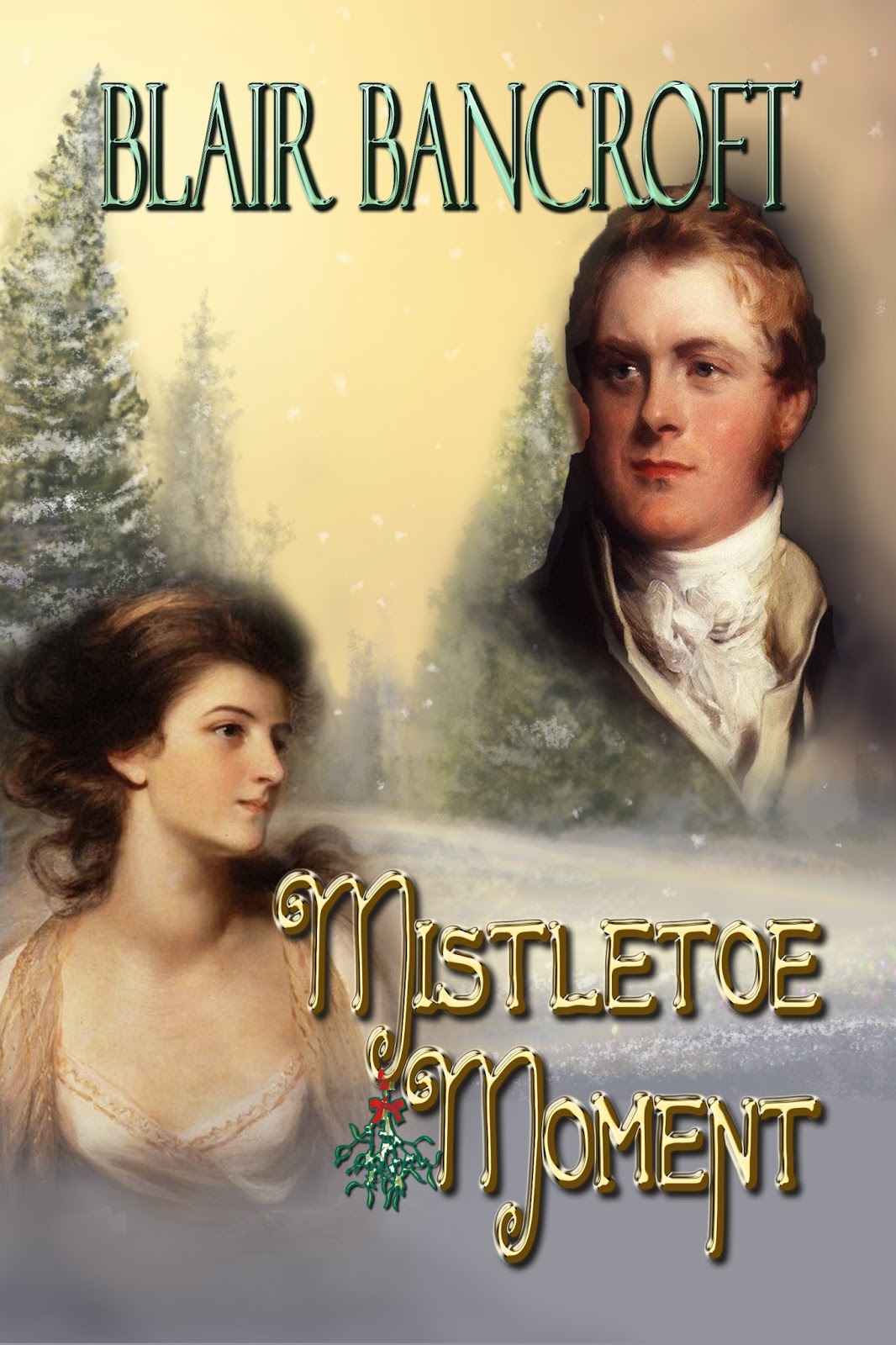 A young lady, humiliated and hiding from the world, finds love under the mistletoe with a soldier wounded in both body and spirit.
~ * ~ Links to Amazon and Smashwords are below. If you read The Blackthorne Curse, I would very much appreciate a review posted to Amazon, Goodreads, and/or Smashwords.
And don't forget the 20% free read offered by Smashwords.
For a link to The Blackthorne Curse at Amazon, click here.
For a link to The Blackthorne Curse at Smashwords, click here.
For a link to Mistletoe Moment at Amazon, click here.
For a link to Mistletoe Moment at Smashwords, click here.
For a link to Blair Bancroft's web site, click here.
For a link to Blair's Facebook Author Page, click here.
Thanks for stopping by,
Grace
November 25, 2017
That Old Bugaboo - EDITING!
On the premise that "A picture is worth a thousand words":

 I suspect this one may have been deliberate. A disgruntled employee?
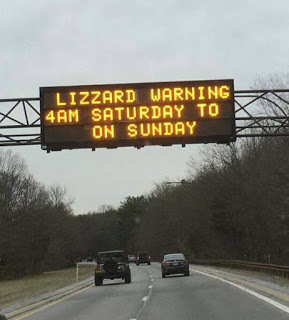
THAT OLD BUGABOO - EDITING!
I never lack for examples of poor editing. Over the last few weeks, I read a very long and well-written saga - not romance or sword & sorcery, but a serious series that encompassed many of the world's problems. But every once in a while, the words on my Kindle screen went nuts, stacking the letters one on top of the other in the center of the page. I have no idea how the coding messed up, but this was not a new book. There had been plenty of time to fix the digital edition, but it was still flawed. Why? That's the wonderful thing about ebooks - they're so easy to fix. Sigh.
The other flawed book I read recently was a mystery - a great start to a new series, but the copy editing was poor. Too many mistakes for a book of quality. Beginner's arrogance, I presume. We all think we're too smart to miss typos, particularly on our first venture into the digital world. And then comes the revelation . . .
My husband and I ran an educational publishing company for more than twenty years—just at the dawn of IBM's first typesetting "typewriter." And finally into the age of the first computerized typewriter, the IBM Displaywriter. I'll never forget my first look at that machine. I had to have it! The year was 1981. But even after this seminal moment when computer met typewriter, the ancient rule of publishing still applied: No matter how many people look over a manuscript, upon publication it will likely have at least three typos.
And I freely admit the first of my backlist published to "e," Lady Silence, had more than its share, for I too—particularly as a long-time editor—was certain I'd found all those pesky little errors. Multiple sighs.
So, authors, join the crowd and admit Editing is something you absolutely have to do. You have to edit for Content, and you have to Copy Edit, looking for all the "little things." And you have to do it again and again until you can't stand to look at another page. And then you do it yet again. Even authors who are print-published by major houses should never be careless about the manuscripts they submit. In the digital age, books no longer have to be typeset; they are published from the original manuscript. Yes, you have the added safety net of in-house editing and copy editing, but, let's face it, editors are going to be more pleased by "clean" manuscripts than by those they have to spend a lot of time and money on to get right.
Long-time readers of Mosaic Moments will recognize the definitions below, but it's been a while, so they bear repeating.
CONTENT EDITING. This is what editors get paid the big bucks for. Did you stray off the plot or the romance, adding irrelevant details that slow the story down? Do you have too many secondary characters who detract from the focus that should be on the hero and heroine? Did you skim over a major point, just touching it as you ran by, intent on getting to the next scene? Did you leave out motivation, descriptions, settings—i.e., are your characters talking heads against a blank background? Did you leave important backstory events in your head, never putting them where the reader can find them? Have you made your hero and heroine likable? (Flaws are okay, but they must be people readers can empathize with, root for, etc.) And on and on. Content editing is what makes or breaks a book. And for indie authors, it's something you must learn to do for yourself.
COPY EDITING. This is the nitty-gritty. Publishing companies frequently farm this work out to part-time "English major" graduates or junior staffers. Alas, it needs a special someone who can read line by line and not get so absorbed in the story that they miss the glitches. (I, alas, am not among them. My Copy Editing ability is far from perfect.) Copy editors look for typos, missing words, extra words, continuity errors. They check punctuation, using the style sheet provided by their employer (and which varies from company to company). They are also supposed to "fact check." But as so many Historical authors have discovered, many copy editors have no idea what the facts are—or they don't care. My own favorite story about Copy Editors dates back to my first published book, He Said, She Said, a Kensington Precious Gem. The copy editor put a decimal point before 9mm, making it ".9mm." Which would require a bullet about the size of a needle! Fortunately, authors do have the opportunity to go over the copy edits, accepting or rejecting the changes, so that my heroine was not confronted by a .9mm pistol!
I was going to include a summary of the agonies I've been going through with final edits on The Blackthorne Curse and the first chapter of Royal Rebellion, which turned out to be a stand-alone short story, but I think those are best left 'til next week.
Meanwhile, to borrow a line from one of my very first Mosaic Moments:
EDIT THE BLASTED BOOK!
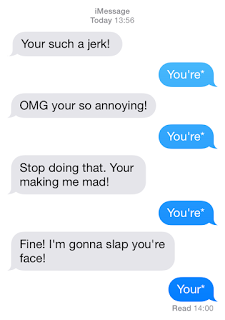 And the last one, which I believe I haven't posted before for obvious reasons - and am hiding at the very bottom of this post . . .

I almost missed this one . . .
 From September 2017
~ * ~
If you missed the short story, "The Witch and the Wolf," please scroll down to last week's Mosaic Moments. (From the SciFi Saga, Blue Moon Rising)
For a link to Blair Bancroft's web site, click here.
For a link to Blair's Facebook Author Page, click here.
Thanks for stopping by,
Grace

 I suspect this one may have been deliberate. A disgruntled employee?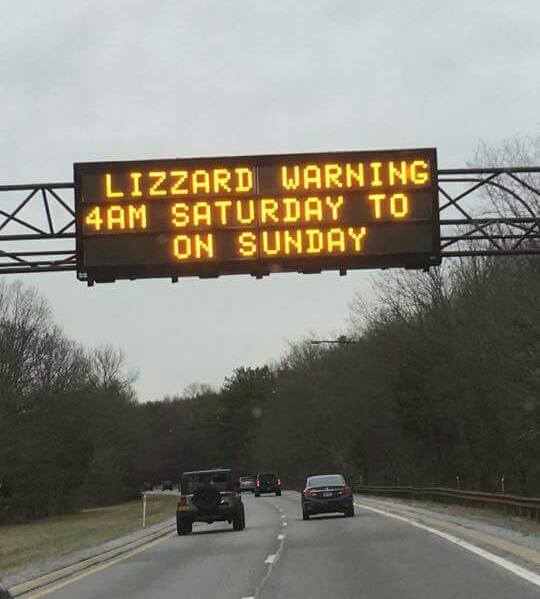
THAT OLD BUGABOO - EDITING!
I never lack for examples of poor editing. Over the last few weeks, I read a very long and well-written saga - not romance or sword & sorcery, but a serious series that encompassed many of the world's problems. But every once in a while, the words on my Kindle screen went nuts, stacking the letters one on top of the other in the center of the page. I have no idea how the coding messed up, but this was not a new book. There had been plenty of time to fix the digital edition, but it was still flawed. Why? That's the wonderful thing about ebooks - they're so easy to fix. Sigh.
The other flawed book I read recently was a mystery - a great start to a new series, but the copy editing was poor. Too many mistakes for a book of quality. Beginner's arrogance, I presume. We all think we're too smart to miss typos, particularly on our first venture into the digital world. And then comes the revelation . . .
My husband and I ran an educational publishing company for more than twenty years—just at the dawn of IBM's first typesetting "typewriter." And finally into the age of the first computerized typewriter, the IBM Displaywriter. I'll never forget my first look at that machine. I had to have it! The year was 1981. But even after this seminal moment when computer met typewriter, the ancient rule of publishing still applied: No matter how many people look over a manuscript, upon publication it will likely have at least three typos.
And I freely admit the first of my backlist published to "e," Lady Silence, had more than its share, for I too—particularly as a long-time editor—was certain I'd found all those pesky little errors. Multiple sighs.
So, authors, join the crowd and admit Editing is something you absolutely have to do. You have to edit for Content, and you have to Copy Edit, looking for all the "little things." And you have to do it again and again until you can't stand to look at another page. And then you do it yet again. Even authors who are print-published by major houses should never be careless about the manuscripts they submit. In the digital age, books no longer have to be typeset; they are published from the original manuscript. Yes, you have the added safety net of in-house editing and copy editing, but, let's face it, editors are going to be more pleased by "clean" manuscripts than by those they have to spend a lot of time and money on to get right.
Long-time readers of Mosaic Moments will recognize the definitions below, but it's been a while, so they bear repeating.
CONTENT EDITING. This is what editors get paid the big bucks for. Did you stray off the plot or the romance, adding irrelevant details that slow the story down? Do you have too many secondary characters who detract from the focus that should be on the hero and heroine? Did you skim over a major point, just touching it as you ran by, intent on getting to the next scene? Did you leave out motivation, descriptions, settings—i.e., are your characters talking heads against a blank background? Did you leave important backstory events in your head, never putting them where the reader can find them? Have you made your hero and heroine likable? (Flaws are okay, but they must be people readers can empathize with, root for, etc.) And on and on. Content editing is what makes or breaks a book. And for indie authors, it's something you must learn to do for yourself.
COPY EDITING. This is the nitty-gritty. Publishing companies frequently farm this work out to part-time "English major" graduates or junior staffers. Alas, it needs a special someone who can read line by line and not get so absorbed in the story that they miss the glitches. (I, alas, am not among them. My Copy Editing ability is far from perfect.) Copy editors look for typos, missing words, extra words, continuity errors. They check punctuation, using the style sheet provided by their employer (and which varies from company to company). They are also supposed to "fact check." But as so many Historical authors have discovered, many copy editors have no idea what the facts are—or they don't care. My own favorite story about Copy Editors dates back to my first published book, He Said, She Said, a Kensington Precious Gem. The copy editor put a decimal point before 9mm, making it ".9mm." Which would require a bullet about the size of a needle! Fortunately, authors do have the opportunity to go over the copy edits, accepting or rejecting the changes, so that my heroine was not confronted by a .9mm pistol!
I was going to include a summary of the agonies I've been going through with final edits on The Blackthorne Curse and the first chapter of Royal Rebellion, which turned out to be a stand-alone short story, but I think those are best left 'til next week.
Meanwhile, to borrow a line from one of my very first Mosaic Moments:
EDIT THE BLASTED BOOK!
 And the last one, which I believe I haven't posted before for obvious reasons - and am hiding at the very bottom of this post . . .
I almost missed this one . . .
 From September 2017
~ * ~
If you missed the short story, "The Witch and the Wolf," please scroll down to last week's Mosaic Moments. (From the SciFi Saga, Blue Moon Rising)
For a link to Blair Bancroft's web site, click here.
For a link to Blair's Facebook Author Page, click here.
Thanks for stopping by,
Grace
November 18, 2017
Short Story - The Witch & the Wolf
I had a post on Editing ready for this week, and then Amazon informed me that Rebel Princess, Book 1 of the Blue Moon Rising series, would be on sale for 99¢ from Sunday, November 19 to Sunday, November 26. So, change of plans. I am, instead, posting the opening chapter of Book 4, a short story complete in itself. If you'd like to know more . . .
For a link to Rebel Princess, click here.


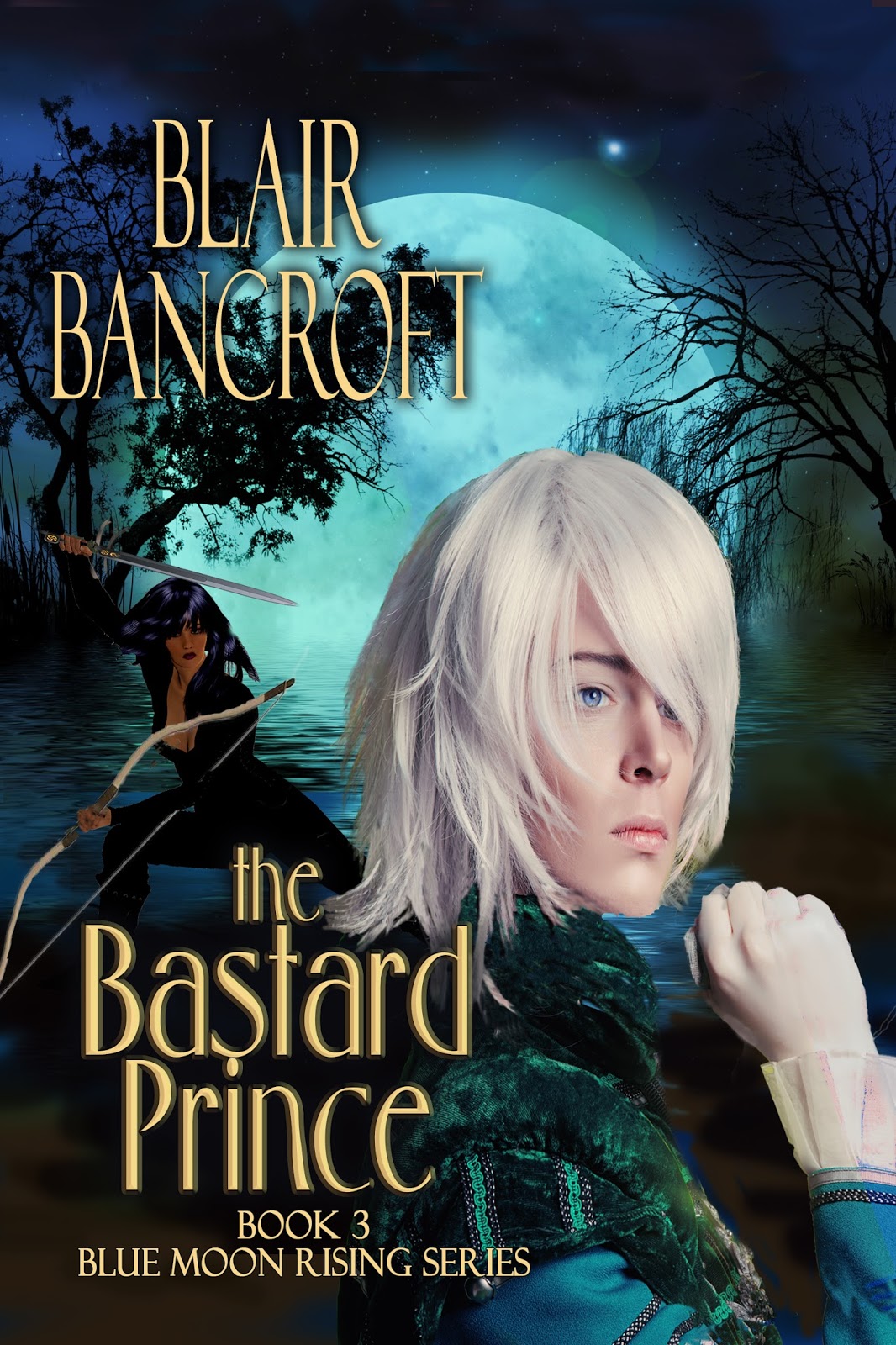
~ * ~
One day, when I was in the middle of final edits for my sixth Regency Gothic, The Blackthorne Curse, the opening chapter of Royal Rebellion, Book 4 of the Blue Moon Rising series, insisted on being born. I called the chapter “Interim” because I needed to tie up an important loose end, remind readers what happened in three previous books, and bridge a gap of several years between Books 3 and 4. But as I read it over, I realized I had a stand-alone short story, even though it needed a bit of background for it to make sense to those who have never read any of the Blue Moon books. So . . .
In a Star Wars-style Sci-Fi saga, there is an on-going rebellion against the Regulon Empire—a rebellion headquartered on Blue Moon, one of three moons of the pacifist planet Psyclid. King Ryal of Psyclid has four children—two legitimate daughters and two bastards (by different mothers), the youngest his only son. All four have been swept into the rebellion, using their unique psychic gifts to help bring down the military might of the Empire. The leader of the rebellion, however, is a former Regulon (Reg) starship captain. And then there is the Psyclid resistance leader whose “gift” is older than the thousand-year civilization on Psyclid.
INTERIMorTHE WITCH AND THE WOLF
The ballroom, Crystalia, the Psyclid royal palace
Two Blue Moon cycles after the Battle of Psyclid
The music flourished to a close, the women’s skirts flaring in a final kaleidoscope of color before settling to hug their bodies close as they dipped into curtsies. Their partners bowed, the men’s bright tunics competing with the women for which gender would add the most brilliance and sparkle to the evening.
All but one, that is—a man slunk into the shadows behind a marble pillar, his back against the wall. Although he wore the required tight white hose, his tunic of black velvet fell well below his knees, his sole concession to fashion the intricate gold embroidery on his sleeves and on the bottom of the tunic. Embroidery he could not reject because his sister had created the garment with her very own hands, so what was a man to do?
Except hide.
He should not be here. This was a night for celebrating the completion of Psyclid’s ridó.
A full two Blue Moon cycles after it was needed.
He had failed. Men had died, ships were lost because there was a gap in the force field intended to protect Psyclid from the Regs. From the revenge of a mighty Emperor on a pacifist planet that asked only to be left alone.
He, T’kal Killiri, had been tasked with getting the job done, and he’d fallen short. He was here tonight only because King Ryal had ordered it. And if there was one thing the Pysclid engineer was, it was loyal to the crown.
A trumpet fanfare echoed through the vast ballroom. T’kal winced, recognizing the signal for what it was. The royal family was arriving and the ceremony was about to begin. The ceremony he wanted no part of.
Fyddit! (Only the Regs had profanity strong enough for the occasion.)
There was a great shuffling as the crowd parted, making a broad aisle from the ballroom’s double-doored entrance to the dais raised a good two meters off the floor, where a gilded throne with scarlet velvet seat and back, flanked by equally colorful sidechairs, awaited the Psyclid royal family.
And there they were, emerging from the crowd, ascending the steps—King Ryal and his wife Jalaine. Six feet behind, the Princess M’lani, her red-gold hair gleaming in the light of the crystal chandeliers, her beauty unrivaled, even by the sister she had replaced as Heir Apparent. At her side, not accepting his proper place a few steps behind, was her husband Jagan, the Sorcerer Prime. The man who came late to the rebellion. T’kal’s lips curled in remembered derision. He and the Jagan Mondragon were never going to be close. It had, in fact, taken considerable effort by the Princess M’lani to get them to work together to save Psyclid from the Regs.
What . . . ?
Shaken out of his stubborn indifference, T’kal stared as another couple mounted the steps. Unexpected guests from Blue Moon. Not Tal and Kass, but the youngest royal and his Herc wife—K’kadi the bastard. K’kadi, whose powers seemed to expand from minute to minute. K’kadi the Strange turned K’kadi the Seer. The despair of the royal family become its most powerful weapon.
Maybe.
T’Kal, who had witnessed one of K’kadi’s losses of concentration, still had his doubts.
Among the missing royal children was King Ryal’s other bastard, his eldest child, B’aela Flammia, a witch best known as the Sorcerer Prime’s foremost assistant and long-time mistress. Before, that is, she transferred her favors to the acting Reg governor, Admiral Rand Kamal, nephew of Darroch, emperor of twelve star systems, the man who abhored the defiance of an obscure pacifist planet that refused to stay conquered. Unfortunately, Baela’s notoriety would never go away, even though her liaison with Kamal had been as a spy for her country. T’kal, knowing her as well as he did, suspected B’aela had likely refused to join the royal parade. She had not, after all, been raised a royal, as had Ryal’s other three children.
She was here, though—somewhere in the crowded ballroom. T’kal always knew when she was near. Whether on a dark, dangerous night in Oban or in Crystalia’s crowded ballroom, her scent filled his head. A problem he had steadfastly ignored for many years.
It was no surprise, however, that Tal and Kass weren’t here. Tal, leader of the rebellion, had sent a handwritten letter congratulating T’kal on the completion of the ridó. And confided that his wife, once Psyclid's Princess Royal, was suffering through a bad first trimester and would be unable to attend the festivities. As for his own absence, he hoped T’kal would understand. He still liked to think that keeping a low profile was protecting his parents and brother and sister who still lived on Regula Prime. Although, Tal added, it was more likely that by now half the Nebulon Sector must suspect that former Reg Captain Talryn Rigel and his huntership Orion had not been lost in a battle with the Nyx.
T’kal ducked his head, glowering at the intricately patterned floor of green and white marble tiles. Tal’s note had suddenly become a stark reminder that the battle against the Regs was far from over. That celebration—even a small one like tonight—was premature.
Another fanfare. The crowd surged forward, the gap filling in as all eyes turned toward the dais.
Gap. T’kal winced.
King Ryal, still a vital, fine-looking man though closer to sixty than fifty, stepped forward, his words smoothly amplified so they could be heard in the farthest corner of the ballroom. Even all the way to the wall stuck to T’kal Killiri’s back. “Friends, guests, welcome! You all know why we are here. Tonight we honor a man who has gone too long without recognition.”
As he spoke, Ryal’s sharp eyes searched the crowd. Not a sign of tonight’s honoree. “When we were invaded by the Regulons . . .” Psyclid's king continued. “When we were shocked, confused, and in despair because we had no idea how to fight back, one person stepped forward. One person sought out other brave souls, found ways to make the Regs sorry they’d ever thought of invading Psyclid. Five years later when our Sorcerer Prime returned from exile, he found a large and effective resistance force already in place, considerably shortening our march toward Freedom Day.”
Murmurs of agreement and approval swept through crowd. T’kal continued to study the colorful swirls in the marble tiles.
“So naturally, when the Emperor threatened us once again, we turned to the same man, putting him in charge of building a ridó twenty times the size of the one protecting Blue Moon, a task which required re-discovering a technology long lost. And in spite of the near impossibility of what we asked of him, the ridó was built, only a tiny gap over open ocean unprotected by the time the Regs attacked.”
King Ryal paused, dropping his gaze to his eldest daughter, who was standing in the front row just below the dais. “There are many other heroic acts I could name, but Killiri is a modest man. He will tell you that he failed because the ridó was not complete on the day the Regs struck. But where would we be now if it had not held over Crystal City? Over every city, town, and field on the planet? Where would we be without . . . T’KAL KILLIRI!?”
T’kal wanted to turn tail and run, but he settled for pushing his back tighter against the wall as the roar of the crowd nearly deafened him. He didn’t stand a chance of remaining anonymous, of course, since his friends, knowing how he felt about this event, had stacked the odds against him long before the evening began. His brother-in-law, Anton Stagg, descended on him from one side; Master Sergeant Joss Quint from the other. In front, two of the men who had been with T’kal that night in Oban opened a way through the crowd, both grinning from ear to ear.
He’d known it would come to this. There was no way out of it. And now that the moment was here, he said all the right things, praised those who had done the actual engineering. Thanked those who labored so long and hard at a task whose completion seemed more a miracle than a technological triumph. He even thanked that constant source of annoyance, Jagan Mondragon, Sorcerer Prime. Looking back through the years, it was a wonder they hadn’t killed each other.
Not that he said that, of course. T’kal’s lips twitched. No, he and B’aela’s long-time lover would never be friends.
After granting a teeth-gritting half-minute to acknowledge the crowd’s shouts, howls, claps, and stamping feet, T’kal forced himself to descend the steps with dignity, his full attention on the goal of losing himself in the mass of people below. Except . . .
B’aela was there. She seized his hand, the crowd melting away before them, with no more hindrance than calls of Well done! Thank you! and a fervent May the Goddess bless you! to mark their passage across the ballroom. The open doors to a balcony closed behind them, T’kal’s self-appointed bodyguards taking up a stance before them, barring any who might try to follow.
“A well-executed maneuver, Highness,” T’kal drawled. “I suppose you planned the whole thing.”
Dark eyes that had been sparkling with joy turned frigid. “Highness?” she asked. “Since when, T’kal?”
“Since the day I learned the truth.”
“Ancient history, Daman Killiri,” she returned with equally lethal formality. “You have had plenty of time to get over it.”
“I have had time to face the reality of it.”
“T’kal! We’ve spoken fifty, a hundred times since then, and never before—”
“We were colleagues, working together against the Regs, working to restore the country—”
“We were friends. Are friends!”
T’kal looked out over the palace curtain wall to the shimmering beauty of Crystal City at night. At the crystalline buildings lit in a rainbow of colors topped by black sky, the infinite number of stars outshone by the light of Psyclid’s three moons—Blue at full, Red a mere crescent, and White down to a waning half low on the horizon. He was being stubborn. Again. The quality that made him so good at getting things done. And so poor at achieving any personal happiness.
He suspected tonight was now or never. B’aela had played her part. It was his turn to be braver than he’d ever had to be before. Even that time on Oban.
“A fine setting for solving problems,” he offered.
“Yes.” Her face softened ever so slightly. The militant look in her dark eyes faded to questioning.
And there she was, the only woman with the capacity to make him forget N’tali. Even when he had not liked B’aela Flammia, she had stirred him out of the grief he had wrapped around himself for so long. T’kal took in the view that was far more fascinating than the beauty of Crystal City at night: a strong nose in a pale narrow face, huge brown eyes accustomed to hiding every emotion, the masses of dark brown hair as curly as his own, confined tonight in an intricate array of braids and studded with diamonds. If he didn’t unfreeze his tongue and say what needed to be said, he really was the greatest fool in the Nebulon Sec—
“Sometimes,” B’aela said with care, “I miss the days of the resistance. There was a camaraderie, a special something impossible to recapture.”
He knew exactly what she meant. He’d had thoughts, even back in the days when she was Jagan Mondragon’s discarded mistress. Thoughts that coalesced in Oban. And were shattered when she offered herself, willingly, to the enemy. Disintegrated completely when B’aela’s mother revealed she was born of the House of Orlondami, fathered by a king.
Which, of course, reminded him of another problem—the once-favorite nephew of Emperor Darroch. “I heard that Kamal came back with you from Hercula,” T’kal said, tossing yet another obstacle into the mix. “That he fought the Regs. Evidently, your powers are even more wondrous than anticipated.”
B’aela sucked in a sharp breath. “You cannot think—you who were my contact—” She broke off, gaping at him. “You know quite well I went to Kamal for revenge. And as a spy. You cannot believe that now we are free, I would—”
But, agonizingly, she had to admit it was true. Regulon Admiral Rand Kamal, former acting governor of Psyclid, had been at the forefront of the Regulon attack on Hercula. He had lost his ship, been captured, and ended up commanding an armed merchant against the Reg’s latest attack on Psyclid. And she, B’aela Flammia, had shared a ship with her former lover all those long weeks home from Hercula to Blue Moon. T’kal had every right to wonder if she had played a role—perhaps an intimate role—in his defection from the Empire.
“You will appreciate the irony, I'm sure,” she returned, her tone now cool and slightly caustic. “On our journey to Hercula, I shared a cabin with K’kadi’s mother, Anneli, and we have kept in touch. Which is how I know that Rand Kamal has a new interest in his life. And that it has become serious enough he may make the liaison permanent if his wife ever grants him a divorce.”
T’kal rubbed at the frown lines on his forehead. Kamal and K’kadi’s mother? Then again, it was a pairing no stranger than the other convoluted romances that marked the rebel cause. Tal Rigel, once a Reg Fleet Captain, and Kass, former crown princess of Psyclid. M’lani married to her sister’s former fiancé, Jagan Mondragon. K’kadi from Blue Moon and Alala, the Herculon warrior. T’kal’s own sister married to Anton Stagg, a Reg.
Of all the royal children, only B’aela, the eldest, remained unmarried. And, to T'kal's gut-wrenching surprise, seemed to be hinting at an interest in the weirdest pairing yet.
“There is a certain matter Ryal did not mention,” B’aela said. “He wished to spare me further humiliation, but we have not forgotten that among your many heroics, I owe you my life.”
“I would have gone to Oban for anyone who needed rescuing.”
“I know . . . but it wasn’t like that, was it?”
T’kal drew a deep breath. “No.”
“You were so angry when I went to Kamal. Every time I reported to you, you positively seethed.”
“Yes.”
“I know you loved your wife. A good woman. Pure." The words tumbled out. "It is the talk of Psyclid that you have never looked at another—”
I looked. I did not act.”
“Oh.”
He knew what she was trying to say. An acknowledgment of something they’d each known for a long time, and for a myriad reasons refused to examine more closely.
“B’aela,” he burst out, “you know what I am!”
“As you know what I am.” A whore. Unworthy of the Hero of Psyclid. Most particularly, the role of mother to his children.
“Feelings aside,” T’kal said, ignoring the scarlet letter B’aela was certain must be flashing on her forehead, “I fear the pairing of witch and wolf.”
Dear goddess! She’d thought of all the other reasons he might object, but not that. Under the light of a full Blue Moon, B’aela studied the man she had admired for so long—the dark eyes, the square jaw, the sturdy body with shoulders broad enough to carry the whole of Psyclid on his back. “When I was very young,” she told the Alpha of his pack, “I thought I knew what love was. I wanted the Sorcerer Prime as a plant longs for the sun. But the sun burns, and in the wisdom of a more advanced age, another man caught my eye and my admiration. A man who flew half way round the world to save me from the most terrible degradation of my life. A man who single-handedly took down the Reg Governor-General—”
“‘Handedly’ is perhaps not the most accurate word,” T’kal drawled.
Distracted for a moment by his grim humor, B’aela pictured a shaggy gray wolf tearing out the throat of Governor-General Anton Grigorev. She had not been there, but she had savored the reality of it many times over.
B’aela drew a shuddering breath and continued with the most difficult words she would ever have to say. The truly important ones she had to get out because it appeared T’kal never would. She was unworthy, she knew that, but she had crafted every second of these snatched minutes on the balcony, and she would not throw the opportunity away.
“I wish to continue my list,” she said, meeting him eye to eye and emphasizing each word. “A man I have come to love, and whose children I would like to make my own.” Her chin jutted up. “Even though I know I have fallen too far and have no right to ask for any man’s love—”
“Hush!” At long last, T’kal did not hesitate. He folded her tight against his chest. “I would say madness has attacked us both, but since it’s been this way with us for some years now . . .” B’aela felt a chuckle ripple through his chest. “Whichever way I look at it, it’s wrong. Except you are the only woman who has ever tempted me into a second love. So I fear we may be stuck with each other.” His lips against her temple, T’kal added, “As part of your plans, you wouldn’t by any chance have a limm standing by?”
“But of course. How else would I take home the man of the hour?”
K’kadi, who had been released from the dais and was dancing with Talora Lassan, the woman some called his second wife, smiled and nodded his satisfaction. It was about time B’aela took his mother’s advice. Which, he realized, would likely make him related to four of the most powerful men in the Nebulon Sector: Tal Rigel, Jagan Mondragon, T’kal Killiri, and in the not-too-distant future, the Emperor's nephew, Rand Kamal.
The end of the Empire was coming. It would take a while, but it would happen. That much he knew. Though who would sit on which throne—which thrones would even exist when all was said and done—was beyond even his powers of prognostication.
~ * ~
For a link to Blair Bancroft's web site, click here. For a link to Blair's Facebook Author Page, click here.
Thanks for stopping by,
Grace
November 11, 2017
Accent on Unusual Recipes
RECIPES
Here are three rather different recipes I have enjoyed over the last few weeks:
 Sweet Potato SaladThis is one of the most exotic tastes I have encountered among the many recipes I've collected. I prefer it served warm and with pine nuts in place of pumpkin seeds, but that does not affect the overall flavor impact, which is truly remarkable. This recipe is from Grits and Pinecones. Below is the original recipe for 8 servings. I halved it for my personal use.
Grace note for Recipes One and Three: If you a serving only 1 or 2 persons and expect to have leftovers, do NOT mix the dressing with the salad ingredients. Save and use only when needed, so salad greens do not wilt nor the flavors become overbearing.
SWEET POTATO SALAD
4 medium sweet potatoes, peeled & cut in 1" cubes
3 TBsp olive oil
1 TBsp finely chopped fresh rosemary
1 tsp kosher salt
1 tsp ground black pepper
½ tsp ground cumin
½ tsp ground ginger
1 cup dried cranbeerries
½ cup chopped scallions (green & white parts)
½ cup jarred roasted sweet peppers, chopped *
½ cup roasted pumpkin seeds (or pine nuts, sunflower seeds, etc.)
Dressing:
6 TBsp balsamic vinegar
1/3 cup reular or mango chutney (not hot)
1 TBsp Dijon mustard
2 TBsp honey
2 garlic cloves, finely minced
¼ cup olive oil
*I actually found jarred strips of roasted pepper, but this is rare.
Make dressing ahead. Combine all ingredients in a jar and shake until well mixed.
To make the salad, preheat oven to 425°.
1. Mix the sweet potatoes with the olive oil on a large baking pan or cookie sheet and toss to combine. Make sure the sweet potatoes are evenly covered with oil.
2. In a small bowl, combine the rosemary, salt, pepper, cumin, and ginger. Stir to combine. Sprinkle evenly over the sweet potatoes and toss to combine. Spread the sweet potatoes out in a single layer and bake until potatoes are fork-tender and golden brown - about 20-25 minutes. Do not overcook.
3. Meanwhile, put cranberries, scallions, and red pepper in a small bowl & mix well. Set aside.
Assembly:
Put the roasted sweet potatoes in a large bowl. Add the cranberries, scallions, roasted red pepper and half of the dressing. Toss carefully & taste. Add additional salt and pepper if needed, and more salad dressing if you like. Sprinkle with the toasted pumpkin seeds. Serve warm or cold.
~ * ~
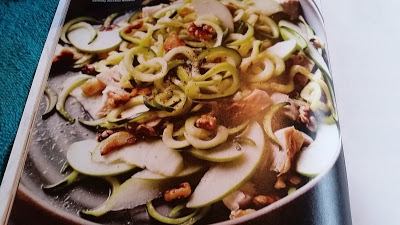 Garlicky Zucchini Noodles
Grace note: for this one you will need the help of a "spiralizer." I bought mine online from Amazon, along with a recipe book with a lot more "spiral" recipes. If you really can't get into fruits and vegetables, this might be a way to make them more interesting. Here's what I bought:
 Three-blade spiralizer by Zest
GARLICKY ZUCCHINI NOODLES
2 medium zucchini
3 TBsp walnut or olive oil
6 cloves garlic, smashed, peeled & halved lengthwise
½ cup coarsely chopped walnuts
½ tsp sea salt
2 cups chopped cooked meat or poultry*
1 cup thinly sliced tart green apple**
Fresh ground black pepper
*I used pre-cooked Perdue chicken pieces
**I used the spiral cutter blade on the spiralizer to cut very thin apple "flowers." Or you can use a mandoline* to cut finer slices than is possible by hand.
1. Using a spiralizer, julienne cutter, or mandoline, cut zucchini into long thin noodles.
2. In a large skillet, heat 2 TBsps of the oil over medium-high heat. Add garlic; cook and sir 2 minutes or until starting to brown. Add zucchini noodles; cook and toss with tongs 1 minute. Transfer to a serving bowl. Add walnuts to skillet; cook and stir 1-2 minutes or until toasted. Add to bowl with zucchini. Sprinkle with salt.
3. Add remaining 1 TBsp oil to skillet. Add meat; heat through. Add to bowl with zucchini. Add apple slices; toss gently to combine. Sprinkle with black pepper.
*I later bought a mandoline by Kitchen Bask, which slices at both 1.5 and 2.5, as well as having three other types of blades. (I am still experimenting with my two new gadgets, but so far they work as promised, and they have definitely increased my interest in fruits and vegetables. And added a whole new frontier of recipes.) The recipe above is from Paleo Recipes.

ARUGULA AND ASPARAGUS SALAD
Grace note: I used the 1.5 slicer blade to cut the red onion very fine, making it more like ambrosia than an onion.

½ cup very thinly sliced red onion
½ cup white wine vinegar
1 lb. asparagus, trimmed, cut to lengths desired
3 cups fresh argula
2 TBsps snipped fresh mint
2 TBsps olive oil
¼ tsp sea salt
1/8 tspn black pepper
1. In a small bowl, combine onion and vinegar, pressing onion into liquid to cover as much as possible. Cover and let stand at room temperature 30 minutes or chill up to 24 hours, stirring occasionally.
2. Cook asparagus, covered, in enough boiling water to cover 2 to 3 minutes or until crisp-tender; drain. Rinse with cold water to cool quickly; drain again. In a large bowl combine asparagus, arugula, and mint.
3. Using a slotted spoon, transfer onion to asparagus mixture.
4. For dressing, pour 3 TBsps of the vinegar from onion bowl into a small screw-top jar. Add remaining ingredients; covr and shake well. Drizzle dressing over asparagus mixture; toss gently to coat.
Added note: If asparagus spears are thick, cut in half lengthwise.
This recipe is also from Paleo Recipes.
~ * ~
For a link to Blair Bancroft's web site, click here.
For an eerie true tale, visit Blair's Facebook Author Page at: click here.
Thanks for stopping by,
Grace
Here are three rather different recipes I have enjoyed over the last few weeks:
 Sweet Potato SaladThis is one of the most exotic tastes I have encountered among the many recipes I've collected. I prefer it served warm and with pine nuts in place of pumpkin seeds, but that does not affect the overall flavor impact, which is truly remarkable. This recipe is from Grits and Pinecones. Below is the original recipe for 8 servings. I halved it for my personal use.
Grace note for Recipes One and Three: If you a serving only 1 or 2 persons and expect to have leftovers, do NOT mix the dressing with the salad ingredients. Save and use only when needed, so salad greens do not wilt nor the flavors become overbearing.
SWEET POTATO SALAD
4 medium sweet potatoes, peeled & cut in 1" cubes
3 TBsp olive oil
1 TBsp finely chopped fresh rosemary
1 tsp kosher salt
1 tsp ground black pepper
½ tsp ground cumin
½ tsp ground ginger
1 cup dried cranbeerries
½ cup chopped scallions (green & white parts)
½ cup jarred roasted sweet peppers, chopped *
½ cup roasted pumpkin seeds (or pine nuts, sunflower seeds, etc.)
Dressing:
6 TBsp balsamic vinegar
1/3 cup reular or mango chutney (not hot)
1 TBsp Dijon mustard
2 TBsp honey
2 garlic cloves, finely minced
¼ cup olive oil
*I actually found jarred strips of roasted pepper, but this is rare.
Make dressing ahead. Combine all ingredients in a jar and shake until well mixed.
To make the salad, preheat oven to 425°.
1. Mix the sweet potatoes with the olive oil on a large baking pan or cookie sheet and toss to combine. Make sure the sweet potatoes are evenly covered with oil.
2. In a small bowl, combine the rosemary, salt, pepper, cumin, and ginger. Stir to combine. Sprinkle evenly over the sweet potatoes and toss to combine. Spread the sweet potatoes out in a single layer and bake until potatoes are fork-tender and golden brown - about 20-25 minutes. Do not overcook.
3. Meanwhile, put cranberries, scallions, and red pepper in a small bowl & mix well. Set aside.
Assembly:
Put the roasted sweet potatoes in a large bowl. Add the cranberries, scallions, roasted red pepper and half of the dressing. Toss carefully & taste. Add additional salt and pepper if needed, and more salad dressing if you like. Sprinkle with the toasted pumpkin seeds. Serve warm or cold.
~ * ~
 Garlicky Zucchini Noodles
Grace note: for this one you will need the help of a "spiralizer." I bought mine online from Amazon, along with a recipe book with a lot more "spiral" recipes. If you really can't get into fruits and vegetables, this might be a way to make them more interesting. Here's what I bought:
 Three-blade spiralizer by Zest
GARLICKY ZUCCHINI NOODLES
2 medium zucchini
3 TBsp walnut or olive oil
6 cloves garlic, smashed, peeled & halved lengthwise
½ cup coarsely chopped walnuts
½ tsp sea salt
2 cups chopped cooked meat or poultry*
1 cup thinly sliced tart green apple**
Fresh ground black pepper
*I used pre-cooked Perdue chicken pieces
**I used the spiral cutter blade on the spiralizer to cut very thin apple "flowers." Or you can use a mandoline* to cut finer slices than is possible by hand.
1. Using a spiralizer, julienne cutter, or mandoline, cut zucchini into long thin noodles.
2. In a large skillet, heat 2 TBsps of the oil over medium-high heat. Add garlic; cook and sir 2 minutes or until starting to brown. Add zucchini noodles; cook and toss with tongs 1 minute. Transfer to a serving bowl. Add walnuts to skillet; cook and stir 1-2 minutes or until toasted. Add to bowl with zucchini. Sprinkle with salt.
3. Add remaining 1 TBsp oil to skillet. Add meat; heat through. Add to bowl with zucchini. Add apple slices; toss gently to combine. Sprinkle with black pepper.
*I later bought a mandoline by Kitchen Bask, which slices at both 1.5 and 2.5, as well as having three other types of blades. (I am still experimenting with my two new gadgets, but so far they work as promised, and they have definitely increased my interest in fruits and vegetables. And added a whole new frontier of recipes.) The recipe above is from Paleo Recipes.

ARUGULA AND ASPARAGUS SALAD
Grace note: I used the 1.5 slicer blade to cut the red onion very fine, making it more like ambrosia than an onion.

½ cup very thinly sliced red onion
½ cup white wine vinegar
1 lb. asparagus, trimmed, cut to lengths desired
3 cups fresh argula
2 TBsps snipped fresh mint
2 TBsps olive oil
¼ tsp sea salt
1/8 tspn black pepper
1. In a small bowl, combine onion and vinegar, pressing onion into liquid to cover as much as possible. Cover and let stand at room temperature 30 minutes or chill up to 24 hours, stirring occasionally.
2. Cook asparagus, covered, in enough boiling water to cover 2 to 3 minutes or until crisp-tender; drain. Rinse with cold water to cool quickly; drain again. In a large bowl combine asparagus, arugula, and mint.
3. Using a slotted spoon, transfer onion to asparagus mixture.
4. For dressing, pour 3 TBsps of the vinegar from onion bowl into a small screw-top jar. Add remaining ingredients; covr and shake well. Drizzle dressing over asparagus mixture; toss gently to coat.
Added note: If asparagus spears are thick, cut in half lengthwise.
This recipe is also from Paleo Recipes.
~ * ~
For a link to Blair Bancroft's web site, click here.
For an eerie true tale, visit Blair's Facebook Author Page at: click here.
Thanks for stopping by,
Grace
November 4, 2017
More on Women's Fiction
 Sneak peek at the cover for my 6th Regency Gothic, set on DartmoorPub date - hopefully by the end of November 2017
MORE ON WOMEN'S FICTION For previous posts on Women's Fiction, please seethe Mosaic Moments Archives, 6/25/17 and 7/1/17.
In October our local RWA chapter presented a workshop on Women's Fiction, and I found it interesting to hear someone else's description of the differences between Women's Fiction and Romance Fiction. (Many people, alas, have no idea there is a difference!) The speaker told of a time when "Romance" was defined as "Fiction written about women, by women, and intended to be read by women." Well, thank goodness, most of us realize that is no longer true. There are men who write Romance, men who read Romance, and many plots and themes that peer inside men's thoughts and actions, their likes and dislikes.
And there we have the major difference between Women's Fiction and Romance. Women's Fiction really does come close to the definition of "About women, by women, for women." Romance Fiction must have a hero, usually a character prominent from beginning to end. Even in gay romance, there must be a definite romantic pairing, not a long pastiche about the foibles of the "female" side of the relationship.
The speaker at the meeting of Central Florida Romance Writers also defined Women's Fiction as "What comes after Happily Ever After." If you are familiar with the musical Into the Woods, Women's Fiction would be Act II. In the first act, we see all our favorite fairy tale characters and their stories come to a happy conclusion. (The Broadway musical was undoubtedly the precursor to TV's Once Upon a Time.) But in Act II we discover what comes next. And it isn't pretty!
Women's Fiction can also be a story of family (or a whole village), with the emphasis on the female line; i.e., a central female character and her interaction with her female relatives, good and bad. Also with her female friends, acquaintances, adversaries, etc. The men are there, but as more realistic characters than in Romance fiction. We see them with all their idiosyncracies, faults, their glaring wrongness. And they are not major players in the story, just a backdrop against which the female relationships play out.
Illness, death,divorce, childbirth, depression are frequent themes of Women's Fiction—female struggles usually shunned by Romance fiction. (Yes, deaths occur in romantic Mystery and Suspense, but as part of action or murder plots, not part of an anguishing of the soul.)
In Romance fiction—which can be as simple as a Harlequin contemporary or as complex as an Historical Suspense . . . which can also be Mystery, Sci Fi, Paranormal, Fantasy, Young Adult, New Adult, or any of a vast variety of sub-genres, the only absolute requirement is that Happily Ever After ENDS the book. And that's where Women's Fiction BEGINS. In the world of reality.
To complicate matters a bit, there are some authors of Women's Fiction who include a definite romance in each book, including an HEA ending. The difference? The emphasis is on the problems of the women in each story, enough so the romance remains almost peripheral to the main plot.
Who reads Women's Fiction? A good question. I suspect the readership is almost entirely female. And includes those who like to read about other women who suffer as they have suffered. Or perhaps those who like to read about other people's problems so they can say, "Thank God my life isn't like that." I do not number myself among them. I like heroes who are heroes, even if their only fights are on the homefront. I do not want to read about unremitting agony, suffering, desperation, and death. Not even on a small, hometown scale. But that's me. I'm a great believer in "To each his own." Certainly, there should be books that cater to every taste. The important point is to recognize which genre you want to write. Recognize the differences and follow the "rules." Do not wander on and on in the world of Females Only and think you are writing Romance.
And now a challenge—one I asked myself as I examined the differences between Women's Fiction and the Romance Fiction market. Why are my Regency Gothic novels, like The Blackthorne Curse, above, not Women's Fiction?
Gothic novels are written in first person female. Always. That's the basis of the genre. A female, usually alone, attempting to survive in an inimical world. The entire story is told through her eyes. The people she interacts with are frequently female. The eerie twists to the plot usually take precedence over the romance. So why is a Gothic novel a Romance, not Women's Fiction?
Because the ending is definitely Happily Ever After. Gothic heroines suffer death threats, not the pangs of childbirth. They try to figure out who is trying to kill them, not who is back-stabbing them at work. And men play major roles throughout the book, even if they do not have a Point of View. The men can be witty, charming, villainous, surly, stupid, petty, etc., but they stand shoulder to shoulder with the women as participants in the plot. And in the end there is one male who is true blue, a hero who pairs with the poor beleaguered heroine to give us that traditional HEA.
In short—at least in my not-so-humble opinion—Romance Fiction is for women who really like men, as friends as well as lovers. Women who think there's enough trouble in this world without having to read about the angst of daily living. We want Happily Ever After, and let's avoid the reality of what comes after. We live that; we don't need to read about it. And yes, we use the world of HEA as an escape from our problems.
Women's Fiction is for females who prefer socializing with women, discussing female-oriented topics, and facing the ugly realities of the world, often while keeping men relegated to bread-winning and bed. And yes, that is a deliberately provocative statement written by someone who is not a fan of Women's Fiction. And I invite rebuttal from those who find WF rewarding.
If you are a "reader" rather than an author, you're fortunate. You can choose to read both Romance and Women's Fiction. For writers, it's a tougher call. Know your genre. Know what makes it tick. Know your readership. Write to the emotions they want and expect. And yes, of course, there's leeway for a bit of experimentation. (As mentioned in my July post about Nora Roberts's Come Sundown.)
I leave you with the happy thought that next week I am avoiding controversies by presenting recipes.
~ * ~
For a link to Blair Bancroft's web site, click here.
For "inside" information about The Blackthorne Curse, click here.
Thanks for stopping by,
Grace
October 29, 2017
The Shroud of Turin
 Medieval Sorceress as Greeter at the 19th annual Reale Halloween partyWith hat & wimple slightly askew. (And yes, that's me.)
THE SHROUD OF TURIN
On Saturday morning, October 28, 2017, I attended a lecture at the Episcopal Church of the Resurrection in Longwood, Florida, on the Shroud of Turin (named for the city in Italy where the shroud is now housed). Below is a photo of the full-size replica we saw on Saturday, (shared by a friend, since one of my grandgirls had managed to "hide" my phone!)
 Shroud of Turin replica at Church of the Resurrection, 10/28/17
It was an enlightening presentation, I have to admit. Like so many of us, I had read about the shroud - or heard about it on the news - many times over the years; most particularly, a couple of decades ago when the cloth was debunked as being from Medieval times, not the time of Christ. But step by step, the speaker (R. G. Chiang) went through each cry of "fake" over the centuries, including the carbon-14 test, which was later declared invalid because the frayed edge of the linen had been contaminated by medieval "soiling." Basically, I felt he did a successful job of "debunking the debunkers." But, as he frequently emphasized, belief is very much a matter of the mindset you bring to the problem, the lifetime of teachings that affects how we think. As for me, I was pretty much won over to the assertion that the Shroud now preserved under glass in Turin, Italy, was very likely once spread over the body of Christ.
The lecture was strikingly detailed with drawings and biblical quotations, and a history of the Shroud since it was acquired from the Knights Templar. I am, however, kicking myself because I failed to ask: "Where was the shroud before the Templars acquired it?" But, alas, I didn't think of that one until I got home. The questions I did ask are:
How was the reproduction made? A photographic process imprinted on cotton by a firm in California. The original? Our speaker believes the imprint to be the result of the energy of the resurrection.
Where is the shroud now? Inside a full-length glass-topped case in a vault in the cathedral attached to the palace of the House of Savoy in Turin, Italy. The restoration of the shroud (2002) and construction of the protective room and container cost two million dollars.
To properly view the shroud, you need to know that it was folded in the center. The left half in the photo above was under Jesus's back, the right over his front. Therefore, an imprint of his face can be seen just to the right of center. (In the middle of the cloth, above the third support post from the left.) In the first photograph ever taken (1898), the negative image is startlingly clear from head to toe, his hands folded over his genitalia. Unless I was willing to deny that a picture is worth a thousand words, I could not help but be impressed.
Grace note: It is believed the cloth was "laid" not "wrapped" as women were coming back to prepare the body with spices and perfume.)
All the other marks on the cloth are due to age or accident. Evidently there was a fire in 1532 which melted the silver decoration on the reliquary box in which it was kept, burning holes in the cloth. There are also "fold" marks and small holes along the fold lines, most of which have been carefully mended at some time or another. You will notice that the larger triangular holes that look like teeth mirror each other on either side of the center. As do most of the small "fold line" holes.
The most remarkable thing about the very first photo taken (1898) is that no one, including the photographer, expected the negative image to be so much more vivid than the faint sepia tones of the shroud itself.
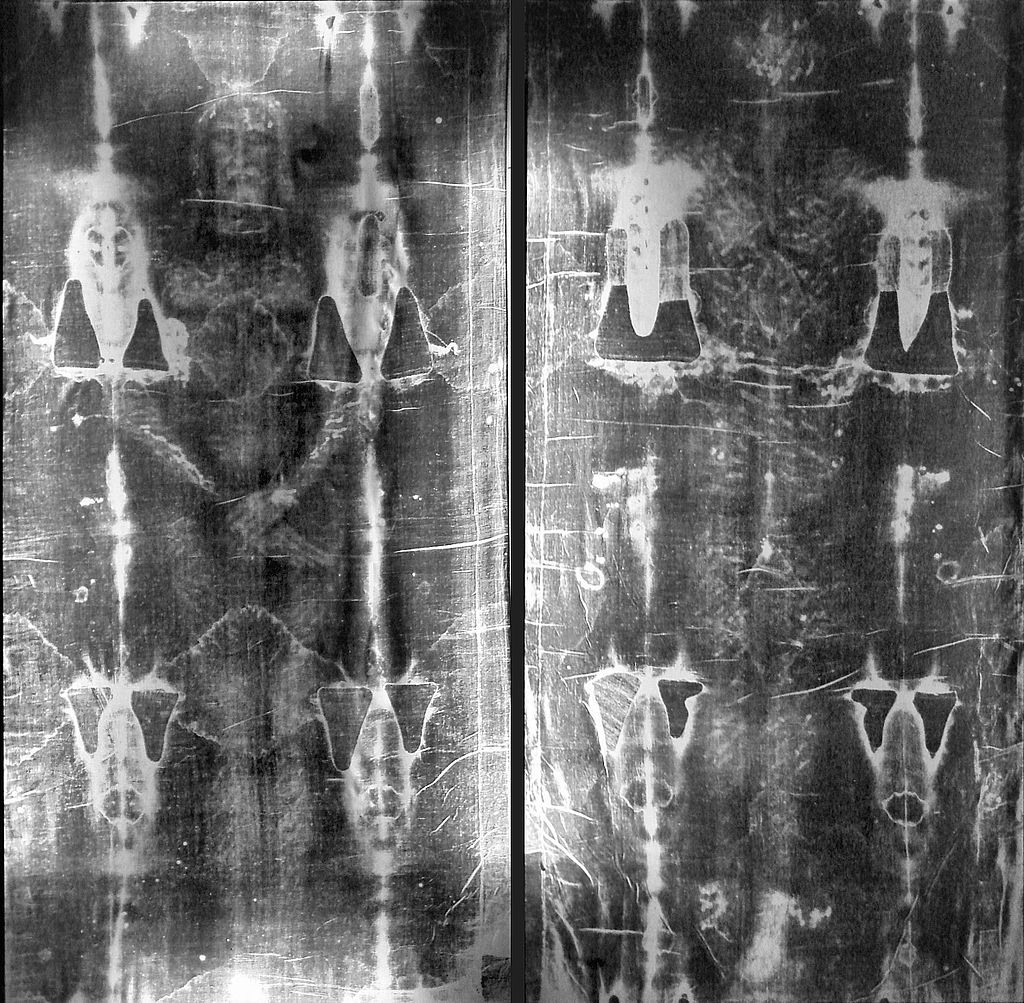 Shroud "negative" photo, 1898 (front & back)
 Shroud "negative," 1931
Whether you're a believer, a scoffer, or think Jesus just another religious prophet, I hope you take a moment to ask yourself: "Could the so-called Shroud of Turin really be the linen cloth draped over Jesus at the moment of resurrection?"
With food and costuming to prepare for Susie's party that same night, I almost didn't go to this lecture. I'm glad I did. In this world which seems to be "going to hell in a handbasket," as my mother used to say, it's good to have reason to believe that miracles can and do happen.
~ * ~ For a link to Blair Bancroft's web site, click here. For a link to Blair's Facebook Author Page, click here.
Thanks for stopping by,
Grace
October 21, 2017
Comments on a Mix of Books
 Hailey, Riley & Cassidy at a local pumpkin patch
HURRICANE UPDATE.
The giant brush & log heaps are gradually being taken away, but not gone. Nothing is left of the oaks in the photos posted two weeks ago, except two mounds of roots & dirt. The tree that crashed two houses from me was finally carted away this week - the roof is undergoing repair. We've had enough rain that the St. John's remains flooded. The statistics are coming in: Damage to Florida agriculture - 2.5 billion dollars, 60% of that is our citrus crop.
Grace's Recent Reading - A Mixed Bag
SHOGUN by James Clavell - first published 1975
I manged to go more than forty years without reading this book, but when BookBub made me an offer I couldn't refuse . . .
The trouble is, I've been reading Shogun for six weeks or more and still am only little more half-way through. There's only so much torture, mayhem, death, complex conniving, and a shockingly wide culture gap that I can take at one time. (And being told how inferior Western culture is.) So periodically I take a break, sneaking off to lighter fare on my Kindle or paperbacks off my "favorites" shelf.
Why do I continue to read this book? Because Shogun is a tour de force tale by a Westerner who immersed himself in Japanese culture well enough to portray it to people like me who never got much beyond Madame Butterfly. Are the details of 16th c. Japan correct? I can only assume so, or Shogun wouldn't have become a legend in the publishing world. (The portrayal of the influence of Spain and Portugal in a time when England was just discovering the Orient is also amazingly well done.) So the historian in me keeps reading, even as I wonder if it was really necessary to have almost every last character, minor as well as major, have his/her own Point of View.
I tell myself I'm going to grit my teeth and finish this book, but I'm not certain I will. I mean, do I really want to know the incredibly convoluted details of Japanese politics and battles 500 years before I was born? And read about brutality, savagery, and treachery that make Stephen King novels read like children's fairy tales?
THE COLE TRILOGY—THE PHYSICIAN by Noah Gordon - first published 2012
When I bought this book for my Kindle, I had no idea what I was getting into. That, like Shogun, I would read and read and read, and only be at 11%. So when I finished Part One, I took time out for lighter fare on this one too. I am, however, looking forward to finishing the whole saga. It's a remarkable tale of a time even farther back than Shogun - beginning in the year 1021 when Canute the Great was king of Norway, Denmark, and England; i.e., when a Viking ruled.
Upon the death of his parents a boy in London is apprenticed to the 11th c. equivalent of a huckster. A man who travels from town to town, performing magic tricks, selling "snake oil," and, astoundingly, healing the sick after the show is over. The boy gradually discovers he has "the gift," an aptitude for healing far beyond that of his mentor. And when his apprenticeship is over, he sets out for Persia, which, he is told, is the only place he can learn true medicine, not the travesties practiced by the so-called doctors in England. I am currently reading the part where he travels across France, Germany, and into Eastern Europe on roads built by the Roman Empire. That's as far as I've got, but the story is as well written as the plot is well thought out. Mr. Gordon's research is superb, bringing the era to life with amazing details. I am looking forward to reading the rest.
DEAD STOP by Barbara Nickless
Okay, I suppose I can't call this lighter reading, except that it's standard book length, not an epic. And a contemporary mystery is a big break from two hefty historical novels. I discovered Ms Nickless not too long ago with her first book, Blood on the Tracks, and was delighted when Amazon let me know a second book was out. The heroine, Sydney Parnell, is an ex-marine with PTSD who you appears to be hiding in a role where she can use her military skills while attempting to deal with the dead people she sees and hears on a regular basis. The unique setting of the first two books is in and around railroad yards, where Sydney has become a railroad security cop. And she is so very good at it that at the end of Dead Stop it appears she will be moving on to the FBI or the city police. (I'll miss the train background, which was truly fascinating.) This is a series I cannot recommend too highly. Unless you only like your mysteries cozy. Ms. Nickless does not write cozy.
ROYALLY RUINED by Nora Flite
This is about as far from Shogun and The Cole Trilogy as one can get. Maybe not from Dead Stop, as there's quite a bit of violence or talk of violence in between the graphic sex scenes. But Ms Flite creates excellent characters and genuine plots, enough so that, like the books of Ruby Lionsdrake, I enjoy them even though the erotic is not my thing. I also like this series as its prime location is in Rhode Island, and I spent most of my growing up in Connecticut, within a few miles of the Rhode Island border. Which includes encountering mafia families first hand. My neighbor was a capo, and my children grew up so instilled with the rule of omerta (silence) that we were nearly three years in Florida before they told me about the bullet holes they'd seen in my neighbor's Cadillac.
As far as the "Royally" series is concerned, I think I liked the first book (Royally Bad) better. The hero of Royally Ruined is the crime family's heir apparent, and frankly I expected a bit more for him. But Ms Flite's dialogue is as sassy as the sex is hot; in fact, I can't page over the sex scene, as I often do, because the quips are too good to miss! So if you're not easily offended, this is a fun series, definitely in the light reading category.
THE FIRST ADVENTURE OF SIR ERROL HYDE by Gay Hendricks
I researched the name Gay Hendricks, because I felt the author simply had to be male. The total obliviousness to the female mind (deliberate), the badinage, the snark - no way did a woman write this. And yes, he is male and a PhD as well.
This mystery, the first of a series, is hilarious. The fictional characters priceless, and the wonderfully placed hints about real characters of the early 20th c. both intriguing and nicely integrated into the plot. Because of my age, I recognized the historical characters at first hint but suspect that most will not, making the revelations that much more fun. Sir Errol Hyde is, it seems, a rival of Sherlock Holmes. And although our hero prides himself on being much more knowledgeable about women than Holmes, any female reader is going to be groaning loudly about his cluelessness.
Basically, this book is well thought out, well written, and filled with humor, both raucous and wry. (It could have used a bit more copy editing, however.) The intricate plot hinges on world affairs in a time leading up to World War I. I strongly recommend it to those who like their mysteries intelligent and humorous, with outstanding characterizations.
~ * ~ Hmm-mm - I suspect the above comments qualify me as someone with eclectic tastes. Or maybe just plain strange??
~ * ~For a link to Blair Bancroft's web site, click here. For a link to Blair's Facebook Author Page, click here.
Thanks for stopping by,
Grace


