
David Boyle's Blog, page 32
July 13, 2015
The future of food is local after all
 It is now nearly 12 years since I published my book Authenticity: Brands, Fakes, Spin and the Lust for Real Life. I can't say I exactly won the argument at the time, which was that the demand for authenticity - and especially in food - was a long-term major trend.
I also argued that it wasn't a con. It wasn't about the big food manufacturers pulling a fast one, just by putting a picture of an old-fashioned farm on their packaging (see my more recent take on it in my ebook The Age to Come ).
Another book, also called Authenticity, has been published by Harvard University Press, which makes the call the other way. It was a tough argument. I had a hard time with it, from people who felt I was being hoaxed to people (Vanessa Feltz springs to mind) who just got cross with me.
Then I opened a recent copy of Fortune magazine and realised that I was right, after all. The demand for healthy, fresh, 'real' food is now so powerful in the USA that it is turning the food industry upside down, and beginning to re-localise the production of food.
Hershey's are taking BST milk, GM ingredients and artificial flavours out of their chocolate bars. Campbell's Soup has bought baby food maker Plum Organics, and - to keep its authentic spirit - has made it a public benefit corporation.
There are also - according to a separate article - now nearly 8,300 farmers markets in the USA, having grown at an average of 19 per cent a year for 19 years.
That is one hell of a lot of money shifting out of big food corporations and into small-scale local production. You can see signs of similar trends emerging here, but not nearly so fast.
The 25 biggest food and drink corps in the USA have lost a total of $18 billion in market share since 2009. That seems to me to be good for the economy: it is $18 billion not going in mega-salaries, and dedicated to the wrong kind of efficiency, and shifting instead into local employment and innovation.
This is what Campbell's CEO Denise Morrison said:
"We understand that increasing numbers of consumers are seeking authentic, genuine food experiences, and we know that they are sceptical of the ability of large, long-established food companies to deliver them."
As I predicted, this is hard for the big companies. To demonstrate the same kind of authenticity, they are buying up small, healthy food producers, only to find that - in the stultifying big company culture - their new purchase kind of shrivels up like an elderly organic lettuce.
You can see something similar happening in the beer market. It is an overwhelmingly healthy sign - forcing the big food corporations to adapt and change or to die out. I hope something similar emerges here fast - and, perhaps, even in banking.
It is even happening in the energy market, but extremely slowly. But the mere fact that it is possible at all - that we are not locked into buying from semi-monopolies as much as we feared we were - is a heartening thought on a less than heartening day.
Subscribe to this blog on email; send me a message with the word blogsubscribe to dcboyle@gmail.com. When you want to stop, you can email me the word unsubscribe.


July 8, 2015
Voldemort returns to banking
The sacking of Anthony Jenkins as the Barclays CEO is a loss. It is also a commentary on his own belief that he was changing the culture of banking. As it turns out, he wasn’t - though he certainly tried. Clearly his board didn't really want him to.
It also puts into perspective the failure of the political system to shape an effective banking system that is capable of supporting the real economy. This is, it seems to me, one of the big failures of the coalition years.
Because the political elite– and this involves all the parties at Westminster – have managed to combine precisely the wrong kind of regulation with a kind of lazy idea that anything the market can’t do immediately somehow isn’t worth doing.
It is at the same time the wrong deregulation and the wrong regulation. The combination means that the economy will not succeed as fast as it should, and will be that much more vulnerable than other economies when the time comes – and the crisis is coming, whether it begins in Greece or China or somewhere else.
The wrong deregulation is a constant theme of this blog when it comes to banking. Every other nation in Europe has a network of local and community bank designed to look after local business needs.
We don’t.
Of course the P2P alternatives are growing fast, but they won’t look after the slow small companies, the backbone of the local economy. Nor will they provide bank accounts or places to put their takings at the end of the day.
Nor will they create the money in the form of loans. A world without bank loans will not have the means to create money, unless the Bank of England does – and they show no signs of expanding the ludicrously useless quantitative easing programme.
Of course the challenger banks will help too, but they are mainly not providing current accounts – and when they do, it is for wealthier areas.
That is the great failure of the coalition. Vince Cable’s British Business Bank will help local lending, but it provides no local infrastructure. It doesn’t provide the missing information which the big, centralised banks lack about potential loans.
Worse, the shift in yesterday's budget - from a levy on banking size to a surtax on banking profits - just excludes challengers.
Then there is the failure of regulation. The new Basel regulations, and the whole drift of the regulators here as well, has been the same – to insist on yet more safety margins. To require more capital held to cover small business loans. To stress test constantly.
To repeat, in a small way, the destructive announcement by the European Central Bank about Greece that – far from bailing them out – they would require more capital underpinning.
The result of this regulation will be to make small business lending virtually impossible, just as it will make small scale banking virtually impossible.
The more they demand in regulation, the narrower and more useless the banks will become. Until they are safe as rocks, but they are unable to carry out their basic functions.
So the news that Anthony Jenkins has been sacked by Barclays is double trouble. They have got rid of someone with a different vision and fallen back on the old useless model of investment banking, slaving away in the innards of the Great Economic Machine that funnels money to the very rich.
I cast no aspersions on the chairman who has taken Jenkins’ place, but note that the rule of Voldemort is clearly returning to the banking system. Mordor is rising again.
And in a way, you can’t really blame them. The regulator has been busy making effective, useful domestic banking virtually impossible. And after all that, the big banks are still too big to be allowed to fail - though there are of course new regulations that are said to be designed to prevent them from doing so.
Ironically, neither the bad regulation nor bad de-regulation are building a banking market - quite the reverse. Neither are doing anything to bring more competition.
What they should be doing is making it easier to start small or experimental banks, and copying the speedy American procedure to wind them up over the weekend if they fail. And of course getting the big banks to fund and mentor a new community banking infrastructure - starting with reshaping RBS (of which more later).
Subscribe to this blog on email; send me a message with the word blogsubscribe to dcboyle@gmail.com. When you want to stop, you can email me the word unsubscribe.
It also puts into perspective the failure of the political system to shape an effective banking system that is capable of supporting the real economy. This is, it seems to me, one of the big failures of the coalition years.
Because the political elite– and this involves all the parties at Westminster – have managed to combine precisely the wrong kind of regulation with a kind of lazy idea that anything the market can’t do immediately somehow isn’t worth doing.
It is at the same time the wrong deregulation and the wrong regulation. The combination means that the economy will not succeed as fast as it should, and will be that much more vulnerable than other economies when the time comes – and the crisis is coming, whether it begins in Greece or China or somewhere else.
The wrong deregulation is a constant theme of this blog when it comes to banking. Every other nation in Europe has a network of local and community bank designed to look after local business needs.
We don’t.
Of course the P2P alternatives are growing fast, but they won’t look after the slow small companies, the backbone of the local economy. Nor will they provide bank accounts or places to put their takings at the end of the day.
Nor will they create the money in the form of loans. A world without bank loans will not have the means to create money, unless the Bank of England does – and they show no signs of expanding the ludicrously useless quantitative easing programme.
Of course the challenger banks will help too, but they are mainly not providing current accounts – and when they do, it is for wealthier areas.
That is the great failure of the coalition. Vince Cable’s British Business Bank will help local lending, but it provides no local infrastructure. It doesn’t provide the missing information which the big, centralised banks lack about potential loans.
Worse, the shift in yesterday's budget - from a levy on banking size to a surtax on banking profits - just excludes challengers.
Then there is the failure of regulation. The new Basel regulations, and the whole drift of the regulators here as well, has been the same – to insist on yet more safety margins. To require more capital held to cover small business loans. To stress test constantly.
To repeat, in a small way, the destructive announcement by the European Central Bank about Greece that – far from bailing them out – they would require more capital underpinning.
The result of this regulation will be to make small business lending virtually impossible, just as it will make small scale banking virtually impossible.
The more they demand in regulation, the narrower and more useless the banks will become. Until they are safe as rocks, but they are unable to carry out their basic functions.
So the news that Anthony Jenkins has been sacked by Barclays is double trouble. They have got rid of someone with a different vision and fallen back on the old useless model of investment banking, slaving away in the innards of the Great Economic Machine that funnels money to the very rich.
I cast no aspersions on the chairman who has taken Jenkins’ place, but note that the rule of Voldemort is clearly returning to the banking system. Mordor is rising again.
And in a way, you can’t really blame them. The regulator has been busy making effective, useful domestic banking virtually impossible. And after all that, the big banks are still too big to be allowed to fail - though there are of course new regulations that are said to be designed to prevent them from doing so.
Ironically, neither the bad regulation nor bad de-regulation are building a banking market - quite the reverse. Neither are doing anything to bring more competition.
What they should be doing is making it easier to start small or experimental banks, and copying the speedy American procedure to wind them up over the weekend if they fail. And of course getting the big banks to fund and mentor a new community banking infrastructure - starting with reshaping RBS (of which more later).
Subscribe to this blog on email; send me a message with the word blogsubscribe to dcboyle@gmail.com. When you want to stop, you can email me the word unsubscribe.
The lesson from the Chicago police that never gets learned

It is now exactly four decades since the future Nobel laureate Elinor Ostrom carried out her groundbreaking research into the systems used by the Chicago police.
When she won the Nobel Prize for economics in 2009, it was doubly unusual: no woman had ever won it before, and she wasn't even an economist. She had been at Indiana University for most of her career, spending much of her time in the 1960s, by her own admission, getting her own students out of gaol after anti-Vietnam War protests.
It was the period which saw the huge consolidation of schools in the USA, reducing the number of school districts from 110,000 to just 15,000 in the four decades up to 1950. There was a similar consolidation of hospitals, police forces and companies. This was the emerging era of big corporations that has rendered so many of our public services so ineffective.
Ostrom was fascinated by the issue of scale. When she scraped up enough money to begin research, she decided she would look at the same phenomenon which was happening across the USA of consolidating police forces into larger and larger units.
She had just enough money to hire cars for her research students to drive around Indianapolis for ten days, and test out the effectiveness of different styles of policing. It was pretty clear, after the results came in, that the smaller the police force, the better they were at responding to emergency calls. It is the same in the UK, even now.
This challenged conventional thinking, which assumed then – as it still does – that bigger is better. Her black students urged her to have a proper look at policing in Chicago, and sure enough, it was the same there. The small police forces in the black suburbs were just as effective as the huge police force covering central Chicago, which had fourteen times the funding.
The Chicago police were interested in her research and asked her why she thought the crime rate seemed to be rising when police shifted from walking the beat to driving round in patrol cars. It was here that she made her real breakthrough, understanding how much the police need the public, and how cut off they had become.
She needed a word that described that indefinable co-operation between police and public which was so easy when they walked around. She called it ‘co-production’. More about this in my book The Human Element.
If the police forget how much they need the public – and disappear into technocratic systems, patrol cars or bureaucracy – then crime goes up. It is the same pattern with doctors: they need the co-operation of patients if they are going to make them well.
It was such a momentous finding that public service managers have found it hard to swallow, then or now. But I thought of it after reports last week that the Bolton police have withdrawn their people from the beat - just as the Chicago police did 40 years ago.
Apparently, the days of police on the beat have gone, according to senior officers from Greater Manchester.
Of course, this isn't a decision that is entirely taken for its own sake. There have been warnings for months now that more spending cuts would mean withdrawing from the beat.
But for some reason, public service managers find it hard to learn the basic lesson. If you take away the human element and rely on systems, and IT systems in particular, then your effectiveness will be seriously constrained. In this case, crime will go up.
Last week, I asked why politicians find it so hard to grasp the opportunities of new models for public services, even when they are proven and less expensive. This question is just as important: why do public services managers have to learn the same lessons about the human element over and over again, but never remember it?
Subscribe to this blog on email; send me a message with the word blogsubscribe to dcboyle@gmail.com. When you want to stop, you can email me the word unsubscribe.
July 7, 2015
Batmanghelidjh represents the killer question for Whitehall
Charities during the Blair-Brown years tended to go on one of two directions. They either abandoned their services in favour of marketing to change government policy (the NSPCC springs to mind), or they became subject to central government targets by delivering public services.
In both cases, they kind of sold the pass - one of the virtues of the voluntary sector, at least from a Liberal point of view, is its independence from government. Its ability to see beyond government agendas and see through their targets. It's refusal to accept that governments have a monopoly on action.
The ultra-utilitarian approach to services was largely carried on by the coalition. It has a peculiar attitude to innovation. On the one hand, no funding or grants is ever forthcoming without some claim to be doing something new - it is hard for charities to get funding to do the tried and tested things that always need doing.
On the other hand, when you measure answers in the way approved by Jeremy Bentham, you tend to become blind to big new ideas.
Camila Batmanghelidjh is bound to be an object of suspicion in Whitehall because she has partly bucked this trend. Yes Kid's Company delivers services for the government, and I'm very glad they do, but they have been promoters of a big idea - and a vitally important one - that doesn't really fit into the assembly line services that Whitehall currently aspires to.
I've never met Camila, though I've been hearing about her for the past 20 years or so, and the way she brought the latest understanding of child development into her practice - the idea that love is what literally switches on the brains of young children. Starved of love, they never quite come alive.
Yet can the way services are presently constituted ever provide love, when they are so obsessed with process?
And, if they don't make these kind of relationships possible in children's lives, are they making a difference?
So I've been feeling pretty dismayed at the whispering campaign against Kid's Company over the past week. I can see why they are extremely inconvenient for some of those in Whitehall, and my fear is that by sidelining Batmanghelidjh they may also sideline her radical edge.
She may not represent the answer yet for how we shape humane and effective services for children and vulnerable families - though she has presided over vital pieces of the puzzle - but she represents a deeply uncomfortable question for anyone who believes that the welfare state is effective in its current shape.
Or that it will remain even as effective as that after George Osborne has chopped away at it in the budget today.
I'm one of those who believes that the way to save money in public services is to revolutionise their effectiveness. The worst of both worlds is to keep the existing model and then cut back the money. That is a recipe for ineffectiveness and therefore more expense in the medium-term.
Subscribe to this blog on email; send me a message with the word blogsubscribe to dcboyle@gmail.com. When you want to stop, you can email me the word unsubscribe.
In both cases, they kind of sold the pass - one of the virtues of the voluntary sector, at least from a Liberal point of view, is its independence from government. Its ability to see beyond government agendas and see through their targets. It's refusal to accept that governments have a monopoly on action.
The ultra-utilitarian approach to services was largely carried on by the coalition. It has a peculiar attitude to innovation. On the one hand, no funding or grants is ever forthcoming without some claim to be doing something new - it is hard for charities to get funding to do the tried and tested things that always need doing.
On the other hand, when you measure answers in the way approved by Jeremy Bentham, you tend to become blind to big new ideas.
Camila Batmanghelidjh is bound to be an object of suspicion in Whitehall because she has partly bucked this trend. Yes Kid's Company delivers services for the government, and I'm very glad they do, but they have been promoters of a big idea - and a vitally important one - that doesn't really fit into the assembly line services that Whitehall currently aspires to.
I've never met Camila, though I've been hearing about her for the past 20 years or so, and the way she brought the latest understanding of child development into her practice - the idea that love is what literally switches on the brains of young children. Starved of love, they never quite come alive.
Yet can the way services are presently constituted ever provide love, when they are so obsessed with process?
And, if they don't make these kind of relationships possible in children's lives, are they making a difference?
So I've been feeling pretty dismayed at the whispering campaign against Kid's Company over the past week. I can see why they are extremely inconvenient for some of those in Whitehall, and my fear is that by sidelining Batmanghelidjh they may also sideline her radical edge.
She may not represent the answer yet for how we shape humane and effective services for children and vulnerable families - though she has presided over vital pieces of the puzzle - but she represents a deeply uncomfortable question for anyone who believes that the welfare state is effective in its current shape.
Or that it will remain even as effective as that after George Osborne has chopped away at it in the budget today.
I'm one of those who believes that the way to save money in public services is to revolutionise their effectiveness. The worst of both worlds is to keep the existing model and then cut back the money. That is a recipe for ineffectiveness and therefore more expense in the medium-term.
Subscribe to this blog on email; send me a message with the word blogsubscribe to dcboyle@gmail.com. When you want to stop, you can email me the word unsubscribe.
July 6, 2015
Time for emergency currencies for Greece
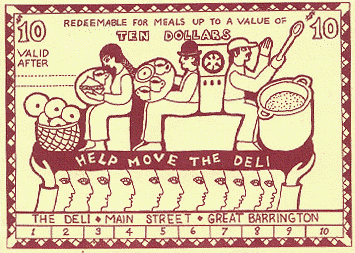 “The purpose of Free-Money is to break the unfair privilege enjoyed by money. This unfair privilege is solely due to the fact that the traditional form of money has one immense advantage over all other goods, namely that it is indestructible.” So said Silvio Gesell, the Argentinian trader who came up with the idea of rusting money.
 It is always going to be easier to make money out of money, rather than using it to do something productive, wrote Gesell in 1913. Because money grows if you invest it – but real commodities tend to rust or go mouldy.
The answer, he said, is to have money that rusts too. The idea was taken up enthusiastically during the Great Depression, most dramatically in the Austrian ski-ing town of Wörgl. And by catching the eye of the great American economist Irving Fisher, rusting money was adopted all over the world before it was declared illegal by the world’s central banks, fearful of a threat to their own authority.
Wörgl was in a terrible state in the Great Depression when the burgomaster Michael Unterguggenberger persuaded the town to issue its own currency, to the value of 30,000 Austrian schillings, known as ‘tickets for services rendered’. But unlike ordinary money, these notes lost value by one per cent a month, and to keep value – if you hadn’t spent them – you had to buy their stamps once a month and stick them on the back. The proceeds of the stamps went on poor relief.
The notes circulated incredibly fast. Within 24 hours of being issued, most of them had not only come back, via shops and businesses, to the municipality in the form of tax payments – sometimes months in advance – but had already been passed on their way again.
During the first month, the money made the complete circle no fewer than 20 times. After four months, the town had built public works of 100,000 schillings, employing people who were jobless; most of the town’s tax arrears had been paid off too.
Fisher was inspired by what he found in Austria and rushed out his own instruction manuals, called ‘Stamp Scrip’, for the struggling American towns. Within months, about 300 US communities were printing their own negative-interest money. Senator Bankhead introduced a new law to congress that would have created a billion dollars of stamp scrip.
Then, on 4 March 1933, it was all over. President Roosevelt, advised that the monetary system was in danger, banned scrip systems and gave the existing ones a short time to wind themselves up. As he did so, he also created the conditions for a final flurry of activity.
Fearing a complete collapse of the American banking system, he closed all the banks – and all over the country, communities and companies had to provide some kind of alternative to money. “I care not what kind – silver, copper, brass, gold or paper,” said one senator from Oklahoma. One community in Tenino in Washington state even produced its own wooden money.
Stamp scrip was like blood. As the stamp scrips were shut down on one side of the Atlantic, the Austrian National Bank was taking action to suppress the Worgl experiment too. Four years later, Austria was annexed by Nazi Germany.
These days, the fiddly business of sticking on stamps is unnecessary, because computers can do those calculations. Stamp scrip might not provide the stability people need for real money – money they can use for savings – but it might as well serve for exchange money. We can still learn something from Gesell, Fisher and Unterguggenberger.
I was thinking about this when I heard that the Greek's had rejected the bail-out terms, and you can see why. It looked just a little like slavery for comfort.
The Greeks have been led into debt partly by the failures of successive Greek governments, and partly because the euro is a machine for recycling money from poor cities and countries to rich cities and countries. Neither makes me feel any more comfortable about the fate of the Greek people.
One of the great problems with the euro, as presently constituted, is that it prevents governments creating money if they need to. The Greeks are doubly hamstrung because their own mints are only allowed to print low denomination euro notes. The rest have to be trucked in.
The re-establishment of the drachma, at least with coins, will take a long period. I remember that it took the Belgian government three months and 80 lorries a day to dispose of their old Belgian franc coins when they joined the euro. Presumably it would take a similar effort to bring them all back again.
But this is now an unprecedented period of economic crisis for a corner of Europe and I have no idea what contingency plans the Greek government has made, and worry that maybe they haven't.
The key in an emergency, it seems to me, is not to fall into the trap of thinking that all money needs to be denominated by a central bank. Or that it needs to mix the functions of money - store of value, medium of exchange and so on - in exactly the same way as conventional money. It can be different - maybe even should be to suit a variety of new situations.
The medium of exchange function needs to be foremost in situations like this.
What Greece needs now is a major set of experiments with new kinds of money, and it seems to me that there are a number of institutions inside and outside Greece that might be able to help:
1. Greek cities. They must take the lead in creating 'self-liquidating' currencies to provide a means of exchange, along the lines of Worgl in 1934.
2. Silicon Valley. There hardly seems to be a Silicon Valley entrepreneur who doesn't have ambitions to create a new payment system or currency innovation. Facebook and Google have both been experimenting with them. Well, now is the time to test it out: provide a means of exchange - preferably using mutual credit systems - that can keep the Greeks alive while their leaders sort out some kind of long-term solution.
3. Bartercard. The leading Australian barter company could lend its online system to a couple of Greek cities, and waive their usual rake-off. This is about life and death, after all.
4. STRO and other currency entrepreneurs. There are so many online systems of virtual exchange now available, from Cyclos to HourWorld, CES in South Africa, Zumbara in Turkey. It is time to partner with a Greek city and be a bit useful. Start perhaps with Community Currencies in Action.
5. Brazil. Their highly successful community banking network, co-ordinated by Banco Las Palmas, has developed a use for a parallel currency designed to support women entrepreneurs. Greece needs it, and now that it is backed by the Brazilian central bank, I suggest a link up.
6. The big banks. If they lend their considerable IT knowhow to the Greeks to provide credit systems, then the credits will at least carry the kudos from them.
I may be surprised. Perhaps Greece's government has some idea what it is doing. Perhaps the European Central Bank may draw back at the brink from allowing the destruction to go ahead. But if they don't, it seems to me it is at least an opportunity for the new money world to step forward and offer their services.
Let's forget the debt for a moment. Because without some kind of means of exchange, the Greeks face what Keynes used to call "a perigrination in the catacombs - with a guttering candle".
Subscribe to this blog on email; send me a message with the word blogsubscribe to dcboyle@gmail.com. When you want to stop, you can email me the word unsubscribe.
July 2, 2015
Turning the Lib Dems inside out and upside down
 I can’t remember whose joke about the Lamb/Farron leadership contest it was, but I repeat it here. It is a wonderful thing to take part in an election and know that, whoever wins, it’s going to be a Lib Dem.
I’ve even voted already. I’ve been hugely impressed by both leadership candidates and the way they have kept level heads. There have been peculiar incidents but nothing like the ‘calamity Clegg’ business of the last Lib Dem leadership tussle.
I’ve found the focus on what either candidates did or didn’t vote for or against more than frustrating because – in the end – what they did in the past, while interesting, doesn’t really go to the nub of the issue between them. It's an important issue and it needs some resolution.
Which seems to me to be this: should the party shout louder or should it turn itself upside down and inside out?
I’m pretty definitely in the inside out camp. I’m only too aware of how much the future of Liberalism needs to be thought through, how the old slogans seem emptied of meaning, how much thinking has to be done.
Tim Farron is a ferocious campaigner, but I looked at the ‘six steps to rebuild our party’ in his magazine – I don’t know if he wrote them himself – and they really are extraordinarily vacuous.
In some ways, they are a demonstration of the problem: exhausted phrases without underpinning – “defend our values”, “rebuild our base”, “do things better”, “concentrating on winning elections”.
Perhaps emptiest of all is the phrase “grow our membership” – No. 2 of the six points – as if somehow this was a point of issue, or as if there was some particular proposal for doing so.
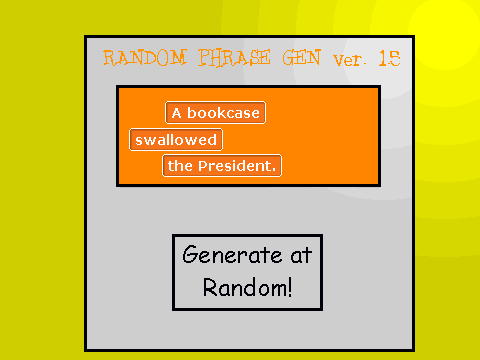
I feel pretty confident that Tim had little to do with these – the read as if they were written by a random Lib Dem phrase generator – but that’s the problem: I’m sure he has six better steps than this up his sleeve – but why hasn't he set them out?
Norman Lamb on the other hand has a short book which he’s published and which at least has a plan that it might be possible for someone to disagree with.
I've tried to make sure this blog doesn't criticise people individually, and this is emphatically not intended as a criticism of Tim Farron himself, who I'm sure understands this. Also he has written a little more on the subject here.
To be fair to him, the introduction to these six steps hints at something deeper, but the bottom line is this. None of the things the six steps say should be done better - “concentrating on winning elections, building our membership, fundraising, training and development” – can be done without a great deal of rethinking the intellectual underpinnings of Lib Dem policy.
That means turning the party upside down (more thinking) and inside out (open up the party to the outside world) as well. Otherwise we are in danger of finding ourselves campaigning using a Random Lib Dem Phrase Generator, and that won't feel good. It also won't work.
Subscribe to this blog on email; send me a message with the word blogsubscribe to dcboyle@gmail.com. When you want to stop, you can email me the word unsubscribe.
July 1, 2015
Heathrow: a sad tale of cost-benefit analysis
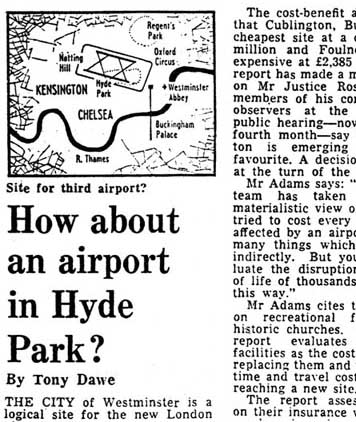 Waking up to the miserable and depressing conclusions of the Davies Commission, that there should be another runway at Heathrow, reminded me of the biggest cost-benefit analysis ever carried out - to somehow calculate where to build the third London airport.
I tell the story in my book The Tyranny of Numbers and it casts a sad shadow over the current debate, with its bogus talk of 70,000 new jobs.
Back in 1969, the government had rejected the preferred site at Stansted and, for the next two and a half years, the commission chaired by the senior judge, Mr Justice Roskill, combed the evidence.
To make sure there was a choice of sites, the Town and Country Planning Association put in their own planning application to build an airport at Foulness, on marshland off the Essex coast much-frequented by Brent Geese. An early version of Boris Airport.
Cost benefit analysis had been used successfully a few years before to defend the idea of extending the Victoria Line to Brixton. But this wasn't so much a calculation – it was a way of giving transport minister Barbara Castle an excuse to say yes, which she duly did.
The Roskill Commission, on the other hand, were determined to work out the answer mathematically. They would do a cost benefit analysis on all the possible sites - the biggest analysis of its kind ever carried out. They would put a value on the noise of aircraft, the disruption of building work, the delay of flights, the extra traffic and they would calculate the answer.
For the Roskill Commission, there was going to be no value judgement at all. The figures would speak for themselves.
To avoid any chance of judgement and to keep the process completely ‘scientific', the measurements were put together in 25 separate calculations. They were only added up right at the end of the process. And to the horror of some of the members of the commission, when the final addition was made, the answer was wrong.
The site they believed was best - Foulness - was going to be £100 million more expensive in cost benefit terms than the small village of Cublington. After 246 witnesses, 3,850 documents, seven technical annexes and 10 million spoken words, some of the planners on the commission felt cheated.
In public, they stayed loyal to Roskill. The commission was excellent, said Britain's most famous planner Colin Buchanan - a member of it – “it just got the small matter of the site wrong".
The team had managed to measure the exact cost of having too much aircraft noise by looking at the effect noise tended to have on house prices. But when it came to measuring the value of a Norman church at Stewkley, which would have to be demolished to make way for the runway, things got more confused. How could you possibly put a money price on that? One joker on the team suggested they find out its fire insurance value. Everyone laughed, but the story got out and reached the press.
Doing it like that would have measured the value of the church at just £51,000.
As it was, the government rejected Cublington for political reasons, and went for Foulness/Maplin/Boris. This in turn fell victim to the energy crisis and the airport was built at Stansted anyway. As we know.
The planning professor Peter Self - Will Self's father - wrote a book about it as a revenge for the mauling he received at the hands of the commission's planning barristers. "It struck me at the time as strange," he wrote, "that so many intelligent people should apparently accept trial by quantification as the only sensible or possible way of reaching such a decision."
The whole thing was a "psychological absurdity and ethical monstrosity", he said. He advised economists to take Dr Johnson's advice and kick a wall hard to convince themselves that the external world exists. His attack destroyed cost-benefit analysis for nearly two decades.
What I find bizarre about cost-benefit, of the kinds put forward by the Davies Commission, is that this of nonsense gets accepted by the Treasury - which is so sceptical about cost-benefit arguments about jobs put forward by anyone else. And rightly so.
At least Roskill's team tried to do some subtraction, but somehow Heathrow's lobbyists convince people that there will be no jobs lost by making London dirtier and noisier and by accelerating climate change. As if somehow you can construct a financial 'package' that will offset the noise.
And there is the rub. What anyone who loves London wants to know is if there are any limits to the destruction of London's environment - especially today when the heat becomes intense and the air like soup.
I don't live there any more. But I don't want London to become any more of a third world city than it already is - the noise and air pollution visited on the poor, the ridiculous house prices visited on everyone, and the vanity runways for the international elite who can't re-arrange the existing runway slots to accommodate new priorities.
Go to some of the nearby suburbs, like Southall, to see where it leads. Dirty, overcrowded, polluted, ruined. That's the future for London by cost-benefit analysis.
Are there limits? Would they ever stop? Or do we really believe the Heathrow chief executive who implied we had been vacillating about a runway for half a century, when the first runway was only built by stealth, and wartime emergency requisition powers, in 1946?
It isn't vacillation. It's civilisation.
Subscribe to this blog on email; send me a message with the word blogsubscribe to dcboyle@gmail.com. When you want to stop, you can email me the word unsubscribe.
June 30, 2015
Public services could be more effective, less expensive

I wrote last week about the emerging new kinds of public service organisation, and got quite a response. I didn't write about it before, but I'm constantly struck by the gap between the way public services have been run since the Blair-Brown years - like assembly lines - and the lessons from the most innovative enterprises emerging in the USA, which genuinely understand their staff have something to offer beyond mere obedience.
But fascinating new research from Birmingham University seems to demonstrate something of what I've been saying about scale. They have spent the past two years studying micro-enterprises in social care.
There are opportunities under the new Care Act, one of the legacies of the coalition years, to encourage micro-enterprises, because they tend to be more innovative, more personal and more flexible.
What I hadn't realised until I read the research (thanks, Alex), was that they are also more cost effective. This is what the research summary says:
"The distinctive contribution of micro-enterprises appears to be the ability to offer more personalised and valued care without a high price tag. Price data provided by all of the organisations in the research indicated that the hourly rate for micro-enterprises was slightly below that of larger providers. As we indicated above, this was not at the expense of quality, as responses on personal control and use of time ... were at least as positive as for larger providers. With the larger providers it was easier to identify trade-offs between price and quality: the cheapest prices were offered by those that conformed to the 15 minute care visit model, and the people who used these services reported high rates of turnover among care staff. At the more expensive end of the market, larger providers were able to match the micro-enterprise offer more closely, providing longer care visits and better staff continuity."
This is important. It is a continuing mystery that there are models available for problem areas of public services in other parts of the world, which are actually more cost-effective than the problem models that dominate the UK - yet we are only tiptoeing in that direction.
Here are three of them:
1. Micro-enterprises in social care. See above. They exist in ever greater numbers in the UK, but policy-makers seem somehow to overlook them.
2. Co-operative nurseries, considerably less expensive than conventional ones, but using some parent energy and knowhow, as they do across Scandinavia and North America, but barely here.
3. Local area co-ordination, also in social care, the informal solution from Western Australia, and working very well already in Middlesborough, Derby and some other places, but being rolled out ever so slowly.
So here's the question, and it is one I try to answer in my book The Human Element . Why, despite the austerity years, are UK public services so staggeringly stuck? And why are big changes not even advocated by the Left or Right?
Subscribe to this blog on email; send me a message with the word blogsubscribe to dcboyle@gmail.com. When you want to stop, you can email me the word unsubscribe.
June 29, 2015
The unforgiveable sins behind the Greek tragedy
Back in 1999, an emergency IMF loan to Russia of $4.4bn disappeared completely from their central bank within hours of its arrival. You know you're in economic trouble when that kind of thing happens.
But I was always fascinated, not so much by the failure of the Russians to rebuild their economy - which they did eventually, after all - but how the ordinary Russian people survived the banks closing and the dwindling of the money circulating around. What Keynes once described as "a perigrination in the catacombs with a guttering candle".
They did so partly by growing their own food, and by highly complex - and highly inefficient - barter exchanges, and the fact that so many of the old Soviet era flats had district heating schemes which you couldn't turn off even if you wanted to.
The Far Eastern currency crisis, also in 1998, was faster and fiercer, with soldiers throwing hospital patients onto the street because the hospitals had run out of money.
All these now seem possible for the long-suffering Greeks.
I've no idea what kind of local economic contingency plans the Greeks have made, but you can't help wondering whether they haven't actually managed anything, for fear of upsetting the European Central Bank.
Have they got emergency plans in place to reintroduce the drachma, or a variety of regional currencies? Have the got plans for something local, on the basis of the Clubs de Truque which kept two million Argentinians alive during their debt crisis in 2000? We know they had schemes up their sleeve for a version of bitcoin which would be engineered to pay off their euro debts - can they launch it at short notice?
Because, if not, they have condemned the Greek people to the catacombs without any medium of exchange just as surely as the European Central Bank.
It is perfectly possible just to carry on writing almost ad infinitum at the failures of successive Greek governments, but there are two major wrongs visited on the Greeks by the eurozone. And they are what this post is about.
Sin #1. The technocrats have turned their backs on democracy. The Greeks have been expected to suffer over the past few years in order that the rest of the eurozone might rest easier. As fellow members of the European Union, the UK has also colluded with the ECB and the so-called Troika to keep our banks solvent at the expense of theirs. That is why they have reacted with outrage at the suggestion that the Greek people should be consulted on the terms of the next deal. We keep the Greeks imprisoned because it is more comfortable to do so for us.
Sin #2. The euro as presently constituted was a disaster waiting to happen. Even those most in favour of the euro before 2000 recognised that it would tend to impoverish the outlying areas, and benefit the central ones - which is why the original plans allowed for major regional transfers to counteract this problem. They were never put in place.
The idea that one currency, and one interest rate, could possibly suit a diverse continent like Europe was always insane. It was always liable to unleash dark and intolerant forces. It was always going to impoverish.
I take no credit for this, because lots of people raised the same concerns, but this is what I said to the Lib Dem conference in 2001:
"There is a fundamental problem at the heart of the euro that makes me fear for the future of Europe. And it’s this: single currencies tend to favour the rich and impoverish the poor. They do so because changing the value of your currency, and varying your interest rate, is the way that disadvantaged places are able to make their goods more affordable. When you prevent them from doing that, you trap whole cities and regions – the poorest people in the poorest places – without being able to trade their way out. That’s the danger of the euro as presently arranged, and don’t underestimate it. It means success for the cities that are already successful. It means a real struggle for the great Lib Dem cities of Liverpool and Sheffield. It means a potent recruiting ground for the next generation of fascists in the regions that no longer count."
Unfortunately, the cities of Liverpool and Sheffield are not exactly Lib Dem any more. But the fascists are on the march, and when we ignore the needs of people for some kind of economic self-determination, that's what happens.
Subscribe to this blog on email; send me a message with the word blogsubscribe to dcboyle@gmail.com. When you want to stop, you can email me the word unsubscribe.
But I was always fascinated, not so much by the failure of the Russians to rebuild their economy - which they did eventually, after all - but how the ordinary Russian people survived the banks closing and the dwindling of the money circulating around. What Keynes once described as "a perigrination in the catacombs with a guttering candle".
They did so partly by growing their own food, and by highly complex - and highly inefficient - barter exchanges, and the fact that so many of the old Soviet era flats had district heating schemes which you couldn't turn off even if you wanted to.
The Far Eastern currency crisis, also in 1998, was faster and fiercer, with soldiers throwing hospital patients onto the street because the hospitals had run out of money.
All these now seem possible for the long-suffering Greeks.
I've no idea what kind of local economic contingency plans the Greeks have made, but you can't help wondering whether they haven't actually managed anything, for fear of upsetting the European Central Bank.
Have they got emergency plans in place to reintroduce the drachma, or a variety of regional currencies? Have the got plans for something local, on the basis of the Clubs de Truque which kept two million Argentinians alive during their debt crisis in 2000? We know they had schemes up their sleeve for a version of bitcoin which would be engineered to pay off their euro debts - can they launch it at short notice?
Because, if not, they have condemned the Greek people to the catacombs without any medium of exchange just as surely as the European Central Bank.
It is perfectly possible just to carry on writing almost ad infinitum at the failures of successive Greek governments, but there are two major wrongs visited on the Greeks by the eurozone. And they are what this post is about.
Sin #1. The technocrats have turned their backs on democracy. The Greeks have been expected to suffer over the past few years in order that the rest of the eurozone might rest easier. As fellow members of the European Union, the UK has also colluded with the ECB and the so-called Troika to keep our banks solvent at the expense of theirs. That is why they have reacted with outrage at the suggestion that the Greek people should be consulted on the terms of the next deal. We keep the Greeks imprisoned because it is more comfortable to do so for us.
Sin #2. The euro as presently constituted was a disaster waiting to happen. Even those most in favour of the euro before 2000 recognised that it would tend to impoverish the outlying areas, and benefit the central ones - which is why the original plans allowed for major regional transfers to counteract this problem. They were never put in place.
The idea that one currency, and one interest rate, could possibly suit a diverse continent like Europe was always insane. It was always liable to unleash dark and intolerant forces. It was always going to impoverish.
I take no credit for this, because lots of people raised the same concerns, but this is what I said to the Lib Dem conference in 2001:
"There is a fundamental problem at the heart of the euro that makes me fear for the future of Europe. And it’s this: single currencies tend to favour the rich and impoverish the poor. They do so because changing the value of your currency, and varying your interest rate, is the way that disadvantaged places are able to make their goods more affordable. When you prevent them from doing that, you trap whole cities and regions – the poorest people in the poorest places – without being able to trade their way out. That’s the danger of the euro as presently arranged, and don’t underestimate it. It means success for the cities that are already successful. It means a real struggle for the great Lib Dem cities of Liverpool and Sheffield. It means a potent recruiting ground for the next generation of fascists in the regions that no longer count."
Unfortunately, the cities of Liverpool and Sheffield are not exactly Lib Dem any more. But the fascists are on the march, and when we ignore the needs of people for some kind of economic self-determination, that's what happens.
Subscribe to this blog on email; send me a message with the word blogsubscribe to dcboyle@gmail.com. When you want to stop, you can email me the word unsubscribe.
June 25, 2015
How to launch a new preventive service sector

I wrote a blogpost a couple of days ago about new kinds of organisations emerging in the nether world between the public sector and voluntary sector. I used the Dorset Coast Forum as an example.
But I've had such interesting responses that I can't resist coming back to the issue. One in particular - I haven't asked whether I can quote her so I'd better not say who it was - complained at the way that, because of the way seed funding for social enterprise works, effective new ideas tend to stay small:
"You can have great results, demonstrate traction but there is nowhere to go to develop something from a 'that's nice' to something real!"
That is quite right. There are so many innovative people working away at solving problems related to ineffective public services, only to find the funders just want 'innovation'. The moment one of these projects proves itself, the funders lose interest.
So let me say what I think is happening. Partly because of austerity - one of its few positives - public services are forced to think in revolutionary ways about their effectiveness. Often they can't think further than a ten per cent cut, which just makes things worse, but that's another story. But there are imaginative commissioners and managers out there who realise how the system gets in the way.
They ask how services might reach out upstream and 'prevent'? How do they also manage the transition from professional support to nothing? In both cases, these are often problems of co-production - bringing in patients, their families and neighbours, and asking for their help.
So clustering around these innovative managers are projects which work on a small scale, and may well stay small scale. But you can imagine that small plus small plus small plus small amounts to something much bigger.
The problem is that they are managed as exceptions rather than integrated, and they struggle for funding and are often replaced by something identical and unproven but new.
The answer, I think, is that these clusters will begin to link to GP surgeries, hospitals, police stations, housing estates, schools as a new preventative layer of services - paid for because they work and save money by the organisation they are linking to.
This preventative infrastructure will overlap with each other. It will look untidy, because that is its nature. It is already involving what seems to me to be a whole new co-production professional - recognisable in time banks, local area co-ordinators in social care, health champion co-ordinators, enterprise coaches, community justice panels. They use a similar set of skills and I know, from experience, that the traditional professions are not suited to it.
The big question is: why will traditional services eventually pay for this, given that they resist doing so now, even when these semi-services are effective?
I think what can shift this is quite simple, though far-reaching. There needs to be a change in the agreements with all public services contractors, inside the public sector and outside.
They all need to set out how they will do the following:Use their beneficiaries as equal partners in the delivery of services.Reduce demand during the lifetime of the contract.The answer is to broaden and deepen the objective of each service. Often, the most convincing way of explaining how they will do this is to reveal which aspects of the preventative infrastructure they are building partnerships with.
There might be an objection that, by sub-contracting aspects of their work, services will cost more to run. This is true in the narrow sense, though they are doing it already - especially when they are aware that they can't have the personal impact they need without local organisations.
It is true that while these projects are funded because they are 'nice' then there is more than a possibility that sub-contracting will simply be exploitative. It depends how seriously those contractors will be held to their assurances that they will reduce demand. If they have to do that, and are paid accordingly, then they need to nurture the preventative infrastructure very seriously indeed.
Subscribe to this blog on email; send me a message with the word blogsubscribe to dcboyle@gmail.com. When you want to stop, you can email me the word unsubscribe.
David Boyle's Blog

- David Boyle's profile
- 53 followers
David Boyle isn't a Goodreads Author
(yet),
but they
do have a blog,
so here are some recent posts imported from
their feed.

