Mark Sarvas's Blog, page 8
May 10, 2011
ERNEST SABATO DIES
Ernest Sábato, one of the giants of Spanish-language literature, died on April 30.
Over subsequent decades "el Maestro", as his compatriots came to refer to him, wrote thousands of influential essays, short stories and magazine articles. But he published only three novels. Those were enough, though, to win him the Cervantes Prize, the most coveted award among Spanish-language writers, in 1984. His lack of published output, he explained, was because he had a tendency to burn in the afternoon what he had written in the morning – it was not that he was making a point of "being existentialist". He suffered from depression – nothing really mattered, good or bad. "It may be because I considered that all my work was imperfect, impure, and I found that fire was purifying," he once said.


GOING MANE-STREAM
There's nothing quite like a photo feature on "writers' unruly manes" to directly feed one's own insecurity about thinning hair ... assuming, you know, one suffered from such an insecurity.
(One does.)
April 26, 2011
CREATION OF A MONSTER
Daniel Mendelsohn deconstructs Julie Taymor's Spider-Man musical, untangling threads of modern comics and ancient myths (an approach sure to burst blood vessels in Dale Peck's very small brain).
But these are merely symptoms. If Taymor's show is a failure, it fails for interesting reasons—as it were, for genetic reasons. For the show itself is a grotesque hybrid. At the heart of the Spider-Man disaster is the essential incompatibility of those two visions of physical transformation—the ancient and the modern, the redemptive and the punitive, visions that Taymor tried, heroically but futilely, to reconcile. As happens so often in both myth and comic books, the attempt to fuse two species resulted in the creation of a monster.
(Spider-Man was the only comic I collected as a child, but I collected it assiduously. Marvel Tales, Peter Parker, you name it, I had them. For me, the series reached its high point with the death of Captain Stacy and its nadir with the Hobgoblin saga. I wish I knew what became of all those comics; no doubt they were the victim of some long ago purge. Even with all that, I can report precisely zero interest in the Taymor/U2 collaboration.)
LOS ANGELES REVIEW OF BOOKS
During my prolonged hibernation, the Los Angeles Review of Books (of which I am a contributing editor, with a promised essay on Tintin on the endless To Do list) has unveiled its temporary home. Of particular note is Kathryn Schulz's take on Saran Bakewell's marvelous and engaging How to Live: or, A Life of Montaigne in One Question and Twenty Attempts at an Answer.
EVENTS: PEN'S PALE KING & LATFOB
A couple of events of note this week. First, there's PEN Center USA's Pale King event at the Saban Theater Thursday night. It's hosted by David Ulin and features monologues read by Henry Rollins, Josh Radnor, Megan Mullally, Nick Offerman, and many more. You can learn more and buy tickets here.
Then this weekend the Los Angeles Times Festival of Books kicks off at its new location down at USC. It's got the usual mix of literary worthies and celebrity banalities, and you can find more details here.
April 7, 2011
SALTER MONTH
A number of my friends and readers, ever attentive to my obsessions, have written in to advise that it's James Salter Month over at The Paris Review. Get thee hence.
(A real highlight is the outline of Light Years. I never tire of snooping into the working methods of novelists I admire.)
I've been given permission to reproduce the introductory essay from the recent Salter tribute by PEN, and I do promise to get it up for you in the next ... well ... soon.
April 1, 2011
WEEKEND READ: GRH ON DFW
The always insightful Garth Risk Hallberg's take on The Pale King is the Weekend Read around Chez TEV.
Under the hood, though, what's remarkable about The Pale King is its congruity with Wallace's earlier ambitions. Recent generations of Americans have, with a few notable exceptions, been allergic to what used to be called "the novel of ideas." Information we love, and the more the better. Memes? By all means. But inquiries into ontology and ethics and epistemology we've mostly ceded to the science-fiction, self-help, and Malcolm Gladwell sections of the bookstore. A philosophy-grad-school dropout, Wallace meant to reclaim them. Infinite Jest discovered in its unlikely milieu of child prodigies and recovering addicts less a source of status details than a window onto (in Wallace's words) "what it is to be a fucking human being." And The Pale King treats its central subject—boredom itself—not as a texture (as in Fernando Pessoa), or a symptom (as in Thomas Mann), or an attitude (as in Bret Easton Ellis), but as the leading edge of truths we're desperate to avoid. It is the mirror beneath entertainment's smiley mask, and The Pale King aims to do for it what Moby-Dick did for the whale.
In the file of TEV Posts I've Never Written But Keep Thinking About is the one about my failure to fully appreciate Wallace (a failure I continue to view as mine, not his). I remember thinking if anyone could make me see the error of my ways it would be Wyatt Mason, but I found his NYRB essay a spectacular disappointment, his argument essentially "If you don't like him, you don't understand him." Hallberg comes the closest to inspiring me to try yet again. I am nothing if not persistent.
March 17, 2011
INSIDE THE CLASSROOM
I taught my last writing class at UCLA Extension on Tuesday night, at least for a little while. I'm taking a semester or two off to focus on personal business and getting back to my novel. I taught Novel III this year and it was my favorite class to date. I had a great mix of committed students, half of them loyalists who have been with me through Novel I, whose work I have watched progress in that time; and half of them genuinely talented noobs who have brought a welcome new energy to the class.
What I enjoyed most about Novel III was the opportunity to go into greater detail than in previous classes. Where Novel I did one class apiece on character and point of view, Novel III included three classes on character - one class on main characters, one on secondary characters and one on minor characters - and two classes on point of view, one of which looked at the same scene as told by three different characters. The text this semester has been The End of the Affair which has lent itself very nicely to that kind of study.
Now that the class is over, I thought I might share some highlights of some my lessons here, since I know many writers read this site; as well as many close readers. And my lessons more often than not have been much more about reading than writing. My recent discussion on voice and language was a case in point.
Here is a paragraph I distributed from The End of the Affair. It's from a scene in Book One, where the narrator Bendrix is waiting for the first appearance of Sarah, his former lover whom he hasn't seen in years.
I laid the newspaper on the table and read the same page again because I wouldn't look at the doorway. People were coming in, and I wouldn't move my head up and down and betray an unmet expectation. What have we all got to expect that we allow ourselves such disappointment? There was a murder in the evening paper and a Parliamentary debate about sweet-rationing, and she was late. She caught me looking at my watch. I heard her voice say, "I'm sorry. I came by bus and the traffic was bad."
Only it's not the actual paragraph from the book. It's an altered version, in which I changed some of Greene's word choices and sentence rhythms, resulting in a paragraph that essentially does the same narrative lifting but is workmanlike. The original paragraph, which I put on the back of the distributed page, is as follows.
I laid the newspaper flat on the table and read the same page over and over again because I wouldn't look at the doorway. People were continually coming in, and I wouldn't be one of those who by moving their heads up and down betray a foolish expectation. What have we all got to expect that we allow ourselves to be so lined with disappointment? There was the usual murder in the evening paper and a Parliamentary squabble about sweet-rationing, and she was now minutes late. It was my bad-luck that she caught me looking at my watch. I heard her voice say, "I'm sorry. I came by bus and the traffic was bad."
I wanted my class to think closely about word choices. Why the first paragraph, while doing the same work, is inferior. How the efficient use of the word "continually" paints, with one word, a busy cafe that a less experienced writer might have spend a sentence or two on. Why "squabble" is more interesting, more telling and more musical than "debate." I urged them to listen for the melody of sentences - the "over and over again." I used the analogy of the knife drawer - we all know which is the sharpest knife in our kitchen and invariably reach for it, bypassing the duller blades. Writers should reach for the sharpest words possible - precision, focus, tone are the writer's sharp blades.
In future posts, I'll share highlights of our point of view class, as well as my famous "The Many Dratfts of the First Draft" lesson. And thank you again to my wonderful students, whom I hope to see again in the fall for Novel IV.
March 9, 2011
AND SO WE BEAT ON ...
The mansion believed to have been the inspiration for Daisy Buchanan's home is set for the wrecking ball to make way for a five home subdivision.
... the mansion at Lands End has long been rumored to be the inspiration for Daisy Buchanan's house in F. Scott Fitzgerald's The Great Gatsby. (Sands Point is thought to be "East Egg," the tonier of two peninsulas in Fitzgerald's version of Long Island.) The 25-room colonial pile, built in 1902, sits in splendid isolation on thirteen acres of land. It's been on and off the market for years, most recently listed for $30 million in 2009.
February 25, 2011
UNPACKING THE SHELVES: D-F
The unpacking of the Sarvas Library continues, slowly but pleasingly. As expected, there are many detours, and I've actually even refilled a few holes I've noticed. For example, my copy of The Hitchhiker's Guide to the Galaxy had mysteriously vanished, although the rest of the trilogy remained. So that's been replaced. And my copy of Charles D'Ambrosio's superb Dead Fish Museum existed only as a bound manuscript, so I decided to upgrade that to an actual finished copy.
Along the way, though, I encountered a problem that I haven't yet sorted out to my satisfaction. I'm presently unpacking fiction only. Typically, I've kept my collection of writers' letters - another obsession of mine - in a separate section, which has always worked reasonably well. Now, I'm sort of wondering what to do about writers' biographies. I don't have nearly as many of those, but I've accumulated a few since the last time the library was on shelves. So I'm left wondering do I store my copy of Frederick Brown's Flaubert biography with the rest of my Flaubert, or do I separate the biographies as well.
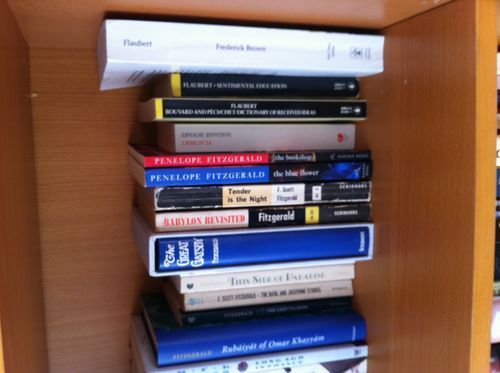
(I don't know why this photo is oriented this way, having technical issues this morning.)
This might sound like a trivial question, and in the grand scheme it is. But I've just added two more bookcases, and it's clear I won't have the shelf space for everything I own. And as you can see from the picture above, the biography - like most biographies - takes up a healthy amount of shelf space. So what to do? For the moment, I'm placing the bios with the fiction, but as shelf space disappears, I might revisit.
I also notice that Alexandre Dumas wrote some truly fat books - yes, he was writing serials, paid by the word - and the 11 volumes of his I own eat up nearly an entire shelf. Will I ever re-read The Vicomte de Bragelonne, I wonder? Still, for now it remains.
Other than recommending a mental health care visit, any suggestions?