Mark Sarvas's Blog, page 5
October 26, 2011
CROSSBONES REVIEW
My review of Nurrudin Farah's Crossbones has been published over at the Barnes and Noble Review. It starts thus:
Most Americans, if they think of Somalia at all, know it only from Black Hawk Down, the 2001 film adaptation of Mark Bowden's 1999 account of the bloody Battle of Mogadishu. Tragic though those events were, they represent a mere sliver of the decades of internal strife that have left Somalia one of the poorest and most violent countries in the world. Moving from Communist rule to dictatorship to civil war, there has been no functioning central government for twenty years. Warlords and clan factions have given way to militant Islam, and pirates terrorize the coastal waters. "That unfortunate country, cursed with those dreadful clanspeople, forever killing one another and everyone around them," is the bleak précis offered by one of Nuruddin Farah's characters. It's to this unpromisingly harrowing milieu that Farah has tirelessly devoted himself for eleven novels that paint a more nuanced picture of the country's woes than one is likely to find on CNN.


STEVEN CORBIN REDUX
Some years back, I wrote a brief reminiscence of my friend and writing teacher Steven Corbin. I've revised and expanded that essay as part of the Los Angeles Review of Books' Writers on Teacher series, and it's now online. An excerpt:
He looked at me from across the table, realizing that I hadn't yet known (he thought he'd told me already); and he said, "I've shocked you." I remember mumbling something non-committal but before I could absorb the news, Steven began talking with his familiar enthusiasm about how he was confident of his chances of beating it, that he was healthy, his t-cell count was good, that he was going to beat it. I nodded and was supportive but later that day in my journal, I wrote one sentence: "Steven is going to die."
October 23, 2011
L.A. EVENT - NORMAN RUSH - ***DO NOT MISS!***
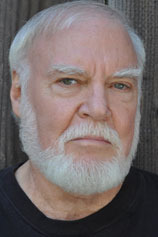 Folks, seriously - do not miss this one.
The great Norman Rush is making an altogther too rare appearance in the L.A. area, where he will be in conversation with Mona Simpson at the Hammer on Tuesday evening. It's the first time that I am cursing the fact that I teach that evening, and I'm tempted to shuttle my Novel III students over to the event.
For those of you who don't know Rush's work, you can read what James Wood has to say about the superb novel Mortals here. To wit:
In the way of all powerfully narrated first-person monologues, Mating occasionally breeds in the reader the desire to escape the constant intensity and interest of the language, as houseguests sometimes want to escape their over-vivid hosts. It is the price that the writer pays for the immediacy of first-person access. Mortals is told in the conventional third person, so that it distributes its effects more spaciously and calmly, as is proper for such a massive work. But Rush has not lost his interest in spoken language; indeed, he has intensified his study, at once funny and brilliant, of what happens to language when brainy Americans get mixed up with it. Mortals is many things, and does many things beautifully, but its central achievement has to be the fidelity with which it represents consciousness, the way in which it tracks the mind's own language. This concern with the insides of our minds makes Rush almost an original in contemporary American writing.
You can also read Rush's Paris Review interview here, in which he says:
It's a rare reader who doesn't go to the novel looking for a kind of encouragement to live. No doubt this is because the novel is the rude pretender who stepped into the place of that long-reigning narrative, the religious bedtime story, which, before Darwin and Lyell and those guys, was the only narrative in town. As I write a novel, I'm aware that I'm struggling against the "obligation" to solace. But I want my books to reach only the conclusions that are implicit in the trajectories of their characters. As it happens, bothMating and Mortals have sad outcomes—but optimistic codas. So sue me.
A related question is, when should novels end? I must love big novels, because that's what I've written. It takes a while before you begin to breathe the air the characters breathe. I also like long exchanges, because plots so often turn on nuances in the ways characters understand each other. In moments of madness, I've had the fantasy of simultaneously publishing my novels in two versions, Regular and Jumbo. In the book I'm working on now, though, I'm trying to keep everything shorter: shorter scenes, fewer plots, general brevity. But a shorter novel goes against some of my deepest instincts. Dostoyevsky died still intending to write another volume of The Brothers Karamazov. It's like a knife in my heart that he didn't.
Go. Drink it all in. Send me dispatches. The details are all here.
September 6, 2011
RIFFING ON DFW
I can't imagine at this late stage of the game that anyone needs me to direct them to Maud Newton's New York Times Magazine Riff on David Foster Wallace's influence on writing on the net, which has been lighting up Twitter, Facebook and the blogs. But in case you've been as hunkered down as I've been, I send it along, with a hearty endorsement of Newton's take. (I took another ill-fated crack at Infinite Jest a few months ago but foundered yet again. I fear I will fall into the Geoff Dyer camp on this one.)
Geoff Dyer, an essayist as idiosyncratic and perceptive as Wallace but far more economical, confessed recently in Prospect magazine that he "break[s] out in a mental rash" when forced to read Wallace. "It's not that I dislike the extravagance, the excess, the beanie-baroque, the phat loquacity," Dyer wrote. "They just bug the crap out of me. " Wallace's nonfiction abounds with qualifiers like "sort of" and "pretty much" and sincerity-infusers like "really." An icon of porn publishing described in the essay "Big Red Son," for example, is "hard not to sort of almost actually like." Within a brief excerpt from that piece in The New York Times Book Review, Wallace speaks of "the whole cynical postmodern deal" and "the whole mainstream celebrity culture," and concludes that "the whole thing sucks." Nor is this an unrepresentative sample; "whole" appears 20 times in the essay, so frequently that it begins to seem not just sloppy and imprecise but argumentatively, even aggressively, disingenuous. At their worst these verbal tics make it impossible to evaluate his analysis; I'm constantly wishing he would either choose a more straightforward way to limit his contentions or fully commit to one of them.
Still, I will continue to try and grapple with DFW. His shadow is too long to ignore. I am not done yet.
WHY SO SILENT, YOU?
Been on a bit of a late summer tear, reading-wise, hence the silence around here. Expect some long overdue updates to the Recommended sidebar later this month. As for the books that have caught my eye, though, and should catch yours as well, a sampling: Harold Bloom's The Shadow of a Great Rock: A Literary Appreciation of the King James Bible is just fascinating, brilliant and reliably Bloomsian ... Michael Ondaatje's latest, The Cat's Table (October) is a lovely coming of age tale ... I've finally dipped into Bruce Chatwin, checking out his novel Utz and his justly celebrated travelogue In Patagonia ... Kundera's latest essay collection, Encounter, should be read by any novelist, published or un, and it sent me back to The Curtain, which I'd never read ... I'm finally reading Nuruddin Farah, who has forever been on my radar and comes highly recommended ... Dipping into Edward St. Aubyn's Patrick Melrose novels, which are set to make a splash on these shores next year if Zadie Smith has anything to say about it ... and have been enjoying Georges Bernanos' 1937 classic, The Diary of a Country Priest. With much more to come. I'd love to hear how my readers spent their summer reading time ...
UNPACKING THE SHELVES: AESTHETICS
I've finally gotten all the fiction put away, and have got the next three groupings staged and ready to unpack. First is my collection of writers' journals and letters, in which I've always had a slightly prurient interest; then my literary criticism; and then poetry. That will bring me to about the two-thirds mark, and then I'll pause to just enjoy them for a while.
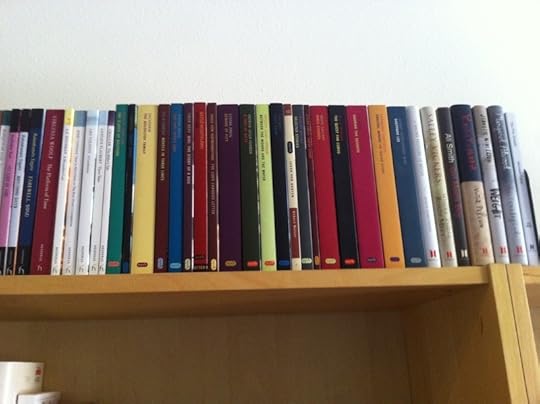
My latest conundrum came yesterday as I struggled over what to do with my series of New York Review titles. It's one of several wonderful series I keep, including others from Hesperus, Penguin and Canongate. If I were truly anal retentive, I suppose I would place each book where it belongs alphabetically. Zweig's Beware of Pity would go with the rest of my Zweig. But I confess a fondness for the look of those beautifully designed books all lined up so neatly on my shelves, and so I made one decision based on aesthetics alone and kept them together. I also have a near photographic memory for the books I own, so I'm confident, for example, that I won't forget that my copy of Simenon's Tropic Moon will be found amid its NYRB brethren.
I anticipate the opprobrium of the purists. Lord knows, I feel it myself ...
BIRNBAUM v. B&B (BANVILLE & BLACK)
My pal Robert Birnbaum has a nice chat up with John Banville to ease us into the autumn ...
RB: Do the Banville books get more rigorous editing?
JB: No, the Banville books are not edited at all.
RB: Who, ostensibly, is your editor? Sonny Mehta?
JB: Yeah. He would make some suggestions, which I would take or leave. I've been working two to five years on this thing. There is nothing that anybody can tell me about it that I don't already know.
RB: You're honest with yourself?
JB: Of course. You couldn't write if you weren't honest. That's what makes art so valuable. No matter how dreadful the person, the art is always honest. Art can't be made dishonestly. It just can't. I mean, you can do it but it will be bad art.
The latest Black, A Death in Summer, is right here on my desk, but it's queued up behind a few others. It's been a bit of a late summer reading binge around here, about which more presently.
September 5, 2011
AUTUMN EVENTS ADDED
It's going to be a busy season in L.A., with the like of Michael Ondaatje, Norman Rush, Anne Enright and many others coming to town. Check out the Worthy Readings sidebar on the left for all the latest updates.
August 27, 2011
EAST COAST WISHES
To my friends, loved ones and readers back east, I am thinking of you all tonight. Be careful, stay safe, be well.
August 22, 2011
UCLA WRITERS FAIRE
After a blissful two semester hiatus, I will return to teaching this fail at UCLA, repeating my Novel III class (now open for registration), and then teaching Novel IV in the winter. In advance of those classes, I will be appearing on a pair of panels this Sunday at the Writers' Program's annual Writers Faire at UCLA, so you can come kick the tires before signing up for a class.
At 1:30 I will be participating in Making it to "The End": Story Staying Power for Novelists and at 2:20 I will be part of the Getting Your Fiction Published panel. Since I've already got a number of students who have successfully finished drafts, I'd say my thoughts on the former are worth hearing out. I'm a bit less enthused about the second panel, in that my feeling - grotesquely oversimplified - is that if you are thinking about getting your work published, you're thinking about the wrong thing. I tell my students time and again that the only thing any of them need to be thinking about is writing the best possible manuscript. Period. I'll say as much on Sunday.
If you can't make it in person, UCLA does plan to stream things this year. And I will be noodling around in the morning, taking in a few other panels, including my friend, author and fellow instructor Darcy Cosper who will be talking about Writing Your First Novel (11 am) and Writing With A Day Job (11:50 am). There will also be great exhibitors including the Writers Junction and 826LA, so do come out for a fine literary Sunday at UCLA. It's all free. Hope to see you there.