Mark Sarvas's Blog, page 7
June 20, 2011
McMORE
My posts on unpacking my library continue to generate the most (and most interesting) emails. Regarding my conundrum in my prior post about where to place my books authored by the Mc's, one of my readers kindly writes in:
...just to let you know that the "mc and mac" rule is not set in stone. The branch of the county library where I work follows by alphabetic sequence - so much easier and less fussy.
She then went on to comb through the ALA wiki and sent me this link to their filing rules, which sort of seems to play it both ways, although one of the two validates my choice:
In the ALA Filing Rules, names beginning with M', Mc, and Mac are filed alphabetically as spelled. (letter-by-letter)
That's my story and I'm sticking to it.


June 15, 2011
KINGSLEY AMIS INTERVIEW
One of the many things drawing my attention these days, this old interview with Amis pere.
June 12, 2011
UNPACKING THE SHELVES: J-N
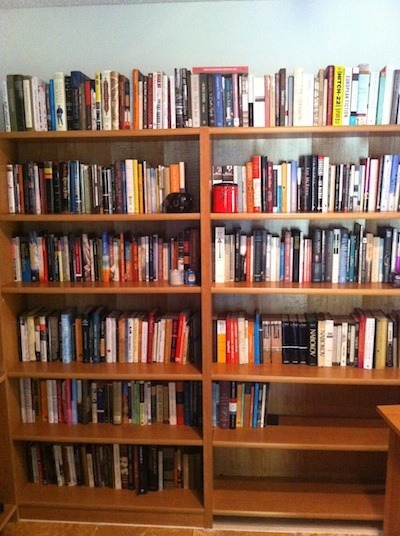
Unpacking of the library has resumed, after an interruption of several months to accommodate the completion of Part One of my novel (about which, more anon), and to do some home rearranging to add bookcase space. I'm now back at it and have unpacked another two shelves of my fiction collection, pictured below, in the course of which some random thoughts and observations arose.
First, I don't think there's another single volume in my collection about which I have as much critical commentary as I do about Ulysses. (Second place goes to The Magic Mountain but it's not even close. Actually, while unpacking I became utterly engrossed with Doctor Faustus, which will probably get a re-read quite soon now.) I have several companions, including the great Hugh Kenner's, as well as a double-CD set of lectures on the novel. I'm sure there are plenty of other books which have a similarly deep well of critical accompaniment, and I suspect it probably says more of my own interest in Ulysses than anything else. Still, no other single title in my library claims so much space in quite the same way.
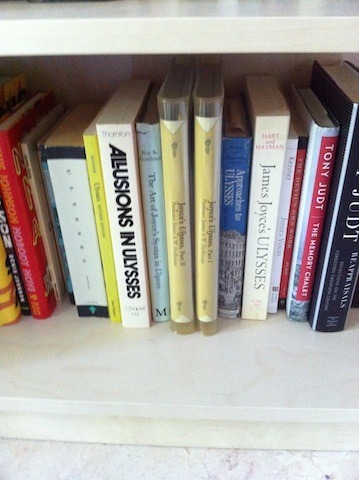
(Yes, I'm aware that Tony Judt is not a novelist, but there are a few writers I revere who I feel write non-fiction with a novelist's grace, and so I imprecisely include them here.)
Speaking of imprecision, I grappled with another librarian problem when I got to the letter "M" which, incidentally, is the largest stretch of letters so far, taking up nearly five shelves. What to do with the McWriters? I have quite a lot of McEwan and McGahern, and I've always struggled with where to put them. I remember being taught as a child that when alphabetizing names, Mc came before Ma, but that feels antiquated and just plain wrong. Certainly, my iTunes doesn't put McCartney before Marvin Gaye. Nor do I. And so, McEwan follows Markson. My grade school librarian is rolling in her grave.
I also noticed that the large bulk of my Hungarian novelists emerged in this series of letters - Kertesz, Konrad, Marai and Nadas. Absolutely nothing insightful or scientific to note here, just kind of amusing to be swarmed by so many Hungarians at once. (Part Two of my novel is largely set in Budapest, so I suppose I do have Hungary a bit on the brain these days.)
Then came the the question of what to do with my James Bond collection. I have a series of boxed reprints of the original Jonathan Cape editions, which are quite splendid but take up a ton of shelf space. When I first unpacked the "F"s, I was worried about that and so I did not unpack the Flemings, although I admit now that there might have been a bit of snobbery afoot. Seemed odd to place Casino Royale next to A Sentimental Education. But I recently came across the box of reissues and was struck again by how handsome they are, and so I decided to unpack them, along with a few vintage hardcovers, and set them atop the "F" bookcase (the space below long having been filled up). It seemed a suitable compromise:
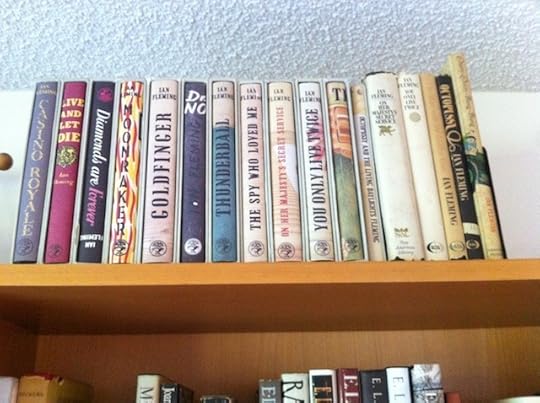
And yes, that's Chitty Chitty Bang Bang on the far right.
Finally, I have a whole lot of Nabokov. Which is entirely as it should be. Ondaatje waits in the wings, including my beloved hard cover copy of In the Skin of the Lion. But it's time to begin Part Two, so who knows when the rest of the alphabet will see the light of day?
May 31, 2011
WHERE WE GO NEXT (PLUS, OF COURSE, BANVILLE)
What is to become of TEV?
I'm not entirely sure yet. The benign neglect that has characterized the last year or so might well be an indication that it's time to pack things in. Yet there's something in me that stops me from pulling the plug. I continue to value the intelligent discussion with smart, committed and opinionated readers and, despite the overwhelming number of book-related sites, I continue to find that sort of dialogue in strangely short supply.
In recent weeks I've read a number of posts at lauded sites, sites I admire, written by folks I like, and I've been, well, dismayed at how lousy they can be. But that's nothing, in and of itself – we all have our off days, we've all written things we probably would like to take back.
What I found more troubling was the chorus of commenters who would invariably leap in after each post declaiming its virtues. And I've come to believe that perhaps the problem with the internet isn't that it gives voice to every crank with a keyboard and a broadband connection. No, it may be that the insidious thing is the insularity of the waiting chorus of those who champion mediocrity, who validate self-indulgence or unoriginal thinking.
So, what I can say is that the days of daily updates of literary news are probably over. That sort of thing is crazy time-consuming but, more importantly, I'm just not as interested in this prize and that obituary as I once was. Plus I have some considerable life changes to navigate, not to mention a novel to finish.
What I will continue to do is to run interviews with authors of note; to point out books I think are worthy of your attention and to wave you off the overrated ones; to take this piss out of the occasional blowhard; to draw your attention to especially thoughtful essays and discussions online; to continue to post about teaching and share some of my writing lessons; to post longer, random train of thought essays (like this one) and to discuss second novel travails. (A new post on that subject is in the works.)
And, of course, I will continue to advise you on all matters Banville-related.
Speaking of which, I've been asked several times about my failure to discuss Banville's latest novel The Infinites. Some people have taken my relative silence to be somehow damning. Not the case. There are three reasons why I haven't talked as much about the novel as I might.
First, I've come to realize that there is an assumption among my readers that a Banville novel is a pre-sold quantity to me. I'm not sure that's entirely inaccurate, but at a minimum, I suspect no TEV reader would have been much surprised to see me endorse the novel. (Which, incidentally, I do.)
Second, many of you are likely to remember that Banville was kind enough to blurb Harry, Revised. And so I found myself perhaps a bit oversensitive to accusations of logrolling and the like. On the one hand, I've seen enough about the ecology of blurbs that I've come to understand they are, as often as not, gestures of friendship as they are of critical respect. (Think of the familiar round-robin of names that routinely surfaces on the back of any novel by Believer alumni.) On the other, a good book is a good book, whether written by a friend or foe, and I've come to see it seems excessively fastidious not to say so. Still, I continue to pick up books hopefully, gambling each time against experience that a blurb will be meaningful, and so I've been a bit reluctant to further undermine an already debased form.
Finally, and most relevant, I hadn't actually read the book until last month.
How on earth is that possible? Let me explain. MOTEV called me some weeks ago to inform me that her book group had turned to The Infinities, and she was loving it. She was eager to discuss it with me, when I had to shamefacedly admit I hadn't read it yet. I had started it when it came out, but I'd set it aside and now I couldn't remember the reason. The last year really has been tumultuous, and amid my personal travails and focus on my novel, much has fallen by wayside.
So I picked up the book and began it again, and was thrilled anew as I always am by Banville's prose. After a dozen pages or so, I remembered why I'd put it down. My novel is, among other things, about a character dealing with the death of his father. Which is one of the main themes of The Infinities. I decided that I wanted to avoid any additional Banville influence – as it is, anyone who has read The Book of Evidence will immediately see that my book is a rip-off, um, homage to this earlier work. So I decided to wait.
Unfortunately, Novel 2 has taken much longer than planned – subject of the future post – and I realized at this rate, it might be years before I could read it. And I remembered something Joseph O'Neill said when I interviewed him:
TEV: Do you read fiction while you are writing fiction?
Joseph O'Neill: I do. And I might do a couple of quick laps, and that's it. It depends. Obviously, I can't go seven years without reading a book. If I'm stuck for juice, I will go back to certain writers or investigate new writers and find out what's going on.
TEV: Will there be any risk of seepage when that happens?
Joseph O'Neill: I hope so. I mean, you want a little bit of that. You know, you've got be grown up about influences. I think you've either got it or you haven't. By 'it' I mean the knack of writing something valuable that's your own. So if you are worried about being influenced, it's almost a pointless worry. Either you're going to be influenced or you're not going to be influenced—it doesn't change anything, it's all about whether you have the knack. Anyway, the alternative is to not read anything. And no one can be a writer without being familiar with other writers.
And so I decided to bring it, and I'm glad I did. The Infinites is superb, and O'Neill is right, it makes a difference. Which makes it a timely moment for Harold Bloom's latest to land on my desk. About which I intend to say more in the future. For now, I leave things here in a state of fragile equipoise, and I assure you posting here will continue, as the form struggles to make itself known to me.
May 30, 2011
BANVILLE, MEET KAFKA
However sporadic my posting might be these days, you can always count on me for a Banville Bulletin - he's won the Kafka Prize.
An international jury which included German literary critic Marcel Reich-Ranicki and British publishder John Calder selected Banville for the prize, which is awarded annually and includes $10,000.
May 23, 2011
INSERT VIRAGO PUN HERE
I've had my head down the last week or so cleaning up the first half of my novel, so I managed to miss the news of both Philip Roth's winning of the Man Booker Prize, and Carmen Callil's absolutely idiotic comments in the wake of that victory.
"I don't rate him as a writer at all. I made it clear that I wouldn't have put him on the longlist, so I was amazed when he stayed there. He was the only one I didn't admire – all the others were fine. Roth goes to the core of their [Cartwright and Gekoski's] beings. But he certainly doesn't go to the core of mine . . .Emperor's clothes: in 20 years' time will anyone read him?
I mean, yes, OK, The Humbling - embarrassing. But come on.
Putting my head back down. Nice to see you all survived the Rapture.
May 16, 2011
L.A. EVENT: SCOTT O'CONNOR AT SKYLIGHT BOOKS
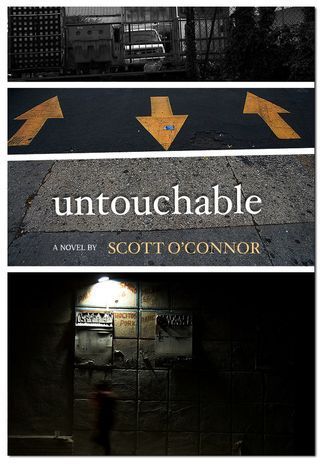 Scott O'Connor first came across my radar with his sharp little 2004 novella Among Wolves. Since then, we've become pals - he's acknowledged in Harry, Revised for assisting me in the mechanics of throwing a punch - and I'm terribly excited to read his debut novel Untouchable. It's described thusly:
It is the autumn of 1999. A year has passed since Lucy Darby's unexpected death, leaving her husband David and son Whitley to mend the gaping hole in their lives. David, a trauma-site cleanup technician, spends his nights expunging the violent remains of strangers, helping their families to move on, though he is unable to do the same. Whitley – an 11 year-old social pariah known simply as The Kid – hasn't spoken since his mother's death. Instead, he communicates through a growing collection of notebooks, living in a safer world of his own silent imagining.
His publisher has set up a nice page which includes a trailer and a first chapter download, but I'm writing to advise you he's reading at Skylight this Tuesday evening, and although I am sick as a dog, I'll be there spreading my germs through the crowd, and hope you can come by and check it out as well. Scott is an engaging reader, smart and witty and a splendid time is guaranteed for all.
May 10, 2011
SECOND NOVEL WOES
I am, understandably, obsessed with tales of second novelhood, like this one in Slate. (Thanks to Katherine Taylor, who bested me!)
My first novel had gotten good reviews and sold, for a first novel, reasonably well; I wanted to do better this time. At the very least, I wanted not to go backward. This novel's success would also impact my next book deal—hell, it might determine whether there would be a next one. And then there was Deborah. She works as a high-level editor at a major magazine; I didn't want to put her in the position of walking into the office the wife of second-rate novelist. The prospect of embarrassing her—of being anything less than a husband she might feel the urge to brag about—was even worse than the prospect of embarrassing myself.
The unfortunate use of impact as a verb notwithstanding, it's worth a read.
A LATTERDAY GRAND TOUR
John Banville reviews James Attlee's Nocturne for the Guardian.
Nocturne – a term taken over by Chopin from the Irish composer John Field, but frequently employed by painters, too, particularly Whistler – is written in the relaxed, ambulatory tone of an 18th-century rambler's tale. Attlee conducts us on a latterday grand tour that takes in, among many other places, Turner's Thames, Basho's Japan, Pliny's Vesuvius and Rudolf Hess's solitary cell in Spandau prison. We learn little about the author, not necessarily a bad thing in these confessional times, although he does throw us hints as to his predilections and anathemas; for instance, he has a keen interest in painters – Samuel Palmer, Joseph Wright of Derby, the aforementioned Whistler – and in Japanese poetry; he deplores the seemingly unstoppable spread of light pollution yet considers Las Vegas at night one of the wonders of the world; he is not too happy about noise pollution, either – "Why aren't we ever content to just shut the fuck up?" – and declares "a particular hatred for wind chimes, hanging bells and all such paraphernalia".
CAN WRITING BE TAUGHT?
The Guardian rounds up several notables to address this apparently undying question.
Will Self: I'm still not convinced creative writing can be taught. Perhaps you can take a mediocre novelist and make them into a slightly better one, but a course can't make someone into a good writer. Ian McEwan and Kazuo Ishiguru both did the UEA MA, but they were both innately good anyway. Some people swear by creative writing courses. I say, go and get a job, a fairly menial one instead. Otherwise what are you going to write about? Writing is about expressing something new and exploring the form in new ways. So unless you want to churn out thrillers or misery memoirs, you can't work from a pattern book. You need to autodidact.
As my students at UCLA already know is, my answer - maddening as always: It depends.