
Jane Brocket's Blog, page 17
August 17, 2013
really real
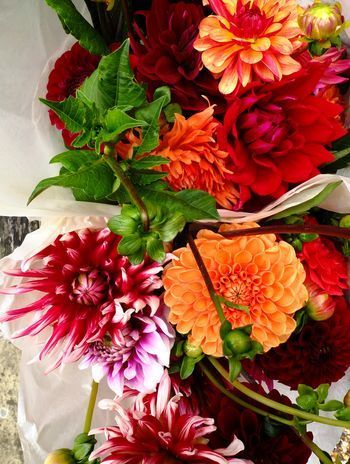
Very real, very short-lived, very beautiful and dust-free. Dahlias from the cutting garden at Green and Gorgeous which is a explosion of flowers tucked away between Oxford and Reading where it's possible to wander round admiring the blooming rows, coveting the polytunnels full of colour, and inhaling the scent of sweet peas. There are cut flowers for sale, but today was a pick-your-own dahlia day, which for me is the equivalent of being let loose in a sweet shop.
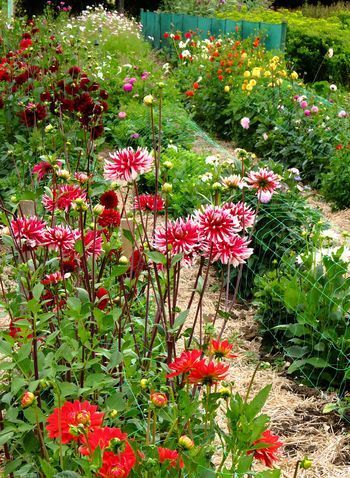
Rachel Siegfried has created a wonderful busines - the place is bursting and the flowers are full of vigour and energy.
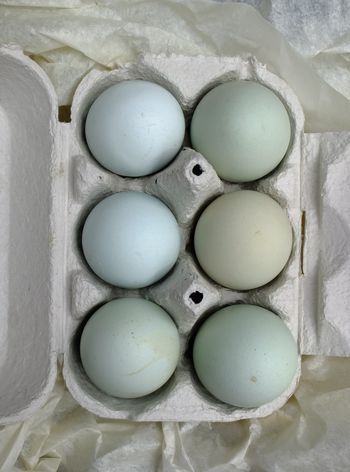
She also grows and sells vegetables, and today there were a few pale blue eggs which are almost too perfect to crack.

Not far from Green and Gorgeous is the old and pretty village of Nettlebed where the church has been converted and now houses The Field Kitchen, a great cafe and deli which is worth a detour. Especially if you have just been to visit Nuffield Place. We saw the house which is unchanged and fascinating - the free-to-roam policy is excellent and means you can spend as long as you like in Lady Nuffield's sewing room and Lord Nuffield's very boyish bedroom - but the cafe is serving cakes that wouldn't have been out of place during the heyday of the house, and are so dry you wonder if they are really real.


August 16, 2013
for real
IKEA is an ordeal, but one that is worth it when you want cheap bedding, glasses, cups and bowls for students, with a 9-piece breakfast for £2.75 thrown in for sustenance. I always wonder how people would cope in there if, as happened in the Second World War, all the signposts were taken down. No doubt it would qualify as one of the circles of hell.
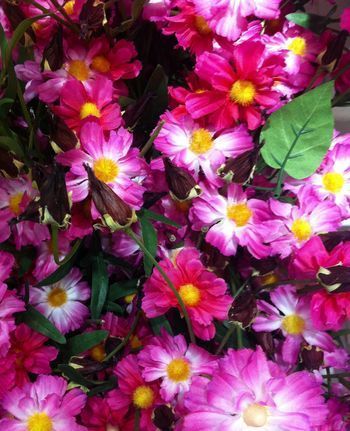
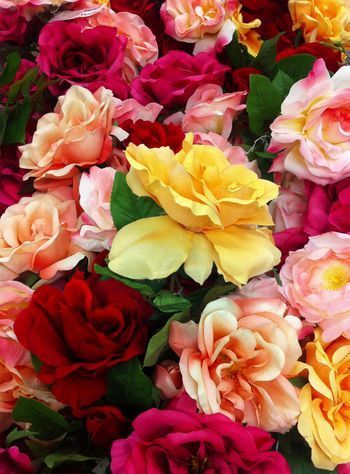
Our visit this week was made more bearable by the sight of a brilliant mass of artificial flowers on sale. AlthoughI can't say I'd ever buy fake flowers (I see them as dust-catchers), if I had an old VW Beetle I'd fill the little vase with lots of them so I wouldn't sneeze as I drive. I did buy a set of vases (good value, plain glass, simple shapes) for some real flowers, though.

August 15, 2013
roots
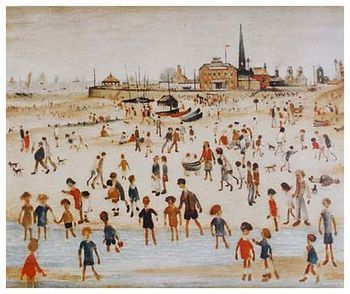
[At the Seaside (1946) LS Lowry]
Much has been written recently about LS Lowry. All sorts of opinions have been aired and shared. Lots of nonsense has been said. A few reasonable voices have been heard. But in the end, you have to make up your own mind about Lowry. He never forced his way of seeing the world on the world and he never made pompous claims for his art; he just let it be and speak for itself. And it is doing this brilliantly at the Tate.
I grew up with a print of this seaside painting on the wall of our lounge, so was pleased to see it for real at the exhibtion, although I'd never quite realised that this is a relatively upbeat, colourful painting for Lowry. Seen next to all the industrial landscapes and wastelands, it looks positively jolly. But then again, unlike so many humourless art critics, I reckon Lowry possessed a sense of humour - a sly, dry one, maybe, but still a sense of humour which can be seen in little details, small visual jokes, and witty observations of people and life.
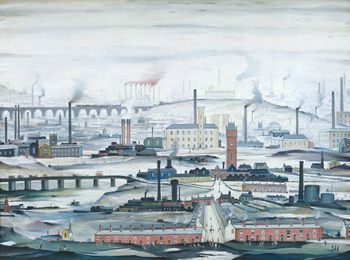
[Industrial Landscape (1955) LS Lowry]
While the familiar small scenes of Northern life on display bring back memories of growing up, it's the huge industrial landscapes that pack the punch and evoke a sense of recognition: that's the Stockport viaduct above transposed to some brilliantly realistic but imaginary city of the north, and below are the rowing boats like those on the boating lake in Platt Fields where we spent many a Sunday.
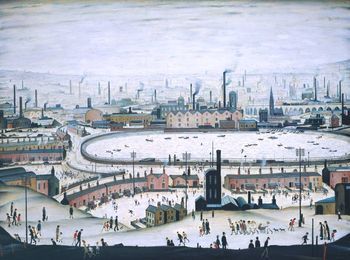
[The Pond (1950) LS Lowry]
It's incredible that some people find it hard to believe that Lowry was painting from life. Yet you have only to talk to northeners and look at contemporary photos and film footage to know that he was telling the truth. In some ways these huge landscapes are utterly real (and still there) and in some ways hideous dystopian visions, but the fact is that they could be both things at once. And I think that they are nowhere near as dystopian as some might say, nor are they cold and removed - how could they be when this was daily urban reality, full of incident and energy and football matches and fights and ambulances and corner shops and children playing outside terraced houses and drunks swaying along the streets?
The curators, though, have done Lowry a disservice by concentrating on the industrial and urban landscapes (to predictable reviews) when in fact he was far more wide-ranging in subject matter and scale. His seascapes are fantastically meditative, his portraits strange and his sketches and drawings fluid and full of movement. For the life of me I can't understand why the Tate would ask two Marxist art historians who live in the US who don't specialise in C20 art and who, by their own admision, don't particularly like Lowry to curate this exhibition. I tried to read the catalogue but, to put it politely, lost my way very quickly.
Maybe the Tate thought it could re-present Lowry on its own terms when in fact the exhibition proves that the artist and the paintings rise above the chatter and published opinions, and continue have a life of their own which is rooted forever in the North West (do have a look).
August 12, 2013
cake boss
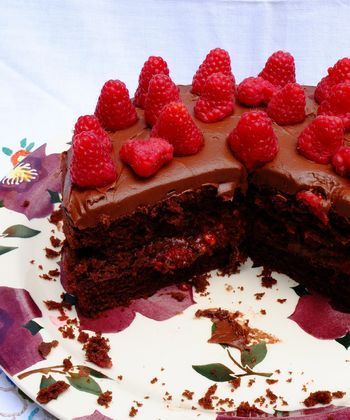
A new Brocket baker. Tom has always been good at specific baking tasks such as kneading, or rubbing in butter and flour, or eating chocolate buttercream from the bowl, yet he hasn't really felt the urge to bake (no wonder, really, given the amount of baking the rest of us do - even Simon has been perfecting his banana bread in recent months). But, inspired by a slice of cake he bought in a supermarket and by the dozens of episodes of Cake Boss that seem to be showing on an endless loop here this summer, he made a chocolate raspberry cake yesterday morning before going off to work (on riverboats, so odd hours).
This is the first time he's made a cake from start to finish. I was there to say the recipe and method (a sort of audio-guide), advise and generally wield a wiping cloth, but this is all his work. And it's delicious, especially with more raspberries and some cream.
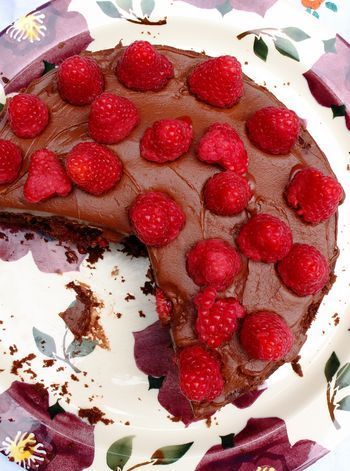
Maybe we've got a new cake boss. To go with the four already here.
August 11, 2013
bee aware
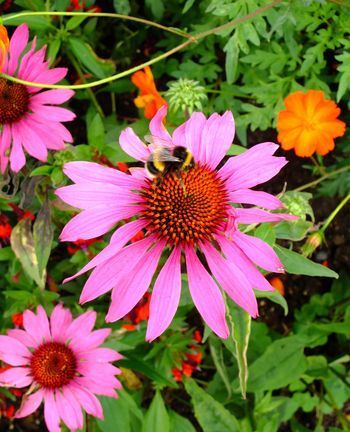
The answer to 'Where have all the bees gone?' is 'Wisley'. Yesterday, the place was a buzz and abuzz with bees.
On echinaceas.
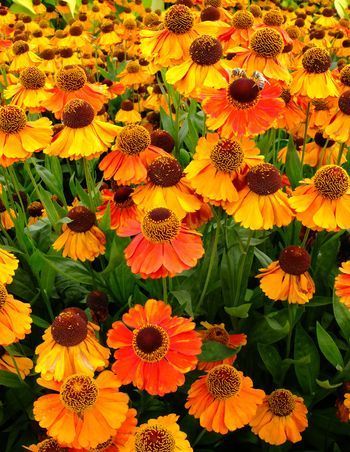
On heleniums.
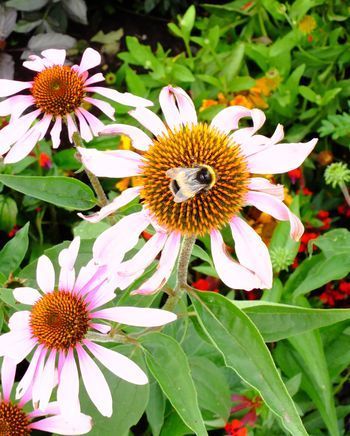
On pale echinaceas.
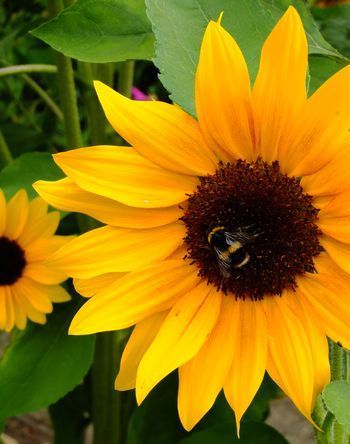
On bright sunflowers.

And no doubt they were just about the land on this briliant dahlia as soon as I moved away.
In particular, there were masses of bees on the tall veronicastrums in the lovely, sweeping perennial borders designed by Tom Stuart-Smith near the glasshouse. Clearly, this is what we should be planting if we want to be bee aware.
August 9, 2013
for two pins

[Garden Museum garden, plants on a well worn gravestone with faded lettering]
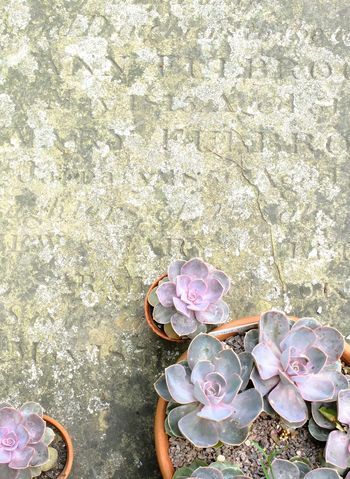
Simon once said I'd win a gold medal for jumping to conclusions, so yesterday after I'd been to the Garden Museum (unplanned visit on my way to see the Lowry exhibition) I decided that instead of assuming the museum's policy of putting up prints of photographs by the brilliant Howard Sooley with what amounts to a couple of a drawing pins is due to the fact that they just don't care how poor it looks, I would question why they do it . But I'm afraid I drew a complete blank as to why they let these unframed, unmounted photos curl up at the edges so that they look like fliers and posters on school and university notice-boards that have been blown about by draughts and roughed up by shoulders and bags.
I wouldn't mind if it were free to get in but it's not, and I reckon that £7.50 (£3 with an Art Fund card) is enough to warrant two more drawing pins per photo if nothing else. In my attempt to be fair, I asked Simon what he thought (I showed him photos I'd taken of the displays) and he who rarely jumps to conclusions is sure that the messy, loose approach must be deliberate. Now I'm stumped because it's impossible to jump to any conclusion that explains why an entry fee-charging museum would do this.
To be even fairer, I have phoned the museum twice today to ask about their hanging policy as it's the second exhibition I've seen done like this, but there's no answer. They must be out at Ryman.
('For two pins' - one of my favourite threats.)
August 7, 2013
in touch

[Lotta Jansdotter's Glimma fabrics, upside down]
I feel as though I've been out of touch for a while, with myself as much as with the world. Recently, though, I've had an early September-style rush of enthusiasm for work and making and getting back in touch.
I'm making quilts again. Cutting out Lotta Jansdotter fabrics while watching cricket (we have a vested interest as one of Tom's friends is playing in the finals) which means I nearly always miss the spectacular moments when the bails fly off or someone is run out. The fabrics are demanding a different sort of design to one I normally do and it really hurts my brain trying to calculate and work it all out. In the end, as ever, I am just cutting out what I think will work, and will improvise if necessary. Or make it all look planned and deliberate.
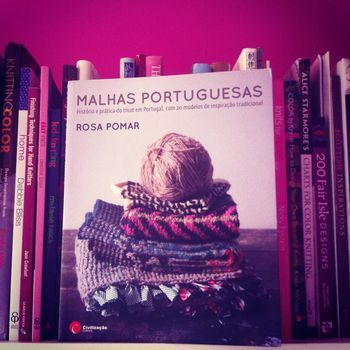
[Rosa's book]
I don't read too many blogs these days, but I stay in touch with some old favourites. A little while ago I bought Rosa Pomar's knitting book partly because I thought it looked lovely, and partly because I admire Rosa's style and her commitment to her subject. Over many years of blogging (Rosa was one of the first), she has remained true to her own style and her interests, and as a result has done, and is doing, a huge amount for Portuguese handicrafts and Portuguese customs and life. The book is in Portuguese (it should be translated into English, really, as I'm sure there's a market in Portugal and elsewhere for Portuguese books in English) but it doesn't really matter (a little like the wonderful Finnish and Japanese books I have). It's a mix of Portuguese knitting history, instructions, and a number of patterns (socks, scarves hats). The photos are great, and the book goes way beyond your average knitting title.
Another blog I like is Oyster and Pearl. I met Lottie when she invited me to speak at the Malago WI, and she is an incredibly talented photographer. As with Rosa, I enjoy Lottie's blog's sense of place and the way she is so in touch with Bristol - I want to visit old haunts and discover new ones every time I read it.

[Kaffe Fassett's Quilt Grandeur]
I've also just got my hands on Kaffe Fassett's new book (the annual Rowan one), and it's a great collection this year. So many good ideas, so many beautiful quilts, such a grand setting (and it looks as though it was all great fun on the shoot).
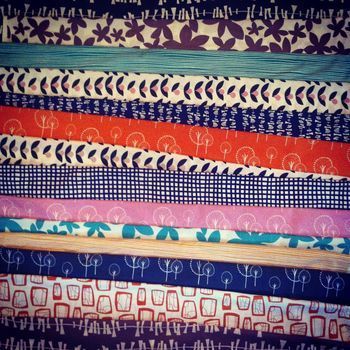
[right way up, the way I now feel]
I hadn't been to London for a while, but we went to see the BL propaganda exhibition yesterday. A good idea spread too thinly and too widely defined; since when have public information films stressing the need to cross the road safely qualified as propaganda? Better to stick to political propaganda (and to give visitors the choice of whether they wish to hear Alistair Campbell on an audible loop on two screens - very ironic in a propaganda that you can't mute him). It's rather cold and gloomy in there, so you need specs and a cardie, and warm-up at Princi.
It's nice to be back in touch.
August 5, 2013
mansfield park
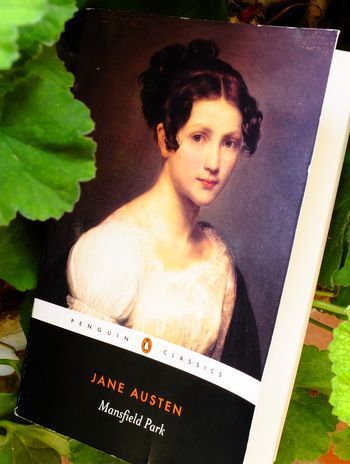
Mansfield Park was the one I'd never read, had failed to get into several times, was put off by the slow start and the idea that this is Jane Austen's most 'difficult' and least sparkling novel. So I limbered up with Persuasion (a great read) and Emma (perfectly formed) in order to get my brain and imagination into Jane Austen mode, and gave it another go.
I'm so glad I did. It turns out to be a dense, rewarding read. I'm not saying I enjoyed it without reservation and I'd certainly join in a debate about Fanny Price as a heroine, her priggishness, her self-effacement, her 'creepmouse' behaviour, her silences, her debilitating shyness, her non-presence and shadowiness, her total lack of stamina, her ultra-close relationship with her brother and her brotherly love for Edmund, her puritanical distaste for her boozy, noisy family in Portsmouth (which sounds more fun that the strictly controlled civility of Mansfield Park) - but also her moral compass, her steadfastness, her 'nest of comforts' (books and plants in a room of her own), her adherence to her own truth, her willingness to learn, her rather soppy but genuine Romantic tendencies, her dignity when badly treated, her conscience and her loyalty.
It's Jane Austen at her most psychologically astute and the novel contains incredibly well-drawn characters whose behaviour is so well presented that it's hard to believe that it's just one person making it all up; their impulses, contradictions, hidden motives, egotism and vanities are marvellously imagined. There is the utterly awful Mrs Norris, the wonderfully idiotic Mr Rutherford, the dangerously attractive Crawfords (who would be great at parties), the spaced-out and languid Aunt Bertram, and Sir Thomas, the cat/lord of the manor whose absence causes the mice to plan a play while he's away. There are some wonderful set-pieces such as the visit to Sotherton and the theatricals, some very funny moments, and some extremely modern themes of 'improvement' (of women), the assignation and acceptance of gender roles, and the value placed on a woman's external appearance and demeanour.
So why, oh why, after constructing all these amazingly complex characters did Jane Austen pretty much bail out on them? The end of the book, the dénouement and the tying up of loose ends are perfunctory and disappointing. It's as though Austen is feeling her way out of something she has created that has taken on a life of its own and not gone exactly as planned, with too many characters who should have been black or white having become interestingly grey and ambiguous and thus very convincing. But no, cod psychology takes over, the bad 'uns must be punished and the good 'uns rewarded, and the stock endings go against all our carefully raised expectations and vested interests - as well as the remarkable novelistic fineness that has gone before.
August 2, 2013
ah, frances
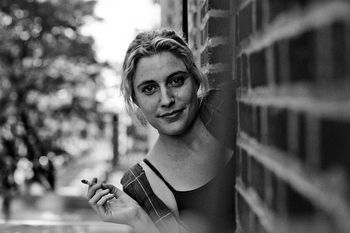
Although I loved children's Saturday matinées, when I got older it would have been unthinkable to see a film in the middle of the day as I associated going to the cinema with darkness: darkness inside and darkness outside. Until I found I wanted to see films no-one else did that were on while the children were at school and Simon was away. Now, every so often, I buy an 'early bird' ticket (always cheaper), disappear into a virtually empty cinema (always quieter), enjoy the film that no-one else wants to see (always easier), and emerge into daylight, blinking and taking time to adjust to the real world. (At weekends Simon comes with me, a happy convert to daytime cinema.)

This week I asked if anyone wanted to see Frances Ha. Maybe my selling technique was a little off ('it's in black and white, about a young dancer in New York, story of female friendship, the Guardian says it's good') but there were no takers, so while Simon was in Nigeria, Alice and Tom were at work, and Phoebe was in Suffolk, I took myself off to Richmond.

I was completely absorbed by the film. The black and white works fantastically well, and New York is the beautiful city of Woody Allen's Manhattan and Annie Hall. But what's really good is that this is a film dominated by a female character who is not defined by her relationships with men, a portrayal of a deep female friendship, with an absence of neurosis and introspection and sex, and a real joy in movement. Greta Gerwig is astonishingly good (and attractive in what these days is a 'daringly' natural way). I imagine Frances would irritate some people, but she manages to combine a rather endearing clumsiness (in social situations and sometimes physically) with a not-too-annoying arrested development, a gift for friendship, a gentle independence and, eventually, the ability to grow and move on. The movement thing is what Frances Ha is all about for me, how she moves through the city and through life. As one critic said, it's Frances Ha, not Frances Ha Ha. For me it's Ah, Frances.
August 1, 2013
ray-stitch workshop
Jane Brocket's Blog

- Jane Brocket's profile
- 27 followers

