
Brendan Halpin's Blog, page 23
August 1, 2011
Some Thoughts on Rizzoli & Isles
At my house, we enjoy a good crime drama. And, as it turns out, we also enjoy Rizzoli & Isles. Or, at least, we've enjoyed the two episodes we've watched.

I like it because the main character, Jane Rizzoli, is a grumpy pain in the ass. Being one of those myself, I have a soft spot for grumpy pains in the ass, and women are rarely allowed to be grumpy pains in the ass on TV. I really can't think of a show that's had a female lead who's a grumpy pain in the ass since Roseanne. And I certainly can't remember a show where a woman as beautiful as Angie Harmon was a grumpy pain in the ass--it's just something you never really see.
So I enjoy the show, but it will always be a guilty pleasure because I have several problems with it.
1.) It's a hokey female bromance. (Why don't women have their own cheerfully derogatory term for things where their friendships are important? That's straight up discrimination! I blame the patriarchy!)
2.)Its tone is kind of light and fluffy, which is to say that the crimes never really feel like the kind of gritty urban crimes you see on other shows or, you know, real life.
3.)Its complete lack of verisimilitude. As a Boston resident, I enjoy the nice HD establishing shots of Boston landmarks that pepper the show. And I'm willing to overlook a lot. I can accept that there's a family of Boston cops where no one has a Boston accent, and where, indeed, the mom has a New York accent and the daughter has a southern accent. I can accept the idea that Rizzoli can live in a very nice apartment in what appears to be the Back Bay or the South End on a cop's salary. I can even accept that they've rigged up a fake Boston Police Headquarters for the establishing shots. But I can't accept the complete disregard for any details that might even vaguely resemble real life in Boston. Here's an example: in a recent episode, our heroines are seen relaxing in a day spa. We later hear that this is "in the arboretum." In the nearby woods, a guy camping in his RV who is a cliche of a hillbilly/trucker type finds a murder victim. Now, I live about a mile from the Arboretum, and I can tell you that there is not a single person within a twenty mile radius of the place who is wearing a trucker cap unironically. It's not that I care so much that there is no day spa and no camping at the Arboretum, but it just seemed like they didn't care enough about the setting to put a character that might realistically be found there on the scene. I mean, look, I'm not expecting The Town every time I turn this on, but if you're going to aspire to a sense of place, you have to follow through by making just the bare minimum of effort to make your setting believable.


July 30, 2011
The Hell With Scrivener
If you hang around writerly types online for more than about twenty minutes, someone will start singing the praises of Scrivener. People will tell you that it revolutionized their process and such things, and if you click over to the website, you'll quickly get the idea that all the cool kids are using it.
42 years old, and I am still vulnerable to this kind of appeal. Pathetic.
So I downloaded the first version and worked for a while on a project that was ultimately rejected by an editor who kept asking for stuff and then turning it down. I didn't really see what the big deal was. I tend to write my way into stories rather than outlining my way in, so all the organizational features didn't do much for me. I wrote a scene that took place outside a particular convenience store, and I was able to have a picture of the store in the pane below while I wrote the scene. Which was kind of cool, I guess. But not 40 bucks worth of cool.
And then time passed and they released another version, and I heard more people sing its praises, and I started work on a project that's more plot-driven than my usual character-driven stuff, so I figured I'd try it again.
While the peer pressure thing was still in play, I fell victim to another part of Scrivener's appeal. If we have a complicated software package to learn, then we must be doing real work! Otherwise, we're just sitting around making up stories!
So I tried it again. With about 40 pages of an existing work under my belt, I started breaking it into chapters. And promptly lost two of them somewhere in the novel template. They may still be there. Or they may have disappeared into a rip in the space-time continuum. Probably if I had invested another 15 minutes or so, I might have found it. So that's one danger. (I had backups.)
Another danger: I was futzing with Scrivener instead of writing. It felt like work, because I was messing around with An Invaluable Tool That Real Writers Use, but I wasn't actually making any progress on my novel.
So, look--you may be one of those people for whom Scrivener is a godsend. Good for you. But if you donwload the trial version and find that it's getting in the way of your writing instead of helping it, I just want to tell you that it's not just you. Maybe this software is just not for you. Guess what: you can still be a real writer without it.
I wrote an outline and saved it in Evernote, and returned to my favorite word processing program, Mariner Write, which I like because it's way simpler and more intuitive than Microsoft Word. It gets out of my way and lets me write.
July 28, 2011
Borders Dies; Can Comic Book Stores Fill the Void?
Back in January, I wrote about why I didn't want Borders to fail. The writing was on the wall at the time, and I'm frankly surprised they made it all the way to July.
As I said, I hope that independent bookstores will rush in to compete for the readers of speculative fiction, but, sadly, I just don't think that's going to happen. Most independent bookstores, which are, I hasten to add, really excellent stores in other respects, maintain desultory speculative fiction sections, and seem to have planted their flag in the sand as not the kind of place where you might discover something fun and pulpy and pay money for it. Unless it's a mystery, preferably involving cats. I don't understand this, but it seems to be the case.
So with the best speculative fiction store closed, who's going to pick up the slack? Comic book retailers, a nation turns its lonely eyes to you. Woo woo woo. Look--you've already got the target audience in your store every Wednesday. You've got a knowledgeable, enthusiastic staff, the great majority of whom are now defying the Simpsons stereotype of the comic book guy and actually seem to like talking to customers. You've got a customer base that likes to come in and talk about what they're reading. Sure, space is tight, but how many of those collectible figurines are you selling anyway?
Just think about it.
July 14, 2011
How to Stay Sane on the Internet
Just because I care, a couple of simple but oft-broken (by me and others) guidelines for staying sane on the internet.
1. Never argue with a troll.
(image via)
I was on twitter venting all my highs and lows during the US vs. Brazil Women's World Cup match, and one of the things I said was that I enjoyed Julie Foudy's commentary. I stand by this--she offers really good insights about strategy that aren't usually obvious to me with my limited soccer knowledge. I got this in return from someone I don't know or follow: "Are you retarded? Her comments are stupid." I guess this was meant to get me into a twitter fight. Which I honestly might have done if the subject were anything I cared deeply about. But, really--there's no point in fighting with someone like that. If they provoke you into a response, they've won. Just ignore it.
2. Everyone's a troll.
It's not just juggalos, objectivists, libertarians, Howard Stern fans, or members of other weird cults who act as trolls on the internets. I just did it myself with that list! For whatever reason, the internet is a repository for a lot of people's excess anger. Obviously some people (me) have more than others, but still-- I think a lot of people vent excess anger they might otherwise direct at people they actually know by firing off some sort of nasty message into the electronic ether. And some of these things are profoundly offensive. And you shouldn't respond anyway. Here's why:
2a. You won't change their mind. I've tried to argue with people before on the internet. You can't make a dent in their preconceptions by arguing with them. I've also tried to start discussions with people, but people who are yelling aren't interested in a discussion. They'll just block you and retreat to their own blog and call you names. (Or retreat to their own blog and passive-aggressively refer to you obliquely in hopes that you'll recognize yourself and get mad and post something else nasty.)
but more importantly
2b. Your disagreement amplifies their message. There is way too much content on the internet for people to keep up with. When you tweet, blog, or facebook your disapproval with a link to the offender, you've amplified their message and made sure that it gets a hearing. I think a lot of us who were young adults in the 90's are trying to apply the lessons of that era to this one, and it doesn't work. It was disastrous to progressive causes in the 90's that people like Rush Limbaugh got away with saying ridiculous crap on the airwaves without anybody challenging them. But now, when everyone is a content provider, there's more ridiculous crap out there than you could ever possibly respond to or, more importantly, pay attention to. Now answering ridiculous crap only serves to legitimize it by giving it a wider audience.
Here's an example. Back when I attempted, in sarcastic, troll-like fashion, to mansplain that women can be both powerful and fallible (apparently untrue--something to do with the patriarchy or something), I got exponentially more hits on my blog than I had ever gotten before because people linked to me in order to say I was a dick. I had said more or less the same thing before in even more dickish, provocative terms, but since nobody cared enough to disagree with me, very few people even saw those posts.
Another example: The Wall Street Journal lady who wrote about how terrible YA literature is because it's dark and depraved. People jumped all over her with the #YASaves hashtag on twitter, and then instead of someone saying something irrelevant in a publication that few people outside of business read because it's hidden behind a paywall, she became a spokesperson for this idea. She then wrote an unrepentant follow-up post (because, see, if you respond to a troll, you prove that they've "touched a nerve," which legitimizes their post in their mind) and got all kinds of media bookings because she was at the center of a controversy. None of this would have happened if she'd just been ignored. But because we responded (yeah, me too), she's been able to say the same thing to a much larger audience than she ever would have gotten if we'd just thrown up our hands and said, "whatever, troll."
July 12, 2011
The Summer I Learned to Fly
As regular readers of this space know, I am a bitter, sarcastic little man, and, as such, whenever I'm sincere, people generally wait for the punch line. So just to clarify: WARNING! SINCERITY AHEAD!
I ask my readers and friends to shout from the rooftops whenever they like one of my books, so it's only fair that I do the same. I'm just going to go onto my porch roof, though, because the actual roof is quite slanted.
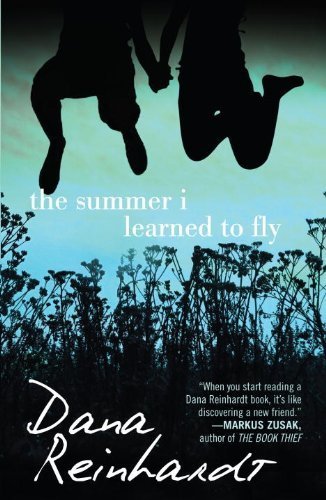
Ahem: The Summer I Learned to Fly by Dana Reinhardt is a really wonderful book! It's out today, and I strongly urge you to go buy it or get it from the library as quickly as possible.
It's difficult to explain what makes this book so special. It's a small, quiet, and pretty simple story about a girl named Drew who works in her mom's cheese shop, has a pet rat, and meets someone extraordinary who opens up her world a little.
So why did I love this book so much? It's nearly impossible to explain because love by definition defies rational explanations. There's just something wonderfully warm and inviting about this character and her world. I was reminded of the way I felt reading the early Harry Potter books: like the world of this book was so cozy that I just kind of wanted to curl up inside it and never leave.
Full disclosue: Dana and I have been friends for years. I'm writing this, though, not out of loyalty to my friend, but out of love for the really tremendous book she wrote. It doesn't have a high-concept hook, and as you can see, it's challenging to explain what makes it so special, but I'm sure I'm only one of many readers who will be eagerly pressing this book into people's hands, saying, "you have to read this. It's wonderful."
June 23, 2011
June 20, 2011
My Message: I Don't Have One.
I've seen a lot of authors recently saying that they don't read reviews of their work. I kind of think they're lying, but in any case, I will say that's certainly not true of me. I read everything people write about my work.
Why? I guess probably some combination of narcissism and masochism. (I'm guessing the percentages are, like, 90-10 there.) But also, I do think that part of my job is to communicate, and I know what I'm trying to get across, and I should check in and see if that's what I'm actually communicating.
So now I'm going to break one of my own rules and respond to some criticism. Or rather, observations. I have noticed, in both positive and negative reviews of my work, people talking about the messages I'm trying to convey.
Here's the thing, though: I'm not every really trying to convey a message. That's not why I write. I write because I like to tell stories to amuse myself, and hopefully other people as well. Of course, I have values and ideas and preoccupations that are going to color what I write. And I often like to have things work out in my fiction in a way that they don't always work out in life. I guess what I mean is that whatever messages come out in my work are messages I'm sending myself, little ways that I'm working out whatever issues are roiling under the surface while I write.
Now, obviously I have to do some soul-searching here. If I'm not trying to send a message, but I appear to be trying to send a message, I'm doing something wrong. So I'm gonna look at that.
But I think some of this comes from the belief, which I ranted about a couple of weeks ago, that fiction written for young people should be instructive. If you believe that YA fiction is about sending messages, then you're going to look for the message. But depicting something is not always the same thing as endorsing it.
I dislike this utilitarian view of art, as I wrote during the #yasaves thing. I have philosophical objections, but my biggest objection is pragmatic: nobody likes stuff that's supposed to be good for them.
Nobody assumes that video games have messages, and yet young people spend tons of money and time on them. The chains stock several more shelves of paranormal romances than any other kind of YA fiction because they sell. Young people buy these books on their own. Because they're not assumed to be "good for you"--they're just assumed to be entertaining.
The disapproval of my middle school English teachers kept me hooked on Stephen King, Peter Straub, and Ian Fleming novels. I felt like I was getting away with something by reading them, not dutifully doing what my elders told me.
I really think that realistic YA fiction in particular needs to shake off this stigma of being instructive. We shouldn't be fiber; we should be that lukewarm beer illicitly consumed in your friend's basement. We shouldn't be vitamins; we should be heavy petting in the back seat. I want people to read our work not because they think they should, but because they think it's going to be fun.
June 19, 2011
Super 8 and Father's Day
My elder daughter and I went for amazing Chinese food at Taiwan Cafe on Oxford Street in Boston last night, and then to see Super 8.
The meal was simply amazing. If you are ever in Boston and have a hankerin' for amazing and very reasonably-priced Chinese food, you've gotta check it out. But I wanted to talk for a minute about Super 8.
This is a really delightful movie. Exciting, funny, and sweet without being maudllin, mostly. There's just so much crap out there that when someone decides to make a movie with some sense of artistry, it's incredibly refreshing. We saw the preview for the next Transformers movie, and the contrast was pretty stark--a heartless spectacle where lots of stuff blows up versus a real movie with real characters where lots of stuff blows up. Suffice to say this is my favorite kind of thing.
But I have a gripe. Of course.
If you haven't seen the movie, I highly recommend it despite my quibbles. It's an excellent movie. Please enjoy the trailer. Everybody else, see you after the trailer.
Here be Spoilers! Turn Back Now!
I am a little sick of the dead mom thing in every freaking movie with a kid in it. Now, it's been pointed out to me that I write about this kind of a lot myself. Which is true. My dad died, and then my wife died, and so this experience is going to inform a lot of my work.
But I did start thinking. What I object to is really not the dead moms. It's the incapacitated dads. My elder daughter and I have a running joke about this hackneyed crap. Dad is somehow completely incapacitated by mom's death and becomes emotionally distant and/or overprotective until finally told off by his offspring in what my elder daughter and I refer to as the "since mom died" speech.
And then there's a big hug and dad realizes the error of his ways.
Well, you know what, the hell with that shit. I was a widowed single dad for a while (still widowed, I guess, or should I say widowed 4 life!, but thankfully not single), and I was crushed, of course, but my daughter was my first priority. I've met several other widowed dads since then, and to a one their focus has been taking care of their child.
Look, I'm sure it happens that some guys can't man up when their wives die. But must every representation of a widowed dad in popular culture be a guy who's completely helpless? I guess we have to accept that as long as people are making art about kids, they're gonna be killing moms, but can we please give the dads their due?
The thing that frustrated me about this in Super 8 was that it was totally unnecessary to the plot. It was a cheesy device to buy emotional resonance that the movie earned in other ways. The mom's death did form a nice backdrop for the love story, but the dad didn't need to be such a feeb.
And the kid's speech to the alien was, for me, the one false note in a movie that otherwise felt real. "Bad things happen! But you have to live!" Criminy. I nearly barfed. Sure, it wasn't as bad as the "I love you, E.T.!" moment that completely ruined that movie, but it was bad. As was the last shot. What the hell are we supposed to make of that? The kid's not allowed to keep a keepsake of his mom?
I definitely recommend this movie, but the lazy reliance on hackneyed plot devices with the dad and the dead mom really undermined what was, in most other respects, a really delightful movie. By the way, the kids' performances are all amazing.
June 14, 2011
The Best Coffee I've Ever Had
You'll periodically see things about how writers love their booze. Perhaps, though my informal observations of my writer pals, both in real life and on the internets, show that writers have another favorite beverage: coffee.
Maybe Raymond Chandler could bang out thousands of words of hardboiled prose with a bottle of hooch by his side, but I think that would have me asleep over my keyboard before long. No, when the writing gets tough, the writers get caffeinated.
So it's probably not surprising that I'm in love with my new coffee maker.
I am always asking people to tell the world on facebook, twitter, goodreads, and random streetcorners if they like one of my books. So I think it's only fair that I should praise the aeropress in a public forum.
Here's how good it is: I no longer like getting coffee at coffee shops because it's not as good as what I can make at home.
But I'm getting ahead of myself. It may, perhaps, seem unlikely to you, as it did to me, that the people behind the Aerobie, the Megatop, and the Rocket Football should be the ones to make the best coffee maker on earth. And yet it is so.
You can look at their website for all the technical reasons why this is an awesome coffee maker; I'll just tell you what I like.
1.) It's quick. I've long been a french press partisan, and this cuts the time from turning on the stove to enjoying the coffee at least in half.
2.) It's clean. Funnel the grounds into the aeropress and then pop 'em out in a nice little hockey puck straight into the trash or compost!
3.)The coffee is freaking fantastic.
As I tried to write this, words failed me, so I made a video. I have no commercial interest in the Aeropress; I just like it so much I made a free ad for it. Which is what I often ask you guys to do for my books, so fair is fair, as The Legend of Billie Jean reminds us.
June 6, 2011
My Response to the WSJ: Ars Gratia Artis
For those of you who were not on the twitters this weekend, a quick recap: Some bluenose wrote an article in the Wall Street Journal tut-tutting about YA literature and how dark it is, and isn't this horrible, there's swearing in those books, and people write about unpleasantness. Won't someone think of the children?
I got a kick out of the article. (Which I'm intentionally not linking to--I'll explain) I figure any time you can piss off someone like this, you're doing something right. I guess I feel if the art you're making is worth a damn, someone's going to dislike it. I'm thrilled and proud to be working in a genre that causes out-of-touch puritans to get the vapors.
But it seems that many of my colleagues in the YA fiction arena weren't so tickled by the disapproval of a humorless prude. They rose up as one and began composing blog responses and got a hashtag trending on twitter: #yasaves. Most of the tweets illustrated ways in which YA fiction has touched people. Many were quite moving. It is very gratifying to know the work we do can touch people's lives. And yet, I still think this defense cedes important ground to people like the author of the Wall Street Journal article.
Because once you start insisting that your art is useful, you've agreed to the idea that art needs to be useful in order to be valuable. I think this tacit agreement that art needs a pragmatic purpose leaves you open for many more attacks.
And, furthermore, once you start arguing that something intended for teenagers is good for them, you're likely to alienate your core audience. Teens are, in general, not known to flock to stuff labeled as good for them.
Also, when you link to an article you disagree with, you amplify its effect. The Wall Street Journal is important in the worlds of business and technology and completely irrelevant to any other aspect of our culture. I don't know a single person who's ever so much as referred to a movie review in that publication, much less an article about books. I never would have read this article if some well-meaning YA author hadn't linked to it.
Here's my response: art is its own justification. Art is not utilitarian. If you want something utilitarian, go buy a shed. We needn't insist that our art serves an important purpose. Art is valuable because it's art. If you don't like it, watch, read, or listen to something else. Or, as Kurt Vonnegut memorably said in a work of art that I enjoyed as a teen: "go take a flying fuck at a rolling donut! Go take a flying fuck at the moooooooooon!"


