
Brendan Halpin's Blog, page 19
April 30, 2012
Diversity in YA: Live Authentically to Write Authentically
Today my fellow YA author Sarah Ockler, responding to a piece in The Atlantic (or on one of their blogs, or something), wrote this piece with advice for white authors about diversifying YA fiction.
I respect Ms. Ockler's intentions but must respectfully disagree with her prescription for increasing diversity in YA literature.
I think that you don't see many white YA authors writing with very diverse casts of characters because it's pretty easy for people in this country to live lives that don't have very diverse casts. Despite the diversity of the country in which we live, I think many many people live in bubbles in which they don't really know anybody who isn't like them.
I think that it's going to be difficult for you to write fully-developed, three-dimensional characters from another background if you don't know any people like that in real life.
I'm not saying every author should move to the city or anything. There are parts of the country where it's pretty difficult to find diversity, and I don't think living there disqualifies you from writing fiction or means that you don't have important stories to tell.
But I think that writing a diverse cast of characters out of a sense of obligation is going to end badly. Look no further than Ender's Game, where Ender's friendship with a black character is handled so clumsily that it's really painful to read. (Basically Card, who is a hooting loon of an anti-gay bigot who has issued veiled threats of anti-government violence and therefore should not be getting any more of your money anyway, imagines that the way white people can show they're not racist is by throwing the n-word around and making slavery jokes with their black friends. I am not making this up.)
I actually think it's worse to write stereotypical, inauthentic characters than it is to have a cast of characters that's not diverse.
We write to reflect the world we live in and to imagine the world we'd like to see (as I wrote so eloquently here). I don't know how anybody else's creative process works, but when I've written casts of characters who aren't entirely white, it's because it fits the story and the setting, but also just because in some indefinable way, it feels right. I don't mean right as in "the right thing to do," I mean because, at the risk of sounding precious, the characters tell me that they're not white. Or middle class. Or heterosexual. Or whatever. I don't know this for a fact, but I strongly suspect that this happens more often when the people in my life aren't all exactly the same.
So I guess what I'm saying is this: I'd recommend against writing a diverse cast if you are only doing it because you feel like you should and you're fundamentally uncomfortable with it. And I suspect that the more different kinds of people you get to know, the more different kinds of people you'll be able to write.


April 21, 2012
Under the Big Black Sun
Not all the music we loved as teens ages incredibly well. Or maybe it's that we don't age well. The music may be just as awesome as ever, but we aren't the same people, so it doesn't speak to us as well. Morrissey said this better: it's in "Rubber Ring."
So I have to confess that, though I would surely have listed them as my second-favorite band in high school, I haven't listened to X all that much in the last ten years.
Today I figured out why.
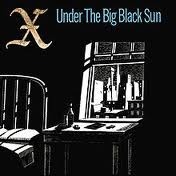
I listened to Under the Big Black Sun for the first time in a long time. This was one of those albums I used to listen to over and over as a teenager and just marvel at. I remember wondering if they knew how good it was when they were making it.
So why haven't I listened to it much in the last decade?
Because it's about grief, and it's too damn good.
It's raw and polished at the same time. It's mournful and angry, and it captures the experience of grief better than just about anything I can think of. It helped me to unlock my grief over my dad's death when I was a teenager, and I think I haven't listened to it in so long because it cuts a little too deep.
I keep trying to write regular music geek stuff about how awesome the guitar sounds on this album or how there are no bad songs or how it's perfectly sequenced or how it's perfectly produced, but I keep tripping over myself because this album hits me harder and deeper than that.
I set out to write about a great album and found myself at a loss for words. All I can say is that this is a kickass record that is just more true than almost any other.
All four original members of X are still alive, so John Doe, Exene Cervenka, Billy Zoom, DJ Bonebrake: if you're out there in internet land, thank you for this record. It means more to me than I can say.
April 19, 2012
Ann Patchett Doesn't Want Your Business
As you probably know, there was no Pulitzer Prize for fiction this year. Or, as I like to tell people, I tied with Jeffrey Eugenides in Pulitzers this year. Boo-ya!
I don't really care about the Pulitzer Prize, but Ann Patchett does. Ms. Patchett is a bestselling author who opened a bookstore in Nashville, and yesterday she wrote in the New York Times about why it's terrible that there's no Pulitzer for fiction this year.
I guess literary fiction heads take this stuff very seriously, which is cool--I'd probably be shocked if there were no Printz award. Or no Newbery. Or no Nebula. Or Hugo.
But I do take issue with one part of Ms. Patchett's essay: With book coverage in the media split evenly between “Fifty Shades of Grey” and “The Hunger Games,” wouldn’t it have been something to have people talking about “The Pale King,” David Foster Wallace’s posthumous masterwork about a toiling tax collector (and this year’s third Pulitzer finalist)?
Let's put aside the fact that the Times' copy editors are apparently okay with this misuse of quotation marks. It seems that Ms. Patchett lives in a world where David Foster Wallace is not the most overrated novelist ever, which seems like a place I would like to visit, but here's my issue: this is in the part of the essay where Ms. Patchett is explicitly talking as a bookseller.
In other words, if you go into Parnassus Books in Nashville, you can probably buy a copy of The Hunger Games or Fifty Shades of Grey, but you can do so secure in the knowledge that the owner of the store doesn't really want your business and thinks you're kind of a rube for not reading literary fiction.
This sentence in the essay reminded me the scene in High Fidelity where the asshole clerk (Jack Black in the movie) abuses a guy who comes in looking for a copy of "I Just Called to Say I Love You."
I mean, Ann Patchett has gotten a lot of ink for opening this bookstore, and she's saying in the national press that she doesn't really want to sell the books that people actually want to read.
Of course it's her money and her store, so she can do what she wants. But I'd rather not read another article about how this heroic business is making a brave stand against corporate hegemony and blah blah blah when it's clear that, businesswise, Parnassus is shooting itself in the foot.
If you think customers won't catch your dispproving vibe when you want to buy The Hunger Games instead of David Foster Wallace, then clearly you never tried to buy a copy of The Fury of Firestorm at a comic store in the 80's. Or a pop record at a used record store.
In other words, if your own snobbery is costing you business, then you can't really complain about evil corporate overlords shutting you down with their predatory business practices. The community-building aspects of bookstores are written about a lot, and are, I think, a lot of the reason people shop there. But if you're implicity or explicitly excluding people from that community, well, don't be surprised if they place their order from a business that won't judge their taste.
April 10, 2012
Ashley Judd is a Terrible Writer
So I started a Facebook fight yesterday. I regret this action because a) I pissed off somebody I like and respect and b) I always feel bad when I indulge my urge to be a jerk. I do enjoy arguing with smart people, but, you know, I should probably find a better way to release my anger.
It all started because of this Ashley Judd piece that many people are sharing today.
I said some things I regret, but one thing I don't regret saying is that this is a really bad piece of writing.
Now, I agree with most of what Ms. Judd is saying in the piece. But it's just so badly written that it's not going to reach anybody who doesn't already agree with it. I see this as a flaw in a piece published in a mainstream publication.
My friend Roxy admonished me to remember that I'm not Ashley Judd's writing teacher, which is true. But if I were, I would tell her this: "Your good ideas are being obscured by your overly complex prose."
I think this piece falls victim to a pretty common writing fallacy: the idea that throwing a lot of big words around and stringing a bunch of clauses together is the same as writing well.
The trouble starts in sentence 3: "We are described and detailed, our faces and bodies analyzed and picked apart, our worth ascertained and ascribed based on the reduction of personhood to simple physical objectification." Now, look. I went to college. I can decode prose this dense. I can even admire the mastery of parallel construction. But I don't want to work that hard. The fact is you can say the same thing in a much simpler, clearer way.
Being clear is not the same as dumbing down. Expressing your ideas in a way that allows people to grasp them easily is elegant and intelligent, not dumb.
Here's another terrible sentence: I ask especially how we can leverage strong female-to-female alliances to confront and change that there is no winning here as women.
This is a clunky, wordy, inelegant sentence. (One hint: saying "leverage" when you mean "use" is a bad writing red flag.) I would demand that any of my students revise it. It's just an example, but the whole piece is like this--barely readable, stuffy, self-consciously wordy prose.
And what I was trying to say, but failed in the heat of verbal facebook combat, is that I think it's important that ideas like this (essentially: it's pretty screwed up that we, including women and girls, view appearance as the only important thing about women and are so nasty about it) reach people who don't already hold them. And this piece is not going to reach a single person who doesn't already agree. If you agree, you'll suffer through the pretentious, awful prose to have the opinions you already hold validated. And if you don't, you'll just click on the next article.
Ashley Judd is, as far as I can tell, a competent actor. She does decent commentary on Univeristy of Kentucky college basketball. And she is a really terrible writer.
April 9, 2012
Why I'm #TeamTessa
Over the last week or so, supporters of Veronica Roth's Divergent series have been carpet bombing twitter with tweets in support of Team Dauntless, which I assume has something to do with the novels, which I haven't read. I'm sure they're good and wish Veronica Roth well with Divergent, its sequel, Insurgent, and the forthcoming third part of the trilogy, Detergent. Okay, I made the last one up.
I love the energy and enthusiasm of Roth's fans and am not here to hate on anybody. I saw Team Edward and Team Jacob stuff during the height of the Twilight craze (which, judging by the derisive laughter that greeted the Breaking Dawn trailer when I saw The Hunger Games, may have peaked), I saw Teem Peeta and Team Gale stuff for The Hunger Games, and now we get Team Dauntless. There may be another team associated with Roth's book, but I haven't seen anyone supporting it.
All these great public shows of support for team this or that gave me an idea. In Tessa Masterson Will Go to Prom, some characters wear Team Tessa shirts to show their support for an inclusive prom at their school.
I was listening to the Savage Lovecast the other day (as I've said before, anyone who is or wants to be sexually active should definitely listen) (link may feature a not incredibly SFW ad), and, in discussing the verdict in the Tyler Clementi case, Dan (we appeared in the same anthology. Also he once answered a question of mine on the lovecast. So we're pretty much besties) said that the kid who harassed Tyler Clementi was essentially being scapegoated, and that the blame for Tyler Clementi's hopelessness and suicide lay with the society that consistently dehumanized and degraded him for being who he is.
I was pretty moved by this. So here's my idea. I've created a Team Tessa twibbon for my use and, hopefully, yours, during prom season. But you don't have to do that. I'd love it if you could just signal your support for the idea with the #teamtessa hashtag once in a while. Signing on to Team Tessa means you are supporting inclusive proms and the following beliefs:
1.All people--gay, straight, lesbian, bi, trans, queer--are valuable.
2.Loving who you want and being honest with the world about it is a fundamental human right. 3.Wherever people are dancing, everyone should be allowed to dance with anyone who will have them.
That's it.
It's my hope that if this catches on, we can send a message to all kinds of teens, not just that it's going to get better (which is a valuable message that I totally support) but that there are people right now who support their right to be who they are and who think the world might be a better place if we all got together and danced.
I'll be monitoring the #teamtessa hashtag, and I'll try to retweet anything that looks of interest--i.e., prom controversies we might want to be aware of.
Even if you choose not to publicly sign on to Team Tessa, I hope that if you support these ideas, you'll find another way to make your support public.
April 7, 2012
Thoughts on the Hunger Games Movie
Just back from seeing The Hunger Games with my elder daughter. We both really enjoyed it. Here are some thoughts:
Things I didn't like:
As in the book, my problem with the whole scenario is that Katniss is never put in the situation where she has to kill a sympathetic character. I think both book and movie want to have it both ways, in that we are never put in the scenario where we have to root for a character who does something awful. Which is pretty much what the setup demands. Battle Royale is inferior to the Hunger Games in almost every way, but this is one way in which it's better. We're forced to confront the ugly realities of the scenario rather than denying them.
Also, the fight sequences in the movie are horrible. This seems to be a new thing, and let me just say I freaking hate it. People start fighting and the camera goes crazy, herking and jerking all over the place so that you don't have any idea what's happening. What the hell is the point of that? If you're going to obscure it with your convulsive camera, why film combat at all? Why not just report on stuff that happens offscreen?
Boring love scene in the cave that brings the entire movie to a screeching halt.
Ways in which the movie was better than the book:
Yeah, I said it. But two. One: the movie is a little more explicit in indicting us for enjoying the spectacle of these kids fighting to the death. In the book, I felt we were absolved for enjoying it as an adventure, but the movie, with its constant cuts to the actual show and the behind the scenes people running it, reminds us again and again that we are just like the people in the story who watch this for entertainment.
Also, in the book, the boringass love triangle is pretty clearly an actual love triangle, but in the movie, it's never quite clear whether Katniss really likes Peeta or is just feigning her affection for the sake of ratings (and sponsors and medicine and such). In the movie we see her becoming not only a fierce competitor and survivor, but also way more media savvy as the movie progresses. I liked this. I figure the tiresome love triangle will become more actual as the sequels arrive, (Haven't read the sequels) but for now, I really liked the fact that we couldn't tell whether her affection for Peeta was just one more way in which Katniss is using all the tools at her disposal to survive.
Conclusions:
The movie is very well done and definitely worth seeing.
As in the book, the world building is incredibly halfassed. As in the book, the action is good enough that I didn't care.
Finally, Stanley Tucci is freaking awesome.
April 5, 2012
Twilight Was Porn Already
So I've been hearing a lot about 50 Shades of Grey recently. You know, the Twilight fanfic turned porn sensation? (I refuse to use the term "erotica." As near as I can tell, all that means is "porn without pictures.")
Now, I know that Twilight didn't feature explicit sex until the marriage, but it's pretty clear to me that it was porn already.
That is, as long as we use my definition of porn, which everybody should: "A work of art whose primary purpose is the depiction and/or fulfilment of a fantasy and that is risible or repulsive to anyone who doesn't share that fantasy."
I like the word risible.
Sure, my definition is expansive, but I think you'll find it very accurate. And I think you'll find it describes the entire Twilight series pretty well. A plain girl with a sour disposition has incredibly hot and just-dangerous-enough-to-be-enticing boys fighting over her!
Risible, I say!
Of course, my definition then encompasses pretty much the entire Conan oeuvre of Robert Howard (Guy first kicks and then gets a ridiculous amount of ass. Guess this probably covers James Bond too.) I have enjoyed both.
It also covers Pride and Prejudice, one of the most frankly pornographic novels I've ever read (again, using my definition): Oh, there's a bad boy, but he's really nice inside. And only the snarky, bookish girl can tame him!
Risible.
My friend Kevin calls shows like Burn Notice, which I love, "competence porn," because we watch them in order to fulfil the fantasy of being really good at something. I suppose Sherlock Holmes, and, indeed, most detective fiction falls under this definition as well.
All of which is to say, we're surrounded by porn all the time, and we all enjoy different kinds. What's fantasy fulfilment to me may be risible to you. Which is okay. So perhaps those of us who find Twilight and its fanfic offspring repulsive should be aware that we've got our own risible porn on the bookshelf. And people who are into Twilight and more sexually pornographic variants thereof should understand why other people find it risible.
March 30, 2012
Wearing A Kilt To Prom? Illinois High School Declines Student's Request
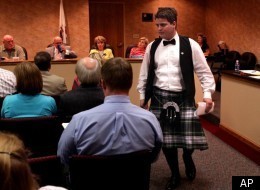
A senior high school student in southwestern Illinois will be resigned to wearing pants to his prom, after a Tuesday decision by the school board banned him from wearing a kilt to the event.
William Carruba would have preferred to wear a kilt to honor his family's Scottish-Irish roots, but the Granite City School Board, instead, argued that the garment is "nontraditional" and not in line with the district's dress code, the Associated Press reports.
Wow. So prom is the place where people want to make a stand for conformity. But this is why the issue at the heart of our book is important. It's not just the freedom for gay, bi, and trans kids to go to prom as who they are that's under attack; it's everybody's freedom to be themselves. I got married in a kilt (what can I say, my calves are my best feature). I'm glad the fearful, angry people behind this decision didn't have a say.
March 29, 2012
In Defense of Fairy Tale Endings, or the Dori Bangs Manifesto
Early reaction to Tessa Masterson Will Go To Prom has been the most positive I've received in my career. Reviews--whether in print or blog or goodreads form--have been really nice.
And I can't even take issue with the caveat, that some people have raised, which is that the book has a fairy tale ending.
Damn right it does.
Now, it's my hope that the ending of this book is credible in the world of the book. But I know very well that this kind of thing doesn't really happen in real life. The same could be said of the endings to many of my books. My novels often, though not always, end with some big event, often involving music, in which everything comes together and works out better than any of the characters might have hoped.
And my ability to do such things is one of the main reasons I write.
I have a real life. I am not interested in writing, or, for the most part, reading novels that are an accurate reflection of real life. Real life is wonderful and beautiful, but also unspeakably cruel and unfair. And it too often falls on the cruel and unfair side.
So, yeah, you could depict that realistically, but the hell with that. We've got that reality already. One of the main things I like about writing is my ability to make things work out in a way they rarely do in real life. I don't mean everything has to be unicorns and rainbows and pretty princesses--I think it's important to acknowledge the darkness and horror of this life. But I want beauty and wonder to triumph over it in spectacular fashion. Because in real life, they usually don't.
That may or may not be your taste, but it's mine.
Bruce Sterling summed it up better than I could in the story "Dori Bangs", which has stuck with me for decades as few other stories have:
"Two simple real-life acts of human caring, at the proper moment, might have saved them both; but when those moments came, they had no one, not even each other. And so they went down into darkness, like skaters, breaking through the hard bright shiny surface of our true-facts world.
"Today I made this white paper dream to cover the holes they left."
I am, in many respects, incredibly fortunate. I've also got a lot of holes in my life. Maybe you do too. Nothing can ever fill them. But if we have white paper dreams that can, even for a moment, cover them up, maybe we needn't be crushed by life's cruelty.
That, of course, is not the only thing art is for. But it's one of them.
March 22, 2012
Enough Advice for Writers, Already
Just looked at twitter saw the umpteenth tweet from an agent or editor whose ostensible purpose was to give friendly advice to writers but whose pretty thinly-veiled subtext was "a writer just did something to annoy me."
Look: everybody gets annoyed at work. I totally understand the urge to sound off on this stuff publicly. But here's what bugs me. Agents and editors never sound off on stuff they do to annoy each other. And I'm sure that agents and editors annoy each other just about as much as writers do.
So what's the deal? Well, agents and editors need each other and don't want to burn bridges. They need writers too, but there are a lot more writers than agents or editors, so burning a slush pile bridge here or there is not going to hurt an agent or editor's career the way a thinly-veiled dis of a colleague they're trying to sell something to or buy something from will.
Here's my plea to agents and editors on twitter: Continue to sound off on stuff that annoys you. It's part of what makes twitter fun. I even get that you're going to sound off on people who have less power than you but not people with more power than you. That's just career smarts.
But for the love of God, can you please stop framing this stuff as helpful advice? It's carping, and that's cool--carp away! But please stop pretending it's a public service. Thanks!


