
Brendan Halpin's Blog, page 18
July 24, 2012
Some Thoughts on Being Pirated
Today I discovered that Tessa Masterson Will Go To Prom has been pirated. No, I'm not linking. But if you wish to steal an electronic copy of this book, you can now do so pretty easily.
If you'd like to read the book for free, I totally get that. I do not have the money to buy all the books I want to read. Fortunately, the library exists. These folks, not some self-satisfied, website-running douchenozzle, are the real guardians of literacy and culture. And they paid for their copy of the book!
Now, I suppose that the fact that you can steal my book without leaving your living room might lead people who otherwise wouldn't take a chance on my work to seek out other books to buy. This is the most common argument advanced by the "stealing is okay if you do it digitally" people.
It's not without merit. I, like many people, have wound up buying work of authors whose books were given to me, or musicians I first heard on a cassette tape recorded by a friend (yeah! I'm old!).
At least on the internet, the "everything should be free" people have dominated the debate. And the fact that they are loud and passionate doesn't mean they are always right.
If you havent read David Lowery's excellent blog post, I recommend it. He lays out the costs to musicians of an entire generation not paying for music. And musicians have two other revenue streams (merch and live performances). Book theft concerns me because the book is our only revenue stream. If people don't pay for the book, we don't get paid. Period. Yes, I want readers, and I'll get more if they can read some of my books for free. Which is why, as I stated above, the library exists. And also why it's awesome to have friends who will lend (i.e. give, because lent books rarely come back) you books!
Which leads me to this: I think, maybe, Amazon and the big six publishers did us all a huge favor with their widely-derided DRM on Kindle books. Because they helped shape our idea of ebooks as something you pay for.
Back to music: for most people who were alive and buying music at the time, their first experience obtaining music on the internet was through Napster or some other file-stealing service. Me too! I heard about Napster when I saw it on the desktop of the IT guy at a school where I worked. I installed it and downloaded some Prince bootlegs. And then the IT guy yelled at me for installing Napster. True!
There was no legitimate alternative at the time, and it was just so freaking easy: type what you want into the search box and click to download. My generation was primed for this experience by the analogy to cassette tapes: we had all given and received mix tapes, so how was this different? (it was trading a perfect copy, not a copy that lost sound quality and lived on a medium that degraded every time you played it, but whatever--free music!) The generation after mine just learned that this was how you got music on the internet. By the time the itunes store came along, and it was finally as easy to buy digital music as steal it, a bunch of people had already been lost to file stealing.
When Amazon introduced the Kindle, they included DRM that made it harder (but not impossible, as any of the "everything should be free" people will tell you) to free the book from the Kindle. This meant that ordinary users, who have neither the time nor inclination to go poking around under the hood, couldn't share infinite perfect copies of their Kindle books. So there was no way to set up an immediate and easy file-stealing network for books.
Even now, with DRM mostly gone, the pirate sites are nowhere near as good as the legitimate ones. So we've got the exact opposite of what happened with music: the first generation to get ebooks saw them as something you have to pay for.
And yes, this was a service to publishers and online retailers, but it has benefitted authors as well. Ebooks are a big part of the revenue stream. I'd have to check this to be sure, and I'm not going to bother right now, but my memory is that Jenna and Jonah's Fauxmance sold more electronic copies than physical copies. And I got paid. Because of big bad Amazon and big bad publishers set up bad bad DRM and convinced consumers that they should pay for ebooks.
On the internet, it's mostly taken as a given that DRM is evil. But I think it may have saved publishing and even allowed the self-publishing boom.
I'm inherently suspicious of big corporations, but in this case, their interests dovetailed with mine. And I think we really need to think and talk about how artists are going to get paid for their work. "I want all the stuff for free" has pretty much dominated the conversation up to this point. And that's awesome on the consumer side and horrible on the production side.


July 13, 2012
Penelope Trunk, Jessica Park, and Me.
Every couple of weeks, the web seems to blow up with an anti-traditional-publishing piece. This week, it comes courtesy of Penelope Trunk, who writes a very fishy, scarcely-credible screed about how New York publishers are idiots because they don't have her genius for promotion, blah blah. It's a pretty brilliant sales piece masquerading as a blog entry. "Yeah, fight the power!" you can think as you plunk down 6 bucks for a 50-page ebook. That a major publisher agreed to publish. And then let Penelope keep the advance when she pulled it. Three months before publication when there weren't even any galleys printed yet. Riiiight.
A couple of weeks ago, it was the "How Amazon Saved My Life" blog entry, which at least has the ring of being a true story but is peppered with nasty little jabs at those evil New York publishers.
Perhaps because I'm a teacher, which is to say, a member of another group that is routinely vilified by people who think they know more than they do, I feel the need to stick up for traditional publishers. Which is not to suggest that self-publishing ebooks is bad--I'm gearing up to do it myself--but I don't think traditional publishing is as evil as these and other pieces suggest.
Let me start out with something that should be obvious. Pretty much every book you've ever loved that came out over five years ago was bought, edited, and promoted by those idiots in traditional publishing. Just ponder that for a second. So yeah, sometimes they're a little timid. Sometimes they work too hard to chase the next bestselling trend. Sometimes they look at sales records over the actual content of the work. Sometimes they put out books by Snooki. But those hidebound old-media dinosaurs have actually served you pretty well as a reader.
I'd like to address this especially nasty shot from Jessica Park's piece: You’re eating Ramen noodles while they are taking all of December and January off and while they essentially shutdown during the summer to vacation on the Cape? First of all, you've used the noun "shutdown" when you meant the verb phrase "shut down." But also, this: publishing doesn't actually pay very well. The great bulk of the work is done by underpaid assistants who struggle to make ends meet by selling the books they get for free to The Strand. It is ridonkulously expensive to live in New York, and the great majority of people who work in publishing houses are not getting rich doing it. I had an editor--not even an assistant-- at a major house say this to me once: "I had to work from home today because tomorrow is payday and I don't have train fare." Publishing is like teaching in that only idiots go into it for the money.
Let's examine the other big theme in these pieces: these idiots don't understand promotion. They have no idea how to sell books.
Fair enough, but here's a little shocker for you: neither do you. Because nobody does. Books sell mostly through word-of-mouth, and nobody knows what makes some books catch fire and others not. Publishers would be thrilled to make more money. So if they knew how to make every book a bestseller, they would.
Here's a little example from my own experience back in the pre-ebook era. When promoting It Takes a Worried Man, I had an excerpt in Ladies' Home Journal and a piece in Rosie Magazine. (which was a thing at the time). I got a rave review in People Magazine. I was on the Today show. I was on The Rosie O'Donnell Show. I was on All Things Considered. Really, publicity-wise, it could not possibly have gone better unless I'd been on Oprah. And that book sold 5000 copies. Why? Whose fault was that? I have no idea. Was there too much swearing in the book? Was the cover bad? Are people just too scared of cancer to read a non-Chicken Soup for the Soul kind of book about it? Did Dave Eggers' debut sate people's appetite for sarcastic but soft-hearted memoirs by caregivers? I have no idea. Nobody at Random House has any idea either.
If you get a book published by a major house, you probably won't have the success of a Stephen King or a Suzanne Collins. And you'll never know why. If you self-publish, you probably won't have the success of a J.A. Konrath or a-- um, anybody else who's a big self-publishing success. And you won't know why.
I mean, don't get me wrong. I wish you, me, and everybody else all the success in the world in their publishing endeavors. But the people who are wildly successful in either self-publishing or traditional publishing are outliers. And no one can explain their success.
Publishing is in flux right now, and nobody knows what's coming. And yes, probably traditional publishing houses are dragging their feet a little bit in terms of adapting to the new environment. But I just want so say something against what I think is a pernicious idea embedded in all the self-publishing hype: the idea that you can control your own fate.
This is a pretty American kind of idea that's promoted all over the place and skewered brilliantly by Barbara Ehrenreich in Bright-sided, which I recommend to everybody. The idea is that limitless success is within your grasp if you're only willing to think positively enough and work hard enough. But that's not true. Luck plays a huge part in anyone's success and in many people's failure. You may well find greater satisfaction in taking the reins and guiding your own writing career, and if so, good for you. But just don't torture yourself wondering what you could have done better if the book doesn't catch fire.
It's pretty terrifying to think that we live in a chaotic world that is beyond our control. But I'm always very suspicious of anyone who tells me otherwise.
July 5, 2012
Your Irregular Update on My Writing
Hey everybody! I hope everyone is having a fantastic summer. I wanted to take time out from my normal ranting about pop culture and the ongoing fraud calling itself education reform in order to update everybody on what's happening with my writing.
Definitely Getting Published:
Tessa Masterson Will Go To Prom, co-written with Emily Franklin, is probably the best-reviewed book of my career. Our publisher, Walker Books, recently announced a paperback edition (yay!) along with a fancy new cover.
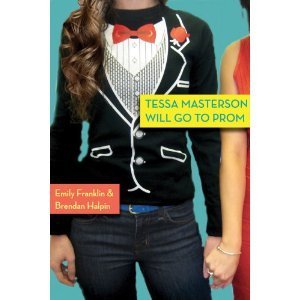
The paperback arrives in April 2013. Mark your calendars! Also, I keep wanting to call my BFF Dan Savage* to tell him what a great book this is for LGBTQ youth, but I can't figure out a non-awkward, non-terrible way to go about this. If you've got any bright ideas, let me know. Also looking for non-awkward non-stalkerish ways to get Molly Ringwald to read my Breakfast Club 2 script, if you've got any of those.
*BFF here defined as "we once had essays in the same anthology, and he answered one of my questions on the Lovecast." (Not telling which one. Except it wasn't the pie fight fetish one.)
Escape from Assland, co-written with Trish Cook, is currently in the copy-editing stage and will be coming from Egmont USA in 2013. It's about two kids at a therapeutic boarding school who...well, no spoilers. But it's fantastic. And so far they actually haven't asked us to change the title. I have no idea why.
Regular readers may recall that Forever Changes has gone out of print. But fear not! My artist is putting the finishing touches on a new cover and I'm going over my electronic copy to make sure its perfect, and this, probably the best thing I ever wrote, will be coming back as an ebook, available everywhere I can make it available. Stay tuned!
Also, for the young superhero fan in your life, you might check out The Amazing Spider-Man Storybook Collection. It's a huge bargain full of cool stories and art, and I wrote the Black Cat story. True!
Hopefully getting published (yeah, yeah, you shouldn't use hopefully that way, blah blah nobody cares.)
I have two novels currently in the hands of the smartest, best-looking, and most capable and competent editors in the entire world as we speak, awaiting offers which they are certainly just about to make.
The first one is a YA noir superhero novel called Enter The Bluebird. It's definitely one of the best things I've ever written and a real departure in both style and genre.
The second is a horror novel set at the Jersey Shore (no, it does not involve any cast members from that show being dispatched in bloody and awful ways, though a sizable number of people seem to wish this was the case). It is a ton of fun and will probably appear under the name of my good friend Seamus Cooper.
Still Being Written
1. Working on a novel with Trish Cook. We're only about 20 pages in, so I don't wanna say too much lest we lose the creative mojo we got workin'. But I'll just say we're having a ton of fun with it.
2.Working on a novel with Emily Franklin. We're also about 20 pages in, so similar superstitious claptrap about mojo apply. It's apocalyptic, though.
3.Working on a novel by myself. It's about a girl who changes schools after a bad experience and quickly finds that things at her new school may be even weirder. About 40 pages in on this one.
Thank You
As always, thank you to everybody who has bought or checked out or borrowed or otherwise obtained one of my books. Thanks also to everyone who has recommended one of my books to someone else, either in real life or on the internet. I've said this before, but you folks are my unpaid publicists (so maybe you could call yourself interns!), and your work on my behalf is awesome and critical. And thanks also to everybody who has let me know that one of the stories I made up has touched you in some way. I appreciate your support more than I can possibly convey here. I hope to have more good news to share with you soon!
June 29, 2012
The Genius of Steve Gerber
I have recently been spending time rereading the Essential Man-Thing collection. And it's caused me, once again, to ponder the genius of Steve Gerber.
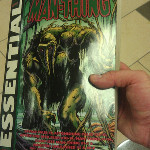
If you're unfamiliar with Steve Gerber, here's the wikipedia entry. He wrote comics in the 1970's and 80's, and he brought this sense of madcap glee to just about everything he did.
In an era when mainstream comics were pretty much superheroes, romance, or horror, Steve Gerber brought the sui generis Howard the Duck, which is about a gruff, cigar-chomping duck from a world of talking ducks who finds himself trapped in a world he never made, driving a cab in Cleveland. And enjoying a cross-species romance with a young woman named Beverly. He fought a giant gingerbread man, a bell-headed, clapper-armed villain named Dr. Bong, and the rampant stupidity of the "hairless apes" (as he referred to us) all around him. Howard also ran for president in '76 under the auspices of the All-Night Party.
Howard was spun off of a brief appearance in a Man-Thing story which Gerber also wrote. Man-Thing is an empathic former scientist who is comprised of swamp muck. He goes around doing good and occasionally tripping through dimensional rifts, because apparently there are several in the Everglades, and burning the crap out of people he grabs because "whatever knows fear burns at the Man-Thing's touch!"
Man-Thing spent a lot of issues fighting the plans of evil developer F.A. Schist to pave the swamp and put an airport in. The narration (extensive, since Man-Thing can't speak) is portentious, the action is wacky and usually preposterous, and the whole thing winds up being an environmental parable and a satire of society that still resonates to a sometimes uncomfortable degree nearly 40 years later.
There's one story involving a dimensional rift when a whole buch of people from different dimensions are assembling, and Daredevil and Electra swing through a hole in space time, have a brief conversation, and swing back out. This is the kind of crazy shit that happens in Gerber's stories all the time.
For me, Gerber-written comics are everything that comics can be: over-the-top, hilarious, thought-provoking, and, most of all, tons of fun. Honestly, although I love comics, I don't think I've ever read anyone else's work that I've liked as much as Gerber's.
I hope to one day write something as completely awesome as Gerber's run on Man-Thing. (Actually, I'd really like to write a Man-Thing reboot, so, um, Axel Alonso, if you're reading, totally call me. ) I don't think I've done that yet, but Gerber's funny, idiosyncratic vision continues to be an inspiration to me.
Steve Gerber died in 2008 at age 52. So he obvioulsy can't read this, and it kind of breaks my policy of honoring people while they're alive, but still.
If you'd like to check out Gerber's work, Essential Man-Thing, volume 1 is a great place to start. Marvel's Essential series is black and white and on cheap paper, but you get a ton of comic action for not very much money. Ask at your local comic shop!
June 20, 2012
Thoughts on the Death of WFNX and Rock Radio
So many of us in Boston are in the midst of a long goodbye that feels kind of like a messy breakup. WFNX is leaving us. But it's still here. The local media conglomerate that owns FNX announced a while back that they are selling their lease on the frequency to a national media conglomerate, who will almost certainly not put an indie rock station on the air in that spot.
For me, it is strange to not have Henry Santoro and Julie Kramer on the air anymore. Both have been on WFNX as long as I've been in Boston (I think--I got here in 91. Pretty sure at least Henry was on the air then).
And no FNX means the choices on my car radio just got even shittier.
But, in some way, this was probably inevitable. Commercial radio has been at odds with its audience for quite some time. Commercial radio is an advertising delivery system. The music is incidental to the mission of delivering your ears to advertisers. I think a lot of the people who work in radio do so because they love music, but the stations themselves exist as a way to generate ad revenue.
We listen to the radio for different reasons: serendipity and comfort. We like to discover new music, and we like to hear songs that we like. The problem is that, when I can now take my entire music collection with me every time I get in the car, I don't need the comfort anymore. I can supply my own comfort.
And this is how FNX effectively killed itself. For years--decades, even!--they put comfortable safe bands from the 90's, when the mainstream conquered indie rock, on heavy rotation. Because if something familiar is on the air, you're more inclined to stick around for the Atlas Liquors ad. So there was a good chance that at any time you turned this station on, you might hear a 90's hit from Nirvana, the Red Hot Chili Peppers, or Sublime. But as memory got cheaper, we got to the point where anybody who wants to hear a Sublime song every hour has that on their iPod, which they can take with them everywhere. Which means that the constant repetition meant to keep you listening actually started to drive people away. Like me. If I have to hear "Under the Bridge" or "All Apologies" or "Santeria" one more time in my entire life, I may snap like a twig.
So if you wanted music discovery, you turned to satellite radio (where the goal is to keep listeners happy so they keep shelling out subscription money, which is why it's way better than regular radio), podcasts, or the internet. Even Pandora, which is crap, has introduced me to some cool music. (James Kochalka!) By the time FNX eased back on the 90's hits (I think maybe about 6 months ago), it was too late. Everybody who wanted to find cool new music was pretty much looking elsewhere.
And so it looks like rock radio is dead. We've gone from four stations to two. And if a city with an enormous, auto-refreshing population of college students can't support an indie rock station, well, it looks like that's pretty well dead as a format.
There's another thing that radio can do, which is foster a sense of community. FNX, even when they were stumbling musically, did this pretty well. And whatever replaces it--DJ-free music, sports talk, or right wing nutjob talk are my guesses--really won't be able to do that.
I hope Julie and Henry find other jobs--well, I smelled the blood in the water when Henry started tweeting about getting his real estate license--or start podcasting, or something. I really like them, and I'm sorry they were collateral damage when FNX killed itself with timid programming and when the media conglomerate that owns the station and fancies itself an independent voice jumped at the chance to sell our station to Clear Channel.
June 19, 2012
I'm a Writer, Not a Marketer
I haven't updated my site in forever. This is because I was feeling discouraged and uncertain about the future.
I'm still uncertain about the future, but I'm less discouraged.
Basically, I got caught up in envy and resentment. Why do so many books that suck sell better than mine, which do not suck? Why don't I have a hit? Why do the most annoying people on earth have tens of thousands of twitter followers who retweet their every word? Why do people fawn over books that suck? Boo hoo! Poor me! Etcetera!
My writing career is kind of on a knife edge right now. I believe TESSA MASTERSON WILL GO TO PROM has outperformed (very low) expectations. It's currently available in 271 library systems. Otherwise, it's not really selling. Bookstores aren't stocking it, so the only way to get it is to order it. Which you're probably not going to do if you don't know it exists.
Good news: it's getting a paperback edition with a cool cover. No idea if this one will get stocked in the brick n' mortar stores, but they're always more likely to stock a paperback.And recognition of its awesomeness will probably continue, which may build some momentum.
But, I mean, really, I'm awfully sick of caring about this stuff. I'm sick of trying to figure out how to market myself on social media. I'm sick of always second-guessing myself--is there something else I should have done? Is that tipping point where a book catches fire just one annoying self-promotional tweet away? This kind of thinking (which is fed by the millions of annoying "here's what every writer MUST do" blog posts that I have now stopped reading) is freaking exhausting.
I've got to focus on the writing. Emily and I had a really nice conversation with a bunch of folks who read the book (okay, okay, they were my coworkers) last week, and it felt great.
And writing feels great. Trish and I recently finished revisions on ESCAPE FROM ASSLAND, coming next year from Egmont. It's freaking awesome. I've got 2 novels in the can that I'm really proud of, and I'm working on three more. I'm excited about all of them and always look forward to finding time to work on them.
So somebody else is going to have to worry about selling them for a while. I've got to worry about writing. Oh, I know, I've seen the blog posts: all writers must be marketers or face obscurity! But I'd rather be an obscure and happy and successful writer (by which I mean one who enjoys and is proud of his work) than a miserable failed marketer.
What does this mean? I have no idea. I guess it just means I'm going to be trying to focus on things that don't depress me or turn me into an angry, resentful little troll (I mean, moreso than usual). There may be other implications. I don't know what they are yet.
May 31, 2012
Publishing's Secret Calendar Revealed!
Publishing is in many respects an anachronistic business. The self-publishing zealots will berate the industry for this (because the turnaround time for a book seems pretty long, and they're not embracing new technologies as fast as they might and blah blah blah). But there are many ways in which the anachronistic nature of publishing is quite charming and awesome.
To wit: writers are generally treated fairly well by publishers. First of all: We get to keep the entire advance even if we don't earn out. (2 of my 13 published books have earned out, so I'm a particular fan of this one). Name me another industry that does that for creators. Secondly: business is really done with a handshake. Yes, there are written contracts, but if a publisher says they are going to publish your book and then names the advance, you can pretty much count on the fact that the contract will reflect the verbal offer. Sure, the agents and publishers go back and forth on the details of the contract, but, by and large, the contract will reflect what was said to you. I have actually had the experience of turning in revisions before the contract was signed. Because in publishing, as in essentially no other industry I can think of, your word is basically bond. Weird, right?
So all these anachronisms benefit writers, but there's another one that can initially be kind of frustrating. I've come to find it charming and even enviable, but if you're new to the game, you may find it a bit frustrating. I'm talking about the calendar.
Publishing runs on a calendar that is, as near as I can tell, unique. Now, sales are tracked and royalties are paid and such on a year-round basis, but new business, like deciding whether they want to publish your book, or approving your cover, requires input from a lot of people.
And a publishing house can convene a lot of people and make a big decision pretty much year round, with the following exceptions:
2 business days before and after any holiday.
August, where August can be understood to mean the beginning of the week containing August 1 through 2 days after Labor Day. So in 2012, that's July 30th through September 6th.
December, where December can be understood to mean the week of Thanksgiving through two days after New Year's day is observed. So in 2012-13, that's November 19th through January 4th. Which is a Friday, so you can probably write that whole week off, actually. Better say January 7th just to be safe.
The week of any major conference, such as BEA, ALA, ALA Midwinter, and Frankfurt.
The week of many minor conferences.
So, by my calculations, this leaves as many as 26 weeks a year where something new might happen at a publishing house.
"What kind of business runs on this kind of calendar in 2012?" you might well ask. The kind that offers you an advance you don't have to pay back. So keep in mind that this anachronistic calendar that causes you the author to wait a lot (and Tom Petty was right about the waiting) goes hand in hand with anachronistic business practices that benefit you enormously. Take a deep breath, take a walk, and use the time you might spend waiting anxiously for the phone to ring to do some more writing.
May 23, 2012
In Defense of Smash
Smash's inaugural season is over, and most of the commentary I see on the internet pronounces it a failure. People seem to have a variety of beefs with the show, but I think they mostly boil down to people not accepting it for what it is: a soap opera with a Broadway backdrop. 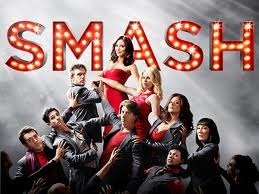
Taken on those terms, Smash works perfectly. And pretty much every criticism of the show can be defended by the simple assertion of what the show is: a soap opera. About a Broadway musical.
I must hereby apologize to Anjelica Huston. On seeing the first episode, I wrote that she "didn't know what to do with the character." O, Angelica, I was wrong! Indeed, in the pilot episode,
I actually believe people's disappointment/annoyance with Smash is NBC's fault. They promoted it like it was The Wire about Broadway, instead of like it was Beverly Hills 90210 about Broadway. So all the people who keep expecting it to be some kind of realistic drama keep being put off by the over-the-top, soapy, all-about-Eve dialogue, when, in fact, that's key to the show's success.
But let's talk about some of the strengths. First of all, Smash is breaking TV taboos left and right in a way I have never seen another network show doing. To wit: guys making out with guys! (seriously. Even Glee doesn't show this shit.) White guys making out with black guys! Women having affairs without being evil strumpets! (Here Smash triumphs over 90210. Julia has an affair and is still essentally sympathetic (at least partly because they've made the poor guy who plays her husband appear pretty much asexual). Compare to Valerie, or Emily Valentine, or Lucinda, or any other 90210 character who showed any sexual agency.) Women in their 60's being sexual beings! (61-year-old Angelica Huston is shown having a sexy, if not entirely believable, romance with a younger man. Find me another show that has allowed a woman of that age to be sexual! And I'm not counting the Golden Girls, where the joke was on the character.)
So, yeah, I love this show. I love hating Julia's inexplicably frumpy outfits. (Kind of revealing that the only time she looked really good was when she was having her illicit romp on the couch in the rehearsal studio. And I loved that they kept using that couch in the rehearsals.) I love Tom. 
In a purely heterosexual way.
And 's performance has been completely awesome.
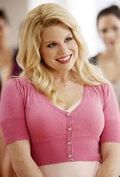
She has, from the first episode, showed this very believable and sympathetic hunger and vulnerability that has kept Ivy appealing.
HERE BE SPOILERS!
And yeah, Ivy totally should have gotten the part. She was better than Karen in every way--deeper, more interesting, and, relevant to being cast as Marilyn, curvier. (The article, I think it was on Slate but I don't feel like looking for it, that called "an anodyne performer" was spot on.) But that's life, and that's showbiz.
If I were writing for the show (call me! I totally would!) I would totally have Karen go all Valley of the Dolls and get overwhelmed by her success and then have Ivy swoop in to pick up the pieces. I would even have a recovering Ivy give Karen the pills.
I saw that neither Dev nor Ellis will return. I won't miss Dev (no knock on Raza Jeffrey, who did the best he could with a part that didn't really have a place in the show), but it's folly to do away with Ellis. 
Jaime Cepero made a fantastic villain, and, again, if I were writing, I'd have him suing for producer credit and totally threatening the success of Bombshell. The only misstep was the show's continuing assertion that Ellis was straight. In a show where almost every utterance was over the top, it was the only thing that I couldn't suspend my disbelief about.
I'm looking forward to next season.
May 20, 2012
Happy Birthday to Two Extraordinary Women
I saw somewhere on the internets that today is Jane Wiedlin's birthday. I've always liked Jane Wiedlin's work. She co-wrote "Our Lips are Sealed" as well as most of the Go-Go's best songs and had a couple of cool non Go-Go's songs as well. She's a gifted pop songwriter. She was an animal rights advocate long before it was cool, she played Joan of Arc in Bill and Ted's Excellent Adventure, and she voices one of the Hex Girls in Scooby Doo and the Witch's Ghost (best of the latter-day Scooby Doo movies, in that it features the line, "do my bidding, bird!" right before the giant turkey runs amok).
In short, I've admired Jane Wiedlin both professionally and personally for a long time, so I'd like to wish her a happy birthday.
I recently read something about Jane Wieldin somewhere on the internet saying that she was bascially holding the Go-Go's together during the making of Talk Show, while many of the other band members were too drugged out to contribute fully. I have no idea if that's true or not, but it's a cool segue to the other woman whose birthday I'd like to write about: my mother, Peg Halpin, who held our family together after my dad's death.
Now, admittedly, I was doing way less drugs than Belinda Carlisle at the time--I was nine--but when our world fell apart, my mother managed to provide a sense of stability and continuity for me, even though she was probably not feeling it herself.
We spent a lot of years broke, but I never felt poor, which was a pretty significant achievement on her part. We always went to the movies and got takeout Mexican food from Taco Casa, but, more importantly, my mother kept alive the idea that anything was possible for me. I know now that this sense of limitless possibility is really what separates being broke from being poor. It's a tremendous gift that I took for granted for too many years. So much of what I've become as an adult is due to the fact that I've believed since I was a kid that I could be whatever I wanted. And this came from my mom.
As did my love of theater (she and my dad met in a play and continued to be involved with the theater throughout my childhood), my appreciation for the power of writing (she was Mount Lookout's Poet Laureate one year! True!), and my inability to keep my mouth shut when things are screwed up. (This comes straight from her. It's gotten us both in trouble a lot, and I really wouldn't have it any other way.)
My mom's influence on my life is profound and incalculable. I don't think I'd be a writer or a teacher or a loudmouth without her influence. And, of course, without her, I wouldn't be alive at all. So happy birthday to Peg Halpin: as you always say on people's birthdays, I'm glad you were born.
Here's Jane Wiedlin with Sparks, doing "Cool Places" because everybody should have a celebratory pop song played on their birthday:
May 5, 2012
Thoughts on the Death of MCA
I was saddened to hear of the death of Adam "MCA" Yauch of the Beastie Boys yesterday. I'm only a casual fan of the band--I have the greatest hits album and that's about it--but they've been a viable creative force for my entire adult life, and I guess I kind of thought they'd be around forever.
But of course that's not true for any of us.
People with more knowledge of the band will be writing about MCA's musical accomplishments, so I just want to say 3 things.
1.)He seemed like a really decent human being. I'm sorry he's dead.
2.) He did not "lose his battle" with cancer. I fucking hate that expression. Nobody "loses their battle" with coronary blockages, for example. I understand that cancer is terrifying, and that we lean on this battle metaphor as a way of telling ourselves that if we get it, we can survive if only we "fight" hard enough. Which is total self-serving delusional bullshit that is incredibly disrespectful to the people who die of this awful disease. Cancer is something that happens. Some people recover from it. Some people don't. This has a lot more to do with the cancer than with the person it's inside of. I know people will still use this every time someone dies, but I just really wish people would cut it the fuck out.
3.)I read in one piece about how, a few years back, Adam Yauch asked fans to mediate with him envisioning a lightning storm destroying cancer or something like that. "Mind over matter," he said. Now, this comes dangerously close to heresy in One Nation Under Oprah, but I'm just gonna say it: your thoughts do not have the power to shape the world around you. If prayer or mediation or positive thinking help you to feel better, that is awesome for you. But you can't shape the world--even the world of the rogue cells trying to eat your body--with your thoughts.
I know some people will see this as hopelessly negative, but I have a beef with the whole positive thinking mind over matter thing: it implies that when something bad does happen, it's basically your fault, because you were negative and the law of attraction drew this hardship to you, or you didn't pray right, or hard enough, or you didn't do enough to stop reality with your mind. Now that is some seriously negative shit. Not only do you have to suffer through something awful, you can also count on people blaming you for it because if you only believe right, or hard enough, you can be rich and healthy like Reverend Run.
It's the same kind of magical thinking that drives the battle metaphor--aha, we can think, smugly, that person got cancer because they, unlike me, didn't perform the necessary rituals to keep it away! Or they died because they didn't clap for Tinkerbell loudly enough! But I clap really loud because I believe in fairies, and so I won't get sick, or if I do, Tinkerbell will wave her magic wand and make me better!
No. Adam Yauch was a good person who did not deserve his illness. Like so many other people. Goodness and positivity will not protect you from cancer or any of the other terrible misfortunes life can bestow on you. Nor will they guarantee you any of the wonders that life can bestow on you.
Life is chaotic and beautiful and wonderful and awful and unfair. Smartass punk rock kids making prank calls to Carvel can become hip hop elder statesmen. Music can bring us untold joy. And sometimes terrible things happen for no reason at all.


