Jacqueline Ward's Blog, page 4
October 26, 2019
Communicating the unspeakable: why I wrote about a women’s refuge in How to Play Dead
It’s not what you think. I have experienced domestic abuse, but it isn’t my story that I decided to write about in my novel How to Play Dead.
Years after my own brush with domestic abuse and when I was on the way to healing, I wanted to pay it forward. I received help and advice and I wondered if I could do the same for other people in this unimaginable situation. Because I was isolated for a long time I was not good at making friends, so I sought out an organisation where I could share my transferable work skills.
I stumbled upon a group of women in my home town who ran an organisation to help families experiencing domestic abuse. They were all volunteers of this charity that ran on a tight funded budget and employed a skeleton staff of women who were paid what they were worth.
These women faced daily funding and operational problems, as well as caring for their own families and working full time in another job. But they cared deeply about people suffering domestic abuse and struggled to make sure that the people experiencing it had access to all the services they needed.
They are Superwomen. They found a way to improve people’s unbearable lives.
Unfortunately this particular story does not have a happy ending. In the austerity cuts the organisation lost it’s funding and had to merge with another organisation less focused on domestic violence and abuse.
How to Play dead is not about me or about the organisation, but inspired by these Superwomen who are everywhere. Because of the nature of domestic abuse and the high percentage of women in refuges, the majority of people who work there are women or exempt from the employment discrimination act. But here’s to the Supermen too!
Ria and Janice are normal women working in an anything-but-normal world. It would have been wrong to focus on their lives, so I have told their story through the lens of the women who are living in the refuge and their stories.
Early reviews point out that some of the plot is ‘predictable’ – yes. Yes it is. Because there was no other way to write it. And how bad is that, that domestic abuse is, in this day and age, predictable? Reviews have also said that ‘this is a novel every women should read’ and ‘Ria is so real’.
If you look carefully women;s stories about domestic abuse are everywhere as they find ways to communicate the unspeakable. I was inspired through this book by Rebecca Ferguson’s Superwoman – it perfectly encapsulates the underlying motives for writing this book.
The post Communicating the unspeakable: why I wrote about a women’s refuge in How to Play Dead appeared first on Jacqueline Ward.


October 12, 2019
PRESS RELEASE: Timely Novel Set in a Domestic Violence Refuge by Oldham Writer Highlights Domestic Abuse Figures
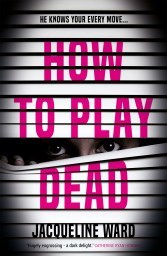 How to Play Dead
Jacqueline Ward, a published novelist living
in the 19th
most deprived area in the UK, will have her psychological thriller, How to
Play Dead, published on 7th November 2019. The novel, published by
Corvus Atlantic Books, is set in a domestic violence refuge and follows the
stories of four women told from the perspective of the manager of the refuge,
Ria Taylor.
Although this is a work of fiction, Jacqueline
wrote this novel loosely based on her experiences on the management board of a
former women’s refuge which was closed due to lack of funding in 2015. Domestic
violence is experienced by one
in four women in the UK in their lifetimes and two women per week are killed
in domestic violence incidents. The
Domestic Abuse Bill 2019 is currently progressing through Parliament and
will be discussed further later in 2019. Greater
Manchester Police’s approach to tackling domestic abuse document begins
with the words ‘The extent and nature of domestic abuse remains shocking’ and
states that 6% of all calls for assistance were for domestic abuse and of these
16% were repeat offences. Early reviews for the
novel on expert reviewer site NetGalley have called the novel ‘heart-wrenching’,
‘realistic’, ‘hard-hitting’ and one that ‘every woman should read’.
Jacqueline, who grew up in Oldham and worked
full-time while a single-parent, now has an MBE and is CEO of a charity dealing
with high hazard safety. Oldham has recently slipped from 34th to 19th
most deprived borough. She has been writing fiction for most of her life, with her
last novel, Perfect Ten, focussing on gas lighting and revenge, receiving
national reviews and was stocked by most major supermarkets as well as
bookshops. A registered Health Psychologist, Jacqueline writes widely about
psychology and storytelling. Prior to her two-book deal with Corvus Atlantic
Books, Jacqueline won US writing competition Kindle Scout and had a crime
series published. She also writes short stories and screenplays.
Jacqueline said, ‘I wanted to be clear
about what domestic violence and control really is. Although domestic abuse a
difficult subject, raising awareness of it through storytelling with fictional
characters is one way that everyone can find out what really happens. The rose-coloured
spectacles are off in How to Play Dead. This is the real deal.’
How to Play Dead will be available online and in bookstores
on 7th November 2019.
Jacqueline is represented by Judith Murray
at Greene and Heaton Media, Film and Literary Agency. For interviews, photographs,
articles, or quotes in the first instance please email pr@jacquelineward.co.uk
Phone: 07925552553
Website: www.jacquelineward.co.uk
Resources:
How
to Play Dead in Waterstones
How
to Play Dead in WH Smiths
How to Play Dead on Amazon
How to Play Dead
Reviews on NetGalley
Refuge
Domestic Violence- The Facts
Domestic
Abuse Bill 2019
Oldham
Council Report on 2019 Indices of Deprivation
Greater
Manchester Police approach to Tackling Domestic Abuse
The post PRESS RELEASE: Timely Novel Set in a Domestic Violence Refuge by Oldham Writer Highlights Domestic Abuse Figures appeared first on Jacqueline Ward.
September 15, 2019
A Huge Thank You to NetGalley and Goodreads Reviewers…
My novel How To Play Dead is due to be published on the 7th November and it is currently up on NetGalley for review. It is also open for pre-publication reviews on Goodreads.
How to Play Dead by Jacqueline WardI logged in to look at the reviews for How to Play Dead as it is on a subject very close to my heart and I wanted to see that what I tried to convey had been successful. Your reviews give me an idea if I have succeeded.
All I can do is thank the reviewers on NetGalley and Goodreads for really ‘getting it’. All the reviewers have completely understood the premise of the novel and thank goodness they have warmed to the characters! It isn’t an easy story to read and it certainly wasn’t easy to write but if it helps one person to escape this situation or prompts donations, I am very happy.
The women in How to Play Dead ARE SuperWomen and we all play our part – by reviewing it each one of you has shared the message to one more person – so Thank You!
The post A Huge Thank You to NetGalley and Goodreads Reviewers… appeared first on Jacqueline Ward.
July 11, 2019
June 16, 2019
How to Play Dead
I am absolutely delighted to announce that my new novel, How to play Dead, will be published on 7th November in ebook and paperback by Corvus Atlantic Book. I can’t wait for you to meet Ria.
She’s watching over them. And he’s watching her…
Ria Taylor is everything to everyone. Wife and mother, the centre of her family. And the manager of a refuge for women whose partners have driven them out of their own homes.
But one night, with her husband away, Ria receives a terrifyingly sinister message. Someone is watching her. Someone who seems to know everything about her. She knows what she should do – seek help, just like she tells her clients to. But Ria is the help. As events escalate, and terror takes hold, Ria must decide whether to run or hide…
How to Play Dead is currently on pre-order here
The post How to Play Dead appeared first on Jacqueline Ward.
May 26, 2019
Subtext: what lies beneath
I never get to see films or to read books when they are released. My life is just too busy. Eventually I will be wowed by certain films and books and take to Twitter to praise them. Late to the Party. Always the Bridesmaid… etc. Last week I watched Quentin Tarantino’s The Hateful Eight.
I was completely shocked at the opening scenes with Jennifer Jason Leigh and I had already spotted that The Weinstein Company had produced it – my opinions were already forming five minutes in. Then I remembered that this was a Tarantino film, famed for extreme violence and my TV set has an off button. It is my choice to watch, and I did.
 What lies beneath…
The Hateful Eight is a masterclass in subtext. The main layer for me as a feminist was the looming question over Daisy Domergue – she was undoubtedly a killer, based, according to Tarantino, on Susan Atkins. Her characterisation raises the same questions that I have had raised about my characters – can women be bad? Daisy was a killer. Yet the violence she endured and, eventually, her death, set all my senses on edge. There was also a strong subtext of racism, beautifully executed by Samuel L Jackson that made me consider a dual viewpoint.
Another subtext showcase is Russian Doll. I love anything Natasha Lyonne does and this was no exception. I am a huge fan of ‘stories told differently‘. I loved the way The Affair was told in trailing flashbacks and overlapping backstory. So when I managed to watch the half hour episodes of Russian Doll on Netflix at the same time as everyone else, I was gagging to discuss the underlying themes.
It turned out that many people had taken the series on face value and likened it to a modern take on Groundhog Day. The overarching plot was enough to grip most people. There were obvious moralistic plot points to hammer home the obvious existential push of the plot, but something else was there, nagging at the edges of my psyche.
Then I realised. as a recovering addict myself (nothing exciting folks, cake and nicotine rather than heroin or cocaine) I recognised the ‘repeating the same mistakes’ mantra. A quick Google confirmed that a lot of other people had the same awakening – it was based on the 12steps. Now, you can even find a guide to the subtext – Russian Doll ‘eastereggs’ – after all, the main character Nadia is a game coder.
These two examples on the screen started life as scripts.
So how is subtext written in scripts and novels?
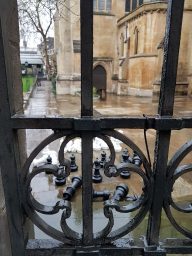
The simple answer is: it isn’t. It is implicit. Subtext is a gradual understanding of meaning behind the text that develops as the story unfolds.
An brilliant example of this in novel writing is ‘Normal People’ by Sally Rooney. Rooney tells the story of Connell and Marianne from meeting at school to going to University. The writing in sparse and concise, but as the novel progresses the subtext of power and class shines through. I cringed at Connell’s discomfort at Trinity College. I found insight in Marianne’s gradual denial, understanding then numbness to her beauty. I strongly resonated by the things unsaid between them that kept them more apart than they should be.
Another example is ‘Daisy Jones and the Six’. Told in a documentary style and, on the surface, a story abut the rise and fall of a rock band, this story is the juxtaposition of the female and male ‘bad’ roles. It works so well and covers a wide range of relationship subtext by employing a wide range of opinions on a particular subject to make the reader think about their own stance. It will be interesting to see how this translates to TV in the Amazon series it has generated.
So how can you be sure that your work contains subtext?
I can only describe my own process. I unashamedly write commercial fiction – psychological thrillers – but I do not believe that subtext is the exclusive property of literary fiction or writing for the screen, even though the marketing engines of publishing suggest this. I wanted to write about revenge in Perfect Ten. ‘Revenge’ is a strong marketing tool as it is an emotion that resonates with lots of people. But it is also a source of pain and deliberation – most people might think they want revenge, but will they act? Is it dependent on the betrayal?
Underneath all this I wanted to ask two questions:
Would a professional woman seek revenge?
Is it more acceptable for men to behave badly than women?
I wanted reader to think about this, and questions related to it when they read the story. I wanted them to look at Caroline’s behaviour and consider why they felt uncomfortable with it. I wanted them to wonder if Caroline’s actions were proportionate to Jack’s.
So how do we know if subtext is working?
The only way we can know if subtext is working is from reviews. By showing other people our work we can find out of their moral compass has picked up the subtext and if they have been affected by it.
The first layer of people who will comment are beta readers, agents and editors. these are typically the people who will help you to define what you have written and to voice their initial insight into the writing, the story and the subtext. Agents and editors are also the gatekeepers of the industry and the connection to trends, markets and zeitgeist, so their opinion is ultra important.
Once published, the second layer is readers. Reviews are so important to authors because thy provide validation in a tough world.But they also provide a deep insight into whether readers have connected to the subtext.
Good Review/Bad Review
The beauty of looking at reviews from the point of view of subtext is that all reviews are good. Yes, again, all reviews are good. From this position, what you are seeing in a ‘bad review’ is often simply the reviewer’s moral position on the subtext. Here’s an example from a two star review for Perfect Ten.
‘One minute Caroline is convincing herself that Jack’s mistresses knew he was married and are therefore fair game for revenge only to retract that statement and claim in the next paragraph they were similarly duped and I found her portrayal hard to equate to the smart, mature woman that the author was obviously keen to present.’
This particular review runs to four long paragraphs, some of the comments a direct, opinion-based comment on the subtext, in this case a reaction to ‘would a professional woman seek revenge?’ This reviewer extends this question to the link between academic intelligence and emotional intelligence. She mentions it twice in the review. She has clearly thought a lot about this. The subtext has worked.
Other reviewers comment on Caroline’s sleeping with random men in Premier Inn, asking if I realised that this is ‘as bad’ as Jack’s philandering. I know from my research that the rights and wrongs of women’s sexual behaviour is a grey area in comparison with men’s sexual behaviour and this is exactly why I included this facet of Caroline. Again, the subtext has raised this question for the reader.
I am so grateful for any and every in depth review as it will help me to pull together an overall precis of what Perfect Ten meant to people. Of course, I am also grateful for reviews that comment on the ‘enjoyment/entertainment factor’ – this is different to commenting on the subtext, but connected because it indicates that the reader was invested in the subtext (not necessarily in agreement but willing to take it on).
Comedy/Tragedy Subtext
I can’t finish this article without mentioning the king of subtext Ricky Gervais. Love him or hate him, his writing and consequently his TV is laden with heavy duty ‘make you think’. The vitriol toward him and his sometimes extreme evoking of feelings fires Twitter to almost breaking point at times and bring out the very worst in people. His latest series ‘After Life’ is the best yet.
Another comedy/tragedy work of genius is Fleabag. Again, a ‘different way of storytelling‘ with the look to the fourth wall enhances the sadness of all the characters and brings mental health into focus as she flashes back constantly to her dead friend. The outcry of ‘posh girl’only strengthens my belief that the biopic on the middle class in a clever piss-take by the writers to make us think about ‘is love really any different for any of us’? Brilliant, brilliant, brilliant.
The comedy/tragedy subtext is powerful because it delves into opposing emotions concurrently. The best of this finds subjects a wide range of people can resonate with and pushes it to it’s boundaries.
Did it make you think?
If a novel or a film or TV makes you think about deep issues, it must be good, right? Not always, according to some. There is a certain viewpoint that is popular a the moment that is against violence in women’s psychological or crime fiction. Their claim is that by showing/describing violence the author is perpetuating it. That is is irresponsible. I have two comments to make about this.
If the violence is gratuitous – i.e. does not key into a subtext, example behaviour or an essential part of the storyline then it is unnecessaryThere is an off switch/choice to buy. I made an open minded decision to watch Tarantino’s The Hateful Eight – if I would have relied only on my own embedded viewpoint I would never have been able to understand the subtext and critique it.
I also note that the people objecting to are often writing in an opposing genre to psychological thriller or crime and, as is often the case in the human condition, have a self interest. They make no comment on other violent subtext such as Tarantino’s or violence before the watershed in soap opera. There appears to be a ‘I know better than you’ nanny effect bordering on control in play here – we are all adults who must make our own decisions and can look away at any given time. I would prefer to be given the choice of which art form I choose rather than have the possibilities censored.
Taking a particular example, one commentator stated that domestic violence should not be portrayed in books as this perpetuates it. I know from academic research that victims of domestic violence rarely articulate their stories in full. This is often because they are afraid that the listener with either not believe it or that it will harm them to hear it. Or that they have been sworn to secrecy by their abuser – a common act of control.
Reading or seeing an account similar to what they have experienced, while triggering emotionally, can also bring a huge sense of relief that someone else has experienced what they have. That they are not alone. Coupled with a recovery subtext, stories about people who have experienced violence can be useful. Stories about death and how others experience it can help with grieving. Stories about good and bad can make us think about how we act in the world.
Subtext can be something we turn to when we have nothing else.
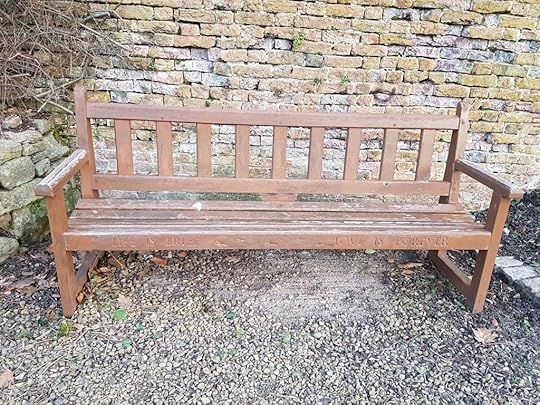 Even this bench has subtext…
The post Subtext: what lies beneath appeared first on Jacqueline Ward.
May 10, 2019
Divided we are not
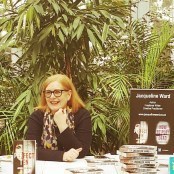 Jacqueline Ward
Oldham gets a lot of bad press, including a massive misrepresentation from Nigel Farage this week claiming that many areas in Oldham are ‘no-go areas’. It just so happens that the venue for my author event was smack bang in the centre of one of these areas. Alexandra Park, a beautiful Victorian space in the heart of Oldham, is often pitched by racists as somewhere race war battles are in full force every day of the week.
I live nearby, yes, a white British working class person living in the middle of the supposed ‘no-go area’. I walked to the park, down a street where I grew up which is now multi-cultural. No one tried to prevent me from going to my cream tea in the ‘war zone’ park. I chatted to my friend for a while and then made my way unchallenged through what Farage would have us believe is the downfall of British culture to my destination.
 Alexandra Park Oldham
Once there, rather than being deafened by the sound of clashing cultures, I passed families different nationalities all playing nicely together. The conservatory has been wonderfully preserved and surrounding area is well maintained gardens. Quite beautiful.
 Cream cakes and laughs
The day, supported by Oldham Library services, went very well. In fact, it was as if it was a normal day in a normal town in England rather than a tense Sunday afternoon in a ‘divided society’. The food was delicious, we all had a good laugh at the bad reviews for Perfect Ten and then went home safely. No one barred our way or threatened us with violence or abuse. It was just a sunny Sunday afternoon in a Northern town.
I walked home through the park and reminisced on how lucky I am to live in Oldham and to have had the opportunity to talk about my book in a magical venue that as a child I used to imagine was inhabited by fairies. I have lived here all my life. I like it. On the way back my next door neighbour Nita Mistry stuck her head out of her bedroom window.
‘Did it go alight?’
I smiled at her.
‘Yes. Yes it did love, thanks.’
Divided we are not.
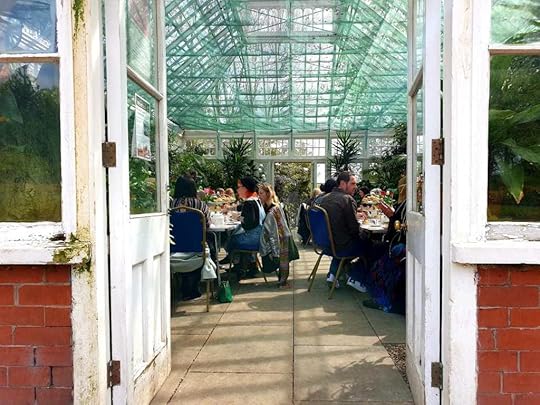 Cream Tea with Perfect Ten
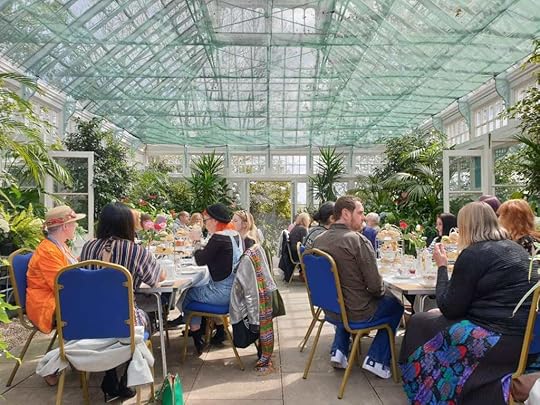 Inside the conservatory
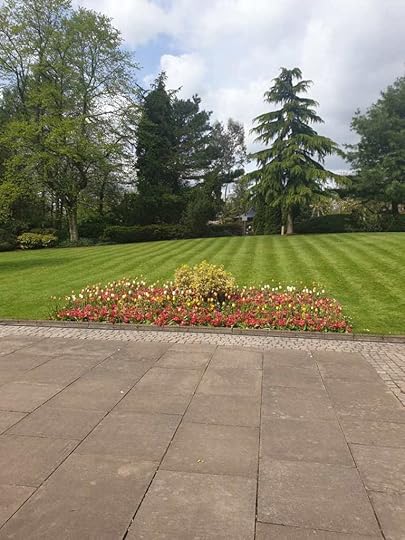 Alexandra Park
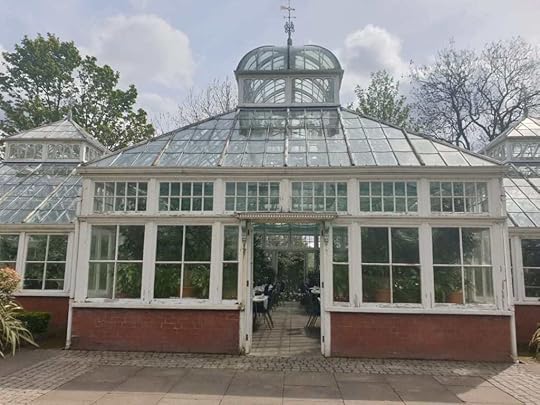 Victorian Conservatory in Oldham
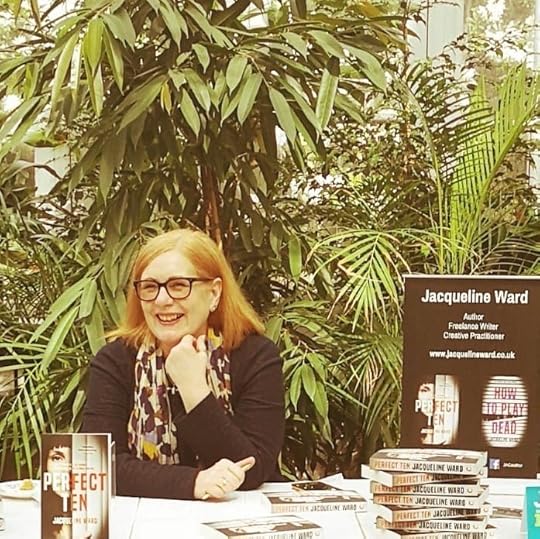 Jacqueline Ward
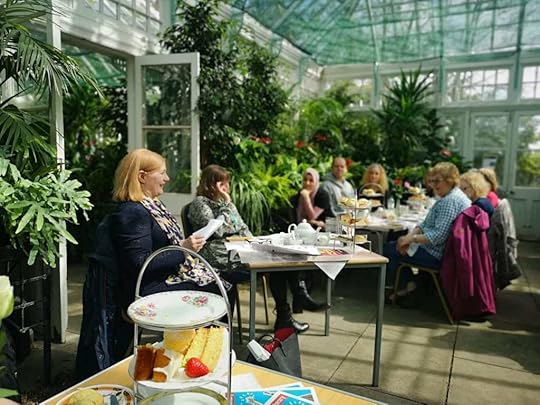 Cream tean and Laughter
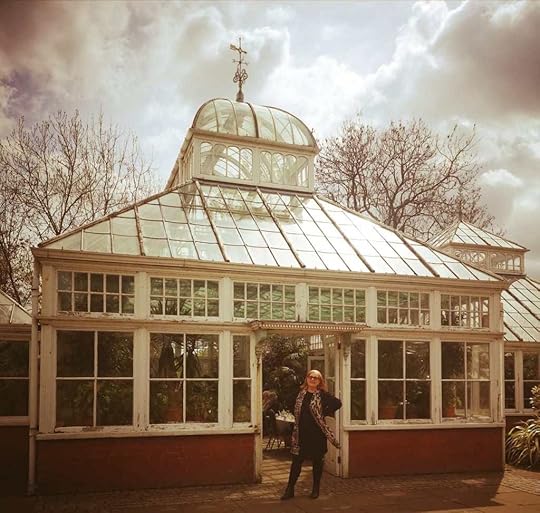 This is Oldham
The post Divided we are not appeared first on Jacqueline Ward.
April 24, 2019
Random Acts of Unkindness now available on audiobook
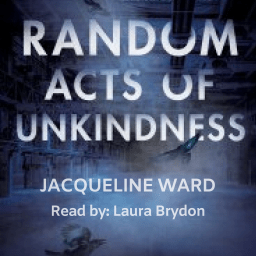
It’s been three years since I won Kindle Scout with my novel Random Acts of Unkindness. Now it’s out in audiobook format on Audible. I am very grateful to the very talented Laura Brydon for reading the novel and bringing the characters to life.
The novel introduced DS Jan Pearce. Jan’s son Aiden is missing and she is determined to find him. Set in Manchester, Ashton-Under-Lyne and Saddleworth and spanning four decades, the story looks at mothers and how they cope with missing children.
You can get the audiobook here
The novel is available worldwide here
Praise for Random Acts of Unkindness:
‘ Having just read this, I couldn’t put down reading late into the night, then spending a day doing nothing but reading as I just had to know what happened to both Aiden and Thomas. ‘
‘… as with other readers here have found I was up into the early hours to finish it in one sitting and it was well worth it. The tone is intriguingly gentle – the story draws you in as the pace and tension steadily rise and rise towards the conclusions.’
The post Random Acts of Unkindness now available on audiobook appeared first on Jacqueline Ward.
April 10, 2019
Perfect Ten on the shelves…
The mass market paperback of Perfect Ten with a brand new cover was released this week. A couple of weeks ago I received an email from my publisher Corvus Atlantic books telling me some fabulous news – that WH Smiths, Asda and Sainsbury’s have agreed to stock it.
As a debut author I was not sure what this meant. My agent Judith Murray and my publishers were pleased, so on publication day I went out to explore.
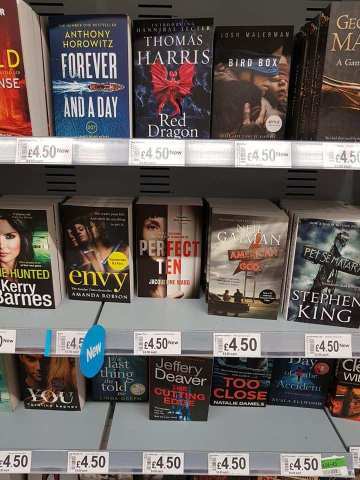
I was astounded to find my novel next to famous authors such as Neil Gaiman and Stephen King. I have been a long time fan of Caroline Kepnes and her book You. I loved the TV series and I was more than delighted to see Perfect Ten near You on the shelves.
As I was browsing I noticed that even in WH Smiths the book section is small. In Asda and Sainsbury’s it consists of a selection of famous names mixed with new releases. But for the amount of books published per day, week and month, the selection is a tiny proportion.
This is good for me and Perfect Ten, but not good for books, authors or readers in general. As I have stated in other posts, visibility is everything and despite social networking, which is reaching saturation point with book advertising, books in shops are a valuable discovery point for readers.
I did feel a little bit sorry for the lovely Craig in WH Smith in Piccadilly Station Manchester, who was just looking at Perfect Ten when I ‘persuaded’ him to buy it and accompanied him to the till to sign it for him. And a woman in Asda Hulme who asked what it was about and received a full presentation of the plot when she had only come shopping for carrots. Other than that, I have managed to observe Perfect Ten from a distance and with restraint!
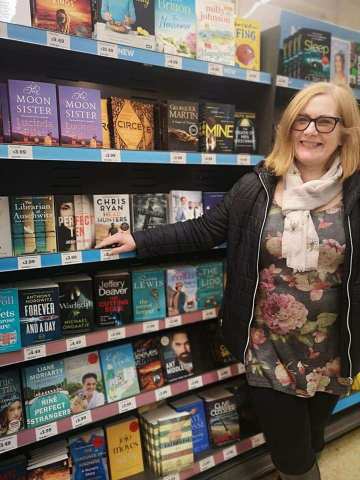
Over the past week I have been inundated with pictures of Perfect Ten on the shelves nationwide. Friends and colleagues have sent me snaps of my novel from Deal to Aberdeen. My friend Neil at Asda in Ashton has sent me updates and Bridget in Aberdeen has been recommending it to everyone! The whole experience has exceeded my wildest dreams – thank you so much to everyone who has bought it.
All in all it has been a very exciting time. I am currently proofreading the page proofs of my next novel. I can’t reveal the title, cover or publication date yet but I can reveal that it is finished and ready to go!
I will be announcing more at the end of April but for now I am working on a new project and developing more ideas. Over the summer I will bring them together, ready to begin writing again.
Watch this space!
The post Perfect Ten on the shelves… appeared first on Jacqueline Ward.
March 24, 2019
It’s never too late to write…
I’m fifty-seven years old and I started writing seriously ten years ago. Everything was against me. Older. Working class. Female. Yet I still succeeded.
Before that I had written short stories and a completed novel that I didn’t send out because I didn’t think writing was for people like me. I’d had a short story published in a magazine and written some articles for local newspapers. My problem had been time. Like a lot of women, day job and family life kept me ultra-busy and unable to spend long hours in front of a computer – my job had been to make the coffee and food while other people did that.

But in 2007, fresh out of a part-time PhD in Identity Construction, funded, because I am working class from a deprived area, everything changed. I realised that writing academic papers and a text book were something I would need to do, but there were other ways to use what I had learned.
So I set myself a target of five novels to transmit the story of what I had learned. And that’s when the fun and games began.
People around me had been supportive of my late entry into academia, but when I told them I was writing a novel the reaction was mixed. I plotted and wrote and joined writing groups. I read books on creative writing and I wrote another novel. All the while I was submitting to agents with some positive responses, but no one signed me.
Eventually, a delegation of people close to me began to sound out the possibility of failure. They pointed out that success in getting published was akin to winning the X Factor, and that maybe at -by this time – approaching fifty years old, I might be being a little over-optimistic? And perhaps time was running out?
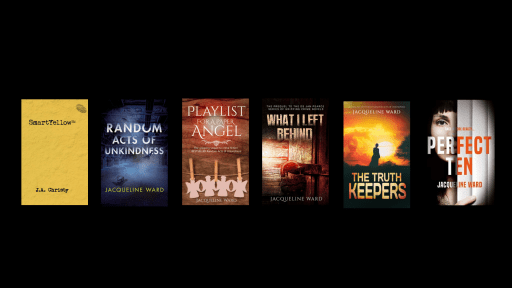
I didn’t think so. I was worried about not living in publishing-centric London, but I was having the time of my life. I was plotting and falling in love with my characters and with creativity. I was waking in the night with the people in the novels calling to me and phoning my landline answerphone to tell myself ideas when I couldn’t find a pen and paper. I just had to write. In 2015 I submitted my speculative fiction novel SmartYellow to Elsewhen Press and they agreed to publish it. The same year I won Kindle Scout. While I was unsure as to exactly what would happen, I soon found that the initial book, Random Acts of Unkindness, was in the top 100 books in UK and US. Kindle Press, a publishing imprint of Amazon, published my DS Jan Pearce crime fiction series.
But I still had a novel I had been writing over four years on my flash drive. It was an angry story of a woman scorned and her journey. I was delighted with the books I had published and by their success, but I was still unagented. I had always said that if didn’t get an agent by the time I was 55 I would give up. I finished Perfect Ten in December 2015, polished it over the Christmas break and sent it out to agents in January 2016 with a killer covering letter.
I had interest and I was signed two weeks later by my wonderful agent Judith Murray. She sold Perfect Ten to Corvus Atlantic Books and the mass market paperback will be in supermarkets and WH Smiths on 4th April 2019.
It was a two book deal and the second book will be released in November 2019.
So it really is never too late. I am really just starting my writing career, and who knows where it will take me? I have just finished another novel and delivered to my agent and I am loving writing – I can’t foresee me ever stopping! But if I had listened to the world, where age is so often a barrier, especially for women, I would never have got to this place.
Never, ever let anyone tell you that you are too old to start a writing career. You have something to say. Say it.