Michael J. Gelb's Blog, page 2
November 28, 2018
Don’t (Re)Engage with the Humanities
(Unless you want creativity, innovation & a meaningful life)
Michael J. Gelb – November 29, 2018, 10th Annual Global Peter Drucker Forum
About ten years ago the magazine of the U.S. Bureau of Labor Statistics published an article entitled “What Can I Do With My Liberal Arts Degree?” The article begins by asking a question that many parents have asked their children when they announced that they wanted to study philosophy, history, art or music:
“What the heck are you going to do with a degree in that?”
The assumption is that the study of “soft”, human-centered questions has little practical value, unless one is seeking a career as a philosophy, history, art or music teacher. If you want to be successful in an era of high technology and big data, then the so-called “hard” disciplines of science, technology, engineering and math are presumed to be the preferred path.
This notion manifests in the STEM initiatives sponsored by many companies and governments today — promoting the importance of Science, Technology Engineering and Math.
But, now more than ever, we need to integrate the hard and the soft, the technological and the human, the scientific and the artistic ways, of making sense of our world. Brilliant thinkers like fellow panelist Fred Kofman make compelling cases for Why this integration is essential.
My passion is exploring and teaching How we can find this balance within ourselves. How can we in real terms discover the integration of yin and yang?
Learning from Leonardo da Vinci
Baby ducks learn to walk by imitating their mothers. Learning by imitation is fundamental to many species including humans. The good news for us, as adults, is that we can choose whom we wish to imitate. If we are interested in the balanced, full expression of our human potential then Leonardo da Vinci can serve as an unparalleled role model.
When I was a child I had 2 heroes, Superman and Leonardo da Vinci. I remember when I discovered that Superman was only a comic book character, but Leonardo was real.
His “Mona Lisa” and “Last Supper” are among the greatest miracles of human expression. His scientific and technological innovations were far beyond his time — he conceived the concept of automation, sketched out the ball bearing, and invented the parachute before anyone could fly!
That’s thinking ahead!
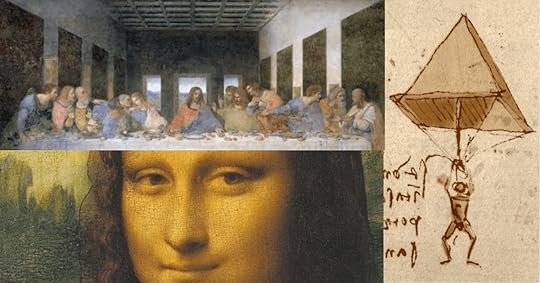
Leonardo serves as a universal archetype of the fulfillment of human potential and a practical role model for the integration of technology and humanities.
Before I share the 7 principles for thinking like Leonardo, let’s consider the context in which our contemporary understanding of the Humanities arose.
The Marriage of Art & Science
Humanism and the idea of individual creative potential go hand-in-hand. Prior to the Renaissance, the notion of individual creativity didn’t exist, because the concept of individuality as we now understand it didn’t exist. Paintings, for example, remained unsigned, and painters, anonymous, because the individual was considered unimportant. All creative power was vested Above.
Gothic cathedrals like Chartres were the products of thousands of people toiling anonymously in collaborative efforts that continued over hundreds of years. The great cathedrals were designed to give the person who entered them an overwhelming feeling of insignificance in the presence of an omnipotent and omniscient Deity.
A remarkable shift occurred during the Renaissance, when the power and potency of the individual began once again to be celebrated, as they had been in classical times. In 1486, the Renaissance scholar and philosopher Pico della Mirandola offered his Oration on the Dignity of Man, heralding the shift from the medieval worldview, which disempowered the individual, to the revolutionary notion that we humans are blessed with powers of free will and creativity that are unlimited and virtually godlike.
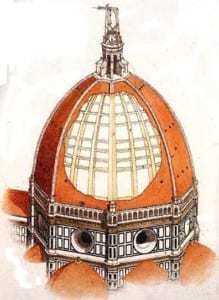 500 years ago, Pico emphasized the importance of reengaging with the humanities. And he articulated the idea that creativity is part of what makes us uniquely human. Leonardo da Vinci’s “Vitruvian Man” and Michelangelo’s “David” are the best-known symbols of this humanistic rebirth of individual creativity. But there is one man, Filippo Brunelleschi, who was the pre-eminent force in the emergence of the new human-centered worldview, for he both literally and figuratively created a new human-centered perspective. Just as the Gothic cathedrals had communicated a message about humanity’s place in the universe, Brunelleschi’s architecture sent an equally profound but different message, as best exemplified by his dome for the Florence cathedral.
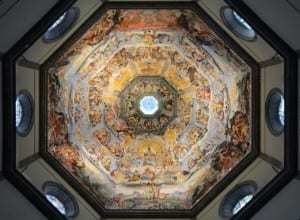 Standing beneath Brunelleschi’s dome, one feels oneself to be at the center of Creation. One does not feel overpowered and belittled, but exalted and uplifted in this space. Humankind’s potential is also affirmed in Brunelleschi’s invention of three-dimensional perspective in art; which he taught to Masaccio, who produced the first Renaissance painting and to Donatello who created the first Renaissance sculpture. And Brunelleschi also registered the world’s first patent for an invention (his remarkable ox-hoist) – thereby formalizing the legal and economic expression of the value placed on individual creative capital.
Ever since Brunelleschi got the first patent there’s been an evolving relationship between creativity, the humanities and business. Then as now, technological developments drive profound change.
The feudal system of the Middle Ages collapsed for many complex reasons but accelerating technology was key, starting with the invention of the long-range cannon, which could blast through the walls of the feudal fortress. As fortress walls crumbled the printing press, magnetic compass, mechanical clock, microscope and telescope expanded European horizons exponentially. The breakthroughs that drove the transformation of the Middle Ages into the Renaissance were all made possible by the funding that became available as innovative accounting and banking systems evolved.
Brunelleschi, Leonardo, Michelangelo, Raphael and all their fellow geniuses wouldn’t have created much of anything without the Renaissance equivalent of corporate sponsorship. If the Sforza, Medici and a succession of Popes hadn’t provided the cash, the Florence cathedral would’ve remained open to the elements and there would have been no “Last Supper,” “David” or “School of Athens.”
The entrepreneurial spirit provides the most energy and opportunity for creative expression. And now, as we face unprecedented global environmental, financial and social challenges, the ability to integrate science, technology, profit, art and the humanities is more urgent and important than ever.
Historian of science George Sarton writes:
“Since the growth of knowledge is the core of progress, the history of science ought to be the core of general history. Yet the main problems of life cannot be solved by scientists alone, or by artists and humanists: we need the cooperation of them all.”
Leonardo gave practical advice to his students on how to cultivate that cooperation through the marriage of art and science. I spent years studying Leonardo’s notebooks and literally walking in his footsteps and aiming to see the world from his point of view with one unifying question: What can we learn from him to fulfill our human potential?
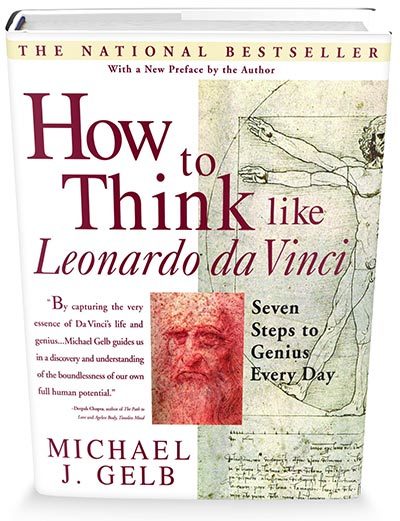
Here’s a brief overview of the 7 da Vinci principles as described in How to Think Like Leonardo da Vinci: Seven Steps to Genius Every Day :
1. Inspire Curiosity: Curiosità
Who asks the most questions?
Who has the most vivid imagination?
And who has the most energy?
Children.
Curiosity is our birthright.
Passionate questioning allows children to learn rapidly in the first five years of life. But then we send them to school, where they learn that answers are more important than questions.
Geniuses like da Vinci, however, maintain a passionate curiosity throughout life. And the most creative, innovative businesses are alive with the spirit of Curiosità.
2. Cultivate Independent Thinking: Dimostrazione
Besides the strictures of the Church, what was the biggest impediment to independent thinking at the time of Leonardo?
Information was hard to get. Books were rare. And only available in Latin, which you wouldn’t have learned unless you were from a noble family. (Leonardo taught himself Latin when he was 40 years old so he could read the classics as they became available).
What’s the impediment to independent thinking today? Too much information! How do we cut through the tsunami of spam to think for ourselves?
Leonardo provides relevant guidance. He noted,
“The greatest deception men suffer is from their own opinions.”
3. Sharpen Your Senses: Sensazione
In business, this translates into listening well and being observant — simple advice that’s difficult to heed in an increasingly distracted world.
Leonardo guides us to sharpen all our senses, and put more dolce in our vita, by cultivating the appreciation of beauty.
4. Embrace Uncertainty: Sfumato
The essence of creativity is to be willing to be surprised. That’s the –nova in innovation.
Leonardo counsels us to smile in the face of uncertainty and ambiguity so creative ideas can emerge.
5. Balance Logic and Imagination: Arte/Scienza
Like Leonardo da Vinci, be a whole brain thinker. Use mind mapping, a practical method inspired by Leonardo’s note-taking, to integrate logic and imagination and generate more ideas in less time.
6. Balance Body and Mind: Corporalità
In addition to being an artistic and scientific genius, Leonardo was also an exceptional athlete, widely known as the strongest man in Florence, and an accomplished fencer, horseman and juggler.
We think of creativity as an intellectual exercise, but it requires tremendous energy. Leonardo gives specific practical advice on how to cultivate health and wellness. He advises,
“Learn to preserve your own health.”
7. Make New Connections: Connessione
Leonardo noted:
“Everything connects to everything else.”
Like Peter Drucker, he guides us toward a systems perspective, to look for connections and patterns, to take a more holistic view of ourselves and our organizations. STEM to STEAM
In a meta-study coordinated at MIT, researchers discovered that scientists and engineers who are involved in an artistic pursuit, in other words, engaged in the humanities, are much more likely to be outstanding scientists and engineers.
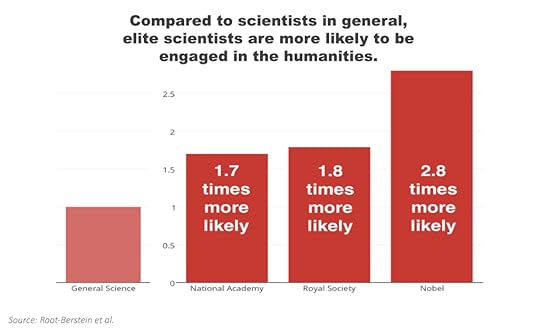
Indeed, compared to general scientists, technologists, etc. members of the US National Academy of Sciences are 1.7 times more likely to be involved in the humanities/arts, members of the British Royal Society are 1.8 times more likely to be involved in the humanities/arts and Nobel Laureates are 2.8 times more likely to be engaged in the humanities/arts.
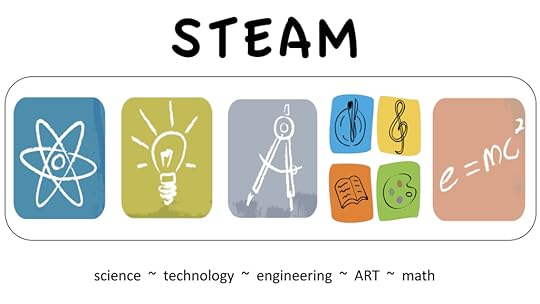
STEM must be replaced by STEAM.
Science, Technology, Engineering, ART and Math.
And Leonardo da Vinci can serve us as the supreme role model for the power of STEAM.
Michael J. Gelb is the author of the international best-seller How to Think Like Leonardo Da Vinci and a new book, The Art of Connection: 7 Relationship Building Skills Every Leader Needs Now.
The post Don’t (Re)Engage with the Humanities appeared first on Michael J. Gelb - Keynote Speaker, Seminar Leader & Executive Coach.


September 12, 2018
The Art of Comparative Appreciation
Learning the art of comparative appreciation can help reinvigorate your senses, enhance your awareness and increase your pleasure in living. Leonardo da Vinci, the prototypical Renaissance man, believed that appreciating sensory delights was one of the secrets to inspiring creativity and happiness. Leonardo understood that the impressions we experience every day serve as nourishment for the soul and that without conscious attention, it’s all too easy for us to take in the sensory equivalent of junk food. Leonardo noted that the average person “looks without seeing, listens without hearing, touches without feeling, eats without tasting, moves without physical awareness, inhales without awareness of odor or fragrance, and talks without thinking.”
If that was true five centuries ago in Tuscany, it is certainly true today, when we are increasingly subject to the numbing effects of the lowest-common-denominator, mass-market “McWorld.”
The good news is that we also have unprecedented access to the sensory treasures of the world. We can easily, and with minimal expense, surround ourselves with beautiful music, food, wine and art – and, in the process, experience a personal renaissance of sorts. These treasures all enrich the quality of our lives. And we can make their positive effects more memorable by practicing comparative appreciation.
When you listen to multiple versions of a musical composition, or compare and contrast three different dark chocolates or a flight of wines, your mind naturally attunes to the differences and similarities among them. You begin to notice greater subtleties, and you deepen your recall for the pleasurable experience.
Comparative appreciation “engages the mind in what psychologists call ‘deep processing,'” explains Vera John-Steiner, PhD, professor of education and linguistics at the University of New Mexico and author of Notebooks of the Mind (Oxford University Press, 1997). “The comparison process inspires more robust neural activity, more cognitive investment, thereby greatly enhancing memory.”
The process of closely comparing two or more different things or experiences also requires a great deal of present-moment focus – a state of mind that researchers have come to associate with increases in happiness and satisfaction and reductions in anxiety and stress.
The key to getting the most out of comparative appreciation is to enjoy being fully aware of and invested in the experience without worrying about getting the wrong answer. Suspend your concerns about making a proper critical analysis and focus instead on contemplating open-ended questions such as these:
How do I experience this (music, wine, art, food, sensation)? Take note of which of your senses (smell, sight, sound, taste, sensation) are involved. Keep in mind that the more senses you employ, the more complex experiences you’ll be likely to have.
What sensations, feelings and associations does this experience inspire or evoke? As your body and mind respond to each experience, notice and describe any thoughts or feelings you find coming to the surface. Try to move beyond “like” and “dislike” to more precise terms and descriptions. Does the experience evoke excitement, pleasure, curiosity, relaxation? Does it trigger memories or call images to mind? Contrast the impressions you get from this experience with those evoked by the other items you’re comparing.
Which of these things do I prefer, and why? Very often, you’ll find that you have a strong preference for one or two of the compared items – in which case, you may learn some things about yourself. (Keep in mind, though, your tastes are likely to evolve as you continue with your comparative appreciation exercises.) Other times, you may feel ambivalent, or incapable of picking a favorite. That’s fine, too. It’s not a contest. The magic happens during the process of the comparative appreciation, not in the outcome.
The beauty of all these questions is that they have no wrong answers. As we free ourselves from the fear of saying something wrong or embarrassing, we allow ourselves to access deeper appreciation and enjoyment. We refine our senses and nurture our latent creativity. Best of all, when approaching experiences with appreciative inquiry, we also tend to enjoy higher levels of pleasure, the neurological and biochemical effects of which trigger mood-brightening and energizing endorphins.
Exquisite Comparisons
Try one or more of the exercises below.
Choose a time and place that allows you to focus your attention. You can enhance your experience further by recording your impressions in a notebook or sharing them with a friend.
MUSIC
Find a piece of music that you consider uplifting and inspiring. Seek out renditions performed by different artists, or if it is an orchestral piece, you can listen to the music played by the same orchestra but with different conductors.
Here are a few suggestions to help you get started:
Multiple Mozart. Compare at least two versions of the exquisite Mozart Concerto for Flute, Harp and Orchestra in C, K. 299, second movement, Andantino. (Renditions by the London Symphony Orchestra and the Chamber Orchestra of Europe are easy to find.)
Beethoven to Brahms. Listen to Beethoven’s Ninth Symphony. For a revealing study in contrasting styles, compare the version conducted by Leonard Bernstein with the one conducted by Herbert von Karajan. It’s the same incredible music, but the differing interpretations will make it easy to deepen your appreciation of this transcendent work.
After you spend some time with Beethoven, listen to Brahms’s Symphony no. 1. Compare the version conducted by Claudio Abbado with the one led by Karajan (both with the Berlin Philharmonic).
After you’ve enjoyed Beethoven and Brahms individually, listen to Beethoven’s Ninth and then listen to the Brahms piece. Brahms aimed to pay tribute to the genius of Beethoven while crafting his own original masterpiece. What similarities can you discern between the two works?
WINE
Find a type of wine that you enjoy – Pinot Noir, for instance – and then get two or more bottles from the same year but from different vineyards, regions or producers. For example, compare a great Oregon Pinot Noir with a wonderful red Burgundy from the fantastic ( in both places!) 2012 vintage. You can make this exercise more fun, and more affordable, by sharing the cost with a group of friends. As you compare the wines made from the same grape in the same year, you’ll enjoy noticing the expressions of each wine’s unique microclimate, soil and wine-making style.
ART
The art appreciation equivalent of a horizontal wine tasting is the comparison of two artists from the same period of time, such as Manet and Monet. Both artists were born in Paris – Manet on Jan. 23, 1832; Monet on Nov. 14, 1840 – and they each played an important role in the evolution of Impressionism. They were friends and admired one another’s work, but their styles are dramatically different.
Here are paintings to inspire you to compare their styles and then share your impressions:
• Monet: Haystacks (Monet’s comparative study of the light falling on haystacks at different times of the day), The Water Lily Pond, and Impression, Sunrise.
• Manet: The Absinthe Drinker, Olympia and Luncheon on the Grass
CHOCOLATE
For a delicious and affordable treat, buy small single bars (or a single chocolate) of three different intensities from an artisanal chocolate maker. You might start with Scharffen Berger (62 percent, 70 percent and 82 percent cacao content) or Theo (look for their Origin signature line; 74 percent, 75 percent and 84 percent cacao). Then enjoy a delicious comparative tasting, chewing slowly and savoring the aroma, texture and flavor of each bite. Take a few moments to appreciate the aftertaste, too: Throughout the tasting cycle, great chocolate expresses the unique properties of the soil and microclimate where it was cultivated.
As you explore the cacao percentage that you prefer, you can begin comparing chocolates from different producers with the same cacao percentage. For advanced appreciation, you can try chocolate from single-origin beans from different producers or you can create a theme around chocolates from different countries, such as Madagascar, Ghana, Indonesia or Venezuela.
FLOWERS
Buy a few different kinds of roses, tulips, orchids or whatever flowers you like. Spend a few minutes, preferably with a loved one, describing the colors, scents and textures and the impressions they evoke.
Of course, the delights you can compare are limitless. Try anything from apples (what’s the difference in scent, taste and texture between McIntosh, Cortland and Fuji?) to essential oils (enjoy a comparison of eucalyptus, lavender and rose).
As you explore the comparative appreciation of sensory delights, you will discover a simple secret for bringing more wonder, awareness and enjoyment into your everyday life.
The post The Art of Comparative Appreciation appeared first on Michael Gelb.
September 10, 2018
Twenty Questions for Michael J. Gelb
1) What do you want people to learn / take away from your presentations?
[image error]
I want them to understand that they are more creative than they may
have previously imagined. I want to see them smile and have a light go
“ON” in their eyes. And I want them to take away practical skills that
will help solve their most important business problems.
2) How do you prepare for your speaking engagements?
My
life is preparation. My speaking is a reflection of who I am. And I
prepare for each engagement by tuning in to the client and focusing on
achieving the results that are most important for them.
3) Have you had any particularly memorable speaking engagements?
[image error]
Yes. Many! Among the most memorable:
In 2014 I spoke to a group of 1000 in Ankara for Turkish Innovation
Week. The sponsors handed out my Edison book in Turkish as a gift. They
invited high school and college students to attend and the enthusiasm of
these young people is something I will always remember.
[image error]
[image error]
In 2014 I spoke to a group of 1000 in Ankara for Turkish Innovation
Week. The sponsors handed out my Edison book in Turkish as a gift. They
invited high school and college students to attend and the enthusiasm of
these young people is something I will always remember.
In 2009 I had the privilege of speaking to a group of company presidents
at the Uffizi Gallery in Florence (They arranged for exclusive access).
I spoke about How to Think Like Leonardo while standing in front of the
Maestro’s paintings!
4) What types of audiences would most benefit from your message?
Over
the years I’ve spoken to people from all walks of life and many
different professions. And, my keynotes are especially popular with
groups that are predominantly analytical: PhDs, engineers, financial
analysts, MBAs. My presentations open their minds to the more
imaginative and intuitive aspects of intelligence.
Here’s a note from a client who recently sponsored my presentation for a group of 200 MDs and PhDs:
On our quest to innovate and bring future to life at the Rome
off-site PDC meeting 2014, we invited Michael Gelb as a guest speaker.
We were going through a challenging transition and it was important to
find someone who would be able to understand the situation and the same
time engage with teams and spark the interest.
Michael Gelb, in his inspiring and thought provoking way layered
with Italian charm, accomplished much more. Skillfully navigating
through the initial anticipation and skepticism, Michael reminded us of
the often ignored power of our senses and imagination once again. He
reignited our need to feel, absorb, and process our uncertainties and
ambiguities and unleash our own creative spark. Guiding us elegantly
through the Leonardo da Vinci’s principles, we were reminded that
creativity is not rushed but comes from living in harmony with oneself
and the deep appreciation for the rich world around us. Perhaps the most
powerful and telling effect of Michael’s lecture were the smiles on the
faces of the usually evidence driven, serious, audience of scientists
who suddenly recovered that suppressed urge to play, enjoy life and
allow their dormant potential to reach the surface. ~Dragana
Bugarski-Kirola, M.D., Genentech, meeting organizer.
~Dragana Bugarski-Kirola, M.D., Genentech, meeting organizer
5) What inspired you to start doing speaking engagements?
I had something to say and people were willing to pay to hear it!
6) Why would you recommend that clients use you as a speaker for their next event?
Here are 10 reasons:
Energy: Clients describe my energy as “scintillating,” “inspiring,” “electric,” “charismatic,” and “enlivening.”Experience: With more than 35 years experience, I will deliver an excellent program under all conditions.Reliability: In 35 years I have appeared at every scheduled engagement on-time.Originality: Learn from an original thinker and creator.Authenticity: All keynotes are an expression of my lifetime interests.Passion: My passion for inspiring your group will lead to a presentation that exceeds your expectations.Global: I have spoken in more than 25 countries and have extensive experience working with multi-national and multi-cultural groups.Relevance: After careful consultation I will focus my message on your most important organizational issues.Humor: People learn better when they laugh and I inspire laughter in the most serious groups.Results: I focus on achieving the results that are
most important to you. I’m frequently invited to keynote the same
conference in multiple years because people get real benefit from my
presentations.
[image error]
7) Which of your keynote
topics are the most popular? How are your keynote presentations unique?
Which of your keynote speeches do you enjoy the most and why?
How to Think Like Leonardo da Vinci
is my most popular program. It’s an expression of my unique study of
Leonardo’s advice to his students and how that advice is relevant in our
world. Innovate Like Edison
is also very popular. Edison is the supreme role model for anyone who
wants to profit from innovation. I enjoy all my presentations. If I
didn’t I wouldn’t do them.
8) How much do case studies, personal stories and humor factor into your keynote speech content?
Examples, stories and humor make a presentation engaging so I use them liberally.
9) What are some of the successes you’ve helped clients make?
It’s probably best for my clients to answer this. Here are a few comments:
We are at least twice as productive as before. We plan, document
and communicate with greater efficiency. Our organization’s productivity
improvement has been phenomenal. ~Dr. Thomas Jenkins, DuPont
Our organization hired Michael because of his novel approach and
unique programs inspiring innovation, creativity and leadership. We
designed a 3-year program that resulted in substantially and permanently
changing the culture of our 300+ person department; from executives to
union employees. There were measurable, significant increases in
employee satisfaction, team effectiveness and communications. Michael’s
programs are for business executives/leaders who truly want to leverage
the creative and innovative talent in their department, division or
company to improve productivity and employee retention. ~Liz Faison, Project Director, Merck
You gave participants an experience that they are the creators of
their own future. Four of my people were able to step up to the
challenges of the next grade/role as a result of your program. ~Ketan
Patel, Greater Pacific Capital
Michael Gelb has worked with HRCG over the last four years to
design, develop and deliver leadership development training. Michael’s
programs on Creativity and Innovation, Executive Presence/Presentations,
and Leadership Communication are of the highest caliber, and he
delivers them in a way that consistently engages our
engineering-oriented, time-pressured team. Michael adds value by
consulting with us on how to leverage these training, and his
outstanding team-building programs, to support the evolution of our
leadership culture. One of his most important contributions was helping
us craft a new, more compelling statement of our Vision, Mission and
Values. He also helped us envision and institute an annual leadership
retreat where he was the facilitator. Michael offers a unique
combination of practical business savvy, original intellectual capital,
and inspiring creative teaching skill. I highly recommend him as a
leadership development resource! ~Sarah A. Murray, SPHR Director, Human Resources, Hunter Roberts Construction Group
10) So, in addition to keynotes you also offer workshops and longer term business consulting?
Yes.
I leverage my unique intellectual capital and years of experience to
partner with clients to help them achieve their most important
leadership development goals. I’ve been on retainer with a number of
clients for more than 10 years.
11) How can people nurture independent thinking, creativity and innovation in the workplace?
First,
they need to learn the skills for thinking creatively. Then they must
understand how to facilitate a culture of innovation. I call this: Innovation Literacy.
If you want to innovate you need to have a critical mass of people
who know how to think like innovators. It helps to have positive role
models, so I use Leonardo da Vinci and Thomas Edison, among others.
12) Could you give us three tips for balancing mind and body to reduce stress?
[image error]
Learn how to recognize the physiological manifestations of stress.Learn how to recognize the psychological manifestations of stressLearn to shift your posture, breathing and attitude in a way that transforms stress into enthusiasm and positive energy.
I’ve been studying the simplest and most practical ways to do this
for 40 years. My study is more than just academic-as a 5th degree black
belt in the martial art of aikido, a teacher of tai chi, and a
professional juggler -I’ve learned how to stay centered under stressful
circumstances. I share the most effective methods in my
book/presentation entitled Creativity On Demand.
13) What are Edison’s Five Competencies of Innovation and why are they helpful for organizations now?
Peter Drucker emphasized: All organizations need one core competence: Innovation.
[image error]
With 1,093 United States patents, Thomas Edison is history’s greatest
practical innovator. Beyond his invention of the phonograph, motion
pictures and a system to light the world, Edison invented the rigorous,
disciplined process of innovation.
In addition to creating the world’s first Industrial Research and
Development laboratory, Edison was also a master at promoting a culture
of innovation. Moreover, he understood that the principles of personal
success and organizational innovation go hand-in-hand. Personal success
and fulfillment requires you to learn how to think like an innovator;
and, for your organization to be successful, innovation is now more
important than ever.
Edison’s Five Competencies of Innovation are:
are:
Solution-Centered MindsetKaleidoscopic ThinkingFull-Spectrum EngagementMaster Mind CollaborationSuper-Value Creation
14) Describe some ways people can improve their mind as they age:
[image error]
In Brain Power: Improve Your Mind as You Age I share the research-validated practical things that we can all do to prevent dementia and improve as we get older.
They include:
Adopt a positive attitude toward aging. (Take a daily dose of GFH –gratitude, forgiveness and humor)Devote 15 minutes to learning something new each dayExercise dailyEnjoy fresh, wholesome food and stay hydratedAppreciate beauty every dayInvest in your social wealthGet 8 hours of sleep (not per week, every night!) and learn to meditate
15) What is accelerated learning and how can it be applied to the workplace?
Accelerated
learning means to learn faster and more effectively. It’s essential in
the workplace because change is accelerating. The ability to adapt and
learn has become the most important sustainable competitive advantage. I
have many tools for demonstrating this but my favorite is to teach
everyone how to juggle. (I worked my way through graduate school as a
professional juggler and performed on-stage with The Rolling Stones.)
16) What are your main professional passions?
One
of my clients calls me a “One-Man World-Class Leadership Development
University.” My passion is to live up to that description by
continuously deepening my knowledge of creativity, innovation and
leadership.
17) What projects are you currently working on?
I’m writing a book on the principles and practices of Conscious Leadership.
18)
You wrote a book entitled Wine Drinking for Inspired Thinking and you
offer an evening team-building program that features wine-tasting and
poetry. Please explain.
[image error]
The
philosophy behind this team-building exercise is simple: Create a
relaxed and enjoyable atmosphere and gently guide participants to get a
glimpse of the creative spark in their colleagues and themselves. In the
sometimes-impersonal world of commerce we need to create an environment
where the soul can shine; where we can gain insight and appreciation of
the hidden depths of our associates and ourselves. The key is to do
this without causing any unnecessary additional stress; and to avoid
invasive, touchy-feely activities.
Fine wine and poetry are the perfect catalysts.
This
exercise involves a comparative wine tasting and poetry contest (we
usually arrange for a comparative chocolate tasting for those who don’t
drink wine). Although most groups don’t think of themselves as poetic, after the second glass of wine everyone is a poet!
Participants discover how the love of fine wine inspired the Ancient Greeks, Renaissance Masters and America’s Founding Fathers.
Here’s a review from a recent participant:In my all my years of participating
in team building events I’ve never experienced anything like this! We
went way beyond the usual “consultant-speak” to discover a new approach
to creativity and sensory awareness. My group of biochemists and
pharmacologists all enjoyed the wine, and then translated their
experience into poetry. In the process we all WOWed our colleagues into a
new dimension!
~Emily Hickey, DVM, PhD – Merck & Co.
19) Your 14 books have sold more than one million copies. Are you more of an author or a speaker?
Both!
The research for the books ensures that I always have something fresh
and new to share with my audiences. Writing is a wonderful way to
learn, and if you’re not continuously learning you probably shouldn’t be
speaking about creativity, innovation and leadership.
20)
You wrote a book (Present Yourself: Captivate Your Audience with Great
Presentations) about giving great presentations and you’ve taught
seminars on presentation skills and executive presence for many years.
What are the most important elements in a great presentation?
[image error]
The most important elements are:
Combine passion with knowledge: The best speakers combine intense passion with in-depth knowledge of the subject.Make it memorable: Understanding isn’t the same as remembering! Great presenters make their message unforgettable.Demonstrate body/message integrity: Shakespeare wrote; “Suit the
action to the word, the word to the action.” Great presenters
demonstrate a seamless integration of body language, voice tone and
message.Provide take home value: The presentation offers useful
information/insight that improves the quality of the audience’s life,
professionally and personally.
The post Twenty Questions for Michael J. Gelb appeared first on Michael Gelb.
September 8, 2018
Tom Peters Guest Blog: The Art of Connection

“The most important personal ‘core competence’ by far is a rich set of relationships.”—Tom Peters
In
a recent seminar for a New York-based construction management company,
our team of 24 senior supervisors was surprised by a realization about
the real key to their success.
Trained as engineers, the group assumed that their technical
expertise was their most important “core competence.” But as we
contemplated the skills that were most critical to the functioning of
the company’s safety effort, and to marketing their services, and in
their ability to manage huge projects by coordinating the efforts of
carpenters, electricians, architects, in the midst of other workers
pouring concrete and operating giant cranes in the crowded Manhattan
landscape, it became clear that the quality of communication was the
most important element in their work.
One of the participants experienced this as an epiphany. He
exclaimed, “Oh my God. I get it: We’re not in the construction business,
we are in the relationship business.”
We are all in the relationship business!
Leaders who cultivate the “core competence” of relationship building will have an increasingly powerful competitive advantage. But, skills of listening and communicating seem to be declining rapidly as we are awash in a tsunami of spam, bloated by infobesity, and addicted to electronic substitutes for face-to-face communication.
The single greatest problem in communication is the illusion that it has taken place successfully, according to George Bernard Shaw. The illusion is compounded by email and texting.
So, make it a priority to meet with the important people in your life
one-on-one, face-to face, and practice giving them your full attention
as you embrace humility. Contemporary research* confirms that humble
leaders are more effective at facilitating employee engagement and
encouraging a collaborative approach to learning.
Humility generates curiosity and a commitment to continuous
learning—the foundation for developing the relationship building skills
every leader needs now.
[CM: Guest post by Michael J. Gelb, a pioneer in the fields of
creative thinking, executive coaching, and innovative leadership. He is
the author of 15 books including How to Think Like Leonardo Da Vinci and The Art of Connection. Website: www.michaelgelb.com]
*(“Expressed Humility in Organizations: Implications for Performance,
Teams, and Leadership,” Bradley Owens et.al. Organization Science 4,
10/13)
The post Tom Peters Guest Blog: The Art of Connection appeared first on Michael Gelb.
September 7, 2018
FORBES: The Real Story Behind The Mind/Body Connection – The Alexander Technique
by Dina Kaplan Contributor ForbesWomen
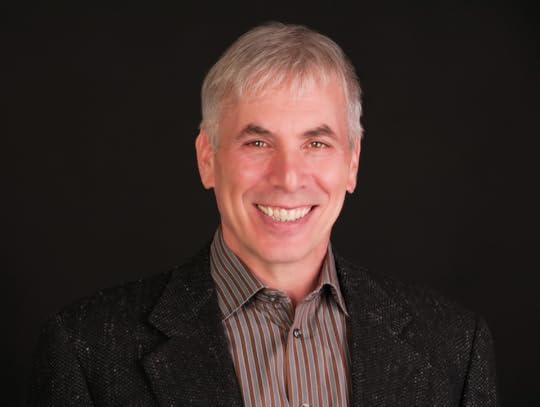 Michael Mahoney of Hat Head Studios
Perhaps you’ve heard of the Alexander Technique, a tried-and-true method to help actors and singers with their voices. But that’s only the beginning. It’s also known to dramatically help people with neck and back pain, to build poise and even boost your mood.
[image error]Body Learning: An Introduction to The Alexander Technique by Michael J. Gelb
I just finished a 5-day retreat on the Alexander Technique and now believe it is the perfect body-focused complement to meditation, which focuses more on the mind. I’m excited to share an interview with one of my mentors, who literally wrote the book on the Alexander Technique, Michael Gelb. He’s also an expert on leadership and recently published The Art of Connection: Seven Relationship Building Skills Every Leader Needs Now. From poise to pain to management, here are some insights from Gelb to delight and inspire you:
What is the Alexander Technique and is it fair to say it’s a nice complement to meditation?
More than 100 years ago, F. M. Alexander discovered that when we are stressed, when we feel fear or any negative emotion, we tend to reflexively contract the whole body and hold the breath. Dr. Frank Pierce Jones of Tufts University called this ‘The Startle Pattern.’ Jones observed that in a world overloaded with stress and fear-inducing stimuli, many people form an unconscious habit that locks in these contractions. The Alexander Technique is an ingenious method for becoming aware of — and gradually releasing — these unnecessary tensions, thus bringing more grace, awareness, and poise to life. Alexander lessons provide a “tune-up” for your kinesthetic sense so it becomes easier to notice and prevent patterns of habitual contraction in our daily activities. This includes sitting in meditation, or sitting and walking in Vipassana… So, yes, it is an ideal complement to meditation.
In your life and with your clients, how important do you find the mind/body connection?
Very! In 1978 I introduced Meditation and Alexander Technique to the executive team of a multinational computer company. That was my first corporate program, and it was called The Mind & Body Seminar. In
a popular TED talk Amy Cuddy, PhD shared her research demonstrating
that when you adopt certain postures ( like Wonder Woman!) you feel more
powerful. I know her research is controversial now, but I do think it’s
fair to say that in a “power-posture” it’s difficult to feel depressed,
and also that if you slump and contract your body you’ll discover it’s
hard to feel optimistic.
Since Descartes we’ve tended to view Body and Mind as separate entities, but this idea is beginning to shift. In 1918 Alexander [the founder of the Alexander Technique] wrote, “The so-called mental and physical are not separate entities. All training must be based on the indivisible unity of the human organism.” His
insights were early but incredibly prescient now that it’s becoming
mainstream to integrate the body and mind and learning to understand
ourselves and our world from a more “integral” or “holistic” viewpoint.
Are people better leaders when they meditate and/or learn the Alexander Technique? How and why?
Yes! The Alexander Technique is taught at The Juilliard School and many other of the world’s elite institutions for training performers. Why? It is the best method we have for developing a compelling stage presence. Over the years I’ve introduced it to leaders at all levels to help them strengthen their “Executive Presence” and presentation skills. It works! I’ve also taught meditation to my clients to help them manage stress and access deeper creativity. I’ve worked with many leaders as they’ve evolved their careers, and these two complementary disciplines continue to be critical elements in my clients’ growth. Moreover, Alexander Technique plus meditation helps put the “consciousnesses” in Conscious Capitalism. I’m passionately dedicated to contributing to a better world by championing this movement.
Can You give us a quick tip on how to apply the Alexander Technique?
Yes. Begin to monitor the amount of energy you put into simple, everyday tasks. Do you need to hold your breath and raise your shoulder to use your toothbrush or cut a carrot? Can you hold the steering wheel of your car with less of a death grip? Every meditation class begins with an invitation to sit upright, aligned around your vertical axis. Are you sitting in this poised manner when you join a meeting or meet friends for lunch? Alexander discovered that the way we use ourselves in everyday life has real consequences for our awareness and well-being. You can try this today, even right now as you read this article!
I know you just published a book on The Art of Connection (for leaders). Is it fair to say connecting with yourself makes you a better leader?
Yes. As my colleague, Professor James Clawson, emphasizes: “Leadership is about managing energy, first in yourself, then in others.” In order to manage energy, connection with oneself is essential. Doing this effectively in our crazy world means that we all need all the help we can get, but Alexander Technique and meditation are great ways to start.
The post FORBES: The Real Story Behind The Mind/Body Connection – The Alexander Technique appeared first on Michael Gelb.
May 24, 2018
New Insights & Upcoming Events
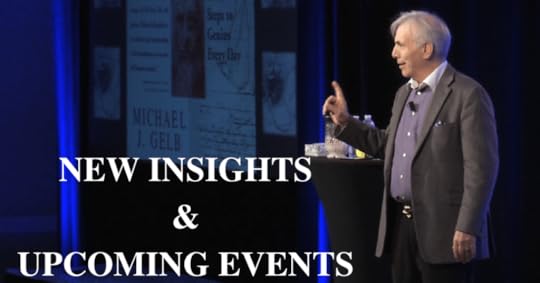
Catch up with Michael J. Gelb’s latest work

Read a special article in Forbes with Michael J. Gelb:
The Real Story Behind The Mind/Body Connection: The Alexander Technique
Perhaps you’ve heard of the Alexander Technique, a tried-and-true method to help actors and singers with their voices. But that’s only the beginning. It’s also known to dramatically help people with neck and back pain, to build poise and even boost your mood. More…
Listen to Michael Gelb’s insightful podcast with Untangle, The Podcast from Meditation Studio
Michael J. Gelb – Why Connection and Relationships Matter (a lot!)
Michael shares the 7 most important relationship building skills needed for leaders, from his new book The Art of Connection. He reminds us why these skills make such a big (and positive!) difference in all of our interactions. More…

Read Tom Peters! guest blogger Michael J. Gelb’s latest article
Michael J. Gelb – Guest Blog: The Art of Connection
We are all in the relationship business. Leaders who cultivate the “core competence” of relationship building will have an increasingly powerful competitive advantage. More…
Upcoming Public Programs
5th Annual Mindful Leadership Summit
November 1 – 4th, 2018
Washington, D.C.
The Mindful Leadership Summit is the world’s largest gathering devoted to the advancement of mindfulness and compassion in the workplace.

New York Open Center
Qigong Secrets for Vitality and Creativity
Robert Peng & Michael Gelb
Contemporary science is now validating the profound benefits of the ancient Chinese practice of qigong. In this workshop, qigong master Robert Peng and creativity expert Michael Gelb team up to teach us how to increase our vitality and creative energy to empower every aspect of our lives.
The day will end with a group healing session, followed by a book signing.
A One-Day Workshop
Sunday, November 11, 2018, 10:00 am – 5:30 pm
Members $130/ Nonmembers $150

10th Global Peter Drucker Forum 2018
Vienna, Austria, on November 28, 29 and 30
Business needs to reframe issues beyond narrow positions; and reconcile apparently conflicting stances to create common ground. Come explore new ideas!

ESALEN
The Art of Connection: 7 Relationship-Building Skills Every Leader Needs Now
JAN 04 – 06, 2019
with Michael Gelb
This dynamic program is based on the exciting discovery that a powerful catalyst for inspiring creative breakthroughs is to guide people to connect with one another first, before trying to solve a problem. When people connect, when they are on the same wavelength, attuned, and in rapport, they are much better at generating – and implementing – new ideas.
Body Learning: Grace, Presence and Power with Alexander Technique and Super-Qi
JAN 06 – 11, 2019
with Michael Gelb
The Alexander Technique is a simple, profoundly powerful method for developing grace, poise, and presence on stage and in everyday life. Renowned as the trade secret of world-class performers (it’s part of the curriculum and the Royal Academy of Drama and Music in England and the Juilliard School in the U.S.), the Alexander Technique is often called “the method for keeping your eye on the ball applied to life.” The Super Qi form is a creative synthesis of the most effective movements from qigong, the ancient Chinese system for cultivating life energy and internal power.

The Omega Institute
Super Qi Summit: Balancing the Masculine & Feminine Energies
May 24-27, 2019 Rhinebeck, NY
Harmonizing the masculine and feminine energies, aka Yin and Yang, is the secret of personal health, well-being, positive relationships and spiritual development. This special Super Qi Summit brings together modern masters with profound expertise in cultivating this harmony.
SAVE THE DATE – You won’t want to miss this!

The post New Insights & Upcoming Events appeared first on Michael J. Gelb - Keynote Speaker, Seminar Leader & Executive Coach.
New Insights & Events
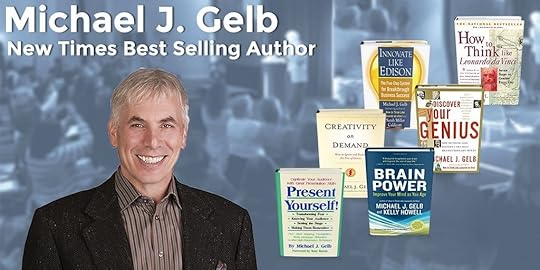
Catch up with Michael J. Gelb’s latest work
Read a special article in Forbes with Michael J. Gelb:
The Real Story Behind The Mind/Body Connection: The Alexander Technique
Perhaps you’ve heard of the Alexander Technique, a tried-and-true method to help actors and singers with their voices. But that’s only the beginning. It’s also known to dramatically help people with neck and back pain, to build poise and even boost your mood. More…
Listen to Michael Gelb’s insightful podcast with Untangle, The Podcast from Meditation Studio
Michael J. Gelb – Why Connection and Relationships Matter (a lot!)
Michael shares the 7 most important relationship building skills needed for leaders, from his new book The Art of Connection. He reminds us why these skills make such a big (and positive!) difference in all of our interactions. More…
Read Tom Peters! guest blogger Michael J. Gelb’s latest article
Michael J. Gelb – Guest Blog: The Art of Connection
We are all in the relationship business. Leaders who cultivate the “core competence” of relationship building will have an increasingly powerful competitive advantage. More…
Upcoming Public Programs
The Omega Institute
Super Qi Weekend: Practices for Healing, Happiness & Creativity
Aug 10 – Aug 12 2018 Rhinebeck, NY
Practice qigong with three modern masters who have more than 100 combined years of experience in the study and practice of vital energy: Michael J. Gelb, Robert Peng, Ken Cohen
The Omega Institute
Uncork Your Creative Juices: Appreciating Wine, Music, Chocolate & Poetry
Sep 21 – Sep 23 2018 Rhinebeck, NY
Come explore the art of appreciation as you increase creativity and happiness through sensory delights! This enhanced experience of wonder and awareness puts more dolce in your vita, more joie in your vivre, and more creativity in your everyday life.
New York Open Center
Qigong Secrets for Vitality and Creativity
Robert Peng & Michael Gelb
Contemporary science is now validating the profound benefits of the ancient Chinese practice of qigong. In this workshop, qigong master Robert Peng and creativity expert Michael Gelb team up to teach us how to increase our vitality and creative energy to empower every aspect of our lives.
The day will end with a group healing session, followed by a book signing.
A One-Day Workshop
Sunday, November 11, 2018, 10:00 am – 5:30 pm
Members $130/ Nonmembers $150
The post New Insights & Events appeared first on Michael J. Gelb - Keynote Speaker, Seminar Leader & Executive Coach.
November 27, 2017
Let Mona Lisa Help You Manage Change

Let Mona Lisa Help You Manage Change
By Michael J. Gelb
Utilizing Creativity to Manage Change
I led my first 5-day management retreat for the International Field Service Leadership Team of Digital Equipment Corporation (DEC) in 1979. The theme was “Utilizing creativity to deal with accelerating change.” DEC’s Field Service Team was ahead of the curve relative to the rest of the company. But their corporate leadership failed to anticipate the rise of the personal computer, and eventually Compaq acquired DEC.
Years later I gave a keynote speech at the global management conference for Compaq and reconnected with many of the participants from our original seminar. Then, a few years after that, I worked with Hewlett-Packard when it acquired Compaq. None of us knew, in that first seminar, just how fast change would accelerate.
The One Key Trait for Successful Entrepreneurs
As the rate of change accelerated through the 1980s and 90s, corporations began to seek managers with a high “tolerance for ambiguity.” More recently, Forbes described tolerance for ambiguity as “The One Key Trait for Successful Entrepreneurs.”
Psychologists define three causes for the anxiety associated with ambiguity: novelty, complexity, and perceived insolubility. In other words, if its new, complicated, and you don’t have any idea how to solve it, you experience anxiety. Creativity, in art or business, requires finding something new, simplifying the complex, and discovering solutions that are unexpected.
Embrace Ambiguity
So, let’s replace the notion of tolerating ambiguity with the idea of embracing it.
The ability to embrace ambiguity and change is the most distinguishing characteristic of the creative mind. This isn’t just for artists, it’s now an essential competency for everyone.
Leonardo da Vinci understood this five hundred years ago. His Mona Lisa is the most famous work of art in history, renowned for her mysterious smile.

Mona Lisa helps you manage change
Why is Mona Lisa smiling?
The best way to discover this is to assume Mona’s posture and imitate her famous smile. Try this for ten seconds now.
How do you feel when you smile like Mona Lisa? I recently asked this question to a group of gifted children. After a few moments, a girl sitting in the back of the room exclaimed, “She’s got a secret.” And then a boy in the front said, “She knows that everything has an opposite!” And then the children offered examples — light and dark, good and bad, night and day, life and death.
When I led the same exercise with a corporate group, one person responded, “I read in the Wall Street Journal that the famous smile was caused by a dental problem.”
The gifted boys and girls did a much better job of perceiving Mona’s expression of perspective in the face of uncertainty. Mona’s fame, in addition to the unprecedented mastery in her execution, rests on the ambiguity that da Vinci creates, the sense of dynamic tension. The ability to embrace dynamic tension is at the heart of the creative process and it’s even more important now than it was in the Renaissance.
Legendary CEO Jack Welch advised, “Change before you have to.” So learn to smile in the face of change now, and know that uncertainty sets the stage for real creativity.
For more help with managing change, visit MichaelGelb.com
The post Let Mona Lisa Help You Manage Change appeared first on Michael J. Gelb - Keynote Speaker, Seminar Leader & Executive Coach.
October 5, 2017
“Why Create?”
Today we take for granted the idea that creativity is a human attribute. The question “Why Create?” is predicated on the assumption that we have the option do so. But that assumption has only been around for about 500 years. Prior to the Renaissance, the notion of individual creativity didn’t exist, because the concept of individuality as we now understand it didn’t exist. Paintings, for example, remained unsigned, and painters, anonymous, because the individual was considered unimportant. All creative power was vested Above.
On a larger scale, great Gothic cathedrals like Chartres were the products of thousands of people toiling anonymously in collaborative efforts that continued over hundreds of years. The great cathedrals were deliberately designed to give the person who entered them an overwhelming feeling of insignificance in the presence of an omnipotent and omniscient Deity.
Individualism Recognized as a Value
 A remarkable shift occurred during the Renaissance, when the power and potency of the individual began once again to be celebrated, as they had been in Greek and Roman times. In 1486, the Renaissance scholar and philosopher Pico della Mirandola offered his Oration on the Dignity of Man, heralding the shift from the medieval worldview, which disempowered the individual, to the revolutionary notion that we humans, unlike other creatures, have been placed at the very center of the universe, and blessed with powers of free will and creativity that are unlimited and virtually godlike.
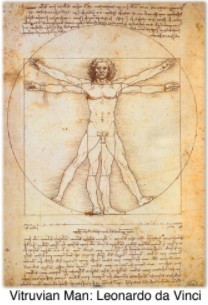
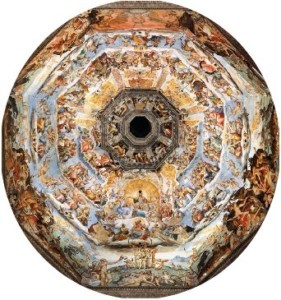
Pico articulated the revolutionary notion that creativity is part of our expression of free will, part of what makes us uniquely human. He celebrates the notion that we create because we can. Leonardo da Vinci’s Vitruvian Man (a.k.a. “Canon of Proportion”) and Michelangelo’s “David” are the best-known symbols of this humanistic rebirth of individual creativity. But there is one man, Filippo Brunelleschi, who was the pre-eminent force in the emergence of the new human-centered worldview, for he both literally and figuratively created a new human-centered perspective. Just as the Gothic cathedrals had communicated a message about humanity’s place in the universe, Brunelleschi’s architecture sent an equally profound but very different message, as best exemplified by his dome for the Florence cathedral.
Standing beneath Brunelleschi’s heavenly dome, one feels oneself to be at the center of Creation. One does not feel overpowered and belittled, but exalted and uplifted in this sacred space. Humankind’s centrality and importance are also affirmed in Brunelleschi’s invention of three-dimensional perspective in art; which he taught to Massaccio, who produced the first Renaissance painting and to Donatello who created the first Renaissance sculpture. And Brunelleschi exemplified the new ethos in his own life by registering the world’s first patent for an invention (his remarkable ox-hoist) – patents being the legal and economic expression of the value placed on the individual’s intellectual capital.
Emergence of the Renaissance Man
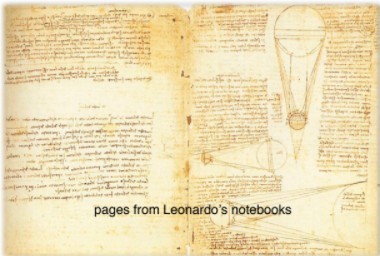 Although Brunelleschi is the seminal force, Leonardo da Vinci reigns as the supreme expression of the “Renaissance Man” or “Uomo Universale” (Universal Man). DaVinci serves as a global archetype of individual creative possibility. In 1994 Bill Gates paid $30.8 million dollars for 18 pages of DaVinci’s notebooks. Why did Gates pay so much? Because he can! And, it’s easy to imagine that Gates recognizes that his own legacy resides in his role in the transformation from the Industrial Age to the Information Age; and that he wanted to associate himself and his brand with the works of a man who embodies the spirit of the dawn of that earlier new age.
The Renaissance, with its brilliant artists and architects, sculptors and scholars, taught us anew that creativity is our birthright, a gateway to our highest expression, the secret of individuation and personal fulfillment, and the secret of the art of living. Creativity may also be a means to earning a good living, as quite a number of artists discovered during the Renaissance. Before we explore the loftier motivations for creating let’s examine the relationship between creativity and profit.
The feudal system of the Middle Ages collapsed because, among other things, of the invention of the long-range cannon (built by a Hungarian engineer named Urban), which could blast through the walls of the feudal fortress. As fortress walls crumbled the printing press, magnetic compass, mechanical clock, microscope and telescope expanded European horizons exponentially. The technological breakthroughs that drove the transformation of the Middle Ages into the Renaissance were all made possible by the funding that became available as innovative accounting and banking systems evolved. Brunelleschi, Leonardo, Michelangelo, Raphael and all their fellow geniuses wouldn’t have created much of anything without the Renaissance equivalent of corporate sponsorship. If the Sforza, Medici and a succession of Popes hadn’t provided the capital, the Florence cathedral would’ve remained open to the elements and there would have been no “Last Supper,” “David” or “School of Athens.” As Professor Lisa Jardine author of Worldly Goods: A New History of the Renaissance emphasizes,
“…those impulses which today we disparage as ‘consumerism’ … occupy a respectable place in the characterization of the new Renaissance mind… A competitive urge to acquire was a precondition for the growth in production of lavishly expensive works of art. A painter’s reputation rested on his ability to arouse commercial interest in his works of art, not on some intrinsic criteria of intellectual worth.”
Creativity as Vocation
Those of us who “arouse commercial interest” through our creative endeavor — writers, photographers, creative directors, web designers, graphic artists, composers, painters and performers – are part of a great heritage of creating art for cash. As literary legend Dr. Samuel Johnson put it: “No man but a blockhead ever wrote, except for money.”
Capitalism provides the most energy and opportunity for creative expression. And the United States of America — founded on the remarkable idea that we are all created equal and have an inalienable right to “life, liberty and the pursuit of happiness” — is the greatest capitalist entity in history thus far. Our nation’s youthful optimism, diversity and emphasis on freedom and equality fosters an environment where creativity and innovation are more the cultural norm than anywhere else. Yet, as we transition out of the Industrial Age, and face unprecedented environmental, social and global challenges, the ability to think creatively becomes more urgent and important.
Historian of science George Sarton writes: “Since the growth of knowledge is the core of progress, the history of science ought to be the core of general history. Yet the main problems of life cannot be solved by men of science alone, or by artists and humanists: we need the cooperation of them all. “Sarton concludes that Leonardo’s “outstanding merit” is in his demonstration that “the pursuit of beauty and the pursuit of truth are not incompatible.”
For Leonardo, creativity was a function of the marriage of art and science. He emphasized, for example, that the ability of the artist to express the beauty of the human form is predicated on a study of the science of anatomy. But Leonardo’s science was also based on his art.
Imagination and Creative Thinking Lead to Invention
Leonardo urged his students to awaken the generative power of imagination in an unprecedented way. Offering “a new and speculative idea, which although it may seem trivial and almost laughable, is none the less of great value in quickening the spirit of invention.” He urged students to contemplate abstract forms – patterns of smoke, clouds, and swirls of mud – and to allow the imagination to run freely to discover in these mundane forms “the likeness of divine landscapes … and an infinity of things.” The Maestro then counsels that the ideas generated in this flight of the imagination “may then be reduced to their complete and proper forms.”
In the thousand years before DaVinci in Europe there was very little encouragement to “quicken the spirit of invention” by seeking “divine landscapes” or searching for “an infinity of things.” Before Leonardo the concept of “creativity” as a human function and an intellectual discipline didn’t exist. Inspired by Brunelleschi and Alberti, Leonardo effectively invented the modern discipline of “creative thinking.”
Just as Leonardo helped to invent the art of creative thinking he also points us toward a compelling reason to create: to know ourselves and the world around us – to appreciate truth and beauty — through mirroring the creative source. In his classic work The Creators: A History of Heroes of the Imagination, Daniel J. Boorstin addresses the mystery of the motivating forces of creativity. He notes, “the human need to create has transcended the powers of explanation.” Boorstin adds, “Peoples of ancient Egypt, Greece and Rome who did not know a Creator-God, who made something from nothing, still created works unexcelled of their kind. And peoples of the East who saw a cosmos of cycles created works of rare beauty in all the arts. Across the world, the urge to create needed no express reason and conquered all obstacles.” Boorstin summarizes the prologue of his journey through the history of Heroes of the Imagination, by proclaiming his intention to “describe the who, when, where, and what.” But, he concludes, “the why has never ceased to be a mystery.”
Creativity and Immortality
Of course, as Boorstin speculates, “Man’s power to make the new was the power to outlive himself in his creations.” In other words, for some, the motivation to create is to achieve immortality. And, of course, it isn’t necessary to posit or believe in God in order to create, but as Vincent van Gogh expressed it, “I can do very well without God in both my life and my painting but I cannot…do without something which is greater than I, which is my life, the power to create.”
The Chinese philosopher T’ang Hou reflects on the nature of the power – the “something greater” referenced by van Gogh: “Landscape painting is the essence of the shaping powers of Nature. Thus, through the vicissitudes of yin and yang – weather, time, and climate – the charm of inexhaustible transformation is unfailingly visible. If you yourself do not possess that grand wavelike vastness of mountain and valley within your heart and mind, you will be unable to capture it with ease in your painting.”
There is a creative force in the universe that we can all experience in our hearts and minds as a “grand wavelike vastness.” In creative endeavors we open ourselves to discover our harmony with “something greater” and, if we persevere, something true and beautiful just might emerge. As Ansel Adams expresses it, “Sometimes I do get to places just when God’s ready to have someone click the shutter.”
So “Why Create?” There are infinite reasons — to make visible the charm of inexhaustible transformation, to become more susceptible to grace, to achieve immortality, to know the mind of God, to manage change, make a living or make a life; but the simplest is: just because we can.
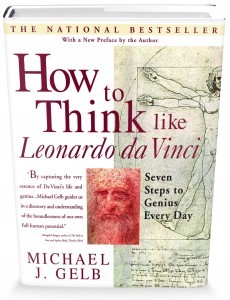
How To Think Like Leonardo da Vinci by Michael J. Gelb
Michael J. Gelb is the author of the international best-seller How to Think Like Leonardo DaVinci and a new book, The Art of Connection. www.michaelgelb.com.
The post “Why Create?” appeared first on Michael J. Gelb - Keynote Speaker, Seminar Leader & Executive Coach.
September 28, 2017
Q&A about The Art of Connection: 7 Relationship-Building Skills Every Leader Needs Now
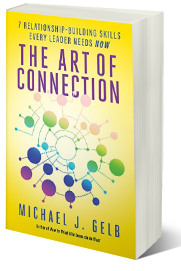 The Art of Connection: 7 Relationship-Building Skills Every Leader Needs Now
has just been released!
The Art of Connection: 7 Relationship-Building Skills Every Leader Needs Now
has just been released!We will be posting links to some of my most recent interviews, but in the meantime here’s a compilation of some of the questions and answers thus far.
Q: You’re known as a thought leader in Creativity and Innovation, so why have you written a book about relationships?
A: My primary emphasis has been on teaching people the mindset and skills of creative thinking. It’s relatively easy to teach people how to generate new ideas. The hard part is getting support for those ideas and overcoming resistance to innovation and change. This demands skill in building relationships, and it often means managing conflict.
Many of my clients are champions of innovative change in companies, schools, non-profits and government agencies, and they seek help in overcoming resistance to new ideas. Whether you are championing innovation and positive change in your organization, trying to negotiate a fair deal with a collaborator, or dealing with a dispute with your spouse or child, your success and fulfillment will be a function of your ability to apply the art of connection.
Q: You are involved with the Conscious Capitalism movement. Please explain.
A: For almost 40 years I’ve worked with corporations, helping them become more creative, innovative and human-centered. This work is part of a growing movement toward sustainable, conscious capitalism. Business leaders are recognizing that they will be more successful and profitable if they care for all their stakeholders including the community, environment, workers etc. They make the world better by the way they do business, and the world responds by making them more profitable. This isn’t touchy-feely idealism; it’s practical, evidence-based reality. One of the core tenets of Conscious Capitalism is: “Create partner relationships that are truly mutually beneficial.” This book is designed to develop the relationship-building skills needed to make that ideal real.
Q: You have a whole chapter focusing on the notion that “Emotions Are Contagious”. Please explain.
A: This is ancient wisdom validated by contemporary science. More than two thousand years ago the Greek playwright Euripides noted “Every man is like the company he keeps.” More recently, computational social science (N. Christakis, et.al.), has demonstrated that our emotions are contagious, for better or worse, affecting everything from our weight and alcohol consumption to our sleep patterns and general happiness.
Computational social science validates Euripides assertion. If, for example, most of the people you interact with are alcoholic, obese, or depressed, then you are more susceptible to those conditions, but if those people are healthy, happy, and fit, then you are more likely to be so too.
Emotional contagion is mediated through mirror neurons. As neuroscientist and physician Marco Iacoboni, author of Mirroring People: The New Science of How We Connect with Others, explains: “Insights into mirror neurons may help us ameliorate a range of mental-health challenges such as narcissistic personality disorder…” Iacoboni adds, “I believe the art of connection is essential for anyone in a position of leadership, and it’s also important for pretty much anyone who wants better relationships. Just as athletes train themselves in their sport, you can develop your ability to connect with others.” (Iacoboni and Michael Gelb offer a compelling seminar together.)
Q: Vulnerability is a hot topic – is it a weakness or a power?
A: In her book Daring Greatly: How the Courage to Be Vulnerable Transforms the Way We Live, Love, Parent, and Lead, Brené Brown argues that “vulnerability is the core, the heart, the center, of meaningful human experiences.” The V-word word has become popular, but it’s not the best term.
Derived from the Latin vulnerare, “to wound”, synonyms include “weak, helpless, defenseless, sitting duck, and sucker.” More helpful words to express this quality include: accessible, approachable, open, present, receptive…
When we are open and accessible, it’s much easier for others to connect with us. For example, at a recent seminar for construction managers in New York, the group engaged in a discussion about the importance of seeking input from work crews on job sites. Joe, a veteran senior project manager, asked, “Won’t my people think I’m weak if I ask for their ideas?” This led to a passionate discussion in which many of the younger participants shared their belief that when a boss asks for their contributions, they feel respected and included. As a result, they see this as a sign of strength. This is a big change in the world of work!
Q: You write that contemporary leaders need to be able to communicate like therapists? Are you joking?
A: It’s a serious point framed amusingly. In the 1970s managers were just managers. In the 1980s managers were asked to learn how to be leaders, something that has become more important every decade since. In the first decade of the new millennium, managers were also asked to develop the skill of coaches. Now if you lead in any kind of organization, in addition to knowing how to be a coach, it really helps if you can think and speak like a psychotherapist. The same thing is true for parents and spouses. (I first learned how to speak like a therapist from my mom, Joan, who worked for years at the Passaic County Mental Health Clinic.)
Q: You write “The Art of Connection is the secret of health, happiness and leadership.” How do we know that’s true?
A: Psychiatrist and professor at Harvard Medical School Robert Waldinger is the current director of the world’s longest-running social science study. For more than 77 years they’ve followed a group of 724 men, measuring the factors that most influence their mental and physical health. Waldinger and his three predecessors all found that most younger men believe that money, power, achievement, and fame are the keys to success and happiness. That’s certainly the impression one gets from contemporary media, advertising, video games, and reality television. But the results of the study are undeniably clear: the most important factor in a happy and healthy life is a positive sense of connection with others.
Waldinger’s conclusions are supported and extended by many other studies. The sense of positive social connectedness yields many research-validated benefits. It:
• strengthens immune function and reduces inflammation.
• prevents dementia, diabetes, and many other ailments.
• promotes longevity.
Q: You state, “The current climate of disrespectful speech may be doing as much harm to our country as the disregard for the planet’s climate.” Can you please explain?
A: We know from decades of research that rudeness, incivility and verbal abuse are not only unpleasant but profoundly destructive. This is a national “teachable moment.” Prof Christine Porath of Georgetown University surveyed more than fourteen thousand people from a wide range of organizations, and found that those who tolerate incivility suffer greater turnover and have trouble attracting and retaining the best people; they are less creative and innovative, lose customers and weaken their brand. Porath sums it up: “Incivility is expensive.”
Q: In a world where people are more dependent than ever on electronic communication, is your book relevant?
A. It’s not just relevant, it’s urgent and critical. Children are growing up learning communication skills from Siri and Alexa. But, successful leaders in different walks of life need to be skilled at intelligent conversation-they connect, listen, and empathize. These relationship building abilities are more relevant and valuable now than ever before.
Order your copy of The Art of Connection: 7 Relationship-Building Skills Every Leader Needs Now

Comments about The Art of Connection and Michael Gelb:
A Masterpiece! Gelb teaches the skills we all need to bridge the gap between the highest ideals of conscious business and the reality of its practice. In the process, he illuminates a soul enlivening, transformational approach to deepening all our relationships. An absolute must-read for aspiring conscious leaders.
~ Raj Sisodia, FW Olin Distinguished Professor of Global Business at Babson College author of Conscious Capitalism
I love Michael’s wonderful new book. It is filled with simple yet profound practices that support us in cultivating deep relationships at work and in our personal lives — the secret to a life of meaning and joy.
~ Eileen Fisher, founder and president of EILEEN FISHER Inc.
Please subscribe to Michael’s YouTube channel.  The videos of the Centering exercise, and other aikido exercises will be posted soon!
Upcoming Workshops you can attend:
Omega Institute
September 29 – October 01, 2017 in Rhinebeck, NY
The Art of Connection – 7 Relationship-Building Skills for Leaders Today
Discover a stronger sense of connection and rapport in your relationships
Differentiate yourself from the tendency toward shallow and superficial communication
Develop new strategies for promoting your ideas and overcoming resistance to change
Understand your leadership style and learn to work effectively with other styles
Cultivate the emotional intelligence and interpersonal skills necessary to bring out the best in yourself and others

1440 Multiversity
January 1 – 5, 2018 in Scotts Valley, CA (near Santa Cruz)
How to Think Like Leonardo DaVinci: Seven Steps to Genius Every Day
You will take away endless inspiration and immediately applicable tools to generate more ideas in less time and make greater connections between ideas. Anyone wishing to maximize their creative potential is welcome.

The post Q&A about The Art of Connection: 7 Relationship-Building Skills Every Leader Needs Now appeared first on Michael J. Gelb - Keynote Speaker, Seminar Leader & Executive Coach.