Michael J. Gelb's Blog, page 6
November 15, 2011
ONLINE SEMINAR: How to Think Like Leonardo Da Vinci
 Sponsored by en*theos academy
Starts this SATURDAY NOVEMBER 19, 2011!
Dates & Tuition
Time: 5 Saturdays at 10:00 am Pacific
Dates: November 19, 26 + December 3, 10, 17
Can't make the calls? No problem! Download an MP3 of the class the next day.
Tuition: $125
(If cash is tight, we offer a "Pick Your Price" model where you can choose to pay $125/$100/$50. And, if cash is super tight, you can apply for a scholarship!)
Course Overview
Thinking creatively, learning faster and staying centered, these abilities are at a premium in a rapidly changing and complex world. What if you could call on history's greatest genius, Leonardo da Vinci, to be your personal mentor in cultivating these highly prized elements of human capital? Anatomist, architect, botanist, city planner, chef, engineer, equestrian, inventor, geographer, geologist, musician, painter, and philosopher, Leonardo da Vinci helped bring the Western world out of the Middle Ages and into the Renaissance. Now, his approach to optimizing human potential is more relevant than ever.
You will be guided to apply the 7 principles for thinking like Leonardo, through a proven series of practical exercises, to your deepest life questions. The da Vinci principles are:
• Curiosità – An insatiable quest for knowledge and continuous improvement
• Dimostrazione – Learning from experience
• Sensazione – Sharpening the senses
• Sfumato – Managing ambiguity and change
• Arte/Scienza – Whole-brain thinking
• Corporalità – Body-mind fitness
• Connessione – Systems thinking
Textbook for the Course
How to Think Like Leonardo da Vinci by Michael J. Gelb
Who Should Attend?
This inspiring and practical look at the essential elements of Leonardo da Vinci's genius will be great for all those committed to living an extraordinary life while enjoying the process.
What You'll Get Out of the Course
In this dynamic, highly-interactive program Michael Gelb brings da Vinci's genius to life. You will learn how to:
• Make a Mind Map that integrates your life vision, values and goals
• Nurture creativity and innovation
• Put more Dolce in your Vita
• Find opportunity in uncertainty
• Improve memory and problem solving
• Balance mind and body to reduce stress
• Access and apply the real spiritual teachings of Leonardo
Leonardo da Vinci invented the parachute before anyone could fly. That's thinking ahead! Imagine what you will accomplish when you learn the approach of humanity's supreme archetype for the fulfillment of human potential.
Enroll Now!



October 31, 2011
Create Like Leonardo, Innovate Like Edison, an interview with Investment Advisor Magazine
From the September 2011 issue of Investment Advisor
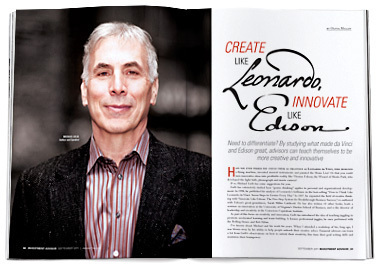
Have you ever wished you could think as creatively as Leonardo da Vinci, who designed a flying machine, invented musical instruments and painted the Mona Lisa? Or that you could turn innovative ideas into profitable reality like Thomas Edison, the Wizard of Menlo Park, who developed the light bulb, phonograph and movie camera?
If so, Michael Gelb has some suggestions for you.
Gelb has extensively studied how "genius thinking" applies to personal and organizational development. In 1998, he published his analysis of Leonardo's brilliance in the best-selling "How to Think Like Leonardo da Vinci: Seven Steps to Genius Every Day." In 2007, he expanded the field of creative thinking with "Innovate Like Edison: The Five-Step System for Breakthrough Business Success," co-authored with Edison's great-grandniece, Sarah Miller Caldicott. He has also written 10 other books, leads a seminar on innovation at the University of Virginia's Darden School of Business, and is the director of leadership and creativity at the Conscious Capitalism Institute.
As part of this focus on creativity and innovation, Gelb has introduced the idea of teaching juggling to promote accelerated learning and team-building. A former professional juggler, he once performed with the Rolling Stones and Bob Dylan.
I've known about Michael and his work for years. When I attended a workshop of his, long ago, I was blown away by his ability to help people unleash their creative selves. Financial advisors can learn a lot from Gelb's observations on how to unlock their creativity, fine-tune their goal-setting skills and maximize their brainpower.
Olivia Mellan: How did you get into exploring the lives of Leonardo and Edison?
Michael Gelb: When I was a child my two biggest role models, my heroes, were Leonardo da Vinci and Superman. Eventually I discovered that Superman was only a comic book character, but Leonardo was real.
One of the great things about being human, once you're a grown-up, is that you can choose who and what you want to imitate. So if you want to learn creativity, it makes sense to model perhaps the most creative person who ever lived: Leonardo da Vinci. And if you want to learn innovation, then you want to model yourself after the greatest innovator of all time: Thomas Edison.
Part of the reason why da Vinci and Edison make such a powerful one-two combination as role models for creativity and innovation, respectively, is that Leonardo was more interested in pure creativity, whereas Edison aimed to link his creativity to business.
OM: How can we apply Leonardo's processes to our professional lives? Advisors want to help clients achieve the life they truly want, and find financial security and true serenity.
MG: For an advisor in a highly competitive world, the challenge is to add value by serving as more than just a resource for good stocks and bonds. The best advisors have the emotional intelligence to bond with their clients and help them take stock of their lives.
I've identified seven principles for thinking like Leonardo da Vinci that can guide advisors in developing an ability to integrate the big picture with the details. Not only can these tools help them better serve their clients, but they also constitute a program advisors can follow to integrate the personal and the professional and keep their own lives in balance.
[Click here to learn one way to think like a visionary.]
Q. Can you walk us through the principles for thinking like Leonardo?
MG: Absolutely. The idea is to first implement each principle in your own life, then see how you can use it to improve what you do for your clients.
Curiosità (curiosity) is the first principle. Leonardo was on an insatiable quest for knowledge and continuous learning. What this comes down to on a personal level is seeking to understand yourself and fulfill your potential. Professionally, it means eliciting from your clients their most important life questions. Dig deep to find out what truly matters to them.
Dimostrazione (demonstration), the second principle, refers to Leonardo's insistence on learning by personal experience rather than taking others' reports for granted. The lesson for advisors is to always think independently and critically, and to help your clients think more objectively about their current situation and their goals.
Sensazione (sensation), which is related to the first two principles, refers to Leonardo's ability to focus on sharpening his sensory awareness. He wrote, "The five senses are the ministers of the soul." You can train yourself and your clients to be sharper by cutting through all the spam and identifying the most critically important information.
Sfumato , the fourth principle, is a painting technique employed by da Vinci to create an ethereal quality in his work. To me, this ability to embrace ambiguity and change is probably the most important da Vinci principle for advisors and their clients. It suggests the importance of maintaining a sense of perspective and alignment with your principles in the face of grave uncertainty.
Arte/scienza (the science of art) refers to Leonardo's whole-brain thinking: his ability to be both imaginative and practical. Advisors too must practice their capacity to think both analytically and intuitively, and encourage their clients to develop the same balance.
Corporalità , which literally means physicality, represents Leonardo's belief that a healthy mind requires a healthy body. Even though an advisor isn't meant to be a wellness consultant, you still need to have a healthy lifestyle and help your clients develop one. In big-picture terms, if your net worth goes up but your energy level and general health go down, you're not a good investor.
Connessione (connection) relates to Leonardo's ability to weave multiple disciplines around a single idea. In other words, he was a systems thinker—which is one of the primary ways an advisor adds value. You have to see all the important connections in your clients' lives, which means understanding their vision, values and goals. To advise them effectively, you have to be able to ascertain the most significant global forces that will impact the investments you recommend.
OM: I understand that USA Today asked you what Leonardo da Vinci and Thomas Edison would ask each other if they ever met. What did you say?
MG: Da Vinci would ask Edison about the nature of light, and Edison would ask da Vinci, "Do you want a job?"
OM: In "Innovate Like Edison," you offer a system for cultivating innovation. Tell us more about the five competencies you've identified.
MG: Edison's strategies for generating new ideas and finding promising business opportunities are especially relevant for advisors and investors. His five competencies of innovation, as I've determined them, are:
1. A solution-centered mindset. This means focusing on solving problems rather than being dragged down by them. This is the attitude that makes innovation possible.
Edison is famous for having said, "Results? I've gotten lots of results. I know thousands of things that won't work." He continually focused on finding solutions and learned from things that didn't work. The message for advisors is not to get bogged down by dwelling on past mistakes and regrets, and to concentrate instead on applying the lessons learned.
2. Kaleidoscopic thinking. Edison said, "If you want to get a good idea, get a lot of ideas." Open your mind to a broad and expansive range of possibilities, then home in on the most compelling ideas.
3. Full-spectrum engagement. This involves the ability to manage complexity—a skill that's even more important now than it was in Edison's time.
Edison believed in Occam's Razor, the principle that when there are a number of possible answers, it's advisable to chose the one that makes the fewest new assumptions. He sought simplicity in the midst of complexity. In the complicated world of investing, this is a valuable instinct to cultivate. For example, if you can't understand what a company does or why it's valuable, don't buy it!
Also, both da Vinci and Edison were deeply contemplative. Leonardo said, "Men of genius sometimes work best when they work least." Here he's expressing the importance of receptivity and deep relaxation in the process of creation. Edison would go off in the middle of a workday to a nearby pond where he would fish with a baitless hook. Why? Because he was really "fishing" for breakthrough ideas, and he knew that relaxation made him more receptive to intuitive insight. He once said, "To do much clear thinking, a person must arrange for regular periods of solitude when he can concentrate and indulge the imagination without distraction."
These modes of consciousness are critically important to investment success and success of any kind. The key is to find your own natural rhythm, balancing intense focus and concentrated work with reflection and receptivity.
4. Mastermind collaboration. In order to create his amazing innovations, Edison assembled a team of brilliant people from diverse and complementary backgrounds. As an advisor, one of the best things you can do to be more innovative is to create your own "mastermind" group of specialists with different backgrounds and viewpoints.
5. Super-value creation. All businesses are based on the idea of creating value for a customer or client. Edison believed he had to create value for his customers in a manner that was dramatically superior to his competitors—hence the term "super"-value creation. Of course, discerning opportunities for value in the investment landscape is critical for long-term success. But in addition to beating numerical benchmarks, advisors can add value by cultivating relationships with their clients that result in continuity, even during periods of underperformance.
OM: What's the single most important thing for advisors who want to innovate like Edison?
MG: I think the most important thing is to align your goals with your passion. Edison said, "I never did a day's work in my life. It was all fun." The best financial advisors I've ever met are by far the most passionate and engaged and caring. They love what they do.
[Click here to learn how to use Edison's principles to help shape your goals.]
OM: I understand you have a new book coming out soon called "Brain Power: Improve Your Mind As You Age." Since much has been written about the graying of the advisory profession, planners will be hungry to learn from this book. Can you tell us a little about it?
MG: I've been teaching people how to improve the mind with age throughout my career, but now it's serious. The exciting news is that scientific evidence that you can improve your mind as you age has become overwhelming.
Most of us grew up believing that our brain power was fixed at age five, and that the mind would inevitably begin to decline after age 30. We now know that that's not true. The brain, as neuroscientist Dr. Richard Restak explains, is designed to improve with use. Your brain is flexible and adaptable, and is designed to continue evolving over time. As Leonardo da Vinci wrote in his notebooks 500 years ago, "Water that does not flow becomes stagnant. Thus it is with the human mind."
Contemporary science demonstrates that the question is no longer "Can your mind improve with age?" but rather "What are the best ways to improve your mind over time?" In the new book, I've identified the most essential, research-validated and practical approaches to continuous neural development.
OM: As someone about to turn 65, my curiosity is running wild. How about a hint?
MG: Interesting you should say that: Maintaining your curiosity and a positive attitude towards aging makes a tremendous difference in mental acuity and even actual longevity. "Brain Power" also covers diet, nutrition, exercise, attitude, continuous learning, the importance of social interaction, nurturing what I call a "brain-enhancing environment"—making your home and workplace an environment filled with beauty, music and enjoyment—relaxation, rest and meditation.
Many people are familiar with some of these, but what this book does is take a systematic approach to help readers get the most out of these practices. It also includes something unique: My co-author, Kelly Howell, is one of the world leaders in brainwave training technology. So "Brain Power" comes with a free download of training programs that will help readers experience the brainwave states associated with rest, relaxation and deep meditation.
OM: Something you once wrote inspires me personally: "Aging well is the supreme expression of wisdom. If you want to age well, nurture your wisdom by studying the lives of great men and women from all walks of life who continued to be productive and fulfilled in their later years." To me, these words have the ring of truth.
MG: That says it all for me, too.
September 14, 2011
Adventures with Genius: A Seminar with Murray Gell-Mann and Michael J. Gelb
In a field cluttered with misinformation, Michael Gelb is an authentic source of practical wisdom for those who seek to develop their creative powers. ~ Murray Gell-Mann
Murray Gell-Mann
Winner of the Nobel Prize in Physics (1969), Murray Gell-Mann is a unique intellectual powerhouse. In addition to being a theoretical physicist he is also a passionate student of linguistics, cultural evolution, archeology, history, ornithology and the psychology of creative thinking. Gell-Mann is a co-founder and one of the prime movers of the renowned think tank, the Santa Fe Institute.
In March 2011 I had the opportunity to entertain Murray at my home in Santa Fe. We enjoyed some superb wines and a very lively conversation. In 2002 I released a book entitled Discover Your Genius: How to Think Like History's Ten Most Revolutionary Minds. Murray was curious about who was on my all-time genius roster; so, I gave him the selection criteria and invited him to guess. As you might imagine, he did rather well. And, he had met one of the figures in the book-Albert Einstein. In the course of the evening Murray shared stories of his interactions with Fermi, Feynman, Oppenheimer, and many other great minds.
After we said goodbye I reflected on our conversation and in a blinding flash of the obvious I realized that a marvelous opportunity was at hand. For the last 30 years I've studied the workings of great minds and aimed to make their wisdom accessible to you. In studying Leonardo da Vinci I traveled to his birthplace and to the place he died. I read his notebooks and interviewed many of the great da Vinci scholars, including Professor Martin Kemp. In researching Innovate Like Edison I worked closely with Sarah Miller Caldicott, the great-grandniece of Edison and visited the Edison Papers Project at Rutgers where I was able to interview Dr. Paul Israel, the renowned Edison scholar. I also visited many historical sites including his estate in Ft. Myers, Florida and the extraordinary re-creation of his laboratories in Dearborn, Michigan at the Ford Museum.
Of course I obviously wasn't able to actually meet with and interview either Edison or Leonardo. But, here, in my kitchen, I had just shared some Volnay with a genius who revolutionized our understanding of the nature of the universe.
Since our initial get together, I've hosted Murray at a series of dinners to continue our conversation about the nature of the creative process and to explore how, in the words of Leonardo, we can "quicken the spirit of invention." I've invited other passionate creative thinkers, such as Pulitzer-prize winning playwright Sam Shepard and archaeologist and head of the Santa Fe Institute, Dr Jerry Sabloff, to join in the festivities. I'm recording these discussions and will eventually turn them into a book.
Meanwhile, Murray and I have agreed that it would be fruitful, fun, and interesting to share our conversations with others who are interested in a deeper understanding of the nature of creativity and systems thinking. We've developed a simple, powerful program for you to take advantage of and participate in this delightful dialogue.
There are several offerings we can make. One option is that during the day I will take your group through the principles for thinking like a genius, and in the late afternoon and evening you will have the opportunity to drink wine and dine with a living genius and discuss how he brings these principles to life. Another option is that we both deliver perspectives on creative thinking and then invite the group into the larger conversation while wining and dining.
You'll be inspired by the depth and breadth of Murray's knowledge, his amazing stories of interactions with many of the great minds of the past 80 years, his delightful sense of humor and unrelenting intellectual curiosity.
To arrange a program with Murray and Michael for your organization, Please contact Michael or call 505-438-1181.
View Gell-Mann's TED talk .

July 26, 2011
Leading Innovation: Thinking Creatively for Positive Change
 Date
DateSeptember 13 – 16, 2011
Location
University of Virginia Darden School of Business
100 Darden Boulevard, Charlottesville, VA 22903 USA, +1-434-924-3900
Register HERE
Faculty
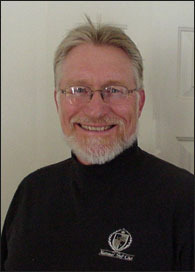

James G. Clawson
Johnson & Higgins Professor of
Business Administration
Michael J. Gelb
Internationally renowned author,
speaker, and consultant
Details
"All organizations require one core competency: Innovation."
– Peter Drucker
As Peter Drucker emphasized, innovation is the core competency for dealing with the aggressive pace of change. More than ever, businesses need people who can think creatively and work together to promote a culture that supports innovation. Through dynamic, interactive learning experiences, participants in Leading Innovation: Thinking Creatively for Positive Change will measurably improve their creative thinking skills and leverage those skills for positive change. Executives and managers will learn how to lead innovation, and return to the workplace with an innovation plan for their organizations. The program features Michael Gelb, internationally renowned author, speaker, and consultant. Discover why the Process of Systematic Innovation is considered to be Thomas Edison's greatest invention, and explore the components of the Five Competencies of Innovation.
Audience
Executives, managers, and directors who want to:
Strengthen their abilities to think creatively and to implement innovation in their organizations.
Use innovative strategies to lead positive change and increase opportunities for growth.
Overcome organizational inertia and resistance to innovation.
Participant Profile
Direct Marketing Manager
Director, Business Analysis and Strategy
General Manager
Manager, Business Strategy
Research Manager, R&Dd
Strategy and Innovation Advisor
Vice President, Engineer Manager
Vice President of Marketing
Benefits
Participants will identify their critical innovation challenges and discover how to generate solutions. They will learn how to:
Think outside of habitual patterns.
Understand the common barriers to innovation and how to overcome them.
Develop strategies that create more value for all stakeholders.
Leverage collaboration to "get out of silos" and create team synergy.
Apply the communication skills necessary to overcome resistance to innovation.
This program counts as one week toward earning a Certificate of Specialization .
Topics
Challenges to Innovation
Developing a Solution-Centered Mindset
Collaborating for Innovation
Creating Super Value
Full-Spectrum Engagement
Innovation and World-Class Performance
Innovative Action Planning
Special Features
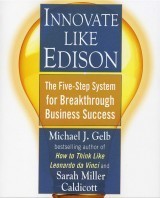

Participants will receive two books: Innovate Like Edison: The Success System of America's Greatest Inventor by Michael Gelb and Sarah Miller Caldicott, a descendant of Thomas Edison, and Level Three Leadership by James G. Clawson.
Innovation Plan: Applying the learning and thinking from each day to their own work environments, attendees will return to the workplace with an actionable 90-day innovation plan.
Register HERE
Fee
$6,500
The fee covers all program materials, program-related meals, and housing in a private room at Sponsors Executive Residence Center for the specified program dates.
Register HERE
July 12, 2011
INTEGRATING MASCULINE & FEMININE: A SPECIAL PRESENTATION WITH MICHAEL GELB AT SANTA FE SOUL
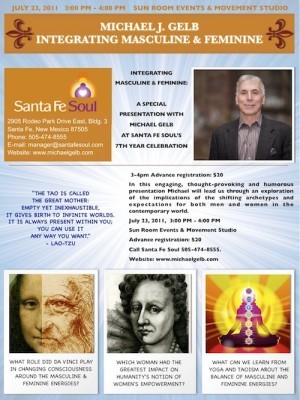
Click the image to view the flyer for this event. Santa Fe Soul - Gelb: Integrating & Masculine and Feminine, July 23 2011
In this engaging, thought-provoking and humorous presentation Michael will lead us through an exploration of the implications of the shifting archetypes and expectations for both men and women in the contemporary world.
SANTA FE SOUL
2905 Rodeo Park Drive East, Bldg. 3, Santa Fe, New Mexico
Phone: 505-474-8555
July 23, 2011, 3:00 PM – 4:00 PM
Sun Room Events & Movement Studio
Advance registration: $20
Call Santa Fe Soul 505-474-8555.
May 31, 2011
GQ Magazine Australia features Michael J Gelb
How to… Live like a genius
Michael J. Gelb has identified the seven essential aspects of Leonardo da Vinci's Genius. Here, he explains how to harness your own inner renaissance Man.
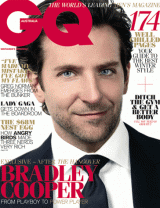
GQ Australia - Michael J Gelb feature June July 2011
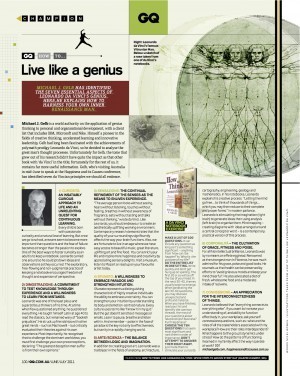
Click image to view article:
Michael J. Gelb is a world authority on the application of genius thinking to personal and organisational development, with a client list that includes IBM, Microsoft and Nike. Himself a pioneer in the fields of creative thinking, accelerated learning and innovative leadership, Gelb had long been fascinated with the achievements of polymath prodigy Leonardo da Vinci, so he decided to analyse the great man's thought processes. Unfortunately for Gelb, the tome that grew out of his research didn't have quite the impact as that other book with 'da Vinci' in the title; fortunately for the rest of us, it contains far more useful information. Gelb, who's visiting Australia in mid-June to speak at the Happiness and Its Causes Conference, has identified seven da Vincian principles we should all embrace.
1.) Curiosità:
An insatiably curious approach to life and an unrelenting quest for continuous learning.
Every child is born with passionate curiosity and a natural love of learning. But once we go to school, answers seem to become more important than questions and the fear of failure becomes stronger than the passion to explore. One of the best ways to foster curiosity as an adult is to keep a notebook. Leonardo carried one around so he could jot down ideas and observations as they occurred. The exploratory, free-flowing and non-judgmental practice of keeping a notebook encourages freedom of thought and expansion of perspective.
2.) Dimostrazione:
A Commitment to test knowledge through experience and a willingness to learn from mistakes.
Leonardo was one of the least pious and superstitious thinkers of his time. At a time when few questioned anything, he questioned everything. He taught himself Latin at age 40 to read the classics, but remained wary of "bookish prejudices". He struck up friendships with other great minds — such as Machiavelli — but critically evaluated their theories against his own experience. Most importantly, he recognised that to challenge the dominant worldview, you must first challenge your own preconceptions, declaring: "The greatest deception men suffer is from their own opinions."
3.) Sensazione:
The continual refinement of the senses as the means to enliven experience.
"The average person looks without seeing, hears without listening, touches without feeling, breathes in without awareness of fragrance, eats without tasting and talks without thinking," wrote da Vinci. Like Leonardo, you should endeavour to create an aesthetically uplifting working environment. Contemporary research demonstrates that the quality of your surroundings significantly affects the way your brain functions. Also, we are fortunate to live in an age where we have easy access to beautiful music, great literature, uplifting art and fine food. You can enrich your life and inspire more happiness and creativity by appreciating sensory delights. Visit a museum, listen to Mozart or read up on your favourite artist today.
4.) Sfumato:
A willingness to embrace paradox and strengthen intuition.
Sfumato represents a distinguishing characteristic of highly creative individuals: the ability to embrace uncertainty. You can strengthen your intuition by understanding its body and emotion-centred nature. Every culture uses terms like "I knew it in my gut." But the gut doesn't send text messages or emails. Learn to pause, breathe and listen within. And remember — poise in the face of paradox is the key not only to effectiveness, but sanity in a rapidly changing world.
5.) Arte/Scienza:
The balance between logic and imagination.
In addition to creating great art, Leonardo was a trailblazer in the fields of anatomy, architecture,cartography, engineering, geology and mathematics. In his notebooks, Leonardo explains his creative process: "Letting the mind go free… to think of thousands of things… which you may then reduce to their complete and proper forms." In modern parlance, Leonardo is stimulating the imagination (right brain) to generate ideas then using analysis (left brain) to organise them. Mind mapping — creating diagrams with ideas arranged around a central concept or word — is a contemporary, practical version of this process.
6) Corporalità:
The cultivation of grace, fitness and poise.
For all his intellectual brilliance, Leonardo was by no means an effete egghead. Renowned as the strongest man in Florence, he was much admired for his grace, poise and good looks. He counsels us that health can be preserved by efforts to "avoid grievous moods and keep your mind cheerful". He also advocated a diet of fresh, wholesome food and a moderate intake of red wine.
7.) Connessione:
An appreciation for the interconnectedness of things.
Leonardo believed that "everything connects to everything else". If you want to increase your understanding of, and ability to function effectively in, your workplace, ask yourself connessione questions, such as: what are the roles of all the stakeholders associated with my workplace? How are their roles interdependent? What happens to the group's dynamics under stress? How do the patterns of functioning I learned in my family affect the way I operate at work?
A Da Vinci notebook exercise
Make a list of 100 questions.
It can include any question as long as it's something significant — anything from 'How can I be happier?' to 'What is the purpose of my life?'
Do the entire list in one sitting. Write quickly and don't get hung up on spelling. The first 20 or so will be off the top of your head. In the next 30-40, themes usually begin to emerge. When generating the last 30-40 questions, you may discover unexpected and profound material. When you have finished, read your list and identify the common threads. Are most of your questions about relationships? Business? Fun? Happiness? choose the ten questions that seem most significant and rank them in order of importance.
Don't attempt to answer them right away, just invite them to stimulate your curiosità.
michaelgelb.com
happinessanditscauses.com.au
Taken from How to Think Like Leonardo da Vinci: Seven Steps to Genius Every Day.
May 30, 2011
“Happiness and Its Causes” Brisbane, Australia June 15-17, 2011
I’m thrilled to be “on the same page” as H.H. The Dalai Lama, Dr. Jane Goodall, et al.!
An amazing gathering of 40+ speakers in science, psychology, spirituality, the arts and more! Be inspired by keynotes including His Holiness the Dalai Lama, acclaimed primatologist Dr Jane Goodall, inspiring humanitarian and photographer Matthieu Ricard, pioneering emotions researcher Dr Paul Ekman, and Michael J Gelb.
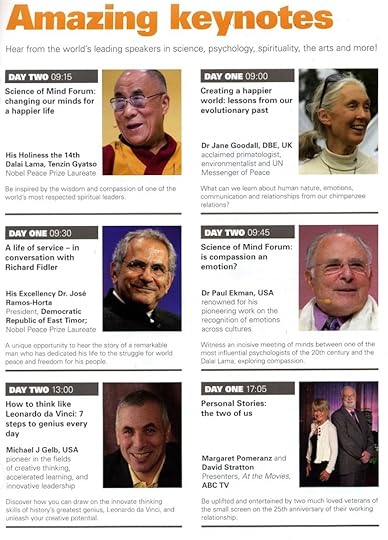
Happiness conference keynotes Brisbane 2011
How to think like Leonardo da Vinci: 7 steps to genius every day
Pre-Conference Workshop:
Wednesday 15 June 2011 9:00 -17:00
Your workshop leader: Michael J Gelb, USA , Pioneer in the fields of creative thinking, accelerated learning, and innovative leadership
What you’ll learn
In our complex world creative thinking is an essential skill for all of us who seek happiness and fulfillment. What if you could call on history’s greatest genius, Leonardo da Vinci, to be your personal mentor in cultivating this ability?
Leonardo da Vinci (1452 – 1519) was the embodiment of the creative spirit and his approach to optimising human potential is now more relevant than ever. This dynamic, highly-interactive program brings da Vinci’s genius to life through fascinating biographical and historical information, setting the stage for an introduction to seven principles for thinking “a la Leonardo.”
Participants are then guided to apply the principles, through a proven series of practical exercises, to your life’s greatest challenges.
You will learn how to:
Think creatively
Cultivate independent thinking
Improve learning ability with age
Find opportunity in uncertainty
Improve memory and problem solving
Balance mind and body to reduce stress
Nurture creativity and innovation
Leonardo invented the parachute before anyone could fly! Imagine what you will accomplish with that kind of innovative thinking.
The post “Happiness and Its Causes” Brisbane, Australia June 15-17, 2011 appeared first on Michael J. Gelb - Keynote Speaker, Seminar Leader & Executive Coach.
"Happiness and Its Causes" Brisbane, Australia June 15-17, 2011
I'm thrilled to be "on the same page" as H.H. The Dalai Lama, Dr. Jane Goodall, et al.!
An amazing gathering of 40+ speakers in science, psychology, spirituality, the arts and more! Be inspired by keynotes including His Holiness the Dalai Lama, acclaimed primatologist Dr Jane Goodall, inspiring humanitarian and photographer Matthieu Ricard, pioneering emotions researcher Dr Paul Ekman, and Michael J Gelb.
Happiness conference keynotes Brisbane 2011
How to think like Leonardo da Vinci: 7 steps to genius every day
Pre-Conference Workshop:
Wednesday 15 June 2011 9:00 -17:00
Your workshop leader: Michael J Gelb, USA , Pioneer in the fields of creative thinking, accelerated learning, and innovative leadership
What you'll learn
In our complex world creative thinking is an essential skill for all of us who seek happiness and fulfillment. What if you could call on history's greatest genius, Leonardo da Vinci, to be your personal mentor in cultivating this ability?
Leonardo da Vinci (1452 – 1519) was the embodiment of the creative spirit and his approach to optimising human potential is now more relevant than ever. This dynamic, highly-interactive program brings da Vinci's genius to life through fascinating biographical and historical information, setting the stage for an introduction to seven principles for thinking "a la Leonardo."
Participants are then guided to apply the principles, through a proven series of practical exercises, to your life's greatest challenges.
You will learn how to:
Think creatively
Cultivate independent thinking
Improve learning ability with age
Find opportunity in uncertainty
Improve memory and problem solving
Balance mind and body to reduce stress
Nurture creativity and innovation
Leonardo invented the parachute before anyone could fly! Imagine what you will accomplish with that kind of innovative thinking.
"Happiness and It's Causes" Brisbane, Australia June 15-17, 2011
I'm thrilled to be "on the same page" as H.H. The Dalai Lama, Dr. Jane Goodall, et al.!
An amazing gathering of 40+ speakers in science, psychology, spirituality, the arts and more! Be inspired by keynotes including His Holiness the Dalai Lama, acclaimed primatologist Dr Jane Goodall, inspiring humanitarian and photographer Matthieu Ricard, pioneering emotions researcher Dr Paul Ekman, and Michael J Gelb.
Happiness conference keynotes Brisbane 2011
How to think like Leonardo da Vinci: 7 steps to genius every day
Pre-Conference Workshop:
Wednesday 15 June 2011 9:00 -17:00
Your workshop leader: Michael J Gelb, USA , Pioneer in the fields of creative thinking, accelerated learning, and innovative leadership
What you'll learn
In our complex world creative thinking is an essential skill for all of us who seek happiness and fulfillment. What if you could call on history's greatest genius, Leonardo da Vinci, to be your personal mentor in cultivating this ability?
Leonardo da Vinci (1452 – 1519) was the embodiment of the creative spirit and his approach to optimising human potential is now more relevant than ever. This dynamic, highly-interactive program brings da Vinci's genius to life through fascinating biographical and historical information, setting the stage for an introduction to seven principles for thinking "a la Leonardo."
Participants are then guided to apply the principles, through a proven series of practical exercises, to your life's greatest challenges.
You will learn how to:
Think creatively
Cultivate independent thinking
Improve learning ability with age
Find opportunity in uncertainty
Improve memory and problem solving
Balance mind and body to reduce stress
Nurture creativity and innovation
Leonardo invented the parachute before anyone could fly! Imagine what you will accomplish with that kind of innovative thinking.
May 28, 2011
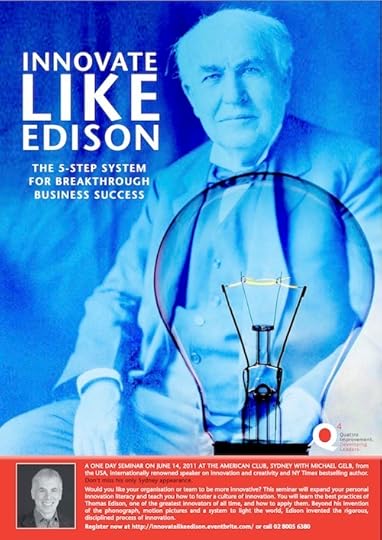
Innovate Like Edison in SYDNEY AUSTRALIA
A one day seminar on June 14, 2011 at the American Club, Sydney with Michael Gelb, from the USA, internationally renowned speaker on innovation and creativity and ny times bestselling author.
Don't miss his only Sydney, Australia appearance.
Would you like your organisation or team to be more innovative? This seminar will expand your personal innovation literacy and teach you how to foster a culture of innovation. You will learn the best practices of Thomas Edison, one of the greatest innovators of all time, and how to apply them. Beyond his invention of the phonograph, motion pictures and a system to light the world, Edison invented the rigorous, disciplined process of innovation.
Register now at http://innovatelikeedison.eventbrite.com/
or call 02 8005 6380
Michael Gelb is a renowned speaker on innovation and creativity and a best selling author of twelve books, including How to Think Like Leonardo Da Vinci and Innovate Like Edison. Based in the USA, Gelb co-directs the acclaimed leading innovation seminar at University of Virginia's Darden Graduate School of Business. He brings 30 years of experience as a professional speaker and consultant to his international clientele including DuPont, Merck, Microsoft and Nike.
This seminar is a unique opportunity to learn from Michael in the small group setting of The American Club, before he heads to Brisbane, Queensland to speak to a group of 1,000+ at a conference.
Every organisation, not just business, needs one core competence: innovation.
- Peter Drucker
Participants will learn how to apply Edison's Five Competencies of Innovation™:
Solution-Centered Mindset
Kaleidoscopic Thinking
Full-Spectrum Engagement
Master Mind Collaboration
Super-Value Creation
1. SolutIon-Centered Mindset: Edison truly believed his success was inevitable. He "aligned his goals with his passions and cultivated a powerful sense of optimism that had a magnetic, positive effect on his co-workers, investors, customers and ultimately the entire nation."
2. Kaleidoscopic Thinking: Edison could work on multiple projects at once and consider each one from many different angles. He was constantly brainstorming new ideas, which he jotted down in a notebook.
3. Full-Spectrum Engagement: Edison balanced the polarities work and play, solitude and collaboration, concentration and relaxation to fully engage in all his work.
4. Master-Mind Collaboration: This idea was coined nearly a century ago by Napoleon Hill who believed that "when people come together under the right circumstances, they can multiply their individual brainpower in an expanding framework of positive, creative energy." Edison was
a master networker and recruited people who would positively contribute to his organisation's "collaborative chemistry."
5. Super-Value Creation: Edison anticipated trends and spotted gaps in the market-place. And then determined how his company could fill these openings. Super-value suggests "creating value above and beyond your competitors."
Michael's programs are for business executives/leaders who truly want to leverage the creative and innovative talent in their department, division or company to improve productivity and employee retention.
Who should attend: Executives, leaders, high potentials in all disciplines as well as professionals working in creative roles or on innovation teams.
Venue: The American Club Sydney – Level 14, 131 Macquarie Street, Sydney Australia
When: Tuesday 14th June 2011, 8am registration, 9am–4pm class
Cost: $795 per person, $745 group rate for 6+, includes morning tea, lunch, afternoon tea and high quality bound handouts for attendees
Register now at http://innovatelikeedison.eventbrite.com/ or call 02 8005 6380 for bookings or information
Registration is essential. All bookings for this event are final, cancellations cannot be accepted. Substitutions can be made up until the day of the event.
Click on image below for the flyer pdf: