Michael A. Ross's Blog, page 5
October 8, 2014
A couple of weeks ago, Oxford University Press had me into the...
A couple of weeks ago, Oxford University Press had me into the office to host a Google hangout to talk to booksellers. Here is a short presentation giving some insight into why I wrote THE GREAT NEW ORLEANS KIDNAPPING CASE and its significance.


The Great New Orleans Kidnapping Case has arrived at bookstores....

The Great New Orleans Kidnapping Case has arrived at bookstores. (Kramerbooks, DuPont Circle, Washington, DC, 10/7/14)
blackhistoryalbum:
The “White” Slave Children of New Orleans |...
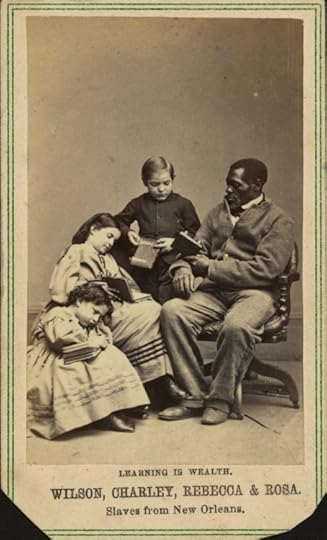
The “White” Slave Children of New Orleans | 1860s
Slave children Wilson, Charley, Rebecca & Rosa, 1863. Former slaves of mixed race ancestry. White Slaves Series 2 of 5
These cards were sold in 1863-1864 to help raise money to pay for schools for emancipated slaves in New Orleans. The organizers realized that the sympathies that people would have for children who looked white but had been slaves was going to be greater than the sympathy they might have for black-skinned children.
Follow us on Tumblr Pinterest Facebook Twitter
Georgetown University Professor Adam Rothman has written a fantastic book on this topic that will be published in Spring 2015. The tragic legacy of slavery in New Orleans and the city’s racial complexity also shaped the events of 1870 that I recreate in my new book The Great New Orleans Kidnapping Case (Oxford University Press, October 2014).
October 7, 2014
Kirkus Reviews Feature on THE GREAT NEW ORLEANS KIDNAPPING CASE
Kirkus Reviews Blog: Nonfiction: Michael A. Ross
Kirkus Reviews interviewed me about how I came to discover the story of Mollie Digby’s kidnapping and the historical significance. From the piece:
"In 1870 New Orleans, two Afro-creole women were accused of kidnapping Mollie Digby, a child of Irish immigrants. The unprecedented amount of press and political attention the case received had much to do with its timing—under the governorship of Henry Warmoth, the recent empowerment of African-Americans in Louisiana bore intense scrutiny, making it one of the ‘most critical moments in American history.’
'The story had become so entangled with Reconstruction politics, that I realized that it had real historical significance,”Ross says. “In part, by demonstrating the way in which a kidnapping, which in a crime-filled city might have been just another Page 3 story, could be blown into something much larger by the fearsome politics of Reconstruction.'
By analyzing this case, which inexplicably slipped through the cracks, Ross augments the historical narrative on race with a sliver of hope, challenging the backlash against the Reconstruction movement.”
Click the link above for the whole feature.
October 6, 2014
October 3, 2014
The big question behind my book, answered on October 14th when...
The big question behind my book, answered on October 14th when THE GREAT NEW ORLEANS KIDNAPPING CASE comes out.
October 1, 2014
Setting the scene of New Orleans during Reconstruction
The Reconstruction era was a critical moment in the history of American race relations. Though Abraham Lincoln’s Emancipation Proclamation made great strides towards equality, the aftermath was a not-quite newly integrated society, greatly conflicted and rife with racial tension.
This is the world in which my book begins. It was this tension that made an ordinary kidnapping and the subsequent trial national news. You’ll see how it all unfolds on October 14th when THE GREAT NEW ORLEANS KIDNAPPING CASE: Race, Law, and Justice in the Reconstruction Era is published.
Sensationalized newspaper image of a Voodoo Ceremony. ...
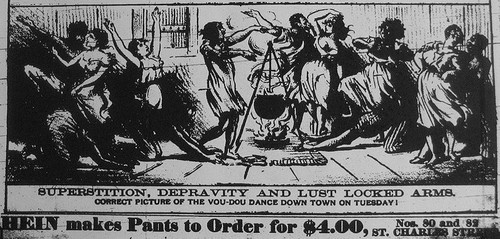
Sensationalized newspaper image of a Voodoo Ceremony. Sensationalized accounts of Voodoo practices played a crucial role in The Great New Orleans Kidnapping Case of 1870.
September 23, 2014
Lamenting What Has Been Lost In a City Where So Much Has...
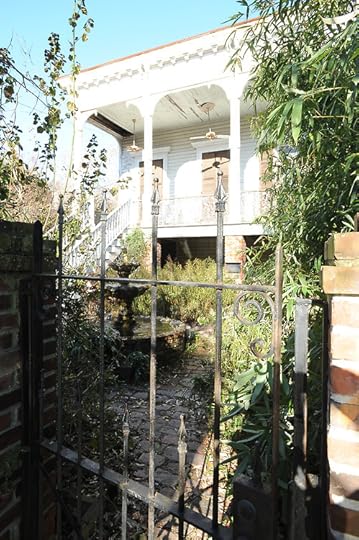
Lamenting What Has Been Lost In a City Where So Much Has Been Saved
Visitors to New Orleans are often struck by the incredible number of buildings that remain extant from the 18th and 19th centuries. They know of the French Quarter and the Garden District even before they arrive, but as they tour they realize there are miles and miles of beautiful old neighborhoods that have survived hurricanes like Katrina and the ravages of time. But those who know the city well are often haunted by the memory of the historic buildings that have been lost to fires, floods, termites, ill conceived urban renewal projects, neglect, and decay. Even in neighborhoods like the Garden District that have had active preservation movements (and that have fared well in the major storms), the list of landmarks lost is staggering. Some of this is inevitable, of course. Wooden buildings don’t last forever, particularly in a subtropical climate. But in a city so filled with architectural reminders of the past, it is hard not to lament what is lost. I found this out first hand as I was writing my book The Great New Orleans Kidnapping Case and I set out to find the homes and businesses that were central to the story in 1870. Almost all had been destroyed or torn down many years ago. How could it be, I wondered, that in a city where so many old buildings still stand, almost all of the ones I hoped to find were gone? I was reminded that the old houses and storefronts that remain today are only a small fraction of what once existed, that they are fragile and precious, and that we need to vigorously protect what is left.
To help readers of my book visualize the neighborhoods where the story took place, I had to rely on photographs of those buildings that still exist near the key locations in the tale. The picture above, for example, is of a nineteenth-century house on Chestnut Street (near St. Andrew’s) that stands on a lot neighboring what was once the home (now torn down) of James Madison Broadwell, the captain of the famous steamboat Eclipse who some believed was the mastermind of the sensational Digby kidnapping in 1870.
When John Pope of the Times-Picayune recently asked readers to tell him about buildings they missed, hundreds of New Orleanians wrote in. Here is a link to photos of some of those landmarks:
http://www.nola.com/business/index.ssf/2014/09/lost_new_orleans.html#incart_river
September 17, 2014
Voodoo, Kidnapping and Race in New Orleans during Reconstruction: Interview with Michael A. Ross
Voodoo, Kidnapping and Race in New Orleans during Reconstruction: Interview with Michael A. Ross
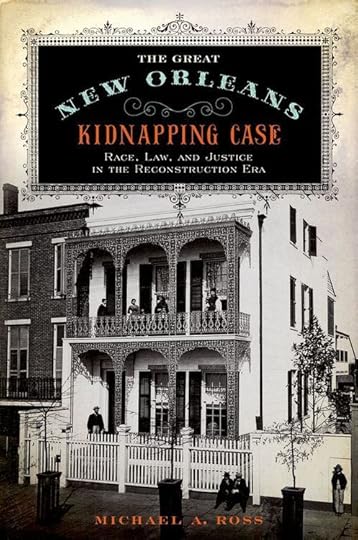
Michael A. Ross
In October, the Oxford University Press will be publishing The Great New Orleans Kidnapping Case: Race, Law, and Justice in the Reconstruction Era by Michael A. Ross,…