Brian Dembowczyk's Blog, page 8
November 3, 2023
An Interview with Champ Thornton
TLDW: In which Champ Thornton and I discuss his new book, Your Count: A Five-Senses Countdown to Calm and scrapple.
Champ Thornton is a pastor, author, and acquisitions editor and all around good guy who I met in the PhD program at Midwestern Baptist Theological Seminary. Champ has a wonderful new book out, Your Count: A Five-Senses Countdown to Calm that I wanted to ask him about. This would be a great book for families in the home, as well as preschool classrooms at churches.
You can learn more about Champ and the book at champthornton.com, check out the book including an accompanying parent connection page at bhpublishinggroup.com/you-count, or order the book here at Amazon.com.
Watch the interview:Listen to the interview:Learn more about scrapple.


October 20, 2023
Fall Festivals and the Ministry of Hospitality
TLDR: Sometimes it might be best to focus our fall festivals on building friendships with others and showing them that we care for them, and trust God to provide opportunities to share the gospel later.
It’s fall, which means cooler weather, colorful leaves, pumpkin spice everything,1 and fall festivals. A question I often see asked about fall festivals is how to share the gospel with those who attend. Is it best to have a time when someone does it over a PA system? Is it better to have a booth or station for sharing the gospel? Hand out a tract?
This is an important question for sure. I’m about to offer an option that you might not have thought of, but I’m going to warn you that you might not like it. Here goes:
Perhaps the best way to share the gospel at your fall festival is NOT to.
I know, I know. That sounds terrible. It sounds so ungodly and anti-evangelistic. But hear me out. Let’s see if I can make a case that not sharing the gospel at times, and for specific reasons can indeed be godly, evangelistic, and effective.
Making a Case from Jesus’ MinistryTo make my case, I want us to take a quick survey of aspects of Jesus’ ministry in the Gospels.
Jesus’ healingsAs we read through the Gospels, one thing that stands out is the number of times Jesus healed people. It was a major focus of his ministry. Why? Because Jesus truly cared about people. Certainly, their spiritual condition mattered most to him, but that doesn’t mean their physical condition wasn’t quite important too. Jesus healed people because they were in need, he could help them, and that’s what he wanted to do because he loved them.
Jesus’ healing the man born blindThe account of Jesus healing the man born blind in John 9 provides some helpful insight about how Jesus connected meeting people’s physical needs and their spiritual need. Jesus healed this man early in the chapter and then sent him away to wash in the pool of Siloam (John 9:7). It wasn’t until later, after the man’s encounter with the religious leaders, that Jesus shared the gospel with him (John 9:35ff). We see that Jesus met both needs, but not at the same time—there was a gap of some time between meeting the physical need and the spiritual one.
Jesus’ eating with sinnersEarlier I said that Jesus healed because he loved people and cared about them. His reputation of eating with sinners and tax collectors (see Mark 2:13–17; Luke 15:2) helps prove that. Jesus didn’t just eat with the outcasts of society once or twice; he ate with them so often that he was known for it. Here’s why that is so interesting: in that culture, eating with someone was a form of acceptance. For Jesus to eat with these sinners and tax collectors was for him to see them as people—to care about them and want to have a friendship with them. Jesus was by no means utilitarian: only preaching the gospel in his limited time on earth. He invested significant time into merely loving people.
Jesus’ friendship with ZacchaeusThe best example of Jesus befriending others is his encounter with Zacchaeus in Luke 19:1–10. When Jesus told him, “I must stay at your house today” (Luke 19:5),2 he was basically looking to begin a friendship. Zacchaeus was a man overlooked by everyone else—not because he was short, but because he was a tax collector. Jesus, however, saw this unseen man. And he cared about him. Jesus didn’t just see Zacchaeus as someone who needed salvation; he saw a man who needed friendship. Zacchaeus had spiritual needs for sure, but he also had emotional and social needs. Jesus cared about all of them.
Our Take-awayOK. So let’s wrap this up by summarizing what we can learn from Jesus’ ministry.
First, it’s not just OK to meet people’s physical, emotional, anre relational needs, but it’s what we should be doing.Again, to be clear, a person’s spiritual need is his or her greatest need. We aren’t here to make life better for people on their way to eternal judgment. However, neither are we here to ignore how God has made people as his image-bearers. Jesus didn’t focus just on the spiritual; neither should we.
Second, we should pursue genuine friendships.One aspect of Jesus’ earthly ministry that is overlooked the most, I think, is his friendships with people. We seem to want to super-spiritualize things and therefore we often fail to appreciate the importance of friendships. God created us as relational beings to imitate his relational identity. Friendships, then, are at the core of our identity as image-bearers. They are of deep value and we shouldn’t look past them. Building friendships is a spiritual act.
Third, while there are surely times to share the gospel out of the gate, there is also a place for what we can call two-step evangelism.This is what Jesus did with the man born blind and Zacchaeus. He cared about them first. Then he pointed them to the gospel. Yes, we need to share the gospel with the lost, but I believe we have some flexibility in when we do that. Sometimes, it’s best right away. Sometimes, though, it’s best a little later.
A Fall Festival PossibilitySo, what might this look like for our fall festivals? Well, if we believe that it’s the only opportunity we will have to share the gospel with those who attend, then we should find a way to share the gospel then and there.
Most often, though, this isn’t the case. Most often, those who attend are our neighbors, friends, and families. These are people we will have plenty of future opportunities to share the gospel with. Perhaps a better option, then, is to see fall festivals as primarily about relationship building—like Jesus’ miracles or meals. What if our main goal was the ministry of hospitality—providing an event primarily to give families something to enjoy? What if we measured success by relationships started or deepened? As long as we have two-step evangelism in mind, this isn’t compromising. It’s simply focusing on people holistically, building friendships, and trusting God to give us future opportunities—ones that might be more effective—to share the gospel.
For the record, I’m on Team Apple as the best fall flavor. Pumpkin has its place—mostly savory, like a great pumpkin soup I make each fall—but give me a caramel apple any day! ︎NET Bible® copyright ©1996-2017 by Biblical Studies Press, L.L.C. http://netbible.com All rights reserved. ︎
October 6, 2023
Coffee, Gold Fish, and the Worship of God
TLDR: What is appropriate and inappropriate in worship is an important question to ask, but one with few clear answers.
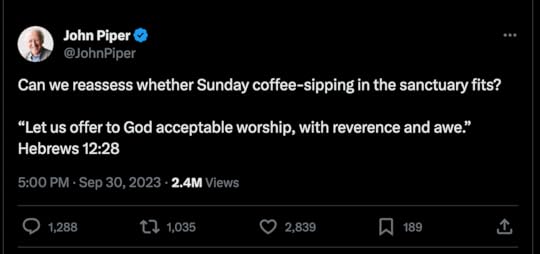
The week’s Twitter(X) flare up came courtesy of this tweet by pastor/speaker/author John Piper:
Disclaimer 1: I greatly appreciate John Piper’s writing and speaking ministries and have grown through them.
Disclaimer 2: I am HUGE coffee fan.
Disclaimer 3: I drink coffee during worship gatherings. I’ve even been known to eat on occasion.
OK. With those important caveats out of the way, I can certainly understand why people responded the way they did to Piper’s tweet. Many saw an opportunity for a little fun and took advantage of it (I posted this tweet and this tweet in this spirit). Some appreciated Piper for asking the question and prompting introspection. Others saw this as permission to disparage coffee-drinking in worship gatherings. And still others took offense at Piper’s question and what they believe was implied legalism.
A Few General ThoughtsI won’t pretend to know Piper’s thinking, but it strikes me as an odd tweet from him. After all, this is the same guy who wrote an incredibly helpful piece called “How to Drink Orange Juice to the Glory of God.” While the subject of that article isn’t worship precisely, it’s about how we can drink orange juice to God’s glory by doing so with gratitude. That’s at least adjacent to worship. If we can drink orange juice with gratitude as a means of thanking God for His provision and proclaiming His glory, it sure seems reasonable to me that we can do those things in a worship gathering, even with a coffee in hand.
The second thing I found interesting about Piper’s tweet was his quote of Hebrews 12:28. Again, Piper didn’t expand on this tweet to my knowledge, so we have to guess at his intention, but it seems as if he was (a) suggesting coffee drinking hinders reverence and awe and (b) assuming “worship” in this verse must be a corporate worship gathering. I’m not sure a strong case can be made for either of those.
But even if we were to see Hebrews 12:28 as speaking to corporate worship, that leads to another problem with what Piper seemed to be saying. The early church, after all, would gather and eat full meals as part of the Lord’s Supper, what many see as the most holy act of worship we can offer. So basically, the inference is that for the early church:
Eating + Lord’s Supper = Worship
but that for the modern church:
Coffee + Preaching/Singing ≠ Worship
A third thing I found curious was the singling out of coffee drinking, or “coffee-sipping” as Piper called it (a term that seems curiously inflammatory, but that could just be me). Why not water drinking? Gum chewing? Mint sucking? Why not phone scrolling? Bulletin reading? People watching? Where is the line drawn?
My Two CentsTo me, unless something is distracting others (e.g., setting up an omelet station in the third pew) or is done with the wrong heart, we need to give a wide berth here. This is an issue of individual conscience first, and the desires of a local congregation second. If someone sees coffee drinking as inappropriate for worship, then he or she should not drink it. If a congregation agrees to that and wants to disallow coffee drinking in their gatherings, that’s their freedom in Christ. But once we step into judging whether coffee drinking is or is not conducive to reverence and awe for all believers, we have pressed too far. How those are defined and how “worship” is defined isn’t clear to me.
Furthermore, it’s instructive that Jesus spoke of eating the Lord’s Supper with Him in the kingdom (Mark 14:25), and feasting and worship, even in heaven, are paired in the Bible quite often (Ps. 23:5; Is. 25:6; Luke 13:29; 14:15, Luke 22:19; Rev. 19:6–9). So basically the inference is:
Eating with Christ in Eternity = Reverent
But:
Coffee Drinking in Worship ≠ Reverent
I’m sure this isn’t anyone’s intent, but it sure seems that contemporary worship gatherings are held in higher regard than being in Christ’s presence.
Two Implications for Kids and Student MinistriesSo, what does this have to do with anyone in kids or student ministry? Here are two takeaways:
First, how might this thinking of “worship,” “reverence”, and “awe” by some in the church—including perhaps on a ministry team—affect your worship times? It’s quite likely that kids and students will eat and drink things (e.g., goldfish given as a mid-service snack), wear things (e.g., hats and shorts), and do things (e.g., play games on stage, dance) that others would find troubling if they saw them. Even if no one has ever shared concerns, it would be wise to be ready with an answer to any objection raised. We should be ready when someone asks, “Can we reassess whether Sunday goldfish eating in kids worship fits?”
Second, to the point Piper seemed to want to make, it should indeed prompt us to consider why we do all we do. Are there any ways that we might “cheapen” worship of God? Do we ever do anything with a utilitarian mindset rather than one that seeks to glorify God? I see a lot of gray areas here. I think there are more questions than answers. But it’s an ongoing conversation ministries should have.
September 14, 2023
“Thriving in Babylon” Sermon
TLDR: At the Kidzmatter 2023 Conference, I shared for a few minutes about the posture we need to take with our upside-down culture. Here, Larry Osborne takes more time to say it better than I can.
What a privilege it was to share with the Kidzmatter Conference attendees from the main stage and talk about a subject that is dear to me: how to engage a culture that seems to be losing its mind. I have a heavy heart in how I see so many of my brothers and sisters in Christ take a combative approach. I just cannot see the love or the biblical warrant to throw “holy haymakers” at the lost. I didn’t see Jesus do that. Why should we?
In my brief message, I drew from 1 Corinthians 16:13–14.
13 Stay alert, stand firm in the faith, show courage, be strong. 14 Everything you do should be done in love.
NET1
From this, we can heed Paul’s admonishment to stand firm together on the gospel of Jesus Christ. We need to stop dividing ourselves and attacking each other because we disagree on secondary or tertiary issues, or worse, because we differ on non-theological issues. We need to stand as one bride of Christ.
But what of our arms and hands? I see the answer in v. 14. We must refuse to ball our hands into fists; we need to keep our hands open with our arms open wide, beckoning our culture to come to Christ. Come to the truth. Stand with us on the gospel.
I have known what I was going to share for some time, but in an act of God’s kind providence, our church began a new series on how to engage with the culture this past Sunday. As I sat listening to our guest Larry Osborne (author of Sticky Teams, one of my recommended reading books) preach that morning at New Vision , I couldn’t help but think I should change my text to Daniel 1. But alas, I wouldn’t have enough time to flesh this chapter out, and I knew I could just post the video anyway. Plus, I learned a long time ago (a) to trust the Holy Spirit and (b) never to imitate someone else’s preaching.
So, friends, I want to encourage you to take some time and listen to Larry Osborne do a wonderful job of showing four principles of how we are to engage with our culture drawn out from Daniel. It’s a message that is unashamed of the gospel but one that’s also saturated with compassion and kindness.
NET Bible® copyright ©1996-2017 by Biblical Studies Press, L.L.C.︎