
George Hodgman's Blog, page 6
April 14, 2015
Reading, April 23, Paris Missouri Library:
I am not bringing this up in an effo...
Reading, April 23, Paris Missouri Library:
I am not bringing this up in an effort to sell books, but because people have asked me if books will be for sale so that they can be signed. To my knowledge, books will not be sold. If you want me to sign, I'm happy to, but you'll need to bring yours, so you'll need to have them in advance. FYI. Thanks.
I am not bringing this up in an effort to sell books, but because people have asked me if books will be for sale so that they can be signed. To my knowledge, books will not be sold. If you want me to sign, I'm happy to, but you'll need to bring yours, so you'll need to have them in advance. FYI. Thanks.


April 10, 2015
I am pretty sure I spotted Toni Morrison at the Cinnabon in Cleveland Airport.
I am pretty sure I spotted Toni Morrison at the Cinnabon in Cleveland Airport.
April 9, 2015
Last night after meeting with Julie Cristal's wonderful ladies at their book clu...
Last night after meeting with Julie Cristal's wonderful ladies at their book club in Shaker Heights, I came back to my hotel here at the old Arcade Building in downtown Cleveland. It was fun to sit in the middle of this stunning place. Sometimes it seems that we have abandoned our desire to create beauty in this country.


April 8, 2015
If you have the chance to be published by Viking, do it. They are energetic, pas...
If you have the chance to be published by Viking, do it. They are energetic, passionate, creative, and nice. Thanks, Viking, for all you've done for me and Bettyville.
I seem to be growing accustomed to finding myself driving across the plains betw...
I seem to be growing accustomed to finding myself driving across the plains between the hours of 3 and 4 a.m., bound for the St. Louis airport. Today and tomorrow I'm in Cleveland where I was invited by the generous and lovely Julie Cristal to read at a large book club. Staying at a hotel in the beautiful Arcade Building which is, in a way, more beautiful for not having been too spruced up. I love old, underdog cities such as St. Louis and Cleveland. I am happy to have been asked to come. Thanks, Julie.
April 6, 2015
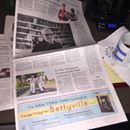
This nice piece appeared in one of my favorite papers in Missouri or anywhere, t...
This nice piece appeared in one of my favorite papers in Missouri or anywhere, the Columbia Tribune, a truly wonderful newspaper. The writer, Amy Wilder, is very talented and I thank her for her good work.
By AMY WILDER
Sunday, April 5, 2015 at 12:00 am
Writer George Hodgman has three mothers: Betty, Missouri and the English language.
The trio, spiritual sisters, share common traits. They’re beautiful and idiosyncratic, and often spar humorously or make unreasonable demands on their wayward son while providing a refuge when he needs it.
These three entities are merged, honored and painted in colorful strokes in Hodgman’s debut memoir, “Bettyville,” which slipped into a No. 9 slot on The New York Times’ best-seller list shortly after its release. He interacts with and loves them all, in complicated ways.
SHOW-ME AND TELL
His literal mother, Betty, has lymphoma and dementia; her proverbial sisters are fretful and indecisive kleptomaniacs. English is a language of stolen words and confused grammar, and “Missouri is a state of stolen names,” as Hodgman begins his narrative.
He goes on to list towns with names borrowed from elsewhere, including his hometown Paris, to which he has returned — after spending decades in New York as a magazine and book editor — to care for his mother and, unemployed, to reassess his career and struggle with the maternal forces at play in his life, the three contrary sisters.
They all demand commitment to truth. “At least I’m out and out with my meanness,” Hodgman quotes his mother in the book, “I’m not a sneak. I hate a sneak.”
The preference to fight her battles in the open rather than present a false front is common in the Show-Me State, which earned its nickname, one legend has it, when 19th- and early 20th-century congressman Willard Duncan Vandiver declared in a speech, “I come from a state that raises corn and cotton and cockleburs and Democrats, and frothy eloquence neither convinces nor satisfies me. I am from Missouri. You have got to show me.”
And Hodgman does. He paints a warts-and-all portrait of himself, his mother, his home state and their interwoven histories in a voice of earthy humor. His character sketches and hilarious anecdotes draw the reader into his prose.
“What makes George unusual is that he is so skilled at taking serious parts of his life, and other people’s lives that intersect with his life, and sharing them with incredible humor and irony,” said Steve Weinberg, a writer, editor and University of Missouri journalism professor emeritus, who also wrote a review of “Bettyvile” for The Kansas City Star. “... George is just laugh-out-loud funny; at the same time that he is writing about sad events.”
The seam between laughter and tears is a thin one.
“I think I laugh instead of cry,” Hodgman said an in interview. “I’m like one of those old Jewish comedians ... the route the emotion takes somehow becomes a joke, not a tear.”
A TRUE TEAM
Hodgman brings grace to his awkwardness by embracing it, letting it all hang out. His interactions with his mother are complex and could be misunderstood by those inclined to hide or seal off the unpleasant experiences of human nature.
The pair insult and irritate one another affectionately, coming off like a two-man comedy team, only it’s not clear which is the straight man. They are a bit like Muppets Statler and Waldorf, heckling the players on the world’s stage, and razzing one another.
Their sparring seems to keep both of them on their toes and illustrates Hodgman’s deep respect and honor for his mother. Even as she becomes increasingly helpless, he intervenes where necessary; he refuses to infantilize her.
“More sophisticated readers are able to kind of get that,” he said. “Here among family and close friends, I worry about some of the humor in the book, and how it comes across to people who are really close to me and my mom.
“For 25 years, I listened to readers talk about memoirs and their reaction. … The reader brings a lot of personal baggage, and so very often the reaction has a lot to do with their feelings about their parents,” Hodgman added, “or their feelings about whatever facet of experience. … Think about how often what you say to people during the day, they take the wrong way or they don’t get the nuance in what you’re saying. People react very, very quickly, a lot of times before they really consider what they’re reacting to very carefully.”
WRITING MEMORIES
That Hodgman has mastered his medium is unsurprising, considering his years as a book and magazine editor for entities that include Simon and Schuster and Vanity Fair.
For those who might wonder if his contacts in the publishing world are responsible for his instant recognition — such as a feature in The New York Times and interview with National Public Radio’s Terry Gross — one has only to read his prose to be assured it is his power as a wordsmith, his ability to coax complex nuance and vivid imagery out of deceptively simple language, that earned his post.
Hodgman skillfully weaves past and present in his narrative in a reflective style. A few transitions require a pause for orientation on the part of the reader, but for the most part these translate smoothly, mirroring the way memory and experience are linked within us. Our personalities are composed of and informed by memory, though this is an often tricky and unreliable informer. Memory is the central feature of the book.
The prose brings to life the decline and demise of an old way of life in Missouri as Hodgman captures the changing landscapes of his mother’s mind and interactions with the world. The erosion of her memories is reflected in the empty storefronts of small-town Missouri; buildings once rich with life and culture now stare blankly, despondently into poorly shod streets. His mother sometimes stares blankly and refuses to wear new shoes.
“I’ve given up trying to control her clothes,” he wrote, describing jeans she insisted on wearing for days on end. “God grant me the serenity to accept the clothes I cannot change.”
Hodgman is writing to preserve something. To capture the fading shades of his mother’s mind at dusk. To record his own experiences lest they fade as well. To solidify something of Missouri’s unsettled, uncomfortable and ever-shifting contours.
Hodgman is also secretly a poet. He slips striking visualizations and metaphors into his prose. He described migrating avians in a memory of his father as “long scarves of lonely birds, flying, finally together, toward home.”
There is a sense that Hodgman is writing for himself, keeping his shirt pinned to the edge of sanity through words: He wrote most of the memoir at a card table in the living room because it made his mother nervous if he left. Writing in real time became an act of filtering the stress of his experience. It was a way to blow off steam, evidenced in his zingers and asides.
“I am a care inflictor,” he wrote of his own imperfect abilities.
Hodgman makes it clear early in the narrative that he struggled with substance abuse; he often wryly wonders if a 12-step program might grant special dispensation for the extremities of his situation.
“I didn’t set out to write a memoir,” Hodgman said. “This book kind of occurred. I was writing down things ... in a therapeutic way. I also discovered I had been carrying around so many bits and pieces from the past, almost like photographs in my head.”
STRANGERS AND SONS
He also writes for his audience. Those hilarious one-liners, the illustrations of absurdities and imperfections, endear the reader to him and to Betty. And through context, providing shades of history — his own and his mother’s as well as that of his home state and hometown — he paints a rich image of flyover country, a strange land to strangers and outsiders.
And yet it is a land of outsiders. This uncomfortable culture — which, for Hodgman, was magnified by his homosexuality in a society that chose, and still largely chooses, to ignore it if not engage in outright hostility — produces independent, no-nonsense personalities. “Salt of the Earth” does not get much saltier than it is in Missouri.
It also produces a certain degree of restlessness and dissatisfaction that results in explorers and writers alike. St. Louis earned its designation as Gateway to the West. Missouri natives are prone to wander, as evidenced in rivers and lines written indelibly across its face. Lewis and Clark began their expedition here, not far from the origin points of the Pony Express, the Santa Fe Trail and the Oregon Trail.
Hodgman wandered in the other direction, crossing the Mississippi to settle in points east. And for many of the pilgrims who have gone that way, the river could be renamed the Rubicon. You can’t go home again. And yet Missouri’s errant children do have a way of coming home, bringing a stewed mixture of love and resentment for her when they arrive.
On the other hand, no Missouri native ever really leaves Missouri. It works its way into the bones and clings to them, along with the humidity. There is a sense in his writing that Hodgman has different, but equally intense, affection for both of his homes. And that he struggled with returning.
“I have always been my work. And now here I am, suddenly, after all these years, home,” he writes in “Bettyville.” “I am not exactly the black sheep of my family, but it is not like I am grazing in pastels.”
He is planted in Missouri for now, he said, but in light of politically conservative attitudes toward its LGBTQ citizens, he remains torn.
“I cannot live in or support a state that discriminates against me and encourages the sad and shameful denigration of gay people,” he wrote in a follow-up Facebook message, “especially the youth.”
By AMY WILDER
Sunday, April 5, 2015 at 12:00 am
Writer George Hodgman has three mothers: Betty, Missouri and the English language.
The trio, spiritual sisters, share common traits. They’re beautiful and idiosyncratic, and often spar humorously or make unreasonable demands on their wayward son while providing a refuge when he needs it.
These three entities are merged, honored and painted in colorful strokes in Hodgman’s debut memoir, “Bettyville,” which slipped into a No. 9 slot on The New York Times’ best-seller list shortly after its release. He interacts with and loves them all, in complicated ways.
SHOW-ME AND TELL
His literal mother, Betty, has lymphoma and dementia; her proverbial sisters are fretful and indecisive kleptomaniacs. English is a language of stolen words and confused grammar, and “Missouri is a state of stolen names,” as Hodgman begins his narrative.
He goes on to list towns with names borrowed from elsewhere, including his hometown Paris, to which he has returned — after spending decades in New York as a magazine and book editor — to care for his mother and, unemployed, to reassess his career and struggle with the maternal forces at play in his life, the three contrary sisters.
They all demand commitment to truth. “At least I’m out and out with my meanness,” Hodgman quotes his mother in the book, “I’m not a sneak. I hate a sneak.”
The preference to fight her battles in the open rather than present a false front is common in the Show-Me State, which earned its nickname, one legend has it, when 19th- and early 20th-century congressman Willard Duncan Vandiver declared in a speech, “I come from a state that raises corn and cotton and cockleburs and Democrats, and frothy eloquence neither convinces nor satisfies me. I am from Missouri. You have got to show me.”
And Hodgman does. He paints a warts-and-all portrait of himself, his mother, his home state and their interwoven histories in a voice of earthy humor. His character sketches and hilarious anecdotes draw the reader into his prose.
“What makes George unusual is that he is so skilled at taking serious parts of his life, and other people’s lives that intersect with his life, and sharing them with incredible humor and irony,” said Steve Weinberg, a writer, editor and University of Missouri journalism professor emeritus, who also wrote a review of “Bettyvile” for The Kansas City Star. “... George is just laugh-out-loud funny; at the same time that he is writing about sad events.”
The seam between laughter and tears is a thin one.
“I think I laugh instead of cry,” Hodgman said an in interview. “I’m like one of those old Jewish comedians ... the route the emotion takes somehow becomes a joke, not a tear.”
A TRUE TEAM
Hodgman brings grace to his awkwardness by embracing it, letting it all hang out. His interactions with his mother are complex and could be misunderstood by those inclined to hide or seal off the unpleasant experiences of human nature.
The pair insult and irritate one another affectionately, coming off like a two-man comedy team, only it’s not clear which is the straight man. They are a bit like Muppets Statler and Waldorf, heckling the players on the world’s stage, and razzing one another.
Their sparring seems to keep both of them on their toes and illustrates Hodgman’s deep respect and honor for his mother. Even as she becomes increasingly helpless, he intervenes where necessary; he refuses to infantilize her.
“More sophisticated readers are able to kind of get that,” he said. “Here among family and close friends, I worry about some of the humor in the book, and how it comes across to people who are really close to me and my mom.
“For 25 years, I listened to readers talk about memoirs and their reaction. … The reader brings a lot of personal baggage, and so very often the reaction has a lot to do with their feelings about their parents,” Hodgman added, “or their feelings about whatever facet of experience. … Think about how often what you say to people during the day, they take the wrong way or they don’t get the nuance in what you’re saying. People react very, very quickly, a lot of times before they really consider what they’re reacting to very carefully.”
WRITING MEMORIES
That Hodgman has mastered his medium is unsurprising, considering his years as a book and magazine editor for entities that include Simon and Schuster and Vanity Fair.
For those who might wonder if his contacts in the publishing world are responsible for his instant recognition — such as a feature in The New York Times and interview with National Public Radio’s Terry Gross — one has only to read his prose to be assured it is his power as a wordsmith, his ability to coax complex nuance and vivid imagery out of deceptively simple language, that earned his post.
Hodgman skillfully weaves past and present in his narrative in a reflective style. A few transitions require a pause for orientation on the part of the reader, but for the most part these translate smoothly, mirroring the way memory and experience are linked within us. Our personalities are composed of and informed by memory, though this is an often tricky and unreliable informer. Memory is the central feature of the book.
The prose brings to life the decline and demise of an old way of life in Missouri as Hodgman captures the changing landscapes of his mother’s mind and interactions with the world. The erosion of her memories is reflected in the empty storefronts of small-town Missouri; buildings once rich with life and culture now stare blankly, despondently into poorly shod streets. His mother sometimes stares blankly and refuses to wear new shoes.
“I’ve given up trying to control her clothes,” he wrote, describing jeans she insisted on wearing for days on end. “God grant me the serenity to accept the clothes I cannot change.”
Hodgman is writing to preserve something. To capture the fading shades of his mother’s mind at dusk. To record his own experiences lest they fade as well. To solidify something of Missouri’s unsettled, uncomfortable and ever-shifting contours.
Hodgman is also secretly a poet. He slips striking visualizations and metaphors into his prose. He described migrating avians in a memory of his father as “long scarves of lonely birds, flying, finally together, toward home.”
There is a sense that Hodgman is writing for himself, keeping his shirt pinned to the edge of sanity through words: He wrote most of the memoir at a card table in the living room because it made his mother nervous if he left. Writing in real time became an act of filtering the stress of his experience. It was a way to blow off steam, evidenced in his zingers and asides.
“I am a care inflictor,” he wrote of his own imperfect abilities.
Hodgman makes it clear early in the narrative that he struggled with substance abuse; he often wryly wonders if a 12-step program might grant special dispensation for the extremities of his situation.
“I didn’t set out to write a memoir,” Hodgman said. “This book kind of occurred. I was writing down things ... in a therapeutic way. I also discovered I had been carrying around so many bits and pieces from the past, almost like photographs in my head.”
STRANGERS AND SONS
He also writes for his audience. Those hilarious one-liners, the illustrations of absurdities and imperfections, endear the reader to him and to Betty. And through context, providing shades of history — his own and his mother’s as well as that of his home state and hometown — he paints a rich image of flyover country, a strange land to strangers and outsiders.
And yet it is a land of outsiders. This uncomfortable culture — which, for Hodgman, was magnified by his homosexuality in a society that chose, and still largely chooses, to ignore it if not engage in outright hostility — produces independent, no-nonsense personalities. “Salt of the Earth” does not get much saltier than it is in Missouri.
It also produces a certain degree of restlessness and dissatisfaction that results in explorers and writers alike. St. Louis earned its designation as Gateway to the West. Missouri natives are prone to wander, as evidenced in rivers and lines written indelibly across its face. Lewis and Clark began their expedition here, not far from the origin points of the Pony Express, the Santa Fe Trail and the Oregon Trail.
Hodgman wandered in the other direction, crossing the Mississippi to settle in points east. And for many of the pilgrims who have gone that way, the river could be renamed the Rubicon. You can’t go home again. And yet Missouri’s errant children do have a way of coming home, bringing a stewed mixture of love and resentment for her when they arrive.
On the other hand, no Missouri native ever really leaves Missouri. It works its way into the bones and clings to them, along with the humidity. There is a sense in his writing that Hodgman has different, but equally intense, affection for both of his homes. And that he struggled with returning.
“I have always been my work. And now here I am, suddenly, after all these years, home,” he writes in “Bettyville.” “I am not exactly the black sheep of my family, but it is not like I am grazing in pastels.”
He is planted in Missouri for now, he said, but in light of politically conservative attitudes toward its LGBTQ citizens, he remains torn.
“I cannot live in or support a state that discriminates against me and encourages the sad and shameful denigration of gay people,” he wrote in a follow-up Facebook message, “especially the youth.”
April 5, 2015
"Rabbit on a Train" (Painting to 3d)"Rabbit on a Train" (...
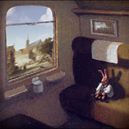
"Rabbit on a Train" (Painting to 3d)
"Rabbit on a Train" (Painting to 3d) Original painting by M. Sowa (http://www.wikipaintings.org/en/michael-sowa/rabbit-on-a-train-detail) Music: Gabriel Fauré -…
April 4, 2015
The highlight of my tour was in Columbia, MO today when my favorite college Engl...
The highlight of my tour was in Columbia, MO today when my favorite college English professor walked into the room. She gave me poetry--The River Merchant's Wife by Ezra Pound, A Mexican Guitar by Frank O'Hara, The Love Song of J. Alfred Prufrock-- and if I have any style as a writer, it is because I started reading poetry in college. I still have my marked-up North Anthology on my shelf in New York. I attended the University of Missouri. I was educated at the University of Catherine Parke. Great teachers bestow such enormous gifts and allow us to imagine ourselves. I am grateful for my teachers.
It is early. Because of the monitor we keep in my mother's room now, I can hear...
It is early. Because of the monitor we keep in my mother's room now, I can hear every word she says to herself all night long. This morning I woke to hear, "Prague! That's where we went on that trip. Prague!" Moments later, I am thinking about Prague as I wait in line with my milk at the convenience store. The dog has bitten a hole in my jacket and it now emits tiny little feather-ish things that follow me everywhere and I am hoping that no one will notice the cloud of them that surrounds me or the fact that my hair is, at best, animalistic this morning. A woman who I remember from Mixed Chorus in high school comes up and says, "I read your book." I flinch. So far, all of these interactions have been positive, lovely and sweet, but I am still waiting for the one that will end with me bound and gagged and held prisoner in the trunk of a vehicle. Because I have trouble taking in the positive.
"It says in the book how much your mother likes strawberries," Anita Dunkle tells me. "I remember when we were on the committee at the country club together and she loved my strawberry cake. I wanted to bring one by this afternoon." Standing there, amidst my swirling feathers, I was so touched. Yesterday, there was the neighbor who made the red velvet cake (which I have already eaten half of) and the homemade bread. There was the German chocolate cake and the cocoanut cake, too. There was the woman who says she "works gentle" who wants to give my mother a manicure. There were the girls from her salon in Columbia who did her hair and make-up before the reading a week ago and then closed the shop and came along. There was David Jones who brought me a pair of red suspenders last Sunday because he thought my pants were going to fall down at a public appearance. There was the high school basketball star who I had a terrible crush on and wanted for my big brother when I was six who appeared out of nowhere at a reading and made me want a big brother again. There are all the letters from people who want to know how my mother is doing and who want to tell me about how their mothers are doing. There was the kid who wrote about his parents, who he has run away from, who sent him to conversion therapy where every day he was called "faggot demon." There was the woman whose eighty year-old gay brother finished the book and broke down sobbing. There has been much generosity, and beauty, but also now and again, the reminder that so many out there are lonely with no one and that too many among us have been, in this life, so terribly hurt.

"It says in the book how much your mother likes strawberries," Anita Dunkle tells me. "I remember when we were on the committee at the country club together and she loved my strawberry cake. I wanted to bring one by this afternoon." Standing there, amidst my swirling feathers, I was so touched. Yesterday, there was the neighbor who made the red velvet cake (which I have already eaten half of) and the homemade bread. There was the German chocolate cake and the cocoanut cake, too. There was the woman who says she "works gentle" who wants to give my mother a manicure. There were the girls from her salon in Columbia who did her hair and make-up before the reading a week ago and then closed the shop and came along. There was David Jones who brought me a pair of red suspenders last Sunday because he thought my pants were going to fall down at a public appearance. There was the high school basketball star who I had a terrible crush on and wanted for my big brother when I was six who appeared out of nowhere at a reading and made me want a big brother again. There are all the letters from people who want to know how my mother is doing and who want to tell me about how their mothers are doing. There was the kid who wrote about his parents, who he has run away from, who sent him to conversion therapy where every day he was called "faggot demon." There was the woman whose eighty year-old gay brother finished the book and broke down sobbing. There has been much generosity, and beauty, but also now and again, the reminder that so many out there are lonely with no one and that too many among us have been, in this life, so terribly hurt.
April 2, 2015
“Bettyville is a remarkable, laugh-out-loud book . . . Rarely has the subject of...
“Bettyville is a remarkable, laugh-out-loud book . . . Rarely has the subject of elder care produced such droll human comedy, or a heroine quite on the mettlesome order of Betty Baker Hodgman. For as much as the book works on several levels (as a meditation on belonging, as a story of growing up gay and the psychic cost of silence, as metaphor for recovery), it is the strong-willed Betty who shines through. She may be trapped in midstage dementia, but her stout sense of self never wavers. And in coming home, Mr. Hodgman confronts the question that has haunted him: why his parents could never bring themselves to talk about his personal life.”
—The New York Times
—The New York Times
George Hodgman's Blog

- George Hodgman's profile
- 100 followers
George Hodgman isn't a Goodreads Author
(yet),
but they
do have a blog,
so here are some recent posts imported from
their feed.

