Ian S. Bott's Blog, page 31
January 18, 2015
Naval architecture
Shayla Carver spends a fair amount of time on board Imperial warships. Although there are only a few brief descriptions of her surroundings, I drew rough plans of the layout to guide me and to ensure inner consistency between one chapter and the next. It was these rough drawings that I fleshed out recently and posted to my website.
In doing so, I wanted to avoid the clean interior lines of Star Trek Federation ships, or the monolithic intimidating feel of Star Wars Imperial craft. Instead, I drew heavily on twentieth century naval plans to get a worked-in look and feel, steeped in the weight of history. In Shayla's time, most ships of the Imperial fleet are many centuries old.
Research included studying real plans from sources such as the excellent Anatomy of the Ship series, and seeking out online examples such as the USS Arizona. I also drew on memories of visiting HMS Belfast, moored in London.
 The biggest impression I get is of function over style. Whereas spaces designed for living in tend to have some visible unifying architectural themes, the internal layouts of warships are dominated by the machinery they carry. Living and working spaces are crammed in wherever they can fit, with little regard for human comfort. The end result has a rather chaotic feel to it, with no effort wasted on aesthetics. Uncompromising mechanics intrude everywhere.
Of course, the physical requirements of a warship in space are very different from those of one afloat, but the principles for me remained the same: arrange the major engineering and combat components first, then storage, and only then think about the crew.
In doing so, I wanted to avoid the clean interior lines of Star Trek Federation ships, or the monolithic intimidating feel of Star Wars Imperial craft. Instead, I drew heavily on twentieth century naval plans to get a worked-in look and feel, steeped in the weight of history. In Shayla's time, most ships of the Imperial fleet are many centuries old.
Research included studying real plans from sources such as the excellent Anatomy of the Ship series, and seeking out online examples such as the USS Arizona. I also drew on memories of visiting HMS Belfast, moored in London.
 The biggest impression I get is of function over style. Whereas spaces designed for living in tend to have some visible unifying architectural themes, the internal layouts of warships are dominated by the machinery they carry. Living and working spaces are crammed in wherever they can fit, with little regard for human comfort. The end result has a rather chaotic feel to it, with no effort wasted on aesthetics. Uncompromising mechanics intrude everywhere.
Of course, the physical requirements of a warship in space are very different from those of one afloat, but the principles for me remained the same: arrange the major engineering and combat components first, then storage, and only then think about the crew.


January 13, 2015
Research - Re-entry bubbles
Could a human survive a fall from space?
The opening chapter of Ghosts of Innocence has Shayla ejecting from a plunging starship and entering the atmosphere in an inflatable bubble.
But there's a snag. She can traverse light years in a matter of hours and no-one will bat an eyelid, but readers might baulk at the likelihood of surviving these last few miles. So is it feasible?
The inspiration for this came from some genuine contemporary ideas for evacuating orbiting spacecraft.
I can't remember where I first heard of it, probably an article in New Scientist when they started looking at options for "lifeboats" on the ISS, but some variations of the idea go right back to the early '60s.
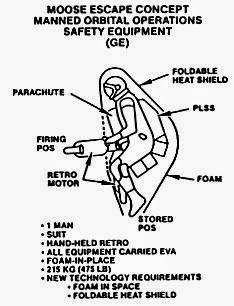 The closest to Shayla's re-entry bubble is probably MOOSE, which was a personal inflatable heat shield conceived in 1963. Various tests proved the viability of some aspects, and the thing might have stood a chance of working, but was never taken further.
In recent years, NASA has got a lot more serious about inflatable landing systems, though these are aimed more at small robotic craft than individuals.
Of course, Shayla's bubble goes far beyond today's capabilities. Light enough to fit in a small backpack, and using molecular engineering to form an airtight seal around the occupant, we haven't begun to develop materials with the necessary properties.
I also took the idea a lot further than simply landing someone in one piece. Shayla's device incorporates a lightweight shape-memory support structure that allows it to be reconfigured mid-flight into a glider wing. Researching typical paraglider sizes, I figured that a viable wing (200 to 300 sq ft) would be a similar surface area to a sphere of 7' to 8' diameter, so it was not hard to envisage suitably advanced micro-molecular engineering to allow one to transform into the other.
The opening chapter of Ghosts of Innocence has Shayla ejecting from a plunging starship and entering the atmosphere in an inflatable bubble.
But there's a snag. She can traverse light years in a matter of hours and no-one will bat an eyelid, but readers might baulk at the likelihood of surviving these last few miles. So is it feasible?
The inspiration for this came from some genuine contemporary ideas for evacuating orbiting spacecraft.
I can't remember where I first heard of it, probably an article in New Scientist when they started looking at options for "lifeboats" on the ISS, but some variations of the idea go right back to the early '60s.
The closest to Shayla's re-entry bubble is probably MOOSE, which was a personal inflatable heat shield conceived in 1963. Various tests proved the viability of some aspects, and the thing might have stood a chance of working, but was never taken further.In recent years, NASA has got a lot more serious about inflatable landing systems, though these are aimed more at small robotic craft than individuals.
Of course, Shayla's bubble goes far beyond today's capabilities. Light enough to fit in a small backpack, and using molecular engineering to form an airtight seal around the occupant, we haven't begun to develop materials with the necessary properties.
I also took the idea a lot further than simply landing someone in one piece. Shayla's device incorporates a lightweight shape-memory support structure that allows it to be reconfigured mid-flight into a glider wing. Researching typical paraglider sizes, I figured that a viable wing (200 to 300 sq ft) would be a similar surface area to a sphere of 7' to 8' diameter, so it was not hard to envisage suitably advanced micro-molecular engineering to allow one to transform into the other.
January 10, 2015
Research
One of the cool things about writing sci-fi is the opportunity for research.
In most genres, research means getting your facts right before someone picks you up on some inaccuracy. But where does that leave stories set far away in time and space? No-one can tell you that you made a mistake in describing your imaginary world because nobody's ever been there! And the cornerstone of speculative fiction is to imagine things that lie beyond our known world. But does that put them beyond research?
Most of the technology in Ghosts of Innocence is hugely speculative although mainstream for the genre. Most far-future stories involve some form of faster-than-light travel. Many have weapons that throw something more futuristic than crude bullets. Much of the time these miracles of technology are introduced with diversionary hand-waving and little more than a passing nod to any solid scientific foundation.
I'm as guilty of that as anyone. For FTL travel, I make a passing reference to folds in space and leave it at that, because, quite frankly, nobody cares. Just throw in enough to suspend disbelief and get on with the story. In fact, the only reason I offer any kind of rationale for my FTL drive is to lay the ground for some of its limitations that affect the plot in some way.
With all this freedom, if you can simply lay out impossible technology limited only by your imagination, where is the place for research?
Well, for starters you can't have it all your own way. No matter how far out your concepts, your readers need your world to have some inner consistency, and that takes some serious thought.
Just as important, the basis of sci-fi (and what distinguishes it from fantasy) is its roots in science. The connection may be tenuous, but it needs to be sufficiently credible to keep the reader hooked. The connection might be nothing more than some speculative theorizing about wormholes or multi-dimensions that may or may not ever be put on a firmer foundation, but there should be some traceable roots back to present day science. That means researching at least enough about science and technology to be convincing, and then stretching that knowledge as far as you can without losing your reader along the way.
The strangest thing about sci-fi, though, is that people happily accept blatant present-day impossibilities like FTL travel, or artificial gravity fields, without so much as a blink of an eye, but they get picky about smaller things. It's relatively easy to get away with big bold lies, but the closer you get to some version of recognizable reality the more demanding people get.
Like trying to plan the perfect murder, it's the little details that'll trip you up.
In future posts I'll be sharing a few things I've come across in the line of duty, but meanwhile, what cool things have you researched for your stories?
In most genres, research means getting your facts right before someone picks you up on some inaccuracy. But where does that leave stories set far away in time and space? No-one can tell you that you made a mistake in describing your imaginary world because nobody's ever been there! And the cornerstone of speculative fiction is to imagine things that lie beyond our known world. But does that put them beyond research?
Most of the technology in Ghosts of Innocence is hugely speculative although mainstream for the genre. Most far-future stories involve some form of faster-than-light travel. Many have weapons that throw something more futuristic than crude bullets. Much of the time these miracles of technology are introduced with diversionary hand-waving and little more than a passing nod to any solid scientific foundation.
I'm as guilty of that as anyone. For FTL travel, I make a passing reference to folds in space and leave it at that, because, quite frankly, nobody cares. Just throw in enough to suspend disbelief and get on with the story. In fact, the only reason I offer any kind of rationale for my FTL drive is to lay the ground for some of its limitations that affect the plot in some way.
With all this freedom, if you can simply lay out impossible technology limited only by your imagination, where is the place for research?
Well, for starters you can't have it all your own way. No matter how far out your concepts, your readers need your world to have some inner consistency, and that takes some serious thought.
Just as important, the basis of sci-fi (and what distinguishes it from fantasy) is its roots in science. The connection may be tenuous, but it needs to be sufficiently credible to keep the reader hooked. The connection might be nothing more than some speculative theorizing about wormholes or multi-dimensions that may or may not ever be put on a firmer foundation, but there should be some traceable roots back to present day science. That means researching at least enough about science and technology to be convincing, and then stretching that knowledge as far as you can without losing your reader along the way.
The strangest thing about sci-fi, though, is that people happily accept blatant present-day impossibilities like FTL travel, or artificial gravity fields, without so much as a blink of an eye, but they get picky about smaller things. It's relatively easy to get away with big bold lies, but the closer you get to some version of recognizable reality the more demanding people get.
Like trying to plan the perfect murder, it's the little details that'll trip you up.
In future posts I'll be sharing a few things I've come across in the line of duty, but meanwhile, what cool things have you researched for your stories?
January 4, 2015
Simple goals
This will just be a short post, but this time of year everyone is posting about goals and resolutions and I didn't want to feel left out.
I don't do resolutions, but I do set myself goals from time to time, not necessarily at the New Year. I also believe it's important not just to set goals, but to review them, see how well I'm doing to achieve them, and make course corrections as needed.
Goals for 2014...
Publish Ghosts of Innocence - CHECK! Including my goals of seeing my own artwork on a book cover, and holding a copy in my hands.Edit Tiamat's Nest - not quite, but half-way there. Goals for 2015 are pretty simple:
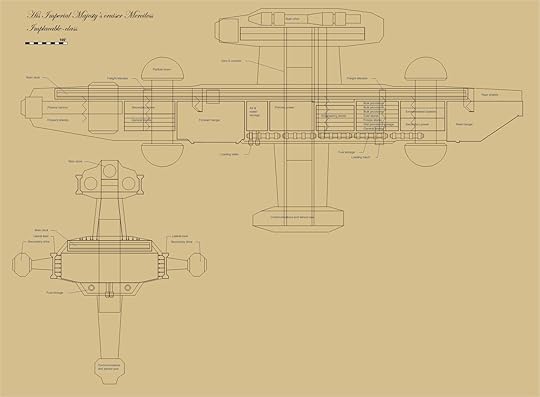
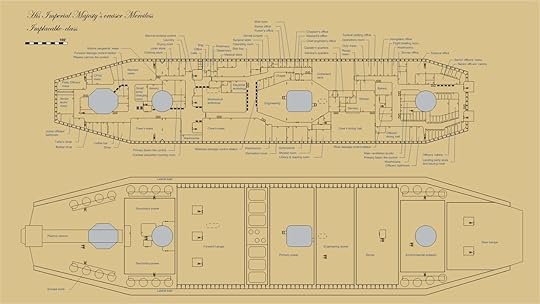
Finish editing and publish Tiamat's Nest. Finish and publish The Critique Survival Guide.Have more fun!The last few weeks, taking a time out from writing, have reminded me how much fun I have with the visual arts, and I don't want to lose touch with that. I've finished the plans of the Implacable-class cruiser Merciless, and posted them to my web site, along with a bit of background on the ship.
I don't do resolutions, but I do set myself goals from time to time, not necessarily at the New Year. I also believe it's important not just to set goals, but to review them, see how well I'm doing to achieve them, and make course corrections as needed.
Goals for 2014...
Publish Ghosts of Innocence - CHECK! Including my goals of seeing my own artwork on a book cover, and holding a copy in my hands.Edit Tiamat's Nest - not quite, but half-way there. Goals for 2015 are pretty simple:
Finish editing and publish Tiamat's Nest. Finish and publish The Critique Survival Guide.Have more fun!The last few weeks, taking a time out from writing, have reminded me how much fun I have with the visual arts, and I don't want to lose touch with that. I've finished the plans of the Implacable-class cruiser Merciless, and posted them to my web site, along with a bit of background on the ship.
December 27, 2014
Guilty pleasures
I guess this is heresy for a writer, but ...
*whispers*
... writing is neither my first nor my only artistic love.
*Looks around shiftily, expecting the Spanish Inquisition*

Whereas most writers that I know have had stories bubbling out of their heads for as long as they can remember, I only started writing ten years ago. And I can hardly pretend to have a logjam of story ideas bursting forth.
On the other hand, I was practically born with pencils and crayons in my hands. I think I could draw a pretty mean Dalek long before I could spell it.
So, on to a related confession. I haven't done much writing this month.
I had been on target to finish revising Tiamat's Nest by the end of January. I started the month over 60% done, after an intense three months' work, then hit a tough spot and came to a screeching halt. I've drafted a few sections of The Critique Survival Guide, but I think that's something I'll need to take in easy stages. Non-fiction writing is very different from fiction.
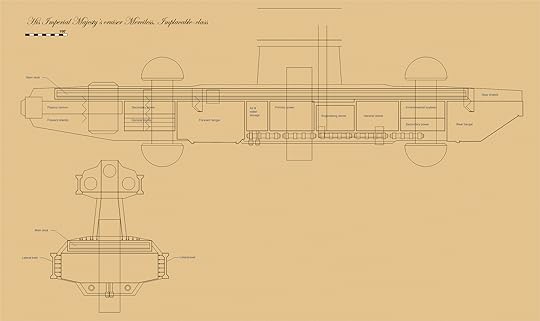
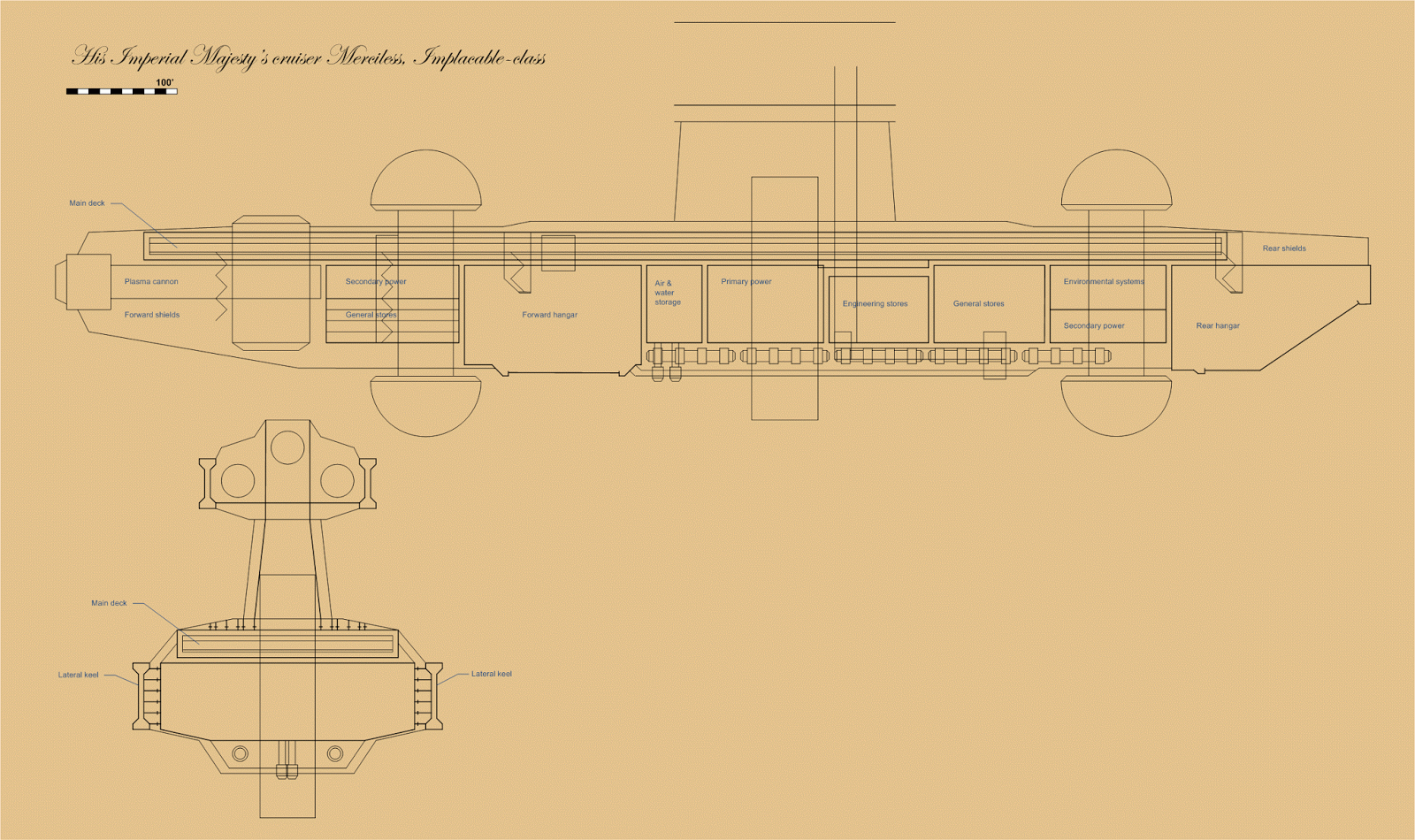
So, rather than beat myself over the head, I'm indulging in some guilty pleasures this month. You can see examples of my paintings on this blog and on my website, but for pure self-indulgence I like to draw plans and maps. I have a fascination for architectural drawings and for ship designs, so I'm having a go at drawing up one of the spaceships from Ghosts of Innocence. Here's the side view in progress, and I'm also working on deck plans. When they're done, I'll post them up to the website as part of the package of background information I'm slowly assembling.
*Looks around shiftily, expecting the Spanish Inquisition*

Whereas most writers that I know have had stories bubbling out of their heads for as long as they can remember, I only started writing ten years ago. And I can hardly pretend to have a logjam of story ideas bursting forth.
On the other hand, I was practically born with pencils and crayons in my hands. I think I could draw a pretty mean Dalek long before I could spell it.
So, on to a related confession. I haven't done much writing this month.
I had been on target to finish revising Tiamat's Nest by the end of January. I started the month over 60% done, after an intense three months' work, then hit a tough spot and came to a screeching halt. I've drafted a few sections of The Critique Survival Guide, but I think that's something I'll need to take in easy stages. Non-fiction writing is very different from fiction.
So, rather than beat myself over the head, I'm indulging in some guilty pleasures this month. You can see examples of my paintings on this blog and on my website, but for pure self-indulgence I like to draw plans and maps. I have a fascination for architectural drawings and for ship designs, so I'm having a go at drawing up one of the spaceships from Ghosts of Innocence. Here's the side view in progress, and I'm also working on deck plans. When they're done, I'll post them up to the website as part of the package of background information I'm slowly assembling.
December 13, 2014
On anniversaries
Anniversaries, on the whole, are celebrations. But some bring sad memories, some bring anxiety. From a cosmic perspective, anniversaries are arbitrary points in time. Why attach significance to the orbital period of a small planet around an average star? Yet they are psychologically powerful.
Yesterday, an anniversary passed which released a build-up of anxiety in the household that had grown so stealthily we didn't notice it until it was upon us.
Yesterday marked one year since my (luckily very minor) stroke. A year ago, my body gave me a warning. What it was trying to warn me of remains a mystery. A year has passed in which batteries of tests showed no obvious cause, which is good in many ways. The most likely explanation left is a culmination of stress and fatigue at that point in my life. So stress, presumably, is the obvious risk factor I need to manage.
Yup. So what did I do?
Started a new job in March, which I'd applied for before the stroke and which I didn't want to pass up. Stressful much!
And published my first book.
Nothing like taking it easy :)
Well, I'm still here. After the early weeks of complete disorientation, the new job has been a good move on balance. It's exciting, challenging, great people to work with. The only persistent down sides are the hideous cost of downtown parking, and the extra 15 minutes commute each way (which doesn't sound like much, but when it was previously 25 minutes it's a noticeable addition).
And keeping on the positive side, we recently marked our tenth anniversary since landing in Canada as new immigrants. Now that's what I call an anniversary!
Yesterday, an anniversary passed which released a build-up of anxiety in the household that had grown so stealthily we didn't notice it until it was upon us.
Yesterday marked one year since my (luckily very minor) stroke. A year ago, my body gave me a warning. What it was trying to warn me of remains a mystery. A year has passed in which batteries of tests showed no obvious cause, which is good in many ways. The most likely explanation left is a culmination of stress and fatigue at that point in my life. So stress, presumably, is the obvious risk factor I need to manage.
Yup. So what did I do?
Started a new job in March, which I'd applied for before the stroke and which I didn't want to pass up. Stressful much!
And published my first book.
Nothing like taking it easy :)
Well, I'm still here. After the early weeks of complete disorientation, the new job has been a good move on balance. It's exciting, challenging, great people to work with. The only persistent down sides are the hideous cost of downtown parking, and the extra 15 minutes commute each way (which doesn't sound like much, but when it was previously 25 minutes it's a noticeable addition).
And keeping on the positive side, we recently marked our tenth anniversary since landing in Canada as new immigrants. Now that's what I call an anniversary!
December 6, 2014
Shopping bags
Every Saturday, I go grocery shopping for the family for the week. I take an armful of shopping bags with me to load everything in to. These are large and sturdy cloth bags bought from the store and which have served us well for many years,
Yes, it's a greener option than getting and discarding paper or plastic bags each week, but it's also convenient. It makes everything easy to carry from the car into the house in three or four trips. I take shopping bags with me, and I expect to use them, because it makes life easier for me, the paying customer.
So why do I have a battle every week with the cashier trying to leave items out of the bags for me to carry individually? They seem to be on a mission to use as few bags as possible.
I wonder if it's in their cashier training manual, because the store offers 3 cents per bag incentive for shoppers to bring their bags in. Well, I've brought mine in and I'd like to be allowed to use them. I honestly don't care about pitiful incentives, keep those few cents if that's what you're worried about, just stop trying to make life awkward for me.
A 5lb bag of potatoes, a similar-sized bag of carrots. "Do you want those left out?" No I bloody well don't. What an asinine question. You can get both of those into one bag and still have room for other things on top.
But while you're at it, stop trying to stuff one more item on top of that already-overflowing bag, I have plenty more here. No need to overload them so that they spill their contents all over the car on the way home.
Even that family-sized carton of cereal can go in. Yes, it's pretty much the size of a bag on its own and there's not much chance of getting anything else in there, but yes, I want it in a bag. You see, rather than tucking an awkward box under my arm to carry, a bag has handles!
So don't roll your eyes at me. Have you ever shopped for a family of four? If you did, you'd know what I'm talking about.
Yes, it's a greener option than getting and discarding paper or plastic bags each week, but it's also convenient. It makes everything easy to carry from the car into the house in three or four trips. I take shopping bags with me, and I expect to use them, because it makes life easier for me, the paying customer.
So why do I have a battle every week with the cashier trying to leave items out of the bags for me to carry individually? They seem to be on a mission to use as few bags as possible.
I wonder if it's in their cashier training manual, because the store offers 3 cents per bag incentive for shoppers to bring their bags in. Well, I've brought mine in and I'd like to be allowed to use them. I honestly don't care about pitiful incentives, keep those few cents if that's what you're worried about, just stop trying to make life awkward for me.
A 5lb bag of potatoes, a similar-sized bag of carrots. "Do you want those left out?" No I bloody well don't. What an asinine question. You can get both of those into one bag and still have room for other things on top.
But while you're at it, stop trying to stuff one more item on top of that already-overflowing bag, I have plenty more here. No need to overload them so that they spill their contents all over the car on the way home.
Even that family-sized carton of cereal can go in. Yes, it's pretty much the size of a bag on its own and there's not much chance of getting anything else in there, but yes, I want it in a bag. You see, rather than tucking an awkward box under my arm to carry, a bag has handles!
So don't roll your eyes at me. Have you ever shopped for a family of four? If you did, you'd know what I'm talking about.
November 20, 2014
30 Days of Thankfulness
I'm over at Mysti's blog today, taking part in her epic 30 Days of Thankfulness giveaway.
Hop over and join in the draw, and you could...
** win a Kindle **
... loaded with books from all the authors taking part this month - including Ghosts of Innocence.
Enter at Mysti Parker's blog here.
Hop over and join in the draw, and you could...
** win a Kindle **
... loaded with books from all the authors taking part this month - including Ghosts of Innocence.
Enter at Mysti Parker's blog here.
November 7, 2014
The Critique Survival Guide
Have you ever submitted your work to a detailed critique or edit?
If not, why not?
I believe that getting detailed, line-by-line feedback, whether from other writers or from paid professionals, is a vital part of the writing process. A necessary step along the way to polishing work for publication, and for self-improvement as a writer.
But, it can be a brutal and dispiriting process.
Next week, I'm giving a talk at my local library on how to receive and handle critiques.
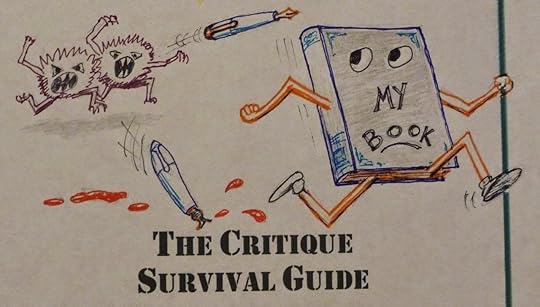
I've based the talk around a series of blog posts I wrote last year.
The aim of the posts was to give tips on how to handle the pain of critiques and become objective and receptive to things you may not want to hear, how to look for points worth taking note of, pitfalls to avoid, and exercising judgment. As well as fleshing these themes out more thoroughly, I've book-ended them with the need to get onto the critiquing road, and some practical pointers on working with online critique groups.
Now I've expanded my notes into a ninety-minute talk, and I wonder if they could be developed further into a short e-book. If I did something like that, the aim would be to make it a freebie.
Do you think there would be interest in such a book? And how do you handle blunt critiques?
If not, why not?
I believe that getting detailed, line-by-line feedback, whether from other writers or from paid professionals, is a vital part of the writing process. A necessary step along the way to polishing work for publication, and for self-improvement as a writer.
But, it can be a brutal and dispiriting process.
Next week, I'm giving a talk at my local library on how to receive and handle critiques.
I've based the talk around a series of blog posts I wrote last year.
The aim of the posts was to give tips on how to handle the pain of critiques and become objective and receptive to things you may not want to hear, how to look for points worth taking note of, pitfalls to avoid, and exercising judgment. As well as fleshing these themes out more thoroughly, I've book-ended them with the need to get onto the critiquing road, and some practical pointers on working with online critique groups.
Now I've expanded my notes into a ninety-minute talk, and I wonder if they could be developed further into a short e-book. If I did something like that, the aim would be to make it a freebie.
Do you think there would be interest in such a book? And how do you handle blunt critiques?
October 26, 2014
First Page Review bloghop
This post is part of the First Page Review bloghop. The idea is simple. On your own blog, post the first 1,000 words of something you're writing or have written, then sign up on this page linking your 1,000 word post. Visit other people on the list and read theirs, then leave a comment to let them know if you liked it, what worked, what didn't, and if you'd keep reading.
Just for fun, here is the opening from The Ashes of Home, sequel to Ghosts of Innocence, which will likely be my next project once I've polished and published Tiamat's Nest.
=====
'Hope springs eternal' the ancient saying goes, but hope is a poor foundation to stake your life on. Shayla Carver, master assassin (retired) and first governor of the Freeworld of Eloon, was shielded by more security than any normal paranoid could hope for.
Any normal paranoid would have died years ago.
Shayla did not believe in hope. The official security measures were there to keep out the bounty hunters and the merely competent. The serious threats she relied on her own senses and training to deal with.
Her airways had clamped shut instinctively at the first salt-sweet taste on her tongue. Years of assassin training identified the airborne drug immediately. Peritax. A small dose would render her senseless in seconds.
Ambushed! In my own fucking bedchamber! Shayla pushed aside the annoyance. Questions of who and how could wait. All that mattered now was survival.
Time slowed as Shayla's mind went into overdrive. Long seconds marked by the thump of her heartbeat in her ears. She knew she had only moments to assess her situation and deal with it.
Peritax was not a poison, it would just leave her helpless. And it dispersed and broke down quickly, which meant there had to be someone nearby to release it and to finish the job. Whatever that might be.
Shayla's eyes scanned the bedchamber while she stumbled forwards a couple of steps, feigning the effects of the drug.
Two figures stood to one side in servants' robes. Barras and Gingallia? No! These could not be her servants. They were still standing for one thing. Any innocent party in this room would be comatose by now. And these two moved with stealth and menacing purpose. One behind Shayla, cutting off her escape, and one between her and the doors leading out to the balcony to her right. The only other way out of her suite.
Any more?
Shayla's lungs screamed for release. To draw a breath. A breath would mean death. Hah! I'm a poet! The irrational thought flitted through her mind on butterfly wings of madness. Focus! Shayla realised that she was losing her fight against the drug just from that small taste.
Her hand crept towards the hilt of the knife under her robes. She stilled it and instead stumbled another step towards the bed. I can't fight these two. If the drug didn't take her, anoxia would.
Another step.
The figures closed in.
Shayla let herself flop towards the bed, buying herself a few precious moments. As she pitched forwards her legs folded under her, then she launched herself across the bed. She rolled, outstretched hand reaching for a concealed button under the edge of the headboard. As she rolled, she glimpsed a face in the shadows of a hood. It looked like Barras, but Shayla noted nose plugs, a tiny breathing unit clamped between thin stretched lips, and eyes filled with hate.
A razor line of blue fire bisected the space she'd just vacated. A rapier shimmerblade!
Her groping fingers found the hidden button as she completed the roll. The bed collapsed behind Shayla, halved effortlessly by the shimmerblade. Tall windows ahead of her flew open and she continued her motion, hurdling the waist-high sill out into a hundred foot drop.
Gravity took Shayla as she forced the last dregs of tainted air from her mouth and drew in a deep, clean draught from the night rushing past her face. A second later, her feet connected with the broad eaves overhanging her bedroom windows. She hung upside down in the grip of an artificial grav field and drew her own blade, watching the lit window for signs of movement.
Every bedchamber should have its secret emergency exits.
Shayla hoped that her disappearance might have confused her attackers. If at least one of them leaned out of the window to see where she'd gone, she'd quickly have one less to deal with.
No such luck.
First one, then the other, appeared through the opening in a tuck roll, too fast and just out of Shayla's reach. Damn, they're good! They must have figured out what had happened. But she'd really expected no less. Only the very best assassins ever got this close.
They both landed in front of Shayla, back to back, in fighting crouches. The nearer one saw Shayla and signalled to his companion, who also turned to face her.
The first one, the Barras lookalike (traitor or impostor?) swung his rapier. Shayla's own blade flashed blue and met it with a jarring wrench.
A shimmerblade was a rare and fearsome weapon, highly prized by undercover agents as a weapon of stealth. When activated, the vibrating crystalline edge could shear through anything less than military grade vehicle armour -- or another shimmerblade. But when two such blades met in hand-to-hand combat, the results were random and potentially catastrophic for one or both combatants.
Shayla's knife hand went numb. She barely managed to keep her grip on the hilt as she stumbled back against the wall towering over her head to meet the ground hanging impossibly above.
But at least she had been prepared. She'd activated her shimmerblade at the last moment and knew what to expect.
Her opponent staggered back in the other direction. One foot found the edge of the eaves, and he stepped, without thinking, to keep his balance. But he was now half out of the edge of the grav field, and conflicting forces led his reflexes astray. He lost his balance. The planet's natural gravity reclaimed him and he fell, shrieking, into the night.
The remaining assassin reached into her robes. Her hood had slipped, revealing a good likeness of Gingallia, one of Shayla's senior personal servants. It also revealed eyes filled with fear and shock at her companion's sudden demise. This looked like the junior of the two, but she was still a force to be treated with respect.
Just for fun, here is the opening from The Ashes of Home, sequel to Ghosts of Innocence, which will likely be my next project once I've polished and published Tiamat's Nest.
=====
'Hope springs eternal' the ancient saying goes, but hope is a poor foundation to stake your life on. Shayla Carver, master assassin (retired) and first governor of the Freeworld of Eloon, was shielded by more security than any normal paranoid could hope for.
Any normal paranoid would have died years ago.
Shayla did not believe in hope. The official security measures were there to keep out the bounty hunters and the merely competent. The serious threats she relied on her own senses and training to deal with.
Her airways had clamped shut instinctively at the first salt-sweet taste on her tongue. Years of assassin training identified the airborne drug immediately. Peritax. A small dose would render her senseless in seconds.
Ambushed! In my own fucking bedchamber! Shayla pushed aside the annoyance. Questions of who and how could wait. All that mattered now was survival.
Time slowed as Shayla's mind went into overdrive. Long seconds marked by the thump of her heartbeat in her ears. She knew she had only moments to assess her situation and deal with it.
Peritax was not a poison, it would just leave her helpless. And it dispersed and broke down quickly, which meant there had to be someone nearby to release it and to finish the job. Whatever that might be.
Shayla's eyes scanned the bedchamber while she stumbled forwards a couple of steps, feigning the effects of the drug.
Two figures stood to one side in servants' robes. Barras and Gingallia? No! These could not be her servants. They were still standing for one thing. Any innocent party in this room would be comatose by now. And these two moved with stealth and menacing purpose. One behind Shayla, cutting off her escape, and one between her and the doors leading out to the balcony to her right. The only other way out of her suite.
Any more?
Shayla's lungs screamed for release. To draw a breath. A breath would mean death. Hah! I'm a poet! The irrational thought flitted through her mind on butterfly wings of madness. Focus! Shayla realised that she was losing her fight against the drug just from that small taste.
Her hand crept towards the hilt of the knife under her robes. She stilled it and instead stumbled another step towards the bed. I can't fight these two. If the drug didn't take her, anoxia would.
Another step.
The figures closed in.
Shayla let herself flop towards the bed, buying herself a few precious moments. As she pitched forwards her legs folded under her, then she launched herself across the bed. She rolled, outstretched hand reaching for a concealed button under the edge of the headboard. As she rolled, she glimpsed a face in the shadows of a hood. It looked like Barras, but Shayla noted nose plugs, a tiny breathing unit clamped between thin stretched lips, and eyes filled with hate.
A razor line of blue fire bisected the space she'd just vacated. A rapier shimmerblade!
Her groping fingers found the hidden button as she completed the roll. The bed collapsed behind Shayla, halved effortlessly by the shimmerblade. Tall windows ahead of her flew open and she continued her motion, hurdling the waist-high sill out into a hundred foot drop.
Gravity took Shayla as she forced the last dregs of tainted air from her mouth and drew in a deep, clean draught from the night rushing past her face. A second later, her feet connected with the broad eaves overhanging her bedroom windows. She hung upside down in the grip of an artificial grav field and drew her own blade, watching the lit window for signs of movement.
Every bedchamber should have its secret emergency exits.
Shayla hoped that her disappearance might have confused her attackers. If at least one of them leaned out of the window to see where she'd gone, she'd quickly have one less to deal with.
No such luck.
First one, then the other, appeared through the opening in a tuck roll, too fast and just out of Shayla's reach. Damn, they're good! They must have figured out what had happened. But she'd really expected no less. Only the very best assassins ever got this close.
They both landed in front of Shayla, back to back, in fighting crouches. The nearer one saw Shayla and signalled to his companion, who also turned to face her.
The first one, the Barras lookalike (traitor or impostor?) swung his rapier. Shayla's own blade flashed blue and met it with a jarring wrench.
A shimmerblade was a rare and fearsome weapon, highly prized by undercover agents as a weapon of stealth. When activated, the vibrating crystalline edge could shear through anything less than military grade vehicle armour -- or another shimmerblade. But when two such blades met in hand-to-hand combat, the results were random and potentially catastrophic for one or both combatants.
Shayla's knife hand went numb. She barely managed to keep her grip on the hilt as she stumbled back against the wall towering over her head to meet the ground hanging impossibly above.
But at least she had been prepared. She'd activated her shimmerblade at the last moment and knew what to expect.
Her opponent staggered back in the other direction. One foot found the edge of the eaves, and he stepped, without thinking, to keep his balance. But he was now half out of the edge of the grav field, and conflicting forces led his reflexes astray. He lost his balance. The planet's natural gravity reclaimed him and he fell, shrieking, into the night.
The remaining assassin reached into her robes. Her hood had slipped, revealing a good likeness of Gingallia, one of Shayla's senior personal servants. It also revealed eyes filled with fear and shock at her companion's sudden demise. This looked like the junior of the two, but she was still a force to be treated with respect.