Research - Re-entry bubbles
Could a human survive a fall from space?
The opening chapter of Ghosts of Innocence has Shayla ejecting from a plunging starship and entering the atmosphere in an inflatable bubble.
But there's a snag. She can traverse light years in a matter of hours and no-one will bat an eyelid, but readers might baulk at the likelihood of surviving these last few miles. So is it feasible?
The inspiration for this came from some genuine contemporary ideas for evacuating orbiting spacecraft.
I can't remember where I first heard of it, probably an article in New Scientist when they started looking at options for "lifeboats" on the ISS, but some variations of the idea go right back to the early '60s.
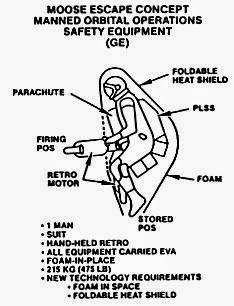 The closest to Shayla's re-entry bubble is probably MOOSE, which was a personal inflatable heat shield conceived in 1963. Various tests proved the viability of some aspects, and the thing might have stood a chance of working, but was never taken further.
In recent years, NASA has got a lot more serious about inflatable landing systems, though these are aimed more at small robotic craft than individuals.
Of course, Shayla's bubble goes far beyond today's capabilities. Light enough to fit in a small backpack, and using molecular engineering to form an airtight seal around the occupant, we haven't begun to develop materials with the necessary properties.
I also took the idea a lot further than simply landing someone in one piece. Shayla's device incorporates a lightweight shape-memory support structure that allows it to be reconfigured mid-flight into a glider wing. Researching typical paraglider sizes, I figured that a viable wing (200 to 300 sq ft) would be a similar surface area to a sphere of 7' to 8' diameter, so it was not hard to envisage suitably advanced micro-molecular engineering to allow one to transform into the other.
The opening chapter of Ghosts of Innocence has Shayla ejecting from a plunging starship and entering the atmosphere in an inflatable bubble.
But there's a snag. She can traverse light years in a matter of hours and no-one will bat an eyelid, but readers might baulk at the likelihood of surviving these last few miles. So is it feasible?
The inspiration for this came from some genuine contemporary ideas for evacuating orbiting spacecraft.
I can't remember where I first heard of it, probably an article in New Scientist when they started looking at options for "lifeboats" on the ISS, but some variations of the idea go right back to the early '60s.
The closest to Shayla's re-entry bubble is probably MOOSE, which was a personal inflatable heat shield conceived in 1963. Various tests proved the viability of some aspects, and the thing might have stood a chance of working, but was never taken further.In recent years, NASA has got a lot more serious about inflatable landing systems, though these are aimed more at small robotic craft than individuals.
Of course, Shayla's bubble goes far beyond today's capabilities. Light enough to fit in a small backpack, and using molecular engineering to form an airtight seal around the occupant, we haven't begun to develop materials with the necessary properties.
I also took the idea a lot further than simply landing someone in one piece. Shayla's device incorporates a lightweight shape-memory support structure that allows it to be reconfigured mid-flight into a glider wing. Researching typical paraglider sizes, I figured that a viable wing (200 to 300 sq ft) would be a similar surface area to a sphere of 7' to 8' diameter, so it was not hard to envisage suitably advanced micro-molecular engineering to allow one to transform into the other.


No comments have been added yet.