Ian S. Bott's Blog, page 14
August 5, 2018
Rattus Evicticus

It’s only 6:30 on a Sunday morning, a time I’m not usually around to see, but already it’s been a hectic two hours.
Winding back the clock a bit, we’ve recently returned from our usual summer camping trip. Except it wasn’t quite the usual as for the first time Megan wasn’t with us. She’s started work and decided to stay behind at home this year. Cue excuse for a party in our absence. Consider ourselves lucky to still have a house to come back to ...
While we were away she called to say she was sure Loki (an aptly named cat) had brought in a rat.
Alive.
She’d seen it that evening scuttling across the living room.
OK. Not a lot we can do about that, and we heard nothing more about it.
Yesterday morning I got up to find droppings on the countertop and around the sink. Yes, Watson, we do have a rodent problem. Yesterday evening, about to get ready for bed, Luna (another cat, and just as dippy as Loki) was very interested in something behind the television stand. Ali spotted a pair of eyes peering out at her. Sighting confirmed, the rat zipped out from behind the stand and along the fireplace.
After lots of moving furniture and pictures around, but no further sightings, we retire.
Four o’clock.
A cat is stalking across the bed, waking me up. I hear nothing, but on a hunch switch on the light to find Luna peering down behind my nightstand. Pull nightstand away to see rat huddling down in the gap.
Let the fun begin!
Quick search for rat-trapping implements ... sticks, pokers, fishing nets, wellington boot ... OK, never tried that with a rat before, but we’ve had repeated success putting a wellington boot on its side for mice to scuttle into when we flush them out of hiding.
But ratty was having none of the boot. Despite my best efforts to coax him in that direction he squeezed the other way and under the bed. A second later there was a scrabbling streak of grey along the ledge that runs the far side of the room towards the back slider.
There followed a fruitless half hour search around the furniture and curtains at that end of the room, but he’d gone to ground again.
Back to restless sleep, then cue a repeat performance. Cats going mental by my nightstand. Lights on. Yes, he’s there again. Out from the nightstand, under Ali’s dresser. Flush out from there, under the couch. We open the slider wide hoping to chase him out the house. The cats are not helping at this point, scaring him back into the room rather than out, so they get shut away. Couch to nightstand to dresser again, then into the far corner by my chest of drawers via Ali’s foot and the front of my dressing gown. Damn, but he’s fast!
A lot of shifting things around and removing clutter from the floor, we try to give him a clear run to the door. Flush him out again and he runs to the open door ... and up the curtains! He’s now on top of the curtain pole at one end. I grab a stick and twice head him off from running along the pole back to the ledge, while Ali tries to knock him off his perch. Finally he jumps down and out the back door!
Whew!
Way too late to go back to bed. Time for a cup of tea, and hope he doesn’t find his way back in!


July 20, 2018
Building a battleship - administration
This will be my last post about the process of designing the Firenzi battleship, Admiral George Leonard, which Shayla infiltrates in The Ashes of Home.
Previous posts talked about the general design, the arrangement of weaponry, machinery spaces, and crew accommodation, as well as some of the practicalities of such a large drawing project. We wrap up with a quick look at how a ship like this is run.
As with any large ship, the analogy of a good-sized town joins forces with that of a fair-sized corporation. And organizations of any size do love their bureaucracy. And Shayla is ready to exploit any loophole that such cumbersome machinery inevitably reveals, after some preparation to seed minds and systems with her newly adopted identity ...
She reached the ship’s administration office and paused a moment to bring her mind back to the task in hand, and to the persona she’d adopted. She asked for the admin clerk the CPO recommended.
Petty Officer Isobel Mullin spun her tale of woe.
The clerk looked up her record, asked questions. Shayla had answers to match the records. Those records also confirmed that tales of woe followed Petty Officer Isobel Mullin everywhere.
He shook his head and helped Shayla access her account. Rolled his eyes when she promptly managed to lock herself out of the system again, though buggered if he knew how she’d managed that under his watchful eye. The system really did hate her. They started again, this time with idiot-proof instructions to keep her account safe.
Petty Officer Isobel Mullin blessed him with a smile to light the darkest night, and Shayla left with a spring in her step that needed no feigning. She’d just completed a paper trail of authenticity that she couldn’t achieve with any of her fictitious identities. She’d created personnel records, training records, disciplinary records, transfer papers, all the administrative details within reach of a payroll clerk, but it took someone with specialized security clearance to activate her system account. She was now officially legit.
The administration office is part of a sprawling suite that includes stores and supply, procurement, finance, payroll, HR, as well as a mail room and the ship’s own internal news room.
The deck below that, right in the heart of the ship, is the command center, or bridge.
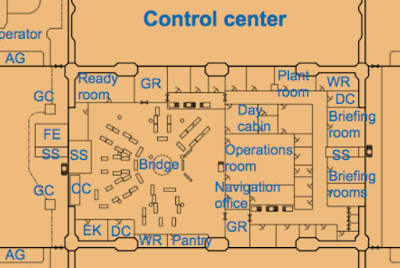 I’ve never understood why sci-fi depictions of spaceships so often place their bridges in the most exposed positions imaginable. On a sea-going warship it makes sense to give the captain and command crew as good a view of their surroundings as possible, but in a space battle I expect speeds and distances to be too great for that to make any sense. Plus, you are working in three dimensions, so no matter where you place yourself the ship itself will obscure at least half your field of view. So in my world, all command decisions are fed into tactical displays fed from arrays of sensors covering the whole sphere. It follows that the last thing they need is access to windows, so the command center is placed in the most protected location possible.
The command center of Shayla’s old Martha Sandover had been strictly off limits to lowly grunts like her. A shiver of excitement ran up her spine as she crossed the threshold into this holy of holies.
The noise struck her first, or rather the lack of it. She remembered her first experience of an Imperial capital ship’s command deck and the cacophony of sound that pervaded the space. Here, the air was heavy with a hundred murmured conversations that seemed muted and distant in comparison.
The captain stood, feet apart and hands clasped in the small of his back, behind a ten-foot-wide tactical display set into a central well in the floor. His white uniform jacket seemed to glow in the twilight world, lit by rank on rank of screens. In front and around him control stations radiated away into multi-hued corridors. A quick survey of insignia confirmed Shayla’s assumption that the most senior officers manned the inner circle of stations, with their underlings seated in decreasing order of rank towards the outer reaches of the wide, low-ceilinged room.
The end result looks nothing like a ship’s bridge, but should closely resemble a modern warship’s Combat Information Center.
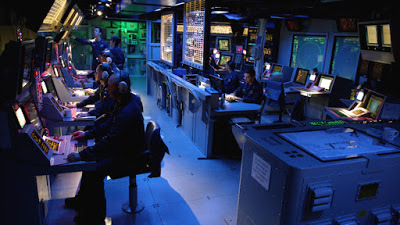
If you want to see more, remember that the full completed plans are posted to my website here.

Previous posts talked about the general design, the arrangement of weaponry, machinery spaces, and crew accommodation, as well as some of the practicalities of such a large drawing project. We wrap up with a quick look at how a ship like this is run.
As with any large ship, the analogy of a good-sized town joins forces with that of a fair-sized corporation. And organizations of any size do love their bureaucracy. And Shayla is ready to exploit any loophole that such cumbersome machinery inevitably reveals, after some preparation to seed minds and systems with her newly adopted identity ...
She reached the ship’s administration office and paused a moment to bring her mind back to the task in hand, and to the persona she’d adopted. She asked for the admin clerk the CPO recommended.
Petty Officer Isobel Mullin spun her tale of woe.
The clerk looked up her record, asked questions. Shayla had answers to match the records. Those records also confirmed that tales of woe followed Petty Officer Isobel Mullin everywhere.
He shook his head and helped Shayla access her account. Rolled his eyes when she promptly managed to lock herself out of the system again, though buggered if he knew how she’d managed that under his watchful eye. The system really did hate her. They started again, this time with idiot-proof instructions to keep her account safe.
Petty Officer Isobel Mullin blessed him with a smile to light the darkest night, and Shayla left with a spring in her step that needed no feigning. She’d just completed a paper trail of authenticity that she couldn’t achieve with any of her fictitious identities. She’d created personnel records, training records, disciplinary records, transfer papers, all the administrative details within reach of a payroll clerk, but it took someone with specialized security clearance to activate her system account. She was now officially legit.
The administration office is part of a sprawling suite that includes stores and supply, procurement, finance, payroll, HR, as well as a mail room and the ship’s own internal news room.
The deck below that, right in the heart of the ship, is the command center, or bridge.
 I’ve never understood why sci-fi depictions of spaceships so often place their bridges in the most exposed positions imaginable. On a sea-going warship it makes sense to give the captain and command crew as good a view of their surroundings as possible, but in a space battle I expect speeds and distances to be too great for that to make any sense. Plus, you are working in three dimensions, so no matter where you place yourself the ship itself will obscure at least half your field of view. So in my world, all command decisions are fed into tactical displays fed from arrays of sensors covering the whole sphere. It follows that the last thing they need is access to windows, so the command center is placed in the most protected location possible.
The command center of Shayla’s old Martha Sandover had been strictly off limits to lowly grunts like her. A shiver of excitement ran up her spine as she crossed the threshold into this holy of holies.
The noise struck her first, or rather the lack of it. She remembered her first experience of an Imperial capital ship’s command deck and the cacophony of sound that pervaded the space. Here, the air was heavy with a hundred murmured conversations that seemed muted and distant in comparison.
The captain stood, feet apart and hands clasped in the small of his back, behind a ten-foot-wide tactical display set into a central well in the floor. His white uniform jacket seemed to glow in the twilight world, lit by rank on rank of screens. In front and around him control stations radiated away into multi-hued corridors. A quick survey of insignia confirmed Shayla’s assumption that the most senior officers manned the inner circle of stations, with their underlings seated in decreasing order of rank towards the outer reaches of the wide, low-ceilinged room.
The end result looks nothing like a ship’s bridge, but should closely resemble a modern warship’s Combat Information Center.

If you want to see more, remember that the full completed plans are posted to my website here.
July 13, 2018
Building a battleship - living spaces
Continuing my tour of the large and ancient battleship, Admiral George Leonard.
Most of the ship’s crew of roughly 6,000 bunk down in the three main mess decks occupying the forward lower section of the ship. Here is the plan of the “G” deck mess where Shayla stows away.
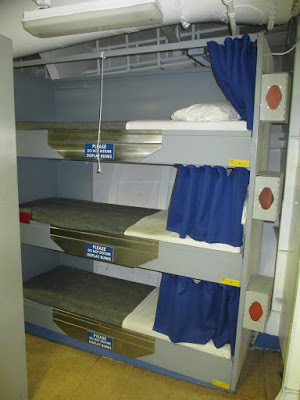
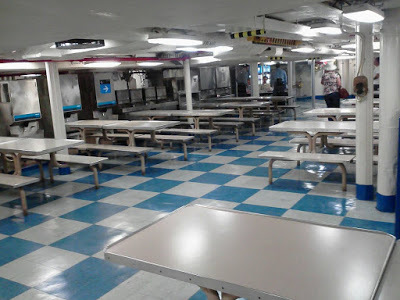
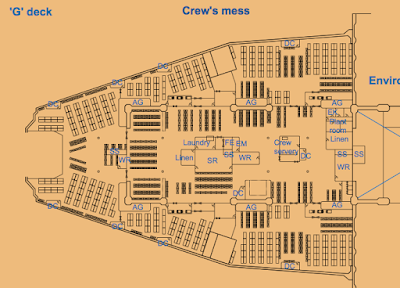 Most of it is given over to rows of bunks and lockers, a cramped labyrinth with occasional more open spaces for mess tables. The bunks are in sets of three, much like this shot from a real battleship.
Knowing your way around a maze like this helps in an emergency, like when Shayla realizes she’s being ambushed ...
As she diverted away from her bunk and towards the locker area, the undercover agent once more, hairs on her neck prickled. In her fatigued state, focused on her bunk and sleep, she’d missed small signals that should have put her on high alert. It was near the end of the night watch, the mess areas were normally quiet but there was always someone, a few small knots of people, eating, playing cards, gossiping in low murmurs. The mess tables around here were suspiciously empty. Instead, a few unfamiliar figures lurked at corners between bulkheads and lockers, feigning innocence. The stake out was obvious. Casual onlookers had been warned away. Casting back through her memory, Shayla pictured who was stationed where as she’d entered the labyrinth of the mess deck. In her mind’s eye she mapped the outline of the quarantined area, aware of a slow drift of people closing in behind her. The epicenter lay ahead, where her locker was.
Each of these decks includes shower and washroom facilities, laundry drop-off and pickup points, and a servery linked to the kitchens a couple of decks above by a hoist. While many crew members might choose to eat down in the mess decks, they also have access to a large canteen, open all hours, in the middle of the main recreation area.
As well as the main crew messes, there are at least another two dozen smaller mess areas for the roughly 1,000 officers and petty officers. To help plan these out, I researched navy ranks to get an idea of a realistic proportion of different ranks in a ship’s population.
A ship like this might be away from civilization for months at a time. It’s not enough to provide basic eating and sleeping accommodation, the ship is a fair-sized self-contained town with essential amenities to keep everyone mentally and physically healthy. The recreation deck includes a coffee shop, library and study rooms, and a chapel. The deck above houses a comprehensive suite of fitness facilities including a running track circling the core of the deck. Along in the next section, there are stores for civilian items, and tailor, cobbler, and barber shops.
Most of the ship’s crew of roughly 6,000 bunk down in the three main mess decks occupying the forward lower section of the ship. Here is the plan of the “G” deck mess where Shayla stows away.
 Most of it is given over to rows of bunks and lockers, a cramped labyrinth with occasional more open spaces for mess tables. The bunks are in sets of three, much like this shot from a real battleship.
Knowing your way around a maze like this helps in an emergency, like when Shayla realizes she’s being ambushed ...
As she diverted away from her bunk and towards the locker area, the undercover agent once more, hairs on her neck prickled. In her fatigued state, focused on her bunk and sleep, she’d missed small signals that should have put her on high alert. It was near the end of the night watch, the mess areas were normally quiet but there was always someone, a few small knots of people, eating, playing cards, gossiping in low murmurs. The mess tables around here were suspiciously empty. Instead, a few unfamiliar figures lurked at corners between bulkheads and lockers, feigning innocence. The stake out was obvious. Casual onlookers had been warned away. Casting back through her memory, Shayla pictured who was stationed where as she’d entered the labyrinth of the mess deck. In her mind’s eye she mapped the outline of the quarantined area, aware of a slow drift of people closing in behind her. The epicenter lay ahead, where her locker was.
Each of these decks includes shower and washroom facilities, laundry drop-off and pickup points, and a servery linked to the kitchens a couple of decks above by a hoist. While many crew members might choose to eat down in the mess decks, they also have access to a large canteen, open all hours, in the middle of the main recreation area.

As well as the main crew messes, there are at least another two dozen smaller mess areas for the roughly 1,000 officers and petty officers. To help plan these out, I researched navy ranks to get an idea of a realistic proportion of different ranks in a ship’s population.
A ship like this might be away from civilization for months at a time. It’s not enough to provide basic eating and sleeping accommodation, the ship is a fair-sized self-contained town with essential amenities to keep everyone mentally and physically healthy. The recreation deck includes a coffee shop, library and study rooms, and a chapel. The deck above houses a comprehensive suite of fitness facilities including a running track circling the core of the deck. Along in the next section, there are stores for civilian items, and tailor, cobbler, and barber shops.
July 7, 2018
Building a battleship - fighting capability
The whole point of a battleship is to be able to fight. As I mentioned in earlier posts, I gave the Admiral George Leonard several docking bays to mount weapons or other payloads, giving the ship class tremendous flexibility during the course of their long service lives.
One of the most common weapons in Shayla’s world is the particle beam. This class of weapon shoots a tightly-focused bolt of charged particles - essentially controlled lightning - and the technology is scalable from hand-held to gargantuan.
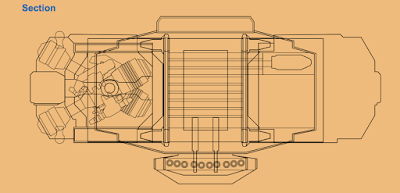
In George Leonard, the primary weapons are mounted in pairs as shown in this cross section. This view also shows a lower pod of torpedo launch tubes attached to the ship’s ventral docking points.
The hatch popped open and Shayla slipped inside the weapon bay. How to board a ship without boarding the ship, that was the trick. Although she was now technically on board, safely enclosed at last within the ship’s armored walls and shielding and subject once more to gravity, this cavernous hold was unpressurized and still technically open to space.
Shayla examined her surroundings with a pang of nostalgia. Life had been so much simpler back then in her days as a lowly marine. A wash of red light barely dispelled the darkness. Suspended overhead, the barrels of two particle beams—warehouse-sized siblings of the hand-held weapons she heartily despised—each dwarfed the scout she’d recently abandoned.
Pale green striplights marked a maze of companionways and catwalks that weaved between the inert bulk of machinery clinging to the bay walls. She craned her neck, eyes tracing the lines of cables and conduits high above.
Of course, this kind of offense needs a comparable defense, which Shayla later uses to her advantage ...
The maintenance corridor ran near the outer skin of the ship. In compartments alongside, electromagnetic shield generators lay dormant ready to protect this flank of the ship in combat. Thick doors at intervals down the narrow passage gave access to the shield machinery. Vivid signs on each door warned of deadly levels of radiation and electrical discharges.
Shayla cracked open the nearest door and slipped inside. She stopped a few minutes to study the layout of cables and machinery. The shields may be dormant but the circuits would still be hot, ready to come to life at a moment’s notice. She might not be an engineer, but she knew engineering, especially anything to do with weapons and defense systems—how to use the former, and how to disable the latter.
A ship’s shields worked by deflecting the energy from charged particle weapons—beams and plasma. Most incoming offense was deflected straight back out into space, but the shields caught and channeled a significant amount of run-off. Shield machinery also contained a large quantity of delicate electronics. The two were not meant to mix.
Shayla stood between two green-painted electrical cabinets. Massive bus bars along the far wall linked the shield coils to banks of cells, reservoirs to contain the leakage. Florescent hazard lines on the floor warned against straying too far into the room. She eyed a run of white-painted pipes along the ceiling, picking her target.
One of the most common weapons in Shayla’s world is the particle beam. This class of weapon shoots a tightly-focused bolt of charged particles - essentially controlled lightning - and the technology is scalable from hand-held to gargantuan.
In George Leonard, the primary weapons are mounted in pairs as shown in this cross section. This view also shows a lower pod of torpedo launch tubes attached to the ship’s ventral docking points.

The hatch popped open and Shayla slipped inside the weapon bay. How to board a ship without boarding the ship, that was the trick. Although she was now technically on board, safely enclosed at last within the ship’s armored walls and shielding and subject once more to gravity, this cavernous hold was unpressurized and still technically open to space.
Shayla examined her surroundings with a pang of nostalgia. Life had been so much simpler back then in her days as a lowly marine. A wash of red light barely dispelled the darkness. Suspended overhead, the barrels of two particle beams—warehouse-sized siblings of the hand-held weapons she heartily despised—each dwarfed the scout she’d recently abandoned.
Pale green striplights marked a maze of companionways and catwalks that weaved between the inert bulk of machinery clinging to the bay walls. She craned her neck, eyes tracing the lines of cables and conduits high above.
Of course, this kind of offense needs a comparable defense, which Shayla later uses to her advantage ...
The maintenance corridor ran near the outer skin of the ship. In compartments alongside, electromagnetic shield generators lay dormant ready to protect this flank of the ship in combat. Thick doors at intervals down the narrow passage gave access to the shield machinery. Vivid signs on each door warned of deadly levels of radiation and electrical discharges.
Shayla cracked open the nearest door and slipped inside. She stopped a few minutes to study the layout of cables and machinery. The shields may be dormant but the circuits would still be hot, ready to come to life at a moment’s notice. She might not be an engineer, but she knew engineering, especially anything to do with weapons and defense systems—how to use the former, and how to disable the latter.
A ship’s shields worked by deflecting the energy from charged particle weapons—beams and plasma. Most incoming offense was deflected straight back out into space, but the shields caught and channeled a significant amount of run-off. Shield machinery also contained a large quantity of delicate electronics. The two were not meant to mix.
Shayla stood between two green-painted electrical cabinets. Massive bus bars along the far wall linked the shield coils to banks of cells, reservoirs to contain the leakage. Florescent hazard lines on the floor warned against straying too far into the room. She eyed a run of white-painted pipes along the ceiling, picking her target.
July 1, 2018
A blustery Canada Day
No, this is not a metaphor for the tariffs on maple syrup and toilet paper that went into effect today, adding to the brewing storms surrounding North American relationships. It’s simply a literal observation.
While much of the country seems to be baking, we’ve had precious few opportunities to enjoy the outdoors this Spring. Even when the rains ease off and the sun peeks out from behind the clouds, like it did today, the wind picks up so much that anything not nailed down is likely to end up on the back lawn.
Like it did today.
Which is kinda weird for this neighborhood.
I’ve grown up used to incessant wind. Living on a small island, with nothing but Atlantic ocean off our west coast, the movement of air rarely fell below a moderate breeze. When we moved out to the west coast of BC, one constant we remarked on time and again over the years was how still it was here.
It was the exact polar opposite to what I’d grown up with. There was now nothing unusual in sitting on the deck with nary a breath to rustle the trees. A noticeable breeze has become the exception. For many summers we strung up a badminton net on the front lawn and happily played with indoor shuttlecocks, not the heavy outdoor variety.
This afternoon, I braved the gusts making my laptop screen quiver, but I sadly abandoned my seat at the table outside when I had to leap up to stop the parasol lifting off like a dandelion seed.
What’s weird is - this seems to have become the norm this year.
Our weather is right royally screwed up.
Ah well, Happy Canada Day, eh!
While much of the country seems to be baking, we’ve had precious few opportunities to enjoy the outdoors this Spring. Even when the rains ease off and the sun peeks out from behind the clouds, like it did today, the wind picks up so much that anything not nailed down is likely to end up on the back lawn.
Like it did today.
Which is kinda weird for this neighborhood.
I’ve grown up used to incessant wind. Living on a small island, with nothing but Atlantic ocean off our west coast, the movement of air rarely fell below a moderate breeze. When we moved out to the west coast of BC, one constant we remarked on time and again over the years was how still it was here.
It was the exact polar opposite to what I’d grown up with. There was now nothing unusual in sitting on the deck with nary a breath to rustle the trees. A noticeable breeze has become the exception. For many summers we strung up a badminton net on the front lawn and happily played with indoor shuttlecocks, not the heavy outdoor variety.
This afternoon, I braved the gusts making my laptop screen quiver, but I sadly abandoned my seat at the table outside when I had to leap up to stop the parasol lifting off like a dandelion seed.
What’s weird is - this seems to have become the norm this year.
Our weather is right royally screwed up.
Ah well, Happy Canada Day, eh!
June 22, 2018
Building a battleship - filling in the details
Continuing my posts about drawing up plans for the ancient battleship, Admiral George Leonard.
Once I had the main structure in place and identified the broad layout, it was time to fill in the details. This is what took most of the time on this project.
There was one aspect of the design that helped here - not planned, it’s just the way it worked out. The deck areas were sharply divided up into distinct zones by the keels and structural frame. This suggested that it would make sense to designate zones to specific purposes, and focus my efforts on one zone at a time.
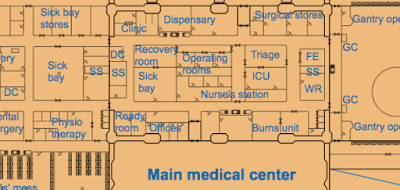
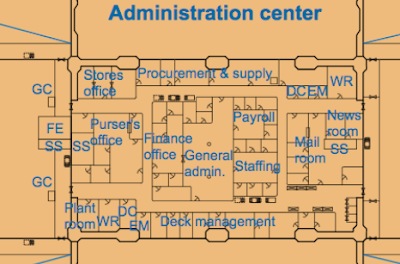
Here, for example, are close-ups of the main medical center and ship’s administration offices.
Once I got going, I quickly realized something that I hadn’t fully thought through yet. Faced with all those empty boxes, repeated deck after deck, I had a lot of space to fill! In the book, despite the overall enormous size of the ship, I do my best to give the impression of cramped and crowded living and working conditions. But in practice I seemed to be faced with a positively embarrassing surfeit of real estate.
Of course, there’s also a lot of stuff needing to go into that space, but I had to start getting pretty inventive thinking through all the possibilities that might be required in a fighting ship with a crew of six thousand, isolated from planets and bases for months at a time. I had to be fairly generous in my use of space, without making it look too generous. So I carved the deck up into lots of small compartments, and assigned functions to them as creatively as possible while making it sound and look credible.
One of the upsides of taking on a large project over a long period of time, new thoughts would pop into my head from time to time. I can tell you, I was always happy when a new idea cropped up, and I thought ... yes, that is going to need a lot of room! And it was a big relief when I neared the end and found I was now having to look for odd corners to squeeze things in.
BTW - the full set of completed plans are posted to my website here.
Once I had the main structure in place and identified the broad layout, it was time to fill in the details. This is what took most of the time on this project.
There was one aspect of the design that helped here - not planned, it’s just the way it worked out. The deck areas were sharply divided up into distinct zones by the keels and structural frame. This suggested that it would make sense to designate zones to specific purposes, and focus my efforts on one zone at a time.
Here, for example, are close-ups of the main medical center and ship’s administration offices.


Once I got going, I quickly realized something that I hadn’t fully thought through yet. Faced with all those empty boxes, repeated deck after deck, I had a lot of space to fill! In the book, despite the overall enormous size of the ship, I do my best to give the impression of cramped and crowded living and working conditions. But in practice I seemed to be faced with a positively embarrassing surfeit of real estate.
Of course, there’s also a lot of stuff needing to go into that space, but I had to start getting pretty inventive thinking through all the possibilities that might be required in a fighting ship with a crew of six thousand, isolated from planets and bases for months at a time. I had to be fairly generous in my use of space, without making it look too generous. So I carved the deck up into lots of small compartments, and assigned functions to them as creatively as possible while making it sound and look credible.
One of the upsides of taking on a large project over a long period of time, new thoughts would pop into my head from time to time. I can tell you, I was always happy when a new idea cropped up, and I thought ... yes, that is going to need a lot of room! And it was a big relief when I neared the end and found I was now having to look for odd corners to squeeze things in.
BTW - the full set of completed plans are posted to my website here.
June 16, 2018
This is how to earn respect
By doing what is hard for you to do, rather than what comes most easily
Being motivated by selfless actions rather than personal gain
By seeking to inspire others, rather than seeking praise for yourself and your own accomplishments
June 15, 2018
I wanna be like yoo-oo-oo

It's a sad day when the leader of the world's second largest democracy envies a brutal dictator
June 9, 2018
Building a battleship - drawing practicalities
One thing that most distinguished this drawing project from others, is the sheer scale of the drawing.
To give you an idea of what I’m talking about, here’s the kind of window I am usually working in ...
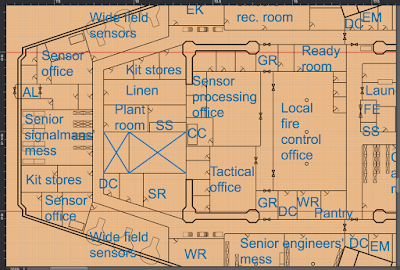 ... it looks small as an image here but this is a snapshot of the drawing window in iDraw that takes up most of my screen. This kind of scale is comfortable to work at, close enough to handle small details but not too close to give me tunnel vision.
And here is the view zoomed out to the whole page, with the previous portion highlighted. You can see that at any one moment I am only working on a tiny fraction of the whole plan.
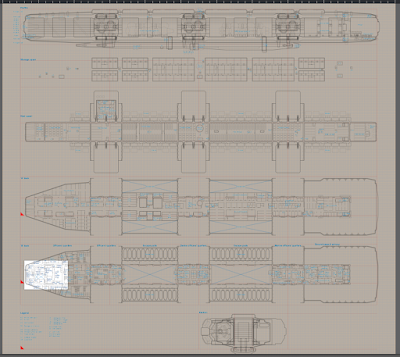 And this is just page one of three!
A task of this size poses a series of challenges.
The big picture
For fine positioning, iDraw has a grid feature. Helpfully, it lets you set up a two-tier grid, with large and small units. In this case I worked with a 0.5mm fine grid, with heavier grid lines every 5mm. My scale is 0.5mm to 1ft. Yes, I’ve always been weird that way - measuring in metric but thinking in feet, but the latter makes sense in Shayla’s world because I have them talk in terms of Imperial units (miles etc.) to give a sense of tradition and antiquity.
This grid is great when it comes to drawing the detail of rooms and corridors, but to help with overall orientation I add in a broader grid of lines to give me a large scale framework.
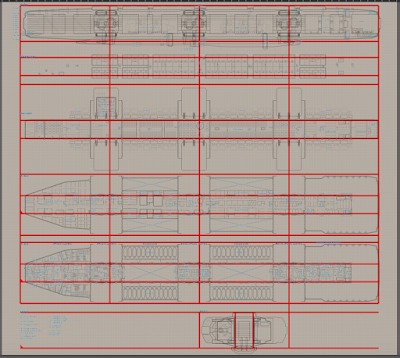
You can see that the plan is actually a series of plans - mostly decks, but also profile and section. Laying these out on the page needs some forward planning. I decided on the overall dimensions for the different elements and then worked out how much room each one needed on the page - not so close that they overlap, but not too far apart either. I then laid out my own large scale grid lines to mark out the boundaries. I put these in their own drawing layer behind everything else so they are visible but don’t interfere.
Here is that same view of the page with the grid lines emphasized.
Keeping it together
The next challenge, which applies to any plan but is made trickier working on such a large scale, is vertical integrity. Decks don’t exist in isolation of each other, there are elements that link them together and which therefore have to be positioned correctly from one to the next. I’m talking here about obvious things like elevators and vertical service shafts, stairs, and inner and outer structural members.
Again, this benefits from some forward thinking. I started off with the main structural framework of the ship - keels and horizontal and vertical plates. Again, I put these into a drawing layer of their own for easier handling. Making this ship a fairly boxy shape helped, because there was a lot of repetition from one deck to the next. Once I had worked out the parts of the framework that pierced one of the main decks, it was a matter of copying and pasting to the others.
Even that simple exercise was a bit of a headache until I developed a technique to handle positioning. With such a large drawing, when you zoom out far enough to see the whole deck you are too far out for accurate positioning. And at that distance I also found it next to impossible to “grab” a set of lines I’ve just pasted to drag them into position. My solution was to add some temporary drawing elements to help move and position. You can see one or two red triangles nestling in the corners of my grid. I select the items I want to copy, along with one of these triangles. When I paste into the next deck, the large triangle is easier to grab while zoomed out, so I can get things roughly into position. I then zoom in on the triangle and nudge it until it is precisely positioned against the grid lines and I know everything else - out of sight because I’m zoomed in - is also moving with it into correct alignment.
With the structural framework laid out, I moved on to the outer hull, and then internal elements such as shafts and stairs. This was a game of patience, and checking and double-checking everything before I started filling out the details.
Keeping track
The last major challenge was simply keeping track of the overall plan, and keeping motivated by seeing progress as I fleshed out the enormous amount of detail.
Here I set up a spreadsheet to mark out zones along the length of the ship, and decks down the page.
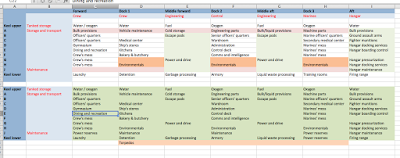
This became my master plan for what went where. On a copy of this master plan I used traffic-light shading to show which sections were complete, in progress, or still to do. At first this served to emphasize what a daunting task I had embarked on, but it was satisfying to see the steady spread of green as time went by.
To give you an idea of what I’m talking about, here’s the kind of window I am usually working in ...
 ... it looks small as an image here but this is a snapshot of the drawing window in iDraw that takes up most of my screen. This kind of scale is comfortable to work at, close enough to handle small details but not too close to give me tunnel vision.
And here is the view zoomed out to the whole page, with the previous portion highlighted. You can see that at any one moment I am only working on a tiny fraction of the whole plan.
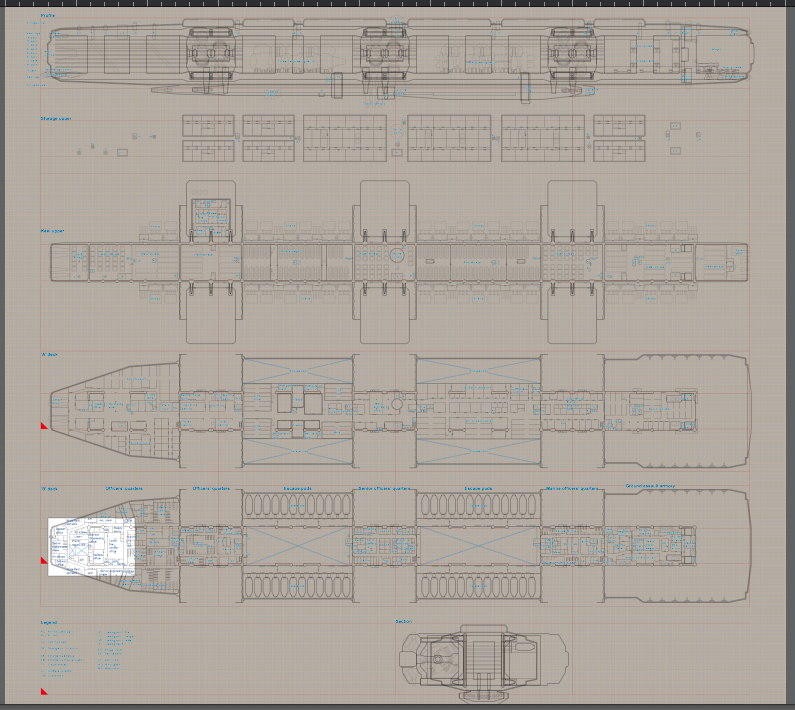 And this is just page one of three!
A task of this size poses a series of challenges.
The big picture
For fine positioning, iDraw has a grid feature. Helpfully, it lets you set up a two-tier grid, with large and small units. In this case I worked with a 0.5mm fine grid, with heavier grid lines every 5mm. My scale is 0.5mm to 1ft. Yes, I’ve always been weird that way - measuring in metric but thinking in feet, but the latter makes sense in Shayla’s world because I have them talk in terms of Imperial units (miles etc.) to give a sense of tradition and antiquity.
This grid is great when it comes to drawing the detail of rooms and corridors, but to help with overall orientation I add in a broader grid of lines to give me a large scale framework.
You can see that the plan is actually a series of plans - mostly decks, but also profile and section. Laying these out on the page needs some forward planning. I decided on the overall dimensions for the different elements and then worked out how much room each one needed on the page - not so close that they overlap, but not too far apart either. I then laid out my own large scale grid lines to mark out the boundaries. I put these in their own drawing layer behind everything else so they are visible but don’t interfere.
Here is that same view of the page with the grid lines emphasized.

Keeping it together
The next challenge, which applies to any plan but is made trickier working on such a large scale, is vertical integrity. Decks don’t exist in isolation of each other, there are elements that link them together and which therefore have to be positioned correctly from one to the next. I’m talking here about obvious things like elevators and vertical service shafts, stairs, and inner and outer structural members.
Again, this benefits from some forward thinking. I started off with the main structural framework of the ship - keels and horizontal and vertical plates. Again, I put these into a drawing layer of their own for easier handling. Making this ship a fairly boxy shape helped, because there was a lot of repetition from one deck to the next. Once I had worked out the parts of the framework that pierced one of the main decks, it was a matter of copying and pasting to the others.
Even that simple exercise was a bit of a headache until I developed a technique to handle positioning. With such a large drawing, when you zoom out far enough to see the whole deck you are too far out for accurate positioning. And at that distance I also found it next to impossible to “grab” a set of lines I’ve just pasted to drag them into position. My solution was to add some temporary drawing elements to help move and position. You can see one or two red triangles nestling in the corners of my grid. I select the items I want to copy, along with one of these triangles. When I paste into the next deck, the large triangle is easier to grab while zoomed out, so I can get things roughly into position. I then zoom in on the triangle and nudge it until it is precisely positioned against the grid lines and I know everything else - out of sight because I’m zoomed in - is also moving with it into correct alignment.
With the structural framework laid out, I moved on to the outer hull, and then internal elements such as shafts and stairs. This was a game of patience, and checking and double-checking everything before I started filling out the details.
Keeping track
The last major challenge was simply keeping track of the overall plan, and keeping motivated by seeing progress as I fleshed out the enormous amount of detail.
Here I set up a spreadsheet to mark out zones along the length of the ship, and decks down the page.

This became my master plan for what went where. On a copy of this master plan I used traffic-light shading to show which sections were complete, in progress, or still to do. At first this served to emphasize what a daunting task I had embarked on, but it was satisfying to see the steady spread of green as time went by.
June 2, 2018
Building a battleship - machinery spaces
Armed with a general idea of the overall layout, it’s time to start piecing the main parts of the jigsaw together.
As I said last time, with a seagoing warship you are pretty much constrained by the realities of marine engineering. The general shape and proportions of the hull follow a common pattern and everything fits into that. But with a space craft you have a freer hand to invent your own body plan.
Even so, it helps to pay a bit of attention to basic physics and structural mechanics. It helps to have something that at least looks like it would hang together.
In the case of the Enforcer battleships, my starting point was the structural frame of the ship. I settled on a box frame arrangement. Typical sea ships have a single keel running along the bottom of the hull, to which everything else is attached. Admiral George Leonard has four keels arranged in pairs, upper and lower. Large horizontal and vertical plates link the keels together, forming a series of boxes down the length of the ship.
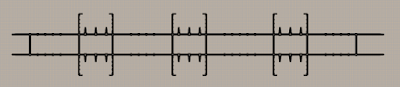 I placed most of the ship’s tanked storage (water and fuel) and services (e.g. waste processing) in the upper and lower spaces between the keels (click on image for a closer look).
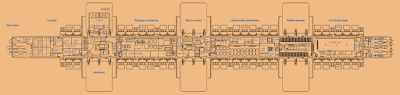
Down ladders once more to the lowest level, Shayla found the laundry and clothing store. Each deck on a ship like this had its own distinctive look, smell, and sound. The similarities to her old Martha Sandover were uncanny, and brought back sharp pangs of nostalgia. Down here, in a space nestling between the massive frames of the lower longitudinal keels, it felt subterranean. Yellow light glistened off cream walls. Pipes twisted thick overhead. Steam and chemicals tainted the air.
The framework between upper and lower keels extends all the way through the decks in between. Everything else has to work around these immovable structural members.

In this view, you can see that most of the ship is taken up by the two main machinery spaces.
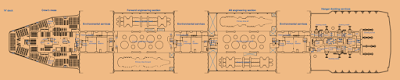
In Shayla’s universe, there is one important design constraint that I don’t have to worry when it comes to the ship’s drive. Most ship designs have to accommodate large rocket (or other) exhausts at the rear. Interstellar technology in this world, however, uses fields that manipulate space and gravity. No opening to the outside world required, so critical machinery can stay safely tucked away behind shields and armor.
Industrial ear muffs barely deadened the noise echoing back and forth in the cathedral space that rose through most of the height of the hull. She’d grown used to near silence in Blazer’s machinery space, but here the quintuplet of hulking, pot-bellied power units was anything but quiet. The curving shells that filled most of the compartment hummed an almost subsonic note that tingled her bones. Accustomed as she was to technology from the microscopic to the gargantuan, she had never been this up close and personal with the living heart of a capital ship. Despite herself, her skin crawled in awe at the unimaginable power contained a few feet away. Behind layers of armor and magnetic containment fields, humans dared subvert the power of suns.
She shivered, and returned her attention to the job at hand and the instructions in her earpiece fighting to be heard. From her vantage point high above the deck, the shrieking din of ancillary equipment that clustered at floor level was lessened, but only just.
A narrow slice of unencumbered air ran the length of the power plant on either side, giving minimally-adequate working room. Canary yellow gantries spanned the engineering space and hoisted the two ton dead weight of the fuel injector high into the air, but it took sweat and muscle, and a constant stream of commands mingled with colorful invective to line the cylinder up with its housing forty feet above the deck.
As I said last time, with a seagoing warship you are pretty much constrained by the realities of marine engineering. The general shape and proportions of the hull follow a common pattern and everything fits into that. But with a space craft you have a freer hand to invent your own body plan.
Even so, it helps to pay a bit of attention to basic physics and structural mechanics. It helps to have something that at least looks like it would hang together.
In the case of the Enforcer battleships, my starting point was the structural frame of the ship. I settled on a box frame arrangement. Typical sea ships have a single keel running along the bottom of the hull, to which everything else is attached. Admiral George Leonard has four keels arranged in pairs, upper and lower. Large horizontal and vertical plates link the keels together, forming a series of boxes down the length of the ship.
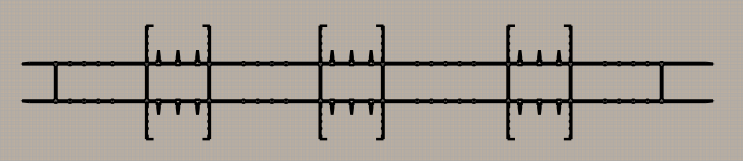 I placed most of the ship’s tanked storage (water and fuel) and services (e.g. waste processing) in the upper and lower spaces between the keels (click on image for a closer look).
Down ladders once more to the lowest level, Shayla found the laundry and clothing store. Each deck on a ship like this had its own distinctive look, smell, and sound. The similarities to her old Martha Sandover were uncanny, and brought back sharp pangs of nostalgia. Down here, in a space nestling between the massive frames of the lower longitudinal keels, it felt subterranean. Yellow light glistened off cream walls. Pipes twisted thick overhead. Steam and chemicals tainted the air.
The framework between upper and lower keels extends all the way through the decks in between. Everything else has to work around these immovable structural members.

In this view, you can see that most of the ship is taken up by the two main machinery spaces.

In Shayla’s universe, there is one important design constraint that I don’t have to worry when it comes to the ship’s drive. Most ship designs have to accommodate large rocket (or other) exhausts at the rear. Interstellar technology in this world, however, uses fields that manipulate space and gravity. No opening to the outside world required, so critical machinery can stay safely tucked away behind shields and armor.
Industrial ear muffs barely deadened the noise echoing back and forth in the cathedral space that rose through most of the height of the hull. She’d grown used to near silence in Blazer’s machinery space, but here the quintuplet of hulking, pot-bellied power units was anything but quiet. The curving shells that filled most of the compartment hummed an almost subsonic note that tingled her bones. Accustomed as she was to technology from the microscopic to the gargantuan, she had never been this up close and personal with the living heart of a capital ship. Despite herself, her skin crawled in awe at the unimaginable power contained a few feet away. Behind layers of armor and magnetic containment fields, humans dared subvert the power of suns.
She shivered, and returned her attention to the job at hand and the instructions in her earpiece fighting to be heard. From her vantage point high above the deck, the shrieking din of ancillary equipment that clustered at floor level was lessened, but only just.
A narrow slice of unencumbered air ran the length of the power plant on either side, giving minimally-adequate working room. Canary yellow gantries spanned the engineering space and hoisted the two ton dead weight of the fuel injector high into the air, but it took sweat and muscle, and a constant stream of commands mingled with colorful invective to line the cylinder up with its housing forty feet above the deck.