J.B. Garner's Blog, page 34
August 10, 2015
Monday Musings: Much Nervous! So Excite! Wow! a.k.a. The Joy and Fear of Stepping Up
It’s great to have a chance to shine, it really is. Getting published is a source of pride and joy for me. At the same time, though, it’s not all peaches and cream. It’s a similar feeling to any other time in my life where I’ve stood at the cusp of a new opportunity.
It’s frightening in a way. Just because you’ve been chosen to take a shot at something (a shot you’ve earned) doesn’t mean you will succeed. You could misstep, you could fall short, or maybe the fates won’t be with you, even if you do everything right. That fear, that anxiety, can be crippling if you dwell on it.
So there you are, walking a tightrope between intoxicating pride and crippling anxiety. Fall into the abyss of fear and you won’t get anything done. Let pride go to your head and you won’t have the presence of mind to adjust your approach to this new opportunity. Both lead to the same end-state: Failure!
So don’t squander your opportunities! Keep a cool head, but never lose your confidence!
Speaking of my own new opportunity, take a moment and check out my first published book, The Opening Bell! Until next time, good reading, good writing, and good luck!



August 8, 2015
Book News: The Opening Bell is available on Amazon!

We’re back, baby! The wrestling action/adventure/drama of Three Seconds to Legend begins with The Opening Bell, now professionally edited, revised, cleaned-up, and turned into a lean, mean, fighting machine with the help of my publisher, California Times!
You can check it out on Amazon here, or flip over to the My Books page on the blog for links and the book summary!
Thank you to everyone who has read, critiqued, commented, and supported me these past years! This wouldn’t have come to pass without you.
— J. B. Garner, your Starving Author


August 7, 2015
Starving Review: The Stove-Junker by S. K. Kalsi

The Stove-Junker by S. K. Kalsi (Amazon, Goodreads)
It’s no secret that most of the care packages that get put into my pantry contain sweet, life-sustaining genre fiction. Sci-fi, fantasy, romance, all that sort of thing, delights both fun and sweet. I do, however, also find a fair share of dramatic literature as well and today’s meal is served up piping hot and filled with a stream-of-conscious narrative to hopefully match the best in drama and tragedy. Does Mr. Kalsi bring the goods or did he drop the plates on the way to the table?
Before we find out, let us stand up straight, hands over our hearts, and recite the Starving Review pledge:
I attempt to rate every book from the perspective of a fan of the genre
I attempt to make every review as spoiler-free as possible.
Stove-Junker stands out immediately from the other books I’ve bitten into it during my stint here as the first (purposeful) stream-of-consciousness tale so far. This stylistic choice, where the chef serves up the meal in a way to emulate how the character’s thoughts in the book pour out, can be a polarizing one among the literary food world. Some people relish the delights of cutting through the myriad thoughts of the human mind; others are turned off by the potentially scattered and confusing narrative. Much of this hinges on the skill of the chef, whether he can craft these numerous threads of thought into an over-arching, decipherable, story.
Mr. Kalsi certainly shows his writing chops by managing to do so. Though certainly embracing the spontaneity and mystery inherent in turning immediate thought into a meal, the chef here imposes a certain order to the chaos, never devolving the stream-of-consciousness narrative into a total morass of words. Making sense of the system may take a chapter or two but, once you have adapted to the unique style, the rest of the book becomes simple to read. With the devil-in-the-kitchen dealt with, let’s touch upon the high points before we get to my one main criticism of Stove-Junker.
The biggest virtue here is the imagery. Images, themes, meaning flows through every bite of words, especially as the narrative barrels deeper into the past of the protagonist. These aren’t flowery words for the sake of flowery-e-ness (That there is a scientific term!) and it certainly isn’t purple prose. Everything is constructed with purpose and works towards the deeper themes of the book.
That doesn’t mean that plot and character are left out here, though! There is no fear in the chef to depict our cast in the harsh light of reality, even if their actual reality is questionable at times. The main cast is starkly real and therefore imminently relatable. No flatbread here, everything has been properly baked and is well-risen. The plot itself steps a bit beyond simple dramatic character study (though that could be considered its core element) with some delicate mixes of mystery and a dash of the supernatural as well. Really, this is all almost perfect ….
And you know that is a set-up for my one criticism. Stove-Junker is soul-crushingly bleak. There are certain segments that push into true horror and I don’t mean ‘running out of bread-rolls at a posh dinner party’ or even ‘serial killer stalking you’ horror. I mean the kind of horrific things you know to be real, that you know happen every day, and there is no upside. There is no justice and there is no dramatic payoff. It’s bitingly real but at the same time depressing as all hell. Now, it is pretty obvious from early on that this book is tragic (the core themes, not the writing talent!) and this can be expected, but there are so few points of light, so little contrast to the waves of sorrow, that it threatens to turn the entire thing, beautiful imagery and deep themes and brilliant characterization and all, into just one grey wasteland.
This doesn’t quite come to fruition, thankfully. Stove-Junker remains, despite that, a beautifully-decorated and sharply-flavorful cake with rich swirls of meaning, but the continual bitter sting of despair never leaves your mouth. Some readers might find richness in that and, if you enjoy continual tragedy, you might add an extra start to my final verdict. Even if you don’t and enjoy a good bit of dramatic literature, you still should find the time to take a bit out of Stove-Junker, just be ready for what you’re getting into!
FINAL VERDICT: **** (A beautiful cake with rich flavors of meaning but the bitter sting of despair is constant.)


Starving Interview: S. K. Kalsi, Author of The Stove-Junker
Good morning, my fellow literary diners! Today, I put forth my menu of questions to S. K. Kalsi, the chef of today’s Starving Review subject, The Stove-Junker. Let’s crack open the questions and see the why’s behind the what’s of this ‘maximalist’ author.
Please introduce yourself to my literary foodies!
I’m an author, married to a professional chef who loves to cook and hates to read! I live in northern California with my son and two dogs. I love vintage motorcycles and performance bikes, and I enjoy beautiful things: Expressionist art, “heavy” music, exotic cuisine, good conversations, good wine, and good Scotch. I like a cigar now and again.
Do you do any work outside of the writing kitchen? Any non-work interests?
Reading and writing, expanding my knowledge and deepening my relationships with people and nature, animals are what I live for.
What is your latest dish to be served up?
I am the author of The Stove-Junker, a novel exploring my three favorite themes: time, memory, and identity. The novel is about seventy-nine year old Somerset Garden, a retired appliance “junker” (one who refurbishes antique stoves), and who, at the end of his life, finds himself reflecting back on his tortured past and his history of violence.
Are there any past pieces of literary cuisine you think we should take a bite out of?
My short story “Nocturnes” is available through The Gettysburg Review, Spring 2015 issue. I quite like that story. There is also an experimental piece called “Kuchaji” in Glint literary journal (online), which is told from the POV of a little Indian girl. It’s dark and quite powerful. That story is up for a Pushcart Prize.
What made you want to put on the chef’s hat and whip up your own books?
Since a very young age, about twelve or so, my interests in music coincided with a love for poetic musings. I would sit alone by the banks of a creek not far from my house and write poems, awful little poems about love and death and nature. I wrote throughout high school, short stories mostly, and served on the school paper, writing articles on music. After receiving my degree from Cal State Long Beach in Creative Writing, I put off writing for a decade or so, believing I lacked the experience and knowledge and depth to tell the stories I wanted to tell. It was only after receiving my MFA from the University of San Francisco that I developed my voice as a writer, but that progress is ongoing. With each new story I find new challenges. And I welcome those challenges. They are all part of the writer’s process of evolution and growth as an artist.
Do you have a genre of specialty or do you dabble?
I am a literary fiction author, but my writing introduces various genre elements, such as mystery, horror, and other literary arts, such as drama, poetry and philosophy. My work tends to reflect my interests. I find I cannot write anything that does not have multiple layers, and great depth, and precisely where I find that depth varies.
Why?
Back when I was learning to write, I discovered that I was drawn into stories that involved psychology or philosophy. I am thinking of Camus’ The Stranger, Dostoevsky’s Notes from the Underground, Knut Hamsun’s Hunger. I therefore turned to thinkers who influenced my favorite authors and found they had read Kant, Nietzsche, Kierkegaard, and Sartre. When I discovered the works of Wittgenstein, he seemed to turn philosophy on its head, forcing a discussion of our greatest metaphysical and existential, epistemological and ethical mysteries into questions of language, yet still holding out for the possibility of mystery. That naturally led to my interest in the Transcendentalists–Emerson and Thoreau–whose work I love very much. I believe all these writers attuned me to a particular way of thinking about the world.
Style! Every literary chef aspires to have their own unique one! What do you think sets yours apart and why?
Style and substance are inseparable. My stories seem to relate the lives of ordinary people whose intense, ceaseless self-exploration comes from having made the wrong choices, or the right ones that turn bad, in a manner that express the depth of their being. No, you cannot have style without substance, otherwise the style is just decorative. So coupling the substantive with stylistic via lyricism is my way of doing it. No one can teach one one’s own style, unfortunately, it must evolve out of one’s deepest, most authentic self. At most one can point the way and let style evolve naturally. Reading my stories you get a sense of the hidden structure of musical language akin to poetry, a musicality, a beat: phrases, rhythms, cadences that sing to the reader’s soul as music does.
Even the best of us find inspiration in the dishes of others. Do you have any literary inspirations, heroes, and influences?
I mentioned those poets and philosophers before, but my literary mentors are Faulkner, Cormac McCarthy, Marilynne Robinson, Herman Melville, and Emerson. My James’s: James Agee, James Baldwin, James Joyce, and James Salter. I also love Paul Harding’s Tinkers, which left a deep impression on my work, and the short stories of William Maxwell. As far as poets go, Wallace Stevens, Emily Dickinson, and I am awed by Stephen Mitchell’s translations of Rainer Maria Rilke’s poetry, whose words speak to me in a way few other poets do. Oh yes, and my lovely Alices: Alice Munro and Alice McDermott. Honestly I could keep adding to this list as I love so many different writers.
Let’s get into the meat and potatoes: the art and craft of writing itself! Do you have a preference of points-of-view when you write?
I love the 1st person POV but enjoy challenges. I tend to break rules quite a bit so my latest novel The Stove-Junker plays with the expansion of the 1st person POV; I segue into 2nd person, 3rd person limited, 3rd person omniscient and even 1st person omniscient, which is evident in one of my favorite novels by Marilynne Robinson, Housekeeping. The concept is expressed wonderfully by St. Augustine and reiterated by Emerson: The nature of God whose center is everywhere and circumference nowhere.
Sparse or wordy, how do you like your descriptions served up?
Lyrical. I am a “maximalist” writer, so I tend to be effusive, but not “purple.” I love the power of literary tropes and modifiers, the power of syntax to shift and alter and guide meaning.
Are you a Hemingway man or do you like some saucy adjectives with your nouns?
The spicier the sauce, the greater the heat in a scene.
Picking off the menu of base literary conflicts, what’s your favorite and why?
Man vs. himself is an eternal conflict that leads to so many others. Man as his own enemy. Man as the architect of his own and others’ demise, like Captain Ahab in Melville’s Moby Dick.
What do you think is more important to your recipes, plot or characterization?
No plot without a well defined character. All plot, no matter how thin, grows from character in conflict with himself and others.
Why?
For me plot is an organic process that grows from character, as it should be. If there is no character in conflict with self and/or others, then the story falters. But I also love plot-less stories, but reading them provides other pleasures than an evolving storyline. Mostly I read for style, the way sentences grab you and how that style evolves out of substance. I read for the nuances of language, for poetic description, for revelation into some hidden aspect of humankind that a plot driven story cannot express. It’s all permissible! As a rule of thumb, if I read a story too carefully plotted, it hurts my brain, then character becomes a tool for rising action and that just feels false.
We all know that the first taste means the most! What do you do to get that first bite hook with your readers?
Start with a compelling “ground situation,” reveal inner conflict early, establish the rules of the story without overtly stating them, reveal slowly, methodically, at a leisurely pace. When the great conflicts in a story arise, I hope the reader is both surprised and sees it as a necessary growth of the character’s deep-seated conflicts. But a POV must fit what you are trying to say with the work, how much psychical distance are you looking for, how close or far from the narrative do you want to get, who gets access to the characters’ thoughts and feelings and who doesn’t? These are all questions that must be answered when undertaking a work.
The most important of questions: Cake or pie?
Let them eat chocolate cake with a side of vanilla ice cream. But I am a diabetic, so my cake and pie and vanilla ice cream days are in the past.
Finally, if you could give one piece of advice to aspiring literary chefs out there, what would it be?
Like Hemingway once said, “Write hard clear about what hurts.” And I’ll add to that this: Read. Write. Re-write. Repeat. Also this: Use your time wisely for it is short, so put all your heart and mind and soul into your stories. Go beyond what you’ve done before. Experiment. Test. Erase. Forget. Remember. Keep your heart open. Let no experience remain unclaimed. Mine yourself, mine your own past, extract from the great injustices and conflicts of your own life and discover the seeds of your stories. Harm no one, except the characters in your stories.


August 6, 2015
Book News: The Transition Begins
It’s coming to fruition.
You will notice that the Three Seconds to Legend series is coming down from Amazon, Goodreads, etc. This is only the precursor of better things though, as the re-release of Opening Bell is imminent from my very supportive publisher, California Times Publishing!
My Books page will be updated with new information as soon as it goes live. Expect updates within the day as to the new cover and more!
Thank you, everyone, for your readership and your support! Here’s to bigger and better things!
Sincerely,
Your Starving Author and Reviewer, J. B. Garner


Starving Interview: J. A. Cipriano, Author of Kill It With Magic and The Hatter is Mad
It’s time for another Starving Review alumni to step up to the interview plate and dish on their writing knowledge! Today, we have J. A. Cipriano, who has been through the pantry twice so far, with Kill It With Magic and The Hatter is Mad. Delve into the mind behind the over-the-top action!
Please introduce yourself to my literary foodies!
Hi, I’m J.A. Cipriano. I’m an urban fantasy writer who laughs in the face of having too much action. My motto is, would this make Michael Bay proud?
Do you do any work outside of the writing kitchen? Any non-work interests?
I’m an engineer by trade. It’s not terribly interesting.
What is your latest dish to be served up? Are there any past pieces of literary cuisine you think we should take a bite out of?
I’m currently working on the third book in my Meet Abby Banks series, Spy for the Spiers. It is a Spy thriller that seems to be going over pretty well. I just finished up All Wrapped Up my second Werewolves vs. Mummies book. (Yes, you read that right.) My editor swears up and down that series is my best one, by a huge margin.
What made you want to put on the chef’s hat and whip up your own books?
I’ve been writing stories since third or 4th grade maybe? I have no idea, but I was really little. I wrote my first novel in high school. (I’d actually written like 4 by the end of high school.)
My grandma was always a big reader so I’ve always read a ton of books and I guess I just graduated into wanting to make my own stories.
Do you have a genre of specialty or do you dabble? Why?
I mostly write urban fantasy and always have. I never really got too much into space or epic fantasy middle ages stuff. I live in this time period and it’s awesome. It’d be more awesome with werewolves, though.
Style! Every literary chef aspires to have their own unique one! What do you think sets yours apart and why?
I think I’m funny =D I also do action really well, or so I’ve been told.
Even the best of us find inspiration is the dishes of others. Do you have any literary inspirations, heroes, and influences?
I wrote my first Lillim Callina book after reading the Dresden files books. I just loved the crap out of them. This was in 2007 or so. I guess he can count himself as an influence. I also really enjoy John Scalzi’s work and have a deep, dark space in my heart for Dean Koontz. I grew up on Koontz and have read almost everything he has written. I still have flashbacks to Bad Seed, Door to December, and Bad Place.
Let’s get into the meat and potatoes: the art and craft of writing itself! Do you have a preference of points-of-view when you write?
I prefer writing in first person because it is easier for me personally. It gives me a straight ahead roadmap I can follow because I don’t have to worry about what other characters are doing off camera so much.
That said, I enjoy dabbling in third person because I can write chapters about other characters doing stuff, but I tend to write my third person from a specific character’s point of view because, again, that is easier for me.
I write in past tense because I cannot stand present tense writing.
Strangely though, I hate reading first person, but I love listening to first person in audio book. I can’t really deal with third person in audiobook but enjoy reading it more. Weird, eh?
Sparse or wordy, how do you like your descriptions served up? Are you a Hemmingway man or do you like some saucy adjectives with your nouns?
I hate wordiness and extra description. I’m much more a Hemmingway, I guess. I don’t care how many veins were in each leaf touching each blade of grass next to each shadow and whatever. I also don’t care what color shoes the characters are wearing and all that. You know what that stuff is to me? Stuff you should be cutting so you can blow shit up.
Picking off the menu of base literary conflicts, what’s your favorite and why?
I’ll be honest. I had no idea what you meant by this question so I looked it up on Storyboard that. Link
I don’t actually have a preference because most of my books sort of encompass all of these things. That said, I guess I’d prefer Man vs. Man or man vs. horrible monster thing because it is easier for me to write stories with clear antagonists and villains. If I know who my villain is, I can write how he will thwart my hero better. If it’s just a faceless entity, that becomes much harder for me to do.
What do you think is more important to your recipes, plot or characterization? Why?
I write mostly first person so my character and his/her voice is super important. If the reader doesn’t enjoy my character’s voice, I’m pretty much screwed. That said, I like cool plots. My characters aren’t super introspective types. They are more I’m going to go punch the bad guy in the face.
We all know that the first taste means the most! What do you do to get that first bite hook with your readers?
I try to write awesome first lines like John Scalzi does. I want my first line to punch you in the face. If it doesn’t do that, I’ve failed.
I cannot tell you how many books I’ve stopped reading because I wasn’t hooked in the first line, paragraph, page. Lots of them. Many of them I’m told “get better.” No. I just can’t.
The most important of questions: Cake or pie?
Pie. I don’t really like cake and I hate frosting. But I love pie. So much.
Finally, if you could give one piece of advice to aspiring literary chefs out there, what would it be?
Your first book sucks. Your fifteenth book will suck. But, you know what? It will suck less than book one. I wrote close to two million words before I wrote something that almost didn’t suck. And you know what, it’s still terrible, but it’s better than when I started.
I guess I’m trying to say that you need to keep writing. Keep learning. Don’t keep polishing your first book. Write it, do whatever on it, and write another one. Always be writing another one.
If you want to level up your writing as quickly as possible, just write books and throw them in a drawer and write another one. When you hit something like a million words, go back and read that first book. Eye opener, it will be.


August 5, 2015
Writing Is A Bad Habit: Hard Hats and Sledgehammers a.k.a. Deconstruction and Reconstruction
Genres, tropes, and archetypes form the building blocks of fiction, something that’s very hard, if impossible, to dispute. We use these things as guidelines and molds because that resonate with our culture, our history, and our life experiences. However, that doesn’t mean these things are perfect. Often they are far from it. Couple that with the march of progress and the changes our culture undergoes at a progressively faster speed, you can be left with a sense that these tried-and-true story bricks can crumble with age. There are some things you can do about that though, namely deconstruction and reconstruction.
Deconstruction is the process of taking a trope or genre or the like, one that usually requires suspension of disbelief or certain cinematic sensibilities to work, and placing it into a ‘real’ setting, thus ‘breaking’ it. On the surface, this may seem to be malicious (and it sometimes is!) but most often deconstruction is done to pull apart a seemingly tired trope and analyze it, both its good elements and bad elements, in an effort to breathe new life in it. A deconstruction should be as much about why we find the trope compelling as about why the trope doesn’t work or is unrealistic.
It’s that particular wrinkle that can trip up many an author that wants to center their work around the deconstruction of something. There is a tendency to get stuck in the rut of slamming on the unfeasibility of it in the ‘real’ world that the writer plunges from deconstruction into straight parody, satire, or even into a straight ‘assassination’ of what they intended to deconstruct. If you undertake a deconstruction of a genre, always be aware of that slippery slope and be ready to compensate for it.
Reconstruction, though seen by some as an opposite of deconstruction, actually walks hand-in-hand with it. While deconstruction is breaking the fantastical by placing it in reality to attempt to analyze it, reconstruction is taking that broken trope, accepting the valid analysis the deconstruction gives, and reworks the original trope/genre into something resembling its original form but incorporating improvements gleaned from the deconstruction. It’s the classic process of taking apart something to learn how to rebuild it in a better state, something that works as well for writing as any science.
This doesn’t mean that every deconstruction must be followed by a reconstruction. If you simply want to break down and analyze a trope or genre in your work, feel free to do so. However, the opposite is not true (obviously!). To rebuild something, you must first break it! Though it’s rare, I have read a piece or two that seems to want to start at the reconstruction phase, as if relying on previous popular culture deconstructions to speak for them. The problem is that this doesn’t really work.
Why? Well, the simplest way to put it is that deconstruction, like any creative works, incorporates the creator’s point of view and emotions into it. Yes, the genre you may be trying to reconstruct has already been popularly deconstructed, but that doesn’t incorporate your thoughts and opinions on it. You may decide, influenced by your own feelings on it, take the reconstruction to places that the original deconstructions don’t address, leading to confusion and a sense of disconnection. You highlight what is to be reconstructed in the process of the deconstruction, so the only way to get it truly correct is to do the job yourself, whether in one volume or over a series of books!
So, fellow feasters of literature, what do you think about deconstruction and reconstruction? If you have any tips, tricks, comments, or questions, leave them in the comments below!
Until next time, good reading, good writing, and good luck!


August 4, 2015
Trope of the Week: Brainless Brute

This is certainly a good one this week!
 Originally posted on break the system:
Trope of the Week: Brainless Brute
Strong as an ox, this guy can’t be taken down easily. Even without his strength, he’s often a talented fighter, that being the only skill he’s honed over the course of his life. However, that’s left his brain awfully soft. The only way to beat this guy is to outsmart him in combat or get a good gun since you surely can’t win against him in a round of fisticuffs.
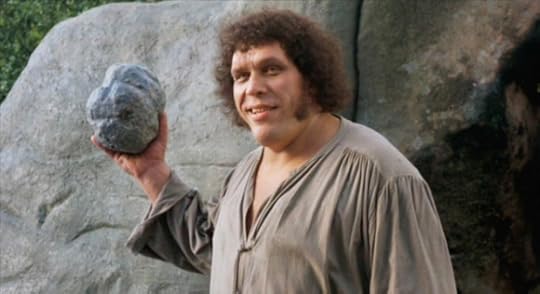 Why this can be bad: When it comes to huge, muscled characters, we expect them to either be the gentle giant or the brainless brute. Whatever the case, we believe them incapable of being intelligent and so the hero will inevitably defeat him via wits (it’s also important to note that this trope is always a male character, never female). So while this already had us ready to start thinking about what our protagonist…
View original 157 more words


Starving Interview: Rick Chapman, Author of Rule-Set
It’s time to step into the review vault and catch up with some of the other literary chefs to enter its halls! That’s right, my friends, it’s time for more Starving Interviews.
Today, we catch up with Rick Chapman, author of my very first Starving Review book, Rule-Set: A Novel of a Quantum Future. Sit back and enjoy as we get a look into his brain!
Please introduce yourself to my literary foodies!
I’m Merrill Richard Chapman, Rick to my friends. (My Dad was Merrill Joseph Chapman and I became Rick about five minutes after birth.) I grew up New York, The Bronx, specifically, and currently reside in Killingworth, CT. I’ve been married for almost 35 years to my wife, Ruth, and we have a daughter, Lilith. I’m also the caretaker of two cats, Hunter and Daphne, and a Schnauzer, Winston.
Do you do any work outside of the writing kitchen? Any non-work interests?
Basketball, collecting vintage stereo (I own 15? turntables), board war games, and vinyl. I am a compulsive reader. I like owning strange and unreliable cars such as the TR-8. Loyal and ever suffering New York Jets fan. I also review other writer’s books on http://www.rule-set.com.
I’ve worked extensively in high-tech as a programmer and product and marketing manager. I was once the product manager of WordStar. For the last several years I’ve run a conference series on SaaS (Software as a Service).
What is your latest dish to be served up? Are there any past pieces of literary cuisine you think we should take a bite out of?
My latest novel book is “Selling Steve Jobs’ Liver: A Story of Startups, Innovation, and Connectivity in the Clouds.” The book is about…err…selling Steve Jobs’ liver and follows the adventures of two serial-failure entrepreneurs who get their hands on the organ’s 1.0 version and proceed to “monetize” it while building a new high-tech firm called “Reliqueree.” It’s a satire, but the marketing and technology contents are accurate and up to date. The action of the novel takes place in San Francisco, Shenzen, China, and New York. More info at http://www.sellingstevejobsliver.com.”;
My first novel is Rule-Set: A Novel of a Quantum Future. It’s blend of advanced particle physics, AI, quantum computing and…Japanese manga. I’m currently at work on the third book and fourth book in the series, “Vorpal Sword,” and “The Hawking Man,” respectively. More info at http://www.rule-set.com.
I’m also the author of “In Search of Stupidity: Over 20 Years of High-Tech Marketing Disasters” which is about exactly what it says. This book is published by Springer and has been released in two edition and I’ working the third. Excerpts up at http://www.insearchofstupidity.com.
What made you want to put on the chef’s hat and whip up your own books?
I’ve been self-publishing since the mid-90s. I fell into the business by accident as a result of a consulting gig I had with IBM. However, I’m also formally published by Springer. I wrote and self- published very niche-oriented business books and still do, but the advent of the Kindle opened up the general audiences to self-publishing and I decided to move ahead.
Do you have a genre of specialty or do you dabble? Why?
To date, I’ve written books in three genres, business, Sci-Fi and contemporary fiction. I was reading serious Sci-Fi in the third grade and always wanted to write my own yarns. So when my daughter got married, received her law degree, and moved to Virginia, I decided it was time to stop thinking about it and start doing it.
Style! Every literary chef aspires to have their own unique one! What do you think sets yours apart and why?
Humor, for one thing. Humor is in short supply in most Sci-Fi these days. There are parodies and deliberate humorists such as Craig Gardner and most famously Douglas Adams and Terri Pratchett.
But my humor differs from theirs in that it’s not “arch.” The protagonist in “Rule-Set,” Clarence Hamilcar, is dragged kicking and screaming into a large pond while very strongly desiring to stay in a small one. He’s cursed by the fact that’s he’s smart enough to realize his plight and possesses the ability to express it via wit.
By contrast, Nate Pennington, the “hero” of “Selling Steve Jobs’ Liver,” is constitutionally amoral and oblivious of his inherent evil, which I think is funny. I was inspired to write the book by a recent contretemps in high-tech. If you buy the book, you’ll be able to figure it out.
Even the best of us find inspiration is the dishes of others. Do you have any literary inspirations, heroes, and influences?
I have many. My favorite novel is “Pride and Prejudice” by Jane Austen and I’ve read every word she ever wrote. I’ve always been a voracious reader and when I was a boy spent several summers at my grandmother’s house in Fort Lauderdale. She had an extensive collection of Dickens, McGuffey’s Readers, many 19th century novels, “Pilgrim’s Progress,” etc. I enjoyed them all. To date, I’m the only person I know who thinks “Silas Marner”‘ is a ripping yarn.
In terms of more contemporary genres, I read the “Lord of the Rings” trilogy in the original, “‘unauthorized” Ace Editions in sixth grade. I was blown away. I also devoured the “Skylark” and “Lensman” series by E.E. “Doc” Smith in the same time period, though those are no longer widely read. Loved Edgar Rice Burroughs, particularly the “John Carter of Mars” series. In regards to Doc Smith, I always thought that “Lensman” would make a great movie or TV, but that’s what I thought about John Carter and look how that turned out.
After that, my early heroes were Heinlein, Asimov (particularly “Pebble in the Sky,” the “I, Robot” series and “The Ugly Little Boy,” Murray Leinster, John Brunner, Jack Vance, Fritz Leiber, etc. In horror, I admired Robert Bloch, Bram Stoker, Lord Dunsany, and others. Not a huge fan of Lovecraft, though “Cool Air” was a “chilling” little tale. Kind of ripped off Poe, though.
I also loved the “Doctor Doolittle” books, though they’re politically incorrect these days. I live within walking distance of Hugh Lofting’s house.
Let’s get into the meat and potatoes: the art and craft of writing itself! Do you have a preference of points-of-view when you write?
Both my novels are written in the first person and as far as “Rule-Set” goes, I’ll continue with that perspective through the series’ end. I’ve recently read an interesting novel, ‘Nighthawks at the Mission’ by Forbes West, which is written in the second person. This is hard to pull off, but he succeeds. I’m planning to write a novel in the future, “Swastika,” which is planned for the third person.
Sparse or wordy, how do you like your descriptions served up? Are you a Hemmingway man or do you like some saucy adjectives with your nouns?
In many respects, I’m a minimalist, though I make no attempt to create the same “hard tone” as Hemingway. ‘The Sun Also Rises’ is a great novel but there’s not a lot of humor in it. Hemingway is not a funny guy.
Also, I stand with Elmore Leonard on speaker identification tags. ‘Said’ should be your go to choice 90%+.
But I do believe in stripping out every unnecessary word from a story. I particularly believe the adverb is usually an enemy of good writing and frankly think that the apostrophe is your friend. Helps pare down all those prepositional phrases into tighter prose.
When I finish writing a book, I use “find and replace” to find all the “ly’s,” “just abouts,” “‘gets,” “thats,” and so on. This is a very valuable exercise I suggest for every writer after finishing your first draft.
I also watch for “tics.” One of the worst examples I’ve seen was Heinlein in his later years. He developed a terrible habit of having his characters always say “uh” during dialog. It was the visual equivalent of having to listen to a Valley Girl constantly repeat “you know” or a millennial say “awesome” five times in two sentences. It reached the point where I couldn’t read him anymore.
Steven King is another writer who’s got the fidgets in too many of his novels. In King’s case, it’s his obsession with nose picking, ear wax, projectile vomiting, pee on the floor and on and on. I think I’d like to meet him, but not sure I’d want to shake his hand.
I also appreciate coherent plots. One of the things I can’t stand about many Sci-Fi and horror movies and books is incoherent writing that makes your eyes roll so hard they almost pop out of your head. Did you see “Oblivion?”‘ Oh, boy. For those of you who haven’t, here’s how the climactic scene goes (and no, I’m not going to apologize for the spoiler and yes, I’m exaggerating. But only a little bit):
The scene begins as TOM CRUISE maneuvers a space shuttle into the lair of The Giant Superhuman Intelligent Uber Machine That Has Conquered the Word and Is Sucking Up All the Earth’s Oceans.
TGSIUMTHCTWAISUATEO: Hey, Tom. Thanks for stopping by. Any reason for the visit?
TOM CRUISE. Oh, nothing in particular. Just happened to be in the neighborhood and thought I’d swing by and see how Earth’s permanent despoliation is moving along from a top-down view. Can I come in?
TGSIUMTHCTWAISUATEO: No problem, Tom. Always great when you visit. But first, could I ask why Morgan Freeman is hiding in the back of your spaceship?
TOM CRUISE. Oh, he’s not hiding. He’s just lying down because he’s space sick.
TGSIUMTHCTWAISUATEO: I see. Do you have any idea what’s in that package he’s clutching to his chest?
TOM CRUISE. Uh, that’s his lunch. A sub.
TGSIUMTHCTWAISUATEO: I thought you said he was space sick.
TOM CRUISE. Uh, that’s for later. When he’s feeling better. Can I come in now?
TGSIUMTHCTWAISUATEO: No problem! I’ll go pull a couple of cold ones out of the cooler.
KAAAABBBOOOMMM!!!
I mean, really. Someone actually paid someone to write that scene.
Picking off the menu of base literary conflicts, what’s your favorite and why?
Hmm. In Rule-Set, the main interaction is between a boy, girl, and a giant particle accelerator. Not so atypical for Sci-Fi. “Selling Steve Jobs’ Liver” is a bit different. There, it’s all about A Boy and His Startup. There is a subplot featuring two star-crossed geeks who find one another. Boy meets girl remains the most powerful trope in literature, I think. It’s why readers of “Great Expectations,” which in my opinion is the greatest novel in the English language, forced Dickens to add an alternate ending. The only theme that rivals it is the lust for power.
What do you think is more important to your recipes, plot or characterization? Why?
IF I had to choose, characterization is the most important. But, let’s be honest. Some very significant Sci-Fi has been written that was plot-driven. The original “Foundation” series is an example. Other than Hari Seldon and the Mule, can you name or remember any of the different characters that appear in the trilogy? Sci-Fi tends to attract writers who are world and system hackers and it’s the mechanism, not the people, who most fascinate them.
“Stand on Zanzibar” is another plot-driven classic. The characters aren’t that memorable, but Brunner’s prescience is. He was one of the few Sci-Fi writer to predict the Internet with a high degree of accuracy. I’ve always found it interesting how Asimov, Heinlein, Vance, Leinster, Dick and many, many others failed to predict the rise of pervasive computing, social networks, digital technology, Cloud computing and so on.
In Rule-Set, I strive to create a balance between plot and technology. I’ve always lived with this dichotomy. When I was younger, I enjoyed programming and technology, but liked to go on dates too.
We all know that the first taste means the most! What do you do to get that first bite hook with your readers?
In my first two novels, I use a prologue to set the table for the book. I think it’s an effective technique in many cases, and works well for me because in my novels I “write” the ending first and work my way to it. But I’ve used that technique twice now and am going to have to give it a rest for a bit.
The most important of questions: Cake or pie?
I’m a pie guy. My favorite is mincemeat, but it’s fallen out favor and a good one is hard to find. My wonderful wife makes it for me when I’m on my best behavior.
Finally, if you could give one piece of advice to aspiring literary chefs out there, what would it be?
Before you start writing your own book, find a really bad one and spend some time rewriting its worst scenes and sentences. This is the literary equivalent of going to the gym and lifting weights to transform yourself from a girly author into a real man. (Or George Eliot.) The increase in your skills and writing fluidity will be very valuable and translate into increased productivity in your own work.
If you find you can’t rewrite these sentences, this means your fundamental writing skills are weak and you need to build them up first before trying to write creatively.


Starving Review: Review Submissions Closed Until October!
The pantry doors are shut once more! I would like to thank all those authors brave enough to step into the kitchen these past few days. I look forward to sampling your books!
I will only be taking submissions one more time in 2015 (the backlog has again become something terrible to behold!) and that is between OCTOBER 1st and OCTOBER 3rd, 2015. I hope to catch up on the backlog of books, as well as enjoy some quiet during the holiday season.
Until next time, good reading, good writing, and good luck!