
Andrew Furst's Blog, page 25
September 2, 2017
The Best Articles of August 2017
Here’s a selected list of what people were reading here on andrewfurst.net in August 2017 :
Join the Broken Glass Art Project
Good Harbor Sunset – Tiny Drops (Photography)
Ideas For the Broken Glass Art Project
Why Was I Born? – Modern Koans
Water – Tiny Drops (Photography)
Views – Tiny Drops (Photography)
Outside – Tiny Drops (Photography)
Bigots? – Thoughts On American Ideals
An Angry God – Dialectic Two Step
Blame the Institution? – Thoughts On American Ideals

 At Patreon you can make small monthly micro-contributions that help support my work.
  If Patreon doesn't work for you, then drop me a one time contribution at PayPal.me
The post The Best Articles of August 2017 written by Andrew Furst appeared on Andrew Furst.


August 31, 2017
What Does Pure Land Buddhism Teach? – Dialectic Two Step
Question: What does Pure Land Buddhism teach?
Response: The Pure Land Sutra is the enlightenment story of the Bodhisattva Dharmakāra. The story is set in the impossibly distant past. Upon fulfillment of 48 vows Dharmakāra became the Buddha Amitabha.
Two of those vows are the central focus of the Pure Land school.
18. If I would become a Buddha, then any sentient being in any one of the ten directions who would earnestly believe and willingly wish to be born in my Pure Land, even if for only the duration of ten thoughts, would be born there. Otherwise, I would not attain Full Enlightenment.
19. If I would become a Buddha, and yet I and all my retinue would not encircle and appear before all those sentient beings at the end of their lives in the ten directions who would have developed the Bodhicitta, have accumulated all kinds of merits and have earnestly vowed to be born in my Pure Land, then I would not attain Full Enlightenment.
The main practice is reciting the name of the Buddha.
The Nature of Buddhas
I’ve always found in vow 18 an interesting interpretation of Buddha nature. Amitabha’s western Pure Land (in Sanskrit Sukhavati or land of bliss) is described as a place in which we cannot regress on our path to enlightenment. In essence, if fulfilled, Dharmakāra’s vow ensures that everyone with a sincere wish for enlightenment, freedom, or contentment will achieve it. Furthermore, and here is the twist, Dharmakāra succeeds in fulfilling his 48 vows – becoming the Buddha Amitabha. Thus it must be the case that all those desiring enlightenment, freedom, or contentment will achieve it.
Who does not wish for such things? What being is exempt from this vow? Are we not all born with the seed of enlightenment?
There are varying degrees of literal and metaphorical interpretations of this Sutra. I would venture that a majority believe they will be met by Amitabha at death. Others read the text to understand rebirth in the Pure Land as brief glimpses found in a mindful state of sincere hope to be reborn there. Others interpret it to mean that the Pure Land is here and now, if we were only to awaken to it (a Buddha being an awakened one).
If you enjoyed this post, please like and share.
Dialectic Two-Step is an ongoing series of my thoughts on questions that come my way.
Wisdom lies neither in fixity nor in change, but in the dialectic between the two. - Octavio
 Dialectic Two Step, Modern Koans, Verse Us, Say What?, and Minute Meditations all copyright Andrew Furst
Subscribe to My Newsletter Join me for a little peace through reflection, art, video, sound, and poetry
The post What Does Pure Land Buddhism Teach? – Dialectic Two Step written by Andrew Furst appeared on Andrew Furst.
August 29, 2017
In the Mail – The Broken Glass Art Project
The first 18 images are in the mail (e- and/or snail-). A good start, but more would be better. I’m really excited about this project, I’m hoping for a little of the same and a little in the category I like to call “something completely different”.
Sign Up
What do you mean completely different? I’m looking for some real off the wall approaches to responding to this call for art. First, since participants are keeping the art (past projects the art was mailed on post cards) the format that I get it in is either a photo, video, or a scan of the art. So, this frees you up in a number of ways.
You aren’t restricted to a post card sized piece of art.
You aren’t restricted by what’s safe to send in the mail
You aren’t restricted to doing anything on paper or with ink or paint or brushes or any traditional art supplies
You can do what ever can be capture in an image
you could use fire
you could project it on the wall of your town hall and take a picture of it
you could feed it to termites
you could put it in a treasure chest and bury it (taking video of it the whole time)
you could use the paper copy to do stop motion animation
you could make a mobile out of it
you could stick it – well I’ll let you decide
This is going to be fun. Come join us
Sign Up
The post In the Mail – The Broken Glass Art Project written by Andrew Furst appeared on Andrew Furst.
August 28, 2017
Facing Pages Study – Concrete Poetry – Compass Songs
Part of a series of concrete poems from the Sackner Archive of Concrete and Visual Poetry founded by Ruth and Marvin Sackner
If you enjoyed this post, please like and share.
Compass Songs is an ongoing series of works by poets that I enjoy. Poetry, as the Zen Masters have said, is like a finger pointing to the moon. It speaks the
Subscribe to My NewsletterJoin me for a little peace through reflection, art, video, sound, and poetry
The post Facing Pages Study – Concrete Poetry – Compass Songs written by Andrew Furst appeared on Andrew Furst.
August 25, 2017
Why Was I Born? – Modern Koans
According to Buddhism, I am not an eternal being or spirit. But, due to my past life karma I am born again. I was wondering what was the cause of my first life. Rebirth takes place due to karma. So if I had no karma before my first life, why was I born?
Response:
This isn’t an answer, but an opinion and a framework to consider.
First, self is impermanent, just like all other observable phenomenon. As you said it arises from causes and conditions. So when you talk about you as self, the answer to how you were created is a simple biological one. Your parents procreated and there you are. This self has a beginning, a middle and an end.
Second, Buddha weighed in on the eternal being point with the concept of Anatman (contradicting the Vedic idea of Atman – the ultimate “self” or God). He said that we are not self.
This leaves a peculiar opening. If we are not self (and there are some semantic ambiguities in that statement) then what are “we”?
Your question, in my opinion, conflates your impermanent self with the subject of karma. I offer this framework to consider the answer to your question.
Consciousness & Karma
Buddhism looks to the skandhas out as an explanation for how consciousness arises.
form – there is a dividing of the world into objects
sensation – there is a sensory experience of an object
perception – mental processes register the sensation
mental formations – concepts and ideas form and are manipulated (here is where karma comes into play)
consciousness – cognition
If we are not self, what develops consciousness? Upon what does karma act?
One opinion that I’ll offer is that the development of life in the universe is the unfolding of skandhas. Confining your search to a human form is too small a view.
The earliest life forms that had the capacity of perspective (i.e. myself looking upon the world) are a good place to start in answering your question.
If you enjoyed this post, please like and share.
I'd love to hear your thoughts in the comments below.
Modern Koans is an ongoing series that recognizes that good questions are often more important than their answers.
The riddles of God are more satisfying than the solutions of man. ― G.K. Chesterton
Dialectic Two Step, Modern Koans, Verse Us, Say What?, and Minute Meditations all copyright Andrew Furst
Subscribe to My NewsletterJoin me for a little peace through reflection, art, video, sound, and poetry
At Patreon you can make small monthly micro-contributions that help support my work. If Patreon doesn't work for you, then drop me a one time contribution at PayPal.me
The post Why Was I Born? – Modern Koans written by Andrew Furst appeared on Andrew Furst.
August 22, 2017
Ideas For the Broken Glass Art Project
I’ve already gotten some good questions about the Broken Glass Art Project. In response I’ve put together a list of ideas.
Sign Up
The first question was this: Do I have to use broken glass in my art work?
Here’s my response: You certainly don’t need to use glass. But you could. Or you could:
paint on it,
fold it into origami,
make it part of a collage,
extend or highlight some of the lines to emphasize an image that you see in the mishmash,
you could make a t-shirt out of it,
or a sticker,
you could make it a small part of a larger work of art,
you could write over it with your favorite Bible passage or steamy love scene from a Harlequin romance novel,
you could use it to wrap a secret piece of art,
you could mail it to the president (send me a picture of the envelope),
or something else that pops into your brain.
I hope that helps
Sign Up
The post Ideas For the Broken Glass Art Project written by Andrew Furst appeared on Andrew Furst.
Good Harbor Sunset – Tiny Drops (Photography)
[image error]Good Harbor Sunset
If you enjoyed this post, please like and share.
All Tiny Drop photos Attribution-NonCommercial-ShareAlike 4.0 International (CC BY-NC-SA 4.0)
Subscribe to My NewsletterJoin me for a little peace through reflection, art, video, sound, and poetry
The post Good Harbor Sunset – Tiny Drops (Photography) written by Andrew Furst appeared on Andrew Furst.
August 20, 2017
Join the Broken Glass Art Project
So, I’ve kicked off another art project titled The Broken Glass Art Collaborative. It’s another opportunity for us to do art together. You can treat it as a spiritual practice, an excuse to get together with friends, or a way to connect with other people around the world.
Sign Up
The Broken glass series is inspired by a directive in the book Grapefruit, A Book of Instructions and Drawings by Yoko One. Originally published in the year I was born (1964), it offers hundreds of koan like instructions for producing paintings, music, film, etc.
The specific instruction that inspired this effort is this
PAINTING TO HAMMER A NAIL
Hammer a nail in the center of a piece
Of glass. Send each fragment to an
Arbitrary address
1962 spring
Sign Up
Taking license, I’ve related the instructions to my post card art projects. Here’s what I’m doing for Broken Glass and what I’m asking of you as a participant.
I’ve mined my stash of photographs and selected an image of a tangle of wires.
I’ve edited the photo into 6 minimalistic black and white contrast images similar to the images below.
I will distribute one image per participant to incorporate into their own piece of art, which they will keep.
I’m asking that each participant to send me two photos of their art,
The first should simply depict the art itself
The second should include the art with some indication of your identity included in the image,
[image error]
Let’s Go
If that sounds fun, then fill in the form here to get your postcards.
Sign Up
The post Join the Broken Glass Art Project written by Andrew Furst appeared on Andrew Furst.
Join the Broken Glass Art Collaborative Project
So, I’ve kicked another art project titled The Broken Glass Art Collaborative. It’s another opportunity for us to do art together. You can treat it as a spiritual practice, an excuse to get together with friends, or a way to connect with other people around the world.
The Broken glass series is inspired by a directive in the book Grapefruit, A Book of Instructions and Drawings by Yoko One. Originally published in the year I was born (1964), it offers hundreds of koan like instructions for producing paintings, music, film, etc.
The specific instruction that inspired this effort is this
PAINTING TO HAMMER A NAIL
Hammer a nail in the center of a piece
Of glass. Send each fragment to an
Arbitrary address
1962 spring
Taking license, I’ve related the instructions to my post card art projects. Here’s what I’m doing for Broken Glass and what I’m asking of you as a participant.
I’ve mined my stash of photographs and selected an image of a tangle of wires.
I’ve edited the photo into 6 minimalistic black and white contrast images below
I will distribute one image per participant to incorporate into their own piece of art, which they will keep
I’m asking that each participant to send me two photos of their art,
The first should simply depict the art itself
The second should include the art with some indication of your identity included in the image,
[image error]
Sign Up
Let’s Go
If that sounds fun, then fill in the form here to get your postcards.
Sign Up
The post Join the Broken Glass Art Collaborative Project written by Andrew Furst appeared on Andrew Furst.
August 19, 2017
A Few Thoughts On Pure Land Buddhism- Collections
Here is a collection of posts capturing my thoughts on Pure Land Buddhism. It includes articles, questions, answers, etc. They’re drawn from a number of regular series including Modern Koans and Dialectic Two Step.
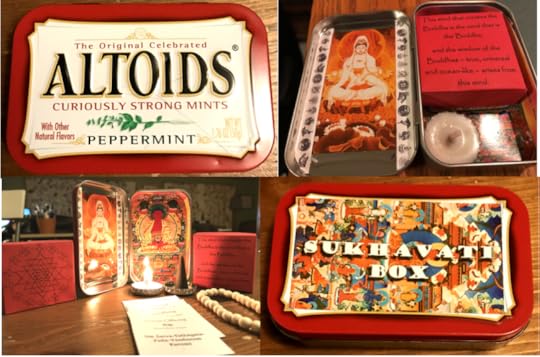
Hand Made Buddhist Shrine – Altoid Tin Project
Buddha
Modern Koans – Why Right Action?
Eightfold Path Series, Modern Koans, Writings
The Whole Enchilada – Dialectic Two Step
Dialectic Two-Step, Writings

Is Enlightenment Achievable? – Dialectic Two Step
Dialectic Two-Step, Writings

Hearing – Meditations on Gratitude
Meditations, Meditations on Gratitude
Why Does Religion Always Go Bad? – Modern Koans
Buddha, Modern Koans, Writings
One With The Universe? – Dialectic Two Step
Dialectic Two-Step, Writings
Look West – A Two Minute Meditation
Meditation Videos, Meditations
The post A Few Thoughts On Pure Land Buddhism- Collections written by Andrew Furst appeared on Andrew Furst.



![[image error]](https://i2.wp.com/ww3.rediscov.com/sacknerarchives/FULL/43114S.JPG)