
Shevlin Sebastian's Blog, page 59
March 20, 2018
Days Of Wind And Rain



COLUMN: LOCATION DIARY
Actor Isha Talwar talks about her experiences in the films, 'Two Countries', 'Ranam/Detroit Crossing', 'Bangalore Days', 'Thattathin Marayathu' and 'Balyakalasakhi'
Photos: Prithviraj and Isha Talwar hamming it up for the camera on the sets of 'Ranam/Detroit Crossing'; Isha
By Shevlin Sebastian
One day, Isha Talwar was sitting at her home in Mumbai when she got a call. A Telugu producer wanted to make a remake of the Mollywood film, 'Two Countries' (2015). Isha was offered the same role that she had done in the film. As Isha agreed, she suddenly went blank. She could not remember what her role and the movie was all about.
“So I thought that it would be best to call [director] Shafi Sir up and find out,” says Isha.When she stated her request, a shocked Shafi began laughing loudly. Then he said, “This is the first time anybody is asking something like this to me.”
But, he complied and told Isha about her role and the storyline. However, because of a clash of dates, Isha could not act in the film.
But Isha is deeply immersed in her latest film, 'Ranam/Detroit Crossing' which stars Prithviraj and will be releasing in April. “During the shoot, we were literally taken by storm,” says Isha. “Hurricane Irma hit Florida, while we were some distance away in Augusta. There was a lot of rains and winds and it had become chilly. But the shoot was stopped because many technicians, like the make-up artist and assistant directors, had families who were living in the eye of the hurricane. So they had to rush back to place their families in safe shelters and organise food for them.”
Shooting in the USA is quite different from what it is in Kerala. For example, the junior artists belonged to some of the richest families. “They just loved being part of a Malayalam film,” says Isha. “Many of them came to work in their Mercedes Benzes or flashy SUV's (Sports-Utility Vehicles).”
During the two-month shoot, Isha interacted with a lot of Malayali families. And during one shooting schedule, she stayed for a week with Dr Daniel George, his wife Grace and their family at Augusta, because she wanted to eat home-cooked food. “My producer was thrilled because he would be saving money,” says Isha jokingly. “As for Grace Aunty, she cooked the most amazing food.”
On the sets of 'Bangalore Days', Isha also had a one-of-a-kind experience. After a shoot one day, Isha spent time with co-actors Parvathy and Nasriya in a hotel room. “It was the first time I was interacting with my fellow women actors in Mollywood,” she says. “It felt good to know that we could all leave our vanities aside, and just hang out with each other and have regular girly conversations. Of course, the bonus for me was to get a peek into the Malayalam film industry from their point of view.”
Both Parvathy and Isha felt that Nasriya was natural in her acting. “Nasriya has more fun because she is so spontaneous and does not seem to care,” says Isha. “On the other hand, Parvathy told me she was a pure Method actor and does research before she plays a role. For me, I was so new, just hearing all this gave me a different perspective. I realised that I had to find my own way of doing things.”
Isha had a completely different experience on the sets of her debut film, 'Thattathin Marayathu' (2012). The shoot was taking place in Thalaserry and it was about 40 degrees Celsius and burning hot. When there was a break in shooting, Isha took shelter in an air-conditioned vanity van. “It was like a match-box and there would always be six or seven people – Aju [Varghese], Nivin [Pauly], Srinda [Arhaan], Tushara [Thomas], and Bhagath [Manuel],” says Isha. “There was a lot to chat about, but mostly the conversation was, ‘Vacate the seat, I want to do the touch-up’, or ‘I want to use the bathroom, can you get out?’ We were jammed into each other’s spaces, but we also had a good time.”
Another unique experience that Isha had was when she acted with superstar Mammootty in the film, 'Balyakalasakhi' (2014). During breaks in shooting, the duo would talk a lot. “The conversation ranged from food to his exercise regime and Mammootty Sir’s journey as an actor,” says Isha. “It was amazing how he could connect so easily with people of varying age groups.”
And then one day Mammootty said, “At some point in their careers, all actors become narcissistic.” Isha immediately said, “Sir, I beg to differ.” But today, she is not so sure. “I believe what Mammootty Sir said was correct since actors tend to live in a bubble,” she says.
(The New Indian Express, Kochi, Thiruvananthapuram and Kozhikode)


March 16, 2018
In Search Of The Divine


Musician Joshua Pollock talks about his best-selling book, 'The Heartfulness Way – Heart-based Meditations For Spiritual Transformation'
Photo of Joshua Pollock by Albin Mathew
By Shevlin Sebastian
As author Joshua Pollock enters the Crossword book store in Kochi, on a weekday afternoon, he looks a trifle tired. That is because for the past few weeks he has been travelling all over India, going to places like Jaipur, Delhi, Mumbai, Kolkata and Hyderabad and holding events highlighting his book, 'The Heartfulness Way – Heart-based Meditations For Spiritual Transformation'. This has been written by Joshua, along with his guru Kamlesh D. Patel, who is otherwise known as 'Daaji'.
And all this hard work has paid off. The book, published by Westland, had reached No 1 on Amazon and the Hindustan Times/Nielsen Non-Fiction Bestseller list. “It is very gratifying,” he says. It helped that the President of India Ram Nath Kovind released the book. In Jaipur, it was Chief Minister Vasundhara Raje who did the honours and immediately tweeted a photo of herself and Joshua. And this is what she wrote: 'The Heartfulness Way' offers interesting insights into the spiritual way of living by and from the heart.'
Joshua seems an unlikely person to lead a spiritual life. A classical violinist who grew up in the USA, he played for several film-based songs of double Oscar winner AR Rahman. “But there was an emptiness within,” he says. A chance meeting with a woman while standing outside a shop in the US led him to the Heartfulness way of meditation which is propagated by Daaji, the fourth guru in the Heartfulness lineage, who lived and worked in New York for many years.
What attracted Joshua to heartfulness was the many parallels with music. “The heart always has to be the leader, especially when you are a musician,” he says. “It does not matter how technically perfect it is, the music will fall flat. It is the sincerity that is most important. That is not just for music. It is true for everything that we do in life.”
In the book, Joshua elaborates on three topics: meditation, cleaning and prayer.
“What do we do in meditation?” Daaji says to Joshua. “We go within. We move towards the core of our being. In deep meditation, we come into contact with our Source. Dissolving in it, mingling in it, and merging in it, we become one with it.”
But it does not come easily. “You have to wait, but not impatiently, as if you are pacing back and forth waiting for a bus,” says Daaji. “It is a relaxed kind of waiting. You are at ease. You are comfortable. Everything happens in its own time. For example, you cannot cut open a butterfly’s cocoon before it is fully matured. That would kill the butterfly. Similarly, we cannot expect spiritual states to bloom before their time.”
Apart from meditation, cleaning is very important. This is how it is done. “Sit in a comfortable pose,” says Joshua. “The aim is to remove all the impressions you have accumulated during the day. Close your eyes. Imagine that all the complexities and impurities are leaving your entire system. Feel that they are leaving you in the form of smoke and vapour.”
Continue this process for approximately twenty minutes. “You will know it is finished when you start feeling a subtle lightness in your heart,” says Joshua. “You have now returned to a simpler, purer and more balanced state. Every cell of your body is emanating simplicity lightness and purity.”
This cleaning is the unique aspect of the Heartfulness way. “It is all about inner hygiene,” says Joshua. “It makes your consciousness crystal clear.”
As for the third aspect, prayer, it remains an essential way to connect with something higher than ourselves, says Joshua.
“But prayer is only the first step,” says Daaji. “It must mature into prayerfulness. For example, it is common to pray before eating, but if, after the prayer is completed, your attack your food like a wolf, then what happens to the prayerful mood that you have just created? Without a prayerful inner state, prayer is absurd. So we must offer prayer with feeling. The subconscious only knows the language of feeling.”
So, there are many tips in this well-written book, that if followed diligently, will enable one to reach the inner core of divinity that is within us.
(Published in The New Indian Express, Kochi, Thiruvananthapuram and Kozhikode)
March 14, 2018
A Baboon Creates Havoc


COLUMN: LOCATION DIARY
Actor Indrajith Sukumaran talks about his experiences in the films, ‘Naku Penta Naku Taka’, ‘Ezhamathe Varavu’, ‘Calcutta News’ and ‘Padayani’
Photos: Indrajith; with actor Bhama
By Shevlin Sebastian
Actor Indrajith Sukumaran drove the six-seater vehicle carefully to the shooting spot inside the Nairobi National Park at Kenya. Sitting beside him was actor Bhama. At the back was Vayalar Madhavan Kutty, the director of ‘Naku Penta Naku Taka’ (2014) and cameraman Krish Kymal. As Indrajith stopped at a clearing, he saw a baboon sitting some distance away, by the side of the road.
In order to get a closer look, he drove up to the grey-and-black baboon. “I was curious about it,” says Indrajith. “The baboon, unlike other monkeys, likes to eat meat. It kills deer. It has long incisors and can be dangerous.”
As the car went past slowly, the baboon just stared at them. Then its eyes rested on several red, green and yellow flowers which were placed at the back.
Soon, Indrajith returned to the original spot. Then another car came up. This consisted of people of the art department. The back door was lifted up. And one of the members took out some flowers and moved some distance away.
In the rear-view mirror, Indrajith could see Madhavan and Krish. A few seconds later, he saw a shadow. The baboon had raced up and jumped into the back.
“We all started screaming out of complete fear,” says Indrajith. “The baboon felt unnerved. It ran out but with some flowers. Maybe it thought they were fruits or vegetables.”
The next visual was of the baboon running away but it was dropping flowers all along the way. Soon, it vanished.
After heaving a sigh of relief, the group got out of the car. Preparations began for the shoot to start. But soon, there was an unexpected development. In the distance, the crew saw a group of ten baboons. “Just like human beings, the one who ran away had called his gang,” says Indrajth, with a smile. “As they were approaching, the guards said that it was no longer safe. So we immediately left in search of another location.”
For Hariharan’s film, ‘Ezhamathe Varavu’ (2013) Indrajith faced a danger of a different sort. The shoot was inside a forest called Kannavankadu near Thalassery.
Indrajith, who was playing a hunter, had to shoot a sequence where he had to walk into a river, go some distance, turn around and walk back. As he stood in the water, with a gun in his hand, and a backpack, suddenly he heard a shout, “Chetta, watch out, there is a snake.”
When Indrajith looked back, he saw an eight feet long thick black snake fall into the water with a splash barely five feet away. “I was frozen with fear,” he says. “Most probably, it was a viper.” Thankfully, the snake which had lost its balance and fell from a branch of an overhanging tree felt even more flustered. Using great strength, it fought the current and managed to reach the bank and slithered away. “That was a very close shave,” says Indrajith.
But Indrajith ran out of luck during the shoot of ‘Calcutta News’ inside a tram depot at Kolkata. It was the last day of the 75-day shoot.
At night around 60 people were supposed to leave for Kerala by train and plane. A fight sequence was being shot at 12 noon. The plan was that Indrajith would swing his fist towards a junior Bengali artiste. The latter would move to the right, snapping his head. However, when the shoot began, the artist moved to the left and by accident, his arm hit Indrajith smack in the middle of the nose. “Like a pipe being open, the blood just shot out,” he says. “Soon, my shirt was drenched. I felt groggy.”
The whole unit was shocked. Indrajith was quickly taken to a nearby hospital. However, after inspection, the doctor said there was no major damage. The blood had shot out because of the impact. Nevertheless, the shooting was cancelled along with all the rail and air tickets.
“The shooting was kept on hold because whenever I got up and walked fast, I would start bleeding again,” says Indrajith. “Anyway, it was eventually done on the fourth day. Many crew members had to stay on for a few more days, as they could not get tickets immediately.”
As Indrajith talks in his 15th-floor apartment in Kochi, all of a sudden, his mind goes way back into the past. The shoot of the film ‘Padayani’ (1986) was taking place outside their house in Ashok Nagar at Chennai. Mohanlal played the lead, while Indrajith, in his first-ever role, played the child Mohanlal.
“One day, my father [Sukumaran] told us that Mohanlal wanted to meet us,” says Indrajith. “I must have been six while Prithvi [actor Prithviraj] was only three. We were super-excited because we were fans.”
They ran down the stairs. Mohanlal was sitting outside on a chair. “He was very warm and friendly and had a smile on his face,” says Indrajith. “When Mohanlal is with children he behaves like a child. He made us feel very comfortable and hugged us. Then a photo was taken. It is there in my mother’s album.”
(The New Indian Express, Kochi, Thiruvananthapuram and Kozhikode)
March 12, 2018
Something Is Better Than Nothing

This award has been given by the Kerala Media Awards for Child Rights (English section), jointly instituted by UNICEF and Kerala Child Rights Observatory.Had focused on the seven-minute film, ‘No Go Tell’, which stars Mollywood star Nivin Pauly.Brought out by the NGO Bodhini, the aim of the film is to raise awareness among students about child sex abuse.The article appeared in the Kochi edition (April 22, 2017) of the New Indian Express.
March 11, 2018
A House For Dr Srinivas And Family
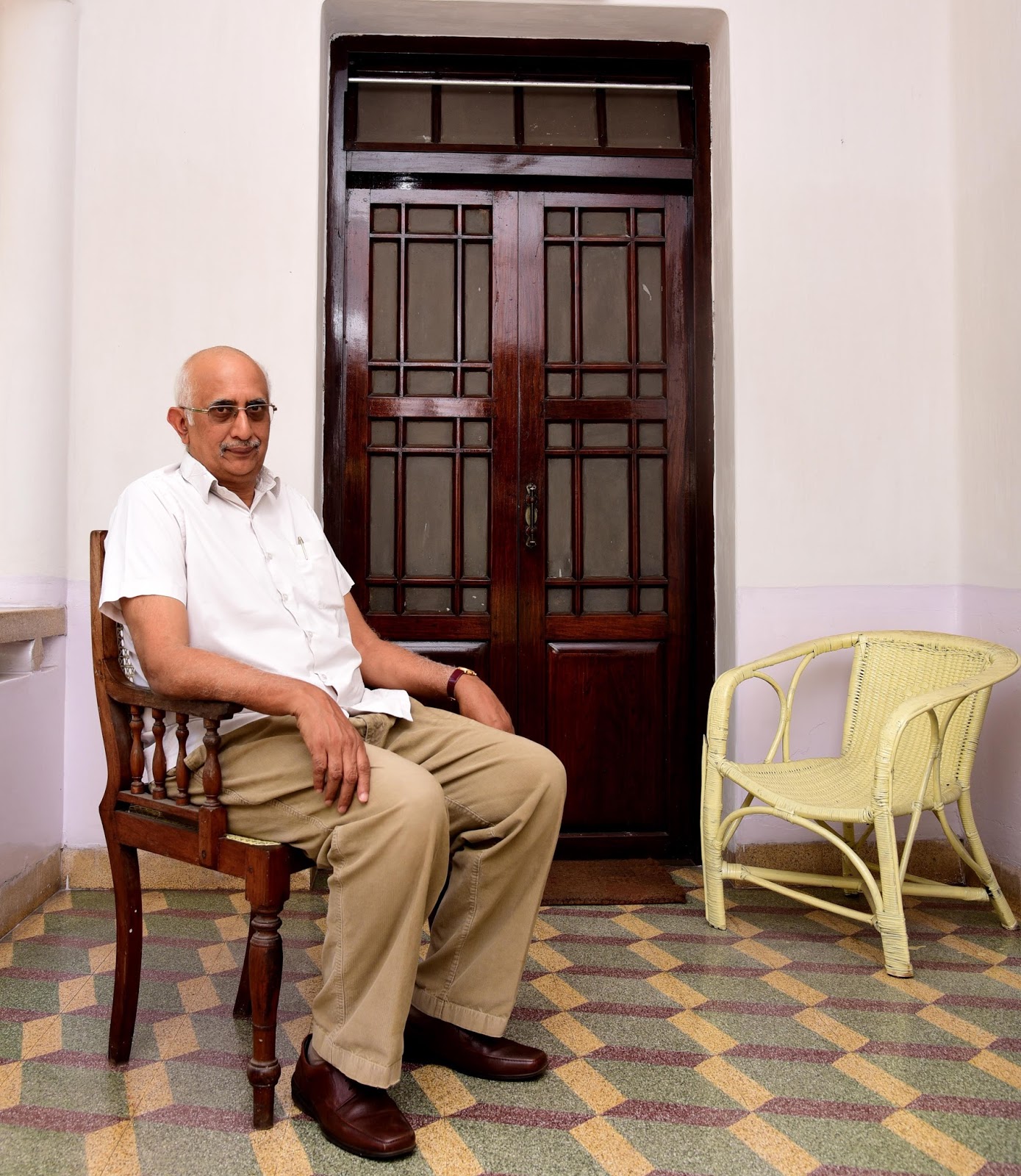

The Mumbai-based urological cancer surgeon V. Srinivas has written a book about his experiences, along with his wife, of building a house at Kotagiri in the Nilgiris
By Shevlin Sebastian
At Kotagiri, in Tamil Nadu, the Mumbai-based urological cancer surgeon V. Srinivas and his wife Vidya were building a homestay. Friends in Mumbai offered numerous suggestions. One friend Reena (name changed) suggested that they should use Burma teakwood for all the floors. Srinivas blanched when he heard that. “It will cost too much,” he said. But Reena said, “Why don't you find some old ship and get the wood from the deck? This is usually made of seasoned old Burma teak wood.”
As luck would have it, a new patient of Srinivas was from Bhavnagar in Gujarat and his business was ship-breaking. After the man recovered, the couple went with him to Alang, near Bhavnagar, which is the centre of ship-breaking in India.
There, the '1952 Manila Princess', which had been a floating casino in the Philippines was being dismantled. So, Srinivas bought a lot of teakwood at a very competitive price. Then, a driver agreed to take the entire material to Kotagiri, but he had never been beyond Hyderabad. “We were told that there was no insurance coverage for this type of transport and all we could do was to leave it to God,” says Srinivas.
In the end, the belief in God worked because on the fourth day, the wood did reach Kotagiri safely.
This anecdote was recounted in the just-released 'A Tale Of Two Homes' written by Srinivas and brought out by White Falcon Publishing. It tells the story of the trials and tribulations that the couple faced while trying to build a homestay on ten acres of land.
Initially buying the land was the problem. “One piece of land was owned by 18 cousins and relatives,” says Srinivas. “We had to get a lawyer to check all the papers to make sure everything was okay. Then we had to wait before we could acquire the next six acres.”
Asked why the couple wanted ten acres Srinivas says, tongue-in-cheek, “We wanted to avoid neighbours. In over-crowded Mumbai, we have too many neighbours all around us.”
Meanwhile, as construction went on, the couple got an insight into the mindset of the labourers. “The labourers need supervision,” says Srinivas. “They were working on five to six buildings at the same time, so they would disappear for a while. They also like their liquor. After working for six days, as soon as they got their wages they would go to the liquor shop. Thereafter, they would be absent for two days.”
But despite all that, the couple grew to love the local people. “The people are simple and honest,” says Srinivas. “After we bought the land, we were going to fence it, but then the local people told us, 'Nobody puts a fence'. In most places, the only thing marking a boundary were some white stones. So, we did the same. And, to our surprise, there were no squatters at all, unlike what would have happened in Mumbai.”
Srinivas and his wife faced other difficulties. Their architect was very strong on vaastu. But when the plans were drawn the couple felt that the bedrooms were very small. “We felt upset about it,” says Srinivas. “But then an architect friend of mine came from Mumbai and noticed that there were good verandahs. He told me that in the hills, the beauty is outside the house. So it would be better to have small bedrooms since guests will spend more time outside. Which turned out to be true.”
And throughout his book, Srinivas details numerous episodes in their nine-year odyssey to build their home. But eventually, it was all's well that end's well.
They called their homestay 'Raven's Nest', after their granddaughter and it is doing well. There are six rooms, out of which three are for the guests while the other three are for Srinivas and his family. “Visitors have come from Bangalore, Chennai, Delhi and Mumbai,” says Srinivas.
As for the doctor, every month, he, along with his wife, fly down from Mumbai and spend a week there. “We felt that if we have built a home, we should stay there often, especially in such a salubrious atmosphere as the Nilgiris,” says Srinivas. “It is a place that brings back memories.”
That's because Srinivas did his schooling in Lawrence School, Lovedale. So he has a soft spot for the Nilgiris.
Meanwhile, the book, which is an engaging read, is getting good reviews on Amazon. Says Dr Namrata, “I really enjoyed reading the book. It's not a book only on house building but about relationships. The humour is the USP. I can guarantee the book will sell and will have readers across all age groups.”
Adds Dr Thilak, ophthalmologist, “It is extremely interesting and well written. Got hooked on it.”
(The New Indian Express, Kochi and Thiruvananthapuram)
March 9, 2018
The Master Composer Is Finally Rewarded .... After 50 Years!

By Shevlin Sebastian
It was like any any other day (Thursday March 8) for veteran music composer MK Arjunan. Till he sat on his sofa in the living room at his home in Kochi and switched on the TV. Suddenly, it was announced that he had won the Kerala State Award for Best Composer for the songs he composed for the film, 'Bhayanakam'.
Soon, Arjunan's house became a swirl of activity. Neighbours, friends and relatives dropped in. Television as well as newspaper journalists arrived in a rush. Arjunan received several congratulatory phone calls as well as messages.
But what was lost in this buzz was that it took 50 years for Arjunan to win his first-ever State Award. During that time he had composed the music for over 500 songs in more than 200 films. When this was pointed out to him, Arjunan burst out laughing. Then he regained his composure and said, “I have never thought about awards. For me, it has always been about the music.”
And it is also a fact, that many of his songs, like 'Ninmaniyarayile' and 'Dukhame ninakku', remain evergreen in the minds of listeners despite the passage of time.
As for 'Bhayanakam', the story was based partly on the novel 'Khayar' written by the late great writer Thakazhi Sivasankarapillai. “Since the story was set in World War 11, the songs had to remind viewers about that period,” says Arjunan. “[Director] Jayaraj had given me a clear idea on what he wanted, but it was not very tough for me. I used the harmonium, the tabla and the violin, and other traditional instruments.”
Asked about the music of today, Arjunan says, “The audience likes fast-paced songs. But the music is drowning the words, so we don't know what the song is all about.”
Another problem is that not much effort is expended to make a song. “In earlier days, we would spend as much as five hours to record the song, so that we could get it perfect,” he says. “Today, a singer only needs 15 minutes. The track is already there on the laptop. So, the beauty of songs is going down. I feel sad about this.”
(The New Indian Express, Kerala editions)
March 6, 2018
Taking Candid Shots Of Amitabh Bachchan


COLUMN: LOCATION DIARY
Photographer Rajesh talks about his experiences in the films, 'Kandahar', 'Sakthi', and 'Ratchagan'
By Shevlin Sebastian
On the sets of 'Kandahar' (2010), at Ooty, director Major Ravi noticed that Amitabh Bachchan was taking several photos of butterflies on his personal camera. So, he drew stills photographer Rajesh aside and said, “Take candid photos of Amitabh as he goes about taking these pictures.”
So Rajesh hid from view and took shots of Amitabh taking photos during breaks in the shoot.
“At the end of the day, I had about 50 photos,” says Rajesh. “When I showed them on the laptop to Major Ravi, he said, 'Super'.”
Then the duo went to Amitabh's trailer and showed him the photos. “Amitabh Sir got very excited and hugged me,” says Rajesh. “Then he told me, 'I did not know that I had so many expressions on my face'.”
Amitabh requested for the photos. Rajesh saved it on a USB drive and gave it to the superstar. “Then he told me that since he would be there for the next ten days, I should take more shots,” says Rajesh. So, he proceeded to do so on his Canon Mark 11. And sure enough, at the end of Amitabh's shooting stint, Rajesh once again presented another USB.
“Amitabh was very happy,” he says. “I was so grateful I could interact with such a big star.”
But not all interactions on the set are so pleasant. In KT Kunjumon's Tamil film, 'Sakthi' (1997) the shooting was taking place at Pollachi. In it, a few wild elephants were making a charge. To shoot the scene, the cinematographer Tirru, along with his assistant, was placed on a crane 45 feet high.
Beside him was Rajesh who wanted to take aerial shots. But things went wrong soon after. “Somehow, the mahouts lost control of the elephants and it came charging towards the crane,” says Rajesh. “We knew that if they hit the crane, we would fall to our deaths.”
But somehow, the mahouts and crew members retained their presence of mind. They burst firecrackers and distracted the elephants. The mammals stopped in their tracks and turned around. Thereafter, the mahouts were able to bring the elephants under control. “Watching from the top, I felt grateful to God for saving our lives,” says Rajesh.
There was another close shave during the shoot of Kunjumon's Tamil film, 'Ratchagan' (1997). The climax took place on the Chengalpet highway, 70 kms from Chennai. Nagarjuna was the hero, while this was Bollywood star Sushmita Sen's first Tamil film.
In the climax, Nagarjuna, on a bike, was chasing a truck which was driven by Sushmita. Up above, in a helicopter, a villain takes out a machine gun and shoots at Nagarjuna. There is another helicopter above the first. “Inside it, there was cameraman Ajayan Vincent, an actor, and myself,” says Rajesh.
Both the helicopters had to keep a careful distance between each other, but somehow, the calculation went wrong, and they came much too close. “Realising the error, our pilot suddenly zoomed up and managed to avoid a collision at the last minute,” says Rajesh. “It seemed as if I got my life back.”
And this life in Mollywood began in the most casual way. In 1997, the Thrissur-born Rajesh had gone to Chennai to work in a friend's photo studio at KK Nagar. Just next to the studio there was a vegetarian restaurant. It was there that he met legendary director Bharathan's assistant by the name of Menon. When Rajesh expressed his desire to join films, Menon invited him to meet Bharathan, who lived nearby.
So, he went there and was asked to take photos of Shamili the baby girl who played the five-year-old heroine in the film 'Maloothi', which Bharathan was directing. Rajesh did so and when Bharathan saw the pics, he told Menon, “These shots are very good.” Then Menon said, “Rajesh has a desire to enter films. If he can become an assistant to somebody that would be great.”
Immediately, Bharathan picked up the phone and spoke to the leading stills photographer in Chennai, Soni Sreekumar, who had worked in more than 500 films. Bharathan said, “Soni, there is a young man from Kerala. He is a good photographer. Can you take him as your assistant?”
So, Soni appointed Rajesh as an assistant. Within a year, Rajesh became independent. Today he has worked in 75 films including 30 by noted director Joshy. “I will never forget the kindness shown by Bharathan Sir as well as the opportunities given by Joshy Sir,” he says.
(The New Indian Express, Kochi, Thiruvananthapuram and Kozhikode)
March 4, 2018
The Menace Of Plastic

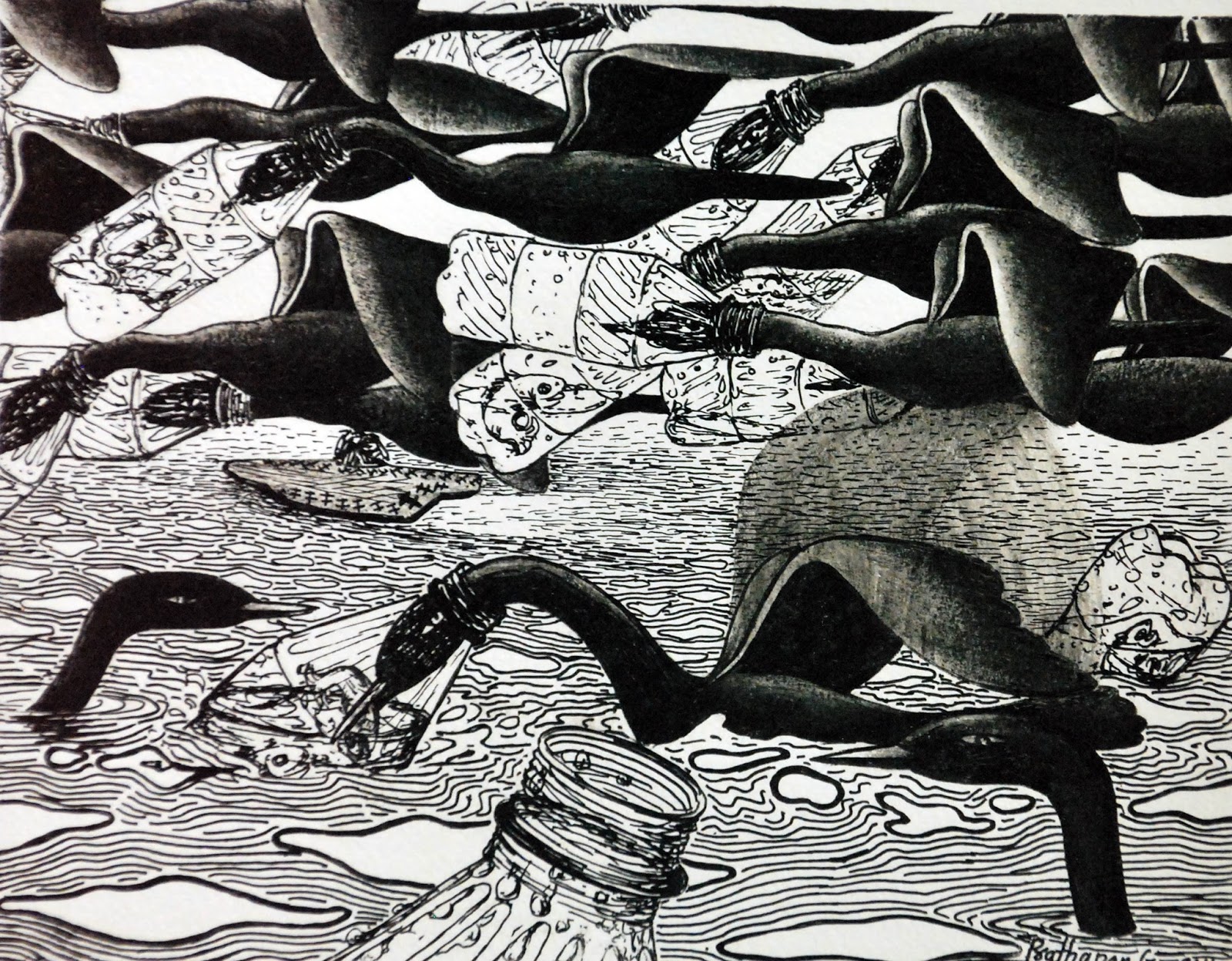
Artist G. Prathapan's art works have shown the damage being done to the environment through the excessive use of plastic. His works were displayed at the Kaarisilta Biennale in Finland, the only Indian to be selected
Photos by K. Shijith
By Shevlin Sebastian
One evening, artist G. Prathapan went for a walk in the town of Mattancherry. After a while, he reached a river. He stood on the side and got into a ruminative mood. Suddenly, he saw a tiny movement on one side. The sleeve of a shirt which was floating in the water was moving. He edged closer to the water.
Prathapan realised something was struggling to break free inside the shirt. So, he took a long stick and began to pull at the shirt. It took a while before the shirt could be removed. And then he noticed the tortoise swimming purposefully away. “I felt so glad that I could free it,” says Prathapan, at the David Hall Art Gallery in Fort Kochi. “And it opened my eyes.”
When Prathapan looked around he was amazed to see a large number of plastic bottles and packets floating around. When he peered closer at the edge of the shore, he saw tiny fish floating inside condoms filled with water.
Prathapan felt disturbed. “Man was destroying the environment,” he says. Soon, he began doing drawings by pen. In one he has shown a seagull which has pushed his beak inside a plastic bottle to eat the fish but his neck gets stuck in the rim. In another, he has shown small fish swimming inside a condom. A tortoise’s head is also stuck inside a bottle.
Prathapan has also drawn an aquarium which contained fish and placed it by the side of the ocean. He then drew a blanket on top of the aquarium. “The fish are asking, ‘Where is the sea?’ They are trapped inside an artificial container made by man,” he says. “Are we doing right?”
When the Kaarisilta Biennale in Finland asked for entries, Prathapan sent these images. It was liked and he was selected. He was one among 197 artists who showcased their works, but the only one from India. Says Johanna Immeli, the curator of the Biennale, “The jury was very impressed by Prathapan's drawings. The subject matter of plastic waste is very important. It is a problem all over the world. This appears in the news often. Many visitors liked Prathapan's works. They stood and observed the drawings for a long time. It made them think, they told me later.”
For Prathapan it has been an exciting moment. “Usually, participation in most Biennales is by invitation only,” he says. “So I was glad that I got a break.”This is his first international exposure. Prathapan is a full-time artist, who has participated in state and national solo and group exhibitions over the years. He has won a few state awards. But even though he has sold a few works, it has been difficult to make ends meet. “But art is my passion,” says the 41-year-old artist.
Meanwhile, Prathapan continued to do research on the Internet on plastic pollution. “I was shocked to realise that the plastic menace is a worldwide problem,” he says. “When you throw plastic into the rivers, it solidifies and forms a mountain under the sea. The amount of oxygen underwater becomes less. Many small fish are dying because of this.”
He made more discoveries. “If you throw plastic anywhere it ends up in the sea somehow,” he says. “So, please do not throw rubbish on the road or in your backyard.”
Prathapan is planning to focus on this subject for a while now. “We need to highlight the problem so that people become aware of how our planet is being destroyed,” he says.
#GPrathapan #KaarisiltaBiennale #Finland #Mttancherry
February 28, 2018
Much Ado About Shakespeare



Prof C. Marydass has enjoyed a lifelong love for the master’s works. His work, ‘Shakespearean Aesthetics for University Wits’ has just been selected as a reference book at MG University.
By Shevlin Sebastian
Photos: Prof C. Marydass by Albin Mathew; William Shakespeare and the speech
Teacher Mary Camoens stood in front of the blackboard and said:
“The quality of mercy is not strained,It droppeth as the gentle rain from heavenUpon the place beneath: it is twice blest;It blesseth him that gives and him that takes.”
Most of the Class 10 students at the Infant Jesus Anglo Indian School at Tangasseri looked on attentively as Mary carried on reciting the speech by Portia from William Shakespeare’s play, ‘The Merchant Of Venice’.
But there was one student who was awestruck. His name was C Marydass. Little did he know then that Mary would engender in him a lifelong love and admiration for Shakespeare.
After getting a doctorate in English literature, Prof Marydass spent decades teaching Shakespeare to graduate and post-graduate students of Sacred Heart College, Thevara. Following his retirement in 2001, he taught at the Sree Sankaracharya University at Kalady and is now an Academic Counsellor with The Indira Gandhi National Open University (Kaloor Regional Centre).
And he had a bit of good news recently. His work, ‘Shakespearean Aesthetics for University Wits’ has been selected as a reference book for English literature students at MG University. He is hoping his other books – ‘A Shakespearean Vision of Human Regeneration’, ‘Shakespeare's Regeneration plays: A Metacritical Perspective’ and ‘What Yokes Shakespeare and Tagore?’ – will be selected.
Asked why Shakespeare is being read after 400 years, Marydass says, “His work contains universal themes. Human relationships are the same all over the world. Shakespeare holds a mirror up to human nature and society.”
The English dramatist concentrated on some major themes. “In the comedies, like ‘All’s Well That Ends Well’, and ‘As You Like it’, he focused on the subject of love at first sight. It culminates in family happiness and social union,” says Marydass. “In the tragedies (‘Julius Caesar’, ‘Macbeth’) we have the great paradox of human nature: the fullness of life in contrast to its brevity, culminating in death. As a dramatist, he was able to sketch people from all walks of life. So his characters are very realistic.”
Asked about the play he likes the most, Marydass mentions ‘The Tempest’. “It is Shakespeare's most humanistic play,” he says. “And it reflects the father of humanistic philosophy René Descartes who had stated that man is a composite of body and mind, unified in a transcendental way.”
While Shakespeare dealt in lofty principles, he was an ordinary man in every sense of the word. “In fact, he was a ladies' man,” says Marydass. “He loved many women and took delight in romance. But he did feel he was a morally weak man. However, when he married Anne Hathaway, who was eight years senior to him, Shakespeare stopped his womanising. He realised that family life is sacred. In his romances (‘The Winter’s Tale’/’Cymbeline’), he upheld the sanctity of friendship and marriage.”
As he went about writing his plays, Shakespeare also faced a lot of opposition. “He was always the centre of rivalry and jealousy,” says Marydass. “Scholars who were associated with Oxford and Cambridge Universities felt that they were the intellectual leaders of the time. Shakespeare had only a school education. They considered him an upstart, who borrowed his ideas.”
In fact, for his historical and romantic plays, Shakespeare had culled material from ‘Holinshed's Chronicles’, by writer Raphael Holinshed, which explores British history at length. As for his tragedies, he depended on Thomas North’s 'The Lives Of The Romans And The Grecians'.
Meanwhile, Marydass is frank enough to admit that students in Kerala find Shakespeare outdated. “The main reason is the language,” says Marydass. “Shakespeare wrote Latinised English. To understand Shakespeare you need to know a bit of Latin.”
These days, there are other options in the syllabus, too. “They can study subjects like feminism, Canadian, American and Australian literature, besides Indian writing in English,” says Marydass. “They are not interested in the Renaissance period of England, in which Shakespeare thrived. I believe the only way Shakespeare will remain relevant in Kerala is on the stage, where his plays can be enacted rather than through the printed word.”
(The New Indian Express, Kochi and Thiruvananthapuram)
February 26, 2018
Timeless And ageless

At 81, Lalitha Das, the founder of the Bangalore Club for Kathakali and the Arts, is busy promoting the art form
Photo by Vinod Kumar T
By Shevlin Sebastian
On most mornings, these days, Lalitha Das is on the phone. Either she is calling up Kathakali dancers or speaking to hotel employees or tour operators or sponsors. That is because she is preparing for an upcoming Kathakali production. “All the artistes will be coming from Kerala,” says Lalitha, the founder of the Bangalore Club for Kathakali and the Arts. “There is a lot of hard work behind the scenes. But I feel confident after our last programme went off so well.”
This took place at the Chowdiah Memorial Hall on a balmy October evening where the Kathakali classical opera, ‘Karna: The Invincible’ was enacted. In the first scene, the dancers stood one behind the other and raised their hands to the heavens. Right behind, on a screen, there was an image of the orb of the sun rising between two mountain peaks.
“In this scene, Kunthi asks for a boon and is granted a son by the Sun God,” says the director and scriptwriter Meena Das Narayan. In the next scene, Karna the baby is adopted by a charioteer and wife and grows up as a commoner. Eventually, he becomes an ace archer who challenges the Pandavas and Kauravas in a display of strength.
Watching from a corner with a smile on her face is Meena’s mother Lalitha. The sequences of the sumptuous cultural extravaganza are dramatic, with dancers wielding maces and jumping across the stage accompanied by pulsating music. Karna is played by Kathak dancer Tushar Bhatt, while his wife Pooja has done the choreography. A total of 55 artistes are taking part.
The idea for a cultural club came up over a dinner conversation that Lalitha had with Meena and her husband, Narayan, after her husband KG Das passed away in 1999. “It became difficult for me to travel to Kerala on my own to watch Kathakali performances. I felt that through the club, we could popularise as well as watch Kathakali in Bengaluru,” says Lalitha.
Today, the club is thriving. But Lalitha has a clear agenda. “I want to promote Kathakali among other communities, like the Kannadigas, Tamilians and the Telugu people,” she says. “Hence, the mudras are explained in detail so that the audience can follow the performance and understand it.”
Apart from Kathakali, the club promotes other classical dance forms like the Kuchipudi, Mohiniyattam and Bharatanatyam.
But the emphasis is on Kathakali. “It is an enduring love,” says Lalitha, who learnt the dance form as a child while growing up in Thiruvananthapuram. Thereafter, at age 17, she got married and left Kerala. Since her husband, a chief engineer, had a transferable job, she moved from place to place: Burla (Odisha), Delhi, Pune, Baghdad and Tripoli. Sometimes, she would organise Kathakali performances whenever the couple were in India.
Asked the charms of Kathakali, Lalitha says, “Kathakali is a combination of excellent music, percussion, and action. There is no other art form that combines all three so well. And the artistes are so dedicated and look beautiful.”
Not surprisingly, her idol is the legendary Kalamandalam Gopi. “When he is in full costume, like Karna, he takes us back to that era,” says Lalitha. “He has the magic to immerse himself in the character. And his eyes are so expressive.” Incidentally, Meena made a documentary on Gopi, called, 'The Making Of A Maestro', which won the Kerala State Award for best documentary in 2010.
Meanwhile, when asked about her future plans, Lalitha says, “I plan to conduct at least five to six performances every year. At 81, I am having the time of my life.”
(Sunday Magazine, The New Indian Express, South India and Delhi)


