
Kelly Flanagan's Blog, page 7
July 11, 2019
There’s No Such Thing As Arriving

It was the best vacation I’d ever experienced, but I couldn’t figure out why until I looked down at my feet.
For the twentieth summer in a row, I vacated to Rehoboth Beach, Delaware. Twenty years ago, it was just my future wife and I, enjoying the beach town in which her family has had a homestead for generations. In the years since then, we got married, had kids, and a new generation of family has fallen in love with the place. It’s always one of my favorite weeks of the year. But this year was my favorite favorite week.
And it made no sense.
Because, for the first time in half a decade, our good friends had been unable to go with us. When I woke the kids up early to watch the sun rise on the first day of summer, and we stood at the edge of our country and waited for it to appear, something felt missing. It was them.
Also, I would be returning from vacation to two busy days in my office and five days of travel for speaking and, usually, when I’m returning from vacation to lots of work, what is ahead taints what is right now. The anticipation should have killed some of the beach bliss, but it didn’t, and I couldn’t understand why. Then, one afternoon, while walking along the boardwalk, I took my eyes off the ocean and looked down at the boards.
They were different colors.
Some of the boards had the dull, gray look of aged and weathered wood, while every once in a while a board had the bright, yellowish gleam of new lumber. When a board gets rotted or warped or damaged, it is replaced with a new board. It struck me: this boardwalk, which looks so timeless and unchanging, is constantly in the process of falling apart and being put back together again. It is never finished. It never reaches its conclusion. It never “arrives.” And that’s why I was enjoying my vacation so much.
For the first time ever, I hadn’t treated it as an arrival.
In the past, I’ve circled our vacation on the calendar, as if my hard work all spring was going to conclude with my feet in the sand. I’ve had the tendency to put too much pressure on that week of vacation, as if it could deliver me into a final state of happiness or satisfaction. Usually, it has made me joyful, though not for good, merely for a moment. And I’ve ruined the final day of the vacation more years than I’d like to admit by dreading the ending. It was my destination, and I didn’t want a new destination. This year, in contrast, I went into our vacation with no expectations for deliverance. Vacation wasn’t my destination.
It was one stop along the way.
I think we’re all hoping to arrive at something, and most of us spend our lives working for that thing or waiting on that thing. In doing so, we run the risk of missing the life that is always happening but never arriving. I spend most of my life hoping to arrive at comfort. My wife spends most of her life hoping to arrive at fun.
This is a bit like mixing oil and water and I wouldn’t necessarily recommend it.
Some of us hope to arrive at perfection. Or peace. Or togetherness or enlightenment or security or justice. And some of us simply hope to arrive at…arrival. Any finished state will do. Perhaps that’s why some of us like to think of heaven as a big conclusion in the sky, while others of us prefer to think that death is simply a conclusion in the ground, with nothing happening afterward.
As I looked down at the differently colored boards, I realized I went into vacation not chasing joy or pretending the week would last forever; I went into vacation with the meager goal of paying attention to the ordinary moments that would continuously arrive and depart throughout the week. For instance, the crack in the clouds that allowed us to see the sunrise. My wife lost in a book on a beach blanket. Caitlin squealing with equal parts delight and terror on the free fall ride at the boardwalk carnival. Quinn making four impossible shots in a row to win a basketball at that same carnival. Aidan for the first time driving the family minivan on the last leg of the road trip. His friend in the backseat, terrified.
None of it adding up to happiness—there’s no math for that—but all of it adding up to presence.
As I looked up from the boards and continued walking along them, I was suddenly grateful for a life that has not and will not arrive at any particular destination. I was thankful for being a human being, constantly falling apart and being put back together, always becoming, never arriving. Not so long ago, that thought would have depressed me. Now, it frees me.
In fact, it feels, somehow, heavenly.
You can leave a comment by clicking here.


May 23, 2019
A Journal of Death and Resurrection
January 6, 2019
I share the last post of a blogging era in which I published on average once a week for seven years. I tell you I’m scaling back because it is time to write a little bit less about my family and to live a little more within it. This is me hanging my ambition—which is to say my ego, in its most benign form—up on a cross.
While we are living, we have a thousand chances to die.
February 8
A Friday evening before Valentine’s Day, and another Daddy-Daughter Dance. A couple of years ago, I wrote a blog post about the whole experience. In other words, while I was dancing with my daughter, my mind was dancing with ideas. This year, we don’t dance very much because we spend most of the evening bouncing balloons around the gym. This year, my thoughts don’t bounce around with the balloons. I am truly with my daughter, rather than my ideas.
Every death already has, within it, the seed of a resurrection.
February 11
A speaking event is cancelled because of low registration, and I discover my ambition, my ego, has not died completely upon that January cross, because something truly dead cannot feel newly wounded.
February 13
A second speaking event is cancelled due to low registration.
One thousand chances to die.
February 16
We find out my eldest son Aidan has been cast as one of the leads in his first high school spring musical, as a freshman. In the space of one week, two small stages had been taken from me. Now, a big stage has been given to him.
The blessed ebb and flow of death and resurrection.
February 18
Aidan texts me: the musical has been scheduled for April 26-28, the weekend I’m hosting a Loveable Retreat in Utah. My heart doesn’t sink, it implodes. I consider missing his high school debut. Then I try to figure out how to bend time and space so I can do both. For a while, I refuse to admit to myself that I’m human and can’t be in two places at once. My ambition has climbed off its cross and is raging against the dying of its dangerous light. Finally, over four long days, I hang it back up there again. I postpone the weekend until October.
Our physical death is rarely up to us; almost every other death is a choice.
March 6
One morning, while contemplating my suddenly empty calendar, resurrection happens. It’s been exactly two months since I announced I want to be right here with my family, a witness to this life we are traveling through together. And suddenly it dawns upon me: through no doing of my own, I’ve gotten exactly what I hoped for. Sometimes resurrection isn’t a new way of living.
Sometimes resurrection is simply a new way of seeing.
April 8
I pull off the bike path because it’s getting hard to see through the tears.
I’m on a writing retreat and taking an afternoon for exercise, listening to the Hamilton soundtrack for the first time. In other words, I’m listening to a story about a man’s ambition, which culminated in the tragic death of his beloved son, the unimaginable which finally brought him to his knees. Not totally comprehending the anguish I’m feeling as I listen, I pull over and let myself feel it, until I understand.
It’s my ambition dying a little more.
It’s me wondering, what is it doing to take to let go of all your grand plans and great aspirations? What is it going to take for you to finally and fully embrace these ordinary moments with your children and your wife as the whole point of the whole thing? Is it going to take something unimaginable for you too? And wouldn’t it be lovely if you could surrender to the grace of it all without first being brought to your knees by loss and reckoning?
One thousand chances to die.
But sometimes, one death more painful than the others.
April 26
Springtime is in full bloom on Aidan’s opening night.
We are front and center for it. He is not in the first scene, or the second. Then, suddenly, he is there. His voice is strong and rich and it reaches the back rows far behind us and he hits a note with so much power his mother gasps and grabs my leg. We were supposed to be in Utah. I actually considered missing this. Had I done so, I’d never have known what I was missing. Now I know, and the death from two months earlier is fully overcome. The stone is rolled away. No tomb can contain it.
I got to be Dad. I got to be around.
Resurrection.
April 27
The day dawns cold and gray. On the doorstep of May, temperatures plunge below freezing. A frigid drizzle morphs into snow. Soccer games are cancelled. Springtime is pushed back into a tomb of its own. We hunker down. So does everyone else. Attendance is down for the second night of Aidan’s play because the roads are bad and it’s too late in the season to think about salting them. Death and resurrection and death again.
One thousand times.
May 3
The cold mist of springtime has persisted through another week of youth soccer. More practices cancelled. More games postponed. Finally, on a damp, gray Friday evening, the games go on as scheduled. The field is mostly mud and slop, but the kids play their hearts out and slowly, oh so slowly, the creation around us begins to honor their effort.
The rain slowly recedes.
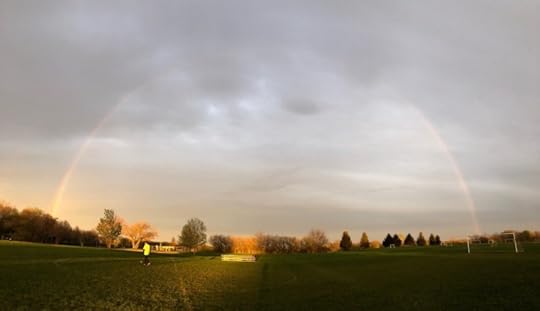
On the western horizon, the setting sun drops below the cloud line and light blankets the fields for the first time in days. It illuminates budding trees on the eastern horizon, and it mingles with the moisture in the air. A rainbow appears, arching its promise above the soccer fields as Quinn, covered in mud and sweat, makes his way to the parking lot. Weeks of darkness followed by a splintered light.
Resurrection.
May 4
The next day dawns warm and clear for the fourth annual running of a family 5k. It will benefit struggling families and kids with disabilities. Those who can run, run. Those who can only cheer, cheer.
Snow comes and goes. Warmth comes and goes. Ego comes and goes. Ambition comes and goes. Happiness comes and goes. Health comes and goes. Everything comes and goes and comes again.
Death and resurrection, one thousand times.
It’s the way the whole thing works and surrendering to the truth of this is the only kind of hope that does not come and go. With this kind of faith, we can begin to find the promise of resurrection in every death, and the promise is this:
One thousand chances to die,
but always, always,
one-thousand-and-one chances for resurrection.
Grace unimaginable.
You can leave a comment by clicking here.
January 6, 2019
The End of a Seven-Year-Long Chapter (The Beginning of a New One)
Something happened to me last summer, and it is still happening.
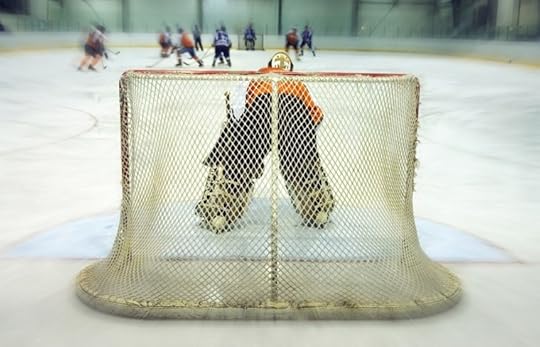
In June, a friend sent me an article about hockey written by two financial gurus. They explained that there is a traditional strategy in hockey called “pulling the goalie.” According to tradition, if your team is down by one goal with one minute left in the game, the coach will “pull the goalie,” sending the goalie on offense in the hope of scoring a tying goal, while risking the chance of being scored on with an open net.
These financial gurus decided to run a statistical analysis of this tradition.
Based upon existing data, they concluded that, on average, it actually takes somewhere between five or six minutes of game time for a team to score a goal with their goalie on offense. The tipping point, where the reward of pulling the goalie is offset by the risk of being scored upon with an open net, was around five minutes and forty seconds remaining in the game.
In other words, every hockey coach pulls the goalie way too late.
The bigger problem, though, is that even in the face of this empirical data, no coach will ever pull their goalie with almost six minutes to go in a game and down by one. Because if their team was scored upon at that point, the fans would be calling for their firing and the front office would probably do it. It is not socially acceptable to pull the goalie that early in the game, so no one does it.
The question, my friend asked me, was, “Where do you need to pull the goalie in your life right now—even if it feels risky, even if it upsets people—before it is too late?”
Today, I ask you the same question: where do you need to pull the goalie right now, before it is too late? Is it getting an evaluation for your child who is struggling in school? Is it getting counseling for your child who is struggling inside? Is it getting your own help before the shame becomes all-consuming? Is it asking your spouse to go to marital therapy? Is it being vulnerable before the intimacy fades for good? Is it starting the book you’ve always wanted to write, or the business you’ve always wanted to run? Is it remembering how to play, before those distant memories of childlikeness fade even further?
When my friend asked me that question, the first thing I thought of was my writing career. I asked myself, “Am I playing it too safe?” “Am I not giving enough time and energy to it?” “Should I scrap my therapy business and go all-in on my writing life?” “Do I need to be doing more to promote myself?” “What would pulling the goalie look like?”
Then, I went for a bike ride.
These questions were racing around in my head as I raced along a bike path, through a forest, several miles from my home. It was early morning and, as often happens at that time of day, I surprised some deer who were grazing along the path. The doe hopped immediately into the deep ravine next to the path, but one of the fawns was startled and began to run ahead of me, between the path and the ravine. Every few seconds there was a hitch in its stride as it looked for a convenient place to dive into the ravine. But it didn’t dive. It just kept on running, and I slowly gained on it.
The fawn was going to wait too long to pull the goalie.
It occurred to me this scene was a metaphor for my dilemma. The ravine represented my writing career and the fawn was me, racing along but never getting up the courage to dive in completely. I began to chide myself for not going all out, leaving it all on the ice, taking a risk while I still had time to take a risk.
Then, suddenly, unexpectedly, grace happened.
And this is what the voice of grace said within me, “Kelly, you have been going all out with your writing, leaving everything on the ice, and taking every risk you can, for almost seven years. The ravine is not your writing career. This bike path is your writing career. You have been racing along it for years. I’m proud of you for being brave and giving everything you have to the passion I’ve given you.”
It was getting hard to see, because there were tears in my eyes.
Then the voice of grace within me said something even more unexpected, as it so often does. It said this: “The ravine is not your writing career. The ravine is your family. Your children. Aidan will be graduating high school in less than four years. By then, Quinn will be on the verge of high school and Caitlin will be on the verge of womanhood. If you wait any longer to dive completely back into their lives, you will be waiting too long. Pull the goalie.”
For the last six months, I’ve been sorting through the debris of that bombshell.
And this is what I’ve concluded:
Seven years ago today, I posted my first blog post. It was a Friday night in January of 2012. It was entitled “A Provocative Question and a Clumsy Owl.” That was 362 blog posts ago. That was seven years of me ago. My kids were eight, four, and two. Back then, they were never going to grow up. But they did. They grew up on my blog and they grew up in my book, and they grew up in my home. And the growing up isn’t slowing down; it’s accelerating. It’s time for me to slow down in some ways, so that I can keep up in others.
What I’m trying to say is, it’s time for me to stop blogging regularly.
I’m aware that it’s hard to pull the goalie right now because a lot of people in the stands are going to be disappointed, maybe even upset. Some of you may fire me, unsubscribe from my mailing list, be done with me altogether. I have to risk that. There’s too much to lose if I don’t pull the goalie and go on offense in my family.
Having said that, I hope you’ll hang around here, because while this chapter is ending, an exciting new one is beginning, and it has at least four parts to it.
My love for writing is seven years bigger than it was in 2012, and I will continue to write blog posts, just not regularly. Maybe I’ll write one the week the kids are at camp. Or the weeks they drive me so crazy I can’t stand to be in the same room with them. I might even start publishing them on Friday evenings again. But they’ll be random Friday evenings. Stick around, and you’ll find there are plenty of words still to come.
I’m thrilled to announce that my next book is under contract! It is a book about companionship, a book for everyone about what it takes to grow old together. I’m going to be working hard behind the scenes to make every page of it the kind of experience you’ve come to expect from every blog post. And you’ll hear about it first if you’re receiving my emails.
I want to do more than just write to you; I want to come meet with you. So I’m going to be dedicating more of my time to crafting the kinds of gatherings that will deepen your sense of worthiness, belonging, and purpose. Specifically, at the end of April, my wife and I will be hosting the 2019 Loveable Retreat Weekend at the 4U Ranch of Donna and Gary Urban, nestled in the mountains of Utah outside of Park City. I would love to meet you there. Click here to find out more and register for tickets.
Beginning soon, I will be hosting a weekly chat on Facebook Live that I will be calling The Human Hour . Each week, we will spend one hour talking about a topic of your choice, something essential to becoming fully and beautifully human, the sort of thing you don’t usually get to talk about in the public square but we all need to be talking about together. Stay tuned to my emails for details to come!
Friends, this is the conclusion to a seven-year-long chapter of my life.
Some of you have been around for most, or all, of those seven years. Your companionship along the way has been one of the greatest blessings of my life. I am looking forward to how our relationship will grow into something new in this next chapter. Whatever it ends up reading like, I know it will be full of worthiness, belonging, purpose, redemption and, most of all, grace.
Of course, some of you have just arrived here at this blog, as this chapter is coming to a close. For you, I have an idea. I have a friend who I met through the blog and then at a Loveable Weekend in Waco last spring. She told me she had started at the beginning of the blog and re-read every post. There are 362 posts. That means this blog could become your daily devotional for 2019. I hope you’ll consider it.
A provocative question and a clumsy owl are waiting for you.
You can leave a comment by clicking here.
January 31, 2017
Dear Little One, Release Your Shame (A Letter from a Father to a Child)
Dear Little One,
You have not been perfect. Far from it.
Do you remember the time you crept downstairs while everyone was sleeping and snuck the Kool-Aid from the refrigerator? Do you remember how, when you got caught, you lied and said you didn’t do it? You’ve punished yourself for that transgression for long enough. You are forgiven. Release your shame.
You are not the poor decisions you sometimes make.
Do you remember the time you accidentally brought home someone else’s homework, feared getting into trouble for making a mistake, and stuffed the homework beneath our house, where you thought no one would find it? You’ve lived in fear long enough. Release your shame.
You are not the things you do when you are most afraid.
Do you remember the bullies on the playground? You were trying to figure out how to become a man, and with every bruise, you doubted more and more if you could become one. The bruises on your skin became bruises on your heart. Your skin has healed—it is time now for your heart to heal, too. Release your shame.
You are not defined by the bruises you’ve picked up along the way.
Do you remember when you became the bully? Do you remember how you teased that poor, sad, lonely kid on the playground? You’ve wounded people. This is true. But the shame you’ve felt about it is a wound that festers, infecting you and everyone around you. Release your shame.
You are not the desperate things you’ve done in order to belong.
Do you remember all the subtle ways you’ve arrogantly looked down upon your peers? I get it. You think you’re fighting for a spot in a very tiny winner’s circle. You’ve fallen into the same trap as the rest of us. You are forgiven. Release your arrogance, which is really just another guise for your shame.
You are not the games you’ve played and won, or lost.
Little One, I pray you will release your shame, because the truth is, you are me. Though I’ve written many letters to my own children, this is a letter to you, the child I once was, the little one who still exists somewhere within me. In fact, I think all those letters to my kids have also been a letter to you—the scared, ashamed, confused, and desperate little kid I was and, in some ways, still am.
Little One, there can be no true healing for this adult version of me until there is, first of all, healing for you. So, please, listen closely. Please hear this grace I pass along to you. Please receive these truer words about you:
When you arrived in this world, pink and slippery and shrill, you were good enough.
Life and time and brokenness have caused you to doubt your worthiness—in other words, they’ve caused you shame. That’s okay. It happens to all of us. But if we are to truly embrace this one sacred life, something else must happen to each of us as well—we must embrace this truth:
Nothing has, will, or can alter our original worthiness.
Little One, you have not been perfect. Far from it. But if you can trust your worthiness in this way, you will be free to embrace your people and your purpose with a blessed abandon. So…
Do your best, make your mistakes, be honest about your messes, and move on.
Go ahead, live in fear—that’s part of being human—but confess your fears and invite other people into them. Life is less lonely that way.
Take your risks and take your lumps, but know that your hidden heart is without bruise or blemish; it has always been whole and holy—love from it, live from it.
People will not always be kind. This will hurt. Cry when it hurts. Then, as often as you can, summon your own kindness in return. When you do, be surprised by the joy you find within you.
And most of all, refuse to play the games people tend to play—know that the battle for your worthiness is already won.
Because you were, are, and always will be, loveable.
Together,
This Bigger Version of You
The post Dear Little One, Release Your Shame (A Letter from a Father to a Child) appeared first on Dr. Kelly Flanagan.
September 13, 2016
The Unfolding of Your Soul (A Post About Becoming Your Truest Self)
The myth: you can’t fold a piece of paper in half more than seven times.
In fifth grade, a friend challenged me to debunk it. We sat in the back of the classroom, wasting trees, trying to fold sheets of notebook paper at least eight times. We couldn’t do it.
Recently, though, Mythbusters accepted the challenge. They started with a sheet of paper the size of a football field. A team of people—along with a steamroller and a fork lift—folded the piece of paper eleven times. It turns out, if a piece of paper is big enough, you can fold it more than seven times. The real problem is, ironically, its growing thickness and weight.
Yet, there is one piece of paper that does not get thicker as it gets folded. There is a piece of paper that feels thinner and smaller and less consequential with each crease. Sometimes, it seems to disappear altogether.
This particular piece of paper is your soul, or, if you prefer, your true self.
Each soul enters the world inside several pounds of wrinkled skin, tiny bones, and wispy hair. However, though our body may initially be wrinkled, our soul is birthed as smooth and as unwrinkled as a crisp, new piece of paper.
Your soul is your truest you.
It harbors your eternal identity, your most beautiful self. It possesses all the love you have to give, and it has the courage to risk actually giving it. It has an energy that feels like passion. It has dreams preparing to be lived. Its temperament is redemptive. Its personality is inclusive. Carried within the tininess of a body, your soul is a living mystery as big as the universe.
Yet, souls get folded in upon themselves. Repeatedly.
I remember a summer afternoon before my third grade year. Our family was penniless at the time, living in a mobile home in the hills of Missouri, and just barely scraping by. A local theater was showing Benji for free, so my mom and I were planning to enjoy the free entertainment and the free air conditioning.
When we arrived, we parked beside the towering brick façade of the theater. I got out and my mom lingered in the car for a moment—just long enough for me to pick up a pebble and wonder how high up on the wall I could throw it.
My first throw was a decent one. The pebble tapped the wall innocently and fell harmlessly to the pavement. I picked it up again, knowing I could do better, a soul enjoying the abilities of the body it was in. I put a little something extra into my next throw, but rather than hitting higher on the wall, the pebble went harder at the wall. It rebounded off the brick, ricocheted over my head, and landed with a tinkle on the hood of the car behind us.
Just as the owner of that car walked around the corner of the theater.
She lit me up. She screamed. She berated. She said things about me that had never occurred to me before. She found the edges of my paper soul and folded it in half. Then she did it again. And again. As she did, I felt smaller. And smaller. And smaller.
Each of us can recall at least one moment in which our soul was folded in upon itself. Most of us can remember many.
Your true self is like a piece of paper that gets folded in half by life, again and again, until it becomes almost invisible. And yet. The good news is, the folding of your soul is not the end of the story.
A soul that can be folded in on itself can be unfolded, too.
Your true self folded in upon itself never ceases to be your truest you. And just as a piece of paper unfolded is becoming once again what it originally was, when your soul finally comes out of hiding and expands once again, it is becoming what it already is.
Your soul is bigger and more beautiful and more mysterious than you can possible imagine. It has been folded in upon itself by people and by experience and by life. But it need not remain that way.
You can become what you already are.
You can unfold.
You can smooth out.
Until one day, many years from now, you are once again a big, beautiful, ageless soul traveling inside of skin gone from one kind of wrinkled to another, bones gone from tiny to brittle, and hair gone from wispy to wispy-and-gray.
Let the unfolding begin.
The post The Unfolding of Your Soul (A Post About Becoming Your Truest Self) appeared first on Dr. Kelly Flanagan.
April 6, 2016
A Daddy’s Letter to His Little Girl (About How Fast She’s Walking Away)
Dear Little One,
We have this unspoken ritual, you and I.
When we pull up to the curb at school, and you disembark for another day in kindergarten, we both know I’m going to idle there and keep an eye on you, until you disappear around the corner of the building. Some days, you walk briskly, never looking back.
Other days, you meander, turning and waving goodbye repeatedly.
Then, when we pulled up to the curb one morning last week, I said, “Sweetie, we’re here really early today; you’ll have plenty of time to play,” and you said something that squeezed my heart a little too hard:
“We have plenty of time for you to watch me walk away, Daddy.”
Oh, Sweetie, if you only knew: that’s what I have done, am doing, and will be doing for your entire life…watching you walk away…
I remember a summer morning at a playground, when, for the first time, you ran toward the slide and didn’t look back. I remember wishing you needed me, and sadly-gladly knowing it was good you didn’t.
I remember that first kindergarten morning, you disappearing into the big, cavernous school, teeming with strange kids. I remember losing sight of you in the hallway of crowded children and knowing it was the first of many times I’d lose sight of you in this crowded world.
I remember the first time you asked me to drop you off at the curb. I remember the purpose with which you walked toward the school, pony-tail bobbing, backpack bouncing, not looking back. Five years old, walking boldly around the corner, as if twenty-five was just around that corner, too.
Oh, Sweetie, I know I’m watching you walk away.
I just don’t feel like there is plenty of time for it.
A month ago you needed me in the pool with you. Today, I watched you swim from end to end with no help at all. You are walking away, and you are swimming away, too.
Three months ago you needed me to read you bedtime books, but something clicked for you recently, and now you’re reading Pinkalicious as if you wrote it yourself. You’re walking away, and you’re reading away, too.
A year ago, you depended upon me for lunches. Now, after school, you climb up on the counter and make a sandwich out of a holy mess of PB&J. You’re walking away, and you’re eating away, too.
Before long, that first date will knock on our front door.
And I’ll watch you walk away.
I’ll watch you grow up and look more and more like your mother—you have her chin and lips and cheeks and that same lone-spiraling curl which kisses the corner of your right eye on its way down. But unlike your mother, who seems like she isn’t going anywhere, I’ll watch you walk away.
First, down graduation aisles.
Then, probably, a wedding aisle.
You’ll turn the corner into jobs and paychecks and, if your current passions are any prediction of your future decisions, you will turn the corner into motherhood and nurturing and caring for children of your own. I’ll watch you walk away into your own season of parenthood, into your own season of letting go.
Then, I pray, one day as you’re idling at the curb and your little one walks away—turning one more corner into his or her own life—you’ll think of me. I hope you’ll pick up your phone and give me a call. I hope you’ll walk back home, so we can talk.
About how there is not even close to plenty of time for watching the walking.
About how we get distracted and forget to watch.
About how we wish it away and choose not to watch.
About how we can’t create more time, but we can cultivate the quality of our time.
About how we can watch more carefully.
Dear Little One, I pray one day you’ll walk back home, so I can let you know: I watched you walk away as closely as I knew how.
Yours then, now, and forever,
Daddy
The post A Daddy’s Letter to His Little Girl (About How Fast She’s Walking Away) appeared first on Dr. Kelly Flanagan.
December 9, 2015
An Open Letter to Millenials About the Insanity of Marriage
Dear Millenials: Surveys show you’re losing interest in marriage and, from what I hear, the main reason is this: to you, marriage doesn’t make any sense. And I know why you feel that way—it’s because marriage doesn’t make any sense.
One life has enough sorrow of its own. Why would you volunteer to share the sorrow of another human being, too? Why would you double-up on pain and mess?
Marriage is a crapshoot. Half of them end in divorce. Do we really need to go out of our way to add things to our life that are going to end up dying anyway? Isn’t that what pets are for?
If marriage is to work, you have to give in. Daily. You have to submit, allow, release, and let go. At least half the time. For crying out loud, it’s hard enough to get a leg up in life, who has the time and energy to spend their days lifting someone else up, too?
Human beings seem to be wired for attraction to many different people. Our appetites are not easily whetted. Why would anyone spend a lifetime trying to rein in that craving?
And people get old. The person you’re attracted to now will eventually be replaced by a smaller, plumper, more shriveled version of themselves. What if, eventually, you’re not attracted to the person wearing the lines and signs of a lifetime together?
Not to mention the brokenness of people. No matter how amazing a person is, they’re still going to mess up. A lot. Forgiveness is a beautiful thing, but it’s also a ruthless thing. Every time you do it, you have to let something inside of you die, like your instinct for retribution or your self-righteousness. And after all, we’re here to live, not to die, right?
Except, Dear Millenials, we actually are here to die.
Not in fifteen years or fifty years. We’re here to die today. And tomorrow. And the day after that. We’re here to let the part of us we value most—the part we cherish without even knowing it—slowly wither away.
That part of us is our ego.
It’s the part of our psyche responsible for protecting us. And it’s merciless. It will do whatever it takes to keep us safe. It starts out by hiding us away behind a false self. But when it can’t hide us—and who can hide in a marriage?—it almost always graduates to subtle and not so subtle kinds of violence. When we don’t feel good enough, it raises us up by knocking other people down.
This year, my oldest son entered the ego minefield called middle school. In adolescence, egos are growing bigger, faster, and stronger at a precocious rate. Insults are thrown around like spitballs and it doesn’t really matter who they stick to, as long as they sting someone else and keep the thrower feeling powerful and better-than.
Yet, somehow, my son has seen the whole thing for what it is: a game we all play. He wears a pencil in his ear, and when people tell him it looks goofy, he tells them it’s a fashion statement. When they tell him he knows too much about world events, he tells them he’s “culturally informed.” It’s like he’s Neo and he chose the red pill and he can see the Matrix and they’re firing ego bullets at him and he’s picking them out of the air and studying them, amused by them.
Lately, though, I’ve noticed even he’s started to fire a few ego bullets of his own. At his friends. At his brother. At me. And of course he has—it’s almost impossible to live amongst egos for too long and not have them trigger the growth of your own. Which is why, someday, my son is probably going to need marriage, too.
After all, that’s the healing and holy purpose of marriage: t o shrink the ego back down to its proper size.
Dear Millenials, many people are pessimistic about your generation. I’m not. In fact, I’m quite optimistic, because I believe you care more about the human race and the survival of our planet than any other generation before you. I just don’t think you’ve been given the tools to accomplish it.
Marriage is one of those tools.
“Tool” sounds so mechanical. But remember, a paintbrush is a tool. A chisel is a tool. A pen is a tool. A kiln is a tool. They’re all tools for creating beauty. Marriage is that kind of tool.
It’s where our egos lay down so our souls can get up and walk, like newborn foals on wobbly legs. It’s where our egos go to sleep so our souls can awaken, like squinting eyes in the bright light of a brand new day. It’s where ego-things—like condemnation, competition, and condescension—go to die, and soul-things—like empathy, courage, sacrifice, commitment, forgiveness, unity, and peace—grow and blossom and flourish.
Marriage is the space in the world that prepares us to change it from the inside out.
Because the heyday for the human ego is over. Now, it is becoming increasingly clear, if we want to survive as a species, we need to do away with it and the tribes it leads us to form and the violence it leads us to perform. If we don’t come together now, we’ll fall apart eventually.
And marriage is where we learn how to truly come together.
Which is why, Dear Millenials, marriage is really the sanest thing of all.
With hope,
Someone Who Believes in You
The post An Open Letter to Millenials About the Insanity of Marriage appeared first on Dr. Kelly Flanagan.
October 1, 2014
The 9 Most Overlooked Threats to a Marriage
I feel bad for marital communication, because it gets blamed for everything. For generations, in survey after survey, couples have rated marital communication as the number one problem in marriage. It’s not…
Marital communication is getting a bad rap. It’s like the kid who fights back on the playground. The playground supervisors hear a commotion and turn their heads just in time to see his retaliation. He didn’t create the problem; he was reacting to the problem. But he’s the one who gets caught, so he’s sent off to the principal’s office.
Or, in the case of marital communication, the therapist’s office.
I feel bad for marital communication, because everyone gangs up on him, when the truth is, on the playground of marriage, he’s just reacting to one of the other troublemakers who started the fight:
1. We marry people because we like who they are. People change. Plan on it. Don’t marry someone because of who they are, or who you want them to become. Marry them because of who they are determined to become. And then spend a lifetime joining them in their becoming, as they join you in yours.
2. Marriage doesn’t take away our loneliness. To be alive is to be lonely. It’s the human condition. Marriage doesn’t change the human condition. It can’t make us completely unlonely. And when it doesn’t, we blame our partner for doing something wrong, or we go searching for companionship elsewhere. Marriage is intended to be a place where two humans share the experience of loneliness and, in the sharing, create moments in which the loneliness dissipates. For a little while.
3. Shame baggage. Yes, we all carry it it. We spend most of our adolescence and early adulthood trying to pretend our shame doesn’t exist so, when the person we love triggers it in us, we blame them for creating it. And then we demand they fix it. But the truth is, they didn’t create it and they can’t fix it. Sometimes the best marital therapy is individual therapy, in which we work to heal our own shame. So we can stop transferring it to the ones we love.
4. Ego wins. We’ve all got one. We came by it honestly. Probably sometime around the fourth grade when kids started to be jerks to us. Maybe earlier if our family members were jerks first. The ego was a good thing. It kept us safe from the emotional slings and arrows. But now that we’re grown and married, the ego is a wall that separates. It’s time for it to come down. By practicing openness instead of defensiveness, forgiveness instead of vengeance, apology instead of blame, vulnerability instead of strength, and grace instead of power.
5. Life is messy and marriage is life. So marriage is messy, too. But when things stop working perfectly, we start blaming our partner for the snags. We add unnecessary mess to the already inescapable mess of life and love. We must stop pointing fingers and start intertwining them. And then we can we walk into, and through, the mess of life together. Blameless and shameless.
6. Empathy is hard. By its very nature, empathy cannot happen simultaneously between two people. One partner must always go first, and there’s no guarantee of reciprocation. It takes risk. It’s a sacrifice. So most of us wait for our partner to go first. A lifelong empathy standoff. And when one partner actually does take the empathy plunge, it’s almost always a belly flop. The truth is, the people we love are fallible human beings and they will never be the perfect mirror we desire. Can we love them anyway, by taking the empathy plunge ourselves?
7. We care more about our children than about the one who helped us make them. Our kids should never be more important than our marriage, and they should never be less important. If they’re more important, the little rascals will sense it and use it and drive wedges. If they’re less important, they’ll act out until they are given priority. Family is about the constant, on-going work of finding the balance.
8. The hidden power struggle. Most conflict in marriage is at least in part a negotiation around the level of interconnectedness between lovers. Men usually want less. Women usually want more. Sometimes, those roles are reversed. Regardless, when you read between the lines of most fights, this is the question you find: Who gets to decide how much distance we keep between us? If we don’t ask that question explicitly, we’ll fight about it implicitly. Forever.
9. We don’t know how to maintain interest in one thing or one person anymore. We live in a world pulling our attention in a million different directions. The practice of meditation—attending to one thing and then returning our attention to it when we become distracted, over and over and over again—is an essential art. When we are constantly encouraged to attend to the shiny surface of things and to move on when we get a little bored, making our life a meditation upon the person we love is a revolutionary act. And it is absolutely essential if any marriage is to survive and thrive.
As a therapist, I can teach a couple how to communicate in an hour. It’s not complicated. But dealing with the troublemakers who started the fight? Well, that takes a lifetime.
And yet.
It’s a lifetime that forms us into people who are becoming ever more loving versions of ourselves, who can bear the weight of loneliness, who have released the weight of shame, who have traded in walls for bridges, who have embraced the mess of being alive, who risk empathy and forgive disappointments, who love everyone with equal fervor, who give and take and compromise, and who have dedicated themselves to a lifetime of presence and awareness and attentiveness.
And that’s a lifetime worth fighting for.
The post The 9 Most Overlooked Threats to a Marriage appeared first on Dr. Kelly Flanagan.
January 15, 2014
Words From a Father to His Daughter (From the Makeup Aisle)
Dear Little One,
As I write this, I’m sitting in the makeup aisle of our local Target store. A friend recently texted me from a different makeup aisle and told me it felt like one of the most oppressive places in the world. I wanted to find out what he meant. And now that I’m sitting here, I’m beginning to agree with him. Words have power, and the words on display in this aisle have a deep power. Words and phrases like:
Affordably gorgeous,
Infallible,
Flawless finish,
Brilliant strength,
Liquid power,
Go nude,
Age defying,
Instant age rewind,
Choose your dream,
Nearly naked, and
Natural beauty.
When you have a daughter you start to realize she’s just as strong as everyone else in the house—a force to be reckoned with, a soul on fire with the same life and gifts and passions as any man. But sitting in this store aisle, you also begin to realize most people won’t see her that way. They’ll see her as a pretty face and a body to enjoy. And they’ll tell her she has to look a certain way to have any worth or influence.
But words do have power and maybe, just maybe, the words of a father can begin to compete with the words of the world. Maybe a father’s words can deliver his daughter through this gauntlet of institutionalized shame and into a deep, unshakeable sense of her own worthiness and beauty.
A father’s words aren’t different words, but they are words with a radically different meaning:
Brilliant strength. May your strength be not in your fingernails but in your heart. May you discern in your center who you are, and then may you fearfully but tenaciously live it out in the world.
Choose your dream. But not from a department store shelf. Find the still-quiet place within you. A real dream has been planted there. Discover what you want to do in the world. And when you have chosen, may you faithfully pursue it, with integrity and with hope.
Naked. The world wants you to take your clothes off. Please keep them on. But take your gloves off. Pull no punches. Say what is in your heart. Be vulnerable. Embrace risk. Love a world that barely knows what it means to love itself. Do so nakedly. Openly. With abandon.
Infallible. May you be constantly, infallibly aware that infallibility doesn’t exist. It’s an illusion created by people interested in your wallet. If you choose to seek perfection, may it be in an infallible grace—for yourself, and for everyone around you.
Age defying. Your skin will wrinkle and your youth will fade, but your soul is ageless. It will always know how to play and how to enjoy and how to revel in this one-chance life. May you always defiantly resist the aging of your spirit.
Flawless finish. Your finish has nothing to do with how your face looks today and everything to do with how your life looks on your last day. May your years be a preparation for that day. May you be aged by grace, may you grow in wisdom, and may your love become big enough to embrace all people. May your flawless finish be a peaceful embrace of the end and the unknown that follows, and may it thus be a gift to everyone who cherishes you.
Little One, you love everything pink and frilly and I will surely understand if someday makeup is important to you. But I pray three words will remain more important to you—the last three words you say every night, when I ask the question: “Where are you the most beautiful?” Three words so bright no concealer can cover them.
Where are you the most beautiful?
On the inside.
From my heart to yours,
Daddy
The post Words From a Father to His Daughter (From the Makeup Aisle) appeared first on Dr. Kelly Flanagan.
April 17, 2013
A Daddy’s Letter to His Little Girl (About Her Future Husband)
Dear Cutie-Pie,
Recently, your mother and I were searching for an answer on Google. Halfway through entering the question, Google returned a list of the most popular searches in the world. Perched at the top of the list was “How to keep him interested.”
It startled me. I scanned several of the countless articles about how to be sexy and sexual, when to bring him a beer versus a sandwich, and the ways to make him feel smart and superior.
And I got angry.
Little One, it is not, has never been, and never will be your job to “keep him interested.”
Little One, your only task is to know deeply in your soul—in that unshakeable place that isn’t rattled by rejection and loss and ego—that you are worthy of interest. (If you can remember that everyone else is worthy of interest also, the battle of your life will be mostly won. But that is a letter for another day.)
If you can trust your worth in this way, you will be attractive in the most important sense of the word: you will attract a boy who is both capable of interest and who wants to spend his one life investing all of his interest in you.
Little One, I want to tell you about the boy who doesn’t need to be kept interested, because he knows you are interesting:
I don’t care if he puts his elbows on the dinner table—as long as he puts his eyes on the way your nose scrunches when you smile. And then can’t stop looking.
I don’t care if he can’t play a bit of golf with me—as long as he can play with the children you give him and revel in all the glorious and frustrating ways they are just like you.
I don’t care if he doesn’t follow his wallet—as long as he follows his heart and it always leads him back to you.
I don’t care if he is strong—as long as he gives you the space to exercise the strength that is in your heart.
I couldn’t care less how he votes—as long as he wakes up every morning and daily elects you to a place of honor in your home and a place of reverence in his heart.
I don’t care about the color of his skin—as long as he paints the canvas of your lives with brushstrokes of patience, and sacrifice, and vulnerability, and tenderness.
I don’t care if he was raised in this religion or that religion or no religion—as long as he was raised to value the sacred and to know every moment of life, and every moment of life with you, is deeply sacred.
In the end, Little One, if you stumble across a man like that and he and I have nothing else in common, we will have the most important thing in common:
You.
Because in the end, Little One, the only thing you should have to do to “keep him interested” is to be you.
Your eternally interested guy,
Daddy
The post A Daddy’s Letter to His Little Girl (About Her Future Husband) appeared first on Dr. Kelly Flanagan.



![[image error]](https://i2.wp.com/drkellyflanagan.com/wp-content/uploads/2019/06/IMG_6293.jpeg?ssl=1)