Kelly Flanagan's Blog, page 4
November 4, 2021
The Liminal Space Where All Transformation Takes Place
I’m sitting on a beach chair in the summer of 2021, watching my 18-year-old son play in the waves with his younger brother, and I find myself in a liminal space.
We’ve come to this beach every one of his eighteen summers, but this week has felt different, because it’s likely his last one with us. He’s been yearning for adventure since the cradle, and freshman chemistry doesn’t exactly sound thrilling to him, so he’s heading to Chicago after graduation to explore life beyond the confines of college. All of that to say, he’s about to become a working man—no summer breaks for him, no nineteenth consecutive trip to the beach next summer.
All week, I’ve had the feeling that a big, beloved chapter in our lives came to an end while I was doing other things, and that the next chapter has yet to begin. All week, I’ve felt like we’re sitting on the blank page that sometimes exists between the chapters of a book. And I’ve waited for all the ordinary experiences of this kind of passage to arise.
But they haven’t.
No regret. No fear. No clinging to the past, nor clinging to my old vision of the future, which included him in college. After all, if your vision for the future isn’t constantly changing, you haven’t envisioned the future, you’ve attached to it.
Sitting there, instead of all that resistance and attachment, I feel only a deep, deep peacefulness. It is not a feeling in and of itself. Rather, it is the freedom from every other tumultuous and transient feeling. I’m tempted to understand it, but somehow I know that trying to understand it will end it. So I don’t. Instead, I simply sit for a week, on the beach—on a blank page—and I watch peacefully what was, while not knowing what will become.
I came to understand this experience much later, when I came across the following definition of liminal space:
“The word liminal comes from the Latin word ‘limen’, meaning threshold – any point or place of entering or beginning. A liminal space is the time between the ‘what was’ and the ‘next.’ It is a place of transition, a season of waiting, and not knowing. Liminal space is where all transformation takes place, if we learn to wait and let it form us.”
Franciscan friar Richard Rohr describes liminal space as that space where we are “betwixt and between the familiar and the completely unknown. There alone is our old world left behind, while we are not yet sure of the new existence. That’s a good space where genuine newness can begin. Get there often and stay as long as you can by whatever means possible…This is the sacred space where the old world is able to fall apart, and a bigger world is revealed.”
For whatever reason, while we sat on that beach last summer, my old ego habits of attachment and resistance quieted down for a while and, consequently, I found myself in liminal space. It showed me that the peacefulness I’m usually scheming for is already present right here and now, if I can quit trying to leave the space I’m in and love it instead. Even if it’s a blank page.
Especially if it’s a blank page.
Now, it’s autumn in the Midwest, and I’m aware for the first time that autumn too is a liminal space. It is the space “betwixt and between” the oft beloved, vibrant months of summer and the oft dreaded, harsh months of winter. It’s a season of death and dying. It is the season between seasons, if you will, and if you can simply be in it, without clinging to the past or resisting the future, it is the most colorful, beautiful season of the year.
A friend told me recently she was out for an autumn run on an old, familiar path, when suddenly it felt very unfamiliar. The underbrush of summer was dying off, so for the first time she could see more than the path she’d been running all summer. She could see many paths. And it was disorienting at first. She felt lost. But the truth is, she wasn’t lost; she was free, because she could see new possibilities, new options, new ways to move forward.
That’s what happens in a liminal space: what was begins to die off, and at first it might feel like we’ve lost our way, but if we can abide with the experience, we gradually begin to see other ways forward which we didn’t know existed before.
What are the things in your life that are dying off right now? What would it look like if you let them go, instead of clinging to them, or resisting the unknown of what comes next? What might happen if you simply allowed yourself to be “betwixt and between” what was and what is yet to come? I think I know…
Old beaches.
Blank pages.
New paths.
Colors galore.
The post The Liminal Space Where All Transformation Takes Place appeared first on Kelly Flanagan.


October 1, 2021
The One Practice That Is Changing My Life
For the first time in my life, it’s October and I’m still practicing my New Year’s Resolution. And it’s changing my life. Before I tell you what it is, though, I have to tell you a story. The story begins more than two years ago…
I’m co-facilitating a couples retreat with intimacy coach Allana Pratt, when she takes the couples through an exercise. She has them face each other, sitting, knees touching. She tells them to follow her instructions without asking questions.
Then she tells them to close their hearts to each other.
Do it, she says, close your heart. Protect yourself. Defend yourself. Get safe. Keep them out. For thirty seconds, she has them maintain this inner posture.
Then she tells them to open their hearts to each other.
Go ahead, she says, open them up. Allow the other in. Soften. Make yourself vulnerable. Welcome your partner into your heart. For thirty seconds, she has them maintain this inner openness.
Then she tells them to close their hearts again. Thirty seconds. Now open your hearts. Thirty seconds. Close them. Thirty seconds. Open them. And so on. Until she finally asks them all to rearrange their chairs in a big circle for discussion of the exercise.
She asks them what it felt like when they were closed, and what it felt like when they were open. Everyone describes similar bodily experiences of being closed-hearted: hardness, tension, rigidity, anger, the sensation somewhere in their chest of a door slamming shut. And everyone has the same bodily experiences of being open-hearted: tenderness, peacefulness, looseness, warm sensations of love throughout their body. However, these descriptions weren’t the most significant learning of the exercise. The most important discovery was this:
They had a choice.
Oftentimes, we believe the state of our heart is at the mercy of others. If they are kind, our hearts open up. If they are cruel, our hearts close up. The truth is, though, in the words of Victor Frankl, “Between stimulus and response there is a space. In that space is our power to choose our response. In our response lies our growth and freedom.” What the couples learned that day is that regardless of what life and love is sending their way, they have a choice about whether or not they will remain open-hearted to their people and their problems.
Fast forward eighteen months. It was December 2020. I was feeling more banged up by life and love than I ever have before. And I read these words by Michael Singer: “Do not let anything that happens in life be important enough that you’re willing to close your heart over it.” Right then and there, I made my New Year’s Resolution:
I will be mindful of any moment in which I feel my heart closing, and I will choose to open it back up.
It happened just now, in a small and subtle way, as I was writing this blog post. A text came through from my wife, saying she forgot to water the potted plants on our deck, and asking if I could do it for her. I had already dismissed the notification before I noticed the tightening in my chest, tethered to a thought like, “This is finally my chance to write this week, you can water your silly little plants when you get home tonight.” Having noticed it, I breathed. I opened my heart, like those couples did almost two years ago in a hotel conference room in Colorado, and I discovered something utterly different and utterly joyful within me:
With just a couple of minutes of my time, I get to show my wife how much I love her. What a gift! What an opportunity!
This year, I’ve begun to learn that the feeling of our heart closing is our ego coming to our rescue. It’s attaching to something it wants, or resisting something it doesn’t. It’s that simple. That’s the function of our protective ego. Every time. And when we invite our ego to chill out, stand down, take a break from protecting us, that sensation of our heart opening is the sensation of our soul (or true self, if you’d prefer) doing what it does: allowing all of life to flow through it—both the hard and the happy—and allowing Love to flow from it.
When that happens, you discover a lot of things about yourself and your life, because Love is now free to carry a bunch of beautiful longings into your awareness. For instance, you want to be authentic even if it isn’t reciprocated. You want to stay curious even when others seem confrontational. You don’t need to be empowered to feel powerful.
Or, more specifically, you want to start blogging again. You want to write a novel this time around. You want to enjoy what you’re doing with your life, even if you don’t know where any of it is taking you.
And perhaps most importantly, you definitely want to water the plants.
The post The One Practice That Is Changing My Life appeared first on Dr. Kelly Flanagan.
August 30, 2021
How to be a Genius, Today
Ten years ago, I discovered myself to be a creative. A writer. A blogger. A new voice in a big digital world.
It was a good time to have found that part of me. I began blogging at the peak of its popularity, releasing introspective posts into a social media still more interested in self-reflection than self-promotion. I wrote about being a dad at a time when the algorithm still emphasized loving your people rather than hating other people. My voice was a quiet one, but it was audible in a digital world where you could still hear a whisper if you wanted to.
Five years ago, the digital world changed almost overnight, in part because the algorithm changed, in part because we human beings changed, and in part because both of those changes accelerated the other.
I must admit, I’ve struggled since then to understand my place in the so called “attention economy,” which trades in the currencies of sensationalism and outrage, and whose volume is set to eleven.
Of course, I understand some things are sensational—they merit the moniker, they deserve to be above-the-fold—but most of the transformation I talk about is not sensational, it’s incremental. Most awakenings are ordinary and orderly—small moments that add up, gradually, to big change.
For instance, last night, a storm rolled over the youth soccer field, and in its wake it left a rainbow over an old boys-home cemetery with gravestones so smooth no boy can be remembered and a telephone pole standing in the middle of it like a cross, and if you paid just a little bit of attention to it you couldn’t help but notice that all of it was right there—all of life, the tragedy and the death and the hope and the promise and the Love that has stood for eternity right in the middle of it all—and it was just enough to open up my heart, and a heart opening up is just enough transformation for one evening, thank you very much.
That’s how the deepest change happens, but how do you share that truth in a digital world hooked on the next adrenaline rush? Furthermore, I understand there are a lot of things to shout about right now, and a lot of good reasons for shouting. The thing is: I’m not a shouter.
I was thinking about this last night as the dark clouds receded into the distance and the setting August sun shone sideways on a bunch of dribbling middle schoolers. Standing there, taking it all in, I remembered my early attempts as a youth soccer coach to get my players’ attention: I bought a whistle, raised my voice, got louder. And I hated it. It wasn’t me. So, instead, I started whispering. And the kids who wanted to hear what I had to say, they leaned in.
I spent this past summer reflecting on who I am and how I want to show up in this digital world of ours. And I’ve gotten some clarity. I’m not going to shout into it. I’m going to whisper. And those who want to listen will lean in. The truth is, I can’t do it any other way, because that’s who I am, and I want to be the kind of genius Thelonius Monk was talking about when he said, “A genius is the one most like himself.”
So, I’m going to focus on being most like myself. I’m going to whisper.
Which means…
I’m going to start blogging again.
But my emails to you will look more like they did ten years ago—text only, no fancy formatting, a single link or two.
This fall, we’re going to move our Human Hour discussions from Facebook to Zoom, where we can connect more deeply rather than more loudly or more publicly.
Earlier this year, I quietly wrote a novel and it has been accepted for publication, and over the next year I’m going to find ways to whisper to you about it.
We’re going to gather in Utah in October 2022 for Companion Camp, and I’m going to find ways to whisper to you about that, too.
All of that to say, I hope you’ll lean in, but I’ll understand if you don’t. Either way, though, I hope you’ll spend today being a genius, which is to say, becoming even more like yourself.
The post How to be a Genius, Today appeared first on Kelly Flanagan.
May 12, 2021
This is Your Biggest Psychological Blind Spot
The car almost blindsides me.
I’m exiting the interstate on the way to my office, having just passed through one of two adjacent toll lanes which are merging back into one lane, when someone who sped through their lane enters my blind spot. His horn alerts me to the danger. Disaster averted.
Six hours later, during our weekly staff meeting, it’s my turn to share about the ebbs and flows of my career: why I got interested in psychology and why those interests have shifted and evolved. I’m explaining the experiences that shaped each of my significant career decisions, when someone asks for the why behind the why. The common denominator. The theme. I struggle to come up with an answer.
Then, another six hours later, I’m on my way home, passing through the toll booths again, merging back onto the interstate, when I remember my near miss from earlier in the day. Blind spots.
That’s my why behind every other why.
I became enthralled with psychology when I first learned in a high school psychology class about multiple personality disorder (as it was called at the time). Essentially, one of the ways we all cope with emotional pain is to segregate it from our consciousness. To tuck it away into some forgotten place within us. To keep it outside of our story and our sense of self. In extreme cases, the individual develops multiple personalities, each tasked with keeping a part of the pain hidden from the other parts. It’s a rare and tragic affliction, and it is defined by dramatic blind spots.
I was blown away. We don’t just keep secrets from other people, we keep them from ourselves. This was fascinating to me. We have an unconscious part of our mind where we store intolerable or inconvenient truths. What? Really? What is stored in my unconscious? There are things we know about our life that we don’t know that we know. I was hooked.
I wanted to learn everything there was to learn about human blind spots.
In undergrad, I went on to discover that our blind spots, while intended to be the solution to our pain, create even bigger problems for us. It turns out, pain isn’t a bad thing and it can’t wreak havoc on our lives unless we’re unaware of it. For instance, the car that came into my blind spot wasn’t a bad car, but it would have been a disastrous car had I continued to drive as if it wasn’t there. Yet, that’s how most of us live all the time, ignoring the things in our blinds spots and crashing into them over and over again, then wondering why we have a penchant for wrecking things.
Most of the suffering in life isn’t the result of our pain but of our tendency to pretend as if our pain doesn’t exist. Wait, really? We can dramatically improve our lives without doing anything to the world around us, but by simply unhiding the world within us. That! I want to help people do that!
So, I went to graduate school, where I began to learn about some of the most common secrets we keep from ourselves. Amongst them: the reality that if you didn’t reinforce your parent’s self-image, you’d never get the love you so desperately desired. The rage you sensed beneath the surface of everyone, and what you needed to do to make sure it didn’t come out toward you. Hell and damnation taught in Sunday school, like a kernel of trauma planted deep inside of you. The you that you needed to become—and the things you decided you needed to do—in order to survive.
I learned about it all and wiped my brow with relief. Thank goodness I’ve never had to deal with anything like that! Thank goodness I’m the professional and not the patient!
Then, the depression hit: my blind spots’ way of honking at me: “Hey dude, we can’t carry the load of your life much longer, we need a little attention here.” Then, my marriage started to suffer from all my finger pointing. Then, career burnout. Then, massive parenting fails. And on and on.
Eventually, you have to stop learning about blind spots and start looking at them.
So, I became the patient. Ten years ago this month, my therapist was thirty minutes late picking me up from an otherwise empty waiting room, and he had the wisdom to ask what it felt like to wait for him. I said, “Well, it doesn’t make any sense because I was alone, but I felt sort of embarrassed.” He nodded as if this made all the sense in the world, then asked:
“Do you think another word for that might be shame?”
Boom. One of the biggest and most common blind spots of all: shame—the sense that I am not worthy of love and belonging, exactly the way I am. The motherlode of pain. The doorway into almost every other blind spot.
Indeed, shame is eventually the doorway into the biggest blind spot of all. Not a painful one, though. A beautiful one. A worthy one. The soul you were given. The unquestionably loveable thing at the center of you. The part of you that you forgot about long ago, when all the other blind spots began to pile up. It turns out, if we do the work of digging through some of our other blind spots, we discover at the bottom of them our biggest and most beautiful blind spot of all: our true, worthiest, most loveable self, buried right there within us all along.
What a lovely surprise.
My new book True Companions is about three kinds of blind spots in relationships: loneliness, defensiveness, and distractibility. Find out more by clicking here.
The post This is Your Biggest Psychological Blind Spot appeared first on Kelly Flanagan.
April 8, 2021
The Liberating Difference Between Your Power and Powerlessness
Ten months ago today, I crashed.
Riding my bike down a steep hill, approaching a highway with cross traffic that doesn’t stop, I checked left. Nothing. I checked right. Nothing. I eased off the brakes. I checked left again. Something. Coming out of a blind spot behind a squat brick structure, a car traveling about 40 miles per hour.
My mental calculus had us colliding as I crossed the road.
Instinctively, I squeezed the brakes. Hard. The bike slowed. I didn’t. Then, a moment of lift-off, as I went over the handlebars. I’m sure it all happened very quickly, but it felt like slow-motion, and there was at least enough time in mid-air for three words to pass through my mind:
This is happening.
It was a strange thought to have in that moment. If I was a betting man, I’d have put my money on a phrase with more colorful, four-letter words in it. Nevertheless…
This is happening.
This?
What was this, exactly?
In the last ten months, I’ve settled on a lot of answers to that question. None of them correct, probably, and yet all of them true, if you know what I mean. Amongst the true answers, one has been tugging at my sleeve relentlessly, asking for my attention. What was happening?
My passage from power to powerlessness.
You see, each of us is utterly powerful, and each of us is utterly powerless. For instance, in one moment we can be having a tremendous impact on the world within us and around us—with just a mindful breath we can move toward our divine center, with just a few words we can shape the heart of a child, with just a little bit of bravery we can create beautiful things—and in the next moment we are flying helplessly through the air, the only impact that matters the one we’re about to have on the ground.
Power and powerlessness—they fit together within us, like two puzzle pieces.
It’s important that we find that place within us—and within our lives—where our power and powerlessness come together. That edge. That seam. That borderland between the two. Because once you can find that place of intersection, you can start smuggling energy back across the border, taking it back from the things you can’t really control but waste your days trying to influence, and giving it to those things which you can impact.
For instance, instead of trying to become someone we’re not, we could put our energy into becoming the best version of who we are. Instead of hoping to prevent a certain future, we could put our energy into shaping this particular moment. Instead of fantasizing about vindicating dialogues with those who have hurt us, we could put our energy into becoming the safety we never had. Instead of wishing the past hadn’t happened, we could put our energy into redeeming it.
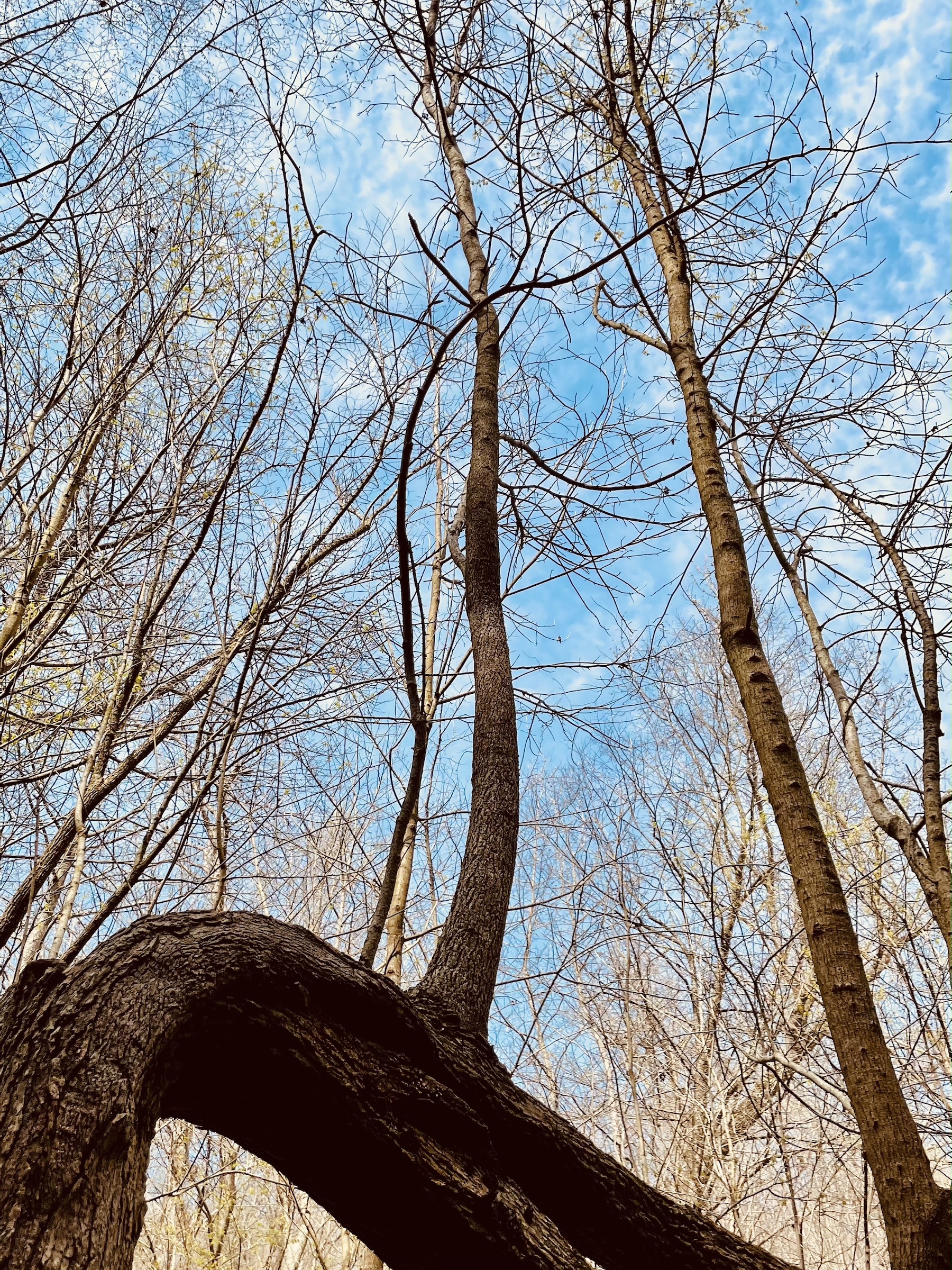
A couple days ago I was on a spring break hike with my wife and kids, when our eyes were drawn to an unusual site. At the edge of a riverbed that becomes swollen with floodwaters during the rainy season, we saw a tree that had been literally bent over by rushing water. It had been powerless to prevent the effects of the weather upon it. That wasn’t what attracted our attention, though.
Rather, we were awed by one of its branches, growing toward the light.
When the tree was upright, this was one of its lowest branches, growing parallel to the ground. Now, with the tree trunk bent sideways, the branch was oriented vertically, and it was taking on all the characteristics of a tree, growing straight upward toward the light, the original trunk now acting like its roots.
In that tree, I saw all the ways we are powerless to prevent the world from bending us out of shape. And I saw how we still have the power to grow toward the light, even when we’ve been bent and broken. Maybe a good life is one in which we learn to accept our limits in liberating ways, so we can maximize our power in loving ways.
Today, ten months to the day after I crashed, I feel a little like that bent and broken tree. My shoulder still isn’t fully healed, and it will never be the same. I’m powerless to change any of that. But I still have the power to ask myself, how will I grow toward the light today?
So, I got back onto my bike for the first time in ten months. As I approached the site of my accident, I broke out into a cold post-traumatic sweat and my heart hammered in my chest and I felt the powerlessness of my bent and broken shoulder. But I kept going, toward the intersection, and through the intersection. Toward the light, if you will.
May you, too,
bent and broken,
find the borderland between what you can and cannot control,
and may you choose to use what power you have,
to grow toward the light.
My new book True Companions is about growing toward the light in all of our relationships by growing quiet, growing strong, and growing old together. Find out more by clicking here.
Also, you can see a full image of that powerless and powerful tree by clicking here!
The post The Liberating Difference Between Your Power and Powerlessness appeared first on Kelly Flanagan.
March 18, 2021
Why You Can’t Replace Analog Companionship with Digital Connection
On the one-year anniversary of the COVID quarantine, here’s a chapter from True Companions about the wonders of digital connection—and the irreplaceable value of analog companionship.
Several months ago, our daughter, Caitlin, and I were standing in the toy section of our local bookstore, when she picked up a Magic 8-Ball from the shelf, shook it, and waited for her answer to float to the surface of the inky liquid. When the word “Yes” appeared in the window, she wiped her brow in a grand gesture of great relief. I asked her what she had asked the 8-Ball. Her answer took my breath away.
“Will I ever feel like I fit in this world?”
I think the Magic 8-Ball gave Caitlin the right answer. Now more than ever, she probably will feel like she fits in this world, because we live in an age of digital miracles. We can connect to billions of people with a few taps of a finger or swipes of a thumb. Just one generation ago, you could only be in one place at a time. In your whole life, you’d meet maybe a few thousand people. Now, the whole world congregates in the palm of your hand. So, Caitlin probably will cross digital paths with enough people who are enough like her to feel like she fits in this world. However, this will give rise to an even more troubling question. Why, if I feel like I fit with so many, do I still feel so alone?
Around 2012, something happened to teenagers in the United States. For two consecutive decades, their reported levels of happiness had been increasing, and suddenly the trend reversed direction. At the same time, rates of reported loneliness and depression spiked, with a 50% increase in teenagers hospitalized for suicidal thoughts between 2008 and 2015. This kind of sudden decline in teen mental health has happened before, but always in connection to a major cultural upheaval or a cataclysmic global event. So, what was the most significant cultural revolution of 2012?
For the first time, more Americans owned a smartphone than did not.
Around the same time, social media became the go-to method for congregating and communicating amongst adolescents. Digital connection quickly began replacing analog companionship. Given a choice between a driver’s license and a smartphone, many kids suddenly preferred a phone. After all, a car can only drive you to one place to see a handful of people, but a phone can transport you everywhere to see everyone. Caitlin’s generation will be the most digitally connected generation in human history. Yet they may end up utterly isolated in the analog world.
Of course, I don’t believe these technologies have created our loneliness. Rather, I think we have created these technologies out of our loneliness. In an attempt to fix our ordinary loneliness, we gathered a digital crowd, but the digital crowd is leaving us more isolated than ever. This is confusing to us, because when we maintain a bunch of Snapchat streaks we feel momentarily accepted—like we really fit in this world, as Caitlin would say. So it seems like our loneliness should be shrinking, but instead it remains what it is and what it will always be, while our sense of isolation slowly grows alongside it. Then, we return to the bottomless well of digital connection, hoping this time it will finally satisfy our thirst for companionship.
It will not.
The morning after Caitlin asked her question of the Magic 8-Ball, I made her chocolate chip pancakes. As I mixed them, it occurred to me that digital connection is like chocolate chips in the pancake recipe of life. It is tasty and tempting to consume by the bagful. It feels good momentarily, and it goes down relatively easily. In contrast, analog companionship is more like the eggs. It holds everything together. It has cracks in it, and it’s messy, and if you don’t cook it all the way through it can even make you sick. However, without it, the recipe of life just doesn’t work very well.
The digital crowd brings with it the thrill of discovering you fit in from a distance, whereas analog companionship brings with it the challenge of figuring out how to fit together, up close and personal. Analog companionship has flesh and blood in its code, not 1s and 0s. It has salt in its tears, not pixels. There’s a big difference between a digital thumbs-up and a warm hug. Nevertheless, because the digital crowd momentarily obliterates our sense of isolation, we are giving more and more of our relational energy to it, rather than to analog companionship. In other words, we keep reaching for the chocolate chips, but we need to be cracking a few eggs instead.
The day after I made pancakes for Caitlin was Father’s Day, and I began the day by kayaking alone down my favorite river in north central Illinois. For long stretches of river, there is no sign of civilization at all, and you can float for miles without encountering another human being. Furthermore, there is no cellphone reception, so you are as alone as you’ll ever be in a world where the digital crowd is always knocking at your virtual door, one push notification at a time. I enjoyed being alone for about ten minutes. By the first bend in the river, though, my isolation wasn’t sitting well.
Out of habit, I reached for my phone. No signal. I waved it in the air like we do now, hoping for bars. Nothing. I put the expensive brick back in its watertight compartment. My feelings of isolation, however, were not so easy to compartmentalize. I had an urge to check my social media accounts. I let the urge float by. I had an urge to text a friend I hadn’t talked to in a long time. I let it float by. My mind wandered ahead to the upcoming week, and I wanted to check my calendar. I let the desire float by. I left my digital crowd upstream. I paddled. I looked around.
I took it all in.
The wind in the treetops. The sun on fire. When my loneliness surfaced, instead of reaching for my phone, I reached over the boat. I grazed the surface of the analog river with my analog hand. I attended to all of these tangible realities: wind and sun and water. These elements. It made me think of how, in my faith tradition, we receive two elements every Sunday: bread and wine. They are meant to symbolize the flesh and blood of Jesus. It’s a weekly reminder that uploading prayers to supernatural gods can only take us so far, that flesh-and-blood presence is the kind of analog companionship we all really need.
Flesh and blood.
On that Father’s Day morning, my restless urge to reach out to the digital crowd never really left me. But in the midst of it I became aware of myself floating toward the flesh-and-blood, analog companionship in my own life. It would be waiting for me on the dock at the end of my journey. Kelly and our three kids. Waving. Chattering. Fighting. Smelling of sunscreen and sweat, of flesh and blood, of bath water and river water, of baptism by life. I had not immersed myself in the rushing waters of the digital crowd, so I had time to value the flow of this analog companionship in my life, this sometimes joyous, sometimes painful, always challenging, elemental philia.
Analog companionship can be hard. It can’t rescue you from all your isolation, because it can’t be there for every bend in the river. Nor can it eliminate your ordinary loneliness, because it can’t see all the way inside of you. However, if you are not cultivating analog companionship on a daily basis—the day-to-day exchange of care and chaos, connection and confession—then like so many young people today your sense of isolation will grow more quickly than your Instagram following ever could. On the other hand, if you commit to the practice of companionship—if you turn from everything to one face, as the novelist Elizabeth Bowen says—then when you arrive at the dock at the end of your journey, you might just discover yourself face to face with everything you could ask for. You might just discover this Magic 8-Ball we call life has given you the answer you’d been hoping for all along.
And we analog companions,
wipe our holy human brows
in a grand gesture
of great relief.
Taken from True Companions by Kelly Flanagan. Copyright (c) 2021 by Kelly Flanagan. Published by InterVarsity Press, Downers Grove, IL. www.ivpress.com
Find out more about True Companions by clicking here.
The post Why You Can’t Replace Analog Companionship with Digital Connection appeared first on Kelly Flanagan.
March 4, 2021
The Sights and Sounds That Can Save You
The layers of abnormal are adding up.
I’m snowblowing my driveway in the darkness before dawn—the whipping wind making it feel like thirty degrees below zero—when that thought enters my mind.
It’s a Tuesday morning in the twelfth month of a pandemic. That’s abnormal. Last night I went to bed exhausted, achy, and feverish, following the second dose of a vaccine intended to end that pandemic. That’s abnormal. I’d gone to sleep right after leading a virtual event in conjunction with the release of my new book. Virtual book tours. That’s abnormal. The virtual event had a low turnout because Texas is in the middle of an apocalyptic weather event. That’s abnormal. It’s the tenth consecutive day of a sub-zero polar vortex in Chicago. That’s abnormal. This morning, for the first time in eleven months, all three of my kids were supposed to be attending school in-person again. Nope.
The winter storm postponed that return to normality, too.
The layers of abnormal are adding up, I think to myself, shivering, tired, sore, and trying to make sure I’m not snowblowing a flowerbed in the dark. I used to hate change. I used to resist it, turning myself and my life into an unhealthy pretzel in my effort to keep things feeling the same and safe and stable. These days, though, I gladly accept that change is a part of life, and a good part of life. I’m flexible now. I bend, just not like an unhealthy pretzel.
How far can you bend, though, before you start to break?
The layers of abnormal are adding up, I think, and I’m not sure how many more I can carry before I buckle under the weight of them. I miss gathering together with my friends and laughing about life. I miss sitting in the stands or the seats at my kids’ swim meets and soccer games and opening nights. I miss seeing the lower half of my employees’ faces. I miss temperatures you can go for a walk in. I miss normal.
I’m thinking all of this as I blow the last bit of snow from the driveway and switch off the machine. I stand there, looking east, where the sky is now clear and bright. And that’s when I hear it. Its call is clear and exquisite and rhythmic. It is coming from the forest across the street from our house: the day-dawning chirping of a cardinal. It moves me to tears and I’m confused by my emotions until I hear in that repetitive, rhythmic call the thing I’ve been longing for:
Normality.
It’s as if my snowblown thoughts had formed some kind of prayerful lament, and my prayer was being answered, and it was being answered in the form of this sound: the utterly normal chirping of a cardinal on an utterly abnormal morning. It felt like God was calling to me through its creation and saying, “Yes, the layers of abnormal are adding up, but there is still something solid and reliable and normal and blessed right here, underneath all those layers; indeed it is the foundation upon which all those layers are sitting.” In that silly bird’s call I heard the call to simply rest on the normal, sacred foundation of everything.
I was busy, though.
I had a clinical day to get underway, with a video session at 7am. So, I quickly parked the snowblower in the garage, hustled inside, changed into therapist-looking clothes, and logged on for my first appointment. And if that’s all that had happened, I would not have remembered that blessed cardinal and I would not be writing this to you right now. But the answer to my prayerful lament was not over. As the sun came fully up, something remarkable happened.
In the crabapple tree, just outside the window, exactly one week after True Companions was released, two companions came to perch.
A bright red male cardinal and his more humbly feathered female companion suddenly alighted in the branches of the tree, about two feet apart, both of them staring directly into the window at me. And they remained that way, for forty-five minutes. Looking right at me, as if to say, “Don’t miss this intentional answer to your accidental prayer, Kelly. There is so much blessed normality woven throughout these abnormal times. The foundation is solid. Look for it and see it. Listen for it and hear it. These will be the sights and sounds that save you and sustain you.”
So, for the last few days, I’ve been watching and listening and I’m noticing that, even as the world turns upside down, its foundation is always under my feet. We are ensconced in a normality that we can stand stably on, that we can trust, that we can enjoy, that we can rejoice in. I’m seeing it in the world. I’m seeing it in my companions. I’m seeing it in myself. I’m hearing it in all things.
May you watch,
may you listen,
and may you, too,
be saved
by the everyday sights and sounds
that can sustain you.
My new book True Companions is in people’s hands, on their e-readers, and in their headphones. Order your copy wherever books are sold by clicking here.
The post The Sights and Sounds That Can Save You appeared first on Kelly Flanagan.
February 11, 2021
Exchange Your Ordinary Protections for Some Valentine’s Connection
This blog post is an excerpt from the free bonus you will receive for ordering True Companions by Friday, February 12th at 5pmCST. See the end of this post for details about how to get the bonus before it goes away!
We fought all the way through our first Valentine’s dinner as a married couple.
My wife and I were penny-pinched clinical psychology graduate students at the time, and we’d decided to spend a month’s worth of grocery money on one dinner at a romantic little restaurant on the outskirts of campus. Our doctoral studies were immersing us in new concepts and theories, and she’d embraced cognitive-behavioral interventions as the most effective methods for therapeutic growth and change. I’d just taken a course on psychodynamics and, with the fervor of a religious convert, I scoffed at her, claiming that cognitive-behavioral theory barely scratched the surface of human problems and potential.
My wife has never and will never suffer a scoffing quietly.
She doubled down on her defense of cognitive-behavioral theory, this time with some fire in her eyes. In response, I doubled the magnitude of my scoff, lecturing her about the naïveté of overlooking our deep-seated drives and dreams. By the time the server delivered the stuffed mushrooms appetizer, our Valentine’s Day dinner more closely resembled a Valentine’s Day massacre.
I suppose you could write off that fight as the unfortunate consequence of mixing two nerds with some intoxicating ideas and a couple glasses of Cabernet. However, over the years—as a couples therapist and a companion of various kinds—I’ve realized there was something more significant at work that night. Specifically, we all have a part of us, deep down, that wants to be connected, but the rest of us just wants to be protected. We came into the world wired for true companionship, we got hurt, and so we developed ways of protecting ourselves from the additional hurt our companions might inflict upon us. And one of our most common forms of protection is competition.
In True Companions, I write, “Competition and connection—like anger and fear—are mutually exclusive intentions. You can’t be competitive and connective in the same moment. This truth isn’t always obvious. For instance, when Quinn’s soccer team is playing a game, they will quickly take a knee when a player on the field gets injured, a generous show of compassion. However, in the moment they take a knee, they quit competing. When play resumes, if they remain compassionate, they will be uncompetitive.” By its very nature, competition protects us from the risks—and rewards—of true connection.
And one of the most common forms of competition is arguing about who is right and who is wrong.
This morning, I was reading Matthew McConaughey’s memoir, Greenlights, in which he tells a story about touring Africa. He was sitting in a cafe with two African acquaintances when they began to discuss a complicated moral issue. At the first break in the conversation, McConaughey chimed in with his opinion about which one of them was right, and why. The man with whom he had agreed turned on him and admonished him, saying, “It is not about right or wrong, it is about, do you understand?” The man with whom he had disagreed then looked at him intensely and said, “Do you understand that?”
Do we understand that true companionship is almost never about who is right and who is wrong but about, do we understand each other?
McConaughey’s story made me think about Jesus. It seems much of the Old Testament was about right and wrong. Which foods you can and can’t eat. Which things you can and can’t do on the Sabbath. And of course those ten ultimate commandments, amongst other things. Then, the entire New Testament is about, do you understand? Does God understand? Does the Divine understand what it’s like to live in human skin, to hunger and to thirst, to be beloved and to be betrayed, to be exalted and to be shamed, to gather together with your companions and experience one of the most simple and sacred of human moments, the breaking of bread together?
This afternoon, we received Quinn’s remote learning grades for the second quarter. The kid usually gets As, and there wasn’t a single one to be found on the report card. I immediately got worried, about him, about his future, about my role or lack thereof in his poor performance. Then, I got angry, because for two months he’d left us with the impression he was doing all of his work. I wanted to tell him what he’d done wrong, and what was right.
Fortunately, McConaughey’s story and the Jesus story were still on my mind.
I asked Quinn to go for a walk and talk, instead. By the time we reached the end of the driveway, he was in full protection mode, expecting a debate about right and wrong and a competition about the severity of his consequences. Instead, I asked him to help me understand what happened. Eventually, as he began to trust my intentions, he opened up. He confessed to taking the easy route at times. He admitted to being overwhelmed by the digital deluge. He realized he’d gotten caught up in groupthink about which remote assignments were worth doing and which weren’t. By the end of the night, I understood him better, and he understood himself better.
On the verge of another Valentine’s Day, Quinn and I both traded protection for connection. As a result, he lost some of his screen privileges until his grades are improved, but he understands why and he understands what to do about it. And I understand my son a little more, which is like the good kind of arrow right through my heart. No Valentine’s Day massacre in our family this year.
Just truer companionship.
To get this free bonus ebook—which amounts to 18 additional chapters of reflections and insights about relationships—here’s what to do BY FRIDAY, FEBRUARY 12TH AT 5PM CST:
Buy a copy of True Companions wherever books are sold, such as Amazon or Barnes & Noble.Enter your invoice number and email address in the appropriate field on this page. Check your email inbox in ten minutes and download the bonus!The post Exchange Your Ordinary Protections for Some Valentine’s Connection appeared first on Kelly Flanagan.
February 4, 2021
Why We Feel Lonely and What (Not) to Do About It
This week’s blog post is an excerpt from True Companions by Kelly Flanagan. Copyright (c) 2021 by Kelly M. Flanagan. Published by InterVarsity Press, Downers Grove, IL. www.ivpress.com.
In 2017, I published a book called Loveable. It is a book about the healing of our shame, which is the belief we all pick up somewhere along the way that we are not good enough to be loved as we are, not worthy of companionship, if you will. I wrote the book because I’d spent almost three decades becoming ashamed and almost a full decade becoming more aware of it and more free from it. However, following the book’s publication, I discovered something a little disconcerting.
Though my shame was shrinking, my loneliness was still lurking.
For a while this confused me. I had been telling myself that shame and loneliness were essentially the same thing, and I assumed as one decreased the other would decrease as well. Perplexed, I bought a bunch of books about loneliness written by authors I respect, in the hopes of understanding why my shame seemed to be diminishing while my loneliness seemed to be thriving. The reading didn’t help. In fact, most of what I read also lumped shame and loneliness together by describing loneliness as an experience which invariably feels shameful. Then, one day, I finally came across the answer I was looking for in a book I already owned. In fact, at the time, I owned almost a hundred of them. The book was Loveable.
In it I had written, “Loneliness happens. It is as much a part of life as hunger and sunsets and funerals. It is simply what happens when we grow up and realize we have a universe inside of us to which no other person has access, and that every other person contains an unknowable universe as well.” At some deeper level, apparently, I had known all along that, though we tend to lump shame and loneliness together in our minds, they exist separately somewhere at the heart of us. Loveable reminded me, once again, loneliness is not an artifact of our woundedness. Loneliness is a fact of our humanness.
We can have family at home and friends in our neighborhood and followers online and still feel lonely, because loneliness is a constant—even in the midst of a crowd—and feeling lonely is merely a glimpse of that constant. When you feel lonely for a time, it is your loneliness surfacing and then settling into the depths again. It doesn’t mean you’re paying a price for something. It simply means you’re paying attention. So, why do we commonly lump loneliness and shame together, as if they are one and the same?
Because we’re looking for explanations.
I have a friend who, as an adolescent, told his mother he was going to a friend’s house and went to an arcade instead. When he got home, the tokens jingling in his pocket gave him away, and his mother began chasing him around the house with a ruler. My friend had been prepared to get grounded for his deception, but getting hit for the transgression had never crossed his mind. So he dodged and laughed, thinking his mother must be feigning her rage. Out of breath, his mother called his father into the room. My friend expected his father to be more measured. Instead, his father backhanded him across the face. His cheek stung, but the three words inside of his head stung even more.
“It’s just me,” he thought.
In other words, “What brings me joy brings them rage. What I think warrants punishment to them warrants pain. I’m all by myself. I’m all alone.” In the sharp sting of skin on skin, the fact of his loneliness rushed to the surface of him. Like abandonment, abuse has a way of suddenly bringing our attention to this inner reality. Indeed, any experience which reminds us that no one else is seeing the world through our eyes can trigger awareness of our loneliness. However, our minds aren’t satisfied with this awareness. Our minds are meaning-making machines. They want an explanation. They want to know why we’ve been abandoned or mistreated or misunderstood. Our minds ask, “Why do I feel so lonely?”
Shame is happy to provide the answer.
The voice of shame within us—and perhaps even the voices of shame around us—tell us we are feeling lonely because we deserve to be alone. Shame tells us no one can hear us shouting for help because we aren’t shouting loudly enough or pleasingly enough or articulately enough, or simply that we aren’t worth saving. Shame tells us we got slapped because our sense of justice is wrong or weird or bad. Here’s a simple way to expose the difference between your loneliness and your shame. Complete the following sentence: “I feel lonely because . . .” Shame is often everything that comes after the word because. Shame is believing your loneliness is a consequence for how badly or strangely you were made.
Shame is weaponized loneliness…
You and I, we may never totally get rid of our shame, but we can tell it to keep its hands off our loneliness, thank you very much. Don’t let your shame write the story about why your loneliness has surfaced. Try not to add a “because” to any moment in which you become aware of your loneliness. Your shame may pipe up within you, but recognize it for what it is. Don’t let it ramble on for too long. Tell it you’re not looking for explanations. Tell it you already trust the only real explanation: you are lonely because . . . you are human. Then, your shame will shrink a little more and, finally, you can be a little more alone with your loneliness. It’s so much quieter that way.
It’s the kind of quiet that can transform you.
True Companions releases on February 9. Click here to pre-order it and submit your invoice number now, in order to receive the exclusive pre-order bonus eBook, An Inside Look at True Companions.
The post Why We Feel Lonely and What (Not) to Do About It appeared first on Kelly Flanagan.
January 28, 2021
The Essential Difference Between Marriage and Companionship
This week’s blog post is an excerpt from the introduction to True Companions by Kelly Flanagan. Copyright (c) 2021 by Kelly M. Flanagan. Published by InterVarsity Press, Downers Grove, IL. www.ivpress.com
When I began writing True Companions, I thought it was about saving this ancient institution called marriage. Seriously. I planned to right this sinking ship we call matrimony by convincing a whole generation of young people to quit jumping ship, to head to the courthouse, and to set sail upon the kind of life-changing journey marriage can become. Plus, “marriage books” sell like hotcakes. It all seemed like a very good idea.
Then, one day, a friend pushed back.
She asked about my next book, and when I told her what it was about, her face fell. “I love your writing,” she explained, “but I can’t pick up any book with marriage on the cover.” She is a single woman. Men have been cruel to her. An uninterested father. A boyfriend who abandoned her in the middle of a pregnancy. A husband who drank their marriage to death. Now, she has the courage to stand alone, while raising her young daughter on her own. She still hopes to marry again, but she has become less willing to settle for more of the same from the men in her life. In other words, for now, she doesn’t have a ticket for the marriage cruise, and she isn’t interested in reading about the poolside piña coladas.
I can’t blame her. So, I wrote this book for her and for everyone like her. It’s a book about a cruise we are, all of us, already on. This is a book about marriage that is also about something bigger than marriage. In her Pulitzer Prize–winning novel, Gilead, Marilynne Robinson writes, “The moon looks wonderful in this warm evening light, just as a candle flame looks beautiful in the light of morning. Light within light. . . . It seems to me to be a metaphor for the human soul, the singular light within the great general light of existence. Or it seems like poetry within language. Perhaps wisdom within experience. Or marriage within friendship and love.” What if marriage is a singular light within the great general light of companionship, but we keep trying to turn it into the big light itself? What if uncovering the secrets to a stellar marriage isn’t as important as finding our way to the truths at the heart of true companionship? This book is about the great general light of companionship, inside which marriage flickers and flames.
If I could, I’d go back in time and join my younger self in the early morning hours of his wedding day. I’d ride with him on that empty highway, with that bottle of champagne resting on the seat between us, and I’d tell him things he couldn’t possibly fathom yet. I’d tell him marriage is relatively simple. It’s a signature on a license at the courthouse, a benediction from the pastor, a kiss, a bunch of rice stuck in hair he won’t have for much longer, a rowdy reception, and years and anniversaries rolling by, until one day the rolling finally stops.
But, I’d tell him, companionship is something he already began, on a painful morning of confession months before. I’d tell him companionship is anything but simple. It’s hard work. It takes guts and perseverance. It’s a long walk through everything: sorrow and celebration, heartbreaking disappointment and heartwarming contentment, all sorts of uncertainty and a moment of clarity here and there. It takes everything you’ve got, and sometimes it gives you back more than you could ever hope for. It is a four-word vow lived out in the midst of our hardest humanity:
We’ll figure it out.
I’d tell him marriage is one very special candle that can burn within the big, bright light of companionship. Friendship is another one, of course, as is the relationship between a parent and a child, or the relationship between siblings. Really, wherever two or more are gathered, a little more light can be added to the great general light of companionship. I’d tell him he has spent much of his life thinking about how to get better at marriage and that might make him better at being married, but getting better at companionship will make him better at being human.
Then, he’d drop off the champagne at the limo office, where the lone attendant will look at him like he’s nuts, and we’d drive back to the hotel together. On the way, I’d be sure to tell him what I witnessed last Thanksgiving Day in a buffet line at a local inn. While someone ahead of me contemplated corn versus carrots, I had time to stand there with an empty plate and observe, through two panes of glass, the line moving a little more quickly on the other side of the buffet. What I saw was two companions.
I’m guessing they were in their early seventies, but something had happened to him. A stroke perhaps, or something nearly as catastrophic. His age was seventy-something, but his body was ninety-something. He slouched heavily with both hands on a walker in front of him, inching it forward with great effort, muscle tone almost completely missing. Large hearing aids were perched in both ears. With both hands on his walker, he was unable to reach for his own food. So she walked behind him, reaching for both of them.
They were figuring it out.
I watched as they slowly moved by the mashed potatoes and the stuffing and a bowl full of something made of marshmallows. She would serve herself and then lean over, with her mouth close to his ears, pointing at each pile of food, asking him if he wanted it. Sometimes he would nod. Sometimes he wouldn’t. Slowly, his plate filled up. It was all very hushed. I could not hear a word of it. Usually, companionship isn’t loud and fancy and intoxicating like a wedding celebration. It’s quiet and plodding and nourishing. I’d tell my younger self that I don’t know if the couple was married. They probably were.
But I do know they were companions.
Click here to pre-order True Companions and submit your invoice number now, in order to receive the exclusive pre-order bonus eBook, An Inside Look at True Companions.
The post The Essential Difference Between Marriage and Companionship appeared first on Kelly Flanagan.