
Harrison Bae Wein's Blog: Harrison Bae Wein, page 9
March 13, 2017
Nostalgic reading John Irving again
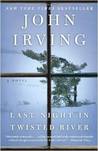 Last Night in Twisted River by John Irving
My rating: 4 of 5 stars
Like many people, I first discovered John Irving with The World According to Garp. After that, I went back and read all his previous novels, and then started reading new works as they came out. What made Irving special to me was his ability to write fun, intricate stories that made you think. They were both enjoyable and rich with passion and meaning.
John Irving makes no secret of his love for Charles Dickens, and his novels capture the spirit of the master novelist like no contemporary novelist that I know. Like Dickens, Irving could be faulted for the intricate potting, the crazy coincidences, and the sprawling casts of fairly one-dimensional characters. None of these bother me when done well. I feel that if an author exaggerates something to prove a point, there's nothing wrong with that.
That said, the best of these sorts of novels breeze along so quickly that you don't tend to think about these things while you're reading. You think about the injustices in society that the author is working to shine a light on. John Irving's particular talent is for creating a rich, warm world of quirky characters that you feel nostalgic for even if you've never been there yourself.
After A Prayer for Owen Meany, Irving continued to create such worlds, but I found that the books were starting to meander and the characters becoming forgettable. At some point I stopped reading them; sadly, I can't even remember which was the last one I read in full.
I picked up Last Night in Twisted River because I read that it was something of a return to form. It is somewhat, and I read it with a warm nostalgia for past masterpieces. Irving has created a rich world that spans decades and many different places. I enjoyed it overall, but there are some aspects that keep it from being a great novel.
The first is that the main character is just as sketchily drawn as much of the supporting cast. After sixty-some years and hundreds of pages with Danny, I can't say I have much of idea of who he is. He's partly autobiographical, and that might be the problem. There's a wall behind which we never see. We're told he loves people, but we don't really see or feel it. Mostly, we see his sense of loss, not what drives him forward.
The other things that kept me from enjoying the novel were the inconsistent ways both the settings and people were drawn. Some places and situations were rich and detailed; some were grotesque sketches that were meant to be funny but missed the mark or even bordered on offensive. Characters were treated in the same way, with some minor characters warmly and painstakingly drawn and others that proved to be very important marked by little more than physical characteristics or linguistic quirks. There was no rhyme or reason to this.
As a writer, I've long been puzzled by the question of character and caricature. Dickens is often criticized for his caricatures, but I find in life that while everyone may have depth beyond what you see on the surface, they can behave as caricatures in society. The magic of Dickens and Irving at their best is that they are able to capture the essence of a person in just a couple of sentences. You can see the caricature but understand the person beneath. There's an art and a finesse in this that Irving has done a lot better in the past.
Lastly, I missed the kind of driving force that propelled my favorite novels by Irving. This book seems to be about the power of stories to shape lives and how that (view spoiler)[makes Danny become a writer. But the power of story is important in all our lives, from childhood to old age. There's really nothing here that convinces you why Danny had to become a novelist, as he seems to believe. In the end, this book is a kind of meditation on how long and tough life is, and how we keep soldiering on. Nothing wrong with that, but many episodes here, including the end, are forced and unconvincing. This author has been a lot more insightful and powerful in past work. (hide spoiler)]
Still, I enjoyed Last Night in Twisted River, and if you're an Irving fan, you'll feel right at home here.
View all my reviews


May 14, 2016
Remarkable, not so enjoyable
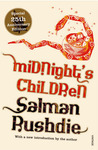 Midnight's Children by Salman Rushdie
My rating: 3 of 5 stars
I've been meaning to read Midnight's Children for a while now, as it's on just about every list you see of best novels of all time. The book is about Saleem Sinai, who is born on the stroke of midnight at the very moment India gains its independence in 1947. His life mirrors that of his country in an expansive tale of dashed hope and disappointment.
This is a remarkable book in many ways. It's got the scope and allegory of Günter Grass, the dark humor and complex plotting of Charles Dickens and John Irving, the wonderfully messy digressions of The Life and Opinions of Tristram Shandy, Gentleman, and some of the descriptive inventiveness of Angela Carter. I finished it thinking, "Wow, how did he do all that?"
That said, I wish I'd liked it more. It's a very dense, difficult read. The digressions and endless cast of characters--many with multiple names--made it a long slog for me. I found the obvious narrative manipulations (backtracking to explain, hiding things that are later explained, etc.) and overt metaphors grating, and almost gave up a couple of times. There's no subtlety here. It's all muscular bravado, a writer showing off. When this kind of thing is done in the service of the story, I tend to love it, but I often felt that the author was throwing too many things against the wall in the hope that something would stick, rather than making thoughtful choices.
I also wasn't a fan of the way this book playfully trivializes very serious events, even though Saleem keeps telling you how horrible things are and how much worse they will inevitably get. Despite the pretense of this all being about a country and a people, there really seemed to be no soul to this book. The narrator is gleefully unreliable and unlikeable, and the characters he depicts are almost all described in an unflattering light. Whereas, say, Graham Greene, Günter Grass, and Gabriel Garcia Marquez thoughtfully examine the struggle for the soul of their countries with characters that pulse with life, this all came across to me as a big and flat joke. Major historical events are really, you see, all about our unreliable narrator.
I know I'm coming at this years after the fact. At the time this book came out, it must have seemed like the arrival of such a new, exciting voice--a shift of the international literary landscape. But taking it purely as a piece of literature in our modern, internationally-connected time, I found it a harsh, cold read with much invention but not so much to take away from it in the end.
View all my reviews
June 15, 2015
An oddly unemotional account of the great London plague
 A Journal of the Plague Year by Daniel Defoe
My rating: 3 of 5 stars
This is a fairly straightforward accounting of the great London plague of 1665 written in the early 1700s. It's somewhat interesting as a historical artifact, with long lists of how many people died and when, along with extended discussions of the veracity of the statistics. The descriptions of policies and their outcomes were the most fascinating aspect, and there were a couple of stories buried in here that were gripping, but these were too brief and way too sparsely scattered through the inartfully disorganized text. As much as I wanted to enjoy this, it was a long, dreary slog to get through. A series of excerpts would be ideal to read, but as a whole I'd recommend this only for people who have an academic reason to tackle it.
View all my reviews
May 28, 2015
Author Interview
My high school alumni newsletter interviewed me for a special issue on creativity. I talk about my journey from being a scientist to science writer and novelist. You can read it here.
April 4, 2015
Bel-Ami
 Bel-Ami by Guy de Maupassant
My rating: 3 of 5 stars
 />
/>George Duroy leaves the military to make his fortune in the big city in this straightforward, almost journalistic account of mid-nineteenth century Paris high society. I'm not generally a big fan of cynical books like this with selfish, despicable characters who slash and burn their way to the top. This was kind of the equivalent of a modern reality show where you keep asking yourself, "Can people really be this awful?" I didn't think it was particularly insightful about human behavior, but I still enjoyed reading this tawdry, malicious snapshot of this particular segment of society at this particular time. The writing is quick and efficient, with some vivid and beautiful descriptions. One important note: be careful about which translation you read. I started with an abridged version that had no indication it was abridged, and it was absolutely terrible.
View all my reviews
March 6, 2015
Pmith in NYC
 Psmith, Journalist by P.G. Wodehouse
My rating: 4 of 5 stars
I've read several Wodehouse books at this point, including the Psmith series up to this entry, and this has to be the strangest one I've encountered so far. Wodehouse shows a darker edge than usual as the unflappable Psmith encounters the underbelly of New York City in a fight for social justice. There are funny bits, but it's not quite the light, rollicking nonsense you might expect from a Wodehouse book. I don't want to give away any plot because it's still deliciously ridiculous. The book is well worth a read.
View all my reviews
February 4, 2015
Join our book discussion
Click here to join the discussion about my book, The Life and Opinions of Housecat Hastings, here on Goodreads.
January 26, 2015
All About Animals Feb book pick!
The Life and Opinions of Housecat Hastings is the official February 2015 book pick of the All About Animals group here on Goodreads! If you’ve been waiting for the right time to read it, now is the time to get your copy so you can join the discussion. For more about the group read, see here.
January 1, 2015
"All About Animal" February Read
My book, The Life and Opinions of Housecat Hastings, is in the running for the Goodreads "All About Animals" group February read: https://www.goodreads.com/poll/list/7....
December 19, 2014
Meeting Wodehouse's Psmith
 Mike by P.G. Wodehouse
My rating: 3 of 5 stars
This edition combines Mike at Wrykyn and Mike and Psmith into one book, with an extra introductory sentence added to the start of the second as a bridge. Mike at Wrykyn, which comprises the first 29 chapters, is pleasant enough but it's really a pretty standard school story about a boy trying to make the cricket team.
Things really take off with the introduction of the monacle-wearing wit Psmith (the P, which he added himself, is silent). I think the clever and quirky Psmith rivals Wodehouse's best characters. I really enjoyed the second book, although it's still early Wodehouse and doesn't approach the brilliant insanity of the best Blandings or Jeeves & Wooster books.
If this is the first Wodehouse book you try, don't let it turn you off. I'd recommend that all but the biggest Wodehouse (and cricket) fans skip the first book and start at chapter 30, where Mike and Psmith begins.
View all my reviews
Harrison Bae Wein

Harrison Bae Wein is author of the novel "The Life and Opinions of the Housecat Hastings." Or the human front for Hastings, depending on whom you believe. You can visit his website at http://harrisonw
...more
- Harrison Bae Wein's profile
- 2 followers

