Keziah Shepherd's Blog, page 5
January 21, 2014
Brueghel's Paintings: JUDGEMENT OR HELPFUL OBSERVATION?
 The Blind Leading the Blind, by Pieter Brueghel L'AncienScorsese once said that ‘Life is the overcoming of one painful obstacle after the next’ and if one looks closely at a Bruegal, the initial pleasure of the colourful scene of 16th Century life in Flanders : the wood framed houses, peasants at leisure, family festivals, village parties, you can see the pains of being human and the obstacles to overcome. First Glance
He worked during the ‘mini ice-age’: a freak spell of crippling cold and cruel weather in the second half of the 16th Century in Flanders. It was also during the splitting of the Catholic church, where Flanders was Catholic and Holland was Protestant.
At first glance, one would think that Bruegal simply enjoyed capturing a familiar drama or a random disaster, but actually much more magic takes place in his painted ‘frame’
But looking closer at ‘Man beaten at a card game’ illustrates that something as frivolous as a game could lead to fatality when the impulses and passions are not controlled.
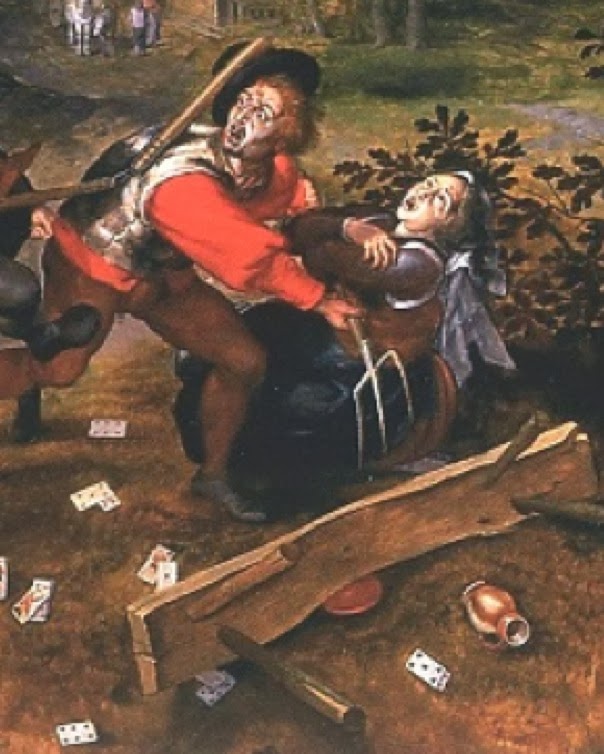 Man beaten at a card game
See the woman in despair with her eyes rolled to heaven? See the man poising a garden fork? See the other man hitting him with a baton of wood, and no sense of responsibility or worry of the consequence of his acts? The humorous title, with its duel meaning, also shows what drama is being made out of just a game.
Travels
A good painting is a painting which structures an image, which helps an onlooker to stand back and think about something, and be objective.
After spending time in Italy, learning about landscape painting in 1552, he returned to Flanders to paint his own world and was nicknamed ‘the rustic’ His paintings were precise, with calm serene landscapes and showed within it the subject matter human beings of his day in the setting of festivals, marriages, arguments, and daily work.
Brueghel as an artist had attained an objective viewpoint, with insight into human behaviour and a means to disengaging from the dramas. He paints his groups of people in the moment, at the moment when they are free of any mask of artifice, and victims of their own pulsion, for he felt that human beings in their most modest and vulnerable represented the cruel reality of a world full of tests and difficulties.
People lost in vice, barrels of booze arriving, lusty dancing, and a wedding with a ‘bland’ looking bride, men fighting over cards are the subjects he chooses. Behaviours and traditions and customs fascinate him: these automatic behaviours we follow without second thought (a priest blessing the marriage bed of a bland drunk looking bride who does not look at all in love)
The only hope in a Bruegal picture is the landscape. In the rear of his dramas, the scenery is brightly lit, serene. He shows the trees and hills, as a place to revere nature and its rules are the most grounding and sane part of the picture in where all else seems crazy. His landscapes have the same shimmer as an angel’s halo, showing that in Bruegal’s eyes, the power of nature is absolute and it is Nature that dominates man.
Perhaps by lovingly portraying the foibles of man, Brueghel hoped for our objectivity, hoping to nurture higher states of the soul: peace, virtue, abundance and divinity.
Seeing with love
Yet the reaching of his vision of this sacred state is not attained by condemning human nature. Brueghel’s way of seeing is not dissimilar to the words of Stefan Sweig, who said“I personally find pleasure in understanding human beings rather than judging them”
Brueghel’s paintings are very carefully entwined with proverbial wisdoms of the time. ‘Do not worship false prophets’ is very literally illustrated in one of his scenes, the very possible likelihood that we will all at one point be duped by a wolf in sheep’s clothing.
 Worshipping of a False Prophet, Brueghel
His painting ‘bird trap’, a wooden board with a rope leading to the hand of some hunter, perched ready to slam down upon ravenous birds below, is a mere metaphor for the dangers of the skaters on the frozen lake, whose lives are in peril at any moment should the ice suddenly crack.
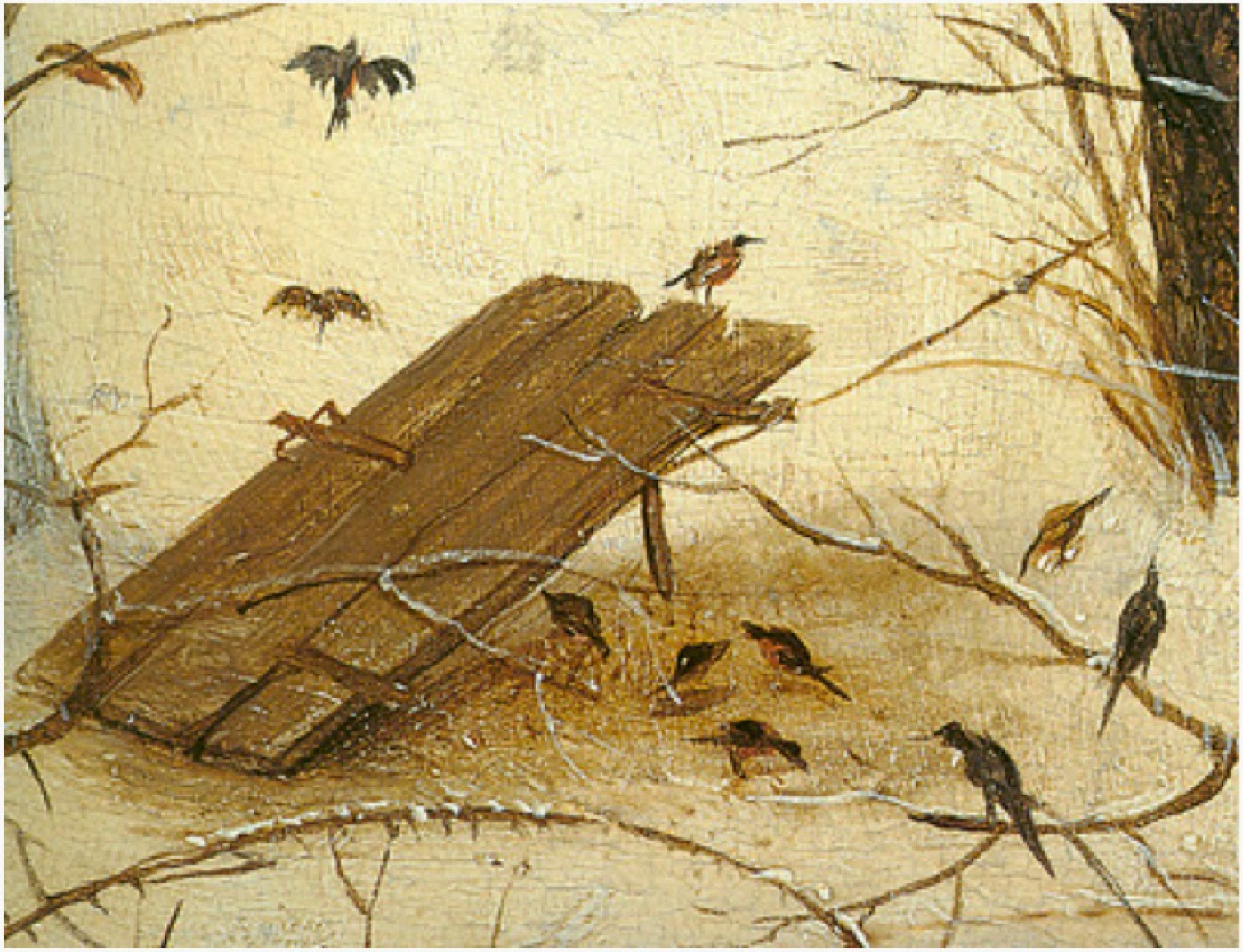 The Bird Trap 1605
In ‘An allegory to love’ he shows a woman absorbed in her own image in a Mirror while allowing herself to succumb to a passionate courtier, illustrating that vanity will only lead to false love and idols.
 An Allegory to Love, by Jan Brueghel
Sin: Loving but learning
But are his and the dynasty's paintings merely warnings? Do they have a moral superiority? Are they judgemental? Is it Brueghel’s intention that a sinner be changed by looking at his paintings? Be it lust, anger, greed, envy, laziness, vanity or covetousness that is your weakness, will looking at a Bruegal ever help you face your faults? Does a painting which is judgemental invites a person to really think. A judgemental painting merely invites a vigilante mob of stone throwers, seen quite clearly in Brueghel's image of the adulterous woman.
 The Adulterous Woman
The Breughel dynasty was a big enterprise, consisting of Breugel the elder and his two sons, Jan and Pieter, plus other artists who joined. Their spreading of the word of God is not attained by criticism and judgement, but rather understanding and love, striving to understand the current trends of thinking and behaviour, rather than condemn human beings for their failures.
It seems that by observing the foibles of others, one can recognise those same foibles in the self and can be used as reminders and warnings to keep making the mistakes of children, for life is too short. Greek thinker Epictetus said that it is only when we stop blaming others for our misfortunes and see the fault in our own action that we begin to find inner peace and love.
Growth and Empathy
Breughel’s paintings show the pains of life with empathy and yet the ever prevalent landscape, glowing in the rear is a reminder that there is always faith. Life is perilous and we are vulnerable. It is a hard way, and with care and attention, you can tread carefully.
“Enter by the narrow Gate. For the gate is wide and the way is easy that leads to destruction and those who enter by it are many. For the gate is narrow and the way is hard that leads to life, and those who find it are few,”
Booze, excess, lust, anger… are lessons for us and we can learn from misfortune and grown. If we do not learn from our mistakes and reflect on the old morals left to us by the dead wise, Brueghel warns us that peril and destruction await. We must also take care with whom we invest our trust. The blind leading the blind, shows a line of blind men falling into a hole.

Many of his paintings are currently on view at the exhibition 'La dynastie Brueghel' at the Pinacothèque de Paris, Madeleine, Paris until 16 Mars 2014


January 13, 2014
Lars Von Trier: Nymphomaniac. Should our dark side be explored?
 Fishing for men: Nymphomaniac, Lars Von Trier
Usually we are so ashamed of our dark side, we put it away and leave it to fester in some dark cupboard under our consciousness. Unconsciously it rots away like an untreated wound that we ignore, never brought to the light of day.
Notorious for bringing out the unexamined in our society, Lars Von Trier has created the film ‘Nymphomaniac’, the story of a woman who is obsessed with having serial sex.
In the story, a man called Seligman discovers a woman lying on the pavement, seemingly beaten to a pulp. Her nose is bleeding, she has a black eye, her legs are covered in sores. Though the man tries to call an ambulance, the woman begs him not to. She asks instead for a cup of tea.
So Seligman takes her into his house and snug in clean sheets and warmed by hot tea, he coaxes her into telling him how she got her wounds.At first the woman sees herself as ‘bad’ and is afraid to reveal her dark side, but Seligman encourages her to continue her tale, saying that “no human being is bad”
So the woman, whose name is Joe, launches into her story, from her early erotic experiences, the loss of her virginity and the growth of her obsession with sex. The audience is voyeuristically led to view her early experiences and feel alarmed at the mass pick-ups in train toilets, the tallies she kept of her conquests and the droves of lovers who came to her apartment each night.
Seligman remains calm as a listener, encouraging her that her behaviour resembles that of ‘fly fishing’ He compares her catching of men in the train corridors as the use of ‘nymphs’ to fish for trout. The upstream presentation is often the easiest and most effective for nymphs because you are downstream or directly behind the fish. While you are in the trout’s “blind spot” (directly behind it) you can often get close to the fish—regularly within 30 feet or less.The girl, Joe, then describes her experience of seeing her dying father. Joe admits to having multiple sex in the hospital basements while her father is dying.“It’s only natural that you would want something to help you with the pain of such an experience” suggests Seligman.
He parallels the manner of Joe’s father’s death to Edgar Allen Poe’s own death, from suggested alcohol and drug abuse where he was found trauma, vascular disorders in the brain, neurological problems such as epilepsy, and infections. Alcohol withdrawal is also a potential cause of tremors and delirium, and Poe was known to have abused alcohol and opiate drugs.
Then, when Joe tells about a love story with Jerome, where she is forced to feel sensation and is alarmed at being unable to control its sensation, realizing that ‘making love’ leaves her unable to feel anything. In wrought panic she cries “I can’t feel anything” The de-numbing process, though begun, is too much of a feat and too frightening a venture for her…
Nymphomaniac explores the beauty of illness, and embraces our dark side with empathy, forcing us the audience to also have empathy. It explores the reasons a person resorts to addiction and shows the journey of an addiction, and the ‘numbing of all feeling and empathy’ leaving the addict in the full sway of danger without realizing it, where, at one stage Joe even uses a strategy for throwing dice in thinking of replies to her men. Number ‘one’ means “I never want to see you again” and number ‘six’ means “I’d like to see you tonight” This gives a sense of ‘russian roulette’ to her meetings shows the madness of her addiction.
However Seligman compares her behaviour to that of Bach, pointing out that he used a number of formal mathematical patterns when he composed his majestic organ fugues. Bach used, for example, the "golden section" as well as the Fibonacci succession (1, 1, 2, 3, 5, 8, 13 etc., in which each number in the succession is the sum of the two previous ones). In many ways he worked like an architect, joining the two different parts of a musical piece into one harmonious whole before the actual process of composition started.
The film Nyphomaniac (part one) explores the complexity of humanity and that it is only embracing and bringing to light the complexity that we can really love and understand it.
Deepak Choprah said: “The shadow self seems to be the opposite of love. Actually it is the way to love”
For me, the alarming gratuity but enlightening examination of humanity and nymphomania in Lars Von Trier’s film is a very real route to love.

December 30, 2013
Is true love's flame enough?
 The Old Flame by Keziah Shepherd
The famous wise king Solomon once said, that “many waters cannot quench love” True love is like a flame. All the monsoon rains, hurricanes, and floods cannot put out the flame of love.But for a flame to flourish as a relationship, it needs three components : Fire, Air and Fuel.The problem for the character Katie, in the Old Flame is that she struggles to attain some of the components. Will she manage to feed all the necessary components of true love flame, as she blindly searches to keep her flame blowing ?The first component for her is easy : there is so much physical and sexual attraction between her and her dream man. It is like “Wow!”… she can hear angels and music…… and initially cannot get over this person. The attraction is overwhelming. Pheromones abound. Electricity and chemistry are constantly zapping and bubbling in and around. She feels an obsessive need to have her feelings reciprocated. But then next necessary part is Intimacy. She needs intimacy leads to attachment, to create closeness and connectedness. She has her chances, hoping to bond with her dream man.Intimacy grows first by spending a lot time with another person. Then it grows deeper by sharing with one another every aspect of our lives. Intimacy is built on trust and safety. If you cannot trust and feel safe with a person then intimacy disappears and will degenerate into distrust and suspicion.Since intimacy takes patience to develop, many are not prepared for such task. It is work. It implies a lot of talking and disclosure. If a person has been hurt with a previous partner, then they will have great difficulty finding closeness due to previously existing walls of distrust. The tendency will be to project past hurts on the present relationship.Katie finds this a difficult task and intimacy seems harder and harder, especially with her history of distrusting others.The final part of the flame is commitment. Commitment implies the ability to stay connected no matter what. A mature person is one who can work through misunderstandings and hurts. A key to staying together is believing the best of the other person, not prejudging them with bad motives. It is working positively to resolve issues. For a couple to stay together they must consistently break through the barriers of being hurt while assuming that the other person wants to resolve the issue also.If Solomon is right, true love's flame will keep burning and one day all the components will one day be put in place. Read Katie’s story about her Old Flame available now reduced from 2,99 dollars to just 99 cents.

December 17, 2013
Christmas near the Gare de l'Est, Paris

At first I wanted to have coffee somewhere but didn't know where. There was a chill wind, biting and scratching my face and it had stripped the last honey gold leaves off the trees. It was a Wednesday around 14:00.
I went up to the station itself, with its huge arched window, a semi-circle of glass segments above which is a large, full moon clock. There was a little wooden house selling specialities: paté de foie gras, Saucisse d'Alsace, gingerbread, sable, mustard and pots of honey. The cab wheels clattered over the cobbles and I went to Café Flo, a chic little place with an expensive menu.
Shocked by the prices, I went to the café in the station. It was near the destination board and reverberated with the drone of trains, the gabble of travelers and the purr of suitcase wheels.
But finding it too droughty, I left the station and wandered over the road to find a cosy little café. It had red velvet seats and a christmas tree, which looked rather fat and drunken and about to topple over. It was covered in odd shaped baubles. Beyond it were too women dipping into their discussion with as much gusto as the food they were eating. They didn't notice me drawing them.
I ordered first an 'omelette nature' with green salad, followed by a crepe covered in cannelle. To wash it all down, a 'café creme' while doing sketches of the women. I drew under the table, snatching away their movements like a thief and storing them in my book.

December 14, 2013
Want versus Need : two characters desire one another but is this what they need?
New Novel : One Morning in Paris
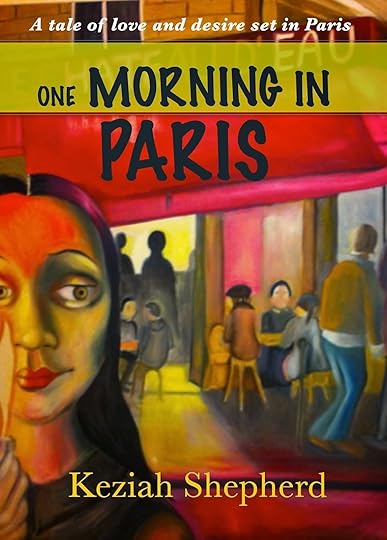
Frequently, there is a conflict between what characters want and what they need. Often we are blind to what we really need and instead exert all of our energy pursuing what we want.
“You can’t always get what you want… but if you try some time, you get what you need” Rolling Stones
It may be that the character desires a relationship that is unattainable or unsuitable. These opposites might battle and one day find love. Finding a juicy discrepancy between the protagonist’s needs and wants and dramatising these opposing forces in the path to a compelling story.My novel is about two characters who want one another but that is not what they need. What they need is to heal their inner wounds from other sources. No Relationship just happens because of attraction. How can any couple learn such things from the source of the other, like vampires, especially if they’ve lived only dysfunctional relationship in the past? What is needed is work on all the areas of love: celebration and gratitude, helping, forgiveness, carefrontation, humour, respect, mindfulness, compassion, loyalty and creativity.
The characters in my novel face these truths. Confucius says:"Life leads the thoughtful man on a path of many windings. Now the course is checked, now it runs straight again. Here winged thoughts may pour freely forth in words, There the heavy burden of knowledge must be shut away in silence. But when two people are at one in their inmost hearts, They shatter even the strength of iron or of bronze. And when two people understand each other in their inmost hearts, Their words are sweet and strong, like the fragrance of orchids"


Frequently, there is a conflict between what characters want and what they need. Often we are blind to what we really need and instead exert all of our energy pursuing what we want.
“You can’t always get what you want… but if you try some time, you get what you need” Rolling Stones
It may be that the character desires a relationship that is unattainable or unsuitable. These opposites might battle and one day find love. Finding a juicy discrepancy between the protagonist’s needs and wants and dramatising these opposing forces in the path to a compelling story.My novel is about two characters who want one another but that is not what they need. What they need is to heal their inner wounds from other sources. No Relationship just happens because of attraction. How can any couple learn such things from the source of the other, like vampires, especially if they’ve lived only dysfunctional relationship in the past? What is needed is work on all the areas of love: celebration and gratitude, helping, forgiveness, carefrontation, humour, respect, mindfulness, compassion, loyalty and creativity.
The characters in my novel face these truths. Confucius says:"Life leads the thoughtful man on a path of many windings. Now the course is checked, now it runs straight again. Here winged thoughts may pour freely forth in words, There the heavy burden of knowledge must be shut away in silence. But when two people are at one in their inmost hearts, They shatter even the strength of iron or of bronze. And when two people understand each other in their inmost hearts, Their words are sweet and strong, like the fragrance of orchids"
November 30, 2013
Should a painter use a camera?
Should a painter use a camera?
 Cafe Beaubourg, ParisThis is my most recent painting. It happened quite unexpectedly in the square in front of the Pompidou Centre in Paris, called ‘Place Beaubourg’ It was quite unplanned. This square is one of my favourite places in Paris, and around the corner there is this fantastic fountain of kinetic sculptures made by Tinguely and Niki St Phalle.Anyhow, last week, however, I went to visit Amsterdam. There I saw the delicate paintwork of Vermeer’s ‘Milkmaid’. I saw how the white drops of paint fell like milk itself over the figure to show the traces of light that fell upon her through the window. The painter used the ‘camera obscura’, a device that projected the image into a box, to help the painter reach greater truth in observation, giving reverence to nature.I asked this question to the artist Danny Gregory. “Should an artist work from a camera image?” His answer was mostly “no” He said that drawing your world from a flat image doesn’t capture its three dimensional sensation, the sensation of really living WITHIN it. I thought about this. I mean, basically we are a solid mass of molecules and atoms, lurking among a whole lot of other molecules and atoms and it is just a unique, crazy coincidence that a clown will walk passed, a little girl with laugh and a waitress smile… these things happen at a mathematical meeting point of time, space and motion. The sketchbook IS the seismic recorder of this crescendoing meeting point… a painter records the experience of living emotions in a moment of happenings, just as a seismoniter records the tremblings of the earth’s plate tectonic movements.Only sometimes, in the composition process, can some forgotten information about the scene, not captured by sketch, be found in a quick camera shot.
November 19, 2013
Nick Cave thanked Muriel for special things, Zenith Concert, Paris, Tuesday November 19th
“Thank you Muriel, for those special things” said Nick Cave tonight, at his concert in the Zenith, Paris, looking at a member of the audience. Well I was left at the end wondering ‘Well, who was Muriel?’ and no doubt the whole packed concert hall wondered. What special things he was meaning?
 Vampire hankering for love
I thought back over the concert, and wondered who Muriel had been. There was something different about this concert, it was true. The last one I saw was Grinderman: and there was longing... a longing for something, like a vampire, being haunted at night for something it hungered.... This concert had a new feeling. Was it during ‘From here to Eternity?’ Then ‘Jubilee Street’?
As soon as Nick had come on, he inspired the same hoots and howls and cries as one would hear in a bullfighting amphitheatre… something about his bull like tread, his determined pace, and his will to get his songs sung. Something about his gold latex Elvis shirt, unbuttoned to reveal an unhairy chest, something about the paradox of the sensitivity and violence in his songs… the hurt and the anger…He capered about the stage on black pipe cleaner legs, his black eyes in a trance, his black hair falling down his back like a cloak.
The Bad Seed Band stood behind with a ghostly menace, with Warren Ellis at his most rampaging and most whining, with violin and sometimes a flute at its most haunting…hurrying around while Cave paced with the passion of a Heathcliff in full sweat….
The songs crescendoed, became louder, the audience more excited, it seemed that the next song had to be more passionate, more drums… only then, flirtily, he came to the front of the stage and took the hands of his adoring fans. He stood upright among the lily long hands which waved about his waist, plucking at his belt straps, as he was singing a song from his new album, Push the Sky away, Mermaids… something about the unproveable being proved:‘I believe in God,I believe in mermaids…I believe in rapture,For I have seen your faceOn the floor of the ocean’
The curtains at the back are velvet red and the lights bright as flames, the effect like red hot glowing coals.. Mercy Seat plays, and the audience is a rapt rhythmic meadow of fists…Then Nick Cave says “This is a Classic,” and we hear ‘West Country Girl’, a song about PJ Harvey.With Nick Cave there is a story, always a story, something about having seen not only the devil… but also the face of god… the story of a journey … a path, Suddenly from being a bull ring of ruthless fans, the concert calms…becomes intimate… you might hear a pin drop…the Zenith, once stadium large, is small and all are silent, huddled around Cave at his guitar. Even the noisy caterwaulers are quietened into intent babes having stories… and ‘Into your arms’And I believe in LoveAnd I know that you do tooAnd I believe in some kind of pathThat we can walk down, me and youSo keep your candles burningAnd make her journey bright and pureThat she will keep returningAlways and evermoreIn ‘Into your arms’a gangly, wiry mover, full of thrilling shakes and skips, Nick Cave caused an oven of pleasure, a Johnny Cash or Elvis Presley. Followed by God is in the House, Higgs Bosun Blues, there was always the preacher in him ‘Push the Sky Away’… words that rock and comfort… voice that is gritty but full of emotion… sometimes screaming like a Halloween horror ghoul… sometimes heavenly in love, a romantic… this spectrum of emotions moves the packed Zenith.
“If you got everything and you don’t want no moreYou’ve gotta just keep on pushingKeep on pushingPush the sky away’
But it’s when the audience is virtually carrying him, when he wades into the crowd and this is when Muriel must have done the ‘special thing’. He is holding the hands of the front row, as they reach up to him, like small children in cots. He sang the lines:
‘Yeah, I'm stagger lee and you better get down onYour kneesAnd suck my dick, because if you don't you're gonna beDeadSaid stagger lee
But this must have been where Muriel came in, when he was swinging his hips and swaggering in a hip high clump of adoring hands, for one wouldn’t have been surprised if someone was willing to do this for him as he basked in the love.
But no-one could fault the amusing swaggers of his groin in Muriel's direction... for it was not love given him, but love he has given… love and humor he has inspired… for with Nick Cave, his loves have helped him to vault those trappings and let love in big time… so the vampire in him seems soothed and fed....and by a presence of love in that Zenith tonight.

November 12, 2013
How did Victorian painters get to be erotic and risqué and STILL get Queen Victoria's blessing?
With Queen Victoria's famous era of covering up the female body, with its huge hoop skirts and suffocating corsets, it seems a miracle that painters of her era managed to get so many nipples and dimpled bums into their paintings.
 Venus Equilina by Alma Tadema
 So what did Victorian painters do to get around the rules of Victorian straightjacket morality and allow their voluptuous female nudes full reign to run a mock?
In order to slip by Victoria's tight dress code, the painters of the day went out of their way to ground their work in an historical context. Alma Tadema visited Pompeii, and while the Victorians were digging up its treasures, he was sketching away, inspired by Greek and Roman antiquity, and setting the ball rolling by cleverly placing his delightful and desirable nudes in acceptable mythical contexts, making it proper and learned. And Frederic Leighton picked up from where Ingres left off. He was inspired by Ingres' very classical nudes, he continued this tradition, as did Waterhouse, Talbort Hughs, Strudwick and Emma Sandys with their paintings and studies set in historical and mythical contexts.
The painters took pleasure in illustrating traditional literature. Greek and Roman mythology, Medieval legends, Shakespearian poetry were some of the more acceptable settings in which to place their sexy nudes and desirable ladies.
But perhaps it was the romantic poet John Keats who paved the way for their them, arguing that beauty indeed be in the 'eye of the beholder'. In Endymion he wrote"A thing of beauty is a joy for ever: Its loveliness increases; it will never Pass into nothingness"
With such an insight as Keats, painters could show that inner appreciation could be expressed in outer form. This was perhaps what painters were inspired by the most. The naked nude became a symbol of all that they wished to reach for, strive for, fight for and desire. Influenced by the Pre-Raphaelites such as Rossetti, Millais and Hunt, the nude is a Femme Fatal, alluring, beautiful, cruel and enchanting. The nude is a muse, motivating a painter to strive with love and joy for this inward sense of beauty. The nude is the metaphor for beauty, something which inside feels unseen, unknown, yet when presented externally can be touched, viewed, loved in physical form. Shakespeare best describes this when he writes in 'Alls Well that Ends Well':"What power is it which mounts my love so highThat makes me see and cannot feed mine eye?"
Like a mirage the Victorian nudes hovver, just out of grasp, desirable, unattainable, visible. They are pulpy, soft, with longing eyes, tempting lashes and 'come-to-bed' eyes. They are Venus or Persephone, Siren or Cordelia. They are an internal striving for love, pole stars to strive for, metaphors representing the inner, unquenched desires.
They are a prize, everything to work for and desire for, the reward for courtly love, the reward of hard work, of respect, of love, of creativity; they cause the flourishing of high mindedness and the attainment of deep desire.
Which are, of course, all things Queen Victoria believed in. And her era flourished. Architecture, industry, literature flowered. There was the construction of the Victoria and Albert museum, the Royal Albert Hall, the railways an viaducts, the composing of Wagner and Gilbert and Sullivan, the work of Dickens, Wilde, Trollop and Hardy, the poetry of Swinburne, Tennyson and Meredith (although it must be noted that Wilde was imprisoned for homosexuality, showing that love had still not had chance to dissolve much of the corseted, cruel mind of Victorian society)but at least the nude had its liberty there, and who better to host the exhibition but art collectors Edouard André and Nélie Jacquemart, whose home on the boulevard Haussmann was later turned into the Musée Jacquemart-André. The couple's love of art resulted in a fantastic collection which you can visit and see in the many boudoirs and banquet rooms, and where upstairs you can see the exhibition of Victorian painters entitled 'Désirs et Volupté' (running until 20th January 2014 )

October 24, 2013
Matthew Barney transforms underground biblioteque de Nationale de France François Mitterrand, Paris, into a place of Osirian initiation
Matthew Barney transforms underground the bibliotheque Nationale de France François Mitterrand in Paris into a place of Osirian initiation
 Image from exhibition Subliming Vessel by Matthew Barney
Today I went to see 'Subliming Vessel: The drawings of Matthew Barney'. At the end of at a long corridor under the ground, were Matthew Barney’s drawings. On first entrance, I snooped my way through a glass covered cabinet and tiny pencil drawings, and like Goldilocks, nosed my way into the glass like a peeping Tom at curiosities, private scenes and freak pictures: an anus excreting, an erotic Japanese print of a couple having sex, a man putting his penis into a car exhaust pipe…. A hermaphrodite with a beehive body, a murderer, a corset, Equis, an Anubis being born, a goat portrait and man with goat shaped face, a Masonic pentagon, a Norman Mailer book, extraordinary feats of Houdini, a bloody chopped off penis ….
My first sensation was visceral. My senses were stimulated by the sights of these images. Drawings were made with chemicals : oxidised iron powder, petroleum jelly, smelted metal, ground topaz, brimstone, sulphuric acid. Sights and oddities, incongruous and strange contradictions : a bull-fight and a whale catcher ; a ravine of snow and a butterfly bush…. Sounds of bagpipes and the noises of whales…. Tartan fabric and delicately coloured papyrus paper.
Yet as I continued my journey, recurrant images embellished the first sightings, creating a thematic rhythm, highlighting their importance as exquisite as any outlining in any drawing. The bagpipes and the tartan, the pan pipes and satyrs, the contemporary myth and the old myth, making the cohesion happen, making sense. I travelled further into the mind via this vehical of drawing. The images began to take on a sensible cohesion, and I felt I had entered the artist’s mind and understood his creative process and his method of gathering his ideas and recording his intuitive connections.
The exhibition is a sketchbook and includes 80 drawings, very delicate, almost pointillists studies, carefully reconciling the contradictory nature of ideas, some used for his films such as the Cremaster Cycles. Gradually, the recurrance of repeated images from myth and dream and architypes begin to draw the mind into more of a timeless state, where suddenly you are reminded that a modern icon : a Marilyn Monroe or the Chrysler building or a free mason’s pentagon are just reoccuring mythologies and that the humans involved in them are heroes of our time. The Chrysler building is the Djed of Osiris, god of the afterlife, and a civilisation transforms into myth in order to civilise its people and yet inside the order of a myth is the creation of the myth, the inside from the outside and here we see the inside of the myth and its alchemical powers before it has been galvanised and hardened into an external myth.
Beautifully, the frames of the outer are made of prosthetic plastic… to express this inner and outer state of things. Further trance-like meditation happens through study of the tiny graphs showing the invisible state and balance of rest and intake in which resistance is produced, a necessary state in which “self-imposed resistance placed upon an organic body is a prerequisite for development and a vehicle for creativity…..” and metaphors, such as a photo of the Ise Shrine, re-built every 20 years to symbolise the impermanance of things while ensuring the transmission of building techniques for one generation to the next…. Show the ressurection of physical form in different forms.
Such ideas carry the mind further into this underground chamber. Like rites of initiation, each metaphor and idea transforms the mind from being images of a constrained civilisation to where the exhibition itself transmutes these so that we feel the artist’s own initiation and his own self-mastery of mankind’s animal nature creating the integration on show, the initiated being. Trance aroused by film, pipes, sensual liquids, this show is a hidden underworld of secrets… secrets of a French cultural heritage and secrets of an artist’s own personal mythology.
The intoxication of this vat of image, physical or spiritual, the initiate recovers the intensity of feeling which prudence often destroys and I walked out of that place feeling the world full of delight and beauty, and my imagination is suddenly liberated from the prison of everyday preoccupations. Matthew Barney’s ritual produced 'enthusiasm', a god entered me down there in that underground Library…..