Keziah Shepherd's Blog, page 3
July 31, 2015
Jean-Paul Gaultier transforms the clothing that separates into clothing that celebrates
The Jean-Paul Gaultier exhibition, recently on show in Paris's Grand Palais, brought to mind the ambiguous meaning of the word FASHION.
In a positive sense, the word fashion suggests a new birth. Fashion is the creative results of new costumes that are to usurp old ones. They are the setting of new trends, new ideas born out of the mind, set on paper and then sewn with fabric and the expression of new identities and self-expression in an ever evolving world of people and ideas.
In a negative sense, however, the word fashion can also mean a trend which draws the masses like a flock of sheep. Thoughtlessly people wear its robing to become members of a mass and hide from their true self. In looking like everyone else, joining the 'fashion', there is no danger of attack or danger of misunderstanding, for humanity at its worst has been known to burn those with interesting, new and eccentric ideas. Fashion can become a dreadful snobbery, causing people to judge others because of their 'fashion labels' and making people hide behind their clothes in fear of not being accepted and not having any status or street cred.
For me, the Jean-Paul Gaultier exhibition removed all skeptical doubts about the negative effects of fashion. This creator has defied the dangers of fashion becoming a uniform by embracing lovingly the uniforms themselves. Playfully he creates hybrids of the old traditional fashions with new: taking traditional nationalistic fabrics and flags and transforming them: Scottish tartan, Kente cloth from Ghana, Army kharki, black sado-masochist leather, Russian ermine, native American feathered head dresses.. and these are transformed into garments for the catwalk. There is a sense of celebration of past tradition by merging it with a creative present.
 Necklace made from bullets and dress made from camoflage army fabric
Nothing is usurping anything in the world of Jean-Paul Gautier. All is loved, tolerated, enjoyed and celebrated. Gaultier is no dictator. His appreciation of difference, of individuals and uniqueness is what makes him a master. His social preoccupations set him apart. He creates a universe we all want to live in, where he embraces with humour, kindness and artistry a coherent and cosmopolitan world.
Born in 1952, he was inspired at age 6 by the Folies Bergères and dressed his teddy bear in feathered head-dress and a conical bra. By 1980 he started his own company and had introduced his conical breast corsets, his skirts for men, his sailor suits and developed a faith in his own judgement.

Madonna was one of many artists to support him by wearing his clothes. In I992 she posed topless in one of his outfits at Amfar.

The exhibition not only shows the stunning, imaginative costumes that are works of genius that he has produced over the years but includes some extraordinary moving mannequins, who talk and who reflect.


April 30, 2015
TEN REASONS TO GO TO AN ORGY
Ten Reasons to go to an orgy
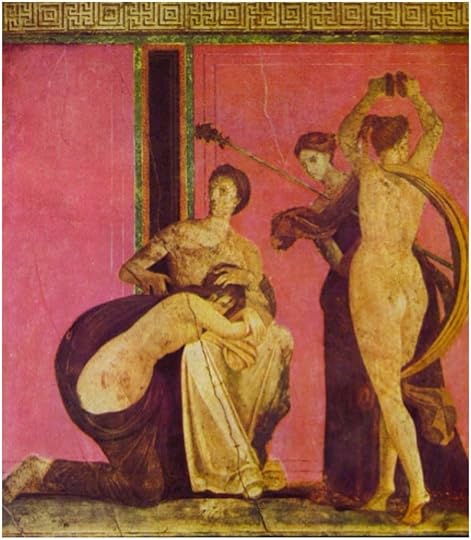 image from the Villa of Mistiri in Pompeii
The exhibition, currently on show at the Petit Palais in Paris is ‘'Les Bas-Fonds du Baroque’ and is showing 70 paintings of artists living in Rome during the 17th century baroque, interested in the Bacchian orgiastic life of their Roman forefathers.The artists of the time were living in the area around the Villa de Medici and had travelled down from France and Northern Europe.
French artists included Valentin de Boulogne, Simon Vouet, Nicolas Tournier, and Claude Lorrain. Artists from Northern Europe were Pieter Van Laer, Gerrit van Honthorst, and Jan Miel; and from the South, Bartolomeo Manfredi, Lanfranco, Salvator Rosa, and Jusepe de Ribera.
However, these paintings are more about the outcome of excess rather than a full appreciation of the thinking of ancient Rome. The Roman Empire was a hugely creative era and while being famous for its inventions, from aqueducts to domes and roadways, it was also famous for its orgies.
The OrgiesMany ancient traditions use extreme states to push through to sacred visions. Devotees of Bacchus engaged in ritual orgies, using wine and sexuality to attain altered states. At this time in ancient Rome, it was thought that this type of revelery was good for the soul. Through the arduous process of bringing the unconsciousness to light, a person was able to reach his mythic roots.
Bacchus was also the god of creative inspiration and the worship was an effort for the attainment of divine ecstasy. The darkness of this journey is what made the frenzies necessary; they were not an end in themselves; and the orgies were a way of smashing the shell of waking consciousness to arouse the sleeping divinity within.
Here are ten reasons to go to an orgy:
1. LEARN TO LET GOTo shed your old, ensnaring thought processes, go to an orgy. It was a way to transcend from the bondage of habits and mental programming.
2. LET GO OF EARTHLY ATTACHMENTS, LEARN NON-ATTACHMENTIf you are possessive, … go to an orgy! At an orgy, everyone belongs to themselves and are free
3. STOP BEING JUDGMENTALIf you are a bit pudic and religious fearing, and want to shatter those old behaviours, judgements and mindsets, go to an orgy. Bacchus represents freedom and transgression!
4 BONDAll Earth’s creatures are special. Bacchus’s acolytes were Satyrs, Silenus or Pan, all creatures of nature
5 OPEN YOUR BOUNDARIES If you awaken your Bacchus within, you should eventually find your spiritual path so that you're no longer living life the same old way and constricted
6 HEAR YOUR INTUITION A lot of artists found wine inspiring and free love. Bacchus also awoke creative ideas.
7. DISSOLVE YOUR INHIBITIONSShow your wobbly bum in public and don't be afraid
8. HEAR LOVE AND NOT EGOInspired by Bacchus, you are more likely to listen to the voice of lover rather than the voice of ego. Ego is fear, judgement, self-criticism. Whereas love is acceptance, liking, understanding compassion….
9. APPRECIATE YOUR SENSES. Bacchus promotes the exaltation of the senses, Let your senses enjoy themselves. Sensitivity, sexuality and sensuality are gifts in life: appreciate them!
10. CONNECT TO A WHOLEOpen to others and open your mind. Though these occasions happened secretly, they were very open and sharing and nobody was excluded. Everyone in the group was loved.
Some of painters at the Petit Palais explore the ideas of these ancient roman orgies. A group of painters called the Bentvueghels reveled in the occult and various intemperate vices, spending their time in brothels and taverns. In order to join this group, new members would go through Bacchanalian initiation rites, indulging in censured activities and performing black magic spells and enchantments.
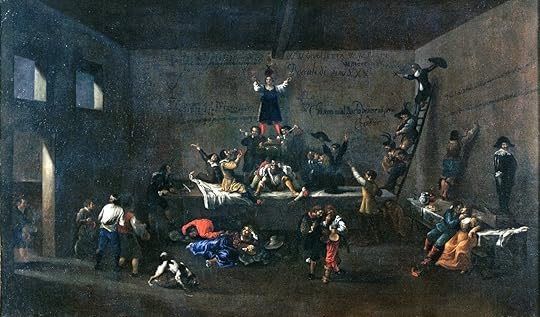 Roeland van Laer’s painting shows syphilitic drunkards in “The Bentvueghels in a Roman Tavern”But most of the work of the exhibition looks at the result of excess. Even any eroticism is often pictured as lurid and sordid. It involves prostitution, deception, manipulation. Two painting use figs and fingers suggestively to insinuate sex, using an image from Dante's Inferno
Peter Van Laer did a self-portrait of himself as a sorcerer's apprentice. Eventually his excesses made him lose his mind and become a victim of depression.
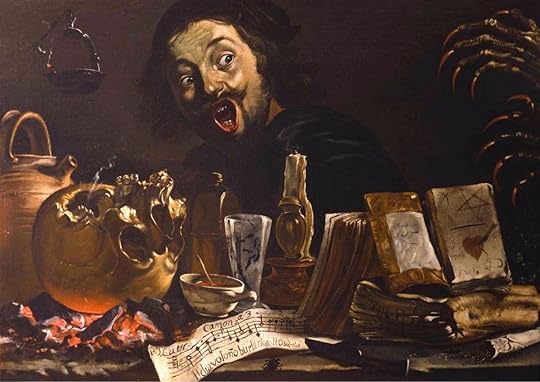 Peter Van Laer self-portrait as a sorcerer's apprentice
Angelo Caroselli painted a young witch overwhelmed by demonic forces, also as a result of excess.
Many paintings ask the ambiguous question: are the aphrodisiacs or wines used to awakening people or actually just to send them to sleep and lose their sense of connection to the earth and their mythic unconscious, Bacchus, the god so lively, inspired, inventive and alert to new ideas, is not awoken in them at all?
Later paintings in the exhibition show people in a trance-like states caused by wine, where the consumers have lost their reason and any music causes trance rather than have any magical effect.
Claude Lorrain paints prostitutes in his and though the sunset distracts, there is still a bleak reality and other painters show beggars with red noses, gypsies, rapscallians, bandits and some of the portraits of the margins of Rome, far away from its glories.
This exhibition explores the theme of excess in Rome. Maybe the painters were making that comment that there is a delicate fineline between Bacchus’s magic powers and the dreadful abyss that is just below the veneer of Rome, with its stately buildings, taking you to a dark underground world, where you could fall into and never return.
The exhibition runs from 24th February to 24th May 2015
 image from the Villa of Mistiri in Pompeii
The exhibition, currently on show at the Petit Palais in Paris is ‘'Les Bas-Fonds du Baroque’ and is showing 70 paintings of artists living in Rome during the 17th century baroque, interested in the Bacchian orgiastic life of their Roman forefathers.The artists of the time were living in the area around the Villa de Medici and had travelled down from France and Northern Europe.
French artists included Valentin de Boulogne, Simon Vouet, Nicolas Tournier, and Claude Lorrain. Artists from Northern Europe were Pieter Van Laer, Gerrit van Honthorst, and Jan Miel; and from the South, Bartolomeo Manfredi, Lanfranco, Salvator Rosa, and Jusepe de Ribera.
However, these paintings are more about the outcome of excess rather than a full appreciation of the thinking of ancient Rome. The Roman Empire was a hugely creative era and while being famous for its inventions, from aqueducts to domes and roadways, it was also famous for its orgies.
The OrgiesMany ancient traditions use extreme states to push through to sacred visions. Devotees of Bacchus engaged in ritual orgies, using wine and sexuality to attain altered states. At this time in ancient Rome, it was thought that this type of revelery was good for the soul. Through the arduous process of bringing the unconsciousness to light, a person was able to reach his mythic roots.
Bacchus was also the god of creative inspiration and the worship was an effort for the attainment of divine ecstasy. The darkness of this journey is what made the frenzies necessary; they were not an end in themselves; and the orgies were a way of smashing the shell of waking consciousness to arouse the sleeping divinity within.
Here are ten reasons to go to an orgy:
1. LEARN TO LET GOTo shed your old, ensnaring thought processes, go to an orgy. It was a way to transcend from the bondage of habits and mental programming.
2. LET GO OF EARTHLY ATTACHMENTS, LEARN NON-ATTACHMENTIf you are possessive, … go to an orgy! At an orgy, everyone belongs to themselves and are free
3. STOP BEING JUDGMENTALIf you are a bit pudic and religious fearing, and want to shatter those old behaviours, judgements and mindsets, go to an orgy. Bacchus represents freedom and transgression!
4 BONDAll Earth’s creatures are special. Bacchus’s acolytes were Satyrs, Silenus or Pan, all creatures of nature
5 OPEN YOUR BOUNDARIES If you awaken your Bacchus within, you should eventually find your spiritual path so that you're no longer living life the same old way and constricted
6 HEAR YOUR INTUITION A lot of artists found wine inspiring and free love. Bacchus also awoke creative ideas.
7. DISSOLVE YOUR INHIBITIONSShow your wobbly bum in public and don't be afraid
8. HEAR LOVE AND NOT EGOInspired by Bacchus, you are more likely to listen to the voice of lover rather than the voice of ego. Ego is fear, judgement, self-criticism. Whereas love is acceptance, liking, understanding compassion….
9. APPRECIATE YOUR SENSES. Bacchus promotes the exaltation of the senses, Let your senses enjoy themselves. Sensitivity, sexuality and sensuality are gifts in life: appreciate them!
10. CONNECT TO A WHOLEOpen to others and open your mind. Though these occasions happened secretly, they were very open and sharing and nobody was excluded. Everyone in the group was loved.
Some of painters at the Petit Palais explore the ideas of these ancient roman orgies. A group of painters called the Bentvueghels reveled in the occult and various intemperate vices, spending their time in brothels and taverns. In order to join this group, new members would go through Bacchanalian initiation rites, indulging in censured activities and performing black magic spells and enchantments.
 Roeland van Laer’s painting shows syphilitic drunkards in “The Bentvueghels in a Roman Tavern”But most of the work of the exhibition looks at the result of excess. Even any eroticism is often pictured as lurid and sordid. It involves prostitution, deception, manipulation. Two painting use figs and fingers suggestively to insinuate sex, using an image from Dante's Inferno
Peter Van Laer did a self-portrait of himself as a sorcerer's apprentice. Eventually his excesses made him lose his mind and become a victim of depression.
 Peter Van Laer self-portrait as a sorcerer's apprentice
Angelo Caroselli painted a young witch overwhelmed by demonic forces, also as a result of excess.
Many paintings ask the ambiguous question: are the aphrodisiacs or wines used to awakening people or actually just to send them to sleep and lose their sense of connection to the earth and their mythic unconscious, Bacchus, the god so lively, inspired, inventive and alert to new ideas, is not awoken in them at all?
Later paintings in the exhibition show people in a trance-like states caused by wine, where the consumers have lost their reason and any music causes trance rather than have any magical effect.
Claude Lorrain paints prostitutes in his and though the sunset distracts, there is still a bleak reality and other painters show beggars with red noses, gypsies, rapscallians, bandits and some of the portraits of the margins of Rome, far away from its glories.
This exhibition explores the theme of excess in Rome. Maybe the painters were making that comment that there is a delicate fineline between Bacchus’s magic powers and the dreadful abyss that is just below the veneer of Rome, with its stately buildings, taking you to a dark underground world, where you could fall into and never return.
The exhibition runs from 24th February to 24th May 2015
March 31, 2015
Katherine Mansfield: How to live life in BLISS
How to live life in BLISS

If you want to learn to live life in bliss, which everyone can, there are many things that you can do to get there.
I will give a list of some of the things Katherine Mansfield evidently did, from looking at her journals, letters to her editor and husband John Middleton Murray and stories.
She was conscious and mindful of the beauty of life
She noticed the signs in life around her that are meant for her alone
She heard her intuitions
She wrote down her insights into things
She was constantly evolving and changing
She took care at recording life around her, the birth of wasps, while watching a wasps nests for instance, with the Wonder of a child
She worked at becoming affectionate, open, trusting and intimate was honest and sincère with her husband, and the two enjoyed deep honesty
She cleansed her conscience by being true to herself, trying to become the best she could be.
She lived life bravely saying and once said “We resist, we are terribly frightened…I believe the greatest failing of all is to be frightened. ‘Perfect love casteth out fear’ When I look back at my life all my mistakes have been due to fear”
Sincerity is the key to self-knowledge and to be sincere with oneself brings great suffering. We have to explore the Fantasy and fear are covers… and Gurdjieff said that ‘until a man uncovers himself he cannot see’
“It’s only the fairy tales we really live by. If we set out upon a journey, the more wonderful the treasure, the greater the perils and temptations to be overcome”

What can the stories of Katherine Mansfield teach us about love consciousness ?
Katherine Mansfield was a great writer living between 1888 and 1923. She was who Virginia Woolf said « I was jealous of her writing… the only writing I have ever been jealous of »
Looking at the story called ‘BLISS’ that was written by Mansfield three years before the end of her life, we learn of the story of a woman of thirty, Bertha Young, who discovers that her husband is having an affair.
Most women would scratch out his eyes.
But we understand, as the story evolves how this character has learnt to see life differently. She has completely dissolved her self-defences of this kind.
How do we know the character lives in a state of bliss ?
Firstly Bertha is full of joy and gets happiness just from taking ‘dancing steps on and off the pavement’ and like Gene Kelly in singing in the rain facing the police inspector, is grevious not to be able express it without being ‘drunk and disorderly’
Bertha values the simple things of life. The colours of a bowl of fruit.
She notices a pear tree in full blossom ‘not a bud nor a faded petal’ and she feels it symbolises her inner state.
Pearl Fulton, her guest for dinner that night, connects with her silently, also noticing the pear tree.
Just that connection, the noticing of the pear tree bring the two women together and this connection and magic brings happiness to Bertha
However it becomes evident that Pearl Fulton is having an affair with Bertha’s husband.
Yet rather than feel anger or any other ego driven response, Bertha feels a sense of unknown, yet her faith in the pear tree remains. The story ends with the pear tree
‘as lovely as ever and just as still’ as if to represent her inner state, the chaos of her outer discovery has not caused any inner change.
The books symbolise show a state of conscious loving.
Unconscious love is that ‘lightening strike love’ where passion, jealousy, possession and all those things are rife, because we are not prepared for love.
Love consciousness is a way of loving. Gurdjieff, who was Mansfield’s spiritual teacher, said
‘He who can love can be; he who can be can do; he who can do is’
He also said:“To love one must first forget all about love. Make it your aim and look for DIRECTION[image error]. As we are we cannot possibly love”
To sum him up : we have to work hard to be lovers.
You have to be willing to go beyond all your ego-defenses to full unity. Also to make a commitment to going all the way with your own individual creative expression and observe the emergence of your defensive barriers every day, communicating about them honestly.
Mansfield was interested in the teachings of Gurdjieff. Her writing is often very child-like in its freshness.

“We must destroy our buffers. Children have none; therefore we must become like little children”
This is similar to the teachings of the Vedas, who said of humans ‘In bliss they were conceived, in bliss they live, to bliss they will return’
What is the difference between falling in love unconsciously, as if struck by a bolt of lightening, and consciously embracing love’s gift with full knowledge that this is what your soul craves, what you live for, what you will put foremost in your life?
In India the ecstasy of conscious love is called ananda or bliss consciousness. The path to love ends with the full realisation of this phrase ‘eternal bliss consciousness’
In the state of bliss, everything is loved. We were born in bliss but the state gets obscured in the chaos of everyday life
Gurdjieff said: “If our consciences were clear, and not buried, there would be no need to speak about morality, for consciously or unconsciously everyone would behave according to God’s commandments. Unfortunately conscience is covered up with a kind of crust which can be pierced only by intense suffering; then conscience speaks. But after a while a man calms down and once more the organ becomes covered over and buried”And of course, in Isiah 48, v. 10 there is the line“I have refined you in the furnace of affliction” which also mirrors this sense. Bliss is a refinement and we have to uncover ourselves, face up to our flaws in order to right ourselves. Mansfield did this by ‘writing’ or ‘righting’ herself.
Other posts of interest:
Ernest Hemmingway: Bookcase Puzzle in Cuba
Daniel Maximin: "Poetry is Emancipation"
Victor Hugo: to love another person is to see the face of God
Kafka’s Metamorphosis: How Art can be as Captivating as Dream
The wisdom of Confucius: How the I Ching can help you find the best answer
The Arabian Nights: how storytelling can nurture a love story

How to live life in BLISS
How to live life in BLISS
If you want to learn to live life in bliss, which everyone can, there are many things that you can do to get there.
I will give a list of some of the things Katherine Mansfield evidently did, from looking at her journals, letters to her editor and husband John Middleton Murray and stories.
She was conscious and mindful of the beauty of life
She noticed the signs in life around her that are meant for her alone
She heard her intuitions
She wrote down her insights into things
She was constantly evolving and changing
She took care at recording life around her, the birth of wasps, while watching a wasps nests for instance, with the Wonder of a child
She worked at becoming affectionate, open, trusting and intimate was honest and sincère with her husband, and the two enjoyed deep honesty
She cleansed her conscience by being true to herself, trying to become the best she could be.
She lived life bravely saying and once said “We resist, we are terribly frightened…I believe the greatest failing of all is to be frightened. ‘Perfect love casteth out fear’ When I look back at my life all my mistakes have been due to fear”
Sincerity is the key to self-knowledge and to be sincere with oneself brings great suffering. We have to explore the Fantasy and fear are covers… and Gurdjieff said that ‘until a man uncovers himself he cannot see’
“It’s only the fairy tales we really live by. If we set out upon a journey, the more wonderful the treasure, the greater the perils and temptations to be overcome”
What can the stories of Katherine Mansfield teach us about love consciousness ?
Katherine Mansfield was a great writer living between 1888 and 1923. She was who Virginia Woolf said « I was jealous of her writing… the only writing I have ever been jealous of »
Looking at the story called ‘BLISS’ that was written by Mansfield three years before the end of her life, we learn of the story of a woman of thirty, Bertha Young, who discovers that her husband is having an affair.
Most women would scratch out his eyes.
But we understand, as the story evolves how this character has learnt to see life differently. She has completely dissolved her self-defences of this kind.
How do we know the character lives in a state of bliss ?
Firstly Bertha is full of joy and gets happiness just from taking ‘dancing steps on and off the pavement’ and like Gene Kelly in singing in the rain facing the police inspector, is grevious not to be able express it without being ‘drunk and disorderly’
Bertha values the simple things of life. The colours of a bowl of fruit.
She notices a pear tree in full blossom ‘not a bud nor a faded petal’ and she feels it symbolises her inner state.
Pearl Fulton, her guest for dinner that night, connects with her silently, also noticing the pear tree.
Just that connection, the noticing of the pear tree bring the two women together and this connection and magic brings happiness to Bertha
However it becomes evident that Pearl Fulton is having an affair with Bertha’s husband.
Yet rather than feel anger or any other ego driven response, Bertha feels a sense of unknown, yet her faith in the pear tree remains. The story ends with the pear tree
‘as lovely as ever and just as still’ as if to represent her inner state, the chaos of her outer discovery has not caused any inner change.
The books symbolise show a state of conscious loving.
Unconscious love is that ‘lightening strike love’ where passion, jealousy, possession and all those things are rife, because we are not prepared for love.
Love consciousness is a way of loving. Gurdjieff, who was Mansfield’s spiritual teacher, said
‘He who can love can be; he who can be can do; he who can do is’
He also said:“To love one must first forget all about love. Make it your aim and look for DIRECTION[image error]. As we are we cannot possibly love”
To sum him up : we have to work hard to be lovers.
You have to be willing to go beyond all your ego-defenses to full unity. Also to make a commitment to going all the way with your own individual creative expression and observe the emergence of your defensive barriers every day, communicating about them honestly.
Mansfield was interested in the teachings of Gurdjieff. Her writing is often very child-like in its freshness.
“We must destroy our buffers. Children have none; therefore we must become like little children”
This is similar to the teachings of the Vedas, who said of humans ‘In bliss they were conceived, in bliss they live, to bliss they will return’
What is the difference between falling in love unconsciously, as if struck by a bolt of lightening, and consciously embracing love’s gift with full knowledge that this is what your soul craves, what you live for, what you will put foremost in your life?
In India the ecstasy of conscious love is called ananda or bliss consciousness. The path to love ends with the full realisation of this phrase ‘eternal bliss consciousness’
In the state of bliss, everything is loved. We were born in bliss but the state gets obscured in the chaos of everyday life
Gurdjieff said: “If our consciences were clear, and not buried, there would be no need to speak about morality, for consciously or unconsciously everyone would behave according to God’s commandments. Unfortunately conscience is covered up with a kind of crust which can be pierced only by intense suffering; then conscience speaks. But after a while a man calms down and once more the organ becomes covered over and buried”And of course, in Isiah 48, v. 10 there is the line“I have refined you in the furnace of affliction” which also mirrors this sense. Bliss is a refinement and we have to uncover ourselves, face up to our flaws in order to right ourselves. Mansfield did this by ‘writing’ or ‘righting’ herself.
February 28, 2015
Can you extinguish the flame of a philosophy? The Marquis de Sade

The Marquis de Sade had a rather large problem in his lifetime. He was living in an age where an idea of God had been created, and this generally accepted idea did not allow for any of the ideas Sade spoke about. there was an idea that God was virtuous, eudaimonic and restrained itself from any profane or hedonistic ways.But this idea of God was challenged by de Sade. He said“The idea of God is, I admit, the only wrong that I cannot forgive man for!”
And the church were neither impressed by him when he said:
“Religion is incoherent when it comes to liberty. No man can be free who pledges himself to a Christian god. Niether its dogmas, its rites, its mysteries or its morals will suit a Republican”
French Revolution era, this ‘God reality’ was so buttress strong that even Robespierre, the great revolutionary, who broke down the French Landed Gentry system and Louis 16th, was shocked by De Sade too and imprisoned him.Robespierre certainly did not approve, especially when Sade said that
“Where does the revolution lead? To the disappearance of the individual, to the death of choice to uniformity”
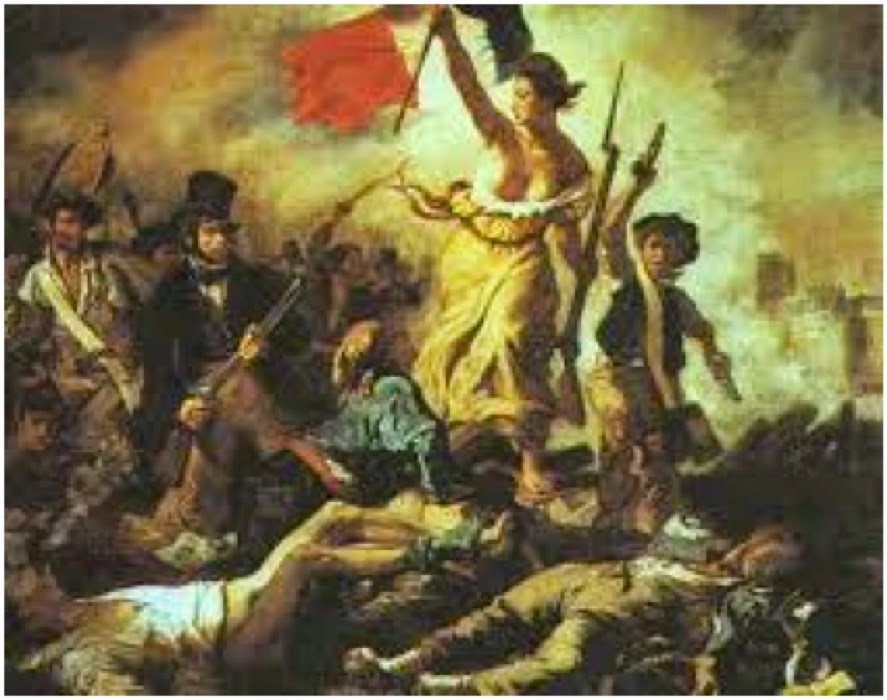
Sade, at an early age, began living the life of a libertine and took the obstinate path of extremism into excess, almost to the level of fanaticism. He was so determined to be a free spirit, he was even prepared to be imprisoned and even die for it. It was Apollinaire in 1909 who was the first to publish some of his works, and then made legal in 1958 by the lawyer Maurice Garçon who argued that there were parallel ideas in Bataille, Cocteau and Breton.
His fantasies of torture, humiliation, assassination were some of the practices in his imagination which filled people with fear and caused his imprisonment. However, behind prison bars his imagination blossomed and in his enclosure his imagination knew no bounds.120 days of Sodom was produced imprisoned between 1772 and

1784. Later Justine was publish in 1791.

His vision of the world is entirely conditioned by his desire. He took a rather Indian God ‘Shiva’ viewpoint, saying that
“Destructive forces are just as much a part of the world as the creative forces”
He believed man to be part of nature and that, nature was violent and therefore natural cruelty, end, death are also natural.
He said
“Cruelty, far from being a vice, is the first feeling imprinted on us by nature”
He even argued that religious practices, such as martyrdom were infact our desire to practice in pain and ‘sado-masochism’.
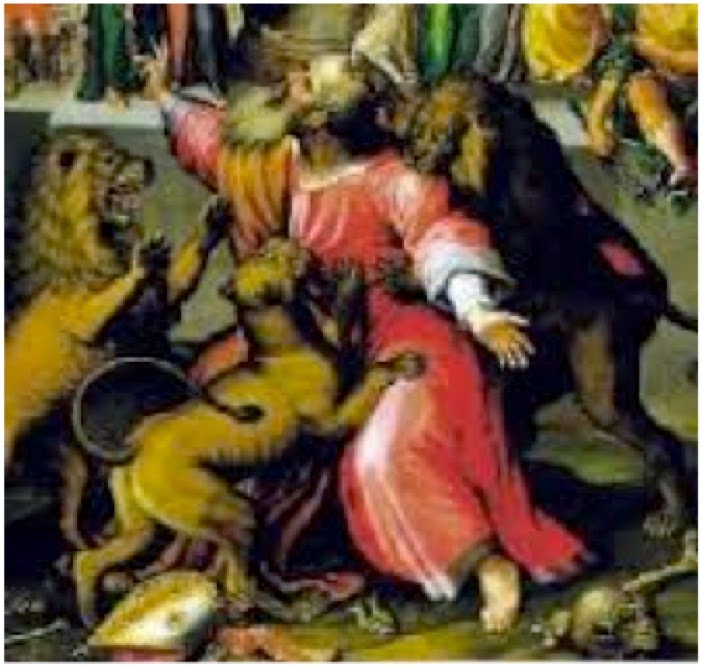
As an artist he was swallowed up by the dark contemplations of his soul.
“To see is to believe, but to feel is to be sure!” he said.
Erotic images were always censured during his era, but he invited people to examine the contradictions in our conscience and the phenomenal vastness of our desires.
He said that
“Virtue, which is only a state of inertia and rest, can never lead to happiness”
His belief was that imagination led to happiness.
“All happiness of man is in imagination” and it was this idea that inspired surrealist artists such as Bunuel, Pasolini, Peter Brook, where the nurturing of dream archaic language where the mind has no control and images run riot, that practiced this creative process.
Sade once said that
“We take a stand against the passions without imagining that this is the very flame lighting up philosophy itself”
January 31, 2015
SONIA DELAUNAY AND HER HALOS OF LIGHT: What are the dangers of ‘giving in’ to a history of darkness, when you can easily follow the mysteries of light?
SONIA DELAUNAY AND HER HALOS OF LIGHT: What are the dangers of ‘giving in’ to a history of darkness, when you can easily follow the mysteries of light?
During the time span of Sonia Delaunay, there were two major and horrible world wars and this is very important to note.
During the first world war, Sonia and Robert Delaunay relocated to Spain and Portugal. Robert was accused of being a deserter, although he was declared unfit for military duty at the French consulate in Vigo on June 13 1916.
Having already met and married by 2010, the couple had, by the time the first world war begun, launched their simultaneous colour studies.
Sonia was already fascinated with the effect of light on solid objects. Originally Sonia Terk, Ukranian born in 1885, was experimenting in pictures, inspired by Van Gogh and Gaugain.
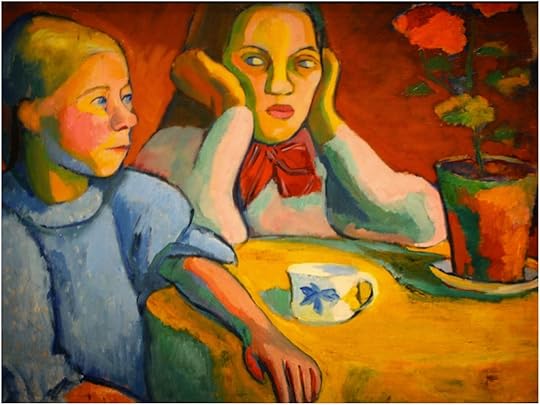 Two Finnish Girls 1907
In her diary she writes:
“The way in which objects and forms are broken by the light give the painting a new structure. The halos of the electric lamps make the colours and shadows vibrate around us like unidentified objects, like allies of the insane”
Her pictorial structures began to dissolve into halos of light. In ‘Flamenco Singers’ 1915.
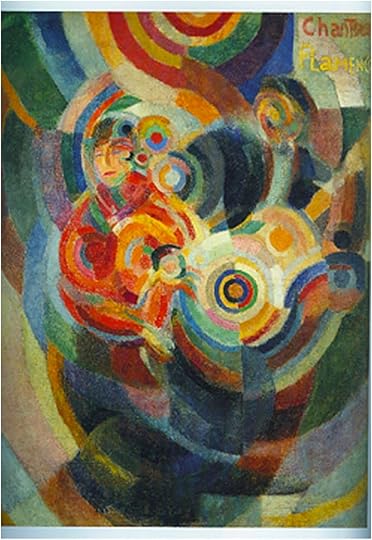 Flamenco SingersThis was especially exciting in an age when electrical light was new. She began to be fascinated with simultaneous contrast, taking the colours of the solar spectrum and juxtaposing them with their complementary colours. She got them to play one another off so that each tone reaches out to bring out the other.
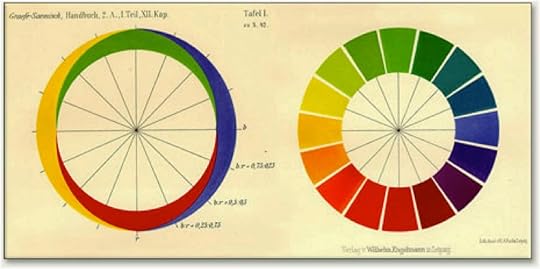
She then took the ‘halos of light’ and formed abstracted paintings of colour, where the colour was the subject.
“Abstract art is the beginning freedom from the old pictorial formula where colour has a life of its own. But a genuine new art will only begin when we understand that colour has a life of its own and that their infinity combinations of colour have poetry and a poetic language that are much more expressive than has been shown in the past. It’s a mysterious language in harmony with the vibrations…”
She wanted to capture the excitement of the new age of electrical light in “Electrical prisms”
 Electric prisms 1913 It could NOT be said that Sonia Delaunay hid her light under a bushel! In fact, she took the advice from the old book almost literally:
"No one, when he has lit a lamp, puts it in a cellar or under a basket, but on a stand, that those who come in may see the light. The lamp of the body is the eye. Therefore when your eye is good, your whole body is also full of light; but when it is evil, your body also is full of darkness. Therefore see whether the light that is in you isn't darkness. If therefore your whole body is full of light, having no part dark, it will be wholly full of light, as when the lamp with its bright shining gives you light."
So that while the rest of the society was fleeing to the darkness of conflict, this extraordinary couple were busy ‘lighting up’ and following their intuitions and mystery. One could call it ‘my story’ and not living ‘his story’ which was simply flocking to the usual dark solution of conflict, intimidation, interrogation, to solve the darkness and problems caused by conquering and attachments.
At the current time of her creativity, some first world war poets were declaring the futility of their darknesses. Siegfired Sassoon, although he initially marched thoughtlessly into battle, soon wrote of the darkness and suffering of the trenches, and wounded by a sniper in 1917, he was sent home to England to recover, going on to write his declaration of war, in which he denounced the conflict as "a war of aggression and conquest," writing "I can no longer be a party to prolong these sufferings for ends which I believe to be evil and unjust"
“I believe that this War, on which I entered as a war of defence and liberation, has now become a war of aggression and conquest. I believe that the purpose for which I and my fellow soldiers entered upon this war should have been so clearly stated as to have made it impossible to change them, and that, had this been done, the objects which actuated us would now be attainable by negotiation. I have seen and endured the sufferings of the troops, and I can no longer be a party to prolong these sufferings for ends which I believe to be evil and unjust”
George Bernard Shaw wrote about “the spiritual bankruptcy of the generation responsible for the war’s bloodshed”
Yet at this time the Delaunays were getting 'richer'. There was a hive of industry, creativity and a thriving inspiration in the Delaunay household on the Boulevard Malesherbes in Paris, the products of which are still inspiring those of today to live in peace. Sonia, living for almost a century she produced a vast range of creative works, from design, fashion, fabric and paint.
It could be said that creativity is a step itself for war prevention, and that any current war mongers are probably starved and deaf from the sound of their own creative muse and intuition. Thanks to this couple, we can be inspired that happiness and creativity can be ours rather than the misery of conflict.
After the Russian revolution, she lost her income of a rented home and began working with Sergei Diaghilev. She also opened a fashion boutique on Boulevard Malsherb in 1921, Gloria Swanson being one of her clients.
At the time of the Dada movement, she incorporated the poems of Tristan Tzara into her dresses, by creating ‘poem dresses’ where she sewed the words of the poet into the fabric.
Just before world war two, despite mounting tensions, she participated in the last universal exhibition as ‘the association of art and light, and decorated the Rail and air pavilion bringing an ‘immense explosion of springtime light and enthusiasm’
After the war, she worked on her abstract images. “Abstract art is only important if it is the endless rhythm where the very ancient and the distant future meet”
“Colour is liberated and itself becomes a subject”
Her home was a source of light and inspiration for other artists of her time: Apollinaire, Cendrars, Sartre and Stravinsky. We should listen to her wise words, though only about colour and its power to be the subject of an image, for her understanding hold the keys to real living way beyond any battle monger.
"Abstract art is only important if it is the endless rhythm where the very ancient and the distant future meet"
The retrospective of her work is currently on show at Paris’s Musée d’Art Moderne.

During the time span of Sonia Delaunay, there were two major and horrible world wars and this is very important to note.
During the first world war, Sonia and Robert Delaunay relocated to Spain and Portugal. Robert was accused of being a deserter, although he was declared unfit for military duty at the French consulate in Vigo on June 13 1916.
Having already met and married by 2010, the couple had, by the time the first world war begun, launched their simultaneous colour studies.
Sonia was already fascinated with the effect of light on solid objects. Originally Sonia Terk, Ukranian born in 1885, was experimenting in pictures, inspired by Van Gogh and Gaugain.
 Two Finnish Girls 1907
In her diary she writes:
“The way in which objects and forms are broken by the light give the painting a new structure. The halos of the electric lamps make the colours and shadows vibrate around us like unidentified objects, like allies of the insane”
Her pictorial structures began to dissolve into halos of light. In ‘Flamenco Singers’ 1915.
 Flamenco SingersThis was especially exciting in an age when electrical light was new. She began to be fascinated with simultaneous contrast, taking the colours of the solar spectrum and juxtaposing them with their complementary colours. She got them to play one another off so that each tone reaches out to bring out the other.
She then took the ‘halos of light’ and formed abstracted paintings of colour, where the colour was the subject.
“Abstract art is the beginning freedom from the old pictorial formula where colour has a life of its own. But a genuine new art will only begin when we understand that colour has a life of its own and that their infinity combinations of colour have poetry and a poetic language that are much more expressive than has been shown in the past. It’s a mysterious language in harmony with the vibrations…”
She wanted to capture the excitement of the new age of electrical light in “Electrical prisms”
Electric prisms 1913 It could NOT be said that Sonia Delaunay hid her light under a bushel! In fact, she took the advice from the old book almost literally:"No one, when he has lit a lamp, puts it in a cellar or under a basket, but on a stand, that those who come in may see the light. The lamp of the body is the eye. Therefore when your eye is good, your whole body is also full of light; but when it is evil, your body also is full of darkness. Therefore see whether the light that is in you isn't darkness. If therefore your whole body is full of light, having no part dark, it will be wholly full of light, as when the lamp with its bright shining gives you light."
So that while the rest of the society was fleeing to the darkness of conflict, this extraordinary couple were busy ‘lighting up’ and following their intuitions and mystery. One could call it ‘my story’ and not living ‘his story’ which was simply flocking to the usual dark solution of conflict, intimidation, interrogation, to solve the darkness and problems caused by conquering and attachments.
At the current time of her creativity, some first world war poets were declaring the futility of their darknesses. Siegfired Sassoon, although he initially marched thoughtlessly into battle, soon wrote of the darkness and suffering of the trenches, and wounded by a sniper in 1917, he was sent home to England to recover, going on to write his declaration of war, in which he denounced the conflict as "a war of aggression and conquest," writing "I can no longer be a party to prolong these sufferings for ends which I believe to be evil and unjust"
“I believe that this War, on which I entered as a war of defence and liberation, has now become a war of aggression and conquest. I believe that the purpose for which I and my fellow soldiers entered upon this war should have been so clearly stated as to have made it impossible to change them, and that, had this been done, the objects which actuated us would now be attainable by negotiation. I have seen and endured the sufferings of the troops, and I can no longer be a party to prolong these sufferings for ends which I believe to be evil and unjust”
George Bernard Shaw wrote about “the spiritual bankruptcy of the generation responsible for the war’s bloodshed”
Yet at this time the Delaunays were getting 'richer'. There was a hive of industry, creativity and a thriving inspiration in the Delaunay household on the Boulevard Malesherbes in Paris, the products of which are still inspiring those of today to live in peace. Sonia, living for almost a century she produced a vast range of creative works, from design, fashion, fabric and paint.
It could be said that creativity is a step itself for war prevention, and that any current war mongers are probably starved and deaf from the sound of their own creative muse and intuition. Thanks to this couple, we can be inspired that happiness and creativity can be ours rather than the misery of conflict.
After the Russian revolution, she lost her income of a rented home and began working with Sergei Diaghilev. She also opened a fashion boutique on Boulevard Malsherb in 1921, Gloria Swanson being one of her clients.
At the time of the Dada movement, she incorporated the poems of Tristan Tzara into her dresses, by creating ‘poem dresses’ where she sewed the words of the poet into the fabric.
Just before world war two, despite mounting tensions, she participated in the last universal exhibition as ‘the association of art and light, and decorated the Rail and air pavilion bringing an ‘immense explosion of springtime light and enthusiasm’
After the war, she worked on her abstract images. “Abstract art is only important if it is the endless rhythm where the very ancient and the distant future meet”
“Colour is liberated and itself becomes a subject”
Her home was a source of light and inspiration for other artists of her time: Apollinaire, Cendrars, Sartre and Stravinsky. We should listen to her wise words, though only about colour and its power to be the subject of an image, for her understanding hold the keys to real living way beyond any battle monger.
"Abstract art is only important if it is the endless rhythm where the very ancient and the distant future meet"
The retrospective of her work is currently on show at Paris’s Musée d’Art Moderne.
December 25, 2014
Nick Cave's 20,000th day on earth
'20,000 DAYS ON EARTH': JUST ANOTHER DOCUMENTARY ABOUT NICK CAVE?
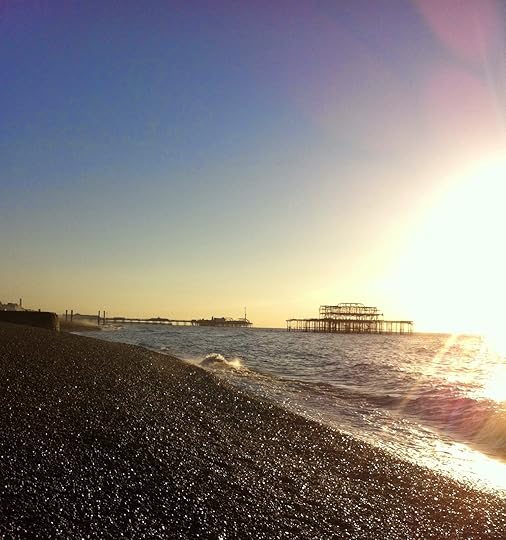 Brighton's Western Pier on Christmas Day 2014It is Christmas day and yesterday the film by Jane Pollard and Iain Forsyth ‘20,000 Days on Earth’ came out in cinemas in Paris. This film, set in Brighton, is not just another documentary about Nick Cave. It is in fact a fiction.
In the film, Nick Cave hears his alarm clock ringing. He gets out of bed, leaving his beautiful black haired wife, Susie Bick, lying in bed. He goes out in a black car to his office and types on a typewriter. Then he has an appointment to be questioned by psychoanalyst Darian Leader. Afterwards other people question him: Kylie Minogue, Ray Winstone from The Proposition and Blixa Bargeld, best known for his work with musical groups Einstürzende Neubauten. He then rehearses some songs. He visits some curators who house his precious ‘important shit’, old photos and junk he’s picked up, and next he has black tagliatelli and eels with violinist of the Bad Seed: Warren Ellis. Then he goes home to have pizza with his two sons and afterwards goes to bed. The end.
Like a groundhog day, it’s a regular day, on a coastal town called Brighton. But it’s a day that is all artificially constructed like fiction is. Everything is put together. It’s not a real day. Blixa has been shipped in, a meeting and conversation that should have taken place fourteen years ago when Nick received an email in Paris telling of his leaving the Bad Seed. Until this day, Nick had never been told the reason why. “Why did you leave the band anyway?” he asked Blixa. Cave’s intuition told him that for Blixa Bargeld it was the end of a creative road together. And Kylie Minogue is brought in too, twenty years after recording the Wild Roses song “I actually had to skim read your biography,” she confesses cheekily. As is Darian Leader and Ray Winstone. The day is artificially constructed to seem true, and yet like a story it is fake and yet it delves into truth.
This day is the precious result of all the days. It is a day, which, like one of Nick Cave’s songs, tells the story of all the richness of a day. It tells how all the days, containing those signs and messages and meanings, which Cave superstitiously notes down, can build the path of future days. It tells how all the pains, and memories of the past can create the loves of the future.
Nick Cave, our troubadour, inhabits the twelve hours of a day, like he would the stanzas of a song, the keys of a piano or notes on a sheet of music. He says, “A song brings out a hero in the listener.” Stories awaken our spirit. He tells Kylie how for him an audience is the group on the front row, and he tells his stories to them alone.“I live to perform” he says. Telling stories, writing songs, is Cave’s mission. He shows you how he writes a song. “A song is just counterpoint” he says. “You bring one line on, and then the second line is there to react with the first line. That is when something happens: in the third line”
This film is a poem. It tells of the fire of life. It tells of the importance of all lives. Not just Nick Cave’s, but a life in general. “Life,” he says, “is a flame that will only disappear and fall into darkness if you don’t protect that flame and make something of it, letting nothing discourage you.” He tells of his important shit: such as a piece of Nina Simone’s gum belonging to Warren Ellis (which he jealously covets) or a photo of someone peeing on the stage while The Birthday Party play in Berlin. Objects are physical proof of internal changes, kept in forensic bags. He tells of his successes, he tells of his adversities. He confesses going to church, shaking the vicar’s hand and then going off to score. We hear of the death of his father. We hear of his father’s first encouragement and the signs of his father’s own passionate love of Nabokov’s Lolita, the flame lighting him up, and inspiring him. How his father had secretly watched his performance and said he performed like an angel. We hear of Cave’s poignant moments. How pain can make beauty. We hear how love can make pain. We hear how life is godly and life is lonely and life is frightening. We see how memories can make our present. How the past can inform the future.
“My biggest fear is losing my memory” Cave says, “because what I remember, those memories of people and the past are what makes me. They don’t play a part in my life now, but they are still important to me”. Real curators play the role of curators with white gloves handle the artefacts he has collected and kept: torn pieces of paper, notes, scribbled drawings. Pieces of life are preserved, becoming like a museum, but life is also alive and something that controls us, something bigger than us. Though each day is a separate story, the question of this film is that all the days contain tentacles of life into which grow the next day, feeding story from story.
The setting of Brighton in itself is a place which Nick Cave says “chose me, rather than me choose it” “I think a place chooses you, rather than the other way around” proving that geography is a place where meetings can take place to metamorphose the soul.
“All the objects I keep have touched my soul” “I’ve always shoved objects in a bag, and kept them somewhere” he says. We feel in this film, like The Christmas Carol, the ghosts of the past, the ghosts of the future and a crying reminder to everyone how these ghosts are here to inform us and remind us of one thing: the preciousness of our days on earth and that our future is born of all those tiny moments in a day.
He reminds us of what is true for all of us: that life is made of small moments. His honesty is exposed in a diary along with recording the weather, another thing in life beyond our control, and life’s narrative, uniquely perceived and understood by each one of us. Just like a song is not true and is fictional, it is however composed of truth.
Nick Cave’s 20,000th day on earth is a story about a man's life, that is a fiction and yet captures a masterly day, a result from years of insights to guide future decisions, a day to inform and delight us all. It is about the specialness of just a day and all the combats within that day and it awakens our hero within us and is a thrilling pleasure to watch.

 Brighton's Western Pier on Christmas Day 2014It is Christmas day and yesterday the film by Jane Pollard and Iain Forsyth ‘20,000 Days on Earth’ came out in cinemas in Paris. This film, set in Brighton, is not just another documentary about Nick Cave. It is in fact a fiction.
 In the film, Nick Cave hears his alarm clock ringing. He gets out of bed, leaving his beautiful black haired wife, Susie Bick, lying in bed. He goes out in a black car to his office and types on a typewriter. Then he has an appointment to be questioned by psychoanalyst Darian Leader. Afterwards other people question him: Kylie Minogue, Ray Winstone from The Proposition and Blixa Bargeld, best known for his work with musical groups Einstürzende Neubauten. He then rehearses some songs. He visits some curators who house his precious ‘important shit’, old photos and junk he’s picked up, and next he has black tagliatelli and eels with violinist of the Bad Seed: Warren Ellis. Then he goes home to have pizza with his two sons and afterwards goes to bed. The end.
Like a groundhog day, it’s a regular day, on a coastal town called Brighton. But it’s a day that is all artificially constructed like fiction is. Everything is put together. It’s not a real day. Blixa has been shipped in, a meeting and conversation that should have taken place fourteen years ago when Nick received an email in Paris telling of his leaving the Bad Seed. Until this day, Nick had never been told the reason why. “Why did you leave the band anyway?” he asked Blixa. Cave’s intuition told him that for Blixa Bargeld it was the end of a creative road together. And Kylie Minogue is brought in too, twenty years after recording the Wild Roses song “I actually had to skim read your biography,” she confesses cheekily. As is Darian Leader and Ray Winstone. The day is artificially constructed to seem true, and yet like a story it is fake and yet it delves into truth.
This day is the precious result of all the days. It is a day, which, like one of Nick Cave’s songs, tells the story of all the richness of a day. It tells how all the days, containing those signs and messages and meanings, which Cave superstitiously notes down, can build the path of future days. It tells how all the pains, and memories of the past can create the loves of the future.
Nick Cave, our troubadour, inhabits the twelve hours of a day, like he would the stanzas of a song, the keys of a piano or notes on a sheet of music. He says, “A song brings out a hero in the listener.” Stories awaken our spirit. He tells Kylie how for him an audience is the group on the front row, and he tells his stories to them alone.“I live to perform” he says. Telling stories, writing songs, is Cave’s mission. He shows you how he writes a song. “A song is just counterpoint” he says. “You bring one line on, and then the second line is there to react with the first line. That is when something happens: in the third line”
This film is a poem. It tells of the fire of life. It tells of the importance of all lives. Not just Nick Cave’s, but a life in general. “Life,” he says, “is a flame that will only disappear and fall into darkness if you don’t protect that flame and make something of it, letting nothing discourage you.” He tells of his important shit: such as a piece of Nina Simone’s gum belonging to Warren Ellis (which he jealously covets) or a photo of someone peeing on the stage while The Birthday Party play in Berlin. Objects are physical proof of internal changes, kept in forensic bags. He tells of his successes, he tells of his adversities. He confesses going to church, shaking the vicar’s hand and then going off to score. We hear of the death of his father. We hear of his father’s first encouragement and the signs of his father’s own passionate love of Nabokov’s Lolita, the flame lighting him up, and inspiring him. How his father had secretly watched his performance and said he performed like an angel. We hear of Cave’s poignant moments. How pain can make beauty. We hear how love can make pain. We hear how life is godly and life is lonely and life is frightening. We see how memories can make our present. How the past can inform the future.
“My biggest fear is losing my memory” Cave says, “because what I remember, those memories of people and the past are what makes me. They don’t play a part in my life now, but they are still important to me”. Real curators play the role of curators with white gloves handle the artefacts he has collected and kept: torn pieces of paper, notes, scribbled drawings. Pieces of life are preserved, becoming like a museum, but life is also alive and something that controls us, something bigger than us. Though each day is a separate story, the question of this film is that all the days contain tentacles of life into which grow the next day, feeding story from story.
The setting of Brighton in itself is a place which Nick Cave says “chose me, rather than me choose it” “I think a place chooses you, rather than the other way around” proving that geography is a place where meetings can take place to metamorphose the soul.
“All the objects I keep have touched my soul” “I’ve always shoved objects in a bag, and kept them somewhere” he says. We feel in this film, like The Christmas Carol, the ghosts of the past, the ghosts of the future and a crying reminder to everyone how these ghosts are here to inform us and remind us of one thing: the preciousness of our days on earth and that our future is born of all those tiny moments in a day.
He reminds us of what is true for all of us: that life is made of small moments. His honesty is exposed in a diary along with recording the weather, another thing in life beyond our control, and life’s narrative, uniquely perceived and understood by each one of us. Just like a song is not true and is fictional, it is however composed of truth.
Nick Cave’s 20,000th day on earth is a story about a man's life, that is a fiction and yet captures a masterly day, a result from years of insights to guide future decisions, a day to inform and delight us all. It is about the specialness of just a day and all the combats within that day and it awakens our hero within us and is a thrilling pleasure to watch.
November 4, 2014
Is true love's flame enough?
 The Old Flame by Keziah Shepherd
The famous wise king Solomon once said, that “many waters cannot quench love” True love is like a flame. All the monsoon rains, hurricanes, and floods cannot put out the flame of love.But for a flame to flourish as a relationship, it needs three components : Fire, Air and Fuel.The problem for the character Katie, in the Old Flame is that she struggles to attain some of the components. Will she manage to feed all the necessary components of true love flame, as she blindly searches to keep her flame blowing ?The first component for her is easy : there is so much physical and sexual attraction between her and her dream man. It is like “Wow!”… she can hear angels and music…… and initially cannot get over this person. The attraction is overwhelming. Pheromones abound. Electricity and chemistry are constantly zapping and bubbling in and around. She feels an obsessive need to have her feelings reciprocated. But then next necessary part is Intimacy. She needs intimacy leads to attachment, to create closeness and connectedness. She has her chances, hoping to bond with her dream man.Intimacy grows first by spending a lot time with another person. Then it grows deeper by sharing with one another every aspect of our lives. Intimacy is built on trust and safety. If you cannot trust and feel safe with a person then intimacy disappears and will degenerate into distrust and suspicion.Since intimacy takes patience to develop, many are not prepared for such task. It is work. It implies a lot of talking and disclosure. If a person has been hurt with a previous partner, then they will have great difficulty finding closeness due to previously existing walls of distrust. The tendency will be to project past hurts on the present relationship.Katie finds this a difficult task and intimacy seems harder and harder, especially with her history of distrusting others.The final part of the flame is commitment. Commitment implies the ability to stay connected no matter what. A mature person is one who can work through misunderstandings and hurts. A key to staying together is believing the best of the other person, not prejudging them with bad motives. It is working positively to resolve issues. For a couple to stay together they must consistently break through the barriers of being hurt while assuming that the other person wants to resolve the issue also.If Solomon is right, true love's flame will keep burning and one day all the components will one day be put in place. Read Katie’s story about her Old Flame available now reduced from 2,99 dollars to just 99 cents.

[image error]
October 31, 2014
Niki de Saint Phalle: Feminist or just our female side?
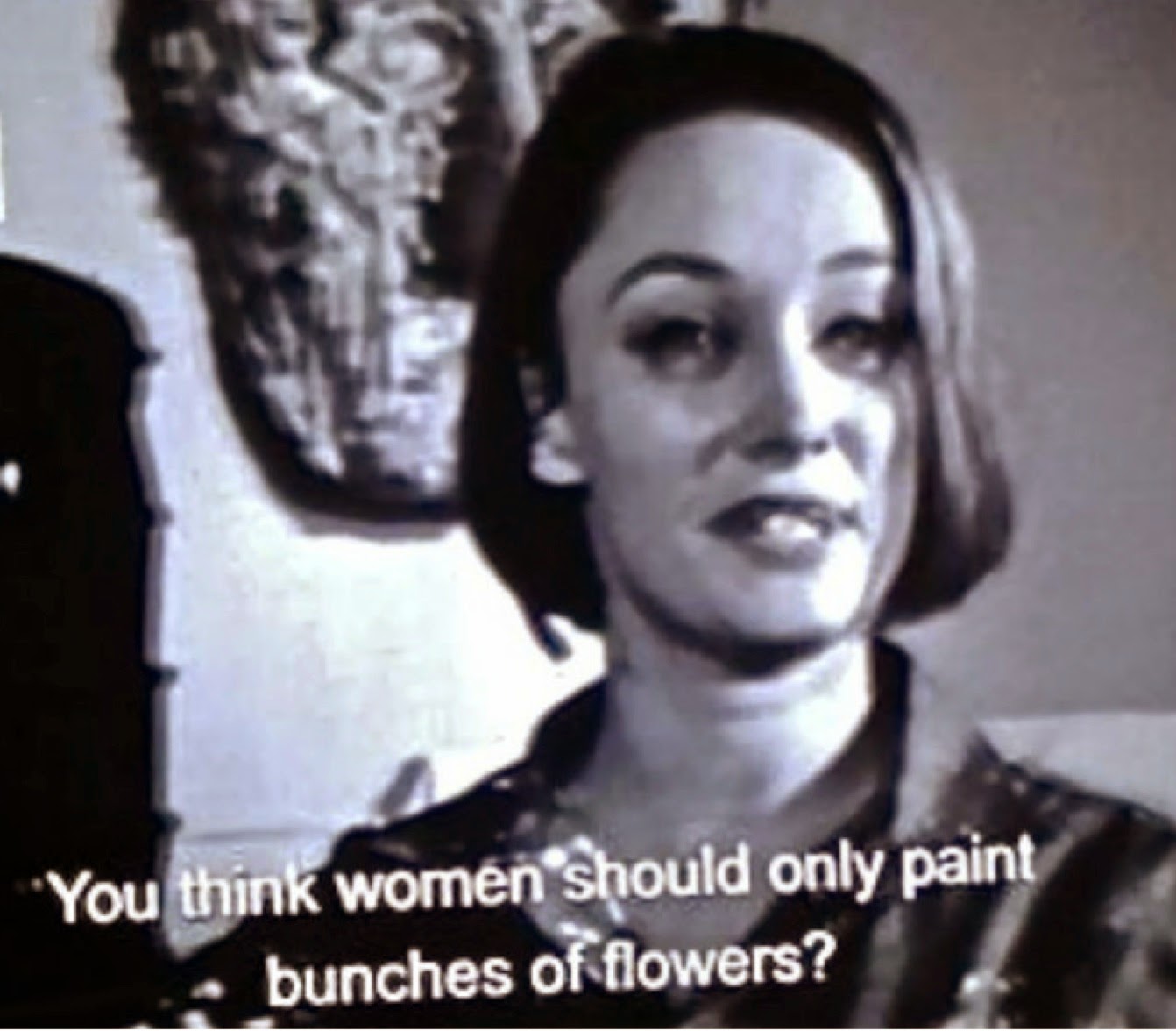
On the surface, Niki de St Phalle must have seemed like the perfect wife: model on the cover of Vogue, intelligent and breeder of two children.
Yet on reaching her thirties, after a painful nervous breakdown, she abandoned her marriage and became a full-time artist.
Recognising something powerful within herself, she began to sculpture the female form. She recognised that most images of women had been made by men and she wanted to celebrate the female form differently from a woman’s viewpoint. Rather than being an object of desire, it became for her a source of creativity.
“My ‘nanas’ are me, of course, because I am a woman” she said.
She began to read Simone de Beauvoir’s ‘Seconde Sexe’ who said of women throughout history
“Were either married of by force, seduced, abandoned or dishonoured”And who said of women artists:
“It is easy to imagine how much strength it takes for a woman artist simply to dare to carry on regardless. She often succumbs to the fight”
And who said of men:
“Men continuously use force to make her shoulder the consequences of her reluctant submission”
Her various nanas represented aspects of women: the child bearers, the bad nanas, the poor hurt nanas, the whore nanas, the black nanas.
 Mrs Haversham's Dream 1965
She called them Nana – after the infamous prostitute invented by writer Emile Zola, French slang for a “broad”.

In 1971 Niki de St Phalle married sculptor Tinguely. Side by side, they made statues, fountains, mobiles, kinetic paintings, inspiring people with their creativity. Yet interestingly in India, the name for creativity is Shiva and the name for creation is Shakti. These two energies must connect and from this flow of passion brings unlimited creative potential.Shakti can be visceral and physical, such as giving birth. It is the hidden power that turns matter into life, the divine spark, the flow of god’s love.Only when Shiva and Shakti are married in you will you be able to enter a sacred marriage with someone else.
She continued to make her pop goddesses with bulging curves were partly a metaphor for the cliché of women as mindless baby machines, but there was more to them – these curved creatures became iconic, powerful. They represented a powerful new matriarchal future. “I love the round, the curves, the undulation, the world is round, the world is a breast,” wrote Saint Phalle.
She began to cover the plaster cast sculptures with polyester resin and to decorate them with vibrant stripes and colours. Her most infamous Nana was a giant architectural piece for the Moderna Museet in Stockholm in 1966. The work was a cathedral sculpture consisting of an enormous woman, legs spread with a giant gaping vagina. It was 90ft long and entitled Hon (“she” in Swedish). People would walk into her genitals and inside the figure, where they found a movie theatre, an aquarium and a gallery full of fake famous artworks. Over 10,000 people flocked to see the work.
She had a sense of the importance of a woman’s role in society, influenced by Simone de Beauvoir, who said “A woman does not have the means to create another society: yet she does not agree with this one”
Instead of for violence, she used guns as a means to paint, transforming weapons and tools into creativity. The illogical and intuitive, feminine aspects so often rendered useless in the running of societies become valued. Her outspoken courage and the bombastic nature of her work drove the importance of her message: man, thoughout history have ignored their guru in woman. They have run the show, tending to bicker and fight and use guns and bombs to solve problems, putting their faith into the arms trade.
Yet only when a human marries Shakti and Shiva within can the world be full of peace, love and a sacred marriage commence.So her encouragement to embrace our feminine side is something of value. Feminist force is for everyone’s good.
The work of Niki de St Phalle is currently on show at the Grand Palais in Paris.

September 28, 2014
Heroic theatre pieces: heroes in modern theatre today
Heroic theatre pieces: heroes in modern theatre today
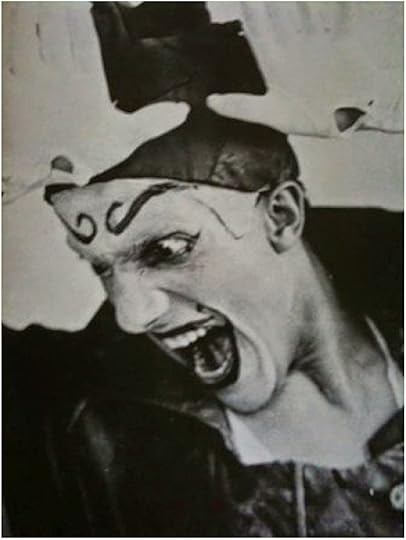 Leonide Massine performs with les ballets russes
Many theatre producers of today are NOT heroic. Why? They prefer to stage theatre that will pay the bills, ensure bums on seats and they heed instead the voice of fear: public pleasing, following familiar trends and prophet making…
Such behaviours are all the features of the non-hero and the makings of stagnation and the lack of change.
A hero heeds the voices of courage, intuition and all the other aspects that make one a hero.
Jean Cocteau famously said about his theatrical work:
“It is not for us to obey the public who doesn’t know what it wants, but it is for us to oblige the public to follow us. If he refuses, tricks must be employed: mirages, magic lanterns, intriguing children to follow making them swallow the show”
And it is the heroes of modern day theatre who obliges the public to follow.
In ‘Hero with a thousand faces’ Joseph Campbell talks of modern humanity having lost its connection to myth, with individuals losing their sense of self under a ruler’s ‘hypnotist’ spell. He describes a German Jewish friend of his doing all that he could to stop himself raising his arm in the frenzied applause after of a speech Hitler.He famously said "Follow your bliss no matter what the cost, though society may revile you, though you may live as an outcast and in poverty"This is the philosophy he followed in his own life in pursuing his intellectual passion—mythology. We are so engaged in activities of outer value—the pursuit of financial security and social gain—and our sense of reality, our sense of ourselves, is so dominated by a popular culture that admits only what is tangible, quantifiable, and measurable that we have little validation of our inner life, our souls. It used to be that there were institutions and other forums that were a home for the expression of what we call the soul—houses of religious worship, the corner bar, the community, the family. All of these have changed, and many have ceased to serve as sanctuaries for spiritual concerns. Most are operating at a deficit and have less time for the spirit than for their own survival.
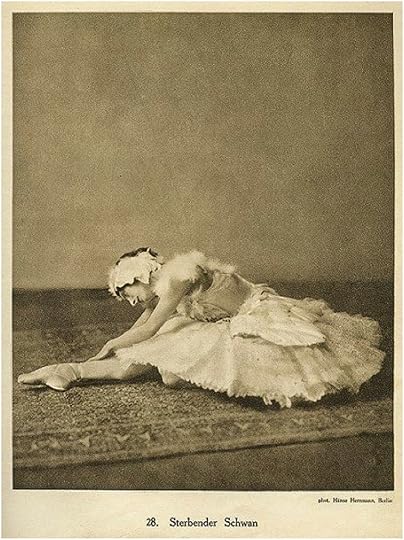 Heroic dancer become legend: Anna Pavlova as the Dying Swan
Looking at our theatrical history, heroic performers have used mythical stories and poetry to portray this heroic quest of the inner soul. Anna Pavlova’s portrayal of a swan exiting life, not only exquisitely celebrates the living swan itself, but carefully accounts the duality of death and life, of joy and sorrow, so beautifully written about in the Tennyson poem“Her awful jubilant voice, with a music strange and manifold, flow’d forth on a carol free and bold, as when a mighty people rejoice”
Life cannot stew in stagnation. We can see this also in Serge de Diaghilev’s work and les ballets ruses, a similar trend of courage and interest in the telling of heroic tales. Working closely with Jean Cocteau, Picasso, Léonide Massine, the theatre director became heroic by celebrating the heroic path of the character journeys he told and set a trend, which audiences would follow.
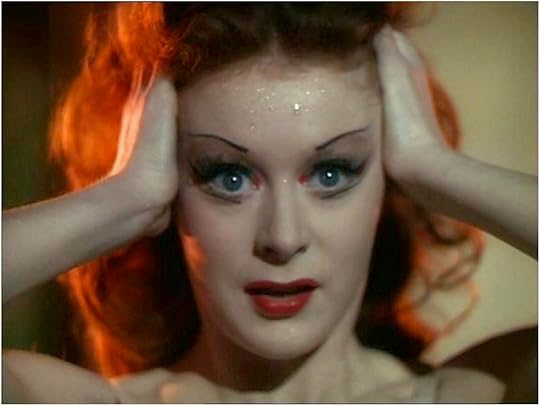 Moira Shearer in The Red Shoes
Filmmakers Powel and Pressburger also followed the mysteries of heroic pathways, producing films about tales: The Red Shoes, The Tales of Hoffman, The Canterbury Tales. The Red Shoes is again the story of this heroic energy which really cannot stop until it has used up itself and become itself. Performance today that explore new bounds, continue to build on mythical tales. Voted the 17th best dancer in the world, Luis Guerra, dances in particular theatrical pieces which are new and innovative and which challenge the stagnation of performance and old trends.
Aswell as working himself as a director and cheographer, he is drawn to directors and choreographers who are interested in ‘unconscious states’ and who challenge the boundaries of theatre in a hugely innovative way, such as Marlene Monteiro Freitas’s “Paradise”, Tania Carvalho in “Weaving Chaos” or Simon Vincenzi in “Luxuriant: within the reign of Anticipation”
In ‘Paradise’ Guerra twists his body into extraordinary forms, combining with the other dancers like creatures from a strange cabinet of curiosities, who could either have ethereal wings from heaven, or be maggot like forms born from hell.
In ‘Weaving Chaos’ shown in the experimental Pompidu Centre, Paris, Guerra again joins a body of dancers. Based on the story of Ulysses, the hero who took his ship of 12 sailors to save Helen of Troy, getting caught up in a never-ending episode of trials and tribulations, we see Guerra dance with a group of trained and non-trained dancers, giving a sense of varying needs of an interdependent group or ship crew.
The piece has a recurring sense of animal instinct surviving the elements. The dancers move in instinctive flocks like migrating birds. The music is elemental sounds, sometimes like super amplified insect noises and bee drones. There is reaction to sound and light, just as the elements in life itself often anticipate our responses.
Yet interestingly, throughout the piece there is, like a mast of a ship, one dancer who keeps ‘night watch’ and the dancers take turns to stand in one spot, awakening themselves should the drop off, with a the same rhythmic pulse of a heartbeat.
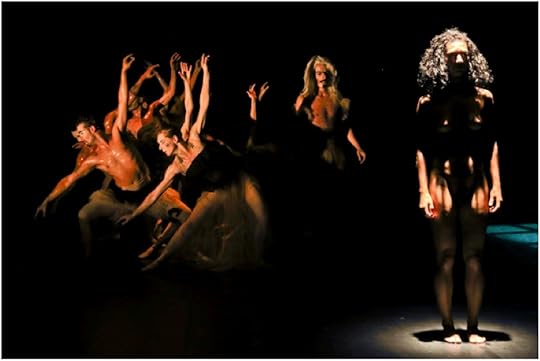 Dancer trying to stay awake on 'night watch': Tânia Carvalho's Weaving Chaos Guerra’s performance is not only is energetic and lithe, twisting and bending to create the various mazes and tests and challenges that the piece shows the dancers are faced with, but his facial expressions have the garish resemblance to an Eduoard Munch’s expression of ordeal, ‘The scream’, or a tortured clown mask, painted by James Ensor. Perhaps it is the mad house of Circe’s, when the crew, from their inability to resist greed, are turned into pigs, that dancers show lust and a constant search for stimulation and satisfaction. The dancers move individual frenzy but with graceful balletic movements.
The dance piece sometimes freezes itself in a state of different story moments: and the dancers form sculptural poses, capturing the group grief has a holiness and unity almost resembling that of Michelangelo’s Pieta and its sorrow ridden Madonna, or they form the resisting of the terrible temptation of the sirens by strapping himself to the mast of the ship.
The set consists of long strands, like a backdrop curtain, through which resembles bars. We feel the person left behind these bars may be Penelope, Ulysses wife, or a personification of his dream of reaching the state he wishes, his heroic state, that which Tennyson described as “the grey spirit yearning in desire to follow knowledge like a sinking star, beyond the utmost bound of human thought”
The hero’s quest is the opposite of stagnating in ordinary unquestioned life: “How dull it is to pause, to make an end, to rust unburnish’d, not to shine in use! As tho’ to breathe were life!”
Interestingly the piece finishes when the person on ‘night watch’ begins to wilter and fall, rather like the dying swan itself, or the dancer of the red shoes, when their powers to dance and live are exhausted by death.
Carvalho brilliantly incorporates other heroic characters and themes into her dance piece and examines theatrical heroism. The piece is a brilliant expression of feeling the sensation of what it is like to experience heroism and one is entranced by the dancers themselves, whose motions, in unity, almost enter and enliven the molecules of the audience with this same sense of energy felt by the hero using the technique of these painterly 'stills'. Interestingly the painter Turner himself tied himself to the mast of a ship to feel the adrenaline and excitement of a storm, so that he could express it in his ship paintings and we do feel something of this excitement and adrenaline from the energy of the dancers.
Another piece explored by Guerra that examines the same unsteady ‘fatum’ this time that of economic crisis, is Simon Vincenzi’s "Luxuriant: within the reign of anticipation" shown in Poland’s Malta festival curated by Romeo Castellucci.
Again, this piece explores a heroic path within external states of chaos. The crisis is Financial, set in context of ‘The Gold Diggers’ about the Depression.Guerra moves with a group of other dancers on tiptoe, with the constant agitation and panic of a herd of deer, on constant alert. Bare, except for trunks, the image conjures the half beast half man image of Pan, whose name derives from the word panic. The performers move in ways similar to modern day crowds when controlled or sprayed with tear gas. The space is affected by surges of dazzling light or huge voltages of sound which alter the motions of the performers, or the performers are made somnambulant motionless by the hypnotic interruption of a Lynchian looking orator or the sudden video flashes of a woman who holds up a commercial projected onto a sheet.
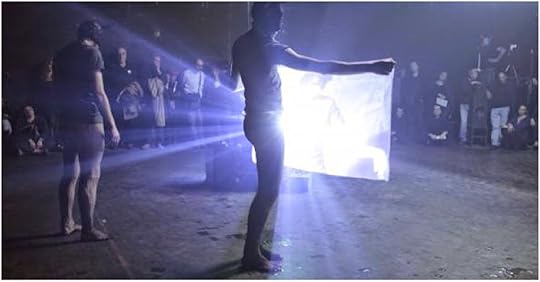 Luxuriant: Within the reign of anticipation
The audience is also under constant video surveillance. There is a constant sense of reeling from constrained stillness from the hypnotic orator or from the turbulent abandon of the dancer’s very frenzied running and fretting where you are almost knocked over.
The same dancers as ‘Troupe Mabuse’, named after the film of Dr Mabuse, the criminal and hypnotist, the piece uses modern day reference points as its testings: dirty money from Las Vegas, black target images from war operations whether they be terrorism or other, and various methods of social mind control and manipulations that disrupt the soul from its true heroic calling.
Extra-ordinary about this piece is the way the audience enters the stage itself achieving the transcending states of consciousness. Set in an abandoned slaughter house, Vincenzi has the audience begin in a seeming ‘back room’ and an uneasy feeling between black masked sadomasochism and ear deafening volts of music and comical Mickey mouse ears with cheering music of “We’re in the money” to following the performers into a deep vault, a second and larger space filled with smoke and walls stained with oxidised rust.
Here as audience member you are allowed to freely move, only stopped by video commercial, or tossed by a domino effect of the dancers hitting your path, or to be hypnotised. It is somehow a relief then, to be freed of this painful ensnarement tests and trials, just as Ulysses was freed of his own difficult ordeals.
Yet what is quite brilliant about this piece is, that part three of Vincenzi’s piece is the transfiguring sensation of leaving the theatre space experience: the scene of the crime, the state of hypnosis, the trauma of the dancers, the resisting of the dazzling commercialist, to find, in a way, the hero within, which Vincenzi so brilliantly awakens in his audience, as they are forced to find a state almost condusive to meditation, leave the state he has put them in and find their thoughts and their own state of being, that only quite brilliant theatre can awaken.
Cocteau says the following of great theatre:
“After leaving the theatre then the audience processes it. If they do not eliminate the beneficial poison, it enters the body. Gradually this magic manages to mitigate and in some rare cases manages to heal”
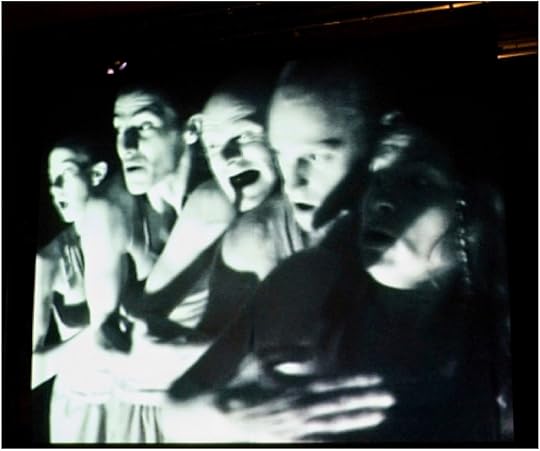 Simon Vincenzi's 'Troupe Mabuse'

 Leonide Massine performs with les ballets russes
Many theatre producers of today are NOT heroic. Why? They prefer to stage theatre that will pay the bills, ensure bums on seats and they heed instead the voice of fear: public pleasing, following familiar trends and prophet making…
Such behaviours are all the features of the non-hero and the makings of stagnation and the lack of change.
A hero heeds the voices of courage, intuition and all the other aspects that make one a hero.
Jean Cocteau famously said about his theatrical work:
“It is not for us to obey the public who doesn’t know what it wants, but it is for us to oblige the public to follow us. If he refuses, tricks must be employed: mirages, magic lanterns, intriguing children to follow making them swallow the show”
And it is the heroes of modern day theatre who obliges the public to follow.
In ‘Hero with a thousand faces’ Joseph Campbell talks of modern humanity having lost its connection to myth, with individuals losing their sense of self under a ruler’s ‘hypnotist’ spell. He describes a German Jewish friend of his doing all that he could to stop himself raising his arm in the frenzied applause after of a speech Hitler.He famously said "Follow your bliss no matter what the cost, though society may revile you, though you may live as an outcast and in poverty"This is the philosophy he followed in his own life in pursuing his intellectual passion—mythology. We are so engaged in activities of outer value—the pursuit of financial security and social gain—and our sense of reality, our sense of ourselves, is so dominated by a popular culture that admits only what is tangible, quantifiable, and measurable that we have little validation of our inner life, our souls. It used to be that there were institutions and other forums that were a home for the expression of what we call the soul—houses of religious worship, the corner bar, the community, the family. All of these have changed, and many have ceased to serve as sanctuaries for spiritual concerns. Most are operating at a deficit and have less time for the spirit than for their own survival.
 Heroic dancer become legend: Anna Pavlova as the Dying Swan
Looking at our theatrical history, heroic performers have used mythical stories and poetry to portray this heroic quest of the inner soul. Anna Pavlova’s portrayal of a swan exiting life, not only exquisitely celebrates the living swan itself, but carefully accounts the duality of death and life, of joy and sorrow, so beautifully written about in the Tennyson poem“Her awful jubilant voice, with a music strange and manifold, flow’d forth on a carol free and bold, as when a mighty people rejoice”
Life cannot stew in stagnation. We can see this also in Serge de Diaghilev’s work and les ballets ruses, a similar trend of courage and interest in the telling of heroic tales. Working closely with Jean Cocteau, Picasso, Léonide Massine, the theatre director became heroic by celebrating the heroic path of the character journeys he told and set a trend, which audiences would follow.
 Moira Shearer in The Red Shoes
Filmmakers Powel and Pressburger also followed the mysteries of heroic pathways, producing films about tales: The Red Shoes, The Tales of Hoffman, The Canterbury Tales. The Red Shoes is again the story of this heroic energy which really cannot stop until it has used up itself and become itself. Performance today that explore new bounds, continue to build on mythical tales. Voted the 17th best dancer in the world, Luis Guerra, dances in particular theatrical pieces which are new and innovative and which challenge the stagnation of performance and old trends.
Aswell as working himself as a director and cheographer, he is drawn to directors and choreographers who are interested in ‘unconscious states’ and who challenge the boundaries of theatre in a hugely innovative way, such as Marlene Monteiro Freitas’s “Paradise”, Tania Carvalho in “Weaving Chaos” or Simon Vincenzi in “Luxuriant: within the reign of Anticipation”
In ‘Paradise’ Guerra twists his body into extraordinary forms, combining with the other dancers like creatures from a strange cabinet of curiosities, who could either have ethereal wings from heaven, or be maggot like forms born from hell.
In ‘Weaving Chaos’ shown in the experimental Pompidu Centre, Paris, Guerra again joins a body of dancers. Based on the story of Ulysses, the hero who took his ship of 12 sailors to save Helen of Troy, getting caught up in a never-ending episode of trials and tribulations, we see Guerra dance with a group of trained and non-trained dancers, giving a sense of varying needs of an interdependent group or ship crew.
The piece has a recurring sense of animal instinct surviving the elements. The dancers move in instinctive flocks like migrating birds. The music is elemental sounds, sometimes like super amplified insect noises and bee drones. There is reaction to sound and light, just as the elements in life itself often anticipate our responses.
Yet interestingly, throughout the piece there is, like a mast of a ship, one dancer who keeps ‘night watch’ and the dancers take turns to stand in one spot, awakening themselves should the drop off, with a the same rhythmic pulse of a heartbeat.
 Dancer trying to stay awake on 'night watch': Tânia Carvalho's Weaving Chaos Guerra’s performance is not only is energetic and lithe, twisting and bending to create the various mazes and tests and challenges that the piece shows the dancers are faced with, but his facial expressions have the garish resemblance to an Eduoard Munch’s expression of ordeal, ‘The scream’, or a tortured clown mask, painted by James Ensor. Perhaps it is the mad house of Circe’s, when the crew, from their inability to resist greed, are turned into pigs, that dancers show lust and a constant search for stimulation and satisfaction. The dancers move individual frenzy but with graceful balletic movements.
 The dance piece sometimes freezes itself in a state of different story moments: and the dancers form sculptural poses, capturing the group grief has a holiness and unity almost resembling that of Michelangelo’s Pieta and its sorrow ridden Madonna, or they form the resisting of the terrible temptation of the sirens by strapping himself to the mast of the ship.
The set consists of long strands, like a backdrop curtain, through which resembles bars. We feel the person left behind these bars may be Penelope, Ulysses wife, or a personification of his dream of reaching the state he wishes, his heroic state, that which Tennyson described as “the grey spirit yearning in desire to follow knowledge like a sinking star, beyond the utmost bound of human thought”
The hero’s quest is the opposite of stagnating in ordinary unquestioned life: “How dull it is to pause, to make an end, to rust unburnish’d, not to shine in use! As tho’ to breathe were life!”
Interestingly the piece finishes when the person on ‘night watch’ begins to wilter and fall, rather like the dying swan itself, or the dancer of the red shoes, when their powers to dance and live are exhausted by death.
Carvalho brilliantly incorporates other heroic characters and themes into her dance piece and examines theatrical heroism. The piece is a brilliant expression of feeling the sensation of what it is like to experience heroism and one is entranced by the dancers themselves, whose motions, in unity, almost enter and enliven the molecules of the audience with this same sense of energy felt by the hero using the technique of these painterly 'stills'. Interestingly the painter Turner himself tied himself to the mast of a ship to feel the adrenaline and excitement of a storm, so that he could express it in his ship paintings and we do feel something of this excitement and adrenaline from the energy of the dancers.
Another piece explored by Guerra that examines the same unsteady ‘fatum’ this time that of economic crisis, is Simon Vincenzi’s "Luxuriant: within the reign of anticipation" shown in Poland’s Malta festival curated by Romeo Castellucci.
Again, this piece explores a heroic path within external states of chaos. The crisis is Financial, set in context of ‘The Gold Diggers’ about the Depression.Guerra moves with a group of other dancers on tiptoe, with the constant agitation and panic of a herd of deer, on constant alert. Bare, except for trunks, the image conjures the half beast half man image of Pan, whose name derives from the word panic. The performers move in ways similar to modern day crowds when controlled or sprayed with tear gas. The space is affected by surges of dazzling light or huge voltages of sound which alter the motions of the performers, or the performers are made somnambulant motionless by the hypnotic interruption of a Lynchian looking orator or the sudden video flashes of a woman who holds up a commercial projected onto a sheet.
 Luxuriant: Within the reign of anticipation
The audience is also under constant video surveillance. There is a constant sense of reeling from constrained stillness from the hypnotic orator or from the turbulent abandon of the dancer’s very frenzied running and fretting where you are almost knocked over.
The same dancers as ‘Troupe Mabuse’, named after the film of Dr Mabuse, the criminal and hypnotist, the piece uses modern day reference points as its testings: dirty money from Las Vegas, black target images from war operations whether they be terrorism or other, and various methods of social mind control and manipulations that disrupt the soul from its true heroic calling.
Extra-ordinary about this piece is the way the audience enters the stage itself achieving the transcending states of consciousness. Set in an abandoned slaughter house, Vincenzi has the audience begin in a seeming ‘back room’ and an uneasy feeling between black masked sadomasochism and ear deafening volts of music and comical Mickey mouse ears with cheering music of “We’re in the money” to following the performers into a deep vault, a second and larger space filled with smoke and walls stained with oxidised rust.
Here as audience member you are allowed to freely move, only stopped by video commercial, or tossed by a domino effect of the dancers hitting your path, or to be hypnotised. It is somehow a relief then, to be freed of this painful ensnarement tests and trials, just as Ulysses was freed of his own difficult ordeals.
Yet what is quite brilliant about this piece is, that part three of Vincenzi’s piece is the transfiguring sensation of leaving the theatre space experience: the scene of the crime, the state of hypnosis, the trauma of the dancers, the resisting of the dazzling commercialist, to find, in a way, the hero within, which Vincenzi so brilliantly awakens in his audience, as they are forced to find a state almost condusive to meditation, leave the state he has put them in and find their thoughts and their own state of being, that only quite brilliant theatre can awaken.
Cocteau says the following of great theatre:
“After leaving the theatre then the audience processes it. If they do not eliminate the beneficial poison, it enters the body. Gradually this magic manages to mitigate and in some rare cases manages to heal”
 Simon Vincenzi's 'Troupe Mabuse'