Daryl Anderson's Blog, page 5
February 16, 2017
The Detection Club
As such things go, detective fiction is the new kid on the literary block. Unlike romance, which can trace its roots back to the middle ages, the detective story burst on the scene in 1841 with Edgar Allen Poe’s[image error] detective Auguste Dupin.
Several decades later, Sherlock burst on the scene in A Study in Scarlet and the game was really afoot. By the twenties and thirties the so-called Golden Age of Detective Fiction arrived, when the likes of Agatha Christie and Dorothy Sayers plied their trade. As many of these writers were based in London, it was perhaps inevitable that they formed their own society–the Detection Club.
Like any club worth its salt, there was an elaborate initiation ceremony including a sacred oath:
Do you promise that your detectives shall well and truly detect the crimes presented to them using those wits which it may please you to bestow upon them and not placing reliance on or making use of Divine Revelation, Feminine Intuition, Mumbo Jumbo, Jiggery-Pokery, Coincidence, or Act of God?
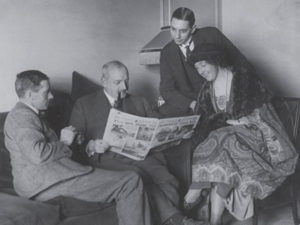
The Detection Club, detecting the Sunday Times
Personally, I have no problem with most of the oath, though I confess to enjoying a little jiggery-pokery now and again. In addition to the blood oath, members were also expected to follow ten commandments in writing a mystery.
The rules were set down in stone by Ronald Knox in 1928. Let’s take a look at five of Ronnie’s rules and see how they’ve stood the test of time:
Rule 1: The criminal must be named in the early part of the story, but must not be anyone whose thoughts the reader has been allowed to follow.
I have no problem with the first part as it’s just a question of playing fair with the reader. Also, the interplay between the sleuth and killer is a big part of the fun in any murder mystery. However, I’m no so sure about about that last bit. If Agatha Christie had taken this rule to heart, she’d have never written the classic The Murder of Roger Ackroyd, where–spoiler alert–the killer narrates the tale. In fact, some contemporary reviewers were so upset, they actually called the Grand Dame of Mystery a cheat!
[image error]
Agatha Christie
Rule 2: There must not be more than one secret room or passage.
I guess Dan Brown didn’t get the memo.
Rule 3: No hitherto undiscovered poisons may be used, nor any appliance which will need a long scientific explanation at the end.
An excellent rule as the real deal–or poison–is almost always preferable to some made-up concoction. I added “almost” because this was another commandment that Christie broke, most notably with the fictitious hypertensive drug Serenite in A Caribbean Mystery and the equally fake sedative Calmo in The Mirror Crack’d from Side to Side.
Rule 4: No accident must ever help the detective, nor must he ever have an unaccountable intuition which proves to be right.
This depends upon how intuition is defined. A gut feeling or sudden insight is valid only when the insight is based on information that the sleuth has gathered.
Rule 5: The detective must not light on any clues which are not instantly produced for the inspection of the reader.
In other words, play fair with your readers, or else you won’t have them for very long! In the opening chapter of Death at China Rose, I slipped in a little fact that virtually identifies the killer. Of course neither my sleuth nor the reader has the context to use that information at that early date–sneaky, but fair.
Before I get to my final verdict, here’s a quick cautionary tale.
When I attended the University of Florida, postmodernism was the big thing. In one of my classes the professor instructed us to write an paper without any rules. Taking him at his word, I wrote a frenetic paper that incorporated everything from Derrida to Moby Dick to Elvis’s phallus. (Trust me, you don’t want to know.)

Elvis, shaking his money maker
Writing the paper was a liberating experience. I jumped from topic to topic in a steam of consciousness that would have done Joyce proud. It was fun and I even got an A!
A year of so after the fact, I was going through some old papers and came across my forgotten masterpiece. A sappy smile on my face, I started reading. Pretty soon, my smile twisted into a grimace. The damn essay made no sense. It was just a bunch of random thoughts tied together with string and spit, signifying nothing. (Sorry, Elvis.)
The fact is that rules exist for a reason. A writer can break any rule she pleases, but only if it serves a purpose.
In other words: Rules are useful, unless they’re not!
________________________________________


August 9, 2015
April 6, 2015
Death at China Rose available now!
Thinking about vacationing in the Sunshine State? Why not experience the real Florida at China Rose Fish Camp? It’s a place steeped in history…and blood.
 Addie Gorsky’s latest adventure is now available.


Also enjoy Murder at Mystic Cove.

November 4, 2014

October 3, 2014
Murder in Mystic Cove Cracks Bestseller List!
Murder in Mystic Cove made the USA Today Bestseller list!
July 30, 2014
Murder in Mystic Cove Book Trailer
Check out my new book trailer!
December 17, 2013
A Good Day

It’s a red letter day for me—today my debut novel Murder in Mystic Cove is published at last.
It was nearly a year ago to the day when I got the call that every aspiring writer dreams of.
“Hello?” I didn’t bother to sound polite. I’d had a bad day. I had a hell of a headache. I’d realized that the holidays were almost there and I wasn’t ready. And despite being on the no-call list, every telemarketer in India was calling me nonstop. So when the phone rang again I was loaded for bear.
A little hesitation and a female voice asked, “Is this Mary Anderson?”
“Yeah.” Now I was worried. My first name is Mary, but everyone except for cops and bill collectors called me Daryl. Which was this? But then I remembered that I hadn’t broken any laws lately and there were no overdue bills. “What’s this about?” I asked.
“It’s about your novel Murder in Mystic Cove.”
“Novel?” I croaked.
The woman on the phone was Angela James at Carina Press. It seemed that on my manuscript, I’d transposed a couple of numbers in my phone number, which, as luck would have it, belonged to another Mary Anderson. After a confused conversation with my doppelganger, Angela located the correct number elsewhere, and the call was made.
I felt like a dope for the stupid mistake, but I was a happy dope. My novel was going to be published!
When the euphoria wore off, I started worrying. You see, I tend to walk on the dark side of the road—not a bad quality in a mystery writer–and given half a chance, I’ll imagine the worst. So I grew anxious about the editing process. What was that like anyway? And what if I couldn’t deliver the goods? What then?
But for once my fears were unfounded. With the help of my wonderful editor Deb Nemeth and all the people at Carina Press the experience was overwhelmingly positive.
And now when I tell people that I’m a writer, I don’t have to add, “Well, I’m hoping to be published soon.”
I just grin and say that my debut novel Murder in Mystic Cove is now available.

Available at Amazon and Barnes & Noble.
August 5, 2013
Daryl Anderson lives in Gainesville, Florida with her husband and three dogs. She enjoys urban farming, cycling, and murder.
Murder in Mystic Cove is also available in audio.