
Daryl Anderson's Blog, page 4
October 4, 2017
Dumb Witness
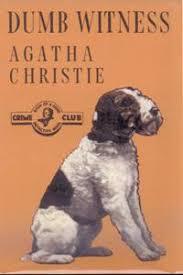
I’m using the word dumb in its original meaning, as in being unable to speak. In mysteries, a dumb witness is one that has witnessed a crime, but is powerless to tell its story.
At least not in the conventional manner.
Perhaps the most beloved dumb witness is Bob the Jack Russell Terrier from Agatha Christie’s novel Dumb Witness. As Bob was with his mistress on the night she was murdered, Poirot is certain the little fellow knows the truth and eventually the great detective “hears” what the dog has to say.
However, a good dumb witness is more than a plot point. As with any other element of the story, it can be used to develop character, inject pathos or even add a little humor. It’s also part of a long and revered tradition in Western literature as the first dumb witness appeared way back in Homer’s Odyssey.
I’m speaking of Argo, Odysseus’ faithful dog.
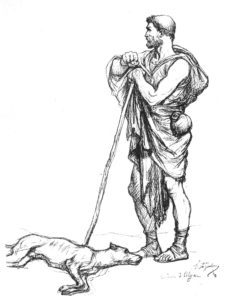
When Odysseus returns home in disguise only Argo recognizes him. The faithful dog wags his tail, but lacks the strength to go to his master. Fearful of betraying his identity, Odysseus dares not acknowledge Argos.
Odysseus entered the well-built mansion, and made straight for the riotous pretenders in the hall. But Argos passed into the darkness of death, now that he had fulfilled his destiny of faith and seen his master once more after twenty years.
There is something so very human and heartfelt in this passage. Through Argo, Odysseus is more human.
A recent impressive use of the dumb witness is found in Donna Leon’s The Waters of Eternal Youth. In the novel Commissario Guido Brunetti is asked to investigate a cold case from fifteen years earlier in which a young girl is attacked and subsequently brain damaged. Before her injury, the girl was an avid equestrian whose greatest joy was her beloved horse Petunia. In the novel’s poignant conclusion, the girl is brought to the farm when Petunia now lives and, against all the odds, the old horse and damaged girl recognize one another.

Now, we move from the sublime to the ridiculous.
I’m a dog person and so when I sat down to write my first mystery Murder in Mystic Cove, I knew a dog was going to play a crucial role in the plot. Sure enough, the victim’s elderly pug Jinks witnesses his master’s murder. Because the victim was such a nasty piece of work I originally pictured Jinks as an extension of his master in order to emphasize the victim’s loathsome nature.
Anyhow, I pictured Jinks as something like this–
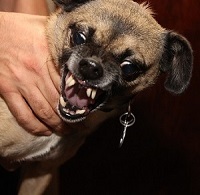
Jinks, first draft
Yeah, he is a bit much and it didn’t take long for me to switch tracks and soften some of Jinks’ rough edges.

Jinks, final draft
Though the elderly pug didn’t exactly became lovable–what with his chronic halitosis and excessive gas–he did become a pitiable creature, which helped humanize my very unlikable victim and add a bit of pathos to the tale.
I hope I’ve shown that dumb witnesses aren’t dumb at all but very smart.


September 3, 2017
Magical Venice!

Venizia
Do believe in magic?
I do, but then I’m a writer, and writers are great believers in magic. We dream up stories, write them down and make them real–if that’s not magic, what is?
But until recently I hadn’t realized that there were truly magical places in the world, places where enchantment is the norm and not the exception–a place like Venice.
It was my first visit to Italy, and as I tend to approach travel from a historical stance, I did my homework and learned that people who would become the first Venetians fled to the lagoon on the Adriatic as a means to escape the “barbaric” invaders that swarmed the mainland after mighty Rome’s fall.

Lady Venice’s Triumph over Italy
The Doge’s Palace

The Doge’s hat
This isolation proved advantageous and during the middle ages the Republic of Venice became a great empire, ruled by a series of Doges, a series of pompous-looking white guys in funny hats.
Somehow these Doges paled when compared to ��pale waxworks when compared to a Caesar or Medici.
Or maybe it was the hat. I really don’t like the hat.
And then I’d heard all the stories about the beauty and romance of Venice, stories that my contrary cynical thought too good to be true. Wasn’t that just travel-book fluff?
My husband and I arrived in the afternoon and while I was charmed by the gondolas and labyrinthine streets, and enjoyed the tour of the Doge’s Palace, something was missing. After an early evening rain, my husband and I walked back to San Marco’s Square.

The Piazzo was almost deserted, at least by Venetian standards. ��We walked up and down the Piazzo, listening to the various orchestras in front of restaurants, stopping if we heard something we liked.
An Adriatic breeze had blown the last of the storm clouds away, and the sky was a unique shade of indigo blue. I was gazing at the silhouette of the winged lion of St. Mark, and at that moment, the violist started playing Moon River.

And that’s when it hit me–the magic of Venice.
The appreciation of true beauty always contains a tinge of sadness, and as the notes of Moon River floated over the Piazzo, I knew that this moment was just that–a single moment that would soon pass. But since nothing gold can stay and beauty doesn’t last, we should grab the moment when is comes and hold on for dear life.
The Venetians know this. Their forebears built this city out of desperation and fear. Riding Fortune’s Wheel, they won and lost an empire, but they left us this place, and made this beautiful night possible, questa bella notte.
Once back in the States, I put together a video to try to express my experience that magical night.
Venice is my magical place–what’s yours?
July 28, 2017
Wicked Florida!

This point was reinforced last year when I attended a fun exhibit at the Florida Museum of Natural��History��called��Wicked Plants, based on the amazing book by Amy Stewart. While perusing some of Mother Nature’s nastier botanical creations, I couldn’t help notice that many of the plants could be found in my home state of Florida–a few are even in my garden.
 Along with the usual suspects such as deadly nightshade and water hemlock, I discovered a wonderful new villain called the rosary pea, so-named for its beautiful, but highly toxic seeds that resemble rosary beads. Rosary peas have long been used in jewelry making, but many a careless person has died after pricking a finger while handling one of the seeds.
This immediately put my writer’s imagination in gear. Under the right circumstances, the little rosary pea would make a clever murder weapon. All a crafty killer had to do is slip a few rosary peas, which had been carefully pricked to release the toxin, into the bead box of an annoying jewelry maker. Pretty darn close to a perfect crime, don’t you think?
Inspired, I created a little video about not only the ��wicked plants, but all the reptiles and critters that make up the darker side of the Sunshine State, the place I call ��Wicked Florida.
Some of the creatures/poison plants are Florida natives, but many–like the rosary pea–are invasive, hitchhikers from all over the globe who’ve made their home in Florida and now thrive. So far I’ve used three of the wicked species from the video in my novels, though I’ve not yet been able to work a snake into one of my murderous plots, which is regrettable because snakes are such a vital part of the wild Florida that I love.
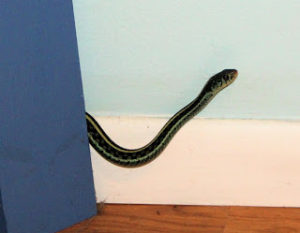
This pretty garter snake came into our house through the doggie door, making himself comfortable in the guest bedroom. The guest was not amused.
Although I’d come with several scenarios–one involving a pet python–none quite passed the credibility test. Sure, there’s a suspension of disbelief in fiction, but there’s a limit as to how far it will stretch before breaking.So imagine my surprise when last month one of my discarded plot points became reality when a deadly cobra escaped its cage in a quiet Florida neighborhood.
So the next time a seemingly impossible plot occurs to me, I’m going with it.
After all, I live in Wicked Florida!
May 8, 2017
Mixing Genres: A Dangerous Game
Although I’d dreamed of writing when I was a kid growing up in Baltimore, life kept getting in the way of dreams, when it should have been the other way around. And so it was only after several careers, which included food service, English teacher and psych nurse, that I finally took the plunge and dove headfirst into fiction writing–though at first it felt more like a belly flop.
Coming from an academic background, I read lots of books on the craft of writing, most of which were unhelpful. (FYI, a decidedly helpful book is Stephen King’s On Writing.) Wading through the material, one warning kept appearing, usually in all caps and with an exclamation point or two:
DO NOT MIX GENRES!
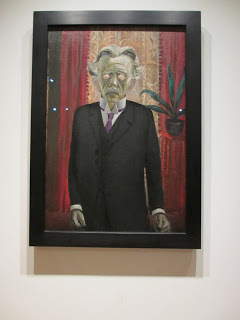
“Thou shalt not mix genres!”
I understood the danger. Readers like to know what they’re getting into and if a book crossed too many genres–maybe a science-fiction western with a comic slant–it would fall by the wayside. And yet following this rule too strictly is self-limiting. I agree with David Byrne:
Putting everything into little genres is counterproductive. You’re not going to get too many surprises if you only focus on the stuff that fits inside the box that you know.
In other words, good writers make their own boxes. Either a book works, or it doesn’t.
Last April in London, I had the opportunity to meet John Connolly at a book signing on a Friday night in London. Connolly is the author of the Charlie Parker thrillers. For those of you not familiar with the series, they’re rather odd books with elements of crime fiction, myth, supernatural, with a dash of dark humor for spice.
Incredibly, these disparate elements come together to form a compelling universe of good and evil, and something in-between.
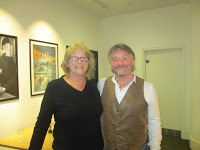
Here I am, schmoozing with John Connolly
It doesn’t hurt that his writer’s toolbox is full. He’s a gifted stylist whose prose often veers into the poetic. And he’s no slouch at characterization. His characters not only bleed, but eat, fall in love, and make bad jokes. They live outside the pages.So how does Connolly do it?
For me, one of Connoly’s most touching characterizations was that of mechanic Willie Brew, whose story figures prominently in The Reapers. Save for his association with Charlie Parker and his lethal friends Louis and Angel, Willie’s sixty years on earth have passed largely unnoticed. A workaday everyman, he worked at fixing cars, got married, got divorced, then worked some more. But in Connolly’s hands Willie’s small life becomes very large, achieving a certain dignity. When Willie’s asked to put everything at risk for his friends, we know exactly what he’s giving up.
I still think about Willie Brew. If he had the chance to do it all over again, would he make the same decision?
But perhaps the most compelling part of these novels is in Connolly’s portrayal of evil. Too often evil is rendered in the abstract, Have you ever noticed that evil is often sensed, rather than seen or felt? I think writers sometimes shy away from the concrete in their descriptions because they fear winding up with a cartoon devil with horns and tail that wouldn’t scare a five-year-old.
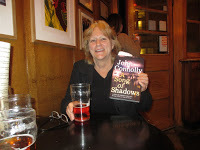
Here’s hoping Charlie Parker keeps fighting the darkness for a long, long time.But Connolly doesn’t look away from the face of evil. In his books, it is felt, seen, smelled, touched and even…well, you get the idea.
March 27, 2017
USA Today Bestselling Author, Daryl Anderson, Selects E.L. Marker™ for Her Third Novel
March 20, 2017 by Administrator
SALT LAKE CITY UT March 20, 2017
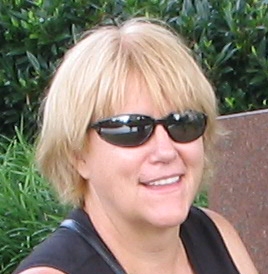
From teacher to registered nurse to mystery writer, Daryl Anderson has transitioned from improving lives to saving lives to ending them – but fear not. She will see that justice is done.
After penning USA today bestseller, Murder in Mystic Cove, and Death at China Rose, Anderson faced a mystery of her own: who would publish her third book? “When searching for a publisher, I’d heard a lot of positive comments about WiDo’s editors, and I was also impressed by the support you provide your authors. A successful book is a collaboration, not a solo act.” This made WiDo a likely suspect.
When E.L. Marker’s submissions editor, Joseph Jones, read through Private Investigator Addie Gorsky’s third adventure, taking place in a psychiatric treatment center, he knew he had found a gem. “Anderson’s writing is really impressive,” Jones remarked. “This is just the kind of engaging story E.L. Marker is looking for.” He forwarded Anderson’s manuscript to Karen Gowen, Managing Editor for the WiDo family of publishers, and the plot thickened.
Upon reading Anderson’s work, Gowen accepted it enthusiastically. “This detective story is fast paced with characters that are easy to visualize. She’s an excellent writer.” Anderson accepted the contract, and the publisher mystery was solved.
“I love mystery because it fires on all cylinders,” Anderson explains. “The thrill of the hunt and the moral dimension are equally compelling. Murder changes everything. There’s more than the loss of a single life. Friends and family mourn. The community is threatened by this breakdown in order. This is where the sleuth comes in. Although the dead cannot be restored, it’s the detective’s job to bring order to this chaos.”
The author continues, “To me, the interesting question is how the sleuth completes the task. Does the detective play by the rules, or does she find justice by any means necessary? Will justice become revenge? There’s a lot to the genre!”
Mrs. Anderson dreamed of writing from a young age. Though she has returned to it now, she spent years as a teacher after earning a degree in English at the University of Florida. Seeking another challenge, Anderson next worked with psych patients as a RN. This was when, at the suggestion of her husband, she finally decided to return to her early dream to be an author.
As a lifelong devotee of Christie, Poe, and Chandler, Daryl Anderson found mystery writing was a natural fit, and she never looked back. Daryl lives in Gainesville with her husband and two spoiled dogs. She spends her days—and nights—happily plotting murders in the Sunshine State. When not contemplating homicide, she enjoys gardening, vegetarian cooking, and hiking. Find out more about the author by visiting her website: www.darylanderson.org or her Facebook page: https://www.facebook.com/DarylAnderso...
March 23, 2017
April in the City of Light

The Eiffel Tower puts on a show!
WHAT MAKES A CITY GREAT?
I’m not sure what makes a city great, but I know a great city when I meet one. I’ve been fortunate to have visited some of the famed cities of the world: New York, London, Chicago, Dublin and Paris. Each is unique, but all have claimed a place in my heart. I’ve often wondered what it is about these cities that intrigues me so. What are the elements of a truly superior city?
A few years my husband and I visited Paris in April. While he ran the Paris marathon, I ran around Paris. These are some of my stops. Join me and maybe together we can decide what makes Paris great.

The architecture of Paris is justly admired, and none more so than the Eiffel Tower, Paris’s most iconic symbol. Standing tall and proud, it is the brightest beacon in the city of light.

The magnificent and monumental Arc de Triomphe was commissioned in 1807 after Napoleon’s victory at Austerlitz, when the Emperor rode the crest of fortune’s wheel. As I viewed the massive structure, I thought of War and Peace, Ozymandias and the Russian winter that would soon destroy Napoleon’s Grande Armée.

These somber thoughts vanished when I climbed to the top of the Arc and saw the Champs Elysees below, glistening in the twilight like a magic carpet. Somehow, the impossible seems possible in Paris.

Versailles is one of the must-see tourist destinations. I like to look for the human side of history and it was
[image error]
Doing the Versailles Shuffle in the Hall of Mirrors
difficult to find at that cold palace. (Clothes of gold offer little comfort–give me soft cotton and fleece.) I’m sure having to dance the “Versailles shuffle” detracted from my enjoyment–the crowds were horrendous–but there was one human connection.
Passing through Marie Antoinette’s bedchamber, I recalled that this was where she and Louis cowered when the crowd of angry peasants arrived from Paris. The mob had marched from Paris carrying pitchforks and sticks and now they demanded their king’s surrender. In those final desperate moments of freedom, Louis and Marie Antoinette clung together.

From that point onward, it was a slow march to Monsieur Guillotine for Louis and his queen.
[image error]
A recreation of Marie Antoinette’s cell, prior to her appointment with the guillotine
Paris is most alive in its streets and cafes. Unlike my fellow Americans who are protective of their personal space, Parisians happily sit elbow to elbow in crowded cafes.
[image error]
I’m going to wind up this little tour with a visit to the exquisite basilica of Sacré-Cœur, which stands on a hill in Montmartre. When I first saw Sacré-Cœur in the early nineties, I wasn’t familiar with its history. At that time I saw a gleaming edifice in white stone that was both elegant and imposing, a product of La Belle Epoque.

Basilica of the Sacred Heart of Paris
First a little history: During the final decades of the nineteenth century Paris experienced an explosion of art and literature. Renoir painted, Gide brooded, and Stravinsky wrote music so revolutionary it provoked listeners to riot. Yet this golden age was rooted in blood, which brings me back to Sacré-Cœur.
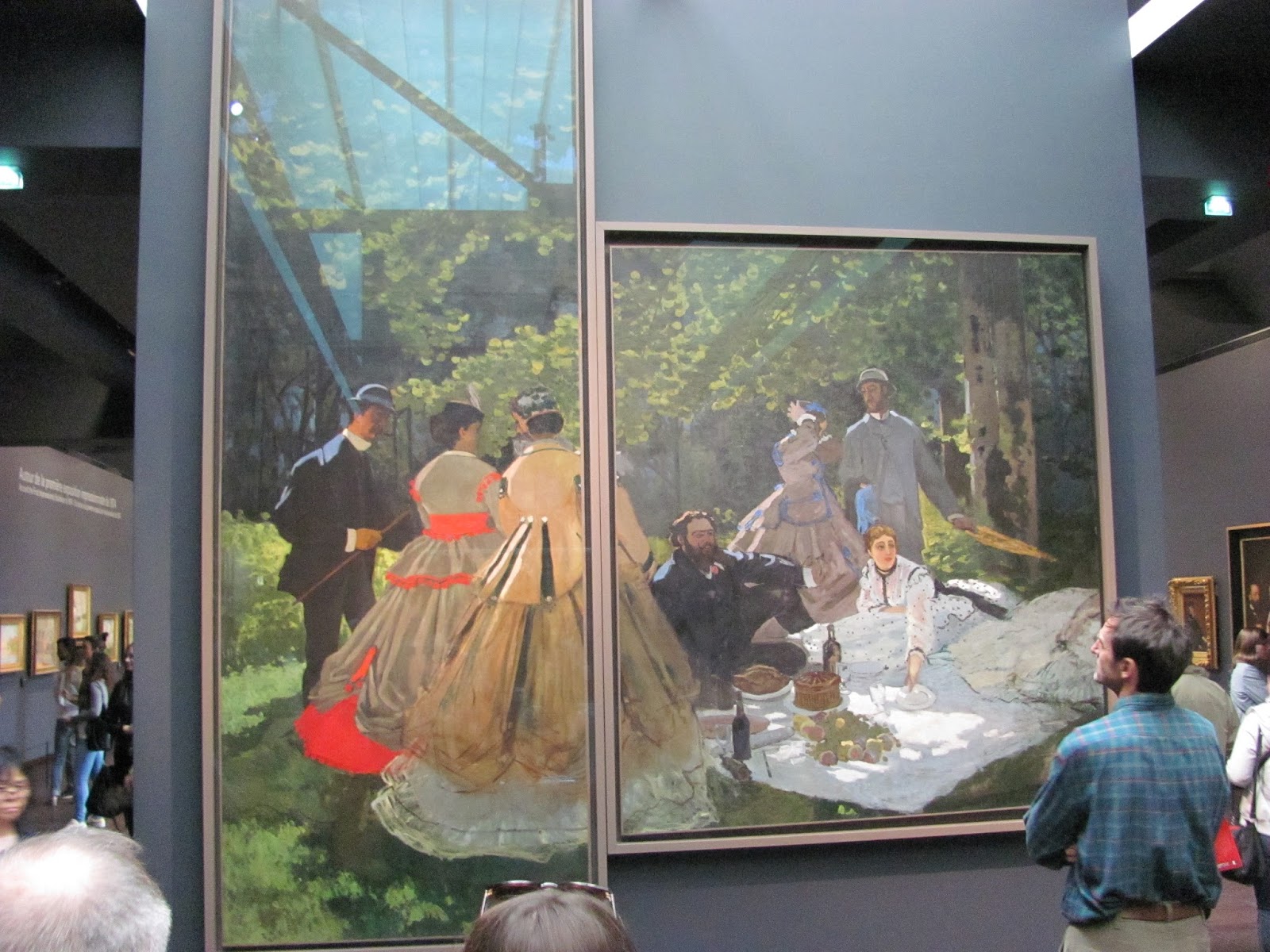
The Franco-Prussian War was an unmitigated disaster for France. After the surrender of Napoleon III in 1871, a revolutionary uprising called the Paris Commune seized power in Paris. They held on for two brutal months before being obliterated by the regular French army and were buried on a hilltop in Montmartre.
In the humiliating aftermath of defeat, the people of Paris erected a grand basilica where the martyrs lay buried. After all, the Communards were secular and had no love of priests. So this was a way of doing penance and erasing the past that had caused such pain.
The history of Sacré-Cœur reads like a metaphor, but I’m not sure what it means. I only know that there is something eternal in that white stone and something horrible as well. There are many places like Sacré-Cœur in Paris, places where the past and present collide.

So what makes Paris great?
The answer is everything. Architecture, art, open spaces, history, culture–all conspire to form the city of light. I don’t think I’d want to live in a world without Paris, and even though it may be years before I see her again, I keep her in my heart.
Perhaps Ernest Hemingway said it best:
“If you are lucky enough to have lived in Paris as a young man, then wherever you go for the rest of your life, it stays with you, for Paris is a moveable feast.”
March 13, 2017
Sweet Dreams

People often ask me where I get my ideas for stories. Of course, all fiction stems from the imagination and the simplest answer is that I make it up. But the imagination is not an bottomless pool of ideas–like anything else, it needs to be fed. So when not actually scribbling away, I’m busy replenishing the toolbox of imagination.
One sure way to get my creative juices flowing is a visit to an old graveyard. From Wolfe’s Look Homeward, Angel to Gray’s Elegy Written in a Country Churchyard, writers have sought inspiration in these cities of the dead. Join me for a little tour of some of my favorite spots.

Is she looking homeward?
The Angel of Peace
Forest Hills Cemetery, ��Boston
This contemplative angel brought to mind the sad lyricism of Thomas Wolfe,
You can’t go back home to your family, back home to your childhood, back home to romantic love, back home to a young man’s dreams of glory and of fame, back home to exile….back home to the old forms and systems of things which once seemed everlasting but which are changing all the time–back home to the escapes of Time and Memory–Thomas Wolfe

A penny for your thoughts?
Antietam Cemetery, Maryland
The Battle of Antietam on September 17, 1862, was ��the bloodiest day in American combat history with over 23,000 casualties on both sides. More than twice as ��many Americans were killed or mortally wounded in combat at Antietam that day as in the War of 1812, the Mexican War, and the Spanish-American War combined.
Previous visitors had left coins on many of the soldiers’s headstone. Most were pennies, though I spotted a few nickles. Was this a fee for the ferryman or was there some other meaning?
Later I read that coins left at grave sites held a special meaning for the military dead, with each denomination meaning something different. But it all comes down to remembrance, which is the last gift the living give the dead.

Antietam Battlefield

City of the Dead, with luxurious above-ground accommodations,
courtesy of Marie Laveau
Lafayette Cemetery,��New Orleans
Mark Twain was much impressed with the neat necropolises of New Orleans:
Many of the cemeteries are beautiful, and are kept in perfect order. When one goes from the levee or the business streets to a cemetery, he observes… that if those people down there would live as neatly while they are alive as they do after they are dead, they would find many advantages in it; and besides, their quarter would be the wonder and admiration of the business world.
I was touched by these dual headstones in Copp’s Hill, the grave site of two young brothers, one-year-old Josiah and his three-year-old Nathaniel, who died on the same bleak November day in 1721.In not too long a time, the writing on the stones will be erased.

Copp’s Hill Burying Ground
Boston
I have heard it said that parents in olden days didn’t mourn their lost children as we do because childhood death was so common. What nonsense! Here is the Puritan poet Anne Bradstreet lamenting the death of her infant ��grandson, who died being but a month, and one day old.
No sooner came, but gone, and fall���n asleep,
Acquaintance short, yet parting caused us weep;
Three flowers, two scarcely blown, the last I��� th��� bud,
Cropt by th��� Almighty���s hand; yet is He good.
With dreadful awe before Him let���s be mute,
Such was His will, but why, let���s not dispute,
With humble hearts and mouths put in the dust,
Let���s say He���s merciful as well as just.
He will return and make up all our losses,
And smile again after our bitter crosses
Go pretty babe, go rest with sisters twain;
Among the blest in endless joys remain.
Memorials aren’t limited to angels and headstones. When Grace died at five years old from whooping cough, her lifelike statue was encased in glass, where it remains as pure and unblemished as the day it was created. From her expression, she must have been a serious little soul.

Forest Hills Cemetery
Boston
Some statuary borders on the whimsical–check out this pair of beds.

This might just be a straightforward representation of the actual beds of the deceased, but every time I look at this picture I think of Prospero’s words, when he realized the party was indeed over.
Our revels now are ended. These our actors,
As I foretold you, were all spirits, and
Are melted into air, into thin air:
And like the baseless fabric of this vision,
The cloud-capp’d tow’rs, the gorgeous palaces,
The solemn temples, the great globe itself,
Yea, all which it inherit, shall dissolve,
And, like this insubstantial pageant faded,
Leave not a rack behind.��We are such stuff
As dreams are made on; and our little life
Is rounded with a sleep.
I bet Shakespeare visited a graveyard or two in his day!
Sweet dreams.
Happy Halloween!
I have a confession to make–I’m a horror gal. Since the day I discovered a pile of pulp mags under a bed in my grandparents’ house, I’ve been a shameless devotee of ghoulies and ghosties and things that go bump in the night. But I’m most fond of monsters, which is why I love Halloween.
As a kid I always felt a rush of excitement when the Halloween decorations appeared in stores. That’s changed a bit, especially now that the skeletons and costumes show up around the Fourth of July. And each year the trick-or-treaters are fewer in number and most Halloween parties for kids are most likely to be called the “Harvest Festival” or “Corn Maze Party.” Somehow the adults have claimed the night for themselves and stripped it of any real fun for the kids.
But I don’t them ruin my fun. October 31 is All Hallows Eve,the night when the monster hiding under the bed comes out to play. And so in the spirit of Halloween, I offer three creepy tales involving a few of my favorite monsters.
The Vampire
Perhaps the preeminent creature of the night is the vampire, the ultimate seducer who offers eternal life, with a catch. Like most people, I first encountered vampires in the movies. However, Bela Lugosi’s Dracula never did much for me–he looked too much like a waiter.
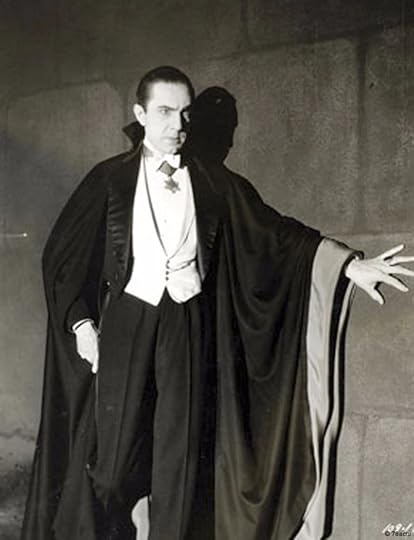
“Today’s special is pan seared Chilean Bass in a balsamic reduction…”
But Christopher Lee’s hissing count scared the heck out of me. I watched most of Horror of Dracula with my hands partially covering my eyes, afraid to look, but unable to turn away. 
However, it was only when I read Bram Stoker’s Dracula that I felt the cold hand of fear. There was always a sexual component to Dracula, who both attracts and repels. I imagine this passage was pretty strong stuff to Stoker’s Victorian readers:
There was a deliberate voluptuousness that was both thrilling and repulsive. As she arched her neck she actually licked her lips like an animal til I could see in the moonlight the moisture that lapped the white, sharp teeth. Lower and lower went her head. I closed my eyes in a languorous ecstasy and waited.
The vampire offers sex, but it is debased and bestial, cut off from the human. And I think Stoker touches on the primal fear that animates much of horror–the fear of losing one’s humanity. Nowadays vampires have morphed from bloodsucking monsters into someone’s prom date! For years I despaired of seeing a pair of fangs I could relate to, until I found Enter, Night by Michael Rowe. It’s a briskly told tale of ancient, toothy horrors, with an ending that is both heartbreaking and transcendent. If you’re hungry for a really good vampire story, this one’s for you.
The Zombie

Zombie flash mob in London
Zombies are all the rage these days, so popular that there’s even a subgenre of literature called zombie lit! Popularity aside, I don’t find anything particularly frightening about these plodding creatures. To me they’re just one-trick ponies on the lookout for fresh brains. Give me an old-school zombie any day, one created by a Voodoo priestess on a moonlit night in New Orleans.
Which brings me to one of the most frightening short stories I’ve even read: Pigeons from Hell by Robert E. Parker. The story’s set in a deserted plantation haunted by ghostly pigeons, and something else. Stephen Kings calls “Pigeons from Hell” to be “one of the finest horror stories of our century. “As usual in matters of horror, King is right.
The Ghost

Can they feel, I wonder, those white silent people we call the dead? …Oscar Wilde
Susan Hill’s novel is the source for the excellent film of the same name. The narrative’s framed as a Christmas Eve ghost story, much as Henry James’ The Turn of the Screw. Like James, Hill conjures an atmosphere of escalating dread and isolation. The horror rises to a shattering and unexpected conclusion.Ancient and enduring, the first ghost appeared at some primeval campfire when one of our ancestors told the first ghost story. More than other monsters, the ghost is a sturdy literary device and pops up in all sorts of fiction, from Shakespeare to Dickens to David Mitchell.
But a Halloween ghost always means mischief and there is no more malicious spirit than The Woman in Black.
Psychologists like to theorize why people like me love horror. In his theory of archetypes, Carl Jung believed that all humans inherited a set of primordial images that are contained in the collective unconscious, and that horror evokes these archetypes. Maybe, but I read ghost stories and watch horror films because I like them.
So tonight, after the last trick-or-treater has come and gone, I’ll pour a glass of blood-red wine and read one of the old tales, one guaranteed to send a shiver down my spine.
HAPPY HALLOWEEN!
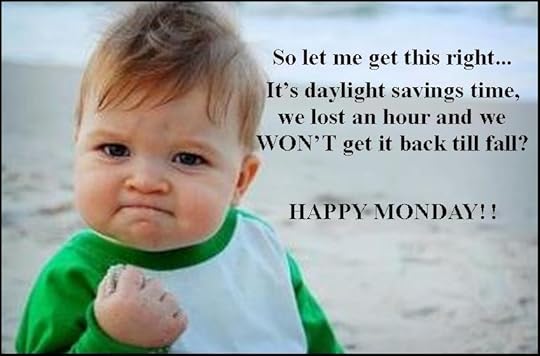
Down with DST!
“You will never find anybody who can give you a clear and compelling reason why we observe daylight saving time.”
Not only that, DST is bad for your health. The Monday after springing forward is one of the deadliest of the year, rife with car accidents, strokes, and heart attacks.
How many more must suffer before something is done?
March 3, 2017
A Visit with Mr. Dickens
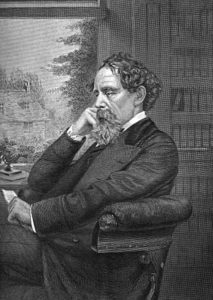
Throughout his all-too-brief life, Charles Dickens was constantly on the move. By any measure, his list of residences is astounding. Perhaps he inherited this restless spirit from his father, who moved from pillar to post, usually one step ahead of the creditors. Sadly, most of Dickens’s home no longer exist, their presence–or rather absence–marked by a sign or commemorative plaque saying Charles Dickens once lived here.
But that’s okay–a great city such as London is like the Phoenix, constantly recreating itself in the ashes of its own destruction. And anyway Dickens’s London still exists in the pages of his books. Still, there is a remaining jewel: 48 Doughty Street. In 1837, Charles Dickens, his wife Catherine, and her seventeen-year-old sister Mary Hogarth moved to the handsome residence, a house that befitted Dickens’s position as a rising novelist.
Delighted with his new digs, Dickens wrote: “It was a pleasant twelve-room dwelling of pink brick, with three stories and an attic, a white arched entrance door on the street level, and a small private garden in the rear…. a genteel private street with a lodge at each end and gates that were closed at night by a porter in a gold-laced hat and a mulberry-colored coat.”
 48 Doughty Street
Charles Dickens Museum
This beautifully restored house is now home to the Charles Dickens Museum and a must-see for any lover of Dickens.When my husband and I visited, we were lucky enough to catch the costumed tour.
Here’s the set-up: It is 1839. Mr. Dickens and his family aren’t at home, but the chatty 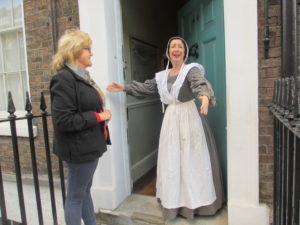 housemaid invites inside for a look around. I rather suspected the young flibbertigibbet was in her cups, but who can blame her? It was a chill April morning and I’d have gladly joined her in a bowl of Smoking Bishop, if she’d offered.
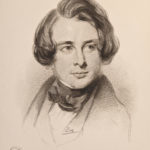
Young Mr. Dickens
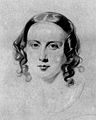
Catherine Dickens
During his three-year sojourn at Doughty Street, Dickens was a happily married young husband and father who’d just experienced his first commercial and critical successes, with The Pickwick Papers, Oliver Twist, and Nicholas Nickleby.
Although they grew apart as the years and babies accumulated, during their stay on Doughty Street, Charles and Catherine were an attractive young couple, very much in love.
When our hostess led us into the room where he had penned these three early novels, I was momentarily struck dumb. This was where Oliver Twist drew his first breath and Nancy her last, Sensing my interest, our hostess took me aside for a private word.
“I daresay when I first entered Mr. Dickens’s employ. I thought the master was mad as hops! I’d be passing on the stairs and here him in his room talkin’ and yellin’ to himself in all different kind of voices. I would have sworn to the Beadle he weren’t alone, though I knew the truth of it, I did.” The good woman laughed and lowered her voice. “Why, once I peeked in and he were winkin’ and twitchin’ at himself in the mirror, like one of them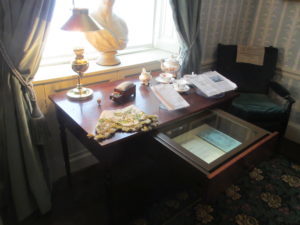 crazed folk at Bedlam!”
“He was happy here,” I said, and a shadow passed over the kind woman’s face. “Wasn’t he?” I prodded.
“You’ve read his books, so you know how it was–how it is. Life is always mixed up, not all one or the other. Come, let me take you to her room.”
“Mary’s room?” I whispered and our hostess nodded.
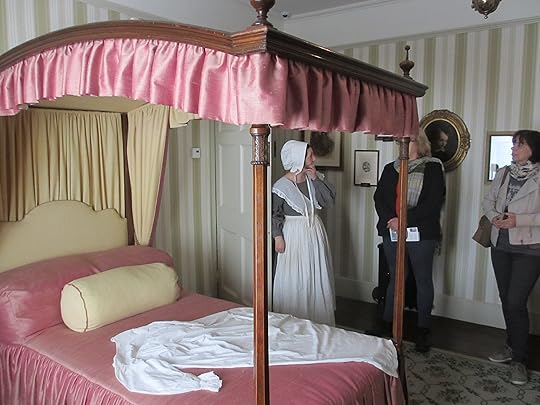
The room where Mary died
Charles Dickens was inordinately fond of his pretty sister-in-law Mary Hogarth, a pretty ephemeral creatures of sweetness and light. One night in 1837, Mary fell ill. She died the following day, in Charles Dickens’s arms.
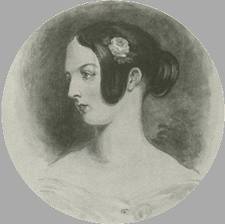
Mary Hogarth, aged 16, shortly before her death
Distraught, Dickens removed a ring from Mary’s cold finger and placed in on his own, where it remained for the rest of his days. Inconsolable after the loss of “so perfect a creature,” he was unable–for the first and last time in his professional life–to put pen to paper. Time and deadlines passed, with no new installments of The Pickwick Papers or Oliver Twist.
Dickens never really recovered from the tragedy–Mary’s untimely death haunted his life and his fiction. His novels are peopled with the ghosts of Mary Hogarth. To some this might seem hard, but that’s what writers do: they mine their own lives and the lives of others to create art.
In The Old Curiosity Shop–a mere three years after the tragedy–Dickens created his most direct representation of Mary in Little Nell, an impoverished, sickly waif of “not quite fourteen”. As Little Nell’s life hung in the balance, two continents nervously awaited her fate. In a nineteenth-century version of going viral, frenzied New Yorkers were so eager to read the final part of Dickens’ story that they crowded the docks on a daily basis, shouting to the sailors on incoming ships, “Is Little Nell dead?”
(Spoiler alert: Yes, she is. In fact, Nell’s death scene is one of the most moving in Victorian literature, no small feat.)
In David Copperfield, Dickens’s most autobiographical novel and one of my personal favorites, Mary is resurrected in the character of wise Agnes. At least here, Dickens wrote himself a happy ending, endowing his literary doppelgangers of David and Agnes with marital contentment.
After leaving the death room, we followed our hostess to the dining room, where I was cheered to find the dining table set for guests.
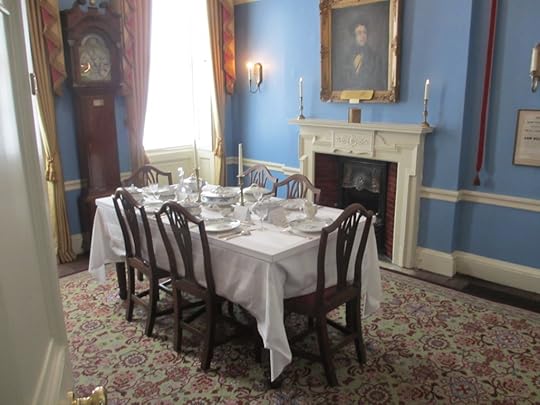 But then, Mr. Dickens so loved company–he was an actor on the stage of life, playing his role to the hilt.
As our time at Doughty Street drew to a close, I thought that this little house was not unlike one of Mr. Dickens’s books. His novels brimmed with life,but death was a constant presence, the uninvited guest at life’s banquet. Though he recognized the evil that men do, he affirmed–again and again–the power of the human heart. Though a frail organ, Dickens believed that there was no darkness so profound that it could not be illuminated by a loving human heart.
I’d like to believe he was right. Wouldn’t you?
All too soon, it was time to leave 1837 and the cozy house on Doughty Street. In farewell, our hostess quoted these words form the conclusion of The Pickwick Papers, when our narrator bids a final goodbye to that goodhearted fool, Mr.Pickwick.
Let us leave our old friend in one of those moments of unmixed happiness, of which, if we seek them, there are ever some, to cheer our transitory existence here. There are dark shadows on the earth, but its lights are stronger in the contrast. Some men, like bats or owls, have better eyes for the darkness than for the light. We, who have no such optical powers, are better pleased to take our last parting look at the visionary companions of many solitary hours, when the brief sunshine of the world is blazing full upon them.
Well said, Mr. Dickens.


![[image error]](http://4.bp.blogspot.com/-yAnaBpoJQn0/Vh22Dg2X_cI/AAAAAAAAATM/FowzMno2pX4/s1600/IMG_1793.JPG)
![[image error]](http://2.bp.blogspot.com/-hogKGNveP7E/Vh24TnW522I/AAAAAAAAATs/HTvzbrzuxw8/s1600/IMG_2045.JPG)
![[image error]](http://1.bp.blogspot.com/-pjjf6IwHzK0/Vh25auBvy0I/AAAAAAAAAUM/GLpT1LYmn8E/s1600/IMG_1694.JPG)