d. ellis phelps's Blog, page 7
January 29, 2024
sudden mud, d. ellis phelps
 Photo by Kelsey Mirehouse on Unsplashsudden mud
please don’t leave my name
hanging around on a park bench
or a paving stone
but sit
alone
sit by the makeshift pond
and wonder:
how deep it is at its center
—maybe a foot or two
how long it will stay
another week another day
—remnant of rain
that lasts for weeks
the way it sometimes does
& how it floods
watch the pickleball players play
wish the way I am today
that you could still play a running game
walk the circled path
listen to granite crush underfoot
see how it glints
in the february sun
how still the swing
where no one swings
its occasional sway
in the teasing breeze
rejoice!
when you see bluebonnet leaves
& know that blooms are coming soon
—the lantana has survived the freeze
notice the net still
without a basketball
–its purpose unfulfilled
the lonely court waiting
like the ankle-deep winter green
grass that waits for spring
take whatever dog we own
with you let her roll
in the sudden mud
listen
to the rooster crow midday
know that he does so
when he does
because he can
& amble round and round again
as many rounds as you can go
and don’t worry
wherever I am
i’ll be just fine
i’ll be just fine
(c) d. ellis phelps


January 3, 2024
fws: prayers, praise, & blessings Fall ’23 issue is live!
 image credit: ”Tree of Righteousness, Diamante Lavendar, fws contributor
Please help me welcome thirty-plus artists and poets to the pages of fws.
I am delighted with the contributions, as I am sure, you will be as well. Be sure to follow the links at the bottom of each page, as there are three pages in the anthology. Be blessed. & share widely!
In the meantime, I send my version of the Buddhist Meta Prayer to all of you:
May all beings be safe.May all beings be free.
May all beings know comfort.
May all beings know relief from suffering.
May all beings know love.
May all beings know peace.
May all beings know healing.
May all beings awaken to the Light of their True Nature.
May all beings know god.
Namaste,
d
November 28, 2023
Great Horned Owl
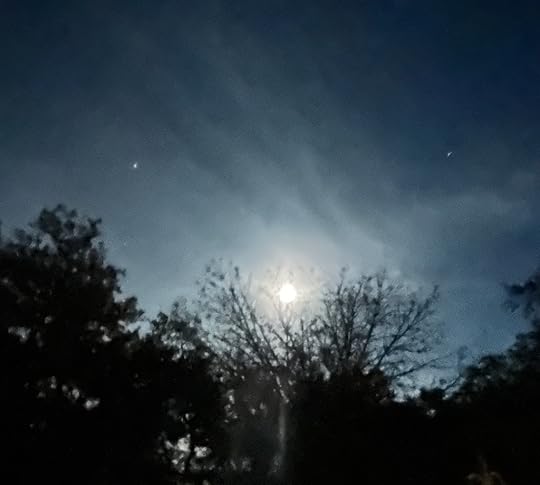
& on this night, under this sky: Great Horned Owl serenades this waning gibbeous moon. listen:
Great Horned Owl callingOctober 31, 2023
where the goblins go by d. ellis phelps
 Image credit: Daniel Jensen on Unsplash
Here’s a little creepy fun for your Halloween enjoyment! The poem appears in my collection, words gone wild (Kelsay Books, 2021). Click on the image above to hear me reading it. Have fun!
where the goblins go way down deep where the willawogs growwhere the creatures creep and the goblins gowhere wigglies and worms uproot the soilwhere headless fish make stink and spoila wild witch sits by in a rocking chaira wicked wind in her wiry hairher crooked hands and gnarly feettap to the music of an eerie beatround and round in a circle dancechicketts and drummons hop and prancetheir scarlet bellies and yellow clawsclick and bounce as they clap their pawsorange feathers and lime green beakssniff the air, say SOMETHING REEKS!tip-toe through the hazy blue—careful that the willawog doesn't catch you!(c) d. ellis phelpsOctober 9, 2023
call for submissions: prayers, praise, & blessings
 image: gratitude to Benjamin Davies on Unsplashfws: international journal of literature & art
We are now reading for the Fall 2023 issue of fws: prayers, praise, & blessings. All writers eighteen years of age and older are welcome to submit art, poetry, creative nonfiction, or prose.
Submit now through Dec. 31, 2023, but don’t wait! We are publishing work as soon as it is accepted.
Read the issue in progress here. I am delighted with what is emerging!
It would be lovely to read new work from you that responds to what has been written already, perhaps even using lines from the issue’s previous work.
Read guidelines and submit here. I look forward to reading your submissions.
Namste,
d
September 20, 2023
Moorings: five women on grief,death & dying
 “Algiz” Digital Art Print, (c) Yana Istoshina. Used with permission of the artist. All rights reserved.
For what is it to die but to stand naked in the wind and to melt into the sun?
~Kahlil Gibran
And what is it to cease breathing, but to free the breath from its restless tides, that it may rise and expand and seek God unencumbered?
This post features the work of five women, four writers, and a visual artist: myself, Luz Leyden, Mary O’Brien, Nupur Maskara, and Yana Istoshina. This work came to be as a result of a writing workshop I facilitated, one that three of the writers attended. During the workshop, coincidentally, each of them accessed and wrote about personal grief. The work was beautiful!
So I invited them to polish their pieces and send them to me for this writing. Two of the pieces are written in a sort of haibun form, the prose being followed by a short poem. I found the art while searching for art of the Spirit World. It’s perfect. I am indeed grateful for the efforts of these women and thank them here, profoundly, for their stunning contributions. Deep bow.
First, a few words of my own:
In my recent readings from Fear: Essential Wisdom for Getting Through the Storm by the late Thich Nhat Hanh, I found the Buddhist teaching of “no birth and no death.” This is the idea that nothing that exists can cease to exist, instead everything changes, changes form, including people. As a metaphor, he writes about observing clouds and having a beloved cloud. One day, you notice that your beloved cloud is missing and you think it has gone. You have lost it. But this is impossible according to the “no birth and no death” teaching. The cloud has only transformed itself into rain, maybe, or it has been absorbed into the atmosphere to appear elsewhere as morning dew, or snow, or river, or ocean. He says the same is true for human beings, that we merely transform.
This matches my theology. I say we transition from our fleshly body into our Light Body.
Hahn offers this meditation as a balm for the feeling of loss:
Darling, I know you are there somehow, very real to me. I am breathing for you. I am looking around [at this beautiful world] for you. And I know you are still there very close to me.
~Thich Nhat Hanh
In 2009, my mother, my dearest friend, and confidante, & spiritual guide made her transition. My grief was overwhelming, coming in waves for months. She was cremated: her body transformed into heat, smoke, and ashes. I kept her ashes on the mantel for weeks, awaiting her memorial service when finally the ashes were placed in a box and sealed in the mausoleum wall.
Though her ashes were sealed away in a box, she was definitely not gone.
We had agreed before her passing, that if she could choose, she would smell of pine like her beloved East Texas Piney Woods. In this way, she would communicate her presence to me.
While her ashes were on my mantel, the scent of pine encircled the space in a circumference at least six feet wide. After the interment, still she lingered, occasionally, wafting the scent of pine throughout the room. A gentle nudge. And I would weep again.
Finally, after weeks or months, she seemed to move on and I have rarely sensed her presence, with a few exceptions. I believe she is at peace. I know that she is One now with The Supreme, One Intelligent Life Force-Being. This is what moors me.
September 16th was the anniversary of her transition and I felt her quietly near, though I did not detect her scent. A children’s song, a faint fading in and out of lyrics I almost knew, a song, one she used to sing to me: a sign, I think. & so I bought chrysanthemums, gold and purple, and placed them on an altar with her last photograph- a scarf, a votive candle.
Mom, I am breathing for you. I am looking around for you. I am listening for you. I am putting my hands in black, rich soil for you.
 “Grief”, Cathy Baird.Used with permission via Creative Commons. Rights reserved.
We Do Death Well in Ireland, Luz LeydenShe whom we love and lose is no longer where she was before. She is now wherever we are.
St. John Chrysostom
“We do death well in Ireland,” is something we often tell ourselves as we queue up to clasp the hands of bereaved friends and neighbours, telling them each in turn that we are sorry for their loss.
People pass and they are usually buried within three days, or maybe four if the family is waiting for a close relative to travel home from abroad.
We have a fine tradition of a wake, in which people sit in the house with the body and their family, mirrors covered for fear of seeing the reflection of the dear departing soul. Whiskey and porter are drunk, sometimes illegally brewed poitín is imbibed. Stories are told. Laughter is allowed, welcomed even.
A funeral takes place, and no invitations are sent, because none are required. Funerals are often very large, and people who knew the deceased or who knew their family attend. Attendance is anticipated and not attending can be seen as a statement.
Afterward, people gather in a local pub or restaurant and break bread together in the form of arrays of sandwiches cut in triangles passed on plates or more formal sit-down meals sometimes. The life of the deceased is celebrated, and stories about them are told that might never have been heard before or repeated since. Someone might say: “There was a good turnout and someone might reply we do death well in Ireland.
When the coronavirus came, it changed everything: our dead lay in funeral homes separated from their family. They were removed. Cremation instead of a proper burial became more common.
During this time, my mother needed a simple procedure on her heart, but the closure of the hospitals for everything but emergencies, would not allow it. She passed suddenly in the end, not from Covid itself, but because of it.
Instead of our traditional wake with stories and whiskey and laughter to ease our pain, we were allowed only fifteen minutes for the funeral, and even fewer people could attend. There was no touching of the coffin permitted, no one could travel, no food could be shared, and no one could hug.
No one said: We do death well in Ireland.
My sister and her family had to watch the funeral live online and it was recorded for people to watch afterward, but I never have. It would be too heart-wrenching to be reminded of all the reassuring rituals of someone passing that we rely on stripped away on screen.
It felt like we were all adrift at sea during that period. Our loss was just one in an ocean of deaths that were announced nightly on the news. Various waves of the coronavirus came and went and with each ebbing tide, we hoped to be able to drift back together as a family and celebrate our mother’s life. Months turned to years before we got to gather.
What moored me most during that time was the knowledge that, no matter how long we had to wait, we would gather again and get to consider our loss and celebrate our mother’s life. She had written exact instructions as to what she wanted to have happen after she died, and I clung to the knowledge that regardless of how long it took, I would carry them out.
We have now had my mother’s memorial. About one hundred people came together in the local hotel, including her four children and eight grandchildren, and we got to watch a slideshow of photographs of her at different ages and see the craftwork and crochet she had made. We heard anecdotes through the night and people who couldn’t attend sent us stories dotted through various periods of her life.
The next day we took the ferry to the tiny Atlantic island we used to live on and accompanied now by her two great-grandchildren, islanders, and close friends, we placed a plaque in the graveyard wall there and scattered her ashes in the harbour that our house had overlooked, and sang songs that reminded us of her. It was healing.
Afterward, I met some women in the local library who had attended, and they said how beautiful it was and how like a traditional wake it was. Finally, we could again say:
We do death well in Ireland.
Four windsWe will reunite this summer.Invitations will be thoughtfully relayed,Responses grouped into atolls of acceptance,Venues reserved to meet islands of needs,Food picked for the picky eaters,Flights flown from Canada and the US Bringing people home to see another’s departure,Ferries will be fixed in a sea of dates,Accommodation arranged to hold us together,Flowers will be procured to brighten the day,Words will be written and carved in stone, Tears will be shed as ashes scattered,As we send my mother to the four winds,Three years after the pandemic turned her to dust. “Rose” by Karen via Creative Commons. Used with permission Rights Reserved.
Her Long Goodbye by Mary OBrienInto the hand that made the rose, shall I with trembling fall?
~George Meredith
She has surrendered to the soft arms of her recliner, no worries to bring to the Lord she has forgotten. Her abundant flower garden long mowed down, she brightens at the sight of gladiolus left leaning against the garage.
She doesn’t remember her favorite flower is the lily of the valley, or that sweet peas are a close second. The grandchildren who picked weeds and sweet, ripe strawberries are relegated to a part of her brain that cobwebs and shadows occupy. Within those caverns rest the thirty-two years of marriage she patiently enjoyed with her husband Claude until his passing in 1996.
I remember so clearly the afternoon I was inducted into this Irish family with trial by fried oyster. I looked to her and her daughter, hoping for allies against this disgusting tradition. No comfort was found – I had no choice but to chomp down on the slimy, gritty sea bug while the entire family gleefully enjoyed my discomfort.
The decline began with the constant flutter of sticky notes on every surface imaginable. Reminders for appointments, birthdays, special dates, as if the calendar notations were not sufficient. She had been the calendar queen in her quest to bind her family together as they grew and moved apart. Every Christmas, we all received calendars with births and anniversaries handwritten, with a current address and phone number list taped into the back.
This was before her heart valve surgery that left her stooped and weakened. A surgery she didn’t want but that we convinced her to endure. She didn’t want to grow old and feeble and was ready to go home to her true north; Jesus. The operation bought time for the weddings of her grandchildren, the births of great-grands, and many happy times.
Yet there were incidents of getting lost in her own town, issues with unwise driving, checkbooks overdrawn, and unpredictable, risky behaviors. As these changes were completely out of character for her, the family slowly came to terms with the long goodbye of an Alzheimer’s diagnosis.
The woman who had birthed and raised the fine man I married thirty-seven years before began slipping through our fingers between visits and phone calls. Running out of things to say, she began to withdraw as her mind became unmoored. We comforted ourselves as we left each time that at least she knew who we were. As we re-membered each other, we washed our goodbyes with tears shed and unshed.
Grieving her loss in advance is a strange process. You lose everything in small increments like leaves falling and withering at the foot of a tree that still looks like a tree. It’s her voice, however strained, saying your name, her smile returning your smile with the same gentle look. Yet her face is often in repose as she dozes through conversations, card games, and visits from family or hospice. Then came the day she didn’t remember us. You know it’s coming but it stings nonetheless.
If peace is the absence of need, then she is at peace with her status as chief ice cream connoisseur and occasional comment injector. Says her favorite name is her own, Eunice, so she does remember herself. The loss of independence and various indignities are endured with patience and cooperation for the most part.
Today her heart valve is failing and the amount of physical care she requires exceeds what her family can provide. Transitioning to a care facility is not what anyone wants. We can only pray that somewhere deep inside she will understand and continue to carry the love in which we have cloaked her.
As she has forgotten the God she has served all her life. I’m not sure what she holds onto to stay her faith. We prefer to believe she is being held and nurtured by that same God and spiritual beings we cannot see. This gives us comfort and moors us when the guilt and sadness overtake the helpless feeling in the pit of the stomach that gnaws in the night.
It continues to be a long goodbye, and I wonder if each visit is the last. We didn’t hug her when we left Sunday, as she was asleep. My jaws clench at the mistake. My husband’s sadness is his own. We now speak in terms of funeral details and our next trip over the mountains to love her and the family as hard as we can.
It feels foreign and perhaps cruel, but we wish her suffering to be short. We hope we can spend the end together singing “Amazing Grace” and “I’ll Fly Away” to this woman who has spent herself devoted to faith, goodness, grace, and deep love for her family. We pray for a peaceful and timely passing. We pray that the sparks she imbued will be passed on through our children and grandchildren in the generations to come.
Litany for Eunice For yardstick spankings that made us feign cries,the patient wife with great pride in her eyes,for the easy, full laugh and permissive sighs,let us now give thanks.For powdered sugar pancakes, jam in old jars,powdered cheese miracles raising the bar,for ice cream achieving her highest regard,let us now give thanks.For Sunday school faithfully each sabbath morn,lace collars on dresses, no pearls were worn,for wintergreen mints when church pews grew warm,let us now give thanks.For being our guidepost with steady, thoughtful hands,our weddings, potlucks, and funeral yams,for pointing each one of us toward the Lamb,let us now give thanks.For grandmothering with long gentle talks,letting us “help” while digging up rocks,“Don’t bleed on the carpet!” at which we would balk,let us now give thanks.For raising kids that made honorable spouses,opening her doors to those needing houses,for garden bouquets for happy announcements,let us now give thanks.For annual calendars with names and dates,old toys in the basement awaiting their fate, for lovingly, carefully washing each plate,let us now give thanks.For shining looks in moments of memory, her singing lips—the old gospel melodies,for teaching us life is full of mercies,let us now give thanks. For rising each day when falling is easier,living long behind cloudy eyes failing her,for all these things and more we treasure,let us now give thanks.Kedar Bodas sings a bhajan, on location in Mulshi. Bhajans are devotional songs, with lyrical themes including ancient epics, saintly teachings, and love for the divine.
Hasta la Vista, Baby: How Indian Philosophy Helps Us Cope With Death by Nupur MaskaraYour body is as transitory as the froth on the surface of water. The Jiva is sitting unattached in the body, as a bird on a tree
~Vyasa
A Whatsapp message at 2:53 AM, May 4, 2022 in Kolkata, India: My aunt, my father’s sister, my bua, had stopped breathing. A cancer patient, we knew the day would come, but that didn’t soften the shock. “Om Shanti (may her soul attain freedom from death, moksha),” I messaged back.
A vivacious lady, she had been 69 years old. She had celebrated her golden wedding anniversary mere months ago. My bua was a successful entrepreneur, at a time when few married women ran their own businesses. She designed, manufactured, and retailed bedcovers, under the brand name Avishkar. Her shop was opposite my house, and she would often come over after work to meet us.
Later in life, after she got cancer, she lost her long tresses. The lack of hair on her head only emphasized her piercing eyes, spare features, and open smile. She enjoyed singing, especially devotional songs, bhajans.
We went in the morning to her home. Her three children were distraught. My uncle flew in from Mumbai. These days, the only times families meet are at weddings and deaths. As Hindus, we have a set of rituals around death. Besides having symbolic meaning, rituals give us something to do and so help us in the grieving process.
These rituals moor us.
We washed her body with clarified butter (ghee), honey, milk, and yoghurt; placing essential oils on her head (turmeric for females, sandalwood for males). We arranged her palms in a position of prayer and tied her big toes together.
We clothed her body in bridal red and bejeweled as her husband was still alive. Her son placed a garland of flowers around her neck. The priest performed a puja, which the immediate family participated in, chanting mantras and sprinkling water on her body. Her son shaved his head, leaving a single strand of hair. Four men in the family took one end each of the bier of bamboo sticks tied with jute strings she lay on, to carry her to the vehicle in which they would go to the cremation ground near the river, the ghat.
Her son lit the funeral pyre. The priest chanted this Sanskrit verse,
“Dhanãni bhumau pashavashcha goshthe,
Nãri gruhadware sakhã smashãne,
Dehashchitãyãm paraloka mãrge,
Dharmãnugo gachhati jiva ekaha.”
which translates as, Wealth will remain buried, cattle will remain in the pen, (her) spouse will accompany (her) to the doorway, friends will accompany her to the crematorium, the body will come till the funeral pyre, but on the path to the next world, the soul (jiva) goes alone (with her actions, karmas).
We mourned for twelve days. The immediate family avoided visiting the family shrine, or temple or using scented products until this period was over. Family members who had flown in left, otherwise they would have to stay for the entire mourning period. They would return once the twelve days had elapsed.
No cooking had happened in her house from the time of her death until her cremation, the parallel being fire for cooking should not be lit until the fire of the cremation pyre had gone out. First, her family offered food to crows, placing a plate outside their house. We believed that she would visit us in the form of a crow, and so her soul would be satiated after she was fed.
Her family hired a cook, or maharaja, to make her favorite dishes for the duration of the mourning period. They fed a holy man, a brahmin, every day, in her stead. A priest came every day, to discourse from a religious text. Her family had framed a photo of her and adorned it with a string of flowers.
On the third day after her death, the tiya, Bua’s male relatives returned to the ghat to collect her ashes, which they would immerse in the river Hooghly, a tributary of the holy Ganga that ran through her hometown, Kolkata. Her soul could then rise to heaven. We assembled at her house to grieve. We sang religious bhajans and wrote our God’s name, Rama, repeatedly on notepads.
On the thirteenth day, tairva, the family hosted a feast in her honour. The priest did a ceremony, a havan, and twelve more priests, or brahmins came to eat at her house. Every month her family would fast for a day, and give food to the priest. This went on for a year till the barsi, the death anniversary.
Every year, during the sixteen-day shradh period in September, when we pay homage to our ancestors, her family would now include her as well. On one of these days, they would pray, feed a poor woman her favorite delicacies, and give her money and clothes.
At the end of three years, there would be another big ceremony, where she would be absorbed among our ancestors, pitron. In stark contrast, another aunt who passed away during COVID had none of these elaborate rituals. At that time, we met on Zoom and watched the priest perform the fire ritual, the havan. Afte the ceremony, we chatted, catching up with each other – after all, even online the only times families meet are marriages and deaths.
The Sanskrit word for death is dehanta, which literally means the end of the body. One of my favourite Indian philosophical texts, The Bhagavad Gita’s most famous verse is –
“Vasansi jirn-nani yatha vihaay
navani grihnati naro-parani
tatha sharirani vihaya jirnany-
anyani sanyati navani dehi.i”
Translated, this means that like we discard old clothes for new, the soul leaves a worn-out body, for one that is new. Hindus believe in reincarnation – that when we die, our souls return in a different form, depending on our karma. There are eight point four million species, whose bodies we don in turn before we attain the body of a human being. This cycle of life and death goes on until we achieve freedom from death, moksha – by uniting with Brahman, or the divine energy.
Since we believe after death, the physical body has no purpose, we cremate it. That is the fastest way to release the soul so that it can be reincarnated. As soon as the soul leaves the body, it adopts a new body, whose limbs grow daily. On the thirteenth day, the soul finishes this process.
Elsewhere in the Bhagavad Gita, God Krishna compares our body to that of a boat, with the captain being our spiritual teacher, the guru, who guides us in crossing the ocean of ignorance. Krishna’s teachings are the wind beneath our sails. His teachings moor us.
These thoughts about death and detachment to the body, also help me live life fully. Any time I find myself getting disturbed about a setback, I try to remember what the Gita says, that we should do our work and not be attached to its results.
The Hindu God of death is Yama. Consider this quote about him from the Yoga Vasistha, another philosophical Hindu text. Named after sage Vasistha, it contains his teachings to Lord Rama, the hero of our great epic the Ramayana.
“Yama will not trouble those wise persons who do not nourish in themselves the hissing serpent of desire with its hood of anxiety, which twines itself round the tree of the perishable body. Yama will not trouble those realized souls who are not bitten by the serpent of greed living in the hole which is their mind, emitting the venom of attachment and hatred.”
As a poet, this striking visual image appeals to me. I try to meditate daily, and it does calm me down, especially when I can’t sleep.
Here’s what Vyasa, the author of our other great epic, The Mahabharata, had to say to his son on moksha – “Your body is as transitory as the froth on the surface of water. The Jiva is sitting unattached in the body, as a bird on a tree.”
I do not fear death but I do consider it.
I’m now forty-one years old and used to more and more unwelcome white hair appearing in my comb. Friends have started coloring their hair, but I don’t want to, at least not yet. I want to be as I am, detached regarding my appearance.
A school friend’s husband passed away due to a heart attack. My younger brother’s friend also died recently, of cardiac arrest. Doctors have noted a rise in deaths among younger people but are at a loss about why this is happening. Because of this, my husband and I keep personal trainers and we are more conscious of what we eat. We’ve lost weight and we feel lighter and healthier.
I think this Bertrand Russell quote echoes much of what I’ve mentioned about Indian philosophy so far:
“The best way to overcome it [the fear of death]—so at least it seems to me—is to make your interests gradually wider and more impersonal, until bit by bit the walls of the ego recede, and your life becomes increasingly merged in the universal life. An individual human existence should be like a river: small at first, narrowly contained within its banks, and rushing passionately past rocks and over waterfalls. Gradually the river grows wider, the banks recede, the waters flow more quietly, and in the end, without any visible break, they become merged in the sea, and painlessly lose their individual being.”
One evening when I was in Pune, shortly before my bua passed away, I got a call from her on my phone. “Kya chal raha hai? (What’s up?)” she asked me. I narrated the latest escapades of the children.
“I’m interested in knowing what you are doing,” she clarified. I told her about my clients (I’m a freelance writer) and that I wrote poems when I was free.
“I’m so happy to hear you’re doing something for yourself,” she said. “Keep doing that, always. It will keep your mind occupied,” she continued.
It felt good to have someone ask about me, not the kids, for a change. Building a legacy to leave behind helps us deal with mortality. Bua’s daughter, my cousin, runs Avishkar now. We met this year for lunch when I was in Kolkata. She looked more mature now. I could see Bua’s smile in hers when she spoke about how well the business was doing, and the new website she was getting designed for it.
A bird chirped on the tree outside the restaurant. I imagined Bua, in her next life, or perhaps she had attained moksha. Either way, she lived manifold – in her family, her enterprise, and in her new being.
 “Crows” Patrick Verstappen. Used with permission. Rights reserved.
Read bios and find links to these contributors here. Contributors are listed in alphabetical order.
Thank you for reading. Tell me: what moors you?
Namaste,
d
August 14, 2023
titmouse sings in the shower, d. ellis phelps
Listen to me reading this poem on Soundcloud below:
titmouse sings in the shower when she flies inher beak is wide openshe sits in the dripsips a bit from the lip of the leafshe has joined the wrenand the chickadeethe cardinal and his youngi put the sprinkler outinto the back patio gardenas i have done every afternoonthis summerthe birds & i agree—regardless of restrictionsthey must have waterat a certain hourthis flock comes in the overwhelming heatof this summer sunwe have a date they say as they arrive one by onewait under the shade of the red umbrella—sing in the shower(c) d. ellis phelpsAugust 14, 2023Thanks for listening/reading, Y'all!Namste,dJune 25, 2023
Porcelain Mother by Johnathan Fletcher
 Photo by WARION Taipei on Unsplash
Porcelain Mother
As a child, I wished to look like you, askeda light-toned Lord, who formed an earthen Adam, to whiten me. Yet he didn’t. Or couldn’t. Perhaps the Potter can’t make porcelain without kaolin. I must have been dug from the wrong color clay. You assured me there were families like us:mothers as light as chalk, children as darkas mud. Materials that stain as easily as love. I would’ve burned in a kiln to turn out the same hue as you. But some clay, however baked, isn’t meant to be china.O, how I envied the figurines of our crèche! Shepherds as white as their sheep, a milky Mary and Baby Jesus. When reminded of your favorite Bible verse: dust thou artand unto dust shalt thou return, I only felt like dirt. I instead preferred your proverb: God doesn’t mold mistakes.~Jonathan FletcherOriginally from San Antonio, Texas, Jonathan Fletcher currently resides in New York City, where he is pursuing a Master of Fine Arts in Creative Writing in Poetry at Columbia University’s School of the Arts. He has been published by or in Arts Alive San Antonio; FlowerSong Press; Lone Stars; University of Texas Rio Grande Valley’s literary magazine, riverSedge; Our Lady of the Lake University’s literary journal, The Thing Itself; TEJASCOVIDO; and Voices de la Luna. His work has also been featured at the Briscoe Western Art Museum.
Photo by WARION Taipei on Unsplash
Porcelain Mother
As a child, I wished to look like you, askeda light-toned Lord, who formed an earthen Adam, to whiten me. Yet he didn’t. Or couldn’t. Perhaps the Potter can’t make porcelain without kaolin. I must have been dug from the wrong color clay. You assured me there were families like us:mothers as light as chalk, children as darkas mud. Materials that stain as easily as love. I would’ve burned in a kiln to turn out the same hue as you. But some clay, however baked, isn’t meant to be china.O, how I envied the figurines of our crèche! Shepherds as white as their sheep, a milky Mary and Baby Jesus. When reminded of your favorite Bible verse: dust thou artand unto dust shalt thou return, I only felt like dirt. I instead preferred your proverb: God doesn’t mold mistakes.~Jonathan FletcherOriginally from San Antonio, Texas, Jonathan Fletcher currently resides in New York City, where he is pursuing a Master of Fine Arts in Creative Writing in Poetry at Columbia University’s School of the Arts. He has been published by or in Arts Alive San Antonio; FlowerSong Press; Lone Stars; University of Texas Rio Grande Valley’s literary magazine, riverSedge; Our Lady of the Lake University’s literary journal, The Thing Itself; TEJASCOVIDO; and Voices de la Luna. His work has also been featured at the Briscoe Western Art Museum.Gratitude to Waco Cultural Arts Festival’s 2022 Anthology where this poem was first published and to Editor, Sandi Horton for choosing the poem.
February 2, 2023

January 13, 2023
Matins on the High Plains & Lavender Dreams by Darlene Logan
 Photo by Patrick Desloge on Unsplash
Matins on the High Plains
~Quemado, New Mexico: Walter De Maria Lightning FieldStanding on parched Quemado earth on that half-moon, mid-autumnal night, we saw no bolts of lightning flash from steel pole to steel pole. Rather, witnessing Venus rising, dazzling, we, dazed by the desert’s thick night, gazed at the pitch-black perfection of a sky illumined by a thousand-thousand suns all framed in darkest, deepest velvet. Our eyes walked the Milky Way, a path of fine-spun angel hair, and read each constellation. But it was the fresh, cold morning that offered us an earth-bound wonder: for while we sentinelled the first streaks of dawn’s pink touch behind a chain of buttes, we saw the morning flash a brilliant light. In that instant, standing stunned in perfect silence, we heard from the west and from the eastthe sharp, shrill, lightning-quick serenade of coyotes welcoming the day.
Photo by Patrick Desloge on Unsplash
Matins on the High Plains
~Quemado, New Mexico: Walter De Maria Lightning FieldStanding on parched Quemado earth on that half-moon, mid-autumnal night, we saw no bolts of lightning flash from steel pole to steel pole. Rather, witnessing Venus rising, dazzling, we, dazed by the desert’s thick night, gazed at the pitch-black perfection of a sky illumined by a thousand-thousand suns all framed in darkest, deepest velvet. Our eyes walked the Milky Way, a path of fine-spun angel hair, and read each constellation. But it was the fresh, cold morning that offered us an earth-bound wonder: for while we sentinelled the first streaks of dawn’s pink touch behind a chain of buttes, we saw the morning flash a brilliant light. In that instant, standing stunned in perfect silence, we heard from the west and from the eastthe sharp, shrill, lightning-quick serenade of coyotes welcoming the day.
 Photo by Dimitri Iakymuk on Unsplash
Lavender Dreams
If love is round, a melody of river, ocean, rain,I love you more than soft wings and dazzling sunsets.You whisper to me the secret of stars before we awaken.In our garden are fully ripened tomatoes, brave snow peas & stalksof string beans, milky okra on prickly stems the fuzzy texture of testicles, blackberry brambles, richest roses & sunflowers reaching for sky.So sorry to come now with these empty hands,my clumsy fingers trying, trying to button up emptinessbut promising to bring arms filled with thistle & lavender next time.Listen! The earth is spinning round and round our solitude.Let us look for secrets below this glass-bottomed boat.Love is all we’ll ever need remember.
Photo by Dimitri Iakymuk on Unsplash
Lavender Dreams
If love is round, a melody of river, ocean, rain,I love you more than soft wings and dazzling sunsets.You whisper to me the secret of stars before we awaken.In our garden are fully ripened tomatoes, brave snow peas & stalksof string beans, milky okra on prickly stems the fuzzy texture of testicles, blackberry brambles, richest roses & sunflowers reaching for sky.So sorry to come now with these empty hands,my clumsy fingers trying, trying to button up emptinessbut promising to bring arms filled with thistle & lavender next time.Listen! The earth is spinning round and round our solitude.Let us look for secrets below this glass-bottomed boat.Love is all we’ll ever need remember.Darlene Logan spent most of her professional life in the humanities. She taught a broad assortment of English classes for thirty years in the Land of Enchantment at New Mexico Military Institute where she also sponsored an annual Shakespeare Festival and hosted many, many poets to read and workshop with cadet students. Retired a dozen years and now living on a pretty half acre in Lakehills with her partner Lad, she reads much, writes a little, engages in hearty discussions, and often entertains four grandsons and a multitude of friends and family