
Robert M. Kelly's Blog, page 4
July 23, 2015
Wallpaper in the Gilded Age, Part I: Introduction
Wallpaper in the Gilded Age:
A Nine-Part Series Based on Ventfort Hall
by Robert M. Kelly
 1. "leather" paperI. introduction to six types of historic wallpaper found at Ventfort Hall
II. 1893: historical context
III. 1893: social context
IV. architectural changes 1850-1910
V. wallpaper's commercial context in the Gilded Age
VI. Wharton's wallpaper complex
VII. revisiting six wallpaper types found at Ventfort Hall
VIII. conclusion
IX. addendum: Cottage Industry: L. C. Peter's Notebook
*** author's note: These blog posts started as a written version of a lecture about six wallpapers found at Ventfort Hall. The six wallpapers are covered in Part I.
I went on. When I came up for breath I had a series of nine parts. I enjoyed exploring the nooks and crannies of related areas such as the architecture and social history of the Berkshire County region, and hope you will, too. Many will wonder in the course of this nook and cranny-ing what the heck happened to those original six wallpapers. Let me assure you: the wallpapers SHALL RETURN in Part VII.
During this work I was introduced by Nini Gilder to the amazing nineteenth-century daybook left behind by L. C. Peters, an accomplished carpenter and fix-it man for the Lenox colony. I decided that his story, (Cottage Industry) belonged here as well. It appears as Part IX.
That said, forward into 1893!
I. introduction to six types of historic wallpaper found at Ventfort Hall
 2. period colorized postcard
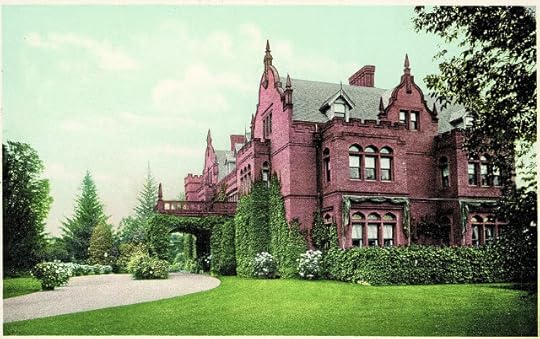
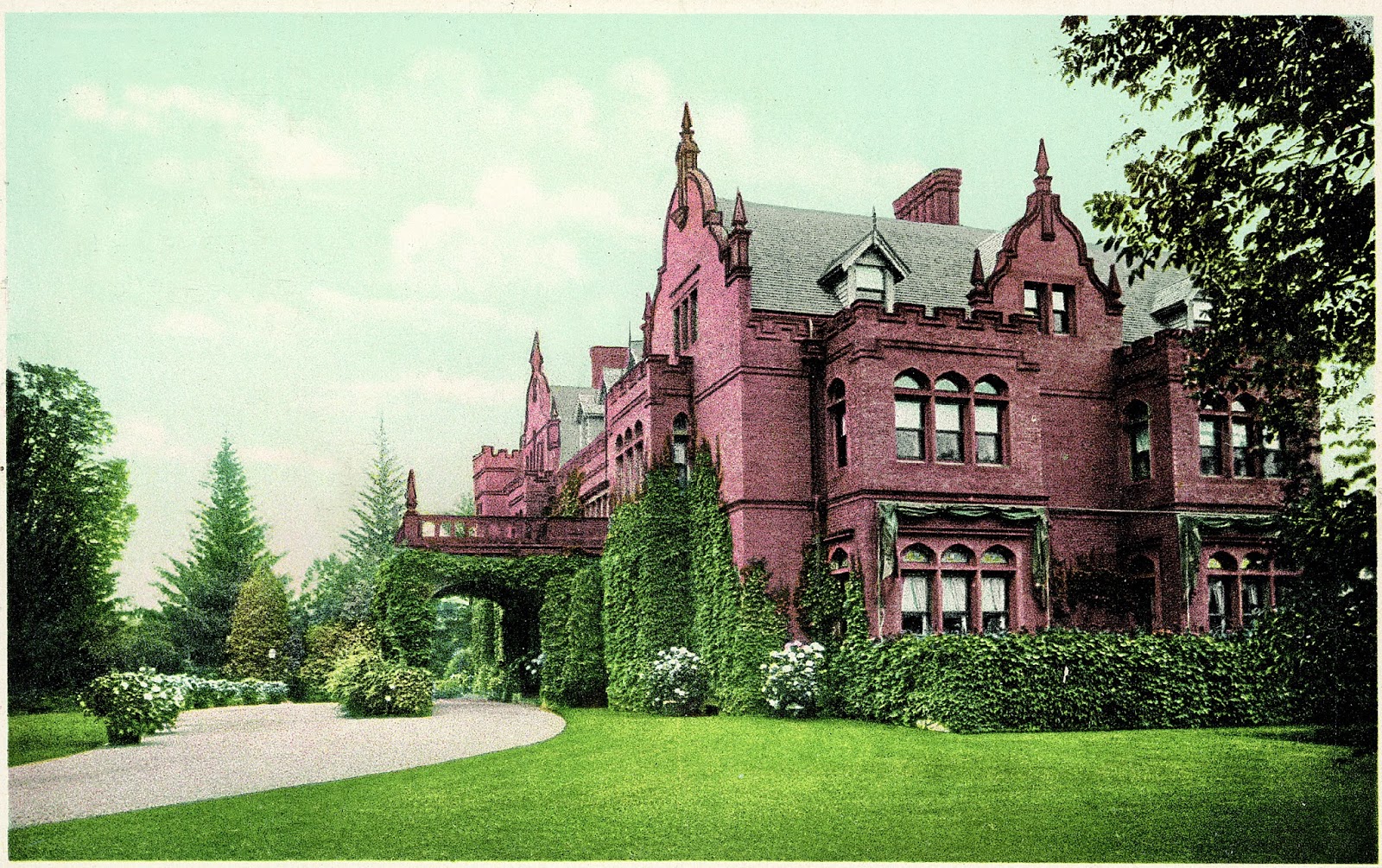
Ventfort Hall, a Jacobean-revival pile in Lenox, Berkshire County, Massachusetts, was narrowly saved from the wrecking ball around twenty years ago. Volunteers instituted a preservation program which has breathed new life into the 1893 structure. The educational programs of Ventfort Hall explore not only the Hall's history but also the culture of the late Gilded Age during which it was constructed.
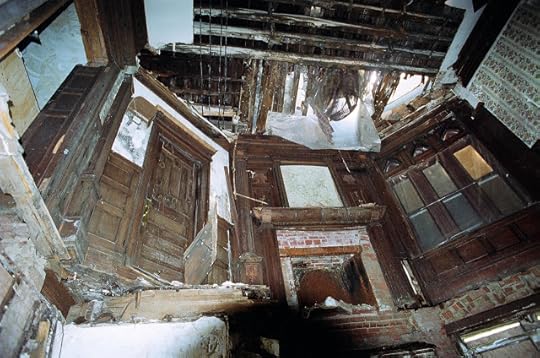 3. Ventfort Hall in disarray: the view from the basement looking up through the collapsed floor to the dining room.
Six seemingly first-generation wallpapers from the house are of prime importance: a leather paper, a block printed floral, a “stenciled look,” a Lincrusta-type, an Anaglypta-type, and a varnished tile.
 4. fabric remnant on 2nd floor
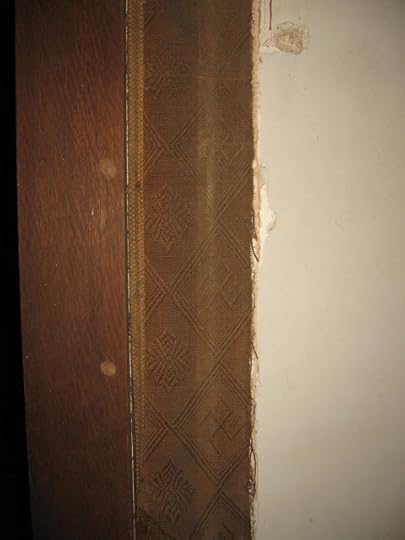
Though not adddressed here, fabric was also important at Ventfort Hall. A batten system to which sewn fabric was tacked extended throughout a second-floor hallway in the private quarters and more fabric was hung in the Salon.
When I was asked to give a lecture about Ventfort Hall's wallpaper I gladly accepted. For starters, wallpaper history is literally made up of fragments, and any opportunity to connect the fragments must be taken. Wallpaper was so prolific in the nineteenth century that we’ve resorted to stereotyping it, perhaps in self-defense.
Few eras are stereotyped more firmly than the last decade of the century, when bilious green and red gilt scrolls, like some invasive species from hell, grew wild on ceilings, friezes, sidewalls, and adjoining surfaces. Or did they? In fact, the colors were often pastels, the scrolls COULD be reform influenced, and many wallpapers of the time were painstakingly colored and nicely matched to their surroundings—a claim that cannot be made for every era. Much that has been written about 1890s decoration treats it as a way station, as a time when decoration was either stuck in a rut or desperately trying to advance out of one. The pages of The Decorator and Furnisher, the major trade magazine of the time, are vivid testimony that this picture is unfair and inaccurate. To be sure, the writers of the magazine were salesmen. Yet, within their sales vocabulary one can discern a genuine pride in American manufacturing that does not seem misplaced when rare samples of 1890s wallpaper are closely examined.
Other than these concerns, case studies are an excellent way to illuminate a moment in time. The moment here is June, 1893, when the George Hale Morgan family moved into their newly constructed home in Lenox. George's wife, Julia Morgan, brought the Morgan name (and Morgan money) into the marriage — she was the sister of J. P. Morgan. But, as impressive as the house and family are, the wallpaper story associated with them is no less important. It leads us far beyond the Hall—to Chicago, to Europe, and to the White House. It turns out that 1893 was a significant year for architecture, design, and decoration. It was, I believe, a hinge year. Broadly speaking, 1893 witnessed the last stand of the picturesque and a resurgence of classicism. The first suggestion of complexity came when my colleague Bo Sullivan sent several gigabytes of information gleaned from the pages of The Decorator and Furnisher, the New York City trade magazine which ran from 1882 to 1897.
 5. The Decorator and Furnisher magazine
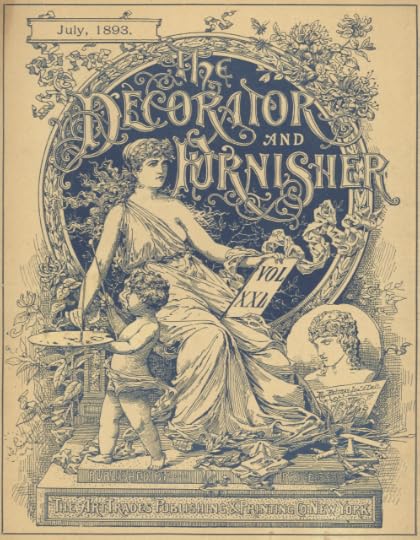
The magazine's style was not quite what I expected. The early 90s are known for grandiosity, but the depth of it displayed in the magazine was surprising. Some historians have proposed that by the early 90s a shift toward the cleaner styles of classicism had occurred and that this forward-looking change was visible in the buildings and plan of the Columbian Exposition in Chicago. These buildings are discussed below. While there is some truth to the claims, upper-class style in 1893, on the evidence of the contemporaneous commercial press, seems, in my opinion, to have been looking not forward, but backward. Back past the short 120-year span of the United States. Back to Europe and to post-medieval if not medieval times. Back to shields, heraldry, mottos, nationalism, and the “colors of woven tapestry” as one writer put it. To some extent, this conservative outlook dovetailed with the design of American wallpapers in the late-nineteenth century, which were often florid, in the sense of flower-based. But, the high-style decoration encountered in the pages of The Decorator and Furnisher went further. It was florid in the sense of exceptionally ornate. This extended to the house style of the magazine.
Although a shift to pared-down styles was certainly in the wind, this de-cluttering is hardly in evidence in much of the documentation from 1893. This makes the somewhat retrograde wallpaper choices of the Morgans more understandable. Yet, it left unanswered the questions that we always have about wallpaper, namely: how popular were these choices?; how expensive were the wallpapers?; how exclusive were they?; were they domestically produced? how did the style of the wallpapers relate to the style of the house? This series of posts aims to answer some of these questions.
Ventfort Hall was build by Rotch & Tilden, a Boston firm, and housed George Hale Morgan and his wife, the former Sarah Spencer Morgan, a distant cousin of George. The house was the most expensive building project yet in an area known for expensive building projects.[1]
 6. "leather" paper in Long Hall
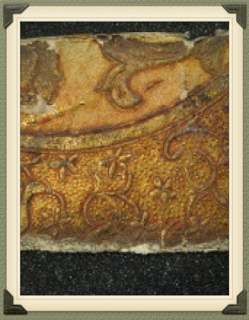
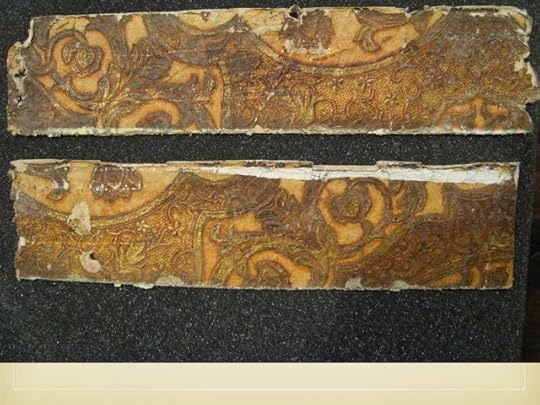
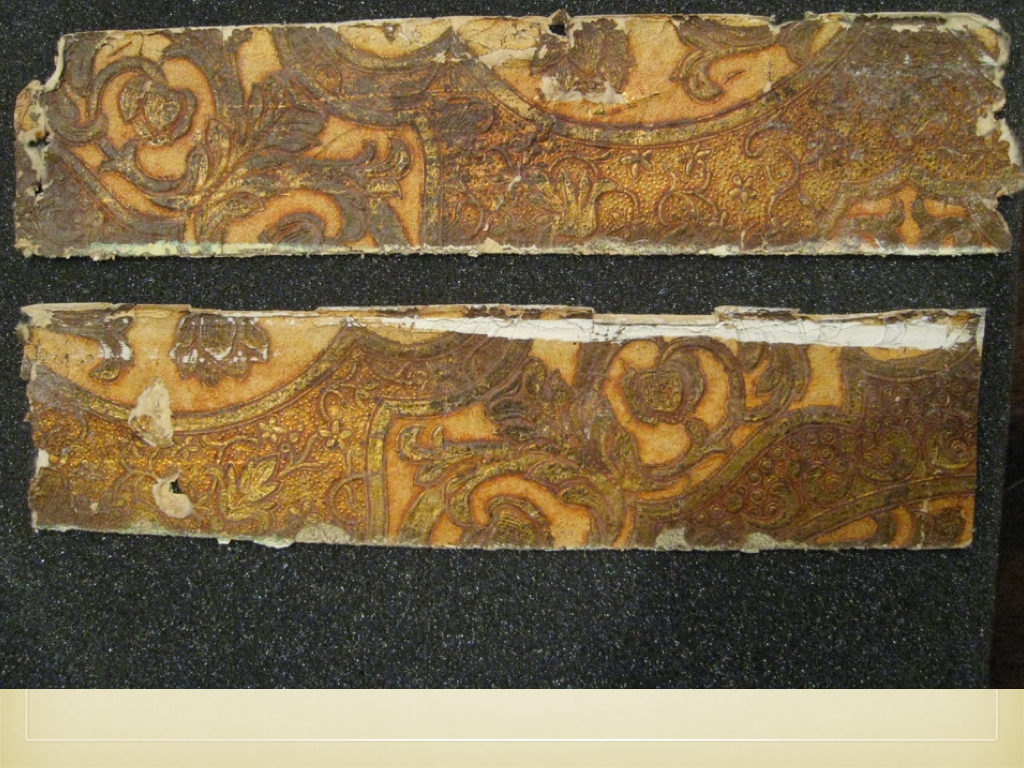
The first samples to consider are the so-called leather papers. These oblong scraps were found beneath the cornice moldings in the first-floor hallway. Leather papers were highly processed. They were created by embossing and finishing paper laminates to approximate the effect of gilt leather. There seems to have been a shift from multiple layers to single layers as machine embossing improved. Leather papers were often promoted in the pages of The Decorator and Furnisher. During a review of the offerings of Warren, Fuller & Company, a writer stated: "We must not forget to mention the leather papers. The most striking one is the Heraldic shield pattern. Unusual care has been taken in producing this high relief effect. These are well named, as they retain the character color and texture of stamped leather. Architects and others will be gratified in finding so close a resemblance."[2] This direct appeal to architects is telling, for it would have been Arthur Rotch or George Tilden who chose, or, have had a hand in choosing, the interior finishes. Both were trained for this creative role at the Beaux Arts school in Paris.
 7. block printed floral in 1894
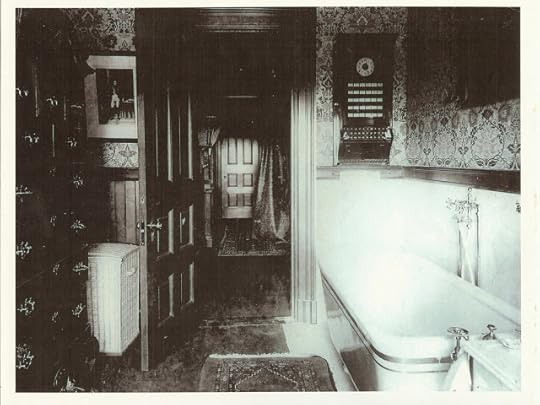
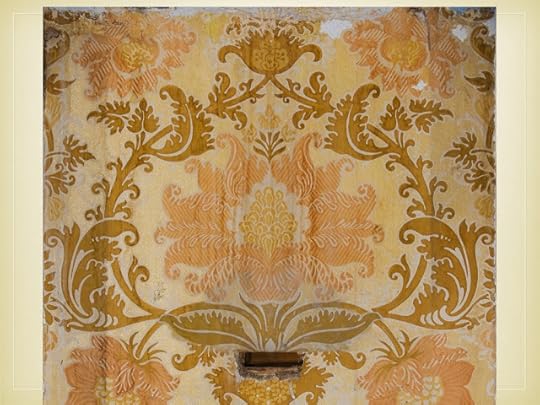
This block printed floral was found in a bathroom thought to be Sarah's. Even though the design and colors are elaborate, the wallpaper conforms to English reform design principles. The flowers are not naturalistic but instead symmetrical, two-dimensional flowers. The strange object on the bathroom wall was apparently part of the burglar alarm system.
 8. recent photo of block printed floral remnant found behind alarm
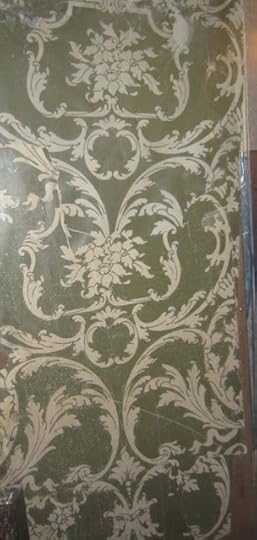 9. "stenciled look"
The next pattern has been dubbed a “stenciled look.” The two colors are simply rendered in a post-medieval style, but the vertical repeat is very long—55". This wallpaper was almost certainly created with block prints, and therefore expensive. This looming pattern decorated the wide third-floor hallways outside of the guest rooms. Incidentally, the pattern as rendered here is askew, due to the preserved strip of wallpaper twisting in mid-air.
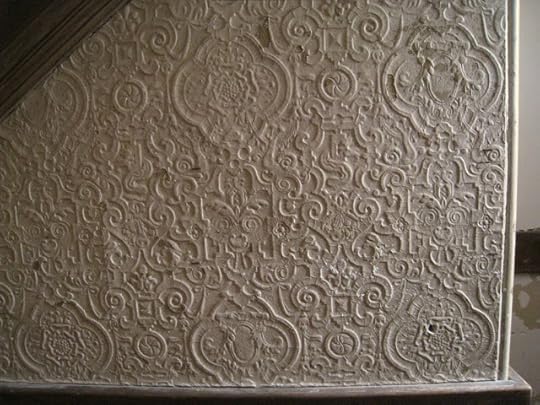 10. Anaglypta-type in service hall
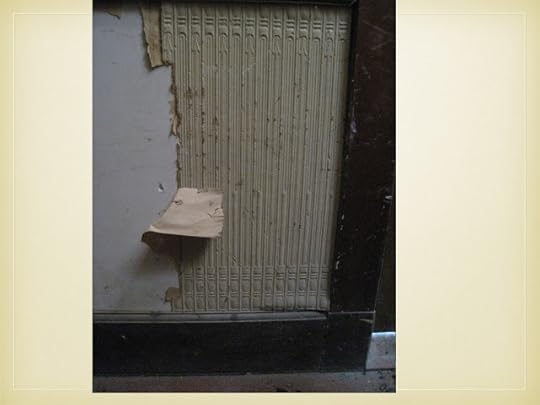 11. Lincrusta-type, service hall
Neither of the manufacturers of the service-hall papers are known. Both the Anaglypta-type (above the dado) and the Lincrusta-type (below the dado) were hung throughout the three floors of the hallway, mute witnesses to the hustle and bustle of household chores. With its spear and shaft motifs the Lincrusta-type presents a somewhat military aspect, albeit the beaded molding and rigid fluting hint at a Classic Revival effect. Both Lincrusta (from 1877) and Anaglypta (from 1887) were English patented products, though there was an American licensee for Lincrusta—Beck—who ran a Connecticut factory.
“Lincrusta-Walton” is often encountered in advertising of the period. Lincrusta was developed by Frederick Walton, inventor of linoleum, while Anaglypta was invented and patented by Thomas Palmer, an employee of Walton. The distinction between the types is that Lincrusta is solid, being made from linseed oil, cork, and other materials which were forced under pressure and great heat into molds. Anaglypta, on the other hand, was hollow, and made from pulp. Thus Anaglypta was cheaper and often used overhead. With a few coats of paint, the Anaglypta types could stand up to regular wear and tear.
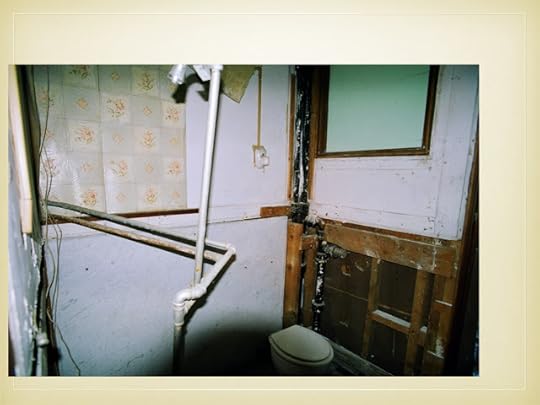 12. varnished tile
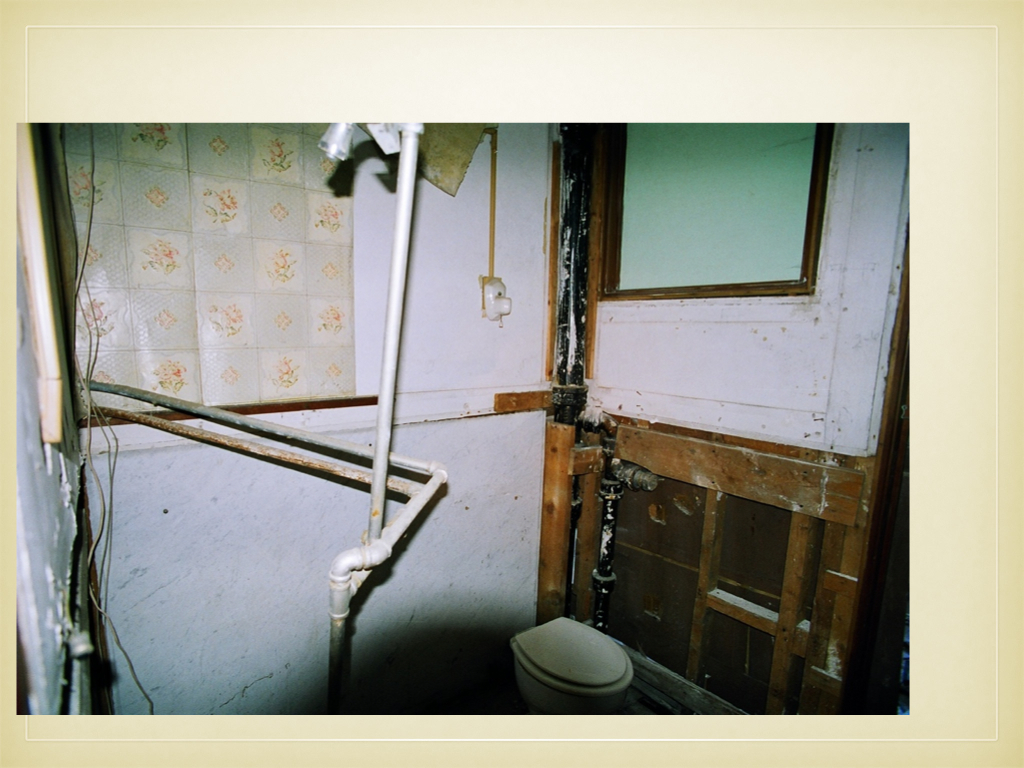
The final paper under consideration is a varnished tile wallpaper which still hangs in a third-floor bathroom. The offerings of Nevius and Haviland were reviewed in 1893 by The Decorator and Furnisher [3]: "That branch of their sanitary grade known as tile patterns contain some new and rarely beautiful designs. There are tile effects with Empire patterns and blue and white, green and white, soft red and white, and other combination, all washable and sanitary, and suitable for halls, kitchens and bathrooms. These goods are artistic, durable and cheap...."
The hygienic aspect of sanitary papers was hugely important to a late-Victorian audience. The company's pitch for varnished tile papers combines this virtue with others: varnished tile wallpaper was artistic, rarely beautiful, durable, and yet, for all that...cheap!—suggesting that low cost was a high value for producers and consumers alike. The varnished tile paper at Ventfort Hall, with its several colors, is a step up from the description in the magazine, but not by much. As we shall see, varnished tiles, like most wallpapers, came in a variety of grades, some of which found their way into other large estates in the Berkshire hills during the Gilded Age.
=====
footnotes:
[1] Gilder and Jackson, Houses of the Berkshires, 1870-1930: The Architecture of Leisure, 2011, p. 132. Some of the wealth which created Ventfort Hall was inherited by Sarah from her father, Junius Spencer Morgan, who was killed in a freak carriage accident in 1890. The Ventfort Hall complex included six greenhouses on 26 acres. The house had 15 bedrooms, 13 bathrooms, 17 fireplaces, billiard room, bowling alley, elevator, burglar alarms, and central heating.
For more about Ventfort Hall:
http://gildedage.org/history/
Before and after photos are at John Foreman's blog site:
http://bigoldhouses.blogspot.com/2012/02/hairbreadth-escape.html
[2] The Decorator and Furnisher, V. 23, N. 4 (July, 1893) p. 147.
[3] The Decorator and Furnisher, V. 23, N. 6 (September, 1893) p. 223.
=====
captions:
1 - 4. © 2015 Ventfort Hall Association, Inc.
5. cover, The Decorator and Furnisher magazine, courtesy Bolling & Company Archive.
6 - 8. © 2015 Ventfort Hall Association, Inc.
9. © WallpaperScholar.Com
10 - 12. © 2015 Ventfort Hall Association, Inc.
A Nine-Part Series Based on Ventfort Hall
by Robert M. Kelly
 1. "leather" paperI. introduction to six types of historic wallpaper found at Ventfort Hall
II. 1893: historical context
III. 1893: social context
IV. architectural changes 1850-1910
V. wallpaper's commercial context in the Gilded Age
VI. Wharton's wallpaper complex
VII. revisiting six wallpaper types found at Ventfort Hall
VIII. conclusion
IX. addendum: Cottage Industry: L. C. Peter's Notebook
*** author's note: These blog posts started as a written version of a lecture about six wallpapers found at Ventfort Hall. The six wallpapers are covered in Part I.
I went on. When I came up for breath I had a series of nine parts. I enjoyed exploring the nooks and crannies of related areas such as the architecture and social history of the Berkshire County region, and hope you will, too. Many will wonder in the course of this nook and cranny-ing what the heck happened to those original six wallpapers. Let me assure you: the wallpapers SHALL RETURN in Part VII.
During this work I was introduced by Nini Gilder to the amazing nineteenth-century daybook left behind by L. C. Peters, an accomplished carpenter and fix-it man for the Lenox colony. I decided that his story, (Cottage Industry) belonged here as well. It appears as Part IX.
That said, forward into 1893!
I. introduction to six types of historic wallpaper found at Ventfort Hall
 2. period colorized postcard
Ventfort Hall, a Jacobean-revival pile in Lenox, Berkshire County, Massachusetts, was narrowly saved from the wrecking ball around twenty years ago. Volunteers instituted a preservation program which has breathed new life into the 1893 structure. The educational programs of Ventfort Hall explore not only the Hall's history but also the culture of the late Gilded Age during which it was constructed.
 3. Ventfort Hall in disarray: the view from the basement looking up through the collapsed floor to the dining room.
Six seemingly first-generation wallpapers from the house are of prime importance: a leather paper, a block printed floral, a “stenciled look,” a Lincrusta-type, an Anaglypta-type, and a varnished tile.
 4. fabric remnant on 2nd floor
Though not adddressed here, fabric was also important at Ventfort Hall. A batten system to which sewn fabric was tacked extended throughout a second-floor hallway in the private quarters and more fabric was hung in the Salon.
When I was asked to give a lecture about Ventfort Hall's wallpaper I gladly accepted. For starters, wallpaper history is literally made up of fragments, and any opportunity to connect the fragments must be taken. Wallpaper was so prolific in the nineteenth century that we’ve resorted to stereotyping it, perhaps in self-defense.
Few eras are stereotyped more firmly than the last decade of the century, when bilious green and red gilt scrolls, like some invasive species from hell, grew wild on ceilings, friezes, sidewalls, and adjoining surfaces. Or did they? In fact, the colors were often pastels, the scrolls COULD be reform influenced, and many wallpapers of the time were painstakingly colored and nicely matched to their surroundings—a claim that cannot be made for every era. Much that has been written about 1890s decoration treats it as a way station, as a time when decoration was either stuck in a rut or desperately trying to advance out of one. The pages of The Decorator and Furnisher, the major trade magazine of the time, are vivid testimony that this picture is unfair and inaccurate. To be sure, the writers of the magazine were salesmen. Yet, within their sales vocabulary one can discern a genuine pride in American manufacturing that does not seem misplaced when rare samples of 1890s wallpaper are closely examined.
Other than these concerns, case studies are an excellent way to illuminate a moment in time. The moment here is June, 1893, when the George Hale Morgan family moved into their newly constructed home in Lenox. George's wife, Julia Morgan, brought the Morgan name (and Morgan money) into the marriage — she was the sister of J. P. Morgan. But, as impressive as the house and family are, the wallpaper story associated with them is no less important. It leads us far beyond the Hall—to Chicago, to Europe, and to the White House. It turns out that 1893 was a significant year for architecture, design, and decoration. It was, I believe, a hinge year. Broadly speaking, 1893 witnessed the last stand of the picturesque and a resurgence of classicism. The first suggestion of complexity came when my colleague Bo Sullivan sent several gigabytes of information gleaned from the pages of The Decorator and Furnisher, the New York City trade magazine which ran from 1882 to 1897.
 5. The Decorator and Furnisher magazine
The magazine's style was not quite what I expected. The early 90s are known for grandiosity, but the depth of it displayed in the magazine was surprising. Some historians have proposed that by the early 90s a shift toward the cleaner styles of classicism had occurred and that this forward-looking change was visible in the buildings and plan of the Columbian Exposition in Chicago. These buildings are discussed below. While there is some truth to the claims, upper-class style in 1893, on the evidence of the contemporaneous commercial press, seems, in my opinion, to have been looking not forward, but backward. Back past the short 120-year span of the United States. Back to Europe and to post-medieval if not medieval times. Back to shields, heraldry, mottos, nationalism, and the “colors of woven tapestry” as one writer put it. To some extent, this conservative outlook dovetailed with the design of American wallpapers in the late-nineteenth century, which were often florid, in the sense of flower-based. But, the high-style decoration encountered in the pages of The Decorator and Furnisher went further. It was florid in the sense of exceptionally ornate. This extended to the house style of the magazine.
Although a shift to pared-down styles was certainly in the wind, this de-cluttering is hardly in evidence in much of the documentation from 1893. This makes the somewhat retrograde wallpaper choices of the Morgans more understandable. Yet, it left unanswered the questions that we always have about wallpaper, namely: how popular were these choices?; how expensive were the wallpapers?; how exclusive were they?; were they domestically produced? how did the style of the wallpapers relate to the style of the house? This series of posts aims to answer some of these questions.
Ventfort Hall was build by Rotch & Tilden, a Boston firm, and housed George Hale Morgan and his wife, the former Sarah Spencer Morgan, a distant cousin of George. The house was the most expensive building project yet in an area known for expensive building projects.[1]
 6. "leather" paper in Long Hall
The first samples to consider are the so-called leather papers. These oblong scraps were found beneath the cornice moldings in the first-floor hallway. Leather papers were highly processed. They were created by embossing and finishing paper laminates to approximate the effect of gilt leather. There seems to have been a shift from multiple layers to single layers as machine embossing improved. Leather papers were often promoted in the pages of The Decorator and Furnisher. During a review of the offerings of Warren, Fuller & Company, a writer stated: "We must not forget to mention the leather papers. The most striking one is the Heraldic shield pattern. Unusual care has been taken in producing this high relief effect. These are well named, as they retain the character color and texture of stamped leather. Architects and others will be gratified in finding so close a resemblance."[2] This direct appeal to architects is telling, for it would have been Arthur Rotch or George Tilden who chose, or, have had a hand in choosing, the interior finishes. Both were trained for this creative role at the Beaux Arts school in Paris.
 7. block printed floral in 1894
This block printed floral was found in a bathroom thought to be Sarah's. Even though the design and colors are elaborate, the wallpaper conforms to English reform design principles. The flowers are not naturalistic but instead symmetrical, two-dimensional flowers. The strange object on the bathroom wall was apparently part of the burglar alarm system.
 8. recent photo of block printed floral remnant found behind alarm
 9. "stenciled look"
The next pattern has been dubbed a “stenciled look.” The two colors are simply rendered in a post-medieval style, but the vertical repeat is very long—55". This wallpaper was almost certainly created with block prints, and therefore expensive. This looming pattern decorated the wide third-floor hallways outside of the guest rooms. Incidentally, the pattern as rendered here is askew, due to the preserved strip of wallpaper twisting in mid-air.
 10. Anaglypta-type in service hall
 11. Lincrusta-type, service hall
Neither of the manufacturers of the service-hall papers are known. Both the Anaglypta-type (above the dado) and the Lincrusta-type (below the dado) were hung throughout the three floors of the hallway, mute witnesses to the hustle and bustle of household chores. With its spear and shaft motifs the Lincrusta-type presents a somewhat military aspect, albeit the beaded molding and rigid fluting hint at a Classic Revival effect. Both Lincrusta (from 1877) and Anaglypta (from 1887) were English patented products, though there was an American licensee for Lincrusta—Beck—who ran a Connecticut factory.
“Lincrusta-Walton” is often encountered in advertising of the period. Lincrusta was developed by Frederick Walton, inventor of linoleum, while Anaglypta was invented and patented by Thomas Palmer, an employee of Walton. The distinction between the types is that Lincrusta is solid, being made from linseed oil, cork, and other materials which were forced under pressure and great heat into molds. Anaglypta, on the other hand, was hollow, and made from pulp. Thus Anaglypta was cheaper and often used overhead. With a few coats of paint, the Anaglypta types could stand up to regular wear and tear.
 12. varnished tile
The final paper under consideration is a varnished tile wallpaper which still hangs in a third-floor bathroom. The offerings of Nevius and Haviland were reviewed in 1893 by The Decorator and Furnisher [3]: "That branch of their sanitary grade known as tile patterns contain some new and rarely beautiful designs. There are tile effects with Empire patterns and blue and white, green and white, soft red and white, and other combination, all washable and sanitary, and suitable for halls, kitchens and bathrooms. These goods are artistic, durable and cheap...."
The hygienic aspect of sanitary papers was hugely important to a late-Victorian audience. The company's pitch for varnished tile papers combines this virtue with others: varnished tile wallpaper was artistic, rarely beautiful, durable, and yet, for all that...cheap!—suggesting that low cost was a high value for producers and consumers alike. The varnished tile paper at Ventfort Hall, with its several colors, is a step up from the description in the magazine, but not by much. As we shall see, varnished tiles, like most wallpapers, came in a variety of grades, some of which found their way into other large estates in the Berkshire hills during the Gilded Age.
=====
footnotes:
[1] Gilder and Jackson, Houses of the Berkshires, 1870-1930: The Architecture of Leisure, 2011, p. 132. Some of the wealth which created Ventfort Hall was inherited by Sarah from her father, Junius Spencer Morgan, who was killed in a freak carriage accident in 1890. The Ventfort Hall complex included six greenhouses on 26 acres. The house had 15 bedrooms, 13 bathrooms, 17 fireplaces, billiard room, bowling alley, elevator, burglar alarms, and central heating.
For more about Ventfort Hall:
http://gildedage.org/history/
Before and after photos are at John Foreman's blog site:
http://bigoldhouses.blogspot.com/2012/02/hairbreadth-escape.html
[2] The Decorator and Furnisher, V. 23, N. 4 (July, 1893) p. 147.
[3] The Decorator and Furnisher, V. 23, N. 6 (September, 1893) p. 223.
=====
captions:
1 - 4. © 2015 Ventfort Hall Association, Inc.
5. cover, The Decorator and Furnisher magazine, courtesy Bolling & Company Archive.
6 - 8. © 2015 Ventfort Hall Association, Inc.
9. © WallpaperScholar.Com
10 - 12. © 2015 Ventfort Hall Association, Inc.


Wallpaper in the Gilded Age: Part I
Wallpaper in the Gilded Age:
A Nine-Part Series Based on Ventfort Hall
I. introduction to six types of historic wallpaper found at Ventfort Hall
II. 1893: historical context
III. 1893: social context
IV. architectural changes 1850-1910
V. wallpaper's commercial context in the Gilded Age
VI. Wharton's wallpaper complex
VII. revisiting six wallpaper types found at Ventfort Hall
VIII. conclusion
IX. addendum: Cottage Industry: L. C. Peter's Notebook
* * * author's note: These blog posts started as a written version of a lecture about six wallpapers found at Ventfort Hall. The six wallpapers are covered in Part I.
I went on. When I came up for breath I had a series of 9 parts. I enjoyed exploring the nooks and crannies of related areas such as the architecture and social history of the Berkshire County region, and hope you will, too. Many will wonder in the course of this nook and cranny-ing what the devil happened to those original six wallpapers. Let me assure you: the wallpapers SHALL RETURN in Part VII.
During this work I was introduced by Nini Gilder to the amazing 19th century daybook left behind by L. C. Peters, an accomplished carpenter and fix-it man for the Lenox colony. I decided that his story belonged here as well. "Cottage Industry" appears as Part IX.
That said, forward into 1893!
 1. The Decorator and Furnisher magazine
I. six types of wallpaper
2. period colorized postcard
Ventfort Hall, a Jacobean-revival pile in Lenox, Berkshire County, Massachusetts, was narrowly saved from the wrecking ball around twenty years ago. Volunteers instituted a preservation program which has breathed new life into the 1893 structure. The educational programs of Ventfort Hall explore not only the Hall's history but also the culture of the late Gilded Age during which it was constructed.
3. Ventfort Hall in disarray: the view from the basement looking up through the collapsed floor to the dining room.
Six seemingly first-generation wallpapers from the house are of prime importance: a leather paper, a block printed floral, a “stenciled look,” a Lincrusta-type, an Anaglypta-type, and a varnished tile.
4. fabric remnant on 2nd floor
Though not adddressed here, fabric was also important at Ventfort Hall. A batten system to which sewn fabric was tacked extended throughout a second-floor hallway in the private quarters and more fabric was hung in the Salon.
When I was asked to give a lecture about Ventfort Hall's wallpaper I gladly accepted. For starters, wallpaper history is literally made up of fragments, and any opportunity to connect the fragments must be taken. Wallpaper was so prolific in the nineteenth century that we’ve resorted to stereotyping it, perhaps in self-defense.
Few eras are stereotyped more firmly than the last decade of the century, when bilious green and red gilt scrolls, like some invasive species from hell, grew wild on ceilings, friezes, sidewalls, and adjoining surfaces. Or did they? In fact, the colors were often pastels, the scrolls COULD be reform influenced, and many wallpapers of the time were painstakingly colored and nicely matched to their surroundings—a claim that cannot be made for every era. Much that has been written about 1890s decoration treats it as a way station, as a time when decoration was either stuck in a rut or desperately trying to advance out of one. The pages of The Decorator and Furnisher, the major trade magazine of the time, are vivid testimony that this picture is unfair and inaccurate. To be sure, the writers of the magazine were salesmen. Yet, within their sales vocabulary one can discern a genuine pride in American manufacturing that does not seem misplaced when rare samples of 1890s wallpaper are closely examined.
Other than these concerns, case studies are an excellent way to illuminate a moment in time. The moment here is June, 1893, when the George Hale Morgan family moved into their newly constructed home in Lenox. George's wife, Julia Morgan, brought the Morgan name (and Morgan money) into the marriage — she was the sister of J. P. Morgan. But, as impressive as the house and family are, the wallpaper story associated with them is no less important. It leads us far beyond the Hall—to Chicago, to Europe, and to the White House. It turns out that 1893 was a significant year for architecture, design, and decoration. It was, I believe, a hinge year. Broadly speaking, 1893 witnessed the last stand of the picturesque and a resurgence of classicism. The first suggestion of complexity came when my colleague Bo Sullivan sent several gigabytes of information gleaned from the pages of The Decorator and Furnisher, the New York City trade magazine which ran from 1882 to 1897.
5. The Decorator and Furnisher magazine
The magazine's style was not quite what I expected. The early 90s are known for grandiosity, but the depth of it displayed in the magazine was surprising. Some historians have proposed that by the early 90s a shift toward the cleaner styles of classicism had occurred and that this forward-looking change was visible in the buildings and plan of the Columbian Exposition in Chicago. These buildings are discussed below. While there is some truth to the claims, upper-class style in 1893, on the evidence of the contemporaneous commercial press, seems, in my opinion, to have been looking not forward, but backward. Back past the short 120-year span of the United States. Back to Europe and to post-medieval if not medieval times. Back to shields, heraldry, mottos, nationalism, and the “colors of woven tapestry” as one writer put it. To some extent, this conservative outlook dovetailed with the design of American wallpapers in the late-nineteenth century, which were often florid, in the sense of flower-based. But, the high-style decoration encountered in the pages of The Decorator and Furnisher went further. It was florid in the sense of exceptionally ornate. This ornateness extended to the house style of the magazine.
Although the shift to pared-down styles certainly occurred going forward, this de-cluttering is hardly in evidence in the available documentation from 1893. This makes the somewhat retrograde wallpaper choices of the Morgans more understandable. Yet, it left unanswered the questions that we always have about wallpaper, namely: how popular were these choices?; how expensive were the wallpapers?; how exclusive were they?; were they domestically produced? how did the style of the wallpapers relate to the style of the house? This series of posts aims to answer some of these questions.
Ventfort Hall was build by Rotch & Tilden, a Boston firm, and housed George Hale Morgan and his wife, the former Sarah Spencer Morgan, a distant cousin of George. The house was the most expensive building project yet in an area known for expensive building projects.[1]
6. "leather" paper in Long Hall
The first samples to consider are the so-called leather papers. These oblong scraps were found beneath the cornice moldings in the first-floor hallway. Leather papers were highly processed. They were created by embossing and finishing paper laminates to approximate the effect of gilt leather. There seems to have been a shift from multiple layers to single layers as machine embossing improved. Leather papers were often promoted in the pages of The Decorator and Furnisher. During a review of the offerings of Warren, Fuller & Company, a writer stated: "We must not forget to mention the leather papers. The most striking one is the Heraldic shield pattern. Unusual care has been taken in producing this high relief effect. These are well named, as they retain the character color and texture of stamped leather. Architects and others will be gratified in finding so close a resemblance."[2] This direct appeal to architects is telling, for it would have been Arthur Rotch or George Tilden who chose, or, have had a hand in choosing, the interior finishes. Both were trained for this creative role at the Beaux Arts school in Paris.
7. block printed floral in 1894
This block printed floral was found in a bathroom thought to be Sarah's. Even though the design and colors are elaborate, the wallpaper conforms to English reform design principles. The flowers are not naturalistic but instead symmetrical, two-dimensional flowers. The strange object on the bathroom wall was apparently part of the burglar alarm system.
8. recent photo of block printed floral remnant found behind alarm
9. "stenciled look"
The next pattern has been dubbed a “stenciled look.” The two colors are simply rendered in a post-medieval style, but the vertical repeat is very long—55". This wallpaper was almost certainly created with block prints, and therefore expensive. This looming pattern decorated the wide third-floor hallways outside of the guest rooms. Incidentally, the pattern as rendered here is askew, due to the preserved strip of wallpaper twisting in mid-air.
10. Anaglypta-type in service hall
11. Lincrusta-type, service hall
Neither of the manufacturers of the service-hall papers are known. Both the Anaglypta-type (above the dado) and the Lincrusta-type (below the dado) were hung throughout the three floors of the hallway, mute witnesses to the hustle and bustle of household chores. With its spear and shaft motifs the Lincrusta-type presents a somewhat military aspect, albeit the beaded molding and rigid fluting hint at a Classic Revival effect. Both Lincrusta (from 1877) and Anaglypta (from 1887) were English patented products, though there was an American licensee for Lincrusta—Beck—who ran a Connecticut factory.
“Lincrusta-Walton” is often encountered in advertising of the period. Lincrusta was developed by Frederick Walton, inventor of linoleum, while Anaglypta was invented and patented by Thomas Palmer, an employee of Walton. The distinction between the types is that Lincrusta is solid, being made from linseed oil, cork, and other materials which were forced under pressure and great heat into molds. Anaglypta, on the other hand, was hollow, and made from pulp. Thus Anaglypta was cheaper and often used overhead. With a few coats of paint, the Anaglypta types could stand up to regular wear and tear.
12. varnished tile
The final paper under consideration is a varnished tile wallpaper which still hangs in an upper-story bathroom. The Decorator and Furnisher reviewed the offerings of Nevius and Haviland on p. 223 of the September, 1893 issue: "That branch of their sanitary grade known as tile patterns contain some new and rarely beautiful designs. There are tile effects with Empire patterns and blue and white, green and white, soft red and white, and other combination, all washable and sanitary, and suitable for halls, kitchens and bathrooms. These goods are artistic, durable and cheap...."
The hygienic aspect of sanitary papers was hugely important to a late-Victorian audience. The pitch for varnished tile papers above combines this virtue with others: artistic, “rarely beautiful,” durable, and yet, for all that...cheap!—suggesting that low cost was a high value for producers and consumers alike. The varnished tile paper at Ventfort Hall, with its several colors, is a step up from the description in the magazine, but not by much. As we shall see, varnished tiles, like most wallpapers, came in a variety of grades, some of which found their way into other large estates in the Berkshire hills.
=====
footnotes:
[1] Gilder and Jackson, Houses of the Berkshires, 1870-1930: The Architecture of Leisure, 2011, p. 132. Some of the wealth which created Ventfort Hall was inherited by Sarah from her father, Junius Spencer Morgan, who was killed in a freak carriage accident in 1890. The Ventfort Hall complex included six greenhouses on 26 acres. The house had 15 bedrooms, 13 bathrooms, 17 fireplaces, billiard room, bowling alley, elevator, burglar alarms, and central heating.
For more about Ventfort Hall:
http://gildedage.org/history/
Before and after photos are at John Foreman's blog site:
http://bigoldhouses.blogspot.com/2012...
[2] The Decorator and Furnisher, July, 1893, p. 147.
=====
captions:
1. masthead, The Decorator and Furnisher magazine
2 - 4. © 2015 Ventfort Hall Association, Inc.
5. cover, The Decorator and Furnisher magazine.
6 - 8. © 2015 Ventfort Hall Association, Inc.
9. © WallpaperScholar.Com
10 - 12. © 2015 Ventfort Hall Association, Inc.
A Nine-Part Series Based on Ventfort Hall
I. introduction to six types of historic wallpaper found at Ventfort Hall
II. 1893: historical context
III. 1893: social context
IV. architectural changes 1850-1910
V. wallpaper's commercial context in the Gilded Age
VI. Wharton's wallpaper complex
VII. revisiting six wallpaper types found at Ventfort Hall
VIII. conclusion
IX. addendum: Cottage Industry: L. C. Peter's Notebook
* * * author's note: These blog posts started as a written version of a lecture about six wallpapers found at Ventfort Hall. The six wallpapers are covered in Part I.
I went on. When I came up for breath I had a series of 9 parts. I enjoyed exploring the nooks and crannies of related areas such as the architecture and social history of the Berkshire County region, and hope you will, too. Many will wonder in the course of this nook and cranny-ing what the devil happened to those original six wallpapers. Let me assure you: the wallpapers SHALL RETURN in Part VII.
During this work I was introduced by Nini Gilder to the amazing 19th century daybook left behind by L. C. Peters, an accomplished carpenter and fix-it man for the Lenox colony. I decided that his story belonged here as well. "Cottage Industry" appears as Part IX.
That said, forward into 1893!
 1. The Decorator and Furnisher magazine
I. six types of wallpaper
2. period colorized postcardVentfort Hall, a Jacobean-revival pile in Lenox, Berkshire County, Massachusetts, was narrowly saved from the wrecking ball around twenty years ago. Volunteers instituted a preservation program which has breathed new life into the 1893 structure. The educational programs of Ventfort Hall explore not only the Hall's history but also the culture of the late Gilded Age during which it was constructed.
3. Ventfort Hall in disarray: the view from the basement looking up through the collapsed floor to the dining room.Six seemingly first-generation wallpapers from the house are of prime importance: a leather paper, a block printed floral, a “stenciled look,” a Lincrusta-type, an Anaglypta-type, and a varnished tile.
4. fabric remnant on 2nd floorThough not adddressed here, fabric was also important at Ventfort Hall. A batten system to which sewn fabric was tacked extended throughout a second-floor hallway in the private quarters and more fabric was hung in the Salon.
When I was asked to give a lecture about Ventfort Hall's wallpaper I gladly accepted. For starters, wallpaper history is literally made up of fragments, and any opportunity to connect the fragments must be taken. Wallpaper was so prolific in the nineteenth century that we’ve resorted to stereotyping it, perhaps in self-defense.
Few eras are stereotyped more firmly than the last decade of the century, when bilious green and red gilt scrolls, like some invasive species from hell, grew wild on ceilings, friezes, sidewalls, and adjoining surfaces. Or did they? In fact, the colors were often pastels, the scrolls COULD be reform influenced, and many wallpapers of the time were painstakingly colored and nicely matched to their surroundings—a claim that cannot be made for every era. Much that has been written about 1890s decoration treats it as a way station, as a time when decoration was either stuck in a rut or desperately trying to advance out of one. The pages of The Decorator and Furnisher, the major trade magazine of the time, are vivid testimony that this picture is unfair and inaccurate. To be sure, the writers of the magazine were salesmen. Yet, within their sales vocabulary one can discern a genuine pride in American manufacturing that does not seem misplaced when rare samples of 1890s wallpaper are closely examined.
Other than these concerns, case studies are an excellent way to illuminate a moment in time. The moment here is June, 1893, when the George Hale Morgan family moved into their newly constructed home in Lenox. George's wife, Julia Morgan, brought the Morgan name (and Morgan money) into the marriage — she was the sister of J. P. Morgan. But, as impressive as the house and family are, the wallpaper story associated with them is no less important. It leads us far beyond the Hall—to Chicago, to Europe, and to the White House. It turns out that 1893 was a significant year for architecture, design, and decoration. It was, I believe, a hinge year. Broadly speaking, 1893 witnessed the last stand of the picturesque and a resurgence of classicism. The first suggestion of complexity came when my colleague Bo Sullivan sent several gigabytes of information gleaned from the pages of The Decorator and Furnisher, the New York City trade magazine which ran from 1882 to 1897.
5. The Decorator and Furnisher magazineThe magazine's style was not quite what I expected. The early 90s are known for grandiosity, but the depth of it displayed in the magazine was surprising. Some historians have proposed that by the early 90s a shift toward the cleaner styles of classicism had occurred and that this forward-looking change was visible in the buildings and plan of the Columbian Exposition in Chicago. These buildings are discussed below. While there is some truth to the claims, upper-class style in 1893, on the evidence of the contemporaneous commercial press, seems, in my opinion, to have been looking not forward, but backward. Back past the short 120-year span of the United States. Back to Europe and to post-medieval if not medieval times. Back to shields, heraldry, mottos, nationalism, and the “colors of woven tapestry” as one writer put it. To some extent, this conservative outlook dovetailed with the design of American wallpapers in the late-nineteenth century, which were often florid, in the sense of flower-based. But, the high-style decoration encountered in the pages of The Decorator and Furnisher went further. It was florid in the sense of exceptionally ornate. This ornateness extended to the house style of the magazine.
Although the shift to pared-down styles certainly occurred going forward, this de-cluttering is hardly in evidence in the available documentation from 1893. This makes the somewhat retrograde wallpaper choices of the Morgans more understandable. Yet, it left unanswered the questions that we always have about wallpaper, namely: how popular were these choices?; how expensive were the wallpapers?; how exclusive were they?; were they domestically produced? how did the style of the wallpapers relate to the style of the house? This series of posts aims to answer some of these questions.
Ventfort Hall was build by Rotch & Tilden, a Boston firm, and housed George Hale Morgan and his wife, the former Sarah Spencer Morgan, a distant cousin of George. The house was the most expensive building project yet in an area known for expensive building projects.[1]
6. "leather" paper in Long HallThe first samples to consider are the so-called leather papers. These oblong scraps were found beneath the cornice moldings in the first-floor hallway. Leather papers were highly processed. They were created by embossing and finishing paper laminates to approximate the effect of gilt leather. There seems to have been a shift from multiple layers to single layers as machine embossing improved. Leather papers were often promoted in the pages of The Decorator and Furnisher. During a review of the offerings of Warren, Fuller & Company, a writer stated: "We must not forget to mention the leather papers. The most striking one is the Heraldic shield pattern. Unusual care has been taken in producing this high relief effect. These are well named, as they retain the character color and texture of stamped leather. Architects and others will be gratified in finding so close a resemblance."[2] This direct appeal to architects is telling, for it would have been Arthur Rotch or George Tilden who chose, or, have had a hand in choosing, the interior finishes. Both were trained for this creative role at the Beaux Arts school in Paris.
7. block printed floral in 1894This block printed floral was found in a bathroom thought to be Sarah's. Even though the design and colors are elaborate, the wallpaper conforms to English reform design principles. The flowers are not naturalistic but instead symmetrical, two-dimensional flowers. The strange object on the bathroom wall was apparently part of the burglar alarm system.
8. recent photo of block printed floral remnant found behind alarm
9. "stenciled look"The next pattern has been dubbed a “stenciled look.” The two colors are simply rendered in a post-medieval style, but the vertical repeat is very long—55". This wallpaper was almost certainly created with block prints, and therefore expensive. This looming pattern decorated the wide third-floor hallways outside of the guest rooms. Incidentally, the pattern as rendered here is askew, due to the preserved strip of wallpaper twisting in mid-air.
10. Anaglypta-type in service hall
11. Lincrusta-type, service hallNeither of the manufacturers of the service-hall papers are known. Both the Anaglypta-type (above the dado) and the Lincrusta-type (below the dado) were hung throughout the three floors of the hallway, mute witnesses to the hustle and bustle of household chores. With its spear and shaft motifs the Lincrusta-type presents a somewhat military aspect, albeit the beaded molding and rigid fluting hint at a Classic Revival effect. Both Lincrusta (from 1877) and Anaglypta (from 1887) were English patented products, though there was an American licensee for Lincrusta—Beck—who ran a Connecticut factory.
“Lincrusta-Walton” is often encountered in advertising of the period. Lincrusta was developed by Frederick Walton, inventor of linoleum, while Anaglypta was invented and patented by Thomas Palmer, an employee of Walton. The distinction between the types is that Lincrusta is solid, being made from linseed oil, cork, and other materials which were forced under pressure and great heat into molds. Anaglypta, on the other hand, was hollow, and made from pulp. Thus Anaglypta was cheaper and often used overhead. With a few coats of paint, the Anaglypta types could stand up to regular wear and tear.
12. varnished tileThe final paper under consideration is a varnished tile wallpaper which still hangs in an upper-story bathroom. The Decorator and Furnisher reviewed the offerings of Nevius and Haviland on p. 223 of the September, 1893 issue: "That branch of their sanitary grade known as tile patterns contain some new and rarely beautiful designs. There are tile effects with Empire patterns and blue and white, green and white, soft red and white, and other combination, all washable and sanitary, and suitable for halls, kitchens and bathrooms. These goods are artistic, durable and cheap...."
The hygienic aspect of sanitary papers was hugely important to a late-Victorian audience. The pitch for varnished tile papers above combines this virtue with others: artistic, “rarely beautiful,” durable, and yet, for all that...cheap!—suggesting that low cost was a high value for producers and consumers alike. The varnished tile paper at Ventfort Hall, with its several colors, is a step up from the description in the magazine, but not by much. As we shall see, varnished tiles, like most wallpapers, came in a variety of grades, some of which found their way into other large estates in the Berkshire hills.
=====
footnotes:
[1] Gilder and Jackson, Houses of the Berkshires, 1870-1930: The Architecture of Leisure, 2011, p. 132. Some of the wealth which created Ventfort Hall was inherited by Sarah from her father, Junius Spencer Morgan, who was killed in a freak carriage accident in 1890. The Ventfort Hall complex included six greenhouses on 26 acres. The house had 15 bedrooms, 13 bathrooms, 17 fireplaces, billiard room, bowling alley, elevator, burglar alarms, and central heating.
For more about Ventfort Hall:
http://gildedage.org/history/
Before and after photos are at John Foreman's blog site:
http://bigoldhouses.blogspot.com/2012...
[2] The Decorator and Furnisher, July, 1893, p. 147.
=====
captions:
1. masthead, The Decorator and Furnisher magazine
2 - 4. © 2015 Ventfort Hall Association, Inc.
5. cover, The Decorator and Furnisher magazine.
6 - 8. © 2015 Ventfort Hall Association, Inc.
9. © WallpaperScholar.Com
10 - 12. © 2015 Ventfort Hall Association, Inc.
September 5, 2014
REVIEW: Chinese Wallpaper in National Trust Houses
by Robert M. Kelly
link to buy "Chinese Wallpaper": (cost of the book is about £10, or $16.33)
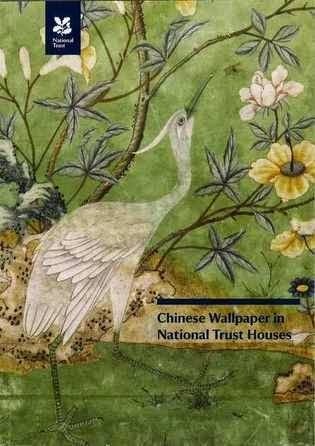 In 1988, paper conservator Catherine Rickman wrote that "there is no information to be had in China about the watercolour paintings, albums and lengths of handpainted paper exported in their thousands from the country over the last two centuries. To find out how such artifacts were made we must study the paintings themselves....." Twenty-five years later this remains largely true, but what enormous strides have been made by the National Trust and the cadre of devoted paper conservators in England and other Western European countries through their periodic work on these marvels of decorative design. This in-the-trenches practice has now been supplemented by a catalog, "Chinese Wallpaper in National Trust Houses," which gives great detail for each of the 45 some-odd Chinese wallpapers that beautify the walls of homes belonging to the Trust.
Distinctions are made from the beginning between so-called Indian pictures (generally small) and wallpaper proper (generally large). References to Chinese pictures at Versailles in the late 1660s and at Whitehall Palace in 1693 establish that oriental wallpaper was an influence long before the tax of 1712 and thus helps to explain the ads of tradesmen like George Minnikin (1680), and Edward Butling (1690), who traded in both Chinese wares and English chinoiserie adapted from them.
The authors report that one art authority (John Winter) found that shimmering grounds not unusually found in Chinese fine art pictures. This prompts speculation that shiny grounds for wallpaper may have been specially made for the West. The catalog is strong in technical details like these. The text is so dense that it even notes whether "the paper was trimmed", or not, but this brings up a point, about the perceived differences between pictures, which arguably remained art objects in the home, as opposed to wallpaper, which submitted more easily to the demands of the architectural environment. It's helpful to know that "drops" in this text means "strips." It's good that there are so many qualifications of the description "hand painted" which, although not wrong, has sometimes left a false impression. Far Eastern artisans turned naturally to stencils and block printed outlines to speed the work, where possible.
The catalog has scoured the history of each house, family, and sometimes even the circumstances of the installation. Whether it was framed by fillets or turned corners to explode away the very architecture of the room, the Chinese style owned a power which repetitive Western design could not match. There is much here about the decorative traditions of China as well.
In this connection the contributions of Anna Wu, PhD candidate, to the catalog cannot be overstated. She brought Chinese books, research and historic sites to the attention of the writing team (Emile de Bruijn, Andrew Bush and Helen Clifford). To cite one example, the decorative schemes in the restored Juanqinzhai (Studio of Exhaustion from Diligent Service). This curiously-named retirement lodge of an emperor is awash in silk hangings painted with tromp l'oeil scenery and offers "...a high-end, customized parallel to the wallpaper produced for export to the West."
Although non-Trust properties are not scrutinized, they are not ignored. In addition to the 45 catalog entries, 125 "other" installations are included in the fine map of locations coded by era, so that in total 170 of these Chinese wallpapers are documented. The bibliography is sparkling and includes the most up-to-date (Peck's "Interwoven Globe" from last year) as well as an assortment of fairly recent titles that will be fresh to most.
Catalog # 29 (a c. 1750 firescreen at Osterly Park) shows the age of that quaint tradition. In retrospect it is astonishing that most of these catalog entries relate to installations before the American Revolution and the founding of the American trade. Yet what could be more "early American" than a blockprinted flowerpot in your fireplace for the summer?
We Americans badly need this new information to be folded into what is known about Chinese scenics here. The best treatment remains that of Carl Crossman's Chapter 15: "Decorative Painted Wallpapers to 1850" in his "Decorative Arts of the China Trade" (1991). Our two older books, McClelland and Sanborn, have pictures of Chinese wallpaper. We must not forget that many Chinese scenics formerly in English country houses were auctioned off to a new home in the US, the most prominent of which may be the former Ashburnham Place wallpaper now at Blair House, the president's guest house.
Even when little wallpaper remains, as at Osterly Park, the scent of tea and perfumes of the exotic East linger in the air. This catalogue supplies many details which bring the past to life, even if the remnants are no more than "various wallpapers of unknown types", to quote a contemporary source. A particular effort is made to untangle and understand the identification of Chinese wallpaper with femininity and sociability. It seems to have been no accident that most of the known locations were dressing rooms, bedrooms, and drawing rooms.
Who were the patrons who made this all possible? The homeowners turn out to be various MP's, landed gentry, and (in a later age) heirs to marmalade-manufacturing fortunes: in other words, those who possessed the patrimony, the tall and large rooms, the resources, and the nerve to order up such exotic wall treatments and live with them. That American rooms tended to be squat, and that our decorative traditions tended to be republican and democratic rather than aristocratic, helps to explain why Chinese scenics are practically unheard of in our nation's early history.
link to buy "Chinese Wallpaper"
link to buy "Chinese Wallpaper": (cost of the book is about £10, or $16.33)
 In 1988, paper conservator Catherine Rickman wrote that "there is no information to be had in China about the watercolour paintings, albums and lengths of handpainted paper exported in their thousands from the country over the last two centuries. To find out how such artifacts were made we must study the paintings themselves....." Twenty-five years later this remains largely true, but what enormous strides have been made by the National Trust and the cadre of devoted paper conservators in England and other Western European countries through their periodic work on these marvels of decorative design. This in-the-trenches practice has now been supplemented by a catalog, "Chinese Wallpaper in National Trust Houses," which gives great detail for each of the 45 some-odd Chinese wallpapers that beautify the walls of homes belonging to the Trust.
Distinctions are made from the beginning between so-called Indian pictures (generally small) and wallpaper proper (generally large). References to Chinese pictures at Versailles in the late 1660s and at Whitehall Palace in 1693 establish that oriental wallpaper was an influence long before the tax of 1712 and thus helps to explain the ads of tradesmen like George Minnikin (1680), and Edward Butling (1690), who traded in both Chinese wares and English chinoiserie adapted from them.
The authors report that one art authority (John Winter) found that shimmering grounds not unusually found in Chinese fine art pictures. This prompts speculation that shiny grounds for wallpaper may have been specially made for the West. The catalog is strong in technical details like these. The text is so dense that it even notes whether "the paper was trimmed", or not, but this brings up a point, about the perceived differences between pictures, which arguably remained art objects in the home, as opposed to wallpaper, which submitted more easily to the demands of the architectural environment. It's helpful to know that "drops" in this text means "strips." It's good that there are so many qualifications of the description "hand painted" which, although not wrong, has sometimes left a false impression. Far Eastern artisans turned naturally to stencils and block printed outlines to speed the work, where possible.
The catalog has scoured the history of each house, family, and sometimes even the circumstances of the installation. Whether it was framed by fillets or turned corners to explode away the very architecture of the room, the Chinese style owned a power which repetitive Western design could not match. There is much here about the decorative traditions of China as well.
In this connection the contributions of Anna Wu, PhD candidate, to the catalog cannot be overstated. She brought Chinese books, research and historic sites to the attention of the writing team (Emile de Bruijn, Andrew Bush and Helen Clifford). To cite one example, the decorative schemes in the restored Juanqinzhai (Studio of Exhaustion from Diligent Service). This curiously-named retirement lodge of an emperor is awash in silk hangings painted with tromp l'oeil scenery and offers "...a high-end, customized parallel to the wallpaper produced for export to the West."
Although non-Trust properties are not scrutinized, they are not ignored. In addition to the 45 catalog entries, 125 "other" installations are included in the fine map of locations coded by era, so that in total 170 of these Chinese wallpapers are documented. The bibliography is sparkling and includes the most up-to-date (Peck's "Interwoven Globe" from last year) as well as an assortment of fairly recent titles that will be fresh to most.
Catalog # 29 (a c. 1750 firescreen at Osterly Park) shows the age of that quaint tradition. In retrospect it is astonishing that most of these catalog entries relate to installations before the American Revolution and the founding of the American trade. Yet what could be more "early American" than a blockprinted flowerpot in your fireplace for the summer?
We Americans badly need this new information to be folded into what is known about Chinese scenics here. The best treatment remains that of Carl Crossman's Chapter 15: "Decorative Painted Wallpapers to 1850" in his "Decorative Arts of the China Trade" (1991). Our two older books, McClelland and Sanborn, have pictures of Chinese wallpaper. We must not forget that many Chinese scenics formerly in English country houses were auctioned off to a new home in the US, the most prominent of which may be the former Ashburnham Place wallpaper now at Blair House, the president's guest house.
Even when little wallpaper remains, as at Osterly Park, the scent of tea and perfumes of the exotic East linger in the air. This catalogue supplies many details which bring the past to life, even if the remnants are no more than "various wallpapers of unknown types", to quote a contemporary source. A particular effort is made to untangle and understand the identification of Chinese wallpaper with femininity and sociability. It seems to have been no accident that most of the known locations were dressing rooms, bedrooms, and drawing rooms.
Who were the patrons who made this all possible? The homeowners turn out to be various MP's, landed gentry, and (in a later age) heirs to marmalade-manufacturing fortunes: in other words, those who possessed the patrimony, the tall and large rooms, the resources, and the nerve to order up such exotic wall treatments and live with them. That American rooms tended to be squat, and that our decorative traditions tended to be republican and democratic rather than aristocratic, helps to explain why Chinese scenics are practically unheard of in our nation's early history.
link to buy "Chinese Wallpaper"
August 28, 2014
In Memoriam: Don Carpentier, Master of the "Useful Arts"
Don Carpentier (September 22, 1951 - August 26, 2014)
Donald G. Carpentier, 62, died Tuesday morning at his home in Eastfield Village near Nassau, NY. He had been battling ALS for the past three years, and lost his voice about a year ago. He kept communicating by writing notes on a pad and continually posted new discoveries via his Facebook account. He was active in workshops at the Village until two days before his death.
I was fortunate to have been one of the huge number who attended classes at Eastfield. He was passionate about wallpaper. Then again, the list of early American crafts he was passionate about, and adept at, would fill a small book. His contributions to the field of pottery are legendary. Somehow, describing Eastfield's agenda as "education," "classes," and "historic preservation" sounds wrong. These words, while accurate as far as they go, fail to capture Don's vision, which he fully realized, much to our enrichment and his delight. He was perhaps the most insatiably curious man I ever met. He did not so much study history as live it, appreciate it, and share it. No detail was too small, and Don was always racing ahead to the next detail. It seemed that for him "history" was synonymous with "discovery."
Though he became internationally known for his breadth of knowledge, Don lived most of his life within a 50-mile radius of Albany, New York. Remarkably, most all of the buildings in the Village were within that same 50-mile orbit. The family moved from Knoxville, Tenessee, where Don was born, to New York in 1954, settling near Nassau in 1966. He began collecting in his early teens. According to the Eastfield Village website, after building up a substantial collection of medicine bottles, he constructed "...storage space for them out of old buildings he found in the fields" — a portentous development.
As a young adult, after studying civil engineering at Hudson Valley Community College and earning a bachelor's degree in historic preservation from Empire State College in Saratoga Springs, he followed a personal path toward professional growth. He began his life project in 1971 after inheriting 14 acres of land — the former east field of his father's farm — in rural Nassau. He was soon acquiring and moving 18th and 19th century buildings onto the land, board by board.
Over many years, a fair copy of an authentic 19th century village materialized. It includes a church, tavern, blacksmith's shop, tin shop, woodshop, doctor's office, shoe shop, pond, general store, Dutch barn, print shop, several residences, and assorted sheds and outhouses. The outhouses are not decorative. Nor have electricity, cable TV or central heating been installed at the Village proper. Participants in the sessions, which range from two days to a week, are informed that they can stay for free at the Village. There is only one requirement: "...each person choosing to stay at the tavern must supply 10 ten-inch white candles…" Eastfield Village is a place to study Americana, like Colonial Williamsburg or Sturbridge Village, but unlike any other place, workshop participants can sleep on rope beds, cook their own food, and haul their own water.
In effect, Don's collection of buildings became a laboratory of early American culture. The Early American Trades and Historic Preservation Workshops are now in their 38th year. The integrity of the buildings, buttressed by Don's burgeoning knowledge about all sorts of undervalued trades and crafts, allowed participants total immersion — a way to handle, use, and learn about hundreds of architectural elements, tools, and typical artifacts of the late 18th and early 19th century. While Don was an excellent teacher, his open-minded attitude and enthusiasm for learning may have been more important. He was respectful toward the collective knowledge of his adult students. At Eastfield, people learned as much from each other and their own experience as from the putative instructors.
The wallpaper workshops at Eastfield in the summers of 1995 and 1996 were seminal events and were led by Bernard Jacqué (Musée du Papier Peint), Treve Rosoman (English Heritage), Allyson McDermott (British paper conservator), Richard Nylander, Joanne Warner, Ed Polk Douglas, Matt Mosca, Margaret Pritchard, and Chris Ohrstrom. The Eastfield wallpaper workshops spurred the resumption of block printing in the United States after a hiatus of close to 50 years. At the conclusion of the workshops the reproduction 19th-century block printing press created by Eastfield's master carpenters went to the Farmers' Museum in Cooperstown, New York for several years before ending up as the first press for Adelphi Paper Hangings, now located in nearby Sharon Springs. Adelphi has now supplied block printed wallpaper for two rooms in the White House and for countless more historic homes.
Many other fields — among them tinsmithing, coopering, typesetting, painting, blacksmithing, masonry, and textiles — have been enhanced by the workshops at Eastfield and by the dedication of its genius, Don Carpentier, sometimes styled the Squire of Eastfield.
Survivors include his former wife, Denise, his husband, Scott Penpraze and stepson Bryce; daughter, Hannah Carpentier, and son, Jared Carpentier; sisters, Linda (and Anthony) Covert and Ellen (and Brian) Cypher, and brother, Jim (and Caroline) Carpentier. Donations in Don's memory may be made to the ALS Association, P.O. Box 6051 Albert Lea, MN 56007, or at www.alsa.org. A private celebration of life will be held for family and close friends. Those who wish information about attending are invited to send a private message to the Historic Eastfield foundation using this URL (the link for messages is in the upper righthand corner of the page):
https://www.facebook.com/HistoricEastfieldFoundation
The Historic Eastfield Foundation, an educational non-profit, was established within the last 10 years or so. It would be fitting indeed if the Foundation can succeed in carrying on his legacy.
Tributes to Don Carpentier:
http://andrewbaseman.com/blog/?p=9242
http://www.crockerfarm.com/blog/2014/08/don-carpentier-1951-2014/
The Facebook page of the Early American Industries Association had been sharing Don's album, and has put up this notice: "The life and accomplishments of Don Carpentier. This album is now dedicated to his memory and a tribute to his craftsmanship and willingness to share with others."
https://www.facebook.com/don.carpentier.7/media_set?set=a.213567902160210.1073741831.100005210049769&type=1
Donald G. Carpentier, 62, died Tuesday morning at his home in Eastfield Village near Nassau, NY. He had been battling ALS for the past three years, and lost his voice about a year ago. He kept communicating by writing notes on a pad and continually posted new discoveries via his Facebook account. He was active in workshops at the Village until two days before his death.
I was fortunate to have been one of the huge number who attended classes at Eastfield. He was passionate about wallpaper. Then again, the list of early American crafts he was passionate about, and adept at, would fill a small book. His contributions to the field of pottery are legendary. Somehow, describing Eastfield's agenda as "education," "classes," and "historic preservation" sounds wrong. These words, while accurate as far as they go, fail to capture Don's vision, which he fully realized, much to our enrichment and his delight. He was perhaps the most insatiably curious man I ever met. He did not so much study history as live it, appreciate it, and share it. No detail was too small, and Don was always racing ahead to the next detail. It seemed that for him "history" was synonymous with "discovery."
Though he became internationally known for his breadth of knowledge, Don lived most of his life within a 50-mile radius of Albany, New York. Remarkably, most all of the buildings in the Village were within that same 50-mile orbit. The family moved from Knoxville, Tenessee, where Don was born, to New York in 1954, settling near Nassau in 1966. He began collecting in his early teens. According to the Eastfield Village website, after building up a substantial collection of medicine bottles, he constructed "...storage space for them out of old buildings he found in the fields" — a portentous development.
As a young adult, after studying civil engineering at Hudson Valley Community College and earning a bachelor's degree in historic preservation from Empire State College in Saratoga Springs, he followed a personal path toward professional growth. He began his life project in 1971 after inheriting 14 acres of land — the former east field of his father's farm — in rural Nassau. He was soon acquiring and moving 18th and 19th century buildings onto the land, board by board.
Over many years, a fair copy of an authentic 19th century village materialized. It includes a church, tavern, blacksmith's shop, tin shop, woodshop, doctor's office, shoe shop, pond, general store, Dutch barn, print shop, several residences, and assorted sheds and outhouses. The outhouses are not decorative. Nor have electricity, cable TV or central heating been installed at the Village proper. Participants in the sessions, which range from two days to a week, are informed that they can stay for free at the Village. There is only one requirement: "...each person choosing to stay at the tavern must supply 10 ten-inch white candles…" Eastfield Village is a place to study Americana, like Colonial Williamsburg or Sturbridge Village, but unlike any other place, workshop participants can sleep on rope beds, cook their own food, and haul their own water.
In effect, Don's collection of buildings became a laboratory of early American culture. The Early American Trades and Historic Preservation Workshops are now in their 38th year. The integrity of the buildings, buttressed by Don's burgeoning knowledge about all sorts of undervalued trades and crafts, allowed participants total immersion — a way to handle, use, and learn about hundreds of architectural elements, tools, and typical artifacts of the late 18th and early 19th century. While Don was an excellent teacher, his open-minded attitude and enthusiasm for learning may have been more important. He was respectful toward the collective knowledge of his adult students. At Eastfield, people learned as much from each other and their own experience as from the putative instructors.
The wallpaper workshops at Eastfield in the summers of 1995 and 1996 were seminal events and were led by Bernard Jacqué (Musée du Papier Peint), Treve Rosoman (English Heritage), Allyson McDermott (British paper conservator), Richard Nylander, Joanne Warner, Ed Polk Douglas, Matt Mosca, Margaret Pritchard, and Chris Ohrstrom. The Eastfield wallpaper workshops spurred the resumption of block printing in the United States after a hiatus of close to 50 years. At the conclusion of the workshops the reproduction 19th-century block printing press created by Eastfield's master carpenters went to the Farmers' Museum in Cooperstown, New York for several years before ending up as the first press for Adelphi Paper Hangings, now located in nearby Sharon Springs. Adelphi has now supplied block printed wallpaper for two rooms in the White House and for countless more historic homes.
Many other fields — among them tinsmithing, coopering, typesetting, painting, blacksmithing, masonry, and textiles — have been enhanced by the workshops at Eastfield and by the dedication of its genius, Don Carpentier, sometimes styled the Squire of Eastfield.
Survivors include his former wife, Denise, his husband, Scott Penpraze and stepson Bryce; daughter, Hannah Carpentier, and son, Jared Carpentier; sisters, Linda (and Anthony) Covert and Ellen (and Brian) Cypher, and brother, Jim (and Caroline) Carpentier. Donations in Don's memory may be made to the ALS Association, P.O. Box 6051 Albert Lea, MN 56007, or at www.alsa.org. A private celebration of life will be held for family and close friends. Those who wish information about attending are invited to send a private message to the Historic Eastfield foundation using this URL (the link for messages is in the upper righthand corner of the page):
https://www.facebook.com/HistoricEastfieldFoundation
The Historic Eastfield Foundation, an educational non-profit, was established within the last 10 years or so. It would be fitting indeed if the Foundation can succeed in carrying on his legacy.
Tributes to Don Carpentier:
http://andrewbaseman.com/blog/?p=9242
http://www.crockerfarm.com/blog/2014/08/don-carpentier-1951-2014/
The Facebook page of the Early American Industries Association had been sharing Don's album, and has put up this notice: "The life and accomplishments of Don Carpentier. This album is now dedicated to his memory and a tribute to his craftsmanship and willingness to share with others."
https://www.facebook.com/don.carpentier.7/media_set?set=a.213567902160210.1073741831.100005210049769&type=1
In Memoriam: Don Carpentier, Master of the Useful Arts
Don Carpentier (September 22, 1951 - August 26, 2014)
I was alerted by a mutual friend that Don Carpentier died Tuesday morning at his home in Eastfield Village, NY. He had been battling ALS for some time, yet had been active in workshops at the village this past weekend. I was fortunate to have been one of the huge number who attended classes at Eastfield. He was passionate about wallpaper. Then again, the list of early American crafts he was passionate about, and adept at, would fill a small book. In particular, his contributions to the field of pottery are legendary. Somehow, calling Don's life work "education," "classes" and "historic preservation," while accurate descriptions as far as they go, sound wrong. These words fail to capture Don's vision, which he fully realized, much to our enrichment and his delight. He was perhaps the most insatiably curious man I ever met. He did not so much study history as live it — and appreciate it — and share it. No detail was too small, and Don was always racing ahead to find another detail, just around the corner.
Don was a bottle collector as a child. Having earned a bachelor's degree in historic preservation from the State University of New York, he followed a personal path toward professional growth. He began his life project in 1971 after the inheritance of several acres of land constituting his father's east field in rural East Nassau, NY. He was soon acquiring and moving 18th and 19th century buildings onto the land, board by board. Over many long years, a fair copy of an authentic 19th century village materialized, complete with church, tavern, blacksmith's shop, tin shop, woodshop, doctor's office, shoe shop, pond, general store, Dutch barn, print shop, several residences, and assorted sheds and outhouses. The outhouses were not decorative.
In his hands, this unique collection of buildings was a laboratory. The integrity and age of the buildings, buttressed by Don's burgeoning knowledge about all sorts of undervalued trades and crafts, allowed students of early Americana the opportunity to handle and utilize thousands of architectural elements, tools and typical artifacts of the late 18th and early 19th century. The wallpaper workshops at Eastfield in the summers of 1995 and 1996 were seminal events and were led by Bernard Jacqué, Joanne Warner, Ed Polk Douglas, Matt Mosca, Treve Rosoman, Allyson McDermott, Richard Nylander, Margaret Pritchard, and Chris Ohrstrom, among others. The Eastfield wallpaper workshops were great fun, but more important, they spurred the development of blockprinting in the United States after a hiatus of close to 50 years. At the conclusion of the workshops the reproduction 19th century block printing press created by Eastfield's master carpenters went to the Farmer's Museum for several years before ending up as the first press for Adelphi Paper Hangings, now located in Sharon Springs, NY.
Don Carpentier was a great man. The Historic Eastfield Foundation, an educational non-profit, was established within the last 10 years or so. It would be fitting indeed if the Foundation can succeed in carrying on his legacy.
I was alerted by a mutual friend that Don Carpentier died Tuesday morning at his home in Eastfield Village, NY. He had been battling ALS for some time, yet had been active in workshops at the village this past weekend. I was fortunate to have been one of the huge number who attended classes at Eastfield. He was passionate about wallpaper. Then again, the list of early American crafts he was passionate about, and adept at, would fill a small book. In particular, his contributions to the field of pottery are legendary. Somehow, calling Don's life work "education," "classes" and "historic preservation," while accurate descriptions as far as they go, sound wrong. These words fail to capture Don's vision, which he fully realized, much to our enrichment and his delight. He was perhaps the most insatiably curious man I ever met. He did not so much study history as live it — and appreciate it — and share it. No detail was too small, and Don was always racing ahead to find another detail, just around the corner.
Don was a bottle collector as a child. Having earned a bachelor's degree in historic preservation from the State University of New York, he followed a personal path toward professional growth. He began his life project in 1971 after the inheritance of several acres of land constituting his father's east field in rural East Nassau, NY. He was soon acquiring and moving 18th and 19th century buildings onto the land, board by board. Over many long years, a fair copy of an authentic 19th century village materialized, complete with church, tavern, blacksmith's shop, tin shop, woodshop, doctor's office, shoe shop, pond, general store, Dutch barn, print shop, several residences, and assorted sheds and outhouses. The outhouses were not decorative.
In his hands, this unique collection of buildings was a laboratory. The integrity and age of the buildings, buttressed by Don's burgeoning knowledge about all sorts of undervalued trades and crafts, allowed students of early Americana the opportunity to handle and utilize thousands of architectural elements, tools and typical artifacts of the late 18th and early 19th century. The wallpaper workshops at Eastfield in the summers of 1995 and 1996 were seminal events and were led by Bernard Jacqué, Joanne Warner, Ed Polk Douglas, Matt Mosca, Treve Rosoman, Allyson McDermott, Richard Nylander, Margaret Pritchard, and Chris Ohrstrom, among others. The Eastfield wallpaper workshops were great fun, but more important, they spurred the development of blockprinting in the United States after a hiatus of close to 50 years. At the conclusion of the workshops the reproduction 19th century block printing press created by Eastfield's master carpenters went to the Farmer's Museum for several years before ending up as the first press for Adelphi Paper Hangings, now located in Sharon Springs, NY.
Don Carpentier was a great man. The Historic Eastfield Foundation, an educational non-profit, was established within the last 10 years or so. It would be fitting indeed if the Foundation can succeed in carrying on his legacy.
May 4, 2014
What I Learned At The White House: Chapter Three
A Memoir
It's time to answer the question I get asked the most: how did a paperhanger from Western Massachusetts find his way to the White House?
The story starts in 1972, when Richard M. Nixon approved the installation of a French reproduction wallpaper, changing the Blue Room walls from fabric to paper. This elaborate wallpaper replaced a silk stripe fabric topped by a fabric drapery border which was installed by Stéphane Boudin in 1962, when he returned the French Empire furniture to the room, setting the tone for an 1820s interpretation. Just prior to these changes, overseen by Jackie Kennedy, the room had been covered in a deep blue silk with gold emblems. For those who want to follow the changes year by year, this site is recommended.
That site also shows the changes to the appearance of the Scenic America panorama installed in the Diplomatic Reception Room by Mrs. Kennedy. I am surely not the only one to notice how much bluer and healthier the wallpaper grew as it aged.
One facet of Nixon's personality is not well known. He was, if not an antiquarian, very knowledgable about antiques, especially furniture. Certainly the wallpaper he chose was stunning. An original set was found in a New York antiques shop by Ed Jones and made its way to the Brunschwig & Fils archives. For the 1972 refurbishment of the Blue Room, this document was chosen, but it was decided to pull some punches.
 The top and bottom borders were reproduced line for line, but the elaborate sidewall, with outrageously detailed lyres and shields, was judged too busy. Instead, only the simple dotted background would be used. Au revoir, lyres & shields!
Another change was made by Brunschwig studio artists: instead of having a separate border overlay the sidewall, as in the original, the bottom border design would be screened onto the sidewall. This was done to simplify the installation. Unfortunately the reverse happened, as we shall see.
It helps to know some of the history. Quite a few early nineteenth-century French wallpaper decorations had “set borders.” That is, separate draperies or other continuing designs were printed to fit over the top and bottom of sidewall designs. See the photo below for an example. This early-nineteenth century French set border ensemble was used to create Damietta Panel by Brunschwig. Another well-known example is the Morning Glory design at the Morris-Jumel Mansion in New York.

 The Morning Glory pattern at the Morris-Jumel Mansion.
 I mentioned in a previous installment that it was the men of the paint shop, led by Cletus Clarke, who did most of the paperhanging and painting in the 125-room White House complex. In 1972 workers were delegated and the paper went up. But, there was a small problem, which grew, as the installation proceeded across the wall. Don't forget, the bottom border design had been screened onto the sidewall, and the top border had been printed separately to be hung over the sidewall. The problem, in a nutshell, is that wallpaper printed across the grain, like a sidewall, expands after pasting by about 1%. Paper printed against the grain, like a border, does not.
The paper didn't mismatch enough to be truly distracting. But those who worked in the house noticed. It's my hunch that a vow was made by house managers that the next time a room of complicated French paper had to be installed, it would be done by experienced professional paperhangers.
Fast forward to the late 80s and early 90s. By then I had started the WRN newsletter (Wallpaper Reproduction News) and was traveling more and more to historic homes for consulting and installing. There was one job in particular that now looks like a dress rehearsal for the Blue Room. In 1991 Bill Seale called about re-installing some original scenic wallpaper fragments of a Chasse de Compiègne scenic found behind a bookcase at Riversdale, Maryland. This mansion built by Belgian nobles fleeing the Napoleonic wars was much admired by Jefferson (though because of political differences Jefferson was never invited to the house). The installation at Riversdale was fleshed out with more of the scenic obtained from the Metropolitan Museum.
Some time later, I led a workshop at Riversdale as part of the Interiors II conference (1992) organized by the National Park Service. The audience included Betty Monkman, then-associate curator at the White House. What I didn't know at the time was that the planning for a re-do of the Blue Room based on the French document at Brunschwig had already started.
On another track, I had hung a block-printed drapery paper from Mauny with set borders in an oval room in the New York area, and shared some photos with wallpaper aficionados. The job included much balancing of motifs on architectural elements. One of the people I sent photos to was Richard Nylander. I knew that Richard was on the Committee for the Preservation of the White House, but that's not why I sent the pictures — I just thought they were interesting.
I don't know if that was the tipping point, but anyway, one fine evening I returned to my desk after a day of paperhanging and found a message on my answering machine. The caller identified herself as from the "curator's office," and asked me to call back in the 202 area code. I assumed that this was a museum. I called back the next day and was put on hold. I waited for about three minutes. Dead air. I hung up. About five minutes later I got another call: "This is the curator's office. In the White House"!
After I picked myself up off the floor I found myself talking to Betty Monkman about whether I'd like to be involved in the installation of wallpaper in the Blue Room. Of course I would! What paperhanger wouldn't? My first visit came on October 26, 1992. I was nervous driving down, and in the subway, and getting through security. But once I was in the room measuring walls and writing dimensions, I was not nervous. I felt at home.
The Blue Room is remarkably symmetrical: it's an elongated oval, with three doors at one end and three windows at the other. It is large — the walls are over a hundred feet around and the base, dado, fill, cornice and crown add up to around twenty feet. The plan was to use the drapery-sidewall-bottom border ensemble in all of its French Empire glory. In other words, a re-do of the 1972 installation, except that the lyre & shield elements would be reinstated. This sounded fantastic, and we began visualizing how the three parts of the ensemble would play out on the wall. Matching and balancing the wallpaper designs would be daunting, but this could be managed with careful math and plenty of double-checking. All the figures at the top would have to be full figures, since it was a continuous ceiling line.
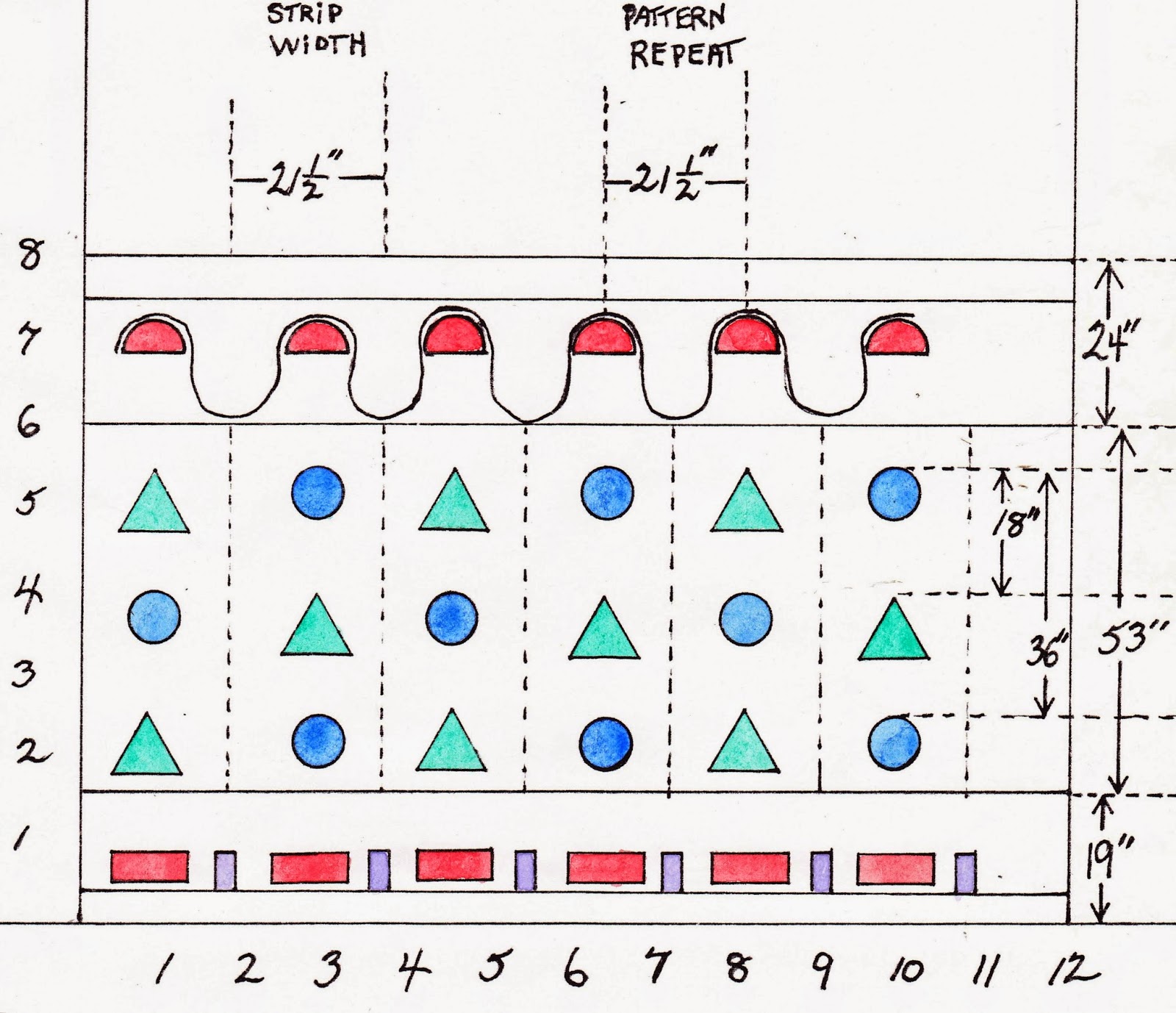
But, the Committee For the Preservation of the White House was still in session and ideas continued to percolate. Soon, an alternate idea began competing and gaining ground. The alternate scheme would be appropriate to the 1820s, but it would be entirely new. A large drapery border and sizable bottom border would be based on French models from the Smithsonian Museum collections, and the sidewall would be adapted from an early American wallpaper from Historic New England. There was a moment when block printing by the then-new Adelphi Paperhangings company was considered, but this was ruled out. Adelphi did eventually supply blockprints for the Lincoln Bedroom and another room, but let's not get ahead of ourselves.
The alternate plan (the interesting combination of French-inspired borders with an American sidewall) was worked up by Brunschwig artists through 1993 and into 1994, and printed up by the Chambord handscreening company in Hoboken just in time for the installation in January, 1995.

After all the planning 1992-1994 (I had visited the screen-engraver, Jacques Cluzel at Tavernon, and the design studio at Brunschwig as well) the installation seemed almost anti-climactic. As noted, this was carried out with fellow paperhangers Jim Yates and Barry Blanchard. But, there were several design issues with the newly-created borders that had to be decided on site.
How should the lower edge of the drapery be cut? Should it follow the horizontal border line? Or should it be hand-cut to follow the curve of the drapery along the shadow line? The latter was adopted since it produced the most realistic look. Another question was about the crescent of dark brown above the folds of the drapery. It seemed too heavy, but what could be done about it? An ingenious solution was found: cut it out. The result was that the sidewall (already hung) peeked through. This added a touch of realism — and interest. Documentation from French precedents helped to settle this question.
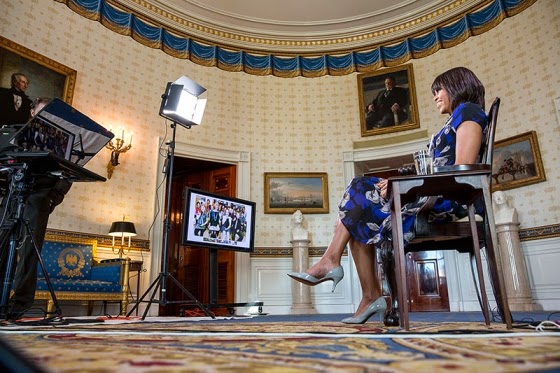
The final problem was that the drapery as printed hung from the top border by the slenderest of threads. It didn't look like it was hung up on a support, like a real drapery fabric. This became a huge topic of discussion among the ad-hoc advisors that Mrs. Clinton had assembled. My role was to prepare several mock-ups and tape them to the wall for examination.
Finally, she decided that an important decision-maker was missing. A day later Richard Nylander was in the room, a quorum assembled, and the decision made. We were soon separating out the lower drapery and hanging it up about an inch and a half into the top border. This provided just the right illusion of support.
(to be continued)
========================
Notes:
- see Mistress of Riversdale, by Margaret Law Callcott (1992) for a superior account of everyday life at Riversdale.
http://www.amazon.com/Mistress-Rivers...
- The President's House, by William Seale (2008, 2nd edition).
http://www.amazon.com/Presidents-Hous...
- photo credits: President Barack Obama talks with religious leaders in the Blue Room of the White House prior to the Easter Prayer Breakfast, April 5, 2013. (Official White House Photo by David Lienemann)
- First Lady Michelle Obama participates in the “Let’s Move!” Google+ Hangout in the Blue Room of the White House. March 4, 2013. (Official White House Photo by Chuck Kennedy)
- the image from the Morris-Jumel Mansion is in the public domain:
http://en.wikipedia.org/wiki/File:Mor...
- top border appears in “Wallpapers of France 1800-1850” by Odile Nouvel (1981); bottom border in “Paper Magic” by Jane Gorden Clark (1992); diagram copyright 1994 by WRN Associates.
Copyright: © 2014 Robert M. Kelly
January 24, 2014
What I Learned At The White House: Chapter Two
A Memoir
I mentioned last time that the oval shape of the Blue Room evolved from George Washington's tenure at the President's House in Philadelphia. Washington preferred an oval at one end of his reception room. He ordered a “bow window” built to improve the rectangular shape. But why? The answer brings us to the monarchical traditions of the seventeenth and eighteenth centuries.
In a tradition called the levee, or “public day,” a line of guests would pay respects to the host or hostess of grand occasions and entertainments. In Philadelphia, Washington had political gatherings a couple of afternoons each week, and Martha presided over a social occasion one night a week. The well-known painting by Huntington “The Republican Court (Lady Washington's Reception Day)” shows her receiving sixty-four distinguished guests while standing on a dais. Behind Mrs. Washington is an alcove, just the type of architectural shape that would highlight her importance. Another clue in the painting is the way that George defers to her. This idealized painting was done in the mid-nineteenth century, and is not to be entirely trusted. For example, each of the rival president's houses in Philadelphia and New York had rounded ends, not alcoves. And, the architectural details of the President's House in Philadelphia paled in comparison to those in the picture, though some townhouses that the Washingtons rented in New York were considered stylish. Yet, the artist did capture what made the levee a special occasion.
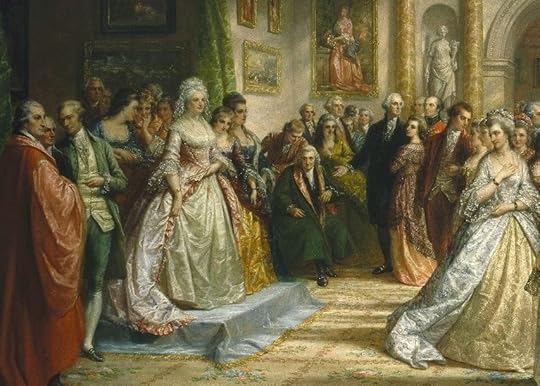
When the so-called elliptical saloon (the future Blue Room) was created, it was to be used it in a particular way. In Philadelphia, Washington would enter first and stand in front of the fireplace. Each diplomat or politician would enter, bow, and take a place against the oval walls, ending up more or less like the numerals on a clock-face. Washington would then travel around the room, greeting and conversing with each. It was formal, but then, so was the occasion. So much for how the Blue Room became oval. In the next segment we will learn how it became blue. But now, back to personal history. I'm often asked: how did I get to hang wallpaper in the White House?
The short answer is that I came in through the service entrance. Both Jack Kennedy and I were born Irish-Catholic in Massachusetts, but I grew up without the lace curtains of the Kennedy clan. Did you ever notice that their family home near Hyannis Port on Cape Cod is always a “compound”? Meanwhile, my parents rented, though a compound would have been more appropriate, since they raised ten children. It was a great day when we finally moved into a rambling single-family residence in the late 1950s. My father was a butcher and my mother was a nurse who gave up nursing for child-rearing. She returned to nursing later and picked up some advanced degrees.
My father was a butcher but perhaps more important, he was a craftsman. I grew up with a love of literature (from Mom) and respect for craft (from Dad). It took me years to figure out what sort of work I was fit for. But why did I get into the business of decoration, of making the world more beautiful? Why was that important?
Thinking now of my childhood in that rented apartment, it's summer again, and eight o'clock: bedtime. I can hear the muffled crunch of pebbles on a dirt road as fat-tired cars snaked slowly around the hollows left by the puddled rain. Diagonal slashes of light make a slow ascent up the wall and light up the ceiling. When they came down the opposite wall they spotlighted the outline of a witch's head on the disfigured plaster. Every time I looked, it was there. I wonder now, is this why my career is so satisfying? Am I in that room still, covering up an ugly wall with beauty, over and over again?
In the first chapter I mentioned the Committee For The Preservation of the White House. About a dozen people are charged with “...preserving the museum quality of the public spaces of the White House...”. The distinction between the State Rooms and the living quarters on the second floor is sharp. New administrations sweep through the living quarters with a fresh broom, most recently wielded by designer Michael Smith, who reports to the Obamas directly (Smith is also on the committee). Decisions about the State Rooms, on the other hand, often take years. The committee's honorary chair is the First Lady, while the official chair is the head of the National Park Service.
During the 1995 refurbishment of the Blue Room, the historian Bill Seale made daily pilgrimages from Alexandria. I grew to expect and enjoy his visits. One day I complimented him on belonging to the committee. He smiled and set me straight. “Bob,” he drawled, “I'm not actually on the committee. I'm just a back-stairs child.” Being from New England I had no idea what a back-stairs child was — but I got the drift. It was Seale, enormously knowledgable about nineteenth-century decoration, who insisted on the milky-white French polished woodwork which complements the silk-upholstered furniture, gilt highlights, and Empire draperies of the room.
The arduous French polishing (using only cheesecloth, linseed oil, rottenstone and elbow grease) was done at night by a team of Polish workers under the direction of Brandon Thompson. Each morning before going home they taped off their work, as best they could, and the paperhanging crew (James Yates, Barry Blanchard, and myself) took over. At the end of our workday, the process was reversed. We taped off our work so that the paint crew could work all night. This tag-team approach continued, at an accelerating pace, from January 14 right up to our deadline of the 24th. A few days later, President Clinton hosted governors from all fifty states in — you guessed it — the Blue Room.
If this schedule seems slightly crazy, welcome to the White House, where death-defying decorative shenanigans like this have been going on since shortly after the walls were erected. Even so, not all interior walls were erected as late as 1803. What is now the East Room was merely walled with canvas. It's a good thing that the occupant was Jefferson's secretary Meriwether Lewis, a man who knew hardship.
When the final push was on so that the first occupant, John Adams, could live in some semblance of style, every fireplace belched fire 24 hours a day in order to dry the newly plastered walls in time for finishing with wallpaper. By far the most interesting thing about the wallpapers hung in the White House in 1800 were the decisions about the "fitness of the pattern." Although American wallpaper had been in production for at least thirty years, it was not yet considered good enough. The first choice of the Commissioners was French wallpaper. The second choice: English wallpaper.
Choice of pattern also played a large role in the 1995 renovations of the Blue Room walls. Yet those choices were influenced by the previous renovation in 1972. That one was initiated by a knowledgable admirer of early American furniture: Richard M. Nixon.
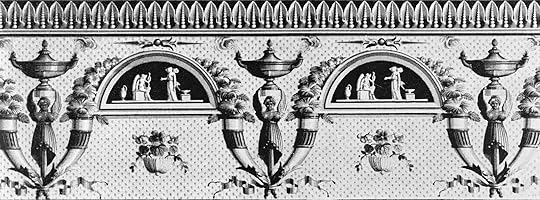
Nixon approved the installation of a French reproduction wallpaper which would change the Blue Room walls from fabric to paper. The pattern is attributed to Jacquemart and Benard, and dated to around 1800. The elaborate frieze shown above was only part of the decoration. Like many French wallpapers of the period, it had an accompanying bottom border and a sidewall with two alternating motifs (lyre and shield —properly, a pelta). All matched perfectly on the wall. That is, they were designed to match perfectly on the wall.
(to be continued)
Notes:
- The painting “The Republican Court: Lady Washington's Reception Day” (1861) by Daniel Huntington is owned by the Brooklyn Museum and shown here for educational purposes. For copyright policy of the Brooklyn Museum:
http://www.brooklynmuseum.org/copyright.php
- “Reception Day” was the the subject of a hugely popular engraving by A. H. Ritchie in 1865 which was often issued with a program listing the dozens of historic personalities in the scene. “Reception Day” was commissioned by Ritchie. This website puts both images in context:
http://www.librarycompany.org/women/republicancourt/intro.htm
- The image of the top border is from Henri Clouzot and Charles Follot's Histoire Du Papier Peint En France (1935), pg. 89.
Copyright: © 2014 Robert M. Kelly
I mentioned last time that the oval shape of the Blue Room evolved from George Washington's tenure at the President's House in Philadelphia. Washington preferred an oval at one end of his reception room. He ordered a “bow window” built to improve the rectangular shape. But why? The answer brings us to the monarchical traditions of the seventeenth and eighteenth centuries.
In a tradition called the levee, or “public day,” a line of guests would pay respects to the host or hostess of grand occasions and entertainments. In Philadelphia, Washington had political gatherings a couple of afternoons each week, and Martha presided over a social occasion one night a week. The well-known painting by Huntington “The Republican Court (Lady Washington's Reception Day)” shows her receiving sixty-four distinguished guests while standing on a dais. Behind Mrs. Washington is an alcove, just the type of architectural shape that would highlight her importance. Another clue in the painting is the way that George defers to her. This idealized painting was done in the mid-nineteenth century, and is not to be entirely trusted. For example, each of the rival president's houses in Philadelphia and New York had rounded ends, not alcoves. And, the architectural details of the President's House in Philadelphia paled in comparison to those in the picture, though some townhouses that the Washingtons rented in New York were considered stylish. Yet, the artist did capture what made the levee a special occasion.

When the so-called elliptical saloon (the future Blue Room) was created, it was to be used it in a particular way. In Philadelphia, Washington would enter first and stand in front of the fireplace. Each diplomat or politician would enter, bow, and take a place against the oval walls, ending up more or less like the numerals on a clock-face. Washington would then travel around the room, greeting and conversing with each. It was formal, but then, so was the occasion. So much for how the Blue Room became oval. In the next segment we will learn how it became blue. But now, back to personal history. I'm often asked: how did I get to hang wallpaper in the White House?
The short answer is that I came in through the service entrance. Both Jack Kennedy and I were born Irish-Catholic in Massachusetts, but I grew up without the lace curtains of the Kennedy clan. Did you ever notice that their family home near Hyannis Port on Cape Cod is always a “compound”? Meanwhile, my parents rented, though a compound would have been more appropriate, since they raised ten children. It was a great day when we finally moved into a rambling single-family residence in the late 1950s. My father was a butcher and my mother was a nurse who gave up nursing for child-rearing. She returned to nursing later and picked up some advanced degrees.
My father was a butcher but perhaps more important, he was a craftsman. I grew up with a love of literature (from Mom) and respect for craft (from Dad). It took me years to figure out what sort of work I was fit for. But why did I get into the business of decoration, of making the world more beautiful? Why was that important?

Thinking now of my childhood in that rented apartment, it's summer again, and eight o'clock: bedtime. I can hear the muffled crunch of pebbles on a dirt road as fat-tired cars snaked slowly around the hollows left by the puddled rain. Diagonal slashes of light make a slow ascent up the wall and light up the ceiling. When they came down the opposite wall they spotlighted the outline of a witch's head on the disfigured plaster. Every time I looked, it was there. I wonder now, is this why my career is so satisfying? Am I in that room still, covering up an ugly wall with beauty, over and over again?
In the first chapter I mentioned the Committee For The Preservation of the White House. About a dozen people are charged with “...preserving the museum quality of the public spaces of the White House...”. The distinction between the State Rooms and the living quarters on the second floor is sharp. New administrations sweep through the living quarters with a fresh broom, most recently wielded by designer Michael Smith, who reports to the Obamas directly (Smith is also on the committee). Decisions about the State Rooms, on the other hand, often take years. The committee's honorary chair is the First Lady, while the official chair is the head of the National Park Service.
During the 1995 refurbishment of the Blue Room, the historian Bill Seale made daily pilgrimages from Alexandria. I grew to expect and enjoy his visits. One day I complimented him on belonging to the committee. He smiled and set me straight. “Bob,” he drawled, “I'm not actually on the committee. I'm just a back-stairs child.” Being from New England I had no idea what a back-stairs child was — but I got the drift. It was Seale, enormously knowledgable about nineteenth-century decoration, who insisted on the milky-white French polished woodwork which complements the silk-upholstered furniture, gilt highlights, and Empire draperies of the room.
The arduous French polishing (using only cheesecloth, linseed oil, rottenstone and elbow grease) was done at night by a team of Polish workers under the direction of Brandon Thompson. Each morning before going home they taped off their work, as best they could, and the paperhanging crew (James Yates, Barry Blanchard, and myself) took over. At the end of our workday, the process was reversed. We taped off our work so that the paint crew could work all night. This tag-team approach continued, at an accelerating pace, from January 14 right up to our deadline of the 24th. A few days later, President Clinton hosted governors from all fifty states in — you guessed it — the Blue Room.
If this schedule seems slightly crazy, welcome to the White House, where death-defying decorative shenanigans like this have been going on since shortly after the walls were erected. Even so, not all interior walls were erected as late as 1803. What is now the East Room was merely walled with canvas. It's a good thing that the occupant was Jefferson's secretary Meriwether Lewis, a man who knew hardship.
When the final push was on so that the first occupant, John Adams, could live in some semblance of style, every fireplace belched fire 24 hours a day in order to dry the newly plastered walls in time for finishing with wallpaper. By far the most interesting thing about the wallpapers hung in the White House in 1800 were the decisions about the "fitness of the pattern." Although American wallpaper had been in production for at least thirty years, it was not yet considered good enough. The first choice of the Commissioners was French wallpaper. The second choice: English wallpaper.
Choice of pattern also played a large role in the 1995 renovations of the Blue Room walls. Yet those choices were influenced by the previous renovation in 1972. That one was initiated by a knowledgable admirer of early American furniture: Richard M. Nixon.

Nixon approved the installation of a French reproduction wallpaper which would change the Blue Room walls from fabric to paper. The pattern is attributed to Jacquemart and Benard, and dated to around 1800. The elaborate frieze shown above was only part of the decoration. Like many French wallpapers of the period, it had an accompanying bottom border and a sidewall with two alternating motifs (lyre and shield —properly, a pelta). All matched perfectly on the wall. That is, they were designed to match perfectly on the wall.
(to be continued)
Notes:
- The painting “The Republican Court: Lady Washington's Reception Day” (1861) by Daniel Huntington is owned by the Brooklyn Museum and shown here for educational purposes. For copyright policy of the Brooklyn Museum:
http://www.brooklynmuseum.org/copyright.php
- “Reception Day” was the the subject of a hugely popular engraving by A. H. Ritchie in 1865 which was often issued with a program listing the dozens of historic personalities in the scene. “Reception Day” was commissioned by Ritchie. This website puts both images in context:
http://www.librarycompany.org/women/republicancourt/intro.htm
- The image of the top border is from Henri Clouzot and Charles Follot's Histoire Du Papier Peint En France (1935), pg. 89.
Copyright: © 2014 Robert M. Kelly
What I Learned At The White House: A Memoir
Chapter Two
I mentioned last time that George Washington preferred an oval at one end of his reception room during his tenure in Philadelphia (1790 - 1797). He ordered a “bow window” built to improve the rectangular shape. But why? The answer brings us back to the monarchical traditions of the seventeenth and eighteenth centuries.
There was a tradition called the levee, or “public day,” when a line of guests would pay respects to the host or hostess of grand occasions and entertainments. In Philadelphia, Washington had political gatherings a couple of afternoons each week, and Martha presided over a social occasion one night a week. The well-known painting by Huntington “The Republican Court (Lady Washington's Reception Day)” shows her receiving guests while standing on a raised platform. This scene shows, to the rear, just the type of architectural shape designed to highlight her importance. Another clue in the painting is the way that George defers to her. This idealized painting was done in the mid-nineteenth century, yet the artist captured what made the levee a special occasion.
When the so-called elliptical saloon (the future Blue Room) was created, Washington used it in a particular way. He would enter first and stand in front of the fireplace. Each diplomat or politician would enter, bow, and take a place against the oval walls, more or less like the numerals on a clock-face. Washington would then travel around the room, greeting each and conversing in more detail, as the situation required. It was formal, but then, so was the occasion.
The short answer to the question: “How did you get to the White House?” is that I worked my way up. I came in through the service entrance. Born in 1949, I grew up without the lace curtains surrounding the Kennedy clan. Did you ever notice that their home near Hyannis Port on Cape Cod is inevitably described as a “compound”? Meanwhile, my parents were renting, though since they raised ten children a compound would have been more appropriate. It was a great day when we finally moved into a rambling single-family residence in the late 1950s. My father was a butcher and my mother was a nurse who gave up nursing for child-rearing. She returned to nursing eventually and picked up several advanced degrees.
I mentioned that my father was a butcher, but perhaps more importantly, he was a craftsman. I grew up with an odd combination: a love of literature (from Mom) and respect for the virtues of craft (from Dad). It took me years to figure out the work I was fit for. But why did I get into the business of decoration, of making the world more beautiful? Why was it important to me?
Thinking now of my childhood in that rented apartment, it's summer again. I can hear the muffled crunch of pebbles on a dirt road as fat-tired cars snaked slowly around the hollows left by the puddled rain. Diagonal slashes of light make a slow ascent up the walls, then rake the ceiling, and at one point while coming down the wall they always spotlight a disfigured plaster wall upon which my fertile mind saw, repeatedly, a witch's head. Every time I looked, it was there. I wonder now, is this where my choice of career came from? Am I still in that room, continually covering up an ugly wall with beauty, over and over again?
In the first installment I mentioned the Committee For The Preservation of the White House. About a dozen people sit on the committee, charged with “...preserving the museum quality of the public spaces of the White House...”. The distinction between the State Rooms and the living quarters on the second floor is sharp. New administrations sweep through the living quarters with a fresh broom, most recently wielded by designer Michael Smith, who reports to the Obamas directly (Smith is also on the committee). Decisions about the State Rooms, on the other hand, often take years. The committee's honorary (unofficial) chair is the First Lady, while the official chair is the head of the National Park Service.
During the 1995 refurbishment of the Blue Room, the historian Bill Seale made daily pilgrimages from Alexandria to oversee progress. I grew to expect and enjoy his visits. One day I complimented him on belonging to the committee. He smiled and set me straight.
“Bob,” he drawled, “I'm not actually on the committee. I'm just a back-stairs child.” Being from New England I had no idea what a back-stairs child was — but I got the drift. It was Seale, enormously knowledgable about nineteenth-century decoration and enormously authoritative, who insisted on the milky-white French polished woodwork which complements the silk-upholstered furniture, gilt highlights, and Empire draperies of the room.
This arduous French polishing (using only cheesecloth, linseed oil, rottenstone and elbow grease) was done throughout the night by a team of Polish workers under the direction of Brandon Thompson from Alexandria. Each morning before going home they taped off their work, as best they could, and the paperhanging crew (James Yates, Barry Blanchard, and myself) took over. At the end of our workday, the process was reversed. We taped off our work so that the paint crew could work all night. This tag-team approach continued, at an accelerating pace, right up to our deadline of January 24th. A few days later, he hosted the nation's governors in — you guessed it — the Blue Room.
If this schedule seems slightly crazy, welcome to the White House, where death-defying decorative shenanigans like this have been going on since shortly after the walls were erected. Even so, not all interior walls were erected by 1800. What is now the East Room was merely walled with canvas. It's a good thing that the occupant was Jefferson's secretary Meriwether Lewis, a man who knew hardship.
Every fireplace belched fire 24 hours a day, part of the final push to dry the newly plastered walls in time for finishing with wallpaper, so that John Adams could begin living there in some semblance of style. By far the most interesting thing about the wallpaper hung in the White House in 1800 is that American wallpaper was not even considered though it had been in production for at least thirty years. Apparently it was not yet good enough. The first choice of the Commissioners was French wallpaper. The second choice was English wallpaper. Choice of pattern also played a large role in the 1995 re-casting of the Blue Room walls. Yet those choices arose out of an earlier renovation, initiated by a knowledgable admirer of early American furniture: Richard M. Nixon.
In 1972 Nixon approved the installation of a French reproduction wallpaper which would change the Blue Room walls from fabric to paper. The pattern is attributed to Jacquemart and Benard, dated to around 1800. The elaborate frieze shown here was only part of the decoration. Like many French wallpapers of the period, it had an accompanying bottom border and a sidewall with two alternating motifs (lyre and shield). All matched perfectly on the wall. That is, they were designed to match perfectly on the wall.
(to be continued)
I mentioned last time that George Washington preferred an oval at one end of his reception room during his tenure in Philadelphia (1790 - 1797). He ordered a “bow window” built to improve the rectangular shape. But why? The answer brings us back to the monarchical traditions of the seventeenth and eighteenth centuries.
There was a tradition called the levee, or “public day,” when a line of guests would pay respects to the host or hostess of grand occasions and entertainments. In Philadelphia, Washington had political gatherings a couple of afternoons each week, and Martha presided over a social occasion one night a week. The well-known painting by Huntington “The Republican Court (Lady Washington's Reception Day)” shows her receiving guests while standing on a raised platform. This scene shows, to the rear, just the type of architectural shape designed to highlight her importance. Another clue in the painting is the way that George defers to her. This idealized painting was done in the mid-nineteenth century, yet the artist captured what made the levee a special occasion.
When the so-called elliptical saloon (the future Blue Room) was created, Washington used it in a particular way. He would enter first and stand in front of the fireplace. Each diplomat or politician would enter, bow, and take a place against the oval walls, more or less like the numerals on a clock-face. Washington would then travel around the room, greeting each and conversing in more detail, as the situation required. It was formal, but then, so was the occasion.
The short answer to the question: “How did you get to the White House?” is that I worked my way up. I came in through the service entrance. Born in 1949, I grew up without the lace curtains surrounding the Kennedy clan. Did you ever notice that their home near Hyannis Port on Cape Cod is inevitably described as a “compound”? Meanwhile, my parents were renting, though since they raised ten children a compound would have been more appropriate. It was a great day when we finally moved into a rambling single-family residence in the late 1950s. My father was a butcher and my mother was a nurse who gave up nursing for child-rearing. She returned to nursing eventually and picked up several advanced degrees.
I mentioned that my father was a butcher, but perhaps more importantly, he was a craftsman. I grew up with an odd combination: a love of literature (from Mom) and respect for the virtues of craft (from Dad). It took me years to figure out the work I was fit for. But why did I get into the business of decoration, of making the world more beautiful? Why was it important to me?
Thinking now of my childhood in that rented apartment, it's summer again. I can hear the muffled crunch of pebbles on a dirt road as fat-tired cars snaked slowly around the hollows left by the puddled rain. Diagonal slashes of light make a slow ascent up the walls, then rake the ceiling, and at one point while coming down the wall they always spotlight a disfigured plaster wall upon which my fertile mind saw, repeatedly, a witch's head. Every time I looked, it was there. I wonder now, is this where my choice of career came from? Am I still in that room, continually covering up an ugly wall with beauty, over and over again?
In the first installment I mentioned the Committee For The Preservation of the White House. About a dozen people sit on the committee, charged with “...preserving the museum quality of the public spaces of the White House...”. The distinction between the State Rooms and the living quarters on the second floor is sharp. New administrations sweep through the living quarters with a fresh broom, most recently wielded by designer Michael Smith, who reports to the Obamas directly (Smith is also on the committee). Decisions about the State Rooms, on the other hand, often take years. The committee's honorary (unofficial) chair is the First Lady, while the official chair is the head of the National Park Service.
During the 1995 refurbishment of the Blue Room, the historian Bill Seale made daily pilgrimages from Alexandria to oversee progress. I grew to expect and enjoy his visits. One day I complimented him on belonging to the committee. He smiled and set me straight.
“Bob,” he drawled, “I'm not actually on the committee. I'm just a back-stairs child.” Being from New England I had no idea what a back-stairs child was — but I got the drift. It was Seale, enormously knowledgable about nineteenth-century decoration and enormously authoritative, who insisted on the milky-white French polished woodwork which complements the silk-upholstered furniture, gilt highlights, and Empire draperies of the room.
This arduous French polishing (using only cheesecloth, linseed oil, rottenstone and elbow grease) was done throughout the night by a team of Polish workers under the direction of Brandon Thompson from Alexandria. Each morning before going home they taped off their work, as best they could, and the paperhanging crew (James Yates, Barry Blanchard, and myself) took over. At the end of our workday, the process was reversed. We taped off our work so that the paint crew could work all night. This tag-team approach continued, at an accelerating pace, right up to our deadline of January 24th. A few days later, he hosted the nation's governors in — you guessed it — the Blue Room.
If this schedule seems slightly crazy, welcome to the White House, where death-defying decorative shenanigans like this have been going on since shortly after the walls were erected. Even so, not all interior walls were erected by 1800. What is now the East Room was merely walled with canvas. It's a good thing that the occupant was Jefferson's secretary Meriwether Lewis, a man who knew hardship.
Every fireplace belched fire 24 hours a day, part of the final push to dry the newly plastered walls in time for finishing with wallpaper, so that John Adams could begin living there in some semblance of style. By far the most interesting thing about the wallpaper hung in the White House in 1800 is that American wallpaper was not even considered though it had been in production for at least thirty years. Apparently it was not yet good enough. The first choice of the Commissioners was French wallpaper. The second choice was English wallpaper. Choice of pattern also played a large role in the 1995 re-casting of the Blue Room walls. Yet those choices arose out of an earlier renovation, initiated by a knowledgable admirer of early American furniture: Richard M. Nixon.
In 1972 Nixon approved the installation of a French reproduction wallpaper which would change the Blue Room walls from fabric to paper. The pattern is attributed to Jacquemart and Benard, dated to around 1800. The elaborate frieze shown here was only part of the decoration. Like many French wallpapers of the period, it had an accompanying bottom border and a sidewall with two alternating motifs (lyre and shield). All matched perfectly on the wall. That is, they were designed to match perfectly on the wall.
(to be continued)
December 21, 2013
December 13, 2013
What I Learned At The White House: Chapter One
A Memoir
The Blue Room of the White House, now resplendent with the annual Christmas tree and trimmings, is arguably one of the most beautiful interiors in America.

This is the official heart of the house, the state room where photo ops, receiving lines, live music, and an infinity of ceremonies both large and small take place. The Blue Room is expansive in mood and size, and these attributes (plus its oval shape) set it apart from its neighbors, the Green and Red Rooms, which perch on each side like a pair of respected aunts. There is warmth in the Blue Room, and zest, now that Michelle Obama has taken to thrilling the bejesus out of tour groups by popping into the room at odd moments.
The key to the room is the Monroe furniture. It was bought for the public reopening of the house (after the disastrous fire of 1814) on January 1, 1818. This silk-upholstered and gilded ensemble goes a long way toward explaining the decisions of the Committee for the Preservation of the White House. In 1995 the committee, headed unofficially but forcefully by Hillary Clinton, restored the room with rich colors, gilding, French polished woodwork, and elaborate draperies in both fabric and wallpaper forms. The sidewall, a copy of a common American wallpaper, is a perfect foil. As paperhanger and consultant I've worked in this room several times, and this memoir shares details of that work. But, I have few illusions about the importance of my work in the big picture. It was wonderful to be walking down a sunny sidewalk in Washington knowing that I was heading for my job at the White House. Yet this heady feeling vanished when I began meeting the dozens who go there daily. The three most frequent questions I'm asked are 1. How did you get that job? 2. Were you nervous? and 3. What's it like to work in the White House? I'll answer those questions in these blog posts. I'll also talk about how the work of designers Kaki Hockersmith, Ken Blasingame, and Michael Smith on the second floor differs from the work done in the state rooms. Staff at the White House tend to stay put and there is a pronounced Southern flavor, especially among older workers. One person I missed on a recent work trip is Cletus Clarke, head of the paint shop. Cletus had to be between 70 and 80 years of age when he finally retired. This cheerful black worker was a walking encyclopedia. He talked effortlessly about the last dozen or so presidential households, a real-life "Butler," if you will. Like staff painters everywhere, Cletus was constantly under pressure, finishing one room as he started prepwork in another. By some accounts there are 125 rooms in the White House. Cletus seemed to be just as happy as I that the wallpaper was being handled by someone else. Certainly wallpaper has had a great run in the White House, especially during the nineteenth century, and it's been an honor to help put some of it back. The great exceptions are the Red and Green Rooms. These have been upholstered for so long that it might take an Act of Congress to change them back. Aside from any decorative statements, the White House as domestic icon and cultural touchstone is woven into the fabric of American life. It is at once a domicile, a seat of power, a tourist attraction, and an armed camp. The second floor, where the First Family lives, is a serene space well-insulated by a ring of professional security from media attention. The politics and pressure of statesmanship are reserved for the offices and apparatus of the West Wing. The chief symbol of the political side is the Oval Office, which was created in 1909 by Taft. It is not to be confused with the oval rooms in the main block of the White House.

There are good reasons why George Washington preferred an oval shape for his main reception room, as we shall see. Although Washington never lived in the White House, he created the model for the "elliptical saloon," as the Blue Room was originally called, at the President's House in Philadelphia (1790 - 1797). Above and below the Blue Room are two more oval rooms, all three stacked something like a wedding cake, except that instead of a tiny bride and groom at the top there sits the Truman balcony looking out on the South Lawn.
Above the Blue Room is the Yellow Oval Room, part of the second-floor residential area just mentioned. Below the Blue Room is the Diplomatic Reception Room into which Jackie Kennedy put the "Scenic America" panorama by Zuber in 1961.

That installation was part of a flurry of important wall decorations provoked by Jackie Kennedy's house restoration in 1961. Two others were a set of "War of Independence" (also by Zuber and based on Scenic America) still hanging in the President's Dining Room, now covered by fabric, and the Chinese scenic wallpaper in the double parlors at Blair House, the President's Guest House across Pennsylvania Avenue. This last was originally hung c. 1765 by John, second Earl of Ashburnham Place, Sussex, England. Without question a good choice for a study guide about decoration at the White House is William Seale's "The President's House", a two-volume tome. The great things about it are the relentlessly domestic tone and the scope. No furnishing detail is too small, and many are found in no other source. One of the first things we learn from the book is that the house was down-sized from the original plans by L'Enfant. As built, the house became less formidable and palace-like. It was also reoriented 90 degrees. The house is most often seen from the north, where the temple-like facade cuts a fine figure. When standing in the middle of the Blue Room the view south through the central window to the Jefferson Memorial is grand. The Memorial is perfectly lined up. The importance of centrality extends to the drapery wallpaper frieze. An oval room demands consistency: there can be no mismatches in running figures at the top of a wall. Full swags being necessary, the border was centered on both the north and south axes and cut to fit. The folds of paper drapery were compressed in one section by about four inches, and elongated in the complementary section by about seven inches. This wallpaper drapery, which is based on early nineteenth-century French models, has a fairly deep vertical design (27" or so), and a large horizontal repeat (22" or so), and it needs to be that large, since the walls are nearly twenty feet high.
(to be continued)
photo credits:
- the 3 floor plans are from Wikipedia, authored in SVG by ZooFari using Inkscape, and are licensed under the Creative Commons Attribution-Share Alike 3.0 Unported license.
- the photo of the White House Christmas tree is from www.whitehouse.gov ("The Blue Room Tree") and appears here under the terms of the Creative Commons Attribution 3.0 License: http://www.whitehouse.gov/copyright
Copyright: © 2013 Robert M. Kelly


