
Lisa Niver's Blog: We Said Go Travel, page 472
August 31, 2013
Pakistan: Why I love Lahore

Badshahi Mosque
Pakistan: Why I love Lahore
I stood in the balcony sipping the aromatic cup of pink tea while watching the sun rise and spreading the vibrant hues of yellow stealthily over the city, bringing the heart of Pakistan to life. My gaze shifted back to the stunning Badshahi mosque as sunlight lit up the beautiful architecture of this fifth largest Mosque in the world that has been depicting the Mughal grandeur since 1673. I stood in awe devouring the splendor of this majestic mosque.

Inside the magnificient Badshahi mosque
Sometimes I wonder why I am so in love with Lahore? And I hear my heart whisper that reasons to fall in love with this amazing city are countless! From a two months old baby to a Mom of two, it has been ages since I am dwelling in Lahore and still Lahore continues to surprise me every day, mesmerize me with its beauty, hustle and bustle and of course, love for food.

Lahore Fort and Shalimar Gardens
If you have a profound interest in history then Lahore is destined to leave you enthralled with its historically rich culture. The inner city of Lahore, a very densely populated area was once surrounded by a 9 meter high brick wall with thirteen gates making this Walled city one of the oldest cities in the world. The Lahore Fort built inside the walled city by Royal Mughals is one of the greatest Forts built in South Asia and was declared UNESCO world heritage site.
However it’s not just the city but also its people who make Lahore so alive.

Minar-e-Pakistan
People are friendly, hospitable and like to dress up in their national dress, Shalwar kameez (long knee length shirts and baggy pants) as well as jeans and shirts. Urdu is their mother tongue but Punjabi is also widely spoken. And English being the official language is easily comprehended among educated masses.
A famous Pakistani proverb goes, “One who has never visited Lahore is not born yet.” and if you have actually had the opportunity to visit this cultural hub of Pakistan, you wouldn’t agree more! Lahore’s famous Food Street is a heaven for those who appreciate fresh food, wide variety of local dishes made with aromatic eastern herbs and spices, the rich curries, spicy gravies, assorted sweetmeats, BBQ platters that tantalize one’s taste buds. It is said that Lahore never sleeps and the same applies for Food street. Street food all over the country is Halal and simply awesome. You just got to locate the most popular hygienic stalls.
Rickshaw is a popular mode of transport here apart from taxis and buses. This brightly colored three wheeled noisy ride with interesting quotes and poetry written at the back makes its way through the traffic jam hastily, bouncing on the slowdowns of the roads, producing a loud traaaaa sound. For inter-city transportation of goods, trucks with wooden carved doors and various floral designs painted in bright colors over the vehicle’s entire body are quite popular.
A seasonal festival that is most enthusiastically celebrated in my city is “Basant”. This festival is celebrated during February to celebrate the arrival of spring and is a major tourist attraction. On this day kites of different colors, shapes and sizes adorn the clear blue sky. Families gather on roof tops to witness the art of kite flying. The colored sharp strings of kites tangle and pull as both kite flyers use tactics to cut the other kite’s thread. Gazes fix in the sky, suspense mounts up and as soon as victory is announced, enthusiasts in family and friends rejoice by hooting and performing “bhangra”, a traditional dance done on the beat of drums.

Pakistani Handicrafts
Catering to the needs of all, Lahore is a shopper’s paradise with malls laden with latest fashionable variety. A 100 Pakistani Rupees is equivalent to approx. 1 USD. Whatsoever is your budget, you can find great stuff at affordable prices here. Ranging from Designer brands to inexpensive stuff, traditional handicrafts to intricate hand embroidered Kashmir shawls, the Persian and Afghani hand woven carpets, Lahore has it all. Lahore is the most popular city but can be really hot during summers.
While standing on the balcony, suddenly I spotted the first vehicle on the empty road. A horse carriage being driven by an old man. The sound of the horse shoes hitting the road was audible in the stark silence of dawn. Soon the vacant roads of Lahore will start getting flooded with vehicles as Lahoris wake up and leave their homes in pursue of bread n butter. Soon the traaa of rickshaws, the Tongas of inner Lahore, smoke arising from the wagons and buses on roads will bring to life these empty roads. I took my last sip of tea and stepped inside.
Photo Credits: My friend Shabnum Zulfiqar

The post Pakistan: Why I love Lahore appeared first on We Said Go Travel.


Myanmar: Boat trip on Inle Lake (video)
WATCH: 36 Boat trip on Inle Lake October 20, 2012, Myanmar (Burma)
We asked the team at Golden Empress Hotel to help us arrange a boat trip on the Lake. With Ya and Nop from Bangkok, we spent the day exploring and we saw the famous Leg rowers, local fisherman, and the Weaving Factory.
Khit Sunn Yin, Lotus, Silk and Cotton Hand Weaving Center
Mya Hin Tha Special Fish Silversmith shop
Golden Moon Restaurant (Near Floating Market) for lunch. The food was hot and sour potatoes and fried vegetables with cashew nut.
Shwe Inn Dain Pagoda: Inn Dain Khone original stupa donated by King Siri Dhamma Sawka 273-242 BC
Eastern stair (2000′ x 12/5′) (1054 pagdoas—14th c AD — 18th C AD) extra time but worth it
Jumping Cat monastery—The monks stopped allowing the cats to jump a few months before our visit in July 2012. Tourists were concerned that it was not nice to the cats. To me it was a Buddha museum. There were so many styles of Buddha from so many centuries. Incredible and intricate work. There were two large golden Buddhas made from Bamboo. We saw a monk teaching a group who came to visit. It is a working monastery.
Definitely spend a day on Inle Lake there is so much to see! October 20, 2012
This movie is from our 28 days in Myanmar (Burma) from September 28, 2012 to October 26, 2012 and our year TRIP in South East Asia, see all the videos from our trip.
Our memoir, Traveling in Sin, is available at Amazon; it is a HOT NEW RELEASE!
Traveling in Sin is a HOT NEW Release on Amazon! from Lisa Niver Rajna
Traveling in Sin is a true tale of TRANSFORMATION thought LOVE and TRAVEL! After meeting online (on two different sites), George and Lisa travel internationally, give up their jobs, condo, ice cream and toilet paper in search of adventure and love. Along the way, Lisa sheds over 60 pounds and the couple gets engaged underwater in Thailand. There are tears, twists and true love!Recent Press:
By Amy Sommer on Westside Today By Dani Stone on Diets in Review
The post Myanmar: Boat trip on Inle Lake (video) appeared first on We Said Go Travel.
Vermont: 50 Shades of Green
Beyond its partially-trussed shoulders, and sensually curved back, beyond its juicy, succulent berries, Vermont is a place that emanates a pheromone that smells more pine than Axe. And yet it somehow manages to excite in ways unexpected. The favored car is not a Porsche, rather a Subaru. The state color not hot pink, but forest green. It is more Von Trapp family than Marvin Gaye. More Orson Bean, who was born in Burlington, than Jodi Bean. It has one of the highest church-to-bar ratios in the country, and the highest cow count per capita in the continent. There are more covered bridges than gentlemen’s clubs; there is more hardwood than neon. Yes, there are a couple of Victoria Secrets in the state, but the wear is more Pendleton than Wendy Glez; the bedcovers more wool than silk.
But then again, what could be sexier than syrup pouring on hot, buttered pancakes?
So, defraying the city’s claim, I set out for a summer swirl in Vermont, more for the activities than anything risqué or romantic. But along the way I discover a fixed point in a turning world, a place endlessly suggestive and evocative, where time and the senses seep like sweet liquid from the maple tree.
I begin in Burlington, at the Hotel Vermont on Cherry Street, a reclaimed oak-floored boutique along the lapping shores of Lake Champlain. The hotel hosts a warm, minimalistic design, appointed with paintings and furnishings from local artists and craftsman, giving it a cool, jazzy feel. The restrooms sport Dyson Airblade hand dryers.
I dine at Juniper, the hotel restaurant, and enjoy farm-to-table, grass-fed pot roast with turnips and horseradish, the raciest of foods. Afterwards, I order up a maple martini, with the local Barr Hill gin, and step outside into the velvety folds of the late afternoon.
On the patio deck, by the fire pit, in the radiance of twilight, hypnotized by the cocktail and its glow, it’s easy to lose willpower, and surrender to Vermont, like followers of Odysseus to the island of the lotus-eaters. There is a tall woman, with cascades of dark hair, marmoreal skin, and eyes like almonds, sitting on the deck sipping a glass of organic, biodynamic Vermont wine, the liquid Franca of the state. I venture to sit in the chair adjacent. No words are spoken, but the evening shadows become our conversation, the softness of the light and the calm of the lake emotions made tangible. When the light on the lake pools to black, she departs.
Thoreau said “give me a wildness no civilization can endure,” and he could have been ordering the Northeast Kingdom, the most remote realm of the state, a domain admired for her refusal to compromise with the contemporary world, a place more Vermont than Vermont. She has, however, become a mountain biking mecca. Lilias Ide, the lavishly tattooed operations manager at Kingdom Trails, describing the trail experience, uses the word “stimulating.” She also says the color green, a hue I more associate with Christmas and St. Patrick’s Day, is sexy. It seems a suggestion that inhabits some previously uncharted crevice between the glib and the profound.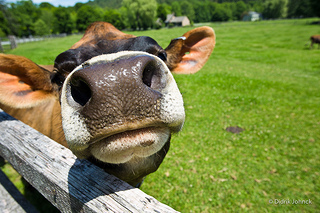
I think about this aperçu while riding the chairlift to the top of Burke Mountain, where several of the more extreme single-track trails launch. And watching the waves of green undulating beneath me, 50 shades of green, I find myself agreeing with Lilias. The woods transcend the ornamental; raw, wild, exciting and implacable, a lusty, voluptuous stealth of Nature. And then the route down, sinuous as a snake, the perfume of churned earth sparking the nose, the cool wind on the face, the hot pant of sun on the neck, and in front, a pair of toned legs pumping. She is right…this is the velocity of desire.
Next I unwind the road through a landscape mercifully caught in the waiting room of civilization. Destination: Jay Peak, a resort just a romp away from the Canadian border, and which has more moose on the grounds than guests. The summer air surges with first date humidity, and the dull clacking sound of soft young antlers in nervous ritual combat.
You can always judge a mountain resort by its film festival….and there is nothing of the sort here, which is bewitchingly impressive. You experience the thrilling charge of life first hand, not aspirationally, not up on a screen.
A portion of The Long Trail, the oldest long-distance footpath in the United States, stitching 272 miles from the buttocks of Vermont to the head, passes along Jay Peak. An Aerial Tramway hangs from a braided haul cable, hoisting us to heaven, the crest, and from here it’s a spectacular rattle along the spine of the Green Mountains. From the summit, four states, and the province of Quebec, unfurl. There’s a certain sensation on the skin when hiking beneath the Vermont summer blaze, the alpine air mentholating the senses. The beat of the placed and lifted foot soaks up the atmosphere of the mountain, which is already coiling itself around my being.
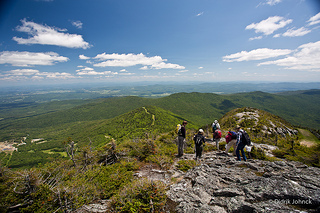
After the hike, drenched in sweat, the best après is an elemental natural wonder, a life force. We drink her in every day. She nourishes and refreshes. We bathe, swim and dive in her. She falls, flows, freezes. We slip, slide and skate over her. We love, honor, cherish her. She’s sensual; she’s fickle. She is water.
And Jay Peak has water in buckets….The Jay Peak Pump House indoor waterpark, at 50,000-square feet, is a city drowned in laughter, a place where the movement of water does more than entertain. It actually moves you. The echoes of voices, made slightly sharper and more diffuse by the effects of the water, bring me back to an unusual afternoon-delight peacefulness that overcame me on my first trip to Vermont, and which is so opposite of my pursuits with purpose. So, just chute me.
The hydraulic cynosure features a tangle of translucent fiberglass slides, the most ardent being the AquaLoop, a twisted version of a roller coaster loop in which you free fall 70′ down a red quim-like tube, and are then propelled, at 40 mph, upwards into a near-vertical loop at a force of 2.5 Gs. Finally you are discharged into a long, lazy turquoise river which gracefully curves around the perimeter of the park. It’s like floating in the Aegean, bobbing up and down with the waves, an agreeable sensation.
There, in a raft gamboling in front of me, is the raven-haired woman from Burlington, hair dripping, long arms and legs gently sculling. And in the back of her raft…a young boy with a solar flare of blonde hair, convulsed in laughter. As we spill around the far end of the river, her raft spins, and she sees me watching her… and sends back a sly smile, before disappearing around the bend.
The river then contours around a sight not reasonably expected in a landlocked state…a roiling continuous surf, simulating a North Shore experience, complete with skimpy bathing suits and Praxitelean athleticism. Water is passion expressed, and the coy fountains gush here in lodes of plenty.
From Jay Peak I wind the serpentine way over to the WilloughVale Inn on the edge of Lake Willoughby, a deep glacially-carved lake walled between the fente vulvaire cliffs of Mt. Hor on the west, Mt. Pisgah on the east. Between these walls, cyptobiologists say, lives “the Willy Monster,” a sexy beast related, it is told, to the supple long-necked Nessie of Lock Ness.
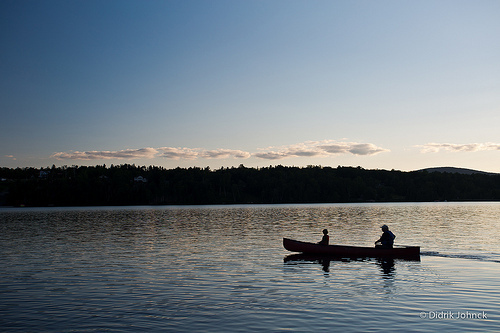
Besides the recherché view, the Inn offers up at least two titillating activities….jumping on a giant, floating trampoline; and gently urging a canoe along the lake. Is there a performance with more erotic torque than a clean paddle stroke? I used to compete in canoe races, and once, after a capsize during a slalom on the Potomac, I crossed the finish line naked, and ended up in a photo in the Washington Post, my paddle blade strategically positioned. Paddling is practically a religion in Vermont, and a place to perfect the smooth, steady rhythm of the efficient stroke, a movement that accentuates a prowess that must almost certainly translate to more terrestrial delights.
As I paddle down the lake I pass another canoe, only a few yards away, and within its gunwales is the dark-haired woman, who sends a swift and percipient glance my way, a look with enough sublimation to power a motorboat. Her paddle then catches the light as she turns the vessel towards shore, leaving me in her wake.
As the skin of the day sheds into the lake, I order a WhistlePig on the lawn of the hotel, a spirit bottled on a farm in rural Vermont that is, according to many critics, the best rye whiskey in the world. I sip unhurriedly, savoring its good, earthy, bread-like flavor, with the caramel-rich mouth feel of well-aged whiskies. And I chat with Roy Clark, the Innkeeper, who tells me he came to Vermont in 1970, and never left. That’s the seductive spell, he says, the state can cast. After the sun is gone, the only movement is the lazy turning of my own hedonistic thoughts.
“All happiness depends upon a leisurely breakfast,” said John Gunther, and so late the morning next I trundle to the southwestern end of the lake, where, in a bright cove there is a buoyant nude beach. The naked truth is that public nudity is legal in Vermont, which may or may not be sexy, depending upon the participants and the beholders. But Vermonters are active and fit, and at least the partakers qualify here.
I whisper down the road to Woodstock, passing tall, imposing silos, and copses of ithyphallic trees through a corridor of savage beauty. Flocks of ducks blow like rocket chaff across the blue sky. I check into the fabled Woodstock Inn, Laurence Rockefeller’s haunt, with a lobby fireplace the size of Scotland. In the rooms are wood-beam bed frames, exquisite linens, organic bath products, and quaint landlines. It’s a place you could check in and never leave.
From the Inn it’s a short steer, through a covered bridge (a Freudian construct if ever one), to Quechee, and a broad green field where I meet Gary Lovell, owner of Balloons Over New England. With tremulous anticipation I watch as Gary and his crew inflate the balloon, using flames to grow the long, flaccid silk dangle to something of size and splendor, and when swollen to full, we jump into the airship, and off we sail, over the unretouched treetops, the light twinkling through the branches. This is the ineluctable sensation of being unhinged. We float along the impatient Ottauquechee River, towards the border with New Hampshire, our bodies eggs in a flying basket. With the burner at our center, the breeze is a cool, feminine hand over a throbbing forehead, the earth below curving to the horizon in tier upon tier of green, the trees looking elusive and crushable, like rare exotic blooms.
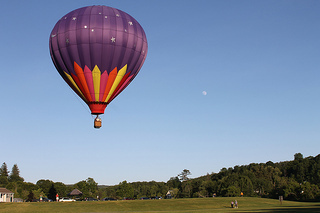
At one point I look down and there is the dark-haired woman, hair billowing around her head like crimped silk, and next to her, the blonde boy. The hairs on the back of my neck quill up. She waves up to us, and then vanishes into the trees.
After a delicious hour inhaling the treacly light of late afternoon, we watch the land grow closer, and drop into a private fenced pen, where two horses, nervous with the approach, prance about the perimeters as though gone feral. One is a China white mare, like a hornless unicorn, muscled and fine-looking as the beasts in fantasy renderings.
As the evening tips towards darkness I stop in at nearby Simon Pearce, a tony restaurant which perches over a frothing waterfall, a roaring, misting diadem of plunging water, another of Sigmund’s expressive images. But it is the downstairs pre-meal tour that unfreezes my flesh. Simon has set up a glass-blowing factory, and there amidst the forges, the fires and tools, a passel of sweaty men and women are blowing bowls and vases, wine glasses and decanters, pitchers and carafes, candle holders and hurricanes, and all manner of immaculate confections in exhibitions of voluptuous shapes and sizes.
Dawn climbs inchmeal, the sky suffused with light so extravagant it seems stolen. I take a ramble down a path through the nearby Quechee Gorge, a burled, narrow cleft of granite through which shoots a white current. The steps are slightly bowed from generations of traffic, the edges rounded down like a pouting lip.
A good hike allows the lambent atmospherics of intimacy with Nature, and I step deeper into the Gorge’s embrace for a long meander by the bracing river under a sky of unnatural depth. There, again, just a short ways down the trail, is the dark-haired woman, camera to eye photographing the blonde boy skylarking with a stick. She drops the camera from her face and tosses a playful grin, the size of a hammock, my way. It’s near the end of a hot day, but the temperature seems to rise.
Like blotting paper, the dawn swallows up the ink of night, and is soon drowned by it. I can’t help but think as I drive the final miles to Smuggs, a busy oasis in the woods, that Vermont is somewhere in between the free-spirited wilderness of centuries ago, and the sleek, hedonism of modern civilization. What if Vermont actually signals the third point of a classic Hegelian dialectical triangle? Deep primeval forests at one point; glistening, neoteric cities at the second; and the third being some subtly unstated “third way” that draws on the tension and contradictory nature of the first two states of being to create a superior third. There is a tantric quality to this thought, and I hold onto it as I turn into Smuggs, short for The Smuggler’s Notch Resort, a seemingly treacherous place that bills itself as “America’s Family Resort,” a tag that seems about as sexy as a bee sting.
But there are so many activities here, it’s impossible not to experience something tactile and pleasurable. There is a zipline park at Arbortrek, offering the prelapsarian zing of whooshing through ancient hemlocks, sugar maples and paper birch at speeds and angles from serene to extreme. Step up; snap on; and fly like lightning.
Another activity is Disc Golf, a guilt-free version of the classic linksman game, in that there are no water-sucking fairways, but rather just chain baskets on forest trails into which players try to lance Frisbees. Golf has long been coupled with Freudian imaginings, swinging balls into holes, and this variation expands, as it requires spinning a smooth surfaced- discus into a manacled pocket. It’s like Diskobolus of Myron come to life, the fusing of rhythm, harmony, balance, though not quite nude. The famous statue, in a pose each golfer assumes, expresses the moment of stasis just before release, the potential energy just before the outflung, like so many facets of this state. And then, of course, there is the decuman billow of bliss with a hole-in-one.
Next I throw off the usual cautions to indulge in the recklessness of extreme off-roading, but in a new way…on a Segway. Dean Kamen, backed by Jeff Bezos and John Doer of Kleiner Perkins, invented the personal electric balancing scooter, with hopes it would change the way the world moves. The cold fusion pogo stick never took off as envisioned, though when George W. Bush fell off one in 2003, and then Jimi Heselden, who bought the company, died after riding one over a cliff at his estate in Britain in 2010, it earned some notoriety as a bad boy of vehicles. Danger deals, after all, something of the aphrodisiacal. So, with some interior butterflies, and no small measure of exhilaration, I board the fat-tire version, lean forward, and murmur into a dark, sumptuous forest of the senses, heightened with every bump and jounce. After a few turns, I’m overcome by a sort of madness, the impetuosity that comes from being in the belly of Vermont, where the usual demands of behavior are relaxed, combined with the special magic of a place that encourages risks and emotions normally tamped down.
I lean forward, put the vehicle into top speed, and head unstoppingly into the unknown, abandoning sanity to the wind.
I survive, and strut back with the splendid frisson that follows a brush with peril.
In the public area in front of Reception a pirate is playing guitar, with a basilisk look in his eye….what could be sexier than Johnny Depp as Captain Jack Sparrow channeling Keith Richards? It’s “Rockin’ Ron, The Friendly Pirate,” who wears his eyepatch on his forehead so as not to scare the kids. “How much does a pirate pay for corn?” he asks. “A buck-an-ear.”
This is a family resort, America’s family resort, nestled at the brink of a pass that once hosted smugglers trafficking booze from Canada, a sexy occupation by some reckonings. Thunder Road, the Robert Mitchum vehicle about running moonshine was the sexiest film of 1958, and it’s not hard to imagine the Smuggler’s fast and furious life here. But this is a place that cleaves to purity, full of giggles and small running feet, of the animality of innocence. “We’re in the exhaustion business,” says Bill Stritzler, owner of Smuggs with a smile identical to that of the Dalai Lama. Certainly the grounds are bursting with bouncing kids, of all ages, surrounded by the exquisite symphony of green that is Vermont, suggesting somehow that the moment will continue forever, and there never will be a tomorrow. It’s hard, here, to occupy with the concerns of the world, for concerns are always about what will happen in the future, and in Smuggs, the future will never come, and the past will never disappear. It’s like being in a different world, where everything fits together, where the play of life is splashing, zipping, tossing, swinging, sliding, in the most uninhibited ways, in a way innocent and wholesome, a way that brings unfiltered pleasure, and that perhaps is the sexiest sensation of all.
Then from the crackling crowd steps the dark-haired Circe, who makes a breezy stroll to my side, takes my hand in hers, and flashes a familiar smile, luminous as a seashell. With the other hand she traces her fingers along my psychic fissures, and then points to the blonde child, a supernal glow on his face, playing excitedly with the pirate. “Thank you so much for this trip,” she whispers in my ear. “I’ve never seen our son so overjoyed.”
——————–
The post Vermont: 50 Shades of Green appeared first on We Said Go Travel.
August 30, 2013
My Journey in Nigeria -Ikare Akoko- Ondo State
 I actually did my one year voluntary National Youth Service Corps (NYSC) programme after graduation in Ondo state, south west Nigeria. The state is five times bigger than Lagos state-Nigeria , the commercial hub of the entire West Africa and most populous city in Africa. However it is sparsely populated having less than one tenth the population of Lagos state.
For want of space l may not describe all the places visited , but l would want to briefly highlight Ikare-Akoko, one of the mountainous areas of the state , which is also an ideal location for both local and international tourism. Ikare –Akoko is one of the uplands of the state. The mountains are sedimentary and metamorphic rocks formed mostly from earth movements and fossilization of the rich natural vegetation of the state –which lies along the rainforest belt.
One of my favorite photograph on the uplands of Ikare Akoko –Ondo state in Nigeria. It was shot during my National Youth service orientation programme just opposite the campsite.
The uplands are beautifully shaped to bring out its natural landscape, and serene topography of the area. No wander the government deemed it fit to create a magnificent youth camp for the training and orientation of Nigerian youths both from home and overseas. The NYSC programme organized in Nigeria is similar to the Peace Corps programme in the United States of America and one year military service in Israel-for all youths.
The people: Very peaceful, easy going and mostly agrarian- farming being the predominant occupation of the people. Root crops, tubers, melons, felling of timbers are some of the ‘million dollar businesses’ in the area. Also education is a big industry. I must say here that every family in Ondo state has a graduate –at least- from an institution of higher learning (University, Colleges etc which are also in abundance in the state). The state is said to have some of the highest number of professors in Nigeria. At least l am a witness to their educated mean and hospitality.
The food: “Yam putting” called ‘inyon’ in the local dialect and ‘melon seed soup’ also called ‘egusi soup’ locally, garnished with bush meat is among the best delicacy in the locality. I must confess that I helped myself with a lot of it until l nearly ran into stomach troubles – it is absolutely delicious. Fresh vegetables are in abundance and l fortified myself too with a lot of it too.
Transport: This is mostly by cab. Buses are few as virtually every household owns a car. I was surprised to found out that the area has some of the most developed cab system in the country- and one of the cheapest too.
Land of Great Men: The state has produced a good number of statesmen like late Pa Adekunle Ajashin of which the state university is named after. The University is located on the outskirts of Ikare. Another good mention is the late eminent lawyer and human rights activist-Chief Ganni Fawenhemi SAN(Seniour Advocate of Nigeria). One of the best disease Diagnostic Laboratories in the entire Africa was recently built and commissioned in the state and named after him(Chief Ganni), by the current state governor chief Olusegun Mimiko.
About the Author: My name is Bede Adazie. I was born some 35 years ago. I am currently a Volunteer teacher -with the Lagos Eko Projects Volunteers Teacher’s Scheme-and also doing some homeschooling for students in Mathematics/Sciences. Find Bede Adazie on Twitter and Facebook.
The post My Journey in Nigeria -Ikare Akoko- Ondo State appeared first on We Said Go Travel.
Going Deep In Queens 1 – Flushing
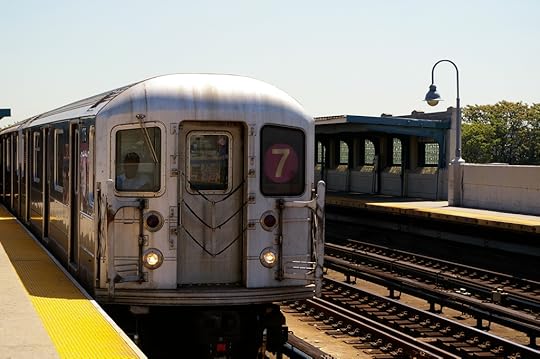
Photo by Bryan Pocius
Question – how do you shoehorn the best Queens has to offer into a single quixotic, mega-hang?
Answer – you just do. (I’ll trust that when you read the rest of this article you’ll know the answer to the other obvious question – “why would I want to”.)
I write a blog dedicated to smart, less-than-obvious travel destinations, travel “best practices”, and weekend getaways, but some of the best travel adventures I’ve discovered are right here in NYC. Given the opportunity to write an article for We Said Go Travel, I couldn’t escape one compelling notion: Let’s Take Them Deep In Queens.
If you’re not from New York, there’s one thing you likely immediately associate with Queens: the Mets. But locals know Queens as something else – the area with most cultural diversity of any in the world (no – really), some of the best Asian food on this side of the Pacific – nay – anywhere, and a head-turning variety of neighborhoods. But how do you even begin to wrap your mind around this sprawling borough, much less try to experience it in a single day?
You have to be slightly crazy, and you need the 7 train.
And, if you’re lucky enough to have the advice of two intrepid New Yorkers, game to “experience everything for you,” then write about it for you, you take it.
We begin in Flushing.
But let’s back up. We’re going to take you to three Queens nabes, amongst which we’ll run you by Citi Field for a Mets Game midday. Since a long subway ride home is a drag – and because dim sum is abundant in Flushing and best at brunch – we’ll start on the far end of Queens and work our way back Manhattan-ward. There are two easy ways to get there:
Cheapest – grab the 7 train over from Manhattan. It’s a little slow – around 45 minutes – to get to Flushing, but you can ride it all-day for a single day-long metro card. (If you’re visiting from out-of-town and can do the queens hang on a weekday, the “diamond 7″ – so-called because of the illuminated diamond enclosing the number insignia – runs express.)
Best – take the LIRR from Penn Station to Flushing Main Street. The ride is around 20 minutes, but will set you back $7.00 for an off-peak fare. Considering what we’re about to put you through, it may be worth-the-investment.
Jade Asian Restaurant
136-28 39th Ave
Flushing, NY 11354
New York’s most famous Chinatown is located in southern Manhattan, but Flushing, its Queens cousin, is far more vast, beginning just across the river from Citi Field and continuing for miles to the East. It’s also more diverse – home to sizable Taiwanese and Korean populations in addition to its Chinese and Hong Kong residents. Chih-Yu and I have been going for years, and we’re barely scratching the surface.
Luckily, you don’t need to know any of that. Just remember two words: dim sum.

Jade Asian restaurant is quick a five-minute walk from either the 7 train or LIRR station (both nearby the intersection of Main Street and Roosevelt Ave). If you haven’t tried it before, Dim Sum is a traditional brunch in Hong Kong, and beloved in most of Asia. A visit to Jade is adventurous-but-accessible for a first-timer. The cultural idiosyncrasies are as much a part of the experience as the food. Jade’s dining room is cavernous and richly ornamented, full of big round tables, with a stage up front where, one imagines, the bride and groom sit when they rent out the place for weddings. A gaggle of waiters in matching aprons and chef’s hats crisscross the floor with food carts overfilled with plates and bamboo steamers, and endless varieties of food – mostly dumplings – offering it up to the seated diners. You could theoretically order from the menu, but nobody does. It’s all about waiting until somebody crosses your path with the item you want, then flagging him/her down and laying claim to it before somebody else does.
Jade is said to specialize in steamed items, while Asian Jewel, down the street, tends toward the fried varietals. In reality you can find both at both spots. At Jade we helped ourselves to a positively fool-hearty abundance of dishes, including, but not limited to, shrimp crepes (pictured above), beef tripe stew, beef ribs, egg-tofu-seafood dumplings, something I like to call “bean curd burritos”, and about five other steamers of ornate steamed confections.
Ten Ren Tea and Ginseng
13518 Roosevelt Ave
Flushing, NY 11354

We were lucky that our next stop, Taiwan’s famous Ten Ren tea franchise, was two long avenues away, because after the embarrassing quantity of dim sum we put away, we needed a walk. I rarely miss an opportunity to visit Ten Ren. (I’ll often drink only conservative amounts of water or tea during a meal just to save room for Ten Ren afterward.)
Bubble-tea joints of varying quality are all-the-rage in Asian neighborhoods these days, and Ten Ren is not the most popular with the high-schoolers. That’s okay. They’re geared toward “discerning” consumers, with an wall of canisters of rare loose tea, some of it running upwards of $100-a-pound. You can still get bubble tea, though. They use bagged versions of their extremely high-quality tea (Taiwan’s tea is reputed to be the highest quality in the world) to prepare the iced drinks. Bubble Tea, in traditional parlance, refers to iced tea with marble-sized tapioca “bubbles”, condensed milk, and corn syrup. You drink it through a large-diameter straw, and if you suspect this looks and feels ridiculous, you’re right.
I keep it simple.
“Iced tea, no tapioca, no sugar,” I tell the server.
“No sugar?” he repeats, incredulously.
“You don’t need it,” I say, more pedantically than I intended.
“Okay,” he assures me, rolling his eyes. I try not to take it personally that a Taiwanese tea-store clerk doesn’t consider me the font of bubble-tea-wisdom.
Bellies full, tea-jonze satisfied, it’s back to the 7 train, and onto Citi Field. Our day is only beginning.
In part 2, will Citi Field’s modernity and convenience make Mets fans soft? Plus, we go down the rabbit hole at Sik Gaek in Woodside, then “get lost” in Long Island City after drinking our fill at Domaine Wine Bar.
The post Going Deep In Queens 1 – Flushing appeared first on We Said Go Travel.
Don’t Stop Living Interview with Jonny Blair
Thank you to Jonny Blair for interviewing us on Don’t Stop Living!

WORLD TRAVELLERS: LISA AND GEORGE FROM WE SAID GO TRAVEL
It’s time to meet Lisa and George who have recently launched their travel memoir, Traveling In Sin!! Lisa and George also run the highly successful travel site “We Said Go Travel”. It’s a pleasure to feature them on here as World Travellers!
Who are you? We are global nomads. We left California one year ago and have spent the last year meandering in Asia.
Where are you from? George was born in Los Angeles, California and Lisa grew up in Los Angeles but was born in Boston, MA, USA. We nearly went to the same high school but did not meet until much later online!
Where have you been? To six continents. We are ready for the final frontier, Antarctica! Maybe we will go for our next wedding anniversary.
Where are you now? We have spent the last two months on Lamai Beach, Koh Samui, Thailand. We just finished editing our memoir, Traveling in Sin, it is available on Amazon!
Traveling In Sin: A True Tale of Transformation Through Love and Travel from Lisa Niver Rajna
The post Don’t Stop Living Interview with Jonny Blair appeared first on We Said Go Travel.
August 29, 2013
Aquincum – The Roman Ruins of Budapest
 The capital of Hungary, Budapest, conjures images of a cruise on the Danube, wine tasting, spicy foods, Sziget Festival and thermal baths, sprinkled with historical places such as the Fishermen’s Bastion. But few travelers know that, not very far from the very well-known sites of Budapest, there is an interesting Roman gem, waiting to be discovered.
Yes, you’ve read correctly. Budapest is home to the ruins of ancient Aquincum , an important town in the Roman province of Pannonia. Before the Huns took over the region, the Romans have settled here between the 1st and the 5th century.
Personally I didn’t even know about this site until my trip to Budapest in July 2011. My husband, knowing my fascination for archeological sites, suggested we should plan a visit. And we did. In the middle of summer, in scorching heat, we had the site to ourselves.
For me, visiting Aquincum set the theme for our next travels. Within two years, we have visited Rome with its Roman Forum and Coliseum, Greece with its Roman Agora , Greek Agora and Acropolis, Romania with its Ulpia Traiana Sarmizegetusa… but it’s always the Aquincum which holds a special place in my heart.
A little bit of History
Emperor Vespasian established a military camp in Pannonia by the mid 1st century BCE which helped the city grow. The easy of crossing the Danube at that point and also the fertile planes helped the area to grow as well.
In 106, Emperor Trajan made Aquincum the capital of Lower Pannonia (Pannonia Inferior) and it only mean the area was about the develop further. In early 2nd century a Roman legion was stationed here and the city was classed as a municipium by Hadrian in 124. In 194, Septimus Severus classed it as colonia. Later, Emperor Diocletian made Aquincum the capital of Pannonia Valeria.
But the great migrations started to pose a threat and the citizens gradually withdrew from Aquincum. When the Huns arrives in the 5th century , they found it deserted.
The historical site
 In the 19th century, the site was gradually excavated – work is still going on in present days. The remains are extensive and there is also a museum on site. The archeological park is not open between November 1 and April 14.
The site comprises the remains of an amphitheater, mosaic floors, tombstones and statues.
The best thing about Aquincum is that you can walk pretty much anywhere – of course, there are areas which are perilous and therefore close to the public – and there is enough throughout the site so that you know what you are looking at.
Best time to visit
I have made the mistake to visit the site right smack during a very hot summer day. Please don’t do the same. Plan for a morning stroll. Wear good walking shoes and don’t forget the bottled water. Since the archeological park is only open between mid-April and late October, chances are the weather will be hotter rather than colder.
How to get to
Aquincum is located in the oldest part of Buda (Obuda). Take the HEV from Batthyany ter (a stop on M2 line) all the way to Aquincum stop.
All photos by Krisztina P. and may not be used without permission.
The post Aquincum – The Roman Ruins of Budapest appeared first on We Said Go Travel.
Myanmar: Biking Inle Lake and Village Leg Rowers After School(video)
WATCH: 35 Biking Inle Lake and Village Leg Rowers After School, Myanmar (Burma)
Myanmar: Biking Inle Lake and Village Leg Rowers After School(video)
We Said Go Travel http://www.wesaidgotravel.com/ October 19, 2012 After the biking in Bagan, I was not sure about biking around Inle Lake. I thought, “Can I do it?” It was supposedly thirty minutes to the Lake but of course it was not. We passed a winery that we would visit later. Near a school, I almost fell down so I was so dizzy and felt sick. We never saw Inle Princess Resort Hotel but we did stop at Inle Resort Hotel. It is a large resort and we sat and enjoyed the lake. I especially enjoyed the black swans.
On the way to the village Mine Thauk we saw a few schools, an orphanage, and a monastery, we passed Red Mountain Vineyard but did not go this day. See our other biking video for views of the vineyard.
We had a noodle lunch at Wang Thouk Restaurant. The best part of the day was when we went to the jetty: we saw all the school kids picked up by LEG rowers!
We also saw festival boats for 45 and 104 people.
The ride back was not too bad. It was much cooler. George said: “You did not give up.” That was my nice thing he told me. I felt so sick at one point but I did keep going and it was a great day.
This movie is from our 28 days in Myanmar (Burma) from September 28, 2012 to October 26, 2012 and our year TRIP in South East Asia, see all the videos from our trip.
Our memoir, Traveling in Sin, is available at Amazon; it is a HOT NEW RELEASE!
Traveling in Sin is a HOT NEW Release on Amazon! from Lisa Niver Rajna
Traveling in Sin is a true tale of TRANSFORMATION thought LOVE and TRAVEL! After meeting online (on two different sites), George and Lisa travel internationally, give up their jobs, condo, ice cream and toilet paper in search of adventure and love. Along the way, Lisa sheds over 60 pounds and the couple gets engaged underwater in Thailand. There are tears, twists and true love!Recent Press:
By Amy Sommer on Westside Today By Dani Stone on Diets in Review
The post Myanmar: Biking Inle Lake and Village Leg Rowers After School(video) appeared first on We Said Go Travel.
August 28, 2013
Northern Seoul – “Rice wine, Monks, and Sheep”
Thank you to Chris Backe for sharing one of his Seoul Itineraries with us from his book, Weird and Wonderful Korea


“Welcome to Korea! An introduction: South Korea – home of soju, kimchi, and love motels. Presented here are the weird and wonderful parts of Korea – the places that tourists rarely reach and even locals don’t know much about. Read this for the real stories and histories behind some of Korea’s most unusual and fascinating destinations.”
Itinerary #1: Northern Seoul – “Rice wine, Monks, and Sheep”
Baedari Brewery – the museum of rice wine Stars: ***
Baedari Brewery has been brewing makgeolli (rice wine), jukyoju (a clearer and more potent rice wine) and soju (Korean fire-water) since 1915. In 1974, Goyang makgeolli was sent to Pyeongyang for the first inter-Korean summit. This museum, dedicated to the brewery’s history, was founded in 2004, and today the fifth generation continues the legacy. Although Baedari continues to produce alcohol, you won’t see it at every corner store. While this particular museum / brewery doesn’t offer taste tests or samples, plenty of offerings exist in the restaurant. Start by entering the main building and appreciating the first few simple exhibits – the majority of the collection is upstairs on the second floor.
A dim light seems appropriate for the dated items that once assisted in the manufacturing of fermented rice wine (known as
막걸리, or makgeolli) and soju. The technology these days is much better of course, but looking at over 90 years of history has its merits as well. They have the wear and tear expected of items used in an industrial setting on a daily basis. Some are simply displays, while other exhibits are models describing the different processes of making rice wine – unfortunately, nothing is in English for the foreign visitor or tourist. Try reading the descriptions if your Korean is good or a Korean friend is with you.
Once you’re finished with the museum, there’s Korean food
(including 김치전, kim-chi jeon, kimchi pancakes, 12,000 won) and locally-brewed makgeolli (3,000-6,000 won per
glass) downstairs. While the typical makgeolli is fine, give the 천년초 막거리 (cheon- nyeon-cho mak-keo-li, or cactus makgeolli) a try. It’s a little pinker and sweeter. There is some irony that you’ll only get by reading the bottle’s labels – Baedari’s cheap but ‘traditional’ makgeolli contains wheat from the US, as well as aspartame. The premium- labeled glass bottles, meanwhile, use organic rice.
Name: Baedari Brewery (배다리 박물관) Address: Gyeonggi-do, Goyang-si, Deokyang-gu, Seongsa-dong, 470-1
Korean address: 경기도 고양시 덕양구 성사 1 동 470-1 Directions: Use the Seoul subway system to get to Wondang station, line 3, exit 6. Cross the street and walk about 500 meters. Look to the right – the building is fairly easy to spot. Hours: 10am-6pm (weekdays) 10am-7pm (weekends) Admission: free (food and drinks are comparably priced to local restaurants) Phone: 031-967-8052 Website: http://www.baedari.co.kr
More from Chris on his site: weirdandwonderfulkorea.net
The post Northern Seoul – “Rice wine, Monks, and Sheep” appeared first on We Said Go Travel.
Greece: Walk On The Wild Side
 Greece: Walk On The Wild Side
As you’re going up the Asterousia mountains, it occurs to you. What if the car stalls and quits, then what? You check your watch for the umpteenth time. The road sign said thirty k., you’ve been driving for over forty minutes and no sea in sight. Just as you’re about to make a U-turn, you come across Miamou. The tiniest village dash oasis in the desertscape of the imposing mountain range. You wonder whether to take a break in the one and only coffee shop of the village or go on, in case you reach your destination at some future point. Either way, you win. The locals let you know it’s a short fifteen minute to where you’re heading and thus recharged, you forge on.
You go down and down and, suddenly, you see it. The Libyan Sea appears before you, timid and savage all at once. Though you’re only stealing glances at it through the mountain peaks, your intuition isn’t mistaken. You’re nearing a magical place.
Lendas means lion and looking up at the haughty rock formation shielding you from indiscrete looks, you understand where the name comes from.
 You get off the car at the village, stretch, drink all the water you went without during the ride and you start acquainting yourself with the place.. Some rooms to let, small taverns and bars which, though true to the image of a typical Greek island, in fact remind you of none of the places you have so far visited. Something different is happening here, you can tell through your skin. It probably is the natural energy of the place, it’s surely no accident this village has existed here for the past two thousand and four hundred years! Here was the Aesclepium where the souls of the ancient Greeks found peace. Here, you will too.
The crystal clear sea of Lendas makes no promises, all comparisons are beside the point. It invites you to come and see for yourself.
The finishing line is now very close. You get in the car (or, if you feel rested, you can walk the distance) to get to Dytiko or Disko as the locals call it, which is a kilometer and a half away. Tents, huts, hammocks and hippies of all ages welcome you warmly as if you were a life-long neighbour. Some in broken Greek, others in Cretan. With one look, you know you’re safe here. No one is going to steal from you, judge you, bother you. Naked sun-tanned men, wildly beautiful women and happy children playing with their dogs, in and out of the water.
You have reached as close as is possible to Paradise. You get rid of your clothes and dive in. The feeling that comes over you is not something the greatest writer or photographer or painter could give you. It’s called living and you only get it by doing it.
 Late in the afternoon, with raki and its attendant morsels, you realize why the rock across the way is called ‘the Indian’. You clearly make out the nose, the eyes, the mouth and the braided hair..
The Lion on one side and an Indian on the other. Small wonder why the hippies, those nature and life lovers, chose this place as their home. Nothing here is yours or mine. It’s all ours, it belongs to us, the curious travellers who seek out real peace and wild beauty and have come across both in Lendas.
About the Author: Dafni Mathioudaki is an aspiring writer from Greece. She studied in the Hellenic Cinema and Television School Stavrakos and over the years she took many creative writing courses. She also worked as a copywriter, find her on Facebook and Twitter.
The post Greece: Walk On The Wild Side appeared first on We Said Go Travel.
We Said Go Travel

- Lisa Niver's profile
- 57 followers

