
Lisa Niver's Blog: We Said Go Travel, page 486
July 19, 2013
Myanmar: Exploring Bagan Day Two (video)
WATCH: 25 Exploring Bagan, Myanmar (Burma) Day Two
ABOUT BAGAN:
I read that at one time there were 13,000 temples, pagodas and religious structures in Bagan. There are now about 2000 temples from the 11th to 13th century.
On October 11, 2012, I took an afternoon walk to see more temples. I found Gu-byauk-nge and Gu-byauk-gyi. A woman opened a temple for me but I am not sure of the name. I did enjoy video-taping by flashlight! From Anawratha Road, I went to temples by walking through the fields possibly Soo lay gon group or Wut ta na taw group. A restoration worker was fixing the three large buddhas in the central area. He pointed up so I went up to look out. You get such a different view from up above. The passageways are dark, steep and have many broken steps but it is worth it. I enjoyed it but then he came up and pointed up one level higher up! It seemed too high but I went. He pointed out Hilo Milo and a few other stupas. When it started to rain, it seemed smart to get down!
I found a very reconstructed stupa with a large Buddha inside and twin stupas that I liked very much with very different looking tops. I crossed the field and found ox in front of a stupa and a team of oxen plowing a field.
Thanks for watching our movies as of June 2013 we are over 92,000 views! And now in July 2013 we are over 104,000 views!
This movie is from our 28 days in Myanmar (Burma) from September 28, 2012 to October 26, 2012 and our year TRIP in South East Asia, see all the videos from our trip
Our memoir, Traveling in Sin, is now available at Amazon.com.
Traveling In Sin: A True Tale of Transformation Through Love and Travel from Lisa Niver Rajna
The post Myanmar: Exploring Bagan Day Two (video) appeared first on We Said Go Travel.


Poland: The Magic of Discovering Legacy
 The Magic of Discovering Legacy
By Esther K. Meyers
My trip grew from a seed planted in the earliest of my days. It gradually took shape inside me and finally demanded to bloom into reality. My parents’ stories about this place populated my youthful dreams. Six decades before I was to walk it, I imagined the magic of this land with its clean air, blue skies and fluffy white clouds.
My coming back to Poland would complete a circle. My parents’ flight from this land almost 70 years ago featured midnight border crossings and false papers. My return trip was a transatlantic flight and a bus ride.
My mother had been a young career woman here, enjoying a highly cultured town and her many suitors. I wondered if they brought her flowers like the bright pink ones near my hotel. My father was a brilliant rabbinic student. Had he walked this very street to get to his Yeshiva, his academy? From their stories, I knew what their houses looked like and the names of their schools.
The Holocaust would change everything, but I was spared those details until much later.
 Mommy told me of her childhood. Her father would bring milk from the family’s freshly milked cow to her bedside in the morning and sing the morning prayers with her. Daddy would remind himself of his family that was no more, “Ikh hob aikhet a mameh gehat!”, that he had a mother once too. I would beg, “Daddy, where is your Mommy? What does she look like? Where does she live? Take me to her, please, Daddy”. I hungered for the details that would make my dreams of this place more vivid.
So, I had finally made it here! It was Friday evening in the place of my dreams and I was one of eight Jews entering a tiny meeting space to celebrate the Sabbath. There was a rush to get ready. A young woman was placing candlesticks on the table, the only man of the group walked in with a pot of homemade humus. While others were busy in the adjacent tiny kitchen, I put out wine glasses and little plates.
The room was stuffy. I opened a window. The suddenly worried faces near me signaled that windows normally are kept shut for these events, to avoid trouble I guessed. The group was too embarrassed to admit their fear, so that night a window remained open and we had the fresh air I knew from my mother’s stories.
I was told that I was the ‘guest star’ of the evening but didn’t understand what was meant until we started chanting the blessings. To my surprise, I was the only one in the room who knew any Hebrew or Yiddish.
My off-key voice dominated by default as we sang the z’mirot, the Sabbath songs and chanted the prayers. I’ve always wished for a nice voice, but that night I ached for the vocal beauty that could transform this moment to the grandeur it deserved.
 Aha! I should have realized that these Jews, ranging in age from age 12-70, had lived under regimes that would prevent them from knowing the richness of Jewish life while I, raised two continents and an ocean away, was steeped in the culture and languages that existed here before the war.
As we pulled chunks from the braided bread, I announced, “My father would be saying, “Akhe! Gishmak!”, Oh! How tasty! I tried my best to channel every bit of my daddy’s deep-voiced enthusiasm for a good challah. To my delight, the others, in turn, echoed my performance as if memorizing the phrase for future use. Giggles turned into hearty laughter around the table. Their faces had brightened and relaxed.
As we sat together, I wished that I could gather up this flock and wrap them up in my Mother’s stories just as I had experienced them on her lap. But, in our all too brief time together, I knew that I could feed them only a taste of what they craved to know about our shared legacy.
I offered up a wordless prayer of gratitude for my own freedom, so clearly etched against the image of my courageous friends in this repressed congregation.
This night had indeed been a celebration. I had completed the circle that my parents started. I had returned to walk this land, to stake my claim to its legacy and to recognize freedoms I had not fully appreciated before.
As I boarded the bus for the four hour ride to the airport, I realized that my dream really had come true. I found my parents’ magical land with its clean air, blue skies and fluffy white clouds. And what’s more, I found my fellow ‘Lantsman’, my townsfolk who, it turned out, needed me as much as I needed them.
About the Author: Esther K. Meyers, who lives in Los Angeles, California, is a Speech Pathologist. She was born in a DP camp at the close of the war to holocaust survivor parents. She is currently writing a memoir about the exploration of her legacy.
The post Poland: The Magic of Discovering Legacy appeared first on We Said Go Travel.
India: Time stops at Kasauli
 There are so many hill stations in India to contemplate upon that one is spoilt for choice while deciding to visit one of them- more so when one is in the beautiful city of Chandigarh from where the hilly places are not too far away. This time we decided to explore the sweet little town of Kasauli which is inconspicuously situated in the pristine and green Shivaliks. It is a quaint and placid destination which is still as obscure as any remote and dusty village in UP, notwithstanding the 150 years since its discovery by our colonisers.
Being a cantonment settlement of the Indian army, Kasauli is undoubtedly one of the cleanest hill stations in the country. With littering attracting a penalty of Rs 1500 and ban on plastic bags being religiously implemented in the entire city, it is definitely a paradise for nature aficionados.
Kasauli offers an old worldly charm- inviting those seeking solace and peace. Scores of photographers, poets and writers flock to the city in search of some solitude and to be inspired by the serene views of towering mountains and deep green valleys. Kasauli is particularly popular for its out of the world views of sunrise and sunset; it harbours in its biome an eclectic flora and fauna which is a treat for nature lovers and wildlife enthusiasts alike.
Some of the most visited tourist spots in and around Kasauli include Manki(some call it Monkey) Point and Christ Church at lower mall road and sunset point at the upper mall road. The Kasauli Bazaar or the Heritage Bazaar is the quintessential mall road market that holistically completes the hill station. The town possesses a setting akin to the Victorian era as if the Englishmen are still overseeing the operations and taking care of their most beloved summer retreat. It’s a fairy tale town with an innocent ability to make you fall in deep love and reverie.
 To tingle our taste buds, we had impeccably cooked momos, tikkis and samosas from a shack that appeared to be a favourite among the locals- as scores of people were buzzing like bees all around the cramped chamber. Momos were served with three bright coloured chutneys(sauces)-refreshing green, piquant red and sweet white-which made for a presentable contrast on the eco-friendly disposable plate. I loved the novel taste and relished the heavenly delicacy with all possible senses-which touched my soul.
The breeze was now cooler and it was now time to jog towards the beautiful sunset point. It was a sight to behold when the sun shed some of its pride for us to make an eye contact-turning crimson red from fiery orange before vanishing from our view-leaving an ephemeral yet ethereal legacy of incredibly spectacular hues in the western horizon. There was still some light when we spotted the moon directly above us- moments after sunset- as if cheering us up and reminding us that there is always a glimmer of hope and light left behind after every “sunset”. Slowly and gradually, darkness enveloped the sleepy town- making way for twinkling stars- as our eventful yet so relaxing journey came to a pleasant end.
About the Author: Anshumaan Goel is an Engineering student at Delhi Technological University, New Delhi, India who loves to explore new places and travel far and wide. Find him on Facebook.
The post India: Time stops at Kasauli appeared first on We Said Go Travel.
July 18, 2013
Mexico: Gringa Finds Freedom in Guanajuato
 The burning sensation in my thighs and glutes fades as I take in the scene before me. The thin, dry mountain air feels light and exhilarating. The wide open space makes me want to spin around and sing like Julie Andrews. Hiking these hills is one of the special perks of living here. This high from being high (about 2,017 meters/ 6,617 feet above sea level) is one of many ways Guanajuato makes me feel free.
I had come to this town, one of Mexico’s famed “silver cities,” as a tourist years before. I remembered the hills, the architecture and the handicrafts. When an opportunity came up to live here as a house-sitter, I jumped at the chance.
The first thing Guanajuato freed me from was the garbage in my head. Upon arriving, I enrolled in a language emersion program – Spanish classes for three hour per day, five days per week. Many of my classes were one on one. No time for spacing out and letting another student carry the load. I had to give 110% of my attention. For a few hours after I class, my brain would stay “in Spanish” and I found myself remarkably free of degrading self-talk and senseless worrying. I simply didn’t have the vocabulary. (Not knowing the word for “should” is a wonderful thing!) Instead, my thoughts were like my grammar – limited to the present tense. It was fabulous therapy.
As I became more confident in my Spanish, I also began to learn my way around. Many Spanish colonial cities are laid out in neat and tidy grids with “avenidas” running north-south, and “calles” running east-west. Not so Guanajuato. Instead, it is a labyrinth of winding alleys which twist and climb in every direction. The brightly colored houses, and grand colonial architecture of Guanajuato spill down the sides of a canyon. This is an inconvenient and unlikely place to build a city, but the surrounding hills are filled with silver, which the Spanish wanted to exploit. Walking somewhere and back, you often find yourself going uphill both ways. Seven years after my arrival, I still barely have a feel for North, South, East and West. Up and down are the relevant directions here. Along with spectacular vistas, those alleyways offered another reward. After six months, I found I’d lost 30 pounds. Talk about liberating! (This, in spite of taking full advantage of the tamales, empanadas, fresh-squeezed orange juice, enchiladas, micheladas and French bread rolls.)
However, I think the greatest sense of freedom comes from having the luxury of being in a foreign place with time to stand still. Culture is both defining and limiting. It’s hard to break the bonds of one’s own culture because you can’t see them. It’s like air, everywhere and therefore invisible. Living in a different culture means encountering people approaching things in a different way.
 The question, “Why do they do it like that?” is quickly followed by another question. “Why do we do it like this?” Suddenly there is a choice where things were once automatic. I know that my enjoyment of being here does not mean that this culture is superior. I don’t think you can ever say one culture is better than another. There are many things – the religious conservatism, hierarchical thinking, and the way everything is over-sexualized – that baffle and sometimes bother me. But since I am obviously an outsider, no one expects the cultural norms here to apply to me. They know that gringos sometime do weird things – prefer living alone, wear ugly but practical shoes, maybe don’t believe in Catholicism. As an expat, I am free to view both cultures from the outside and embrace the parts I like.
It is evening now and I sit on my balcony watching the light change as day gives way to twilight. The hills cast dramatic shadows on one another and the rainbow-colored houses pass through a million different hues as they fade into darkness. A drum and bugle corps starts up in the distance, shattering the quiet, but not the peace. Freed from mental and physical baggage, and from the restrictions of culture, I now indulge in enjoying that greatest of all treasures- free time.
About the Author: Jennifer Choban is a native Oregonian, currently living in Guanajuato, Mexico where writes, hikes, engages in home-improvement projects and attempts to improve her Spanish. Find more stories of her travels.
The post Mexico: Gringa Finds Freedom in Guanajuato appeared first on We Said Go Travel.
WSGT News: 31 Countries in our Contest & Our Book Launch
We Said Go Travel Newsletter 30: July 16, 2013


We Said: Independence Travel Writing Contest,
an International Success!
188 writers from Thirty-one countries participated
in our Independence Travel Writing Contest:
Writers from 31 countries:
Australia, Austria, Canada, France, Germany, Greece, Hungary, India, Indonesia, Ireland, Israel, Italy, Kenya, Netherlands, New Zealand, Nigeria, Pakistan, Philippines, Portugal, Republic of Moldova, Romania, Singapore, Slovakia, South Africa, Sri Lanka, Sweden, Uganda, UK, Ukraine, USA, Vietnam.(see map above)
Wrote about 73 countries:
Argentina, Australia, Austria, Benin Republic, Bermuda, Bolivia, Brazil, Bulgaria, Burundi, Cambodia, Canada, Chile, China, Cook Islands, Costa Rica, Cuba, Estonia, Ethiopia, Fiji, France, Germany, Iceland, India, Indonesia, Iran, Ireland, Israel, Italy, Japan, Kazakhstan, Kenya, Kyrgyzstan, Laos, Latvia, Lithuania, Malaysia, Malta, Mauritius, Mexico, Mozambique, Myanmar, Nepal, Netherlands, New Zealand, Nigeria, North Korea, Norway, Oman, Pakistan, Panama, Peru, Philippines, Poland, Portugal, Puerto Rico, Republic of Moldova, Romania, Russia, Saudi Arabia, Sinapore, South Africa, Spain, Sri Lanka, Sudan, Switzerland, Tanzania, Thailand, Turkey, Turkmenistan, Uganda, Ukraine, UK, USA, Vietnam (see map below)
Thank you to all who have participated or shared about it! We are especially grateful to our two wonderful judges, Richard Bangs and Amy Friedman.
Read the INCREDIBLE INDEPENDENCE ENTRIES! More are being published each day.
Read More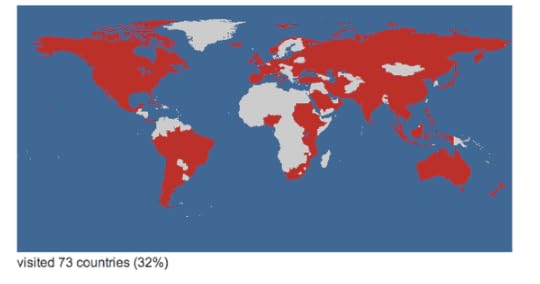
TRAVELING IN SIN is now AVAILABLE at Amazon.com.
We left last July for Indonesia for this one year journey and five years ago in July for our first one year sabbatical! Read our memoir, Traveling in Sin , to learn how we met online, and chose to meander from Indonesia to Mongolia. Along the way, I lost over fifty pounds and we got engaged underwater. This book is NOT a collection of blog posts. We have never published this story before! Enjoy all the colorful characters we met and the tears and triumphs of a Peace Corps Worker and a Princess (cruises employee) finding their way together in Asia.
Read More
Connect with us on Facebook, Google+, LinkedIn, Pinterest , SlideShare, Twitter, and YouTube.
Lisa and George
(Click here to sign up for this newsletter. )

Movies from our Trip
Thank you for watching!
Our YouTube channel is now OVER 102,000 views!
All 45 of our Myanmar movies are now online!
MOVIES from our trip: See our FIRST MOVIE From NEPAL!
Click the country to see all the movies: Bali and Lombok Indonesia,Southern Thailand, Myanmar (Burma) , and Nepal on our YouTube Channel. We will be adding movies from Northern Thailand, and India soon.
Read More
TRAVELING IN SIN
Traveling In Sin: A True Tale of Transformation Through Love and Travel from Lisa Niver Rajna
The post WSGT News: 31 Countries in our Contest & Our Book Launch appeared first on We Said Go Travel.
Rishikesh, India: Body and Soul
 RISHIKESH : WHERE BODY DISAPPEARS AND SOUL APPEARS
Thats it. I decided at last.
Having a last fleeting glance at the items on the bed , I felt fresh and new.
One pair of clothes ,a travel pouch , a towel , a pair of slippers , a novel , a notepad and a shining blue pen. For the next fifteen days , I was about to live with these bare minimum needs . It was not entirely like an animal in a jungle , but it gave me a vicarious feeling of that slice of freedom , which we human beings rarely come to know .
Everything comes with a price tag . How true. This journey did not happen by chance , as nothing ever happens by chance. It took me almost two years , after slogging at a job which pays me enough to survive in a big city , moving from the office back to my small apartment , having breakfast , lunch and dinner all alone for all these two years , when I look back today , how my days were all the same. No single day stands out alone , whispering in my ears , hey I was your day , It was on this day that you felt alive. There is a worst feeling than loneliness. And it is being dead while you are still alive. Have you ever noticed animals in a zoo. I felt like those animals trapped in confined areas with limited access to the outside world . It is neither sadness nor pain , it is a state where there is a complete lack of any sort of emotion. I read motivational books , made freinds , but nothing helped me out to bring back my enthu and zeal towards the life .
Somebody said ………our heart has many wells , some deep , some shallow , but not every rain can fill some wells …….what I needed was a heavy rain so that my soul could be drenched in the shower of some sort of enlightenment……I needed something extraordinary …….out of this world experience.
 With those lines of thoughts , I left for Rishikesh , a small town in the northern state of Uttrakhand , Gateways to the Himalayas , world capital of yoga and a place where Beatles found inspiration. My own reason of going there was none of the above , rather I wanted to see the magnificent beauty of snow capped Himalayas and spiritual power of river Ganges.
On the train from Haridwar to Rishikesh , I was awestruck by the courage of a young sadhu . His eyes gleaming with pride when he spoke those words : ‘ Seven years ago, I left my home and came to Varanasi without a single penny in my pocket . I told my parents that I am not interested in the materialistic world and want to lead a spiritual life .They blessed me and I am right here in front of you. ‘
‘What are you looking for ‘I asked.
‘Salvation’
Well , I was certainly not looking for salvation , but neither was I sure of what I wanted from that place at that point of my life. When you travel , you easily find the companion inside you , which is otherwise burried in some corner , not ready to come out on the surface and loneliness gradually becomes solitude. The healing power of nature is far ahead than all the medical innovations by man.
The next halt of this road was Parmarth Niketan ashram , the largest ashram in Rishikesh , having over 1000 rooms with the modern amenities and allure of yoga and meditation . The price starts with Rs 300 for a single room per person. The whole region is vegetarian by law . Alcohol or smoking is not allowed .
First Day -
Usually a day starts with getting up as early as 4 am in the morning , taking the bath in the hot running tap water and then heading for morning yoga classes , followed by maha arti at triveni ghat and having breakfast in the silence . The vastness of the rooms provided with bare furniture imparts them a peaceful aura. I was more inclined towards mediation , a journey within the self. When west has looked outwards ,India has always looked inside to find the solutions of some of our biggest problems.
 My first step started with a simple breathing exercise , inhaling , exhaling , just to observe the flow of air inside and outside. No mantras , no chants , only breathing patiently.
INHALE , EXHALE , RELAX…………..INHALE , EXHALE , RELAX……..BREATHE…..JUST BREATHE…………………the cycle continues.
Days which followed afterwards -
Slowly and slowly , what I found out on the successive days , was that the world within me was getting larger with each passing day. While just concentrating on my breathing patterns , I entered into a world of immense peace and happiness. And this world is immense , huge and out of my reach . And there was so much to explore .
Gradually I took less time to reach the meditative state , once I closed my eyes , I was in another world . My inner self would wander and cover great distances unknown to me . My eyes would feel the saffron light as if directly coming from the sun , I would find myself flying in the outer space and all around me there were planets , stars , moons and suns moving with great energy. Suddenly my small room was like a floating ship in the sea of void space filled with cosmic energy . I saw the images of animals running towards me , I felt as if there was a rabbit sittting near by me . Elephants , snakes , ducks , birds , horses. I felt their presence around me. As if different sort of creatures were entering into my room through the window , I felt a flying horse with a wing , then a mermaid , then a large flock of small people walking on the floor of my room. It was completely magical . And after this experience only , I was able connect to the magic of Harry Potter series , that all of that can be felt by a human being.
A Sadhu who had been practicing meditation for many years once said to me unaware of the power of those words that ”Each of our thought is a frequency and it carries immense power , if you know how to control your thoughts and you can focus them in a direction , you will acquire a state , which is both powerful and magical . Freedom is in being , in being alive , being close to yourself. We human beings can achieve this state only by two ways , one is love and the other one is the path of spirituality , where your only desire is to know YOU , to be close to YOURSELF ‘
In that serene valley resting in the lap of Himalayas , I dived deep into the depth of my SOUL , feeling light as a butterfly and mighty as those silent mountains standing tall as everything around them changed over all those years.
After coming back form Rishikesh , I made it sure to practice meditation on each day . Nothing really bothers me now . Problems don’t irritate me . I am more calm and relax . The mind has reached a state of peacefulness . I am at peace with my own self . I enjoy each day as it comes , try to gain as much as I can .When I go to bed , I am entirely spent and enter into a deep sleep so that when I wake up on the next day , I am born again into a NEW day of a NEW World.
About the Author: I am Dipti Sharma from India. I love reading , travelling and writing . Connect me on Facebook.
The post Rishikesh, India: Body and Soul appeared first on We Said Go Travel.
July 17, 2013
Spain: Where my Soul Dwells Happiest
 The scent of warm pine filling the air; dusty ground littered with browned needles that I scraped with sandal-clad toes as I rose and fell on the yellow painted metal see-saw; parents sat near-by with a jug of sangria as lizards skittered amongst the chairs.
They say that smell is one of the stronger senses for recalling memories. Every time I stepped off a plane in Spain and the smell of jet fuel mingled with that of warmed pines, the memory rushed back. I have been in love with Spain since the age of three – with the small coves where I roamed the beaches in search of pretty shells or sat in rock-pools commanding mussels and sea-anemone in my private kingdom – and my travels invariably took me back there.
Spain was not particularly free in 1973: Franco still dictated the lives of Spaniards. With his death came a more open Spain, one that northern Europeans flocked to for the sun, food and slow, welcoming pace of life. I returned to her shores at every opportunity, to a country where the young me, free from the worries and constraints of adult-life, had roamed. Then came my chance, and I grabbed it with both hands.
 Forty, and tired of the treadmill of everyday life, I had the opportunity to take a year-long sabbatical. I moved to Spain, my belongings in storage in England, my two dogs and the necessary accoutrements of life loaded into the car. I drove from the centre of England, and the length of France and Spain, to make my home in the Andalucían mountains; to embrace the feeling of liberty that Spain afforded me.
From my mountain-side house where eagles and vultures cast long shadows over the valleys, crevices and dusty tracks, I explored. I explored my inner feelings, dwelling in my house of solitude. I explored the Moorish splendour of Granada, tracing the carved words of a language I do not understand with my fingertips, but whose sentiment felt clear to me. I let my thoughts run free in the cool, quiet patios of Córdoba where water glistened as it bubbled from spouts and filled the channels below. My spirit soured, the duende burned within me, as I watched and listened to Flamenco in the orange-filled piazzas of Seville. In the dark interiors of cathedrals and chapels, as the heavy, cloying incense spiralled towards Mudejar carved ceilings, I lolled in Spain’s warm embrace.
Climbing higher up my mountain, sitting on a soft bed of old pine needles as the dogs snuffled around in search of the wild boar whose scent lingered in the short spikey bushes, I looked across the water to North Africa. A land of adventure and discovery beckoned me to join her. I’ve tasted her culture, infused with the Spanish in Andalucía’s dishes – the warmth of the spices mixed with the olives and goat that can be found on the scrubby foothills. But Spain holds me close, whilst giving me space.
 My one year turned to three before the call of a passion, greater than even Spain inspires, pulled me from her shores. It was not to Africa that I turned but Italy; from the mountains and coastline of Andalucía, to the flatlands of Polesine. I had left England, my home country, without a backward glance; no pangs of regret. I left Spain with deep sorrow despite the happy circumstances of my departure. Spain is where my soul dwells happiest – it is where I feel free – I will return.
About the Author: Deborah Cater is a travel writer, reviewer and blogger. She focuses her travels mainly within Europe, “it is one continent with a multitude of cultures and languages, yet histories that are interwoven tightly together.” Find Debra on her website, Facebook or Twitter @DeborahCater.
The post Spain: Where my Soul Dwells Happiest appeared first on We Said Go Travel.
Shackles Released in Sudan
 On the day I left Philadelphia, I was consumed with stress and grief. So many things had happened to me and the children over the past three years. My mind could no longer comprehend and my heart was unwilling to be patient any longer. In fact, it no longer had the ability to withstand the constant lack of respect. I had been stripped.
For the past three years I sat and contemplated day in and day out. I could look at our relationship and see everything that was wrong with it. What I could not understand is why I was still there.
Love had been squeezed out of my heart, so this was not a contributing factor. I kept saying to myself that I was staying for the children; boys who needed to become men. This is what I told myself. I was a product of divorce and I knew what it felt like to want my father. However, it was more to it than that. Somewhere along the way, I stopped believing that I deserved to be happy. This is the real reason I stayed.
I really don’t think my mind was settled on divorce at that moment; but I knew I had to get far away. He was toxic and everything in his life was too. At t his rate, I would have lost my mind and my children too. Receiving a job offer to teach in Sudan came in the knick of time.
 I had never really heard anything positive about Sudan in the media so my expectations were blurred by the unknown and the negative images of the media. Once I arrived, a sense of peace fell over me. I felt safe. It was so different from the urban backdrop of Philadelphia. Everyone was so calm. They seemed so functional.
Over a period of 3 1/3 years, I went through a transformation that changed my life forever. I had a good job, lovely neighbors, and a secure environment. The boys played freely and were able to establish good relationships. The best thing of all is that I was doing everything alone. I felt empowered. I received absolutely no assistance from my children’s father. Every single thing we had came from my efforts and the help from my Creator.
Not only did I begin to feel I could be happy again; I was happy once again. It had been a long time. True happiness had not been a part of my life for over 13 years. The only thing I could see that was of any value was my children and the effort I put into rearing them.
 I remember sitting up one night contemplating. I reflected on my life back in America. I accepted the reality of all that had happened in my marriage. I embraced it and I repented for it. I repented for allowing myself to be oppressed. I was created for greatness but I had allowed myself to be treated less than I was worth. In a relationship, no one can be oppressed without a certain amount of consent from the other and for this I repented. I was not created for that purpose.
Visiting Kassala, Sudan was monumental. I got a chance to do something I have wanted to do all of my life; go mountain climbing. I arrived late afternoon. The foot of the mountains had such a silent beauty that I could never explain it. To the right of me were the mountains, to the left was open desert, and in the distance I could see another mountain chain. It was explained to me that on the other side of those mountains was the country of Eritrea and if I climbed a small way up the mountains I could see even more.
 Some of my students started running up the side of the mountain and I ran after them. It felt so liberating. When I got about half way up the mountain, I stopped, turned around, and looked at the scenery. Tears came to my eyes. It was the most beautiful thing I had ever seen. I watched a caravan of camels go by and some Bedouin children playing in the sand.
I felt free, uninhibited. Then I looked over to the other mountain chain; the one forming a natural border between two counties. From this altitude it did not seem like a barrier between two places, but rather a peaceful giant sleeping unmolested, undisturbed.
In order to leave the familiar and experience something new, all I had to do was crossover. All the negativity held in my soul, al the heartache, bitterness, low self-esteem, and felling of rejections were released that day. The shackles fell and I crossed over, leaving it all behind. I was free.
About the Author: Fatimah Abdulmalik is a freelance writer and editor originally from America. She has spent the last twenty years traveling and living abroad; sharing her knowledge of the English language and writing about her experiences. She likes to write about acculturation, education and green living. You can follow her on twitter, facebook, and Google+.
The post Shackles Released in Sudan appeared first on We Said Go Travel.
Italy: Finding Freedom In Footprints
 Finding Freedom In My Grandparents’ Footprints
In the summer of 1912 a young couple, Sabato and Palma, boarded a mule cart in their southern Italian town of Vallo della Lucania for the day-long journey to Salerno. From there a train took them to Naples, where they boarded a ship for a two-week ocean voyage that ended in New York Harbor.
Not knowing if they would ever return, Sabato and Palma left behind their families and friends in search of the uncertain opportunities and freedom in America. The journey that began in Vallo della Lucania over one hundred years ago has come full circle.
Sabato and Palma were my grandparents (nonni in Italian) and, like millions of other Italian-American kids, I understood very little about how and why they came to America. That is until I found myself living and working in Naples in 1974. Stepping off the plane, my first thoughts were of my grandparents and how they must have felt stepping onto American soil for the first time. Suddenly I was overcome with a new sense of appreciation and respect for my grandparents and the millions of Italian immigrants who sought better lives for themselves and their descendants. They came seeking freedom.
 Within weeks my wife joined me; she’s also Italian-American and all of her grandparents had made the same journey. We have returned to Italy many times in the past thirty-eight years to explore what our lives might have been like had our eight grandparents remained in Italy.
In the beginning we lived and worked in Pozzuoli (near Naples) where we struggled with the language, customs and everyday challenges. Like our grandparents when they arrived in America we started with almost nothing. Our limited resources forced us to prioritize our needs and taught us what was important. We immersed ourselves into the Neapolitan culture, language and life style which also freed us from the inconsequential aspects of life in America. We learned to live like Italians.
 Every day in Pozzuoli was, to say the least, an adventure. Thanks to some neighbors, we learned how and where to shop. There were no supermarkets, only the small, local shops where we became friends the owners. In time, they shared the personal stories of their family businesses, relatives who immigrated to America and, best of all, their recipes. Soon we were being invited into their homes to celebrate birthdays, anniversaries and christenings.
With every event our language skills improved and our insights into our grandparents’ lives began to emerge. A sense of who we were and where we came from evolved – we began to “fit in” and experience a new kind of freedom. This was the life we might have had if our grandparents remained in Italy.
Life was not perfect and we made our share of mistakes along the way. Learning to drive around Napoli can only be described as an essential survival skill. Local drivers ignored traffic lights, stop signs and lane markings. What were normally two-way streets during the winter became one-way streets (without notice) in the summer. We also learned that, when involved in a minor traffic accident in Napoli, you and the other driver first go to the nearest café for a coffee and chat to get acquainted before exchanging insurance information. And then there’s the parking – an exercise in chaos throughout Italy which has only become more difficult as Italian cars have gotten larger. The ultimate test of skill and courage is driving the narrow road on the Amalfi Coast where one slight miscalculation will have you crashing into a big bus or plummeting over the edge and into the rocky surf below. It’s all part of the fun.
 In 1999 our travels took us to my wife’s ancestral village in Calabria and to a small house that belonged to her grandmother. For twelve summers we returned with our son, where he walked in the footprints of his ancestors and looked into faces that looked just like us. There he became friends with the children across the street. Although they didn’t speak a common language, they all managed to communicate. Watching them from the balcony above, it occurred to me that these two families have been close neighbors for centuries. Today our son is an adult and, thanks to the Internet, he and his Italian childhood friends have continued that long relationship.
I don’t think our grandparents could ever have imagined this for me. They left Italy not knowing that their grandchildren would return. Yet here I am feeling free and as much at home here in Italy as in America. Free to walk the hills and the terraced vineyards and the streets that our ancestors knew so well. It’s like reaching back 100 years and holding hands with my grandparents…grazie, Nonni.
About the Author: Bill Sansone is an Italian-American who grew up near New York City and studied architecture at Virginia Tech, where he met his wife, Carol. On and off since 1973 they have lived, worked and traveled independently throughout Italy studying the regional cultures, food, history and language. Find more of their experiences at LivingItalian Facebook.
The post Italy: Finding Freedom In Footprints appeared first on We Said Go Travel.
July 16, 2013
Becoming the Mask: New Orleans, Myth and Masquerade
 It’s early June and I am sitting pretty in my economy class seat, trying to hold back a grin. As my United Airlines flight descends towards New Orleans, I see the familiar brown, flat surface of Lake Ponchartrain. This is the same lake whose waters swallowed so many of the city’s neighbourhoods in 2005 during Hurricane Katrina.
I breathe a sigh of contentment when I step off the airplane and feel the Louisiana humidity envelop me: after living in Australia for a year, I am elated to be here. New Orleans has always been a special place for me. This is my seventh visit.
New Orleans is a city of many contradictions, and it is these contradictions which have so firmly wrapped their fingers around my imagination. On the one hand, there are the colourful buildings of the French Quarter and the year-round Mardi Gras atmosphere. Yet the sunny surface of New Orleans’ party culture is juxtaposed with dark motifs of cemeteries, Voodoo, ghosts and death. The Disney quality of Bourbon Street is countered by a multiplicity of authentic musical genres and cultural traditions, most of which cannot be found elsewhere in the United States.
In recent years, New Orleans has experienced significant upheaval at the hands of Hurricane Katrina and the BP oil spill. This is not new to New Orleans, as it has always had a turbulent past. Yet its hardships never extinguish the collective spirit.
 There is a continuity of past and present here that is so tangible, so potently concrete that you can taste it in the air. It feels like voices from days long ago are whispering just around the corner. Coming here is like plugging into a socket of powerful, otherworldly energy. The history is shrouded in both myth and masquerade, and this gives me an extraordinary child-like sense that all things are possible. This is the place where my friends and I eschew conventions of normality, and embrace the city’s carefree Mardi Gras attitude.
After a half hour taxi ride, lunch and a stroll by the Mississippi, I eagerly anticipate what the evening holds in store for us. It will be our inaugural night out in the French Quarter, and we will engage in what has now become a tradition for my friends and I. In our hotel room, we patiently apply layers of latex, eye shadow and blood gel: the transformation is complete. We now honour the city’s spooky myths by becoming a horde of shambling undead zombies.
We exit our hotel on Toulouse Street and shamble over to Bourbon, letting out a few groans. I pretend to chew on my friend’s arm. We are a unique sight to behold: a group of thirty-somethings who have totally suspended their disbelief and embraced the spontaneous carnival atmosphere of New Orleans. We stagger down Bourbon, our limbs moving stiffly to mimic the effects of rigor mortis.
 Even at night, New Orleans is hot, so our zombie makeup gets itchy. We stop for a beer or two and growl at passers-by. The group shuffles past Jackson Square where I take photos of its population of feral cats. We continue towards Jean Lafitte’s Blacksmith Shop, our favourite bar. On the way, we encounter two haunted tour groups, who give us a round of applause for our “performance.”
In the city of perpetual Mardi Gras, it is completely and 100% socially acceptable to live out your fantasies in the streets. This is not my first time playing dress-up: I have in the past walked around as a devil, a pirate and in some crazy outfits too bizarre to describe. Engaging in the masquerade is not just about wearing a mask, but rather about becoming the mask, if only for a time. As adults, for a few brief days, we get to become children again, freed by imagination and living in a world of make believe. Displays of creativity and fantasy in New Orleans are normalized and accepted.
All of us find something in New Orleans that we cannot find anywhere else. Here is a place where we are truly free to be ourselves in a way that we cannot at home. While New Orleans is indeed plagued by a myriad of social and economic problems, it remains dichotomous. Where there are flaws, there is also deep beauty and remarkable resilience. Those who know New Orleans cannot help but love it. With all of its flaws and strengths, it is a perfect metaphor for humanity.
After a few hours of wandering, our voices hoarse from moaning, we head back to our hotel, tired from our long day. I look forward to the next, knowing that in New Orleans, the masquerade is a daily reality, and that we are only limited by our imaginations.
About the Author: Suze Tkachuk is a Canadian writer, blogger and traveling foodie. Since 2002, she has visited over 35 countries. She is active in the Twitter travel community and publishes a travel blog, Batsuze Geographic, as her alter-ego Suze von Zombie.
The post Becoming the Mask: New Orleans, Myth and Masquerade appeared first on We Said Go Travel.
We Said Go Travel

- Lisa Niver's profile
- 57 followers

