Sue Fagalde Lick's Blog, page 32
April 4, 2016
Playing the Funeral Circuit
Why is it that as soon as I sink into a hot bubble bath I get ideas? But for you, I got out, tracked water and bubbles all over my carpet and passed by my window naked—hi neighbor!—to get this down because God forbid I relax when there’s an idea buzzing around my head. Here goes.
Most of you know I’m a musician. I sing, play piano and guitar and write the occasional song. I have played here, there and everywhere, but these days, in addition to playing the Masses at Sacred Heart Church, I play the funeral circuit. Most of your major showbiz performers play clubs, fairs and concerts, but funerals? Not so much. Me, I check the obits as soon as the newspaper arrives so I can plan my life.
I always hope nobody I know has died. Beyond that, I hope nobody Catholic has died. Lots of people in our rural coastal community are not having services these days. It’s expensive, their families live elsewhere, and who needs all that commotion? Many others opt for non-church functions, such as potlucks, barbecues and other gatherings at local lodges, restaurants, or people’s homes. I have played for funerals/celebrations of life at community centers and funeral homes, for the religious and the nonreligious, but with my music minister job, most of my funerals are Catholic. I always feel relieved when I read that the Baptists, Presbyterians or Lutherans are taking care of things.
I usually have only a few days to plan, especially if there’s going to be a body in a casket instead of ashes in an urn. We start with a phone call. I’m always nervous about talking to the recently bereaved. I’m afraid they’re going to fall apart, but most of the time they’re calm and just want to take care of things.
Ideally, they either have a list of songs they have picked out from the church hymnal or they let me pick the songs. We have a pretty standard list to work with. Frequently, they want the dreaded “Ave Maria.” It’s a gorgeous song. I want it at my funeral, too, but it’s a bear to play, so I never suggest it. I cannot sing it and play it at the same time, and I have been saddled with soloists who come in at the last minute. It’s not always pretty. I still feel bad about the guy whom I assured I would lower the pitch and I forgot. That poor fellow was hurting trying to get those high notes out.
Sometimes they want a choir, sometimes just me singing, sometime no singing at all. Whatever. I’m easy. Although the next time somebody wants me to play “Wagon Wheels” on my guitar at a funeral, I think I’ll decline. Or “You’ll Never Know.” Scratch that one, too.
I just did a funeral in Waldport at a tiny church that is not my own with a priest whose ways I did not know. The people planning it picked songs out of the air that I was sure the priest would veto. Nope. This priest is easy-going. I hit musicnotes.com, downloaded the songs and was half-way to learning them when the person arranging the funeral changed the song list. Yikes. “Wind Beneath My Wings” in church? Really? Okay. First time in history the bread and wine were consecrated to a Bette Midler hit.
Like mortuary workers, you have to have a funeral wardrobe to play the funeral circuit. Black is still the standard. I own a lot of black slacks, skirts, shirts, jackets and sweaters. In other performing situations, you go for the bling, but not at funerals. No sequins, red scarves, or sassy hats. The folks in the pews may wear anything from jeans to black cocktail dresses, but my job is to be invisible.
In a standard Catholic funeral Mass, I play about 12 pieces of music, including four or five full-length songs and various Mass parts such as the psalm, gospel acclamation, and Holy, Holy. Before the Mass, I play instrumentals for about 15 minutes, all songs designed to console the bereaved. Then the Mass starts with its usual sitting standing kneeling sitting kneeling bowing sign of the cross aerobics while the non-Catholics sit looking confused.
Funerals are naturally emotional. People may be crying, sobbing, fighting to hold back tears, or grabbing for the Kleenex box in the front row. More often than you might expect, they are calm, especially if the person who died was old and had been sick for a long time. The worst funeral I ever played was for a 21-year-old man who died of a brain tumor. His hysterical fiancée had to be taken outside, and the front rows were filled with sobbing young men. I struggled to keep my eyes on the sheet music and think about anything but death.
There’s usually at least one baby ratcheting from giggles to tears and back to giggles or a toddler running up and down the aisles. That’s okay. It helps us all know that life goes on. And yes, somebody’s cell phone inevitably goes off during the service.
Family members giving the eulogies nearly always choke up, which causes the rest of us to do likewise. I get teary, too, missing the person who died if I knew him or thinking about my own loved ones who have died or may die soon. I also get the willies when there’s a casket, usually placed very close to the piano. I start picturing the body inside.
When my husband died (five years ago this month), I sat in the front row while my choir and his friends from the barbershop chorus sang. I was dying to jump up and join the music, but my dad was next to me giving me the sit-and-be-quiet look. I would much rather be the musician than the bereaved. I don’t want a front row seat to that show.
The funeral circuit isn’t so bad. My name is on the program, I get paid, and sometimes at the reception afterward, I get cake. But if you’ve got a gig where I don’t have to wear black, I’m available.


March 21, 2016
Tucson Festival a Writer’s Dream

Books, books, book. Miles and miles of books. That was the Tucson Festival of Books, held at the University of Arizona campus March 12 and 13. Sun so bright we grabbed hand lotion and free visors at a dermatology booth. I never saw so many booths dedicated to books and authors. It was like a state fair that was all books instead of cows, quilts, corn dogs, and food processors. Oh, there were booths for community organizations and lots of food you could eat in a big tent where a woman with boots and a cowboy hat and frilly dress sang Patsy Cline songs and yodeled. But it was mostly books. Readings here, talks there, services for authors and books to buy everywhere. Nothing I’ve seen in Oregon is that big.
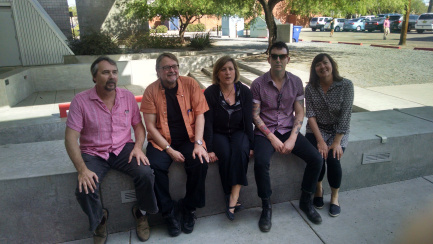 Workshop leaders David Gessner, Luis Alberto Urrea, Bryn Chancellor, Joshua Mohr, and Lynn Cullen
I was in Arizona last week because an essay I entered in a contest won me a place in the master’s workshop attached to the festival. Two full days of lectures, workshops and readings, of bonding with my little nonfiction group and our leader, author David Gessner. It was held in a place on campus called the Poetry Center. A poetry center? Yes. A whole library full of poetry books and books about poetry and poets, a breezeway where we ate the most delicious sandwiches at lunchtime, a comfortable auditorium where we heard readings and talks, and classrooms where we hashed over each others’ manuscripts.
The University of Arizona Poetry Center, housed in the Helen S. Schaefer Building, includes a rare book room, a children’s program called Poetry Joeys, a collection of recordings made by visiting poets, and a Poet’s Cottage where visiting writers can stay. The center hosts readings and lectures, poetry discussions, workshops, and more. When I walked into that place, I thought, “If I could work here, I would gladly live in Tucson.” I’m not moving, but wow. I found a place where everybody speaks my language.
Most people I meet don’t “get” poetry. If it doesn’t rhyme, it isn’t poetry, right? Read poetry for fun? Are you crazy? You’re a poet? What does that mean? Bookstores and libraries rarely allot more than a shelf or two to poetry, but there is so much more.
Why is my MFA in creative nonfiction if I’m so fond of poetry? I wrote poetry first, but a girl has to make a living. I think essays and poetry live on the same spectrum of storytelling. Some essays are poetic and some poems feel like little essays. They’re all magic to me.
 It wasn’t all words this trip. I was blessed to be able to stay at the home of my late husband’s cousin Adrienne and her husband John, both delightful people I’ve been wanting to visit for a long time. They volunteer at the symphony store in the lobby at the Tucson Music Hall. The night I arrived, they took me with them. I helped sell CDs and music-related items such as earrings shaped like treble clefs and mugs, bags, scarfs, etc. We also got to hear the music, which included the Tucson Symphony and guest artists The Mambo Kings. Fun! The day after the workshop, Adrienne and I toured the marvelous Arizona-Sonora Desert Museum, which was loaded with cactus, critters and kids on spring break. And in the warm evenings, we dined in the patio and had great talks.
Then it was time to come home. It was 80 degrees in Tucson. When the captain on the plane announced that it was 43 degrees in Portland, Oregon, people groaned. The Oregonians laughed. Back to hoodies and raincoats with new books to read while the rain pours down outside.


March 7, 2016
Lawnmower one, widow lady zero
I keep looking in the mirror, expecting to see the skin around my right eye turning colors and my right cheek puffing up. That’s where the defeating blow landed. That’s how my glasses got bent so they hung half off and half on my face. That’s what led me to sit on the grass and cry, hugging my dog like a giant teddy bear. You’d think I was 4 instead of almost 64.
What am I talking about? One of the joys of being widowed is inheriting all the home and yard care, unless you have the money to hire someone. I’m thinking that guy in Lady Chatterley’s Lover would be great. For those who haven’t read the D.H. Lawrence book, Lady Chatterley’s husband was paralyzed from the waist down and could not make love. They were rich and had a large estate, cared for by the “Gamekeeper,” Oliver Mellors. Although a man of few words, Mellors was very expressive in other ways, including keeping Lady C very happy. It was quite a racy book for 1928. Now, I don’t have any game to keep, just lots of trees, unmowed grass and a house that’s too big for me, but I wouldn’t mind having a Mellors to take care of the property–and me, too. Or a woman who knew her way around a tool belt.
Anyway, back to the lawn. The rain had finally stopped for a couple of days. All the neighbors were off to work. It was just me and the pooch. After several winter months in the shed, the lawnmower was not working properly. It coughed, smoked, cut a stripe or two in the grass and quit. Over and over. God, how I wished some burly man would come striding up to the fence and say, “Hey, little lady, what seems to be the trouble?” And then he’d come in and fix the damn thing and mow the whole lawn while he was at it. But no.
My mechanical knowledge is limited. I know how to cook, write, play music, and sew. That’s pretty much it. If the tire light comes on in my car, I take it to Les Schwab. If the toilet leaks, I call a plumber. When the cord on the old lawnmower broke a year or two ago, I bought a new lawnmower. Know what I mean? Now I’m not saying this is true of all women. I know lots of women who could wrestle that lawnmower into submission. But not me.
I tried what I knew with the lawnmower. Oil? Check. Gas? Check. Spark plug? Still there. I flipped the lawnmower over, looking for obstructions underneath. I poked around with a screwdriver. Nothing. I pulled the cord. Nothing. I did that about 10 times with the same results. It sputtered and worked for a minute, gushing out smoke and coughing until it died.
I tried pushing the lawnmower up vertically to look underneath, and that’s when it happened. Bam! I lost my grip and the handle crashed down on my face.
Four days later, I don’t even have the satisfaction of a good black eye, although my cheek still hurts and I do have a giant bruise on my upper arm where the handle hit on the way down. Some part of me wants to have a visible injury so people ask about it and admire this poor brave little widow. Yeah, right.
But that’s not the end of the story. On Friday, I was about to load the lawnmower into the car to take it to Sears for repairs. I decided to yank the cord one more time. And guess what? The lawnmower roared into action. As I shouted hallelujahs, I decided I’d better mow the front lawn before the mower changed its mind. Forget Sears. Yes, I was overdressed for lawn-mowing, and I couldn’t see because I wasn’t wearing my mangled glasses, but I mowed it.
The drama wasn’t over yet. On the far side of the driveway, water had been standing dog-knee deep for several days. I thought we had just had more rain than the ground could absorb. But post lawn-mow, my neighbor wandered over and we both ended up staring at that water. It was flowing. This was not rainwater. We had a leak. Pat called the water company while I dashed into town to get my glasses fixed. The optometrist told me I needed to think about buying new ones. They were getting old and brittle and could not take much more bending before they broke. You see, this was about my fifth time having it done. Great. New glasses. No vision insurance.
Back home, I found the street blocked with Seal Rock Water Company trucks and machinery and a half dozen water company guys, including one chest deep in a hole in my front yard, a hole that didn’t used to be there. The only good news was the problem was the connection to my neighbor’s water, not mine. Since I couldn’t get to my house anyway, I went off to my weekly jam in Waldport for a couple hours of music. When I came home, the hole was filled with rocks, and the men were gone.
End of story? Not quite. Last night, I discovered the toilet was leaking. Stop!
Also, my glasses hurt my sore face.
I’m still waiting for Lady Chatterley’s Lover. He was handy.


March 1, 2016
Can I Get an Amen?
The priest pounded the podium as he shouted, “They did it on Sunday morning! On Sunday morning!” He pounded so hard we flinched and a few people covered their ears.
Father David, visiting while our regular priest was dealing with the death of his father, is what you might call colorful. Sitting at the piano as choir director, I had to be alert every second because the Mass would not follow the usual patterns. Oh no. But I could sympathize with his rant about Sundays because I’m constantly dealing with people who expect me to do things on Sunday mornings, not considering that I might possibly be at church. That very day I was missing an important meeting because it was Sunday. Sometimes I want to pound wood, too.
But let’s get back to Father David. He’s a missionary who lives in Warrenton, up the coast near Astoria, Oregon. He has been to Sacred Heart several times now. His Masses are always a wild ride. Father Palmer, bless his heart, has a hard act to follow.
You know it’s going to be different when you walk in and the priest kisses your hand and tells you you’re beautiful. When you tell him your name is Sue, he bursts into song: “Suzanne takes your hand to a place by the river . . .” He knows all the words. Not knowing what else to do, you sing along. When my friend Georgia arrives, he sings, “Georgia, Georgia . . .”
You know it’s going to be different when every door and cupboard in the sacristy is open, and there’s this guy who looks like one of our many homeless visitors who turns out to Father’s assistant and ends up in a white cassock serving communion. And there’s this other young guy named Travis with a tiny tuft of beard who also shows up on the altar in a white cassock and reads the announcements. You wonder what gives with these assistants, but they’re friendly and you suspect Father needs their help.
You know it’s going to be different when you walk in at five minutes before Mass time, and Father is already on the altar talking and leading a prayer. Then he goes back to the vestibule and processes in. Wait? Are we late?
You know it’s going to be different when he finishes the opening prayers and suddenly looks at you expectantly. You’re thinking: We don’t have a song here. He softly says, “The Kyrie,” which is something the priest usually leads, but he’s not going to. So you stand up at the piano, take a deep breath, and belt out “Kyrie eleison!” and hope the choir and the congregation echo you. Thank God they do. The notes vary, but it’s loud.
You know it’s going to be different when out of nowhere Fr. David shouts, “Amen!” and invites you to say Amen back. And he does it again and again until you’re all laughing and shouting and thinking: Is this really a Catholic church?
You know it’s going to be different when he gives a 10-minute sermon before the readings, when he has his assistants stand on either side of him holding candles while he reads the gospel, when he strolls down the aisle during the homily and challenges people with questions and comments, and when he points a finger at you and asks if you have been redeemed. Startled, you nod yes because what else can you do.
You know it’s going to be different when he starts speaking during the offertory song, when he tosses out a new prayer in the middle of the Preparation of Gifts and adds little asides during the Eucharistic Prayer, when during Communion he bends down to hug and talk to the little kids, and when he sips throughout the mass from a little black wine goblet. He says it’s water.
You know it’s going to be different when he scoops handfuls of water from the baptismal font and flings it with his hands at the people on the altar, the choir and you, so that drops of water are running down your face and beading up on the piano keys as he tells you to “tickle those ivories” for the closing song. He sings along. Afterward, he tells you the choir is “awesome.”
You also know that he did it differently last week and if he comes back in the future, it will be different again. All you know is that you don’t know what will happen next and that the Holy Spirit is dancing a jig because the Catholics are finally livening up.
You know you hope Father David comes back soon.


February 22, 2016
What taste captures your childhood?

Occasionally I use writing exercises to get me started. Today’s prompt sparked this trip through memory’s kitchen.
When I think of my childhood back in San Jose, I taste tomato sauce, specially on raviolis. Oh God, those stuffed pasta squares from La Villa’s delicatessen in Willow Glen. The smells of that place. Tomatoes, oregano, cheese. Wine bottles encased in straw baskets. Loaves of French bread. Salamis hanging from hooks on the wall.
Raviolis were a treat for all of us, especially Mom, who didn’t have to cook. While we set the table, Dad would go fetch them, along with little cardboard boxes of macaroni and potato salads. We might have bread, too. White bread stacked on a plate, to butter heavily and use to soak up the leftover sauce. Nobody complained about the all-carb meal in those days. It was just hot and cold, red and white.
We sprinkled on grated Parmesan cheese from a green cardboard container. I never tasted fresh ground Parmesan until well into adulthood.
When the deli in Willow Glen felt like too far to drive, we were stuck with Pianto’s, located nearby and owned by our neighbors. The sauce was more like the stuff Mom bought in cans at the store, and the raviolis were not as fat or as firm. Years after Mr. Pianto died, the family got tired of the business and sold it to another family which moved the business to Saratoga. It closed in 2009. The original location became a pizza place. Pizza has tomato sauce, too, but my parents never ate pizza. My father still doesn’t consider it food.
Other places filled the ravioli gap: By th’ Bucket, Frankie, Johnnie and Luigi’s, and a now-defunct place called Ravioli. All good. By the time I was in my teens, you could also buy frozen raviolis and tubs of frozen sauce at the grocery store, but those were for emergencies only.
There had to be raviolis, something for those nights when Mom wasn’t up to cooking or company dropped in unexpectedly, which they did quite a lot. My parents wouldn’t touch Chinese or any other Asian food. And you couldn’t serve hamburgers for dinner. So, they bought raviolis.
It’s no wonder I became a ravioli head. It’s what I always wanted to eat on my birthdays and what I usually got. I would stuff myself until I wasn’t sure it would stay in my stomach, but it always did, and I always found room for chocolate cake with Cool Whip frosting.
Tomato sauce showed up in other dishes, of course, especially spaghetti. My grandmother had the best sauce. I can still smell it as I hovered near the stove in her kitchen, where the walls and wooden trim were all white and the ceiling was painted bright red. I wanted to immerse myself in it. I think it was oregano mixed with cumin that gave it its distinctive aroma. The only sauce that ever came close was the sauce they served at Cypress School on spaghetti day.
My mother’s sauce most likely came out of a can, but we ate a lot of it on spaghetti or the no-name noodle-hamburger-tomato sauce casserole that showed up on the table all too often. I ate it. I ate it all. Firsts, seconds and thirds.
When I grew up, I wanted to make good sauce, like Grandma’s. I developed a variation of Betty Crocker’s recipe that came close. Then I married Fred, who had his own recipe, and it was better. It included onions, mushrooms, peppers, sausage, stewed tomatoes, cheese and a good dose of wine. Leaning over the pot, I got drunk on the steam. It was heaven.
When we combined that sauce with long flat noodles, Italian sausage and three kind of cheese for lasagna, oh my God. Heaven on a plate.
Tomato sauce was not just for pasta. Mom made a wonderful casserole of zucchini, onions, American cheese and tomato sauce. She also put it on green beans, which almost masked the taste.
If we’re talking tomatoes, we can’t forget ketchup. If we had meat, there was ketchup on the table. Purists might disdain eating steak or prime rib with the red stuff, but for me, it was required. Still is. Hamburgers, pork chops, French fries, onion rings–got to have the ketchup. Mom even put ketchup in our tuna sandwiches and made salad dressing with ketchup, mayonnaise and Worcestershire sauce. Don’t know it till you try it.
Yes, the taste of tomatoes captures my childhood. I might be Portuguese, German, French and Spanish, but my stomach is Italian. As an adult living alone in Oregon, I buy a few fresh tomatoes at the store. Mostly I slice them for BLTs, aware that my doctor doesn’t want me to eat any “T.” My troubled stomach has had its fill of tomato sauce and screams no more acid. I dress my frozen raviolis in pesto or alfredo sauce. I sauté my zucchini with olive oil. But sometimes a girl just has to have a little tomato, especially when it’s quite possible the red cells in her blood are full of tomato sauce. It’s almost my birthday. If I close my eyes, I can still taste those raviolis in the big yellow Pyrex bowl on top of the yellow Formica table. It’s almost my birthday. Do I dare? I must.
What taste captures your childhood? Don’t think too hard.What comes to mind first when you think about those days when your legs were so short your feet didn’t quite touch the floor. Please share in the comments.


February 15, 2016
If We’re Going to Sit This Close Together, We Ought to at Least Say Hello
The man next to me in Row 28 of the Alaska Airlines 737 was handsome and tall, nicely dressed in a white shirt and brown slacks. The lady squashed into the window seat was thin, her red hair sparse. None of us spoke to each other the entire two hours we were in those seats. Window woman knitted. Handsome man worked on charts on his laptop. I read on my Kindle. His leg was touching mine for most of the trip, but we did not say a word, not until we landed and I asked him if he was leaving or going home. He was visiting friends in San Jose. I said I used to live in San Jose. I didn’t mention I was here for my cousin’s funeral. Then we got off the plane and rolled our rolly bags away.
Across the aisle, a man with huge headphones watched a movie on his iPad. The guys next to him dozed. In front of him, an Anglo man with equally huge headphones seemed to be reading Chinese on his laptop. Directly in front of me, all I could see was the beige back of the Row 27 seats with menus and the airline magazine in the pocket. I could barely see the window past people’s heads and the wing blocked our view anyway. Might as well read my book.
It’s crazy how people don’t talk to each other anymore. When I got to the gate in Portland, I couldn’t help but notice that everyone already seated at Gate C2 was staring at a phone or laptop. So I got my phone out, too.
On the return trip, where I had the middle seat in Row 29 of 32, the woman on my left had her sunglasses on and read off her tablet from beginning to end. She switched to games on her phone as we landed. My efforts to talk got nowhere. The woman on my right was a little younger and clearly a regular on these flights. She knew the menu and knew the flight attendants. She plugged in her headphones and had her eyes closed or focused on a magazine the whole trip. The whole vibe was “don’t talk to me.”
Everyone seems to want to be alone. We’re all staring at our phones, tablets, computers, and books. We seem to want to become invisible. People used to talk on planes. I remember a trip long ago where I almost had sex with the handsome guy sitting next to me. We talked the whole trip. That doesn’t seem to happen anymore. Aside from a few couples whispering to each other or a baby screeching at takeoff and landing, I hear only the roar of the plane and an occasional garbled announcement from the captain. With WiFi in the plane now, why talk? Right?
I couldn’t help thinking how much more fun it would be with a friend or a mate. We could talk. Also, we could go to the bathroom at the airport without having to take all our stuff. We could share a table at the restaurant with a person instead of a suitcase. We could make wisecracks about all the people staring at their screens.
I think we’re all nervous about flying, about going through security, about the possibility of the plane crashing, about being late. We’re uncomfortable being so close to strangers. I know I’m a bundle of anxiety when I fly. So much so on the return trip Friday that I handed the TSA agent my debit card instead of my ID. That got me a trip to the possible terrorist line. But they let me through.
These days, with no husband or kids, I always travel alone. Flying solo, you have to ask all the questions, do all the planning, and do all the heavy lifting of luggage. And you have no one with whom to share the memories, the laughs and the experiences. I miss that part the most. That and having someone to greet me when I stagger off the airplane at the end of the journey. But you’d think when you’re sharing an armrest, you’d be able to strike up a conversation. And hey guys, we’re 30,000 feet in the air traveling at a ridiculously fast speed. At least look out the window.
In spite of all that, it was a good trip. Lots of hugs, lots of sunshine, lots of quality time with family, one of whom gave me their cold. Rest in peace, cousin Jerry. I’m going to miss you. Thanks for bringing us together.


February 8, 2016
Looking Back at John Lennon

 Lately I have been immersed in the Beatles, especially John Lennon. I just finished reading a 661-page biography titled Lennon: The Man, the Myth, the Music – The Definitive Life by Tim Riley. Wow. What a long time ago it all was. The surviving Beatles are in their 70s, and I’m almost 64, the age Paul McCartney wrote about in his song, “When I’m 64.” I had no clue about so many things in the Beatlemania days. I was in junior high when the Beatles first came to America in 1964 and in my early years of college when they broke up. Plus I was in love with Paul. John, kind of rough and sarcastic, didn’t appeal to me. I didn’t pay much attention to what he did post-Beatles. By the time Lennon was shot to death outside his New York apartment, I was in the process of divorcing my first husband and working as a reporter for the Pacifica Tribune. I had bigger things to think about than whose records were at the top of the charts.
I was so young and stupid in those days when I was begging my mother for the latest Beatles album, sold at $1.99 for mono and $2.99 for stereo. Oh please, I just have to have it. Once purchased, the album revolved on the stereo in the living room—the only one we had—while I sat with my head against the speaker, singing along. When not attached to the speaker, I was listening to my palm-sized transistor radio. I knew every word and every note of every song. I still do.
I still have my Beatles records, and a few CDs that came out later. The recordings were treasures to be acquired a little at a time. But now in this crazy Internet world, I have discovered that I can find almost everything the Beatles ever recorded online at YouTube, Amazon Prime or iTunes. I can read about a song in the book, go online and listen to it immediately. I can read about a TV interview from the ‘70s, and there it is on YouTube. I have downloaded a ton of Beatles music on my tablet for free and can listen to it anytime I want. It blows my mind.
I have read McCartney bios, but this is my first Lennon book. In recent years as an adult, I have come to admire Lennon’s talents as singer, songwriter and creative person. While I was living my life and obsessing over Paul, I missed so much. Where was I when John was making multiple comebacks and appearing all over American TV? What was I doing the day he was killed? Why wasn’t I paying attention?
Riley’s book is loaded with information, not just about Lennon and the other Beatles but about the times they lived in and the places where they lived. He gives a whole history of rock ‘n roll, linking Lennon’s work back to the musicians who inspired it and ahead to the ones who followed. He offers details behind every song and every album, how it was written, how it was arranged and recorded, who wrote which passages and what they were really about. He shares the times Lennon was drunk or stoned, the times he acted out, and the twisted childhood that tormented him all his life. I don’t know if I would have wanted to know all that when I was a teenage fan experiencing my first burst of vicarious lust years before I would interact with men in real life, but it’s fascinating now.
The research job here is incredible. Riley must have read everything ever written about Lennon, interviewed everyone who ever knew him, and taken in every bit of film, video, vinyl and digital media. Somehow he managed to pull it all together into a very readable book that I had to put down occasionally due to its massive size but didn’t want to stop until I knew the whole story. Now I’m playing Lennon music on my record player and my Kindle Fire, thinking wow, how did I miss all this?
There are many other books about John Lennon. It seems everyone who was a Beatle or knew a Beatle has written a book. I’ll never read them all, but I can’t imagine any of them could be as complete as this one. Bravo, Tim Riley.


February 2, 2016
Who needs words when you’ve got a beach?
Recent trips between rainstorms to Otter Rock, north of Newport, and South Beach, south of Newport, yielded some stunning views last week of beaches scoured by the wind and covered with bubbles that blew around like tumbleweeds. Great for walking, meditating and taking pictures.
![IMG_20160126_152225098_HDR[1]](https://i.gr-assets.com/images/S/compressed.photo.goodreads.com/hostedimages/1454532938i/17978132._SX540_.jpg)
![IMG_20160126_153919986_HDR[1]](https://i.gr-assets.com/images/S/compressed.photo.goodreads.com/hostedimages/1454532938i/17978133._SX540_.jpg)
![IMG_20160128_143925788[1]](https://i.gr-assets.com/images/S/compressed.photo.goodreads.com/hostedimages/1454532938i/17978134._SX540_.jpg)
![IMG_20160128_151450150[1]](https://i.gr-assets.com/images/S/compressed.photo.goodreads.com/hostedimages/1454532938i/17978135._SY540_.jpg)
All images copyright Sue Fagalde Lick. Republish them without my permission and I will send Annie to eat your computer.


January 25, 2016
Nothing a Little Duct Tape Can’t Fix
![IMG_20160122_111231634_HDR[1]](https://i.gr-assets.com/images/S/compressed.photo.goodreads.com/hostedimages/1453870298i/17882995._SX540_.jpg) You might say I need a new guitar case. Look at that poor thing. Even the red duct tape is rotting away. This comes from thirty years of carrying it around, of lifting it in and out of cars, trucks and SUVS, of setting it on carpets, concrete, gravel, sand and polished stages, of propping it against walls in homes and hotels, of opening, closing, opening, closing all four latches, of carrying it to music camp, church, jams, open mics, street fairs, garden tours, coffee shops, concert halls and nursing homes. Up and down, in and out, open, close.
You might say I need a new guitar case. Look at that poor thing. Even the red duct tape is rotting away. This comes from thirty years of carrying it around, of lifting it in and out of cars, trucks and SUVS, of setting it on carpets, concrete, gravel, sand and polished stages, of propping it against walls in homes and hotels, of opening, closing, opening, closing all four latches, of carrying it to music camp, church, jams, open mics, street fairs, garden tours, coffee shops, concert halls and nursing homes. Up and down, in and out, open, close.
Some of my musician friends say it’s good to have a beat-up case. People will figure what’s inside isn’t worth stealing. Well, the guitar is as old as the case. I bought them together at Gryphon Stringed Instruments in Palo Alto, California. My husband Fred kept me company as I tested one guitar after another, playing the same songs until I came to the Martin Shenandoah. A D-35, for those who care. That was the one. Acoustic guitars are said to sound better with age. This guitar has had its issues. The built-in-pickup died. I dropped the guitar twice when my strap gave way. The second time required a trip to the luthier to put it back together. The surface is nicked and scratched and it usually needs a new set of strings, but it’s a Martin. It sounds good. God willing, that guitar will last as long as I do.
The case not so much, although the inside is fine. Its plush maroon padding is like new because the case is usually closed. When it comes to collecting tips, I favor a jar or an old hat over an open case someone could trip over.
I have started looking for a new case. Our local store doesn’t have any in stock and doesn’t do mail-order. I hesitate to order something so big online without seeing it first. I could be using the new case for the next 30 years. I have already spent most of my Christmas money on other stuff, so this case has a few more miles to go. For $4.99, I bought a new roll of duct tape, zebra striped. I’ll definitely know which guitar is mine.


January 21, 2016
‘Sorry, I have to take this call’
Modern TV shows and movies are giving us all ADD. Books, too, to a certain extent. Somebody’s cell phone is always ringing, interrupting every scene. Nobody ever finishes a conversation or has that long difficult moment that might lead to a resolution or revelation. It’s driving me nuts. Yes, some people are always staring at their phones in real life, and I LOVE my smart phone, but I don’t want it in my fiction.
I have been bingeing on “Jane the Virgin,” a Netflix series about a young woman who was accidentally inseminated with this guy Rafael’s sperm and subsequently falls in love with Rafael. Things get complicated. There seems to be all kinds of crime at the hotel Rafael manages. Jane has just met her biological father, who happens to be a big star of Spanish language telenovelas. And more I can’t tell without spoiling the plot. The whole show is a spoof on telenovelas, with lots of melodrama, romance, murders, and anguished reactions by an off-screen narrator. I’m really enjoying it, but I wish everybody would turn their phones off. They ring every couple minutes. The characters constantly interrupt the scenes, saying “I have to take this” or “I have to go.”
One of my writing mentors preached that telephone calls were death to a dramatic scene, but now everybody’s on the phone in books, TV and movies. Always the ring, the text, the email, which takes precedence over whatever else is happening. It seems like lazy writing. Why not find a more interesting way to move a scene along or to convey information? Back in the olden days, on Bonanza or Little House in the Prairie, a rider would come roaring up on his horse to share important news: The cavalry is coming! Johnson’s barn is on fire! The barn might be ashes by the time anyone gets there, but the delay adds to the drama. Can you picture John Wayne talking on a cell phone? Don’t shoot. I have to take this call. Remember Dustin Hoffman in “The Graduate” racing to stop Elaine’s wedding. We’re holding our breath as he runs as fast as he can, and she’s walking down the aisle, and then we hear him hollering “Elaine! I love you!” You can’t get that kind of drama with a cell phone.
Then again, remember way back to “Sorry, Wrong Number?” I know, I’m old. That spooky movie would have been great with cell phones because it was all about telephone calls.
In real life, sometimes smart phones are a blessing. A few weeks ago, when the area was coated in ice and driving was treacherous, it was good to be able to text friends to warn them to stay home. Last week when Highway 20 was closed due to a problem at the railroad crossing, I was glad to get the message. Certainly, if somebody wants to tell me I won a prize, I will welcome a call. But today’s writers are overdoing it with the cell phones. Let the characters on the screen talk to each other. Save the interruptions for important stuff. The barn is on fire. The bad guy is on his way. There’s a bomb in the limo. Otherwise, let’s just talk or operate in silence for a while. Can we do that?
It has been quiet for two minutes. Text me.