Sue Fagalde Lick's Blog, page 30
September 19, 2016
My father offers stories for dessert
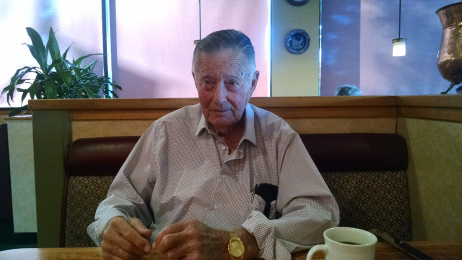 Meals with my dad, Ed Fagalde, are a slow process. It takes him forever to get ready to sit down, and if I’m not careful I’m halfway through eating before he’s finished adding condiments. Slow down, mustn’t rush, I tell myself. We’re going to be sitting here for a while. While I’m itching to check my phone or read a book, now it’s time to listen. Even at breakfast, when I’m still waking up, he stirs Sweet n Low into his coffee, clears his throat, and begins to talk. He’s still talking 12 hours later over ice cream at The Country Inn restaurant and a few hours after that, standing in my doorway while I’m getting ready for bed.
I believe part of the reason I’m a writer is the fact that my father and his father before him were storytellers. While the stories go on, you don’t take notes; the teller would become self-conscious. No, you listen. You nod and react and ask the occasional question while the words flow like a waterfall that never runs out.
Some stories are of modern times, tales of a frustrating visit to the bank or a friend dropping by. With these, Dad gets times and places mixed up, forgets names, and does not understand the computer-based modern world, but the stories of the past are unmarred by his 94 years. Usually, I’ve heard them before, but there are always new details. For example, the ranch house where Dad grew up was not always on the spot where I remember it. The house was moved from another location, with a new room and a porch added. I had no idea.
He’s surprised that I remember that house. I was 9 in 1961 when Grandpa retired as foreman of the Dorrance ranch and moved to Seacliff Beach. I’m amazed to realize I’m now almost the age that he was then.
I remember the barn, the house, the patio, the fish pond, the chickens, the smell of prunes in the dehydrator. I feel as if I remember so much more because of Dad’s stories: the rabbit pens, the blackberries, the acres of prune, cherry and apricot trees, the multi-national crews who worked in the trees and the packing sheds, the horses that waited for Dad to come home from school and feed them the peelings from his mom’s apple pies.
I can’t remember all that. I was just a little girl in mary janes and ruffled socks sitting politely in the living room while the grownups talked. I remember a wood stove, an upright piano, lots of clocks, Dad’s stepmother Rachel’s dachshund Gretchen. I don’t remember my dad’s mother, Clara, at all, but her spirit was still in that house. Last week while visiting Dad, I learned that she never had a washing machine. She washed everything by hand with a scrub board until she got sick and started sending the clothes out to be laundered. Imagine how dirty those work clothes must have been.
I learned that my grandfather, Clarence, decided to retire because the ranch owners had started selling off chunks of land to housing developers and he could see the whole thing disappearing soon, like so many ranches in what was to become Silicon Valley. When my brother came to visit last weekend, we took a drive down Dry Creek Road past where the house used to be. Now there’s a million-dollar house on the site next to many other million-dollar houses, all beige and decorator-furnished. Dad still recognizes the winding road between Bascom and Meridian roads and the giant Sycamore that marks the site of the old driveway. In his mind, he can still see the orchards, the irrigation ditches, the tractors and the packing shed, but I just see these houses and a tree that sparks my imagination more than my memory.
Dad tells about the boxes piled up on the dry ground that became infested with bees. When Grandpa tried to move them, he suddenly ran to the water trough where they dipped the prunes and dove in, covered with bee stings. He swelled up all over, but healed without going to a doctor.
There were so many other stories: going to the “fights” with his dad, riding the water wagon with his grandfather in the days when men sprinkled the dirt roads to keep the dust down, riding his grandfather’s horses bareback down what became Meridian Road, dancing at the Balconades ballroom to the music of the Tony Passarelli Band.
He tells of signing up for the Army Air Corps, of training to be an airplane mechanic, of preparing to go overseas but not knowing where they’d be landing, of making an airstrip out of a road in Manila, of crashing at Leyte, of the guys he kept in touch with after the war. He tells the whole story of his career as an electrician, the different shops for which he worked, the jobs that stick in his mind, his long friendships with co-workers, his decision to retire.
He talks about his Fagalde grandparents, who owned a gas station and store at their home on Almaden Road near Branham Lane, along Almaden Creek. Grandma Lou, handy with a gun, always wanting to go shooting, Uncle Louie starting a business hauling gravel from the creek, Uncle Lloyd getting drunk and beat up, Grandpa Joe training his horses to come when he called their names.
My father talks and talks, as if he has to get it all out, has to tell me everything while he still has time. After he goes to bed, I make notes, trying to remember the details.
The stories go on and on. I feel like a bobble-head doll nodding as I listen. My eyes grow heavy with sleep and sometimes I nod off. When my brain screams stop, I push back my chair and start clearing the dishes. The talk temporarily peters out, but as soon as I sit down again, it continues. I fear the day when it stops for good. Meanwhile I do my best to soak it all in. I know what an important gift it is.
**************
Sorry I missed posting the last two weeks. No Wi-Fi at Dad’s house. But I had some adventures while I was gone and will share them in upcoming posts.
Do or did your parents share their stories with you? If they’re still around, ask questions. See what happens.



August 29, 2016
Enough with the charity calendars!
![IMG_20160829_110205540[1]](https://unleashedinoregon.files.wordpress.com/2016/08/img_20160829_1102055401.jpg) The pink invoice means my payment is late. But wait, it’s OPB, and I never promised to pay them anything. Second notice, my ass. And no, another decal or membership card is not going to make me pay up.
The pink invoice means my payment is late. But wait, it’s OPB, and I never promised to pay them anything. Second notice, my ass. And no, another decal or membership card is not going to make me pay up.
It’s just one of many ways non-profits and charities try to get my money. Most of them send gifts, such as:
Calendars, so many calendars, with pictures of birds, dogs, Oregon scenery, flowers, famous paintings, and random photographs. Big calendars, little calendars, tiny ones for my purse. Nobody needs 20 calendars, and I’d like to choose my own.
Mailing labels, millions of them, never quite as I would like my name and address to be printed but often with cute pictures so I use them.
Notepads. I don’t need any more notepads, and I feel guilty throwing unused paper away. Stop!
Decals I have no use for. Since the crash of 2015, my car is decal-free, and the filing cabinet on which I stick such things is full.
Greeting cards. I have more than anyone could ever use. These days, I send more animated e-cards than the paper kind. I keep promising myself I’ll start sending notes and cards, but it’s not happening.
Datebooks, calculators, flashlights, magnifying glasses, key fobs and pens, all from the National Federation of the Blind. Most of these are great, but now I have multiples which I can neither sell nor give away.
Although the law says we are under no obligation to fill the envelope that is always enclosed, the charities make it look like we owe them. They send notices that say, “Did you receive your calendar? Please respond with payment,” or “We still have not received payment for the greeting cards we sent you.” They’re counting on guilt to make us pay up, and sometimes it works.
Oh, and then there are pleas to hurry up and send a payment before this campaign or this matching opportunity ends. The Alzheimer’s and cancer people use this tactic a lot. The more they push, the less likely I am to give.
I do send checks sometimes if the “gift” is particularly enjoyable or I’m feeling generous. It’s not that I don’t care. But I’d much rather they stop sending crap I don’t need and spend that money on their charities. How many blind people could the federation help with the money they spent sending out that cool light-up magnifier last month? Stop sending junk, especially non-recyclable junk that’s going to end up in the landfill.
I worry about people like my dad. He doesn’t always understand that he doesn’t have to pay for this stuff. Confused at why he’s getting a bill, he will send letters, make phone calls and even visit in person trying to figure out how he suddenly owes them money. He will lose sleep and possibly cash. People shouldn’t have to figure out what’s real and what’s not.
When I receive mail in my mailbox or my post office box, I hope for something real, a letter, good news, a book I ordered, but mostly what I get is charity mail. I am not a wealthy philanthropist. When we get down to the end of the month and I’m calculating whether or not I can afford groceries, I’m not paying for a puppy-dog calendar.
Maybe I should start my own charity, Poor Poets of America. (They always have “national” or “America” in the name.) I’ll send people poems with envelopes enclosed for payment. I’ll send membership cards and mailing labels with pictures of poets who committed suicide. Yeah. Want to join me? I can’t wait for the cash to start rolling in.
What kind of junk mail do you get? Tell us about it in the comments.


August 22, 2016
The Magic of Tidying Up (aka The Satisfaction of Throwing Shit Out)
![IMG_20160822_095957009[1]](https://i.gr-assets.com/images/S/compressed.photo.goodreads.com/hostedimages/1472062829i/20145909._SY540_.jpg) Tidy up your house and your tidy up your life. That’s the thesis of the book I’m reading now, The Life Changing Magic of Tidying Up by Marie Kondo. At a writing workshop recently, the teacher made fun of the book, but I felt it calling to me at the bookstore, so I bought it and slurped it down like vanilla ice cream with chocolate on top.
Tidy up your house and your tidy up your life. That’s the thesis of the book I’m reading now, The Life Changing Magic of Tidying Up by Marie Kondo. At a writing workshop recently, the teacher made fun of the book, but I felt it calling to me at the bookstore, so I bought it and slurped it down like vanilla ice cream with chocolate on top.
Kondo is Japanese and young. The book has been translated into English. There are cultural differences and concepts I just cannot buy. I don’t think she understands how big a modern American house can be and how much stuff is in it. And how rarely Americans use the word “tidy.” But never mind. I like the idea of simplifying my space by keeping only what “sparks joy” and storing it so I’m not looking at my junk everywhere I turn.
She talks to her things, thanking them for their service, urging them to rest when she puts them in the drawer. She asks her house where things should go. My house doesn’t seem to have an opinion.
Kondo’s way of tidying up is radical. It amounts to discarding at least half of your possessions. You must do it all once, not a little at a time, or you will never get done. (I’ve noticed). You must pull everything out, handle each item, and ask if it sparks joy. If it does not, get rid of it. Not just if it’s useful or still good, but do you love it?
Only when you have discarded everything you don’t need should you think about how to store it. Kondo says, “Putting things away creates the illusion that the clutter problem has been solved.” Oh, how I know that. I have moved many times. As soon I pull everything out, I begin to realize just how much I have. Oh for the days when I could fit everything in a pickup truck.
Reading this book, I couldn’t wait to start tidying up. I began with my socks, a big mismatched mess. I threw away socks without partners, socks in bad shape, socks that I just hated and never wore. On Kondo’s direction, I rolled the rest like sushi rolls and set them in my drawer. I love it. Now I can find my blue socks, brown socks, and black socks easily. There are no loser socks anymore.
Moving on, I sorted and rolled up my underwear and my stockings, making a satisfying display. It got harder with nightgowns. If you never wear them, Kondo says they have to go. But wait, that one’s so pretty; if I ever have a gentleman companion again, I’d want to wear it. And that one’s so cute. . . .
If Kondo were here in my house, we’d end up screaming at each other. I was raised to use things up, to keep them if they were good, even if I didn’t love them. Never to waste anything. So now to say if it doesn’t spark joy, I need to throw it away? It cost money. It’s still good. I might use it.
It gets worse. Kondo prescribes getting rid of all paper. I repeat: ALL paper. Credit card statements, owners’ manuals, books you’ve already read—out with all of them. You don’t need them. But . . . .
Keepsakes? Keep the memories, get rid of the mug, the tote bag, the photograph, the ash tray your child made in first grade. Greeting cards? Out. It’s the only way you can process your past, she says. Hold on, Marie Kondo.
I like a tidy, uncluttered space. I have been trying to winnow down my possessions, knowing that someday I will probably move to a smaller home and will have to “downsize.” I know that after I die, somebody will get stuck with my stuff. But right now, I like my stuff. It’s easy to get rid of loser socks, but the last Christmas card with my mother’s signature? My wedding gown? Fred’s aquarium jacket with all his badges still attached? My financial records and notes for my books? Not yet.
It’s crazy that we’ve reached a point where we have acquired so much stuff we need a best-selling book to tell us how to sort it out so we can breathe in our own homes. And yet we keep buying more.
This book has more than 10,000 reviews, most of them five stars, on Amazon.com. On Goodreads, a site for booklovers, the reviews aren’t as good. As one writer says, “This book does not spark joy.” Okay, it’s goofy with its talking to things, and it assumes we can all afford to throw stuff away because we don’t love it, that we can always buy another one. But there’s a lot of wisdom in there, too.
My mother would agree with most of what Kondo says. She did not hold on to things. There was never any clutter in the house. She was always after me to clean up my room, especially my closet. She threatened to throw it all out if I didn’t. But hey, I’m a grownup now, and this is my shit. Hands off.
How about you? Are you ready to purge? Where do you get stuck?


August 9, 2016
There’s nothing like the love of a dog
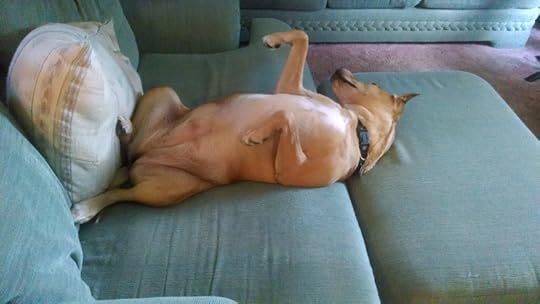
This week, I have decided to share a poem with you. The left side of the loveseat is mine. The rest belongs to Annie. Enjoy.
On the Green Love Seat
Come into the circle of my arms.
Lay your head upon my lap.
I will rub your belly and whisper
into your floppy velvet ears
that you’re my one true love.
Stretch your paw across my arm,
lick my fingers with your long pink tongue,
sniff me with your moist black nose,
fix your amber eyes on mine.
You are my one true love.
Let your nails chafe the worn upholstery,
your tan fur coat my clothes,
your fleas walk across my bathrobe.
I will hold you anyway
for you are my one true love.
When you whimper in your dreams,
I will hold you closer still,
safe in the circle of my arms
in the endless spinning of the earth.
You, dear friend, are my one true love.
Photos and text copyright 2016 Sue Fagalde Lick


August 1, 2016
Back back: rest, ice, yoga, beans?
Rest.
Ice.
Heat.
Yoga.
Rest.
Chiropractor.
NO chiropractor.
Drugs.
Walk.
Rest.
Lie on a bag of beans.
What?
Everybody’s got advice for the person with the hurting back. That last suggestion came from my dad, who said Grandpa believed in the bean cure. Well, at least that wouldn’t give me indigestion, I responded. Anyway, I don’t have a bag of beans.
Back issues run in the family. My parents went to a chiropractor named Dr. Roy. I think he was about a hundred years old by the time he retired, and God knows what methods he used back in the olden days. I was in my 20s the first time my back went out. It happened after I lifted an enormous amplifier out of the back of my VW bug. I began a long acquaintance with Dr. Birdsong.
The last week has been a real bag of beans, thanks to my wonky back going full-out ballistic. I’m writing this standing, with my laptop on a file cabinet. Wait, my legs are tired. Now I’m sitting on a stool. Soon, I’ll be lying down. On my back. On my side. On the other side. There is no perfect position. Finishing this, I’ll be back at my desk, feeling my thighs go numb. And yes, this is an ergonomic chair! Back to Dr. Schones in two hours.
What did you do, everybody asks. I don’t know. Dr. S. says I waited too long to come in for an adjustment, making me ripe for this grand subluxation (where the bones shift out of alignment). I do know that most days the week before, I sat scrunched up at my desk for hours, fascinated by the project I was working on. Come the weekend, I cleaned house on Saturday and went on a yard-work binge on Sunday. Mowed, trimmed, cut, raked, swept, watered. I was so proud of myself. Monday morning I could not move.
In the worst of it, I had a hard time standing, especially from a sitting position. Ask my dog. I hollered every time at the red-hot pain of trying to unlock the muscles and bones that kept me from straightening up. Suddenly all those sit-coms where a character suddenly can’t move were not the least bit funny. I tried going sideways. I tried coming up from my knees. I tried sliding from a high seat to my feet.
Watching me get dressed would make a fun video. I sympathized with my dad, who had me putting on his socks and shoes after his hip replacement and who still can’t bend all the way down. A week earlier, I was doing yoga, but now I could not bend down or lift my feet up. I considered going barefoot, opted for flip-flops. These are the times that make living alone a challenge. If only Fred were still here to help me with my shoes, lift me up when I needed to stand, and say, “Oh, Babe,” when the pain brought tears to my eyes.
I canceled most activities. I watched far too much of the political conventions and the incessant TV conversations about Trump vs. Clinton. I read, I wrote, and I snuggled with my dog. I penned poems about the fragility of the human body. I prayed for healing.
I am healing. I have been going to the chiropractor. I have been icing my back. I have been trying to keep moving so that I don’t freeze up. It still hurts.I worry that it will never be right again, but Dr. S. assures me I just need to get everything in alignment and let the muscles and tendons get stronger. After today’s adjustment, I’ll feel the raw pain again, I’m sure. But every time I can freely move from sitting to standing, I celebrate. I have been through this before, and I’m sure it will happen again. It’s in the genes. Grandpa lay on beans. Dad went to Dr. Roy. My favorite thing is to lie on my back on the deck with my legs right-angled over the hot tub cover. Takes the pressure off my back. But it’s hard to type that way.
Have you heard the warnings about sitting too long? Google it, and scare yourself. We are a sedentary culture. We don’t move enough, and we pay for it. I see far too many young people limping along with hurting backs. Writers and other computer workers try various options. Standing desks. Kneeling desks. Treadmill desks. Timers to make them get up at regular intervals. Perching on an exercise ball. I love to write and revise. I love getting so involved I forget about time. But my body is paying for it.
Annie is enjoying my lazy life. Wherever I settle, she collapses next to me. It’s very comforting. Until she pretzels herself and licks her bottom. Nothing wrong with her back. She only sits when she wants me to give her food. And she nags me when it’s time for a walk. Dogs are definitely smarter than we are.
If you’re sitting right now, get up and be grateful that you can. If you can’t, I sympathize. I’ll share my hot tub with you.
Just hold the beans.


July 25, 2016
Celebrating Twenty Years in Paradise
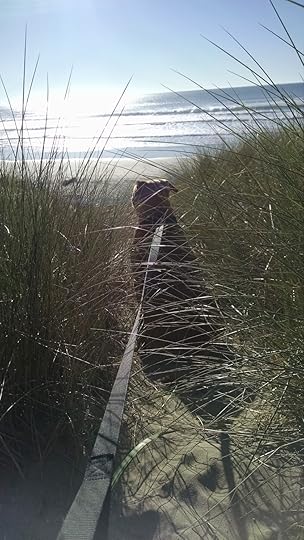
We are gathered here today to ponder me being in Oregon for 20 years.
On July 26, 1996, Fred and I left our home in San Jose, California to start a new life in Oregon. He drove a Ryder rental truck, and I followed in the Honda with the dog, my guitars and my Chatty Cathy doll in the back seat. We had no idea what we were getting into.
I had never lived more than an hour away from my family. I had never lived in a small town. I had never lived where it rains 80 inches a year. If we had not moved, I would never have known that the whole world is not like San Jose. Attention suburbanites: There’s a whole other world out there.
For years, we had vacationed on the Oregon Coast and batted around the idea of moving here. After Fred retired from the city and his youngest son graduated from high school, it seemed like we were free to go.
It happened so quickly we didn’t have time for second thoughts until it was too late. Our house sold in five days. We’d expected it to take months. Suddenly we were quitting our jobs, packing and saying goodbye. If I had to do it again, I probably wouldn’t. Certainly if I had known everything that would happen—my mother’s death, Fred’s long illness and death, me ending up alone—I would have stayed on Safari Drive amid the smog, gangs and traffic roaring right behind us on Santa Teresa Boulevard.
I loved my newspaper job and our house. I loved the music groups I belonged to and the church where I played guitar every Sunday. I had finished my term as president at California Writers and had just been elected vice president of the Santa Clara County chapter of the National League of American Pen Women. Life was pretty good. But the money we made at our various jobs wasn’t enough and the Oregon coast called to us. Up here, we could live by the beach in a more affordable house. I could write and play music. Fred could volunteer at the aquarium. As for the rain, we’d buy raincoats.
So, 20 years. Nearly one-third of my life. If we divide it up, the first third was growing up, the second being a young professional, and the third starting over in Oregon.
Let me toss out a few more numbers:
We lived in Lincoln City one year, Newport one year, and South Beach 18 years. I have been walking dogs along Thiel Creek for 18 years. Six days a week, 1.5 miles a day, times 18 years=2,496 walks and 3,744 miles or all the way across the U.S. and partway back. Add the miles we walked in Newport and Lincoln City, and we’re at least back to Utah.
I have made approximately 50 trips back to San Jose, mostly by car. At 1,400 miles a trip, say 45 trips, that’s 63,000 miles and about 90 overnight stays at the Best Western Miner’s Inn in Yreka, California. I should get a gold plaque or something.
I was 44 when we arrived. Fred was 59, younger than I am now. Later this year, I have to sign up for Medicare. What???
Oregon has given me a lot. Six published books. My MFA degree in creative writing. Twenty years as a church musician. I get to spend my days writing and playing music, which has always been my dream. I have a house with a large, private yard only a block and a half from the Pacific Ocean. I can go to the beach or walk in the woods whenever I want. The air is clean, the traffic is minimal, and the temperature rarely gets over 70 degrees. Of course, we don’t have a shopping mall, serious medical issues require a trip to Corvallis or Portland, and full-time jobs are hard to find, but there’s online shopping, I don’t mind a trip to the valley, and I don’t need a full-time job. I’m already working full-time at work that I love. In other words, we got what we came for.
A week ago Sunday, I attended a concert at Newport’s Performing Arts Center. Walking through the lobby, I kept running into friends from music, writing and church. Lots of smiles, lots of hugs. We knew just about everybody on stage as well as in the seats. I have spent many hours in that auditorium, in the audience and on the stage. I felt this huge sense of belonging as my friend Pat and I settled into our seats. I would not get that kind of feeling in San Jose in a massive venue where everyone was strangers.
Fred and I lived together here for almost 13 years. He spent two years in nursing homes and died five years ago. He absolutely loved Oregon, never had a moment of regret. Over the years, we have lost many family members, including my mother, both of Fred’s parents, Aunt Edna, cousin Jerry, cousin Candi, cousin Dale, Cousin Irene, Uncle Bob, and more. We have also welcomed Candace, Courtney, Riley, Peyton, Keira, Clarabelinda, Kai and Kaleo, Eddie and Wyatt, and more. The cycle of life includes our four-legged loved ones. We lost our dog Sadie in 2007. We gained Chico and Annie in 2009, then I lost Chico in 2010.
My dad, now 94, has survived heart surgery, a broken wrist and a broken hip. My biggest regret of this Oregon journey is not being close to him all the time instead of just a few days or weeks when I visit. When he complains about crime, traffic and heat in San Jose, I encourage him to join me up here, but he is firmly rooted in the city where he was born.
Over the years, I have thought about going home. I miss my family. I get tired of the endless cold, gray winter days. Why am I in this big house alone now that Fred is gone? Most widows seem to move close to their families, usually their children.
But I stay. Why? The opportunities for connections with writers and musicians are huge here. I am allowed to play, sing and lead the choir every week at church even though I have no music degree and I am not a concert pianist. Yes, there are more opportunities in big cities, but you’re one of a crowd.
I might have better luck finding a new man (do I want one?) somewhere else, but when I sit writing on my deck with the dog sleeping at my side, warm sun on my face and a light breeze tousling my hair, I don’t want to leave. It’s peaceful here.
Lots of other people have moved to the Oregon coast since Fred and I came. I’m an old-timer now. California retirees are still falling in love with the place and moving in. But we are unlikely to see our population grow to the point that it’s a problem. Our weather is too challenging, and there’s no easy way to get to the rest of the world–tough roads, minimal bus service, no plane or train service. Also, jobs and housing are scarce. Good. Keeps the riff-raff out.
I like this place where I know lots of people, where the rain has dirt to sink into, where strangers wave at me and Annie as they drive by in their pickup trucks, where I hear the ocean at night instead of freeway noise and sirens, where I can slip away to the beach in five minutes if I feel like it or doze on my loveseat with the dog sleeping beside me. Driving over the Yaquina Bridge into Newport, I look down at the blue waters of the bay, the white boats bobbing there, and the green hills around it and am still awed by how beautiful it is.
On our anniversaries, Fred and I used to ask each other if we were willing to stay together another year. We’d click our wine glasses and pledge not just a year, but forever. It’s time to ask myself that about Oregon and this house. I can’t pledge forever or even a year. Things happen. But for now, I’m staying. It’s home.
***
You can read the story of our journey to Oregon and what followed in my book Shoes Full of Sand. Follow this blog to continue the story.


July 18, 2016
Finding solace amid daily tragedies
Dear friends,
The world is going crazy. Every day, the headlines scream of another mass killing. Orland, Dallas, Nice, Baton Rouge. And yet, here in my little patch of coastal forest where the main aggravation is moles tearing up my lawn, I can almost feel safe. Almost. Today I offer a poem I wrote after the killings in Dallas. There have been so many since then I can no longer tell which for which loss the flags are flying at half staff. Let us all pray for peace.
MASSACRE DU JOUR
On TV, in Dallas, a black woman
with turquoise hair fights tears
amid the blood and bullet shells.
Three days after Fourth of July,
they thought it was fireworks, late
celebrations by boisterous youths.
When the cops fell, the protestors ran,
one picked off by the sniper hiding
in a community college parking garage.
Twelve cops shot, five of them dead,
the suspect, a soldier still carrying guns
blown into ash when he wouldn’t give up.
The blue-haired lady offers prayers
for the blacks, for the whites, for her kids
who worry that they might be killed, too.
President sends his condolences,
lowers the flags to half staff,
rails about gun laws again.
Freeways blockaded in Oakland,
subways stopped in New York,
Texans marching with signs.
Orlando, Nice and Baton Rouge.
Another crisis every day,
more breaking news for CNN.
Talking heads talk on and on,
speculate about why and how.
Ads hawk cars and sleeping pills.
My dog leads me out to the trees,
away from the scenes on TV.
A light rain is starting to fall.
Drops tickle my face and my hands
as sun warms the bones in my back.
Around me, the pine trees stand guard.
Robins trade tunes with the doves,
the Pacific whispers in and out.
In the distance, I hear guns.
**********************************
[Copyright Sue Fagalde Lick 2016]


July 11, 2016
Not the hands! Musicians’ greatest fear
![IMG_20160711_091241546_HDR[1]](https://i.gr-assets.com/images/S/compressed.photo.goodreads.com/hostedimages/1468341068i/19694499._SX540_.jpg) One minute I was deadheading my roses and nudging the compost cart along. The next I was on the ground staring at my throbbing fingers. The open cart had become unbalanced and fallen toward me. I fell in among peach parts and chicken bones. I know I hollered as I went down. Only the trees heard, and they said: “What do you want us to do, we’re stuck in the ground?” If a woman hollers in the forest where no humans can hear her, does she make a sound?
One minute I was deadheading my roses and nudging the compost cart along. The next I was on the ground staring at my throbbing fingers. The open cart had become unbalanced and fallen toward me. I fell in among peach parts and chicken bones. I know I hollered as I went down. Only the trees heard, and they said: “What do you want us to do, we’re stuck in the ground?” If a woman hollers in the forest where no humans can hear her, does she make a sound?
Anyway. I landed with my left-hand fingers first, specifically the middle, ring and pinkie fingers. Yes, I’m left-handed. I also banged my left knee and whacked my ribs pretty hard on the rim of the cart, but all I cared about, once I determined I was still alive, was my fingers. I needed them to hold down the frets on the guitar and play the bass notes on the piano. Everything else I could figure out with one hand. I’ve done it before.
As a musician, I always worry about the fingers first. Once upon a time in Lincoln City, OR, I fell down the stairs of our rental house. I still wince at the memory. My injuries were relatively minor but worrisome. My sideways-pointing big toe was the doctor’s main concern, but I kept whining about my fingers, two of which were swelling rapidly, and hey, I had a performance in a three days. I didn’t need my big toe, but I definitely needed my fingers.
This turned out to be not that bad. Nothing broken, just bruised and slightly swollen. After a few days of ice and rest, they’re almost like new, sore and a little purple but workable. I played all weekend. Why did I put my hands out to stop my fall? It’s instinct. Better hands than head, our body says, throwing the hands down before we have a chance to think about it.
A couple days later, I was chopping berry vines at the side of the house, my hands protected with leather gloves. My late husband Fred had left behind this pole saw thing that I had never used, but I just had to get those high vines that were learning on my house. So I studied the thing, hung it on a branch, pulled the cord, and it cut! Excited, I started cutting everything in sight. However, in my enthusiasm, I pulled down too hard right above the chain link fence and whacked the heel of my right hand on the upward-pointing wires hard enough to bruise it. It was at that point I thought maybe klutzy musicians should not do their own gardening. But then yesterday I pinched a finger in my keyboard stand. Another bruise. Fingers are in for it no matter what we do.
Fingers are so vulnerable. They stick out at the end of our hands with no protection. Without them, it’s hard to play guitar or piano or most other instruments—although I do know two talented men who play well despite missing their left index fingers. It doesn’t take much to put you out of business. A paper cut in the wrong place, a mashed fingernail, a mosquito bite. When people shake my hand too hard, I think: Careful! The fingers!
An injury to one little finger can put us out of business. It seems like we should sit with our hands in our laps and do nothing. But we can’t do that. We have to live our lives. I’ve had sprained wrists, torn shoulder ligaments, golfer’s elbow and tendonitis from my shoulders to my fingertips. I’ve worn slings, splints, and braces. I’ve applied “liquid skin” to torn calluses. Most of the time, I played anyway. I have seen guitar players bleed on their strings from cuts that didn’t have time to heal. Life is dangerous. We take our chances and thank God every time we get to play again, even if it hurts.
It’s not just musicians and fingers. Think about the body parts people use to do their work: the artist’s eyes, the pitcher’s throwing arm, the dancer’s feet, the perfumer’s nose. And you would not believe how paranoid I am about my vocal cords. I can’t get sick! I’m a singer. But that’s a whole other blog.
I’m typing this post with all 10 fingers. The keyboard seems to be a safe place, but you never know. There’s always carpal tunnel syndrome.
Worst case, I’ll play my harmonica. No fingers needed.
Comments? Do you have any finger-hurting memories to share?


July 4, 2016
News flash: widow lady sets up tent
![Tent_7216D[1]](https://i.gr-assets.com/images/S/compressed.photo.goodreads.com/hostedimages/1467727997i/19623177.jpg) I’m sitting in my tent. In my back yard. It’s a green dome tent, and it took me three years plus two hours to figure out how to put it up. It’s cozy in here, protected from the wind, comfy with my lounge cushion to lie on. I’ve got my notebook and pen, a book of poems to read, a cold Heineken, and my phone. Every now and then the dog looks in to make sure I’m still here, but she doesn’t stay. Something about the crackly-sounding floor, I think. I lie here thinking about where I will go with my tent. I could go anywhere.
I’m sitting in my tent. In my back yard. It’s a green dome tent, and it took me three years plus two hours to figure out how to put it up. It’s cozy in here, protected from the wind, comfy with my lounge cushion to lie on. I’ve got my notebook and pen, a book of poems to read, a cold Heineken, and my phone. Every now and then the dog looks in to make sure I’m still here, but she doesn’t stay. Something about the crackly-sounding floor, I think. I lie here thinking about where I will go with my tent. I could go anywhere.
When I was newly widowed, I bought this tent thinking I’d like to go camping. I enjoyed camping with my family as a kid and with my first husband. (Second husband Fred thought camping was a hotel without HBO and room service.) I could set up my tent by a river or in a wooded park and enjoy nature all by myself. Maybe I’d even go fishing.
Sure. When I first bought it, I tried setting up that tent in my front yard. The instructions baffled me. Short pole, long pole—they all looked long to me. It was like Starbucks’ drink sizes where the “tall” is the smallest size. J-hooks, ring fasteners, slip knots, what’s this Velcro thing for? Yes, the pockets for the poles were color-coded. Yes, the instructions said you could put up this tent in minutes. But no. The poles would not sit still, would not arch. I’d get one end in, and the other would pop out. I tried until my back gave out. Then I wadded up the whole thing and stuffed it onto a shelf in the garage.
![Tent_7216B[1]](https://i.gr-assets.com/images/S/compressed.photo.goodreads.com/hostedimages/1467727997i/19623178.jpg) Lately I’ve been cleaning out my garage. (Anybody want a TV vintage 1965?) I still had that tent, along with all the stuff I didn’t sell at my October 2014 garage sale, the day of the monsoon rain. It was use it or get rid of it time. Maybe camping wasn’t meant for me.
Lately I’ve been cleaning out my garage. (Anybody want a TV vintage 1965?) I still had that tent, along with all the stuff I didn’t sell at my October 2014 garage sale, the day of the monsoon rain. It was use it or get rid of it time. Maybe camping wasn’t meant for me.
I assembled my tent parts in the back yard this go-round, to keep my humiliation private. Once again the poles would not stay put. One end in, the other flopped out. Where were these alleged hooks? Okay, the poles crossed and then what? Clearly the people who wrote these directions assumed I was an engineer or someone who had set up tents before. I hadn’t. I never went to camp as a kid. My parents camped in RVs. My first husband was Mr. Nature Guy, but he did the tent-wrangling. I handled the food. I think I hammered in a few stakes, but how the rest of the tent went up, I had no idea.
But darn it, I could picture this tent set up and me inside it being total nature woman. I didn’t want to give it to charity because I was too stupid to set it up.
A couple hours in, my back was screaming again from all the bending and getting up and down. I was ready to quit again when I decided to try one more thing. Bingo. Why couldn’t the directions just tell me or show me that I was supposed insert the end of the little key things attached to the rings into the ends of the poles? I kept putting the poles in the rings and they slid all over the place. Stop laughing at me, experienced tenters. I had no clue. Once I did that, the poles stayed in place, I got them to arch, and the limp pile of “Dry-tanium” fabric turned into a tent. Once it was upright, I was able to figure out the rest—the rain flap, the stakes, the s-hooks. Okay, it looks a little lumpy, like my cakes, and I seem to have three stakes and a rain flap pole left over, but here I am, camping in my back yard.![Tent_7216I[1]](https://i.gr-assets.com/images/S/compressed.photo.goodreads.com/hostedimages/1467727997i/19623179.jpg)
It funny how I have a whole house, but I’m more comfortable in here, writing in the green glow, drinking from the green bottle. Life simplified.
It’s cloudy outside. The ocean is loud. The neighbor’s rooster crows. The yellow dog stands guard. This tent is labeled as a two-person tent. I don’t think so. It’s not big enough, and that’s fine with me. Maybe one woman and a guitar. I have decided to stay here all day, leaving only for food and bathroom trips. Errands canceled.
Now where will I go? Am I afraid to go camping alone? Yes. Should I do it anyway? Definitely. Can I put this thing up again in much less time? I think so. I can’t leave it up in the back yard forever, although I’m tempted to make it my new office . . . .
It’s two days later. I took my tent down for fear the dog would start chewing on the ropes and pulling out stakes. She has done such things before. I followed the disassembly instructions step by step and managed to fold the whole thing small enough to fit in the handy green bag. My back is killing me, but I am so proud of myself.
That’s just part of what I did on my Fourth of July weekend. I also learned how to make S’mores. How about you?
[All contents copyright Sue Fagalde Lick. Republish this without permission, and I will sic my dog Annie on you, and she chews on logs for fun and can destroy an indestructible Kong in minutes.]


June 27, 2016
Can you find one square inch of quiet?
[image error] I’m spoiled. The place where I live is quiet. Sitting in my back yard, I hear mostly birds and the wind. Occasionally a plane or helicopter flies over from the small airport a half mile south, and sometimes I hear a truck gearing up on Highway 101. Sometimes the ocean whispers and sometimes it roars, but overall it feels quiet. Or maybe it’s just that I don’t hear as well as I used to. As noted in earlier posts, I have a measurable hearing loss typical of people my age. But in my yard, I can almost hear the quiet.
Gordon Hempton, author of a wonderful book called One Square Inch of Silence, would disagree. He would say it’s pretty good, but it’s not truly quiet here in South Beach. If he measured the sound levels here, he’d probably come up with about 35 decibels coming from cars, waves, and miscellaneous mechanical sounds that I don’t notice. When a helicopter passes over, it would go up to about 90. Wherever we live, we become accustomed to a certain level of noise: cars, lawnmowers, TVs, appliances, dogs barking, people talking, and so much more. Some of us even become uncomfortable if it’s too quiet. We reach for our iPods or turn on the TV. I confess that sometimes I sleep with the radio on.
Gordon Hempton specializes in sounds. He makes his living mostly from making and selling recordings of birds, beaches, and train whistles. But his favorite sound is no sound at all. He prefers quiet, quiet enough to hear your own footsteps or the chorus of birds that greets the new day. But quiet is hard to find. Even places billed as quiet are filled with the noise of cars, planes, trains, and people. He’s on a mission to set aside one square inch of silence in Washington’s Olympic National Park, making it a place where people don’t speak and planes don’t fly over. As part of that mission, he drove across the country to Washington, D.C. in a VW bus, measuring sounds in cities, parks and wilderness areas. His book is the story of that journey. I found the book fascinating and enjoyed the way the science is folded into an engaging story. I also learned a great deal about sound.
Did you ever think about the fact that our hearing is designed to keep us safe, that most animals depend on their ability to hear predators coming so they can react to protect themselves. Animals won’t nest where it’s too noisy because they can’t hear, Hempton says. For us people, that might mean hearing a car coming so we don’t get run over, hearing a rattlesnake before we step on it, or hearing someone knocking on the door. We need to be able to hear a baby cry or a loved one shout for help. We need to hear each other in order to communicate. Hempton says we don’t have “ear lids” because we need to be able to hear all the time.
But it’s getting to be so noisy we can’t be sure we’ll hear anything. On his travels, Hempton visited a symphony hall, the Indianapolis speedway, and a basketball game. All were so loud it was nearly impossible to converse and the sound levels were high enough to cause damage to people’s hearing. Even in many of the restaurants he visited, it was too loud to talk. The roar of conversation, kitchen noises and Muzak added up to an audio attack. Even in places where people assured him it would be quiet, places like national parks and areas deep in the wilderness, Hempton found planes flying overhead every few minutes and power plants roaring 24/7.
All of this makes me glad to live where it is relatively quiet. Of course, there’s a price to pay. Mid-morning on my street, I’m the only human around. It gets lonely. At my desk, I hear a hum from the refrigerator, I hear my computer keys clacking, I just heard a fly bounce off the window. If I pay attention, I can hear myself breathing. But as soon as I get in my car, I turn on the radio as I ease into a world of noise, a world where quiet is becoming harder every day to find.
Find out more about Gordon Hempton’s One Square Inch of Silence campaign and watch a video at his website, onesquareinch.org.
I found a free app for my phone that measures sound. It rates the sound here in my office right now as a whisper. Is it quiet where you are? What kind of noises surround you? Do you notice them most of the time? Let’s talk about it in the comments. Quietly.