Chris McMahon's Blog, page 8
April 26, 2013
Supanova Pictures

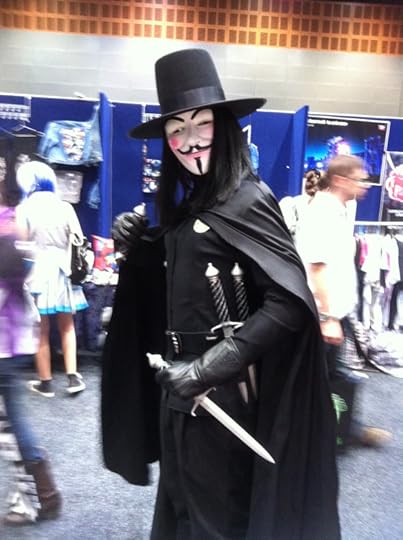


Hi, Everyone. Here are some pictures of Supanova Gold Coast from last weekend. As usual I did not have my brain screwed on and forgot to get someone to take a picture of me (doh!)
Here's one of the best costumes I saw - from V for Vendetta (awesome movie!).
Here are some zombies who wandered by. . .
Batman & Robin…


April 18, 2013
Off to Supanova
Hi, everyone. I’m off to Supanova on the Gold Coast (Aus equivalent of Comicon) this weekend to sell and sign some copies of my fantasy novel The Calvanni. It should be a fun couple of days. Sitting at the table is usually quite entertaining with all the cosplay. Last year there was an excellent Sauron costume that had in-built stilts – truly awesome 7 foot plus figure striding around with his fluted mace – and a Predator and an Alien, who of course duked it out for the crowd. I also managed to get a photo of a large bear reading The Calvanni, which was fun.
Wish me luck. I’ll bring back photos.
Anyone going to Supanova Gold Coast?


April 11, 2013
Poems Anyone?
Poking about in New York history recently I ran across Edgar Allan Poe again.
I had never read any Poe (until now that is), even though I had at various times got hold of collections with the best of intentions. Once I visited a former hotel where he reputedly lived while in New York. Later I discovered the actual location where he wrote his famous poem, The Raven, uptown in 83rd Street where (at that time) a rural cottage was located.
As I was reading through the Raven, with its famous namesake crying out ‘Nevermore!’ to tune of the writer’s loss, I reflected on how much notoriety and fame Poe had during his lifetime. I could not imagine a poem creating the same sensation now. It just goes to show you how much the popular written form can change over time.
It got me thinking how many people read poetry these days, and how many SFF writers actually pursue the art form.
Any speculative fiction poets out there? Who regularly reads and enjoys poetry?


April 5, 2013
Anyone Got any Ghost Stories?
Hi, everyone. I have been totally flat-strapped today and caught out without a post.
I have been busy finishing off my Urban Fantasy Distant Shore, in particular trying to insert a few nice ghost sightings for my chief characters who are beginning to see the Other side of things.
Anyone out there want to share some real life ghost stories?
A few years ago I had a chilling run-in with a pair of possessed masks. That was one New Year’s Eve I’d rather forget. The cat never came back.
Anyone?


March 28, 2013
How Much Backstory is Enough?
I’ve been thinking about backstory lately, and just how hard it is to judge the right balance.
I think part of the problem is that it can come down to a personal choice. Depending on the preferences of the reader or critiquer giving the feedback you can get either no comment, a request for more information, or a desperate plea to cut! Cut! All for the same piece of work.
One of the crit groups I was in had no other writers working on fantasy. That was good when it came to clarity and brevity, but the sort of atmospheric description that often makes a fantasy manuscript was pretty much taken as unnecessary padding by this group. It’s hard to stand in the face of such united feedback, even if it is dead wrong for your manuscript. I learned a lot from that group about putting in only what was necessary and cutting sections that described the same thing from different perspectives. But, based on that experience, I really started to think about the point of view of the person giving the feedback and making some real judgements about whether the suggested changes would take me in the direction I wanted to go.
The rule of thumb is to cut backstory to an absolute minimum in the beginning of the story. It’s a good maxim. I try hard to do this, but there are limits. Many of my worlds, particularly the fantasy ones, have lots of new concepts and terms that need to be explained from the beginning for the story to make sense. I’m caught between the Devil and the deep blue sea. I’m still trying to puzzle that one out.
The other thing that makes me unsure about this is that many stories seem to launch straight into huge sections of backstory/reflection and work well and also find commercial success. In this case it is almost always supporting the establishment of character, rather than the world, but it’s still backstory.
I guess I fall into the same trap as any writer who has spent a long time building a world and getting excited by the concepts – I love to talk about it! And I tend to talk about it on the page. ‘Oh, I have to mention. . .’
But how much backstory is enough? How do you decide?


March 21, 2013
Two Spacecraft Crash into Moon Mountain!
Yes, really! But not by accident.
On December 17 2012, NASA’s twin GRAIL (Gravity Recovery and Interior Laboratory) spacecraft were steered into a mountain near the Moon’s north pole. Both were about the size of a washing machine with a mass of around 200 kg (440 lbs). The aim here was to squeeze one last bit of science out of the spacecraft and take a look at the Moon’s interior.
The crashes alone could not achieve that. The twin impacts created twin plumes, but another spacecraft had to be on hand to analyse what the nature of these implied for the Moon’s composition. In this case it was NASA’s Lunar Reconnaissance Orbiter (LRO).
In the case of the NASA team driving the LRO it was a mad scramble to get the spacecraft into position to observe the impacts. LRO’s team had only three weeks’ notice of the ultimate position of the two GRAIL’s resting places and had to make sure their baby was on hand to focus on the columns of ejecta.
LRO was about 160 km (100 mi) from the lunar surface when the two spacecraft made impact. Because the site was in shadow at the time of the impact the LRO had to wait until the plumes rose high enough to be in sunlight before making its observation. In this case, the LRO used the LAMP instrument (Lyman Alpha Mapping Project), which is an ultraviolet imaging spectrograph. The LAMP saw mercury and enhancements of atomic hydrogen in the plume.
The results are interesting because the presence of mercury was also noted from the LCROSS (Lunar Crater Observation and Sensing Satellite) impact in October 2009, however that impact was at the bottom of the Moon’s Cabeus crater, which has not seen sunlight in an estimated billion years and is likely to be quite cold.
Now two craters around 4-6m in diameter dot the side of the unnamed mountain at an elevation of around 700m above the surrounding plain, around a third of the way up the 2,500m tall massif. Each has a faint, dark ejecta pattern. The dark ejecta is unusual since impact craters on the Moon are usually bright. One theory is that the dark pattern is a result of the spacecraft remnants being mixed with the local materials.
If Elon Musk can get the price of space travel down by his claimed factor of 100, then maybe I can send my old washing machine up to the Moon for a scientifically relevant impact. Now that would be something.


March 14, 2013
Magic Systems
OK, this is geek time now. What are some of the choices in creating magic systems in fantasy?
For originality, Steven Erikson’s idea of the Warrens was really something different. I enjoyed his Malazan books of the fallen, but they eventually got a little bogged down in the storyline, or maybe the characters didn’t grab me as much as some of the earlier novels (Gardens of the Moon is a classic). The originality in the magic did not abate though.
As much as I liked David Gemmell, his magic was pretty straightforward and fairly familiar from the SFF spectrum.
I guess as fundamental distinctions go, one of the most basic is Innate Magic Vs Learned Magic. For example in the Earthsea books, or Wheel of Time series, the talent was there from birth, whereas in other books – I think one of the Lawrence Watt-Evans’s books comes to mind – it is a skill that can be learned, a bit like learning what needs to go into a science experiment in our world to make it work according to our physical laws.
I remember a great little scene (not sure what book this was from) – this skinny, white-bearded, yet very fit Mage, pounding away with his feet on some sort of platform to generate the energy for his spell. The idea here was a sort of conservation of energy, where the Mage had to first generate the energy with his own sweat before he did the spell. That was kind of neat. He also got to burn off lots of calories.
You can have a blend as well. In my fantasy novel The Calvanni, there are innate magic-users (Sorcerers) who are quite powerful, yet rare, while most others can be trained in other less powerful forms of magic (Druids, Priests and Priestesses). The premise was that the Sorcerers came to dominate their world and formed a magic-using nobility. The power in the upper classes – feared and hated by many – waned over time and the Druids took control, forcing a purge of the now ‘evil’ Sorcerers and monopolizing magic.
Another fundamental distinction is just how Powerful is Powerful? Is the pinnacle of magic the ability to obtain a vision, or perhaps influence a person’s thoughts – as in shamanism – or can an ‘Adept’ wipe out armies with the wave of a hand (Pug from Fiest comes to mind)?
I think some books take the ultimate power of the Mage way too far. I like it better when the magic-user is limited, and has to pay for the use of his power.
What magic systems from fantasy literature take your fancy?


March 7, 2013
Who Shrank the Shuttle?
If you see a picture of the X-37B unmanned spaceplane, you would be forgiven for mistaking it for a slightly modified Space Shuttle. If you look closer you realise it’s a mini-version of a Shuttle, around 9m (29ft) in length and 5 tonnes (11,000 pounds), with a payload of your average pickup truck.
Here is a picture of it in its hanger [CREDIT: space.com].

Looks awesome. I like the V-shaped rear wings. Looking at this I’m thinking all that money spent in Shuttle development wasn’t as wasted as I thought.
Two have been built so far (reportedly), and one has been in orbit around Earth since December, although no one knows exactly what it’s doing up there.
The X-37B went into orbit on top of an Atlas 5 rocket from Florida’s Cape Canaveral on December 11 2012. The current mission is designated Orbital Test Vehicle-3 (OTV-3), as the third classified mission under the US Air Force’s X-37B program.
The little robotic vehicle is on the USAF’s books as USA-240.
The vehicle lands on a strip, just like its bigger (defunct) cousin, but even more impressively it does so autonomously. Pretty cool, huh? I thought maybe I could sneak into the back in a spacesuit for some spacewalking next time it goes up, but then realised I could never hope to pack enough oxy-mix – the little craft was up in orbit for 469 days for OTV-2. That’s a long time to hold your breath.
OTV-2 ended on a special strip at Vandenberg on June 16 last year, although the jury is out as to whether OTV-3 will end there or back at the good old shuttle strip at Kennedy Space Centre.
Anyone heard anything about what the X-37B’s doing up there?


February 28, 2013
Who are you Writing for?
I’ve never really thought too much about audience while I was in the process of writing. I think about it plenty after I’ve finished the work – trying to decide what markets to send material to.
From a marketing point of view, I guess I usually go about the whole business upside down. If you were to design a product from a clinical standpoint you would look at the market first and see where the demand was, then go and build your widget to match that.
The only problem is I cannot create this way.
I usually get an idea for a story, or character, or setting that starts the whole business of world creation, then the story gradually grows from that seed. I very much feel as though I am following a particular conception.
As I am writing I usually try to stay as true to that initial conception as I can. To bring to life what I have already see in my mind’s eye. Up until now I have never brought a potential reader or intended audience into this process.
But recently I went through an exercise of trying to summarise the themes I dealt with in each of my manuscripts to help me articulate what they were about in marketing pitches. A strange thing happened. I started to think about the sort of reader the work would appeal to. Now I find that if think about that person as I write it helps me to direct my energy.
Do you think about your ultimate readership when you are in the middle of creating your work? Do you deliberately target your stories for markets?


February 21, 2013
The Return of Air-Breathing Engines
I was reading recently about the Skylon space plane. A pretty cool name, which reminds me of those robotic guys with the light bouncing back and forward where their eyes should be – the vintage Cylons of Battlestar Galactica.
The Skylon spaceplane is a concept for a Single Stage to Orbit (SSTO) plane, which has been a holy grail for the aerospace industry for many decades.
Although the theory of payload Vs rocket mass takes concepts in the direction of multi-staging and non-renewable spacecraft – such as the good old Saturn V and modern equivalent the SpaceX Falcon 9 – the ability to reuse the same spacecraft also makes good economic sense. All rocketry components are damn expensive. Besides it’s such a damn cool idea to be able to get into a spaceplane at the local airport, taxi down the runway and blast into orbit.
What may make this particular SSTO dream feasible is the return of the air-breathing engine. Some of you might remember the HOTOL concept from the 1980s. The moniker stood for Horizontal TakeOff and Landing. I remember being really excited about this joint venture between Rolls Royce and British Aerospace, but apparently funding was cut in 1988 due to serious design flaws and lack of advantage over contemporary launch systems.
Like HOTOL, Skylon features air-breathing engines that use oxygen in the atmosphere as the fuel oxidant [it later switches to liquid oxygen in space]. The majority of fuel tankage is reserved for hydrogen, removing one heck of lot of weight compared to say a shuttle with its big external tank of hydrogen and oxygen. One key feature of the Skylon’s SABRE engines is the cooling of the intake air, which enables a doubling of the efficiency.
The estimated top speed of Skylon is over 30,000 km/h. This gives the craft plenty of scope to fill the niche left by the ill-fated Concorde, with sub-orbital flight times of around 4 hours from London to Sydney. Having suffered through two 30 hour flights to the USA in economy I can’t wait.
The initial goal is to carry payloads to space stations by 2022. English developer Reaction Engines hope to have a working prototype flying by 2016, and a fleet of the craft over the next decade. They are impressive craft. Each will be approximately 82 metres in length with a price tag of around $1.1 billion US.
The spaceplane is a very sleek looking craft. Check out the wikipedia page for graphics.