Chris McMahon's Blog, page 2
October 29, 2019
Po-faced
#WordWednesday // Who would have thought? Use it in a sentence today!
Po-faced (adjective): Priggishly disapproving.
The post Po-faced appeared first on Chris McMahon.


October 27, 2019
There is never enough books!
And never enough places to put them!

The post There is never enough books! appeared first on Chris McMahon.
October 24, 2019
Not a frozen wasteland
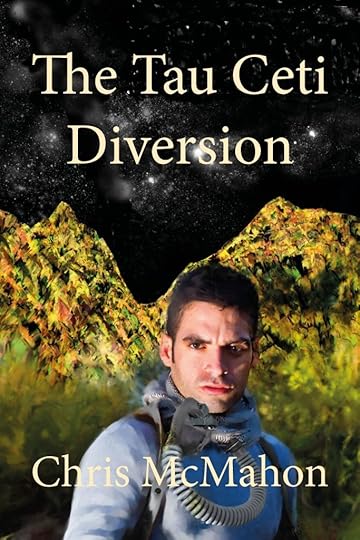
They expected the target planet to be a frozen wasteland, and found an oasis that should not exist @ChrisMcMahon111
Read more in #TheTauCetiDiversion
Get it now on Amazon!
The post Not a frozen wasteland appeared first on Chris McMahon.
October 22, 2019
Pissoir
#WordWednesday // A word to
add some flavour to period fiction — but not literally!
Pissoir (noun): A public urinal, especially
one located on a street, usually enclosed by a wall or screen.
The post Pissoir appeared first on Chris McMahon.
September 23, 2014
Judging Your Own Work
Now this is something I find almost impossible to do.
Every single time I sit down to write I make the journey from ‘My God this sucks’ to ‘this is starting to hang together’ to ‘I’m liking this!’ and back to ‘this is total crap.’
Somewhere through that process I actually get a buzz – usually when I forget to think critically at all.
I’ve won prizes and been shortlisted for genre awards. Other writer friends say I write well. Every now and then I will get a shock when a dedicated critiquer who does nothing but criticize me and my work introduces me as a ‘fine writer.’
It seems that I have no capacity for objectivity. When I look at the work that I have done I see the prose through a microscope (showing ugliness usually) and the story from a lightyear away – focused on the shape of the whole thing and its various subplots.
Getting critique is one way to get feedback. Reviews on published work are another. I’m not sure which one is crueler, probably the reviews since they are public and liable to effect sales.
On a day-to-day basis, how are you supposed to get any sort of handle on your work? I guess writing is a never-ending series of judgements you make – is the sentence too long, is there enough description, should the clown really kill the president, how big are his shoes etc. Yet when the high of actually being in the flow fades, all I am left with is a sense of unease.
How do you go about judging your own work as you progress? Is it actually impossible?
August 12, 2014
Tattoos in Fantasy
I’ve always been intrigued by tattoos. The awesome finality of having your skin inked has made me even more fascinated by traditions where tattoos carry a special meaning, such as the Polynesian cultures.
In my fantasy world of Yos, tattoos carry very particular meanings. Men and women are tattooed with a totem on coming of age, which has a religious meaning and marks inclusion in a particular sect and tradition – men inked on the chest and women on the cheek.
Then, both men and women gain tattoos that show their chosen path in life, their achievements and honours. This is so central to the cultures of Yos that to cover your chest (it’s a warm world) is a sign of deceit. Warriors will only wear armour in full-scale conflict.
In a world where many cannot read or write, the tattoos give a person’s history at a glance, where honour – and dishonour – is written in ink.
Here’s the cover from The Calvanni, that shows some of the tattoos of the Way of the Calvanni – or knife-fighter.

Do you have any special tattoos that carry a particular meaning for you?


July 31, 2014
What’s Your Favourite Fantasy Weapon?
One of the great things about writing fantasy is the fun you can have with weapons:)
In my fantasy world Yos, where my three-book Jakirian Cycle is set, all metal is present as a magical crystal called a glowmetal. These glowmetals are a naturally occurring blend of light and metal that cannot be created or destroyed. So in the development of weapons, swords and metal armour were out. Instead I developed various classes of composite ceramic.
Lanedd – which can be used for blades. This holds a razor-sharp edge, yet avoids the brittleness of pure ceramics.
Mought – incredibly tough material that can be cast into shape as armour or used for the haft of various weapons.
The longest practical lanedd blade that can be cast using the techniques available to Glassmiths in Yos is the ‘calv’ or long-knife. This is where the world ‘calvanni’ or knife-fighter derives.
On Yos the dualist’s weapon of choice is the greatscythe. This is a staff-like weapon with twin concealed blades, one at either end. The blades shoot out and lock into place. It is operated by a mechanism central to the haft . It is also the weapon of the Suul nobility.
I had a lot of fun trying to figure out how the greatscythe worked. After all – with no forged metal – I could not very well have conventional coiled springs.
Here’s what I came up with:
The greatscythe has a central fighting grip and a release grip slightly wider than this which is operated by twisting two rings. These have a thread on the inside that operates a rod moving parallel with the axis of the greatscythe. This movement switches what is known in knife-talk as an Out-The-Front or OTF mechanism.
To make this work I needed two separate types of springs in the internal mechanism, both which had to be some sort of natural material. The first I solved with small bone ‘leaf’ springs for the catches that lock the blade into position. For the main spring that drives the blade back and forward I used a rubber strap-spring.
The greatscythe itself tapers to the ends. Two cover plates attach to a hollow cast core and cover the dual mechanisms – sealed in place with a special mought (ceramic) that melts at a much lower temperature than the mought of the haft. So if the mechanism needs to be fixed the sealing mought can be melted away to free the plate.
What your favourite Fantasy weapon?


July 27, 2014
Need Dry Ice? Try Mars.
A new study on the Red Planet suggests that the sharply etched channels that crisscross its surface may have been cut by frozen CO2, rather than water.
The contention is that these gullies are very much active, and continue to form on Mars even now in cold weather. If that’s the case, than it is almost certainly ‘dry ice’ or frozen CO2 that is developing this geological feature.
Recent photographs captured by the HiRISE camera aboard NASA’s Mars Reconnaissance Orbiter, have enable a new look at the phenomenon, allowing researchers such as lead author Colin Dundas to examine the timing of gully formation over the last couple of years.

The conclusion was that the gully formation is occurring in winter, when the Martian atmosphere is condensing out as a solid. Unlike Earth, where the temperature and pressure conditions for the formation of dry ice does not occur in nature, on Mars they occur every winter, most notably in the form of a seasonal polar ice cap.
As many as 38 sites have now been identified as showing active gully formation. All at times when it would be too cold for liquid water to flow.
So if your heading out the Red Planet – don’t forget the Beer Cooler. The dry ice is free :).


July 23, 2014
Building a Story – Plot Elements
I will be the first to admit there are about a million ways to skin a cat.
When it comes to writing, there are as many valid approaches as there are writers. In fact, I am always fascinated by the varied processes of other writers. I never tire of hearing about it, as though each unique method is like another peek under the hood of some amazingly magical, complex machine. A machine I’ll never have a hope of truly understanding.
That said, I am pretty structured in my own approach. So if I’m going to pass on what I know, it’s going to be an organised method. That’s going to be a godsend to some, perhaps an annoying thorn in the creative brain to others. Either way, I hope you enjoy hearing about it.
OK. Plotting.
In formulating a story, I work around three basic elements. Character, Conflict and Setting.
In a good story, each of these elements should be integral to the others — i.e. the elements of the setting should be unique and have some interrelationship with the characters and their main conflicts. The conflict should be unique to the relationship between character and setting etc. But don’t strain your brain about that too much now.
Starting to put together a story is a time for free-flowing thought – anything goes. There is time enough to scrutinise later (believe me).
When I started putting together plots, it was all pen and paper (I was going to say clay tablets and stylus just for fun, but hey – I’m not that old).
Nowadays I put everything into a single Word file. All plot related notes, the actual plot flow, and all the research notes. Why? It’s so damn easy to find everything! Gone are the frustrated hours trying to find that key handwritten paragraph amidst a mountain of scrawled notes. The Word search function is a bit of code blessed by the Writing Gods. All you need to do and insert some key characters, or just make a mental note of the heading you need and presto, you are there. Between the search function and the ability to split Word into two screens, the power of that single Word document to facilitate the development of your story is truly amazing.
Right. Back to plotting.
I usually start by sketching out all the headings. When I say I have an organised approach, it doesn’t mean my mind is linear — not by a long shot — let’s face it, all creative people have thoughts like supercharged ping-pong balls, all of which insist on going sideways. It makes regular work meetings a nightmare.
What the structure enables me to do is capture these thoughts and ideas as they come, fleshing out the story background, then the story itself.
Here are the general headings I use:
General Notes & Ideas
What is the Book about?
Setting
Character
Conflict
Plot Flow
Specific research I put after these sections, under its own headings.
As I mentioned in a previous post, there is usually some key creative spark – that initial conception – that is your way into the story.
Right at the beginning I start with the General Notes and Ideas section, jotting down all the ideas that relate to the story. I am a visual person, so something in the act of writing these things down helps to solidify and expand the whole storyline. These notes could be plot ideas, character ideas or even worldbuilding. Anything really, just to get the creative juice flowing.
Then, depending on the book, I might need to do some specific research. How much? This is really a gut feel thing. As a general rule, I would say be guided by your own instinct about what you need to read. Don’t be too dogmatic to yourself. Don’t say: ‘Right. If I’m going to X I really need to research Y’. Choosing research is as much part of the mysterious craft of writing as anything else. This is a fact that many people miss. That same itch, or instinct, that makes you want to write in the first place will direct your attention to the work you need to pursue. You will know. It’s like that scene in Dragon – the Bruce Lee Story — where he is in the dream sequence with the demon. He is getting the snot knocked out of him in the graveyard (in the rainJ) and then suddenly there is a beam of light, showing Bruce a pair of nunchucks in the mouth of a lion statue. It’s exactly the same. There will be some beam of mental illumination or gut instinct that will tell you what you need to be reading and researching as background or aid to your work.
Of course, if your world is completely invented, your ‘research’ might be creating things from scratch, although I would usually put that under Setting.
Your research notes can be as clunky and disorganised as you like. The beauty of search function is you can easily find it if you need it.
At this stage I am usually bouncing back and forward between pursuing some research thread (again based on gut instinct) and scribing down ‘light bulb’ moments under the General Notes & Ideas heading as they occurred to me.
I am creating a mosaic of the work to come.
After doing this for a while I reach some sort of threshold and I begin to get more concrete ideas for the book. Often the first area to fill out is the Setting for the world. I have a particular love of Worldbuilding, and I often go pretty far down the rabbit hole sketching out culture, history, life forms, weaponry and of course — magic systems :).
But it’s never the same. A good chunk of the plot flow might come in one piece. Or perhaps the particular conception for this piece of work might actually revolve around a piece of conflict. In this case I might spend some time sketching out the warring parties, the internal dilemma, or even the scene I see.
I do sketch down thoughts on characters in much the same way. But I guess of all the areas I am more deliberate in my approach to Character. Apart from those initial ideas I might get on the fly, I usually have to make a conscious choice to walk down the character development path. I suspect this is very different from pantser writers, who are dragged by the nose by characters who very much take a life of their own from the outset.
In order to flesh out characters I use a number of key category areas to tease the story out of them (more in later posts on that). I work on each of the major characters until I have a really good idea of their personal history, what motivates them, what their current challenge is, and what is driving them in the story.
I usually find that I cannot properly build up the Plot Flow until I know the characters. The secrets of the story – the nuances and the key forces that comprise the narrative momentum — are lurking inside the characters. I’m with Stephen King on that one.
The vast advantage of being able to construct a plot flow before engaging in the actual process of writing as that you can add complexity. Multiple sub-plots. Red herrings. Tiny stories that happen in the background that are living part of setting.
As a reader their is nothing more satisfying to me than being surprised by a satisfying ending where multiple threads come into alignment. That is a truly thrilling part of this art to me, and it cannot happen without structure. To pull that off without sketching out the plot before hand, you need astounding luck and a story sense that is most likely bringing out structures that have been absorbed from other works of fiction.
Again, this is what works for me and my approach is structured.
I have other more specific headings I have not included – the exception being What is the Book About? This is a pretty key thing to give some attention to. It’s usually something I have to consider deliberately, and quite a bit down the track of story development. This is all about theme. It’s critical to get clarity on this. It helps to solidify your thinking, and is vital to later efforts to market and communicate your work. This is the raw material from which you will distil the ’25 words or less’ that sums up your work, often dubbed the Elevator Pitch. This is where you find yourself in an elevator for 2min with a publisher and have only a brief moment to convey your concept. The most memorable being the one used for the movie Twins with Danny Devito and Arnold Schwarzenegger. The pitch was simply. ‘Arnold Schwarzenegger. Danny Devito — Twins.’ That was enough to sell a movie.
Anyway, I hope some of you found that helpful. I describe my own method to get your brain working. Use what works for you – but never stop listening to your own instincts. Remember, there are as many approaches to writing as writers.
Next (I’m doing the longer posts on Writing Craft every two weeks) I’m going to look closer at Conflict.


July 20, 2014
What Space Tourism Needs
Want to get into space? Heck – who doesn’t!
In the early days of space exploration the vehicles were the equivalent of experimental coupes with no room in the back. Rockets like the Saturn V had a lot of power under the hood, but the capsule had no seats for the kids or friends.
Kudos to Virgin Galactic for taking the next step, with vehicles for up to six passengers. These lucky six will be paying anywhere from US$95,000 to US$250,000 depending on the length of the journey. This upgrades us from two-seater to an Orbital Minivan, but really this is still only an extreme sport for the super wealthy. Maybe not the spouse in the passenger seat and kids in the back — more like the CEO and his lucky executives.
True space tourism would be closer to the model we have today with commercial aviation, opening up the unique travel and leisure opportunities for a wider population. That would require something akin to a tourist bus.
Interestingly, the designers of the Space Shuttle originally intended it to be used as far more than a cargo carrier, with some designs carrying up to 74 passengers in a modified rear compartment or ‘passenger module’. Check out the graphic below (attribution: chron.com blog).

Even more fascinating is the fact that the Shuttle was also originally conceived with a reusable manned booster. The problem was the manned booster was about the size of an aircraft carrier. Yet if they had managed to build it, the overall cost of spaceflight might have dropped substantially, taking advantage of the fact that the fuel is only about 1% of the cost of getting into orbit.
It is interesting to note that the development of reusable boosters (unmanned), is the key focus of Space X for this exact reason (i.e. that the hardware is where the real cost is, not the fuel).
If only. . .