
Caroline Abbott's Blog, page 23
May 21, 2014
Hope for the Family Court System

In my last blog I talked about the crisis occurring in our family court system. Abusers are given unsupervised and often full custody with their children, while their protective parents are often required to have supervised visitation with the children they are trying to protect. The more the protective mother* tells the court about the abuse her children experience, the less parental time she receives with her children. This is because the court often believes the mother is lying to hurt the abusive father – that she is attempting to “alienate” him from her children, rather than trying to protect them.
This places an average of 58,000 children with their abusive parent in the United States every year**. Because children are in custody court at age 8 (on average), and remain in custody until age 18, there are approximately 580,000 children in the United States who currently have unsupervised visitation with a parent who is abusing them emotionally, physically and/or sexually. Check out the stories of 40 protective parents here:
Is there anything that can be done to reverse this tragedy?
Yes, there is.
I recently attended a Battered Mother’s Custody Conference where I learned some new ideas for protecting children in our family courts.
#1 – The United States Department of Justice provided a grant to support a major study by Dr. Daniel Saunders of the University of Michigan. In “The Saunder’s Study,”*** which was completed in October 2011, Dr. Saunders compared the self-reported level of knowledge about domestic violence to the actual knowledge judges and custody evaluators have. He found many of these court personnel hold certain beliefs they base their custody decisions on, rather than the facts of the domestic violence cases they hear.
One cluster of beliefs by evaluators (and judges) were:
Mothers often make false allegations about DV and child abuse
They purposely alienate their children from the abusive parent
DV is not an important factor in making custody decisions, and
Children are hurt when abuse survivors are reluctant to co-parent with the abusive parents.
All of these beliefs were found to be false. In fact, the study found mothers in contested custody make deliberately false reports only 1.3% of the time. In contrast, fathers in contested custody cases were sixteen times more likely to make deliberately false allegations.
The Saunders’ study supports earlier findings of substantial gender bias against women litigants. At least forty states and many judicial districts have previously established court-sponsored gender bias committees that demonstrated bias against women. The connection found by Saunders between beliefs in male dominance and patriarchy with inadequate DV training, belief in the myth that women frequently make false allegations and approaches that minimize or deny valid complaints about domestic violence, demonstrate how evaluators and other court professionals contribute to this gender bias.
How can the Saunder’s study be used to change a judge’s patriarchal beliefs, and natural bent to side with the (male) abuser?
In order to encourage the judge to be open to research and practices that are significantly different than he/she is used to, we need to present it in as non-threatening way as possible. Emphasize that the Saunder’s study is brand new research. The message is that the judge is not being blamed for past decisions before the research was available. If the opportunity arises, we can acknowledge that the judge might have been hampered by poor lawyering and unqualified evaluators. Indeed, that is supported by the Saunders’ study. One of the important points in the research is that the training required of judges and other professionals does not provide them with necessary domestic violence expertise, so it is important for judges to be open to information provided by DV advocates or other similar experts. Tell the judge the new research has found most court professionals do not have the DV training they need, they often believe the myth that women frequently make false allegations and this often leads to decisions that place children in jeopardy.
#2 One of the most interesting outcomes of the Saunder’s study was domestic violence advocates are the only profession that has exactly the domestic violence training needed to recognize when domestic violence is present and to formulate responses to protect the victims’ (and their children’s) safety.
Currently, judges in family court rely on psychologists or custody evaluators (who are often lawyers) to give recommendations about custody. However, traditionally neither of these types of experts have specific training in domestic violence. This is where a domestic violence advocate can be a huge help in a custody hearing. While at the Battered Mothers Custody Conference, many DV advocates, (myself included) were trained to act as experts in custody hearings.
#3 While testifying in family court, DV advocates can reference recent research that can be used to protect children in our family courts. In addition to the Saunder’s Study, they can also use the Adverse Childhood Experiences (ACE) Study****. Between 1995 and 1997, the Center for Disease Control conducted a study of Kaiser Permanente patients. In this study, they asked 17,421 patients to list whether they had experienced 10 types of childhood trauma:
Psychological abuse
Physical abuse
Sexual abuse
Battered mothers
Emotional neglect
Physical neglect
Separated parents
Parents with mental illness
Parents with substance abuse problems or
Parents with criminal behavior.
Of the 17,421 adults surveyed, 80% were white (including latino), 10% black, 10% Asian. 74 percent were college educated. Because they were members of Kaiser Permanente, they all had jobs and good healthcare. Their average age was 57. Out of these 17,421 “average” adults, one in six people had an ACE score of 4 or more, and one in nine had an ACE score of 5 or more, indicating adverse childhood experiences are more common than previously thought.
The study found a link between childhood trauma and adult onset of chronic disease, as well as mental illness, doing time in prison, work issues and absenteeism. They also found that the more ACEs a person had, the higher their risk of medical, mental and social problems as an adult. People with 4 ACEs had 240% greater risk of hepatitis, 390% greater risk of emphasema or chronic bronchitis, and 240% higher risk of sexually transmitted disease. They were twice as likely to be smokers, 12 times more likely to have attempted suicide, seven times more likely to be alcoholic, and 10 times more likely to have injected street drugs.
People with high ACE scores are more likely to be violent, to have more marriages, more broken bones, more drug prescriptions, more depression, more auto-immune diseases, and more work absences. Higher ACE scores were even linked with early death.
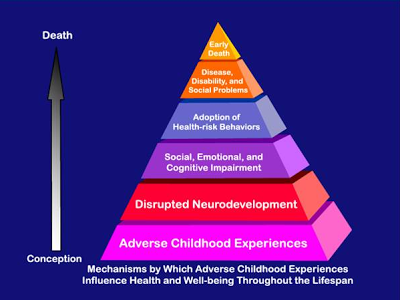
You may be asking how this could possibly be good news?
Because of the ACE study, there is now ample proof domestic violence causes long-term mental and physical health problems for the children who experience it. Traditionally, courts have not looked at the overall toll domestic violence and trauma have on the children who live in the home. You may often hear a judge or custody evaluator say, “There was one fight, but the parents are separated now, so this is no longer an issue.” They have not looked at the pattern of power and control that exists in the home, and the amount of fear the children have of their abusive parent.
Domestic violence advocates are the perfect people to explain this dynamic to court personnel. DV advocates can also explain that the best way to ameliorate the damage from ACEs is to:
Safeguard the child from future abuse. This means the child should not have unsupervised contact with the abusive parent.
Get the child exercise, psychological therapy, and give them anti-inflammatories, (stress causes inflammation in the body which can be overcome with anti-inflammatories). Because of these recommendations, the non-abusive parent should be the person assigned to make medical decisions for the child.
Allow the non-abusive, safe parent to give the child plenty of emotional support. This means the safe parent should be awarded custody of the child.
#4 Protective mothers, you are not alone in your fight to rescue your children from the family court system. Many women all over the United States have bonded together to fight for their children. Here are a few of the organizations I learned about at the conference I can recommend. If you find no groups in your area, contact these groups, and they can refer you to help in your area:
Battered Mother’s Custody Conference
Florida NOW Child Custody & Family Court Committee
Center for Judicial Excellence
Child Abuse Solutions
Barry Goldstein is an attorney who has been representing victims of domestic violence for 30 years. He now provides workshops, judicial and other trainings regarding domestic violence particularly related to custody issues. He also serves as a consultant and expert witness. His website has a great many resources.
I pray all you protective parents will not lose heart while you wait for the family court system to change. I heard many sad stories while at the Battered Mother’s Custody Conference of really good, loving mothers who have had their children taken away from them and given to their abusers. I was impressed by the tenacity of these mothers, some of whom have not seen their child(ren) in five years. These mothers have found ways to continue being mothers, even though they have been denied access to their kids. Some were allowed to see their child one hour a week, or call periodically. These moms poured all their mothers’ hearts into those brief moments, making the best of an impossible situation. Others who had no contact at all with their kids wrote letters to give to them “one day”. Still others used their energy to fight for the mothers of other children, and to keep up their emotional and physical health for the sake of their children. To all of you, I salute your spirit and courage.
I pray these words from the Apostle Paul in 2 Corinthians 4:8,9,16-18 will encourage you:
We are hard pressed on every side, but not crushed; perplexed, but not in despair; persecuted, but not abandoned; struck down, but not destroyed. Therefore we do not lose heart. Though outwardly we are wasting away, yet inwardly we are being renewed day by day. For our light and momentary troubles are achieving for us an eternal glory that far outweighs them all. So we fix our eyes not on what is seen, but on what is unseen, since what is seen is temporary, but what is unseen is eternal.
May you feel the Lord’s presence as you walk this painful journey. Caroline
*In the majority of cases, the abuser is the father, the protective parent the mother. Occasionally, these roles are reversed.
**http://americanmotherspoliticalparty....
***http://www.barrygoldstein.net/importa...


May 15, 2014
A Crisis in the Family Courts

A crisis is occurring for abused women* and their children in many of the family law courts in every state of the United States. I have heard similar stories from women in Australia and the United Kingdom as well.
What is this crisis? Abusive fathers use the court system to aggressively litigate against their former partners, using the courts to stalk, harass, punish, and impoverish them. Some fathers are aided by judges, court-appointed personnel, (such as guardian ad litems and psychologists), along with aggressive “men’s rights” organizations.
Why is this happening? As in the general population, court personnel, (even judges, guardian ad litems and psychologists), are not trained in domestic violence. As a result, they do not understand truths about DV:
A man who abuses his partner will also abuse his children.
90% to 96% of child sexual abuse is perpetrated by males.
Batterers are 6 to 19 times more likely to commit incest than non-battering parents.
Children hardly ever fabricate allegations of sexual abuse (0% to 2%) even though they may later recant (change their story).
Effects of child abuse are cumulative. The best way to ameliorate the effects of child abuse are to prevent additional abuse in the future, (i.e. limit access between the child and the abusive parent) and to allow the non-abusive parent to give emotional support to the child.
Often, court personnel believe children need their fathers, whether or not the child is very attached to the father, and whether or not he is abusive. They also believe abused mothers regularly lie about the abuse they and their children have experienced in order to keep children from their fathers. They believe in “Parental Alienation Syndrome.” This is a theory created by Richard Gardner in the 1980s which claims a parent can alienate a child from the other parent, usually as part of a custody battle. However, a recent study** found that only 6% of children were extremely rejecting of the other parent, and this was usually when there was good cause: sexual abuse in 9% of the cases, general mistreatment of the child in 36%, and domestic violence in 44% of the cases, with the fathers 3 times more likely than mothers to be the perpetrators.
Because most men are wealthier than their female partners, they can spend more on court battles. They can hire better lawyers, and more influential “expert” witnesses. There is a trend in our country to not only give abusers some unsupervised access to their children, but to even give full custody to the abuser, and require the protective mothers to have minimal supervised visits with the children they are trying to protect. Sadly, the more the mother brings the abuse to the attention to the court, the less parental time she gets with her children. As a result, she is told by her lawyer to “say nothing” about the abuse her children are experiencing, in effect, she is told to lie to the court.
There is something seriously wrong with this picture.
Who are the real losers in these court battles? The children the court is supposed to protect.
Click here to listen to three young people describing their experience with the court system while they were growing up. ** Trigger warning for adult and child victims of abuse **
This is the bad news. Is there any good news? Yes there is. I will share the good news in my next blog. Tune in next week.
Until then, let’s pray:
Dear Lord,
Children are precious to you. In Matthew 19:14 you said to let the little children come to you, and not to prevent them. Lord, thousands of little children are suffering at the hands of abusers because our court systems are failing to protect them. I pray we as a society will become more educated about domestic violence, and the toll it has on our children. As we do, I pray our court system will do a better job of protecting these children. Please be with them and their mothers in the meantime. Amen
* While the majority of the time it is abusive fathers who use the court systems to continue abusing their former victims, abusive mothers do use the courts this way on rare occasions.
** Johnston, Walters, & Olesen, Is it Alienating Parenting, Role Reversal or Child Abuse? A Study of Children’s Rejection of a Parent in Child Custody Disputes, The Hayworth Press, 2005.
April 29, 2014
The Lord Gives and the Lord Takes Away

This morning I received an email from FamilyLife about the tornado that ripped through Arkansas yesterday. Dennis Rainey shared that Rob Tittle, a FamilyLife staff member died in the tornado that crushed parts of central Arkansas. Rob was helping his wife and their nine children under a stairwell when the tornado disintegrated their home. Rob was doing what he was apt to do – put his family first – when the tornado hit his home. Two of his children, Tori, age 20 and Rebekah, age 14 were also killed in the storm. All that is left is a grim grey slab of concrete.

Whitney Tittle, age 19, posted this on Facebook: “This is Whitney from a friend’s house. My mom, and six brothers/sisters are alright. We have lost three of our family . . . Dad, Tori and Rebekah; prayers would be appreciated. The house is gone, stripped from the foundation. The Lord Gives and the Lord Takes away, Blessed be the Name of the Lord.”
When I read that quote from Job 1:21 I burst into tears. How many of us could respond this way? Wouldn’t we instead be wailing in grief, cursing God?
Later this morning, I read The Blog by Melodiesther. In it, she chronicles her family’s struggle coming to terms with her five-year old son’s Type 1 Diabetes. Today she said something that I found very profound. She said, “Perspective is a big deal!! Disease, healing, God’s sovereignty, suffering…these are all things we wrestle with daily. It is important to have the right perspective about these issues. Can you see the difference in these two sentences?
It is because of God that I’m forced to survive this painful life.
OR
I can survive this painful life because of God.”
This is my take-away:
Many of us have been through the horrible experience of domestic abuse. No one should ever be abused by someone who they love and who is supposed to love them and protect them. I struggle daily with looking at the world through the negative lenses of someone who has been through trauma. Though my life today looks nothing like it did when I lived in my abusive marriage, I still tend to “catastrophize” everything and expect the worst for my future. Maybe many of you do the same. I forget all the ways God has blessed me with an amazing new husband and a beautiful family. Even if He hadn’t given me these blessings, He gave me Himself, and that’s enough.
I pray we will all count our blessings today, and be able to say with Whitney Tittle,
The Lord Gives and the Lord Takes away, Blessed be the Name of the Lord.
April 24, 2014
Children of Domestic Violence Champion

I feel very honored to be named a Champion by Children of Domestic Violence. CDV.org is a great organization working hard to prevent childhood domestic violence, and also to empower current and former victims.
I don’t often talk about the fact that in addition to being abused in my first marriage, I was also a victim of childhood domestic violence. Many people like me who grew up in abusive homes unintentionally choose abusive mates as adults. This is the way domestic violence passes from one generation to another.
For example, when my future husband yelled at me for ordering a sandwich at a “nice restaurant,” this felt normal to me. After all, being verbally abused by my step-dad was a regular occurrence at our dinner table. I should have told my future spouse to “hit the road Jack, and don’t come back.” Instead, I apologized! For what? I didn’t see anything else on the menu I wanted, so I ordered a sandwich. Why did he care? It cost him less than one of the expensive entrees would have cost him.
Later, when he gave me the silent treatment to punish me for something else I’d done “wrong,” I had another chance to escape before marrying him. Instead, this again felt “normal” to me, since my step-dad often gave us the silent treatment when he was angry. When this happened with my fiancé, I bent over backward trying to placate him, jollying him until he “forgave” me. This episode was a precursor to the later years of my marriage. During the last five years of my marriage, he took giving me the silent treatment to a whole new level. By that time, he would stop speaking to me for a MONTH at a time when I did something “wrong.” The last year of our marriage, he didn’t speak to me for an entire YEAR, unless he was raging at me.
If you would like to read the story about how my childhood abuse led to my being abused as an adult, click here.
I invite you to check out CDV’s website. On it you will find:
A chilling 911 call from a 6-year-old whose parents are “having a fight.”
The “Change a Life” program, an on-line interactive training program to teach you how to help a current child victim.
Video and written stories of survivors (including mine). You can add yours!
The latest research on the effects on children of living in homes with domestic violence.
Ways you can get involved in fighting this epidemic in the media, and in legislation.
God highly values children. He says in Psalm 127:3:
Children are a heritage from the Lord, offspring a reward from him.
Jesus said in Matthew 18:10:
“See that you do not despise one of these little ones. For I tell you that their angels in heaven always see the face of my Father in heaven.”
Let’s pray.
Lord, I pray for the millions of children affected each year by domestic violence. Please let them feel your presence. Give them a caring adult they can confide in. Bring healing to their hearts so they can grow into healthy adults who do not pass domestic violence onto their children. Also, Lord, please be with adult victims of childhood domestic violence. Help them to experience healing as well. Help me and CDV.org be a part of that healing. Amen.
April 11, 2014
How Churches Can Get it Right

In my last blog, I told the story of how I asked two different pastors at my church for help when I was being abused by my first husband. In both cases, my pastors were unable to give me the help I needed. Because of their lack of knowledge about domestic violence, I remained in my hopeless abusive marriage three years longer than necessary.
Because many victims of abuse turn to their churches first for help, I believe it is vitally important for our pastors to be educated about domestic violence. Here are some ideas for ways pastors can become educated:
Read books about domestic violence, I have a good list on my Get Help page.
Seek training at or from their local women’s crisis center – many centers offer free training courses for the community.
Take a college course at a local community college or university.
Next, I’d like to share some thoughts on things a pastor can/should do when an abused wife* comes to him/her for help because of abuse in her marriage. These ideas are taken from A Journey through Emotional Abuse: from Bondage to Freedom, pages 123-125.
The best possible outcome of telling your church would be the church supporting you (the victim), and helping you remain safe, while holding your husband (the abuser), accountable for his actions. If this did happen, you might have hope of saving your marriage, or at least you and your children would be able to live safely.
The church’s response would take two major focuses: what they do for you, and what they do for your husband. For you, they would hopefully**:
Believe you.
Protect your confidentiality.
Not disclose to your husband or anyone else in the church anything you’ve told them.
Not disclose to anyone where you are if you have gone somewhere safe.
Pray with you and for you.
Help you with any questions you have about the Bible and what God thinks about your situation.
Offer to help you find a woman to mentor you through the next difficult period of your life.
Refer you to local agencies that can help, such as women’s crisis centers, legal services, counselors, child protection services, etc.
Offer to help in the short-term with any financial needs you may have.
For your husband, they would hopefully meet with him in a public place with two or three leaders from the church who are able to keep a confidence. This is to protect their physical safety as well as the confidentiality of your husband. At this meeting they would:
Not disclose anything you have said to them, nor would they confront him.
Be prepared for him to confront them, and/or for him to claim to have recently converted to Christianity.
Focus on how your husband perceives his relationship with you, and remind him of his obligations to provide a safe, loving home for his family.
Challenge any rationalizations he might give for his abusive behaviors, such as “Yeah, I am a little harsh, but she. . .” or “The Bible says the man is the head of the wife.”
Help him distinguish between his feelings and his behaviors. Feeling angry and raging at someone are very different; harm comes when emotions are inappropriately expressed.
Help him redefine masculine thinking. Show him “real men” don’t need to use power and control over their wives.
Refer him to a batterer intervention program. Let him know they think this is his best chance to save his marriage.
Let him know they will be following up with him over the next several weeks/months.
Tell you immediately if he threatens to kill you or himself, and call the police. This is because abusers often kill their partners before they kill themselves.
Pray with him and for him.
Often a pastor or elder will want to try to single-handedly counsel an abusive man. Sgt. Donald Stewart, author of Refuge: A Pathway Out of Domestic Violence and Abuse does not recommend doing this.*** He explains that the issues which cause a man to abuse his wife are very complicated, and require more time and skill to work through than a pastor has. For this reason, your husband would be better served by entering a treatment program for domestic violence offenders, which is designed to deal with these issues. The program will need to last at least nine months for it to be effective.
Note: According to the U.S. Department of Justice, “Many practitioners disapprove of – and at least twenty state standards and guidelines expressly prohibit – couples counseling for batterers.”****
Because of this, I HIGHLY recommend you NEVER go to joint counseling with your abuser. Doing this can put your life in serious danger.
What is our take-away today?
Pastors need to become educated about domestic violence before EVER trying to counsel an abuser or abuse victim.
Pastors would be wise to avail themselves of community resources such as women’s crisis centers, domestic violence treatment centers, legal services, child protective services, etc.
Pastors should not try to counsel an abuser on their own. Instead, they should rely on experts in the field.
Pastors should NEVER recommend joint counseling for couples when domestic violence is present in the relationship. Doing this puts the victim’s life at risk.
Pastors and churches, please learn to be wise when it comes to dealing with abusers and their victims.
In Matthew 10:16, Jesus tells his disciples,
“I am sending you out like sheep among wolves. Therefore be as shrewd as snakes and as innocent as doves . . .”
Proverbs 24:1-4 says:
Do not envy the wicked,
do not desire their company;
for their hearts plot violence,
and their lips talk about making trouble.
By wisdom a house is built,
and through understanding it is established;
through knowledge its rooms are filled
with rare and beautiful treasures.
Deuteronomy 10:17-18 says:
For the Lord your God is God of gods and Lord of lords, the great God, mighty and awesome, who shows no partiality and accepts no bribes. He defends the cause of the fatherless and the widow, and loves the foreigner residing among you, giving them food and clothing.
And finally, Ephesians 5:11-16 says:
Have nothing to do with the fruitless deeds of darkness, but rather expose them. It is shameful even to mention what the disobedient do in secret. But everything exposed by the light becomes visible—and everything that is illuminated becomes a light. This is why it is said:
“Wake up, sleeper,
rise from the dead,
and Christ will shine on you.”
Be very careful, then, how you live—not as unwise but as wise, making the most of every opportunity, because the days are evil.
Let’s pray.
Lord, I pray the day will come when all pastors will become educated in how to help families that suffer from domestic violence. I pray fewer victims will be told to “pray harder,” or “submit more,” and given no practical advice. Lord, help us all become wiser in learning ways that will decrease the number of families who are torn apart by this epidemic. Amen.
* In this case, the abuser is the husband, and the victim the wife. Many of the same principles would apply if the roles were reversed.
** Conversation points for the wife and husband taken from The State of New Hampshire Governor’s Commission on Domestic and Sexual Violence and Attorney General’s Office Faith Communities: Domestic Violence Protocol 2007, http://doj.nh.gov/criminal/victim-ass..., 9 – 13.
*** Detective Sgt. Donald Stewart, Refuge, A Pathway Out of Domestic Violence and Abuse (Birmingham, AL:New Hope Publishers, 2004).
****K. Healey, C. O’Sullivan, & C. Smith, Batterer Intervention: Program Approaches and Criminal Justice Strategies. (Washington, DC:US Department of Justice, Office of Justice Programs, National Institute of Justice, February 1998).
March 30, 2014
When Churches Get it Wrong

Lately I’ve been posting comments and questions to my twitter and Facebook accounts about churches and how they help or hinder the abused.
If you ask your church for help with domestic violence, and they tell you to submit, pray harder or be a better wife, they can’t help you.
Often abusers hide in the church as wolves in sheep’s clothing. We need to be as innocent as doves and as shrewd as serpents. Matthew 7:15
One way for a domestic violence victim know whether to seek help from their church? Has the pastor ever preached about it?
I have been surprised at the amount of interest these have attracted, but I shouldn’t be. This issue is the reason I started writing my book, A Journey through Emotional Abuse: from Bondage to Freedom . It is the reason I became a domestic violence advocate, and the reason I became a blogger.
When I was in my emotionally abusive marriage, I felt I could never leave my husband because of my faith. I knew all the verses in the bible that said, “God hates divorce”, and a woman must “submit” to her husband. These verses, and the way my church and I interpreted them kept me in bondage for many, many years.
I did try to seek help from my church though. The first time I went to see one of the many pastors in my large church, I went to see an older beloved pastor. He told me, “I don’t think your husband will change unless you divorce him.” Well, he was right about that. At the time however, I was nowhere near ready to do that. The pastor offered to pray for me. He didn’t offer me any practical advice, and how I needed some practical advice! The phone number to the National Domestic Violence Hotline, 1−800−799−SAFE(7233)* would have really helped me. A list of some domestic violence books to read* would also have helped me. I would have loved the name of a counselor or crisis center in my area I could have called. Any of these things might have saved me three years of pain.
I am sure this pastor had no knowledge of any of these tools, so he only offered to pray for me, and left me to return to my abuser…and three more years of hell.
Two years later, my husband was much more abusive. I decided to try once more to seek help from my church. This time, I went to one of our senior pastors. This pastor listened to my sad tale of verbal and emotional abuse, which had escalated into physical abuse. He offered to speak to my husband, which he did. It made no difference. My husband became more abusive than before. He was furious I had told the pastor what was happening in our home. From that moment forward, he didn’t speak to me (except to rage at me) until I got a restraining order a year later.
We did communicate . . . by email . . . while in the same house. We slept in the same bed, I cooked his meals, we went to church together, and put on a “happy face” for the world. It was really pathetic.
Also during this time, he woke me in the middle of the night by ripping the covers off me to rage at me, he told me how he wanted me to die, he restrained me, he hit me with a belt leaving bruises, he hit our daughter leaving welts on her arm . . . etc.
What was our pastor doing during this time? He called my husband and I separately a few times over a 2 month period. He asked my husband how things were going. My husband lied and said things were improving. Then he asked me how things were, and I told him the truth. Finally, my husband (during a rage) told me to tell the pastor to stop calling. I was afraid of him, so I obeyed. The pastor . . . stopped calling! I hoped he would understand that things were not better and the reason I was asking him to stop calling was I was in danger. But, he had not been trained in domestic violence, so he didn’t get it.
Fast forward 9 months. My life was an interminable hell. I finally called the National Domestic Violence Hotline. They suggested I read Patricia Evan’s book the Verbally Abusive Relationship. I finally acknowledged to myself I really was being abused. The hotline gave me the number of my local women’s crisis center. I went to the crisis center and met with a DV advocate. Within 6 weeks, I had a lawyer, a restraining order, and I had kicked my husband out of my house.
Guess whom my husband called first? You can probably guess . . . our pastor! Our pastor immediately called me, and told me I had no biblical right to divorce!
I can’t remember a time I’ve been angrier. I kept the conversation short. I told him I came to the church twice for help, and that he personally had known for a year I was being abused, but did nothing to help me. I told him I was now afraid for my life, and I couldn’t live in this hell any longer. I said I didn’t want to discuss it any more, and I had better hang up before I said something I would regret.
The next two years of my life were rough. I had to fight for my kids, my reputation at church, and my sanity . . . but that’s a story for another day.
What’s the point of me telling you this story?
My story is not unusual. Christian women** will often go to their churches for help when they find themselves being abused by their “Christian” husbands. They do this because they want to honor their marriage vows, even though their husbands don’t. They are confused about what the bible says about abuse, because it isn’t obvious. They want and need help.
Sadly, most pastors have not been adequately trained about domestic violence. One statistic says that seminaries spend as little as three hours teaching pastors what to do in cases of domestic violence. Given that one out of every four women will experience domestic violence in her lifetime, (and this statistic is the same within the Christian church***), three hours of training is woefully lacking.
The average person does not understand the dynamics of domestic violence. They don’t understand it gets worse over time. They often think it “takes two” to make an argument. Pastors often think if a wife will just “submit”, all will be well. Going to a pastor for counsel who has such erroneous beliefs is worse than seeking no counsel at all.
It can be deadly for an abuse victim.
In Matthew 10:16, Jesus tells his disciples,
“I am sending you out like sheep among wolves. Therefore be as shrewd as snakes and as innocent as doves . . .”
Our pastors, and the church in general, needs to realize that abusers hide in our congregations like wolves among the sheep. Therefore, we need to be as innocent as doves, but as shrewd as snakes. We need to learn how to recognize the wolves, and learn how to prevent them from devouring the innocent sheep among us.
In my next blog, I will talk about ways churches can help abuse victims who come to them for help. Until then, may the Lord bless you all,
Caroline
* For a list of Domestic Violence Hotlines around the world, and Domestic Violence books to read, go to my Get Help page.
**The same principles apply if the abuser is the wife and the abused is the husband, although in this case, the husband is not being asked to “submit” to his abusive wife.
*** “. . .religion is not a deterrent…there is just as much abuse (spousal, child, and sexual) in Christian homes as in non-Christian homes”, according to the Christian Coalition against Domestic Abuse.
March 11, 2014
Returning (Reluctantly) to the Days of Emotional Abuse

Today I would like to get more personal than I usually do . . . here goes.
I am a step-mom. I am also a survivor of domestic violence. Some days these two don’t collide, but often they do. Let me explain.
I love my stepchildren, but make no mistake, being a step parent is hard. Heck, being a parent is hard. Period. But having been both, I can attest that being a step parent is harder. Some days, my step-kids give me the right to parent them, with all this entails: cuddles, and boundaries, giggles, and discipline. The next day, with no warning, they allow me none of these things. They greet my simple “hello” with a frosty glare. Questions about their day at school are answered with a grunt. On numerous occasions, one of them will wake up and decide not to speak to me. All day.
If one of my own (birth) children acted this way, I would either:
Tell them to snap out of it, or
Ignore them.
I wouldn’t enjoy it, but it wouldn’t cause me so much angst. Why not? I am 100% sure my kids love me. No matter what we have been through, this is something I don’t question.
I can’t say this about my step-kids. I am NOT sure they love me. Some days they merely tolerate me. Yes, I pick them up from school, buy and cook their food, plan their birthday parties, go to their parent-teacher conferences, help them with their homework, etc. But, they would really prefer being with their “real” mom. I don’t fault them for this. It is just a fact.
What does this have to do with me being a domestic violence survivor? My loving, supportive, encouraging second husband, (who is also a counselor), explains that because of my history, my step-kids “trigger” me. In other words, their actions bring me back into the time I was being abused by my first husband.
During my emotionally abusive first marriage, my husband’s favorite tool was withholding . . . just about everything. You name it, he withheld it from me . . . attention, affection, love, money, physical touch. He withheld to punish me if I wasn’t doing what he wanted me to do. Early on in the marriage he would do this for a few hours. Later, he would do it for a few days. Toward the end of the marriage, he would do it for a month at a time. The last year of our marriage, he didn’t speak to me for a year…unless he was raging at me.
Imagine if you can, living with a person who is silent to you for an entire year. He was working from home, and I was a stay-at-home mom, so we were in the house together 24-hours a day. I rarely had a break. He would walk by me as if I didn’t exist. At the dinner table, he would eat the meal I prepared for him, but would talk around me to our children. If he needed the ketchup that was next to me, he would ask one of the kids to hand it to him. Because he wanted the kids to believe “nothing was wrong” in our marriage, he did not allow me to sleep in a separate room from him. Therefore, I lay next to him in our bed, night after night.
While he was withholding from me, he would also ambush me with surprise rages. I would think I was alone in a room, and suddenly, he would appear, screaming at the top of his lungs about whatever was making him angry. He woke me several times in the middle of the night by ripping the covers off me. On a different day, he calmly told me he hoped I would die when I went out in my car. My counselor nicknamed him the “terrorist” because of actions like these.
I have been out of my abusive marriage for close to a decade. In most ways I function well in society, and I enjoy a happy second marriage. However, getting the cold shoulder from my step-kids brings me back to those long years. I sometimes wonder if I will ever be healed. When I read the blogs and Facebook posts of other formerly abused women, I know I am not alone in this struggle. We second-guess ourselves, worrying we will never be healed. Can God use us when we are so broken? I believe He can, and this is how:
Imagine you were once a beautiful ceramic jar, perfect and whole. If someone were to put a small lamp inside the perfect jar, how much light would shine out? Only a little bit, from the opening at the top. Now, picture the jar broken and shattered into many pieces. This is a picture of our lives broken by the abuse we have suffered. God can take the many broken pieces of our lives and glue them back together. However, the jar will no longer be perfect. It will now have holes in it where small pieces of ceramic were shattered and/or lost. It doesn’t look perfect on the outside any longer. Yet, what happens when the same small lamp is placed inside the broken ceramic jar? Light can now pour out through the holes, where the broken places are.
This is an allegory of our lives if we give them over to God for healing. The light represents God and His wisdom and joy. We can share this light with others who experience the same pain we have experienced. I have empathy for other abuse victims and survivors, (and even other stepparents) I would never have had if I had never walked in their shoes. I can be more of a help to them because of my brokenness, not in spite of it.
I am no expert on healing from abuse. However, I have been walking down the road toward it for some time. Click here to read a blog I’ve written outlining some of the steps I’ve taken on my personal journey toward healing. I am currently writing my second book, A Journey to Healing after Emotional Abuse. For me, book writing is a slow process, so I’m not making any promises about the completion date. Like my journey to healing, my journey to writing this book is, well, a journey.
If you find yourself still in an abusive relationship, I invite you to read my first book, A Journey through Emotional Abuse: from Bondage to Freedom.
I would love to hear your stories and comments.
I pray you feel the Lord’s presence as you take your own personal journey toward healing. Bless you all.
Caroline
February 7, 2014
Satan is NOT Stronger than God

I often hear that Satan is God’s enemy, which is true. However, Satan isn’t God’s equal. He is no match for God. We often believe that God is in a neck-to-neck war with Satan. Who will win we wonder? While it may appear that Satan will win a battle, there is no question who will win the war. God will always win! Why is that? Satan is not all-powerful, all-knowing, all-present as God is. No, he is only a created being, created by …. that’s right, God.
Satan was once an angel, and has all the limitations of angels. If anyone would be his equal, it would be the archangel Michael. Every time Satan comes up with a new strategy, God is always way ahead of him. Lets look at a few examples from the bible:
When Pharaoh tried to destroy the nation of Israel by heaping heavy labor on their backs, God was preparing Moses in the desert to lead them to the promised land (Exodus 2:23-3:22.)
When the giant Goliath challenged the Israelite army who shook in fear, God had already trained the young shepherd David to kill lions and bears with his sling (1 Samuel 15-16.)
In the book of Esther, when Haman came up with the idea to murder all the Jews in the known world, God had already put Esther in the palace as the Queen (Esther 3-4).
The best example is the cross. Satan thought that by killing Jesus, he would be victorious for all time. But God turned Satan’s plan into his ultimate defeat, and our eternal salvation (John 19-21, Acts 1-2 ).
How can this idea come true in the life of an abuse victim? Satan is partnering with your abuser to bring evil into your life. At the same time, however, God is working for all those who believe in Him to bring them good, not harm. This may seem a ridiculous concept to you now, especially if you are still in your abusive relationship.
Here are some verses to hold onto:
Genesis 50:20a
You intended to harm me, but God intended it for good…
Jeremiah 29:11
“For I know the plans I have for you,” declares the Lord, “plans to prosper you and not to harm you, plans to give you hope and a future.”
Romans 8:28
And we know that in all things God works for the good of those who love him, who have been called according to his purpose.
If you would like to explore the idea of bringing good from the evil Satan has planned for you by trying to repair or safely leaving your abusive relationship, I invite you to read my book, A Journey through Emotional Abuse: from Bondage to Freedom.
May the Lord bless you all today, as He walks beside you each step you take.
Caroline
January 23, 2014
Helping Teens with Relationship Abuse

Teens can experience violence in their relationships, as well as adults. Today I would like to highlight a different organization in three countries that focuses on helping teens.
In the United States, in New York City, the Center Against Domestic Violence (CADV) offers a Relationship Abuse Prevention Program (RAPP). This program teaches students about relationship abuse, sexual harassment, and how to build healthy relationships. Peer leadership gives the program great strength. Their website offers:
A Healthy Relationship Quiz
A Safety Plan for Teens
Ways to help a friend who they suspect is being abused.
In Australia, Bursting the Bubble focuses on abuse teens might be experiencing in their homes. It discusses domestic violence between their parents, how this might affect them, and also emotional, physical and sexual abuse the teens might be experiencing at the hands of family members. Their website offers:
Emotional and Sexual Abuse Quizzes about their family
Discussions about why this happens (it is never the teen’s fault)
True stories from other young people
Action plans for getting safe.
In the United Kingdom, DealwithDV offers a Blackberry Messaging service to support teens in abusive relationships. They also offer workshops for teens, and help for those who are ready to make the transition from victim to survivor. Their website gives:
Warning signs of domestic violence
Equality and respect, and power and control wheels
Lists of ways a person can be abused via social media.
Hotline numbers for each of the three countries are mentioned below:
United States National Teen Dating Violence Hotline 1-866-331-9474
Australia Kids Help Line 1800 55 1800 www.kidshelp.com.au
United Kingdom ChildLine 0800 11 11
What does the bible say about teen abuse? Matthew 18:6 says:
If anyone causes one of these little ones—those who believe in me—to stumble, it would be better for them to have a large millstone hung around their neck and to be drowned in the depths of the sea.
Yes, the Lord places a high value on each life He has created. Psalm 139:13-16 says:
For you created my inmost being;
you knit me together in my mother’s womb.
I praise you because I am fearfully and wonderfully made;
your works are wonderful,
I know that full well.
My frame was not hidden from you
when I was made in the secret place,
when I was woven together in the depths of the earth.
Your eyes saw my unformed body;
all the days ordained for me were written in your book
before one of them came to be.
God has confidence in our youth’s abilities, as it says in 1 Timothy 4:12:
Let no one despise you for your youth, but set the believers an example in speech, in conduct, in love, in faith, in purity.
In fact, the Lord promises, in Jeremiah 29:11-14a:
For I know the plans I have for you,” declares the Lord, “plans to prosper you and not to harm you, plans to give you hope and a future. Then you will call on me and come and pray to me, and I will listen to you. You will seek me and find me when you seek me with all your heart. I will be found by you,” declares the Lord.
Let’s pray:
Lord, I pray that you will be with any teen that is experiencing abuse, whether in their own relationship, or in their home. Please give them courage to seek help from a friend, teacher, or organization who is committed to helping teens with relationship violence. I pray you will allow these organizations to continue the great work they are doing, and encourage them Lord. Amen.
December 16, 2013
Holidays Are Painful for the Abused

The holidays can be extra painful for victims of domestic violence. All around you are images of happy people sitting by cozy fires opening gifts together, or gathered around a table laden with wonderful food. There are parties to attend where everyone is smiling and laughing (and consuming alcohol). Families arrive at church decked out in their Christmas best, their faces shining with joy. You may be present at these parties and church services, but you don’t feel like smiling or laughing. Yet, your abuser expects you to look joyous.
Because of the holidays you may now have many more “to dos” on your list. You must potentially:
Decorate your house
Write and send out a long list of Christmas cards
Buy presents for your abuser, your family, his* family, your children, friends
Bake cookies and pies, and cook an elaborate Christmas meal
Take care of children all day who are now on break from school
Be around your abuser more, who also might be on vacation
Go to parties, or host parties at your house
Have family members stay with you, or travel to see family (some of whom you intensely dislike).
All of the above items will stretch everyone’s (non-existent) patience, and the family’s sometimes very tight budget. In addition, you will feel you need to meet all his expectations, which you know from experience you can’t do.
Is there anything a victim can do to make things better? Can the victim’s family and friends help? The Pixel Project has identified 16 Safety Ideas and Tips for Women (or Men) facing Domestic Violence over the Holiday Season. Here is the link .
Many of the tips for victims have to do with creating an escape plan, and rallying the help of family and friends. Also, there is a tip about how to defuse an argument with the abuser.
For friends and family, there are tips about how to be on standby for the victim.
In addition to these, I would like to remind victims of their worth to the Lord. Christmas reminds us that the Creator of the universe left the beauty of heaven to come and join us in our pain and misery. He suffered just as we do. He came to us not with a display of his power, but as a vulnerable child. During his life he experienced all types of suffering. He was betrayed, forsaken, spat upon, beaten, and finally crucified.
Jesus showed his love for the downtrodden by:
Healing the woman who had been bleeding for twelve years, (Matthew 9:20-22)
Speaking words of life to the immoral woman at the well (who was usually ignored), (John 4:7-26)
Standing up for Mary and accepting her love, (John 12:3-8), and
Preventing the stoning of an adulteress, (John 8:3-11).
This same Jesus says to us in John 16:33:
“I have told you these things, so that in me you may have peace. In this world you will have trouble. But take heart! I have overcome the world.”
This does not mean that the suffering you are experiencing isn’t real. If you would like to explore the possibility of safely leaving your abuser, I invite you to read my book, A Journey through Emotional Abuse: from Bondage to Freedom, or read my blog about entitled “ What Should You Do If You Think You Are Being Abused “.
I pray you will stay safe during this Holiday season, and that you will have a Merry Christmas and a Happier New Year.
God bless you!
Caroline
*Abusers might be male or female. For ease of writing, in this blog, I portray the abuser as “he” and the victim as “she”. The same principles apply if the victim is “he” and the abuser is “she”, or they are the same gender.


