
David Macinnis Gill's Blog: Thunderchikin Reads, page 21
February 14, 2012
C2E2
In what can only be described as a fanboy wish come true, I'm confirmed as a featured guest for C2E2, the Chicago Comic and Entertainment Expo for Friday, April 13. Comics and Friday the 13th? Doesn't get any better than that.
[image error]


February 13, 2012
On Being Thin Skinned
My next book, Invisible Sun, is due out in a couple of months, which means that reviews are starting to filter in. Reviews come from two primary sources these days, print journals and review blogs. Print journals have been around forever. Blog reviews are a very recent phenomenon. When Soul Enchilada came out in 2009, there were very few blogs that reviewed YA ARCs. Now, there are dozens, maybe hundreds. There is Goodreads (which I avoid like a cloak re-gifted by Medea)adding to the deluge. While the source of the reviews have changed, one thing hasn't, and that's the varied quality of the reviews. In both print and blogger reviews, the quality of the writing and insight varies greatly. To me, though, it doesn't matter because I don't read them unless either someone sends me a link or mails me a paper copy of the review. I don't seek the reviews out anymore, and I use an app to block review sites from search results. I don't like reading even terrific reviews. Why? Because I'm thin-skinned. And that, that is a good thing.
Writers are commonly told to grow a thick skin. That, my friends, is nonsense, because thick-skinned people are not very good writers. They are bullet proof to criticism, yes, but they also lack the insight and empathy required to feel the emotions that should resonant throughout their work. Two recent novels, See You at Harry's and The Fault in Our Stars, are full of such raw, terrible emotions that they move the readers to tears. Neither of the authors are thick-skinned. They are empathetic, creative, and sensitive. They have great insight into the human condition. They see what we can't and hold up a mirror so that we can see ourselves. Remove those qualities from the writers, wrap them in protective callouses, and no reader will shed a tear at their work. No one will care enough to write a review.
So the next time you read that Author X must suffer gladly the slings and arrows of critique, consider this: If Author X changes, there would be no great characters, no heart-breaking story, and no emotion that lingers for days after the reading. In fact, there would be no book at all, which would be a very sad thing indeed.
February 12, 2012
Author Insight: Revising the Journey
Wastepaper Prose is publishing a series of interviews with authors, asking each author the same question in each post. The latest question is: "If you could change one thing about your journey to publication what would it be?" My answer: "It would be faster. I set aside my aspirations for write fiction for family and career, and while I don't regret that, I do regret hat I didn't find a way to chase my dream at the same time."
Going Google Free
I have long had a love-hate relationship with Google. Gmail is my primary email address because of its virtually unlimited storage, and Google's search engine allows more data options than any competetitor. On the other hand, like many small website owners who once made extra income from advertising in the early 00's, I watched as Google monetized and kicked my site out of its search results, then turned around and offered me the chance to pay to advertise on the very same pages that my site was removed from. My site has long since gone away, but it has made me very well aware of one fact: Google privileges its own sites and services in its search results. This can be seen in the pagerank tool, which ranks sites in supposed popularity. Massively popular news sites get a 9. Smaller Google sites get 10s.
You can argue that in a free enterprise system, Google has every right to privelege its own products, and I agree. In turn, I would argue that Google has an obligation to tell you on the search results page that you are not viewing search results from the Internet, but from Google's monetized version of the Internet. For me, that changes how I view the integrity of their product, and therefore, the integrity of their motivations as a company.
On March 1, Google will begin using information about our email conversations, search history, and social media conncections in new ways. It has always mined that data to sell advertsing, but now, it's consolidating that data and storing it for perpetuity. In Europe, Google can only store data for 27 days. In the US, they can track me from the first time I logged into my email account and keep that data forever. That makes me nervous because even though Google promises it will do no evil, I don't know that it has any qualms about turning over data to those who will. We have since the company acquiese to governments before. What is the limit of their data sharing when they want to stay in business?
Those hypothetical questions are necessarily left unanswered because no one can see into the future. Other questions about what Google will do with our data are easily answered, but according to the Electronic Privacy Information Center, Google has neglected to respond to them:
The Google privacy compliance report, made public today, raises new questions about the company's failure to comply with an FTC Consent Order. The Order required Google to answer detailed questions about how it protects the personal information of Google users. But Google chose not to answer many of the questions. Most significantly, the company did not explain to the Commission the impact on user privacy of the proposed changes that will take place on March 1. EPIC has filed a lawsuit to force the Federal Trade Commission to require Google to comply with the Consent Order to protect the privacy interests of Google users. For more information, see EPIC v. FTC (Google Consent Order).
That pretty much is the deal killer for me: I'm kicking the Google habit. It won't be easy because Google has insinuated itself into my internet life, and it will take awhile to disentangle. The first step will be to give the boot to Google+, which had promise but never did anything for me except to give Google another way to track my useage. Harder will be switching search engines, dumping Chrome, migrating my calendar, and changing email addresses. I hope to have all of this done by March 1, when the new privacy rules go into effect. By then I hope to have a new privacy plan of my own, one that won't include Google.
February 9, 2012
I'm Going to Marry This Review
An early review of Invisible Sun courtesy of WhatchYAreading:
Oh, the characters. The best thing about these books for me is the fact that the characters are complete people. With sci-fi, it's easy to get bogged down in the cool world-building and the neat gadgets, but David Macinnis Gill has written two novels now where the neat stuff coexists with these great characters he has given us. The gadgets and gizmos are part of the story, yes, but they enhance the characters. We see the pieces the characters see and touch and use. And we see the way the cool science stuff is literally integrated with the characters. It's a great balance and it lets these books be action packed while keeping their soul.
You can find the rest of this thorough but not-spoilery review here.
February 8, 2012
Real World Teenagers Don't Read Stuff They Don't Choose
The Common Core Standards are raising more hackles again. This time, because the architect of the standards, David Coleman believes that it inauthentic to do pre-reading before teens dive into a scintillating textbook piece.
The problem with his premise? Real world teens don't pick up pieces you'd find the the textbook. They don't choose the material, so there is no interest on their parts in reading it. That's where the teacher comes in by "selling" the piece to increase interest and motivation. Pre-reading strategies are how that gets done. People don't go to a movie they don't want to see, but we ask teens everyday to read pieces they don't want to read. That's difference, and it's huge.
February 7, 2012
Der Mars Stinkt
 Die Menschen haben den Mars besiedelt und versuchen, den Planeten bewohnbar zu machen. Der 16-jährige Durango gehört zu den Regulatoren, einer Art Söldner-Kaste, die für Ruhe und Ordnung sorgt. Er soll eine abgelegene Minensiedlung beschützen — vor den kannibalischen, halbmenschlichen Dræu.
Read a preview of Das Mars-Labyrinth, the German version of Black Hole Sun: jetzt reiniesen
February 6, 2012
Author Insight: People Watching
Wastepaper Prose is reading a series of interviews with authors, asking each author the same question in each post. The latest question is: Where is your favorite place to people watch? My answer: The subway.
Creative Outreach Grants for Teachers & Librarians
Applications are now being accepted for the Annual Virginia Hamilton and Arnold Adoff Creative Outreach Grants for Teachers and Librarians. Two grants up to $1,000 each will be given. One grant will be given to a teacher and another to a librarian for proposals to develop new classroom or library programs that raise awareness of multicultural literature among young people; particularly but not exclusively through the works of Virginia Hamilton. The application deadline is Feb. 28, 2012. For complete instructions and proposal guidelines, see the attached application.
Please complete and submit the application form along with your proposal to Meghan Harper, Ph.D., at sharper1 [at] kent [dot] edu, or by mail to Virginia Hamilton and Arnold Adoff Creative Outreach Grant, c/o Meghan Harper, Ph.D., School of Library and Information Science, P.O. Box 5190, 314 Library, Kent State University, Kent, Ohio 44242. Grant recipients will be announced at the Virginia Hamilton Conference on Multicultural Literature for Youth on Friday, April 13, 2012, at the Kent State Student Center.
For further information, contact Angie Stevens or Dr. Meghan Harper (330) 672‑2782.
February 4, 2012
Invisible Sun
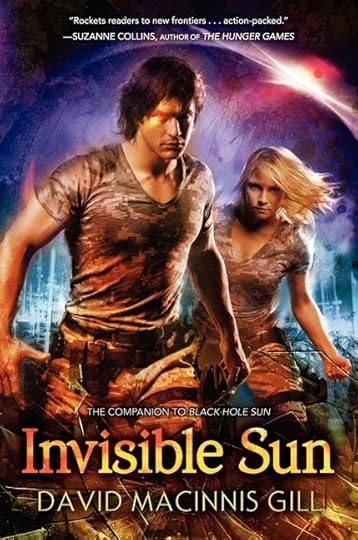 You don't want to mess with Durango. He left his crew behind. His father is dead. And he's going to prove himself to Vienne, even if he dies trying. As he races through flood and fire and across a violent and terrifying planet, there's a 97% chance he's going to die trying. But who's counting?
This grunge dystopian thrill ride with "incredible action, inventive world-building, deadly humor, and more" is the follow-up to Black Hole Sun, which Hunger Games' Suzanne Collins says "Rockets readers," goes on sale March 27, 2012!
Praise for Invisible Sun:
Invisible Sun "reveals new depths in the protagonists..and will leave readers eager for the next volume." –VOYA
Praise for Black Hole Sun:
School Library Journal Best Book of 2010
"Rockets readers to new frontiers … action-packed."- Suzanne Collins, author of The Hunger Games
"Black Hole Sun grabbed me by the throat and didn't let go until the last page. In the best tradition of Heinlein and Firefly, Black Hole Sun is for readers who like their books fast-paced, intense, and relentless. Buy it, read it, pass it on!" - Laurie Halse Anderson, author of Wintergirls and Speak
"Science-fiction fans will cheer Durango on in his exploits and enjoy the twists in the novel's satisfying conclusion."- School Library Journal (starred review)
"Fast-paced, compulsively readable, and outright funny." - The Horn Book
"Action, adventure, sci-fi, and horror buffs will all find this an almost perfect mix of all of the genres." - Bulletin of the Center for Children's Books
Thunderchikin Reads

- David Macinnis Gill's profile
- 134 followers

