
Terry Shames's Blog: 7 Criminal Minds, page 231
July 22, 2015
What to Do? Thin
I find myself in an unprecedented situation, for me anyway: I cannot type with my right hand. Shoulder surgery last week has left me with the unusual complication of nerve irritation (that’s what I’m calling it, since the surgeon doesn’t know just what is.) For someone like me, who types many words every day, it’s frustrating and daunting. And downright scary—although I try not to go there. I’m choosing to think full function will return, and hoping for sooner rather than later.
People’s first reaction on hearing my dilemma is a breezy, “Oh, you’ll have to get some voice recognition software.” Easy for them to say. And I’ll definitely go that route if the situation continues. But I find the prospect disheartening. What this situation has made clear to me is that I think through my fingers, specifically through typing. I type fast, pounding out words as if they were eating up the pages. It’s hard for me to imagine switching to thinking aloud. (It might be a good idea for me to learn to think while I’m speaking, too—but that’s a subject for another day.)

Photo: Puttug my right hand to better use.
The question for now is, what to do while I perform the suggested “wait and see” function. Just before the surgery, I completed a first draft that came in at just over 100,000 words. To say I’m dissatisfied with it is a vast understatement. There’s an occasional scene that works pretty well and it’s an interesting, workable premise, but that’s about it. Characters, setting, action, plot, and motivation all need a lot of work. My usual mode of dealing with this would be to charge at the manuscript full bore, slashing hunks of prose and typing out replacement chunks to see how they work.
Instead, I’m thinking. Instead of writing a lot of words trying to capture what I’m missing in a character, I’m picturing him going about his daily life, pondering what he thinks about when he first gets up in the morning, or when he’s overtired or stressed. Thinking about how he works and what he does for recreation. I’m musing about his regrets, his triumphs small and large, what’s really important to him, and how those things came to be.
Over the years I have cut out articles on writing craft, flagged blog posts, and underlined passages in craft books. Somehow I seldom get around to reading them. I plan to take advantage of my enforced idleness to tackle some of these articles. Who knows, eventually I may come to see this time as a gift.
And now I’ve written an entire post with my left hand—a hand I admire tremendously for stepping up its game!


July 15, 2015
The Pigeon Theory

Have you looked closely at a pigeon recently? They are really pretty birds, with lovely markings, pink feet and interesting eyes. I can hear you now, “Are you nuts? Pigeons are a dime a dozen.” On the other hand, if you see a mountain bluebird in your area, you’re likely to explain, “What a beautiful bird!” Rare. In fact, bird watchers won’t cross the street to see a pigeon, but some travel long distances to see rare birds.
Now imagine that these birds are books and the birdwatchers are readers. The question a writer hoping to be published needs to ask herself is, “Am I writing a pigeon or a bluebird?” In other words are you writing a book very much like dozens of books out there, or are you writing one that will stand out?

I’ve mentioned this before, but it bears repeating. After a long hiatus from trying to get published while my son was young, I decided when he was a senior in high school that it was time for me to get to work again. I promptly wrote a brand new book with a female detective protagonist working for an agency in San Francisco? Sound familiar? Yes, I wrote a pigeon. And sure enough, even though every agent I queried told me it was well-written and many of them said they were eager to read whatever else I wrote, all of them indicated in one way or another, “Ho hum, another pigeon.”
Then I took a weekend writing workshop organized by Sophie Littlefield and Cornelia Read. It was a great workshop, but the pivotal moment for me was when Sophia gave an impassioned speech to those of us struggling to find our writing niche. She urged each writer to reach deep inside and find something he or she was passionate about—something that only “you” could write. She said that’s what you had to do if you were serious about being a success as a writer.
I had heard the first part of that advice before, but this time I heard the second part as well—that this is what you had to do if you were serious. I was working on something else, but that advice kept nagging at me. So about two months later, I sat down to think—really think: what did I have a connection to in my life that no one else had, and that I hadn’t read anything like it. My grandfather and the town he lived in sprang to mind. I had written some short stories set in Jarrett Creek, Texas—even a couple of short stories featuring my grandfather.
The rest is history. The first book, A Killing at Cotton Hill took me only a couple of months to write—it was a book that had been inside me all along—I needed to recognize it. I didn’t know any other characters like Samuel Craddock, and at that time hardly knew any other mystery series set in Texas (one huge exception was Bill Crider).
So I urge you, if you are having trouble reaching an audience, ask yourself if you’re writing a pigeon or an exotic bird that people will flock (groan—pun intended) to see?
July 8, 2015
Writing the Other
Last weekend I was on a panel at an afternoon of all things mystery at Kepler’s Bookstore in Palo Alto. My panel was entitled “It Ain’t Me Babe,” about writing a character who is not you. I write a series about a 60-something man in a small Texas town, an ex-chief of police who takes up the job again. He married a wealthy woman who collected art and grew to love modern art. Under the influence of his next-door neighbor he comes to enjoy a good glass of red wine. He also raises cattle.
It ain’t me, babe! I do like modern art and red wine and I spent wonderful hours in a small town in Texas where my grandparents lived when I was young—but that’s it. I’m noticeably not a man, not a cattle rancher and certainly not a chief of police, ex or otherwise. Sot the panel was just right for me.
But the first question threw me. The moderator talked about a woman who became head of the NAACP for a number of years, pretending to be an African American and asked if we writers were in the position of pretending as this woman was. I’ve been thinking about the question since then. At the heart of the question is the assumption that in order to write someone who is not like you, as a writer you have to pretend to be that person.
I don’t think that’s the case. You don’t “pretend” to become that person. In some ways, mentally, you actually become that person. When I am writing about Samuel, I feel as if I’m a camera, walking through his life, seeing through his eyes, recording events, reacting to them, having opinions about them. In some ways I think that’s what drives us to be writers, the fact that we have other voices in our heads that we channel. Not to be all woo-woo about it, it’s a bit of magic.
Is this what we mean when we talk about being “authentic” as a writer? Sometimes I have trouble getting into a character’s head and the character falls flat. It feels like an inauthentic rendering of his or her part in the novel. In order to come closer to the truth, I find that I have to slip into the skin of the character and mentally move through that world. I don’t know if that’s what other writers do. It’s something I’ve never heard anyone talk about. I’ve heard of writers producing biographies of their characters, but not mentally becoming the character.
I was recently asked if I thought I could write from the viewpoint of a 25-year-old man. Who knows? It feels like more of a stretch than writing an older man and I don't know if I have enough ability to "become" someone so young and with a different world and personal view. I'd like to find out
So I come back to the question. Is it “pretending” or “becoming” someone else? I’m curious to know what others think, and how other writers come to an understanding of the characters they are writing about.
June 30, 2015
I hadn’t heard anyone complain about writer’s block in a ...
I hadn’t heard anyone complain about writer’s block in a while, and then recently someone asked how I overcame it. I am not prone to writer's block, so it was a hard question to answer. After thinking about it, though, I realized that at times I do feel blocked, but that I learned long ago what to do when I can’t seem to get into a writing rhythm. I find a muse.
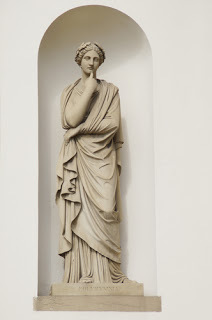
My original muse, who still spurs me to write the best prose I can, will be a surprise to many, who know that I write crime fiction. But I try to write good quality fiction—like my muse. He wrote about the south, and he wrote about crime—true crime. In fact, he wrote one of the most famous true crime books ever written—In Cold Blood.
But his writing that always inspired me was not his crime novels but his short stories. For some reason I could read just a few lines of Truman Capote’s prose, and my writer brain would light up.
In the past few months I’ve been working on a book that is outside my usual genre, a thriller. I was having trouble not only with the action, but also with understanding the protagonist. I couldn’t quite figure out what the reader needed to know about him in order to care about him. It was time to find a muse. I picked up one thriller after another, thinking that if I understood how other thriller writers hooked me I might learn what I needed to know. And one after another I tossed them aside. Each had some kind of problem-- too wordy, no character development, improbable action, too self-conscious. And then I picked up The Tourist, by Olen Steinhauer. I had never heard of this writer, but as soon as I started reading The Tourist I knew instantly I had found a writer who would work for me. His story was convoluted but when he rambled too far afield, he went back and subtly reiterated the salient points. His characters were well differentiated and strongly defined. The story was intriguing and not too over-the-top. Best of all, he made me want to get to work.
So I found my thriller muse. I don’t mean that I will copy him or try to write like him. But when I read his work, I tend to find myself itching to write. For some reason his writing rhythm spurs me to what I need to do to bring my characters and plot to life.
What I wish I had suggested to the person who asked the question about writers block is, “Get yourself a muse.” It doesn’t have to be a writer. It can be music or movies. It can be something in nature, or an animal you love. It can be a friend, or a particular piece of art. But when you see it, you’ll know it. You’ll have a little jolt that makes you feel like you need to get to work. The trick is to recognize it when it happens and to embrace it. And remember it, so that when you suddenly feel empty and unable to put words onto the page, you know where to go.

My original muse, who still spurs me to write the best prose I can, will be a surprise to many, who know that I write crime fiction. But I try to write good quality fiction—like my muse. He wrote about the south, and he wrote about crime—true crime. In fact, he wrote one of the most famous true crime books ever written—In Cold Blood.
But his writing that always inspired me was not his crime novels but his short stories. For some reason I could read just a few lines of Truman Capote’s prose, and my writer brain would light up.
In the past few months I’ve been working on a book that is outside my usual genre, a thriller. I was having trouble not only with the action, but also with understanding the protagonist. I couldn’t quite figure out what the reader needed to know about him in order to care about him. It was time to find a muse. I picked up one thriller after another, thinking that if I understood how other thriller writers hooked me I might learn what I needed to know. And one after another I tossed them aside. Each had some kind of problem-- too wordy, no character development, improbable action, too self-conscious. And then I picked up The Tourist, by Olen Steinhauer. I had never heard of this writer, but as soon as I started reading The Tourist I knew instantly I had found a writer who would work for me. His story was convoluted but when he rambled too far afield, he went back and subtly reiterated the salient points. His characters were well differentiated and strongly defined. The story was intriguing and not too over-the-top. Best of all, he made me want to get to work.
So I found my thriller muse. I don’t mean that I will copy him or try to write like him. But when I read his work, I tend to find myself itching to write. For some reason his writing rhythm spurs me to what I need to do to bring my characters and plot to life.
What I wish I had suggested to the person who asked the question about writers block is, “Get yourself a muse.” It doesn’t have to be a writer. It can be music or movies. It can be something in nature, or an animal you love. It can be a friend, or a particular piece of art. But when you see it, you’ll know it. You’ll have a little jolt that makes you feel like you need to get to work. The trick is to recognize it when it happens and to embrace it. And remember it, so that when you suddenly feel empty and unable to put words onto the page, you know where to go.
June 24, 2015
The Right Advice (at the Right Time)

Writers are constantly bombarded with advice, everything from work habits that are supposed to help you find an agent (or not), get published (one way or another), get blurbs, promote your books, find reviewers, sell more books to personal habits that will help you avoid being overwhelmed, work harder and better, and use resources better, faster, more deeply. We are analyzed as introverts and extroverts and “in-between verts” and advised how to make the most of those traits. We are told what books are hot, which are not and how to take advantage of that.
We are advised which workshops and conferences will give the most bang for the buck, which social media will get our names out in the public—or whether it is worthwhile at all, whether readings at bookstores are worth your time, how to conduct readings to best effect, and what to do if no one shows up at your events.
The advice can be bewildering and sometimes seem at cross-purposes. It can make you feel like you’re never going to be able to do enough. It can make you doubt your abilities and your dedication. It can make you crazy.
So I’m going to give you some advice: Read all the advice you want, but take to heart only the advice that is right for you at this particular time. At first every single tip you read may seem relevant. You are clutching at straws, hoping for that one little tip that will suddenly move you from unpublished to published; from sadly-published to best selling author. Advice that will help you not care if things aren’t going your way or that will make things go your way.
But some advice is better for you in your situation at this moment than others. The advice for how to promote your books is not useful if you don’t have a book out yet, and it’s a waste of your time to dwell on those tips. I’ve had writers who are unpublished ask me what I think is the best way to get a book reviewed in the newspaper. At some point this information might be useful, but it’s a waste of time and precious energy to worry about it until you need it.
I don’t mean you shouldn’t plan in advance—I just mean not too far in advance. At one point, before I found a publisher I began to collect everything I could about the best way to self-publish. I never used the information, but it wasn’t a waste of time because I was approaching the crossroads: I had two novels written and no publisher—and I wanted to be published. But to collect this information before you even have a novel completed is a waste of time. And I don’t mean to ignore the advice. Start a file where you can keep information that you hope to use in the future.
But focus on the advice that’s useful to you right now!
June 15, 2015
The Imperfect Past Perfect
I’m reading a wonderful novel at the moment, which I will not name because I’m going to complain about one aspect of it that drives me crazy: Overuse of the past perfect.
Some of you are going to be mumbling, “I don’t know what past perfect is, really.” Past perfect doesn’t mean that something the past had no flaws. It means that the event happened farther back than the immediate past:
Past: We ran six miles every day for two years.
Past Perfect: We had run six miles every day for two years.
The past perfect implies “in those days.”
Let’s go farther.
“We ran six miles every day for two years. It was glorious. When we moved to the city, we found it hard to keep that up, so we joined a gym.” Completed thought.
“We had run six miles every day for two years. It hadbeen glorious. When we had moved to the city we had found it hard to that up, so we had joined a gym.”

The problem is that in the past perfect the use of the word “had” can get repetitive. (Note the example above “had” in italics). It isn’t necessary to repeat it again and again. The first use of the word “had” establishes that this is something that happened a while back. Then you can use it sparingly:
“We had run six miles every day for two years before we had to move. It was glorious. When we moved to the city we found it hard to keep that up so we joined a gym.”
Does that last sentence lose its meaning by dropping three of its use of the word “had?” No. It just makes the reading smoother.
In the book I’m reading, there is a page or more in which the protagonist is remembering the past. And the author never drops the word “had.” It gets numbing. Not only did the author write it, but the editor did not correct it.
It isn’t that the usage is incorrect; it’s that the usage is cumbersome. Here’s what Chris Roerden says in Don’t Sabotage Your Submission:
“Steer clear of cumbersome…The one-time use of the past perfect tense is usually sufficient to signal a transition to the more distant past…After that the simple past tense is fine. It makes the long-ago action more immediate and less wordy.”
Or from Elizabeth’s Lyon’s Manuscript Makeover, “In flashbacks, drop “had” once the past is established.”
I’m curious to know what grammatical quirks annoy others. Especially those that a good editor should catch and correct.
June 10, 2015
Circling the Computer
I was on an interesting panel at California Crime Writers Conference last weekend. The topic was “The F word.” No, not that word. The word was “fear.” Turns out I’m not a fearful person with regard to writing, although I always have a few days of dread when I turn in a manuscript (what if my editor says, “Uh oh, this one doesn’t cut it.”).
The part that I found interesting is that a lot of people seem to feel embarrassed by procrastination. I listened as several people described their delaying tactics: making sure the kitchen is clean, checking emails, reading an article, doing a little social media, etc. Sound familiar? If it doesn’t, then you are unusual or perhaps telling a little fib.

I suggested that instead of procrastination, those activities could be dubbed “preparation.” Dennis Polumbo, who moderated the panel, said it would come under the heading of “process.” And one member of the audience delighted everyone by saying that her family teases her when they see her doing those little dances. They say, “Mom is circling the computer.” I told her I planned to steal the phrase (note the title above).
I have two different modes of processing my writing. The first is to get up at 6 AM, grab a cup of tea, and start writing. This is usually a first draft method. It works well for me, but only because I’m an early morning person. The second mode is to read the paper, do the Sudoku and Ken-ken, work out, eat breakfast, and finally start working about 10 AM. The first method is draconian and doesn’t allow for much in the way of preparation, and that’s deliberate. When I read The Artist’s Way, by Julia Cameron, I did the morning pages and found that my ideas flowed faster and more freely when I went straight to the page. When I work on first draft, I like having no thoughts between me and the page.
The second works better after I have the first draft done. It gives me a chance to prepare for promotional work, to diddle around, and to keep my world running. In the first method, everything in my household tends to fall to pieces—where are the clean sox? When was the last time the dog had a bath? Why haven’t I written thank you notes to the people who hosted me? The second method allows me to keep my life in some order.
The trick is that, even if you allow yourself procrastination under the guise of preparation, at some point you have to say, “Enough!” and face the pages. Everyone always says I am disciplined, but what I know is that if I dither away the day and don’t get my work done, I feel like a total grump at the end of the day. Just as I would feel embarrassed and sleazy if I neglected to brush my teeth or wash my face. These are essentials. Wearing pajamas all day? That’s okay. Not brushing your teeth? Mmmm, not so much. I don’t think of it as discipline so much as necessity. Preparation is wasted if you don’t put it to good use.
June 3, 2015
Always Learning
This coming weekend, I’m going to do one of my favorite activities—I’m attending a conference--the California Crime Writers Conference in Los Angeles. I’m excited because it’s a conference that’s only put on every other year and last time I went, I learned a tremendous amount. Many conferences are fan-oriented, and they’re wonderful. But this one is a working conference. This weekend I’ll see writers of every level of experience, from beginners to very accomplished and long-published ones.
What makes so many well-published writers spend the time and money to go to a working conference? There’s hardly a writer who can’t benefit from the opportunity to learn what’s new in the world of publishing, as well as to get a refresher in aspects of craft. But it’s also a chance to catch up with friends and become acquainted with other writers. It’s a chance to find out what the current trends are in crime fiction—are food cozies still hot? Is the trend to deeper characterization in thrillers still going strong? Are Scandinavian crime novels still all the rage? Find out who the new small publishers are, and what’s going on with the Big Five. Find out the current state of independent publishing.
When I finally got published, after many years of “close, but no champagne (who needs cigars?)” many people congratulated me on my perseverance. But perseverance was only part of the battle. The bigger part of the equation was that I kept learning, trying to get better. Instead of writing the same book again and again, with different characters, setting, and plot, I kept struggling to write a better book. And I kept up with trends so that I wouldn’t be writing a mystery of the kind that was popular ten or fifteen years ago, but that couldn’t find an audience with current readers.
For the writer trying to break into the business, there’s no better way to meet people who might help you by reading a few chapters and giving you advice or offering to introduce you to someone who can help. You may, as I did, meet a writer who is generous enough to give you a blurb for your first book, or who knows an up and coming agent looking for clients. You may meet an eager editor of a small press who is hungry for good product.
Not only are working conferences a great way to learn, but they are a lot of fun. These days I get to be on the same types of panels that wowed me back when I was struggling. I try really hard to make them as valuable as I found them to be. And you know what? I still get wowed. At every conference I attend I usually find some panel that sparks my creative juices and makes me glad I went. Or I meet an author I’ve always admired and get a chance to hang out with him or her. I’m looking forward to the weekend.
May 26, 2015
Details, Details, Details
Two passages:
“He sat at the kitchen table drinking coffee. He’d have to go out sooner or later.”
“He sat at the stainless steel kitchen table, chosen by his ex-wife and left behind when she moved on, drinking the last of the espresso. He’d have to go out into the cold sooner or later.”
Which passage makes you think you can see the scene? Which one draws you to read on? If I’m not badly mistaken, it’s the second. The old adage is that “the devil is in the details.” But the angel is also in the details. In other words, it’s all about the details.
I’m working on a thriller with a pretty good premise. At 2,000 words a day, it’s humming along. But I hate it. Everyone within earshot has heard me whining about it. If you haven’t heard me, it’s because you haven’t been listening.
The thing is, this is a first draft—what I’m calling a “plot” first draft. It’s one scene after another of who is doing what to whom. Most of the “where” is vague. “Somewhere in Los Angeles.” Somewhere” in Kabul. A few of the characters have made themselves known, but I haven’t bothered to describe them or to describe much of the “place,” where the action is happening. I sometimes mention a polished marble floor here, or a desk there, or a quick glimpse out a window. But that’s about it. And I know that’s why I’m not enjoying the book—because I’m leaving out the details.
In the two passages above, by the end of the first one, you have no idea what “he” looks like or what his “place” is in life. All you know is that he has a table, he drinks coffee, and he has to go out before long. At the end of the second one, you know he’s divorced, and he’s down to his last cappuccino. You also know that he has, or has had, money—to buy the steel table, the cappuccino machine. You know that he let his wife choose the table—does that mean he doesn’t care about furniture? Or that his wife was strong-willed? Or that she was a decorator? You know it’s cold outside and that he hasn’t been out for a while, which may give you some indication of the mood of the story.
I’ve read some manuscripts and even some published books that suffer from the issues that the first passage has. Not that every piece of furniture in a room has to be described, or that every detail of a person’s face has to be described, or that the number of steps leading up to a house has to included. What does have to be included is the “telling” details—the details that indicate something about the character in the scene. So if the point of view character is tied to chair in a strange room, yes he’ll likely look at every single item visible in the room, and we’ll want to know that. If the protagonist is looking at a loved one for the last time, the reader will want to see every detail of that loved person’s face. If your protagonist is walking up to a house he doesn’t want to enter, he might very well count every step.
My point is that it’s the details that make a story worth reading—details that matter. When the details aren’t there, it’s the devil. When they are, it’s the angel.
May 20, 2015
Trying a New Process
When the question “pantser or plotter” comes up, I always say “hybrid.” For the uninitiated “pantser” means flying by the seat of your pants. In other words, the writer starts writing and goes along for the ride, letting the plot unfold on the page. Plotters plot. Some of them make general notes on the direction of the story they want to tell and others write detailed outlines. I’ve heard of writers putting together forty page outlines.
Pantsers say they would be bored to tears if they already knew what was going to happen. Plotters say they will get lost in the weeds if they don’t know what is going to happen.
My hybrid process in my Samuel Craddock series is to start out with a general idea of what precipitated events, and a knowledge of who did the crime. Then I start writing to discover how the story will unfold. At about 20-30,000 words I usually grind to a halt, not sure what will happen next. At that point I write a loose outline of how to get from that point to the end. It isn’t a detailed outline, and things can change, but it gives me a direction.
In the book I’m working on now, that has changed. I’m writing a thriller, and for some reason the mere idea of an outline makes me feel constrained. I want to discover the action as if I am reading the book. I know the end, know who the bad guys are, and know the plot. What I don’t know is how everybody behaves as we move through the book.
Doing this I find meeting my daily goal of 2,000 words really, really hard. Why? Because I have no idea what direction the characters will take. I am discovering who they are as I go along, and in the process am discovering what they are likely to do. I have had a few great surprises, but mostly I find myself slogging along, watching over their shoulder as they show me what they are up to. I find myself favoring some characters over others. I’m doing multiple points of view, and I have to balance whose “turn” it is to be on stage. I have to balance the timeline, making sure I don’t have someone move forward faster than the main action.
The result is that I have chunks of prose that I know will have to go. In some places I mark time, waiting for someone to make a move. At the end of some days I feel like I don’t have any idea what I wrote. Other times I feel pretty good about things—someone explodes onto the scene and shows me what they’ve got.
At close to 60,000 words, I suddenly realized that I have the arc of the book set. Suddenly the converging story lines are all at a critical moment and I know that from here on out, they will start moving together to work toward the end. I don’t know exactly how this happened, but it’s an adventure I’m willing to go with.
7 Criminal Minds

A collection of 10 writers who post every other week. A new topic is offered every week.
- Terry Shames's profile
- 274 followers

